THE LAST AGE OF IGNORANCE
THE LAST AGE OF IGNORANCE. Look, the word “Renaissance” means “rebirth” anew! Strive to be born within yourself; let that labor be true! A gang of religious paranoia, worse than terror’s decree! The “Hanif religion” alone is the prescription for salvation’s key!
APOCALYPSE BOOK
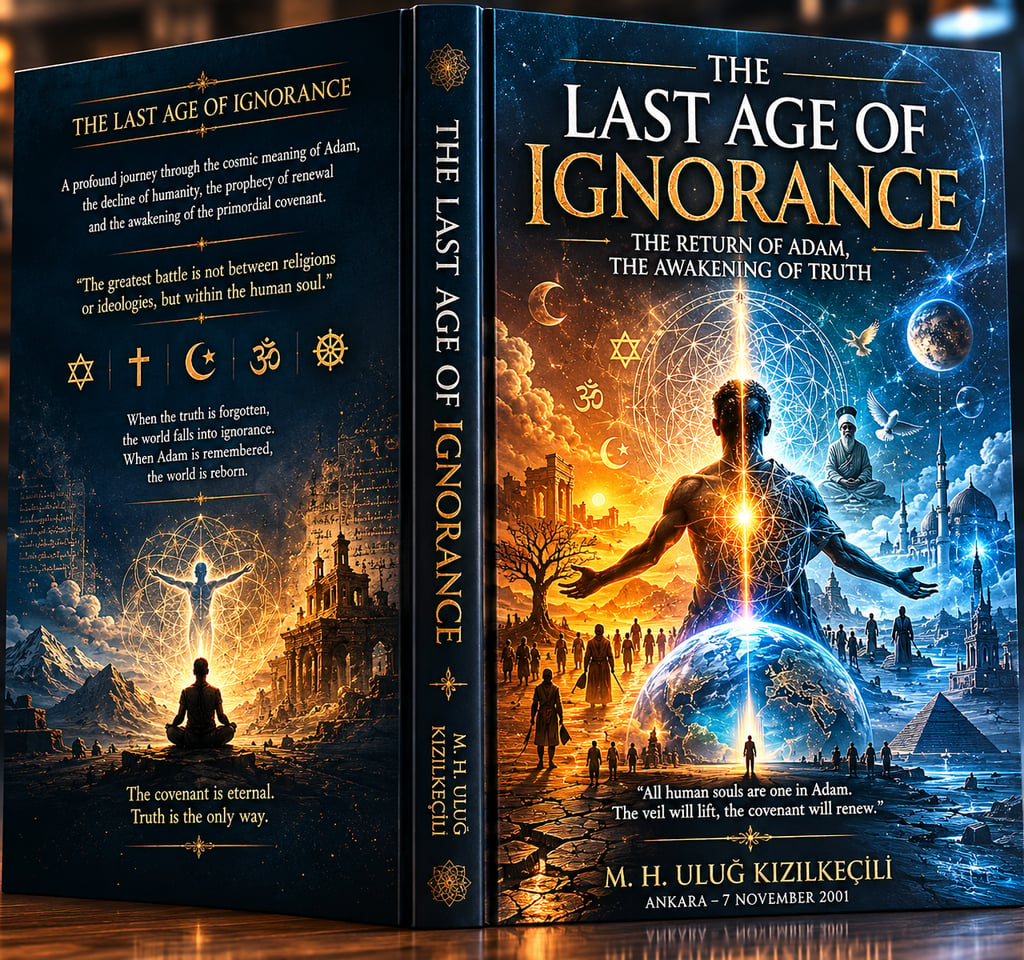
THE LAST AGE OF IGNORANCE
The Islamic, Mosaic, Hindu, and Christian community,
In the Age of Ignorance! Rahman cut off His mercy!
Most are “human devils”! They affirm Allah indeed!
Filled only with themselves! “I shall not worship Adam!” they plead!
“Adam” is the collective name of all human essences!
He is the “Lord”! “Since Rahman commanded worship in this sense!”
The most inverted “jihad” began: “Falsehood” against “falsehood”!
This is the war of the “cross” and the “hungry”; it shakes the “Throne” for good!
In every sacred scripture, this is the moment of the “Apocalypse”!
The earth is swept again, if it produces not “Adam” in its course!
“The community of the Lord shall come!” when the refuse is burned!
The essence enters the heart again, and the “covenant” is returned!
Look, the word “Renaissance” means “rebirth” anew!
Strive to be born within yourself; let that labor be true!
A gang of religious paranoia, worse than terror’s decree!
The “Hanif religion” alone is the prescription for salvation’s key!
M. H. Uluğ Kızılkeçili
Ankara – 07 November 2001
(The section written after this point has no relation to the author, and the author cannot be held responsible for any errors committed thereafter.)
THE METAPHYSICAL MEANING OF THE LAST AGE OF IGNORANCE
At this point, the concept of Adam transforms from a historical personage into the idea of the Cosmic Human. For in esoteric traditions, the First Human is simultaneously the symbol of the Last Human. The beginning and the end are connected to one another. The entire movement of human history is the process by which fragmented consciousnesses reunite around a common center.
For this reason, what Iblis rejects is not merely an individual. What is rejected is the common essence of humanity. The symbol of Iblis thus ceases to be merely the personification of evil and becomes the symbol of metaphysical separation. Every consciousness that regards itself as superior to the whole may be read as a manifestation of the Iblis archetype.
The greatest paradox of the modern world emerges precisely here. Human rights are spoken of, yet the sacredness of the human being is forgotten. Freedom is praised, yet no one can explain why the human being ought to be free. Science advances, yet the question of the meaning of existence remains unanswered. The Last Age of Ignorance is precisely the name of this rupture.
For this reason, the concept of apocalypse in the poem carries a meaning deeper than physical catastrophes. Apocalypse is the lifting of the veils covering truth. Derived from the Arabic root qāme (to stand up), qiyāmah carries the meaning of rising. From an esoteric perspective, apocalypse is the great awakening that occurs within consciousness.
When this awakening occurs on the individual level, a person begins to perceive the truth within himself. When it occurs on the social level, civilizations are transformed. All great spiritual movements throughout history may be read as minor apocalypses. The coming of prophets, the appearance of sages, and the revival of quests for truth are periodic awakenings of humanity.
The phrase “renewed covenant” in the poem refers to humanity’s remembrance of its divine origin. For all esoteric teachings maintain that humanity is attempting to remember something it has forgotten. Truth is not new. Truth is eternal. What is new is only humanity’s recognition of it once again.
For this reason, the salvation opposed to the Last Age of Ignorance is neither a new ideology nor a new religion. Salvation is humanity’s return to its own essential center. The poem’s emphasis upon Hanifism acquires its meaning here. Before it is a historical identity, Hanifism is an ontological orientation. It is the courage to abandon all idols, all false centers, and all artificial affiliations, and to turn directly toward truth.
Consequently, the struggle described by the poem is not a struggle between religions. Nor is it a struggle between ideologies. The true struggle is between humanity’s will to return to its own essence and its tendency to remain imprisoned within its lower self. Every apocalypse begins within the human being. Every salvation likewise begins within the human heart.
THE ADAM ARCHETYPE: ADAM KADMON, PURUSHA, AND THE PERFECT HUMAN
Without doubt, the most important concept at the center of The Last Age of Ignorance is Adam. Yet the Adam in question here is not merely the historical individual described as the first human being. When the poem’s metaphysical structure is examined carefully, Adam appears as the common essence of all humanity. This approach stands in remarkable harmony with the oldest and most profound metaphysical teachings of the world’s mystical traditions.
The overwhelming majority of ancient traditions agree that the human being is not merely a biological organism. Behind the visible body, humanity carries a cosmic truth. For this reason, narratives concerning the First Human are often symbolic rather than historical. The First Human is simultaneously understood as the essence of the universe, the mirror of the divine order, and the source of all consciousness.
The doctrine of Adam Kadmon, which occupies a central place in Jewish mysticism, is one of the most developed expressions of this understanding. According to Kabbalah, Adam Kadmon is not the first created being; rather, he is the divine blueprint of creation. All souls exist within him in potential form. Before the universe emerges, all humanity exists within his body in a state of unity. Later, this unity becomes fragmented, and souls appear as separate individuals.
This idea closely corresponds to the line in the poem: “Adam is the collective name of all human essences.” For here too, Adam does not represent a single individual but the shared essence of all humanity. Though people live in different bodies, they are fragments of a single truth at their core.
A similar understanding appears in Hindu metaphysics under the concept of Purusha. In the famous Purusha Sukta hymn of the Rigveda, the universe is said to arise through the dismemberment of the Cosmic Human. The sun comes from his eyes, the moon from his mind, and the various social orders from different parts of his body. The narrative is not biological but metaphysical. Humanity is viewed as the diverse manifestations of a single cosmic being.
In Sufism, the same idea appears in the doctrine of the Perfect Human (Insān al-Kāmil). According to Muhyiddin Ibn ʿArabī, the Perfect Human is the mirror in which all divine names are manifested most completely. The universe is the sum of truths scattered in multiplicity; the Perfect Human is the center of that multiplicity. For this reason, the human being is not merely a created entity but also the bearer of the meaning of creation.
When these three traditions are examined carefully, it becomes apparent that the same metaphysical core is being expressed through different languages. Adam Kadmon, Purusha, and the Perfect Human are not independent concepts. Each is a cultural reflection of the idea of the Cosmic Human.
THE POWER OF THE ADAM SYMBOL IN THE POEM
The power of the Adam symbol in the poem becomes evident precisely at this point. The poet views humanity not merely as a sociological or biological category, but as a cosmic unity. Therefore, an attack directed against Adam is, in reality, an attack directed against the common essence of humanity. From a metaphysical perspective, when one human being despises another, he is in fact despising his own essence.
One of the greatest crises of the modern age is precisely the loss of this sense of unity. Human beings no longer perceive themselves as parts of a whole connected to the universe; instead, they experience themselves as isolated individuals. This condition produces not only psychological loneliness but also an ontological fragmentation. As human beings increasingly feel severed from the whole, crises of meaning become deeper.
In esoteric traditions, the fundamental condition of salvation is reintegration. Sufism calls this tawḥīd, the realization of unity. Vedānta describes it as the realization of the unity between Brahman and Ātman. Kabbalah employs the concept of Tikkun, the restoration of the shattered vessels. Though different terms are used, they all point toward the same goal: the return of fragmented consciousness to its center.
For this reason, the primary problem of the Last Age of Ignorance is not irreligion. The real problem is humanity’s forgetfulness of its own cosmic identity. When humanity forgets its essence, Adam disappears. When Adam disappears, the sense of unity fragments. When unity fragments, wars, ideologies, divisions, and conflicts multiply.
The metaphysical language of the poem tells us the following: the future of humanity lies not in new technologies, but in the rediscovery of the forgotten Adam. For the secret standing at the center of all sacred traditions is this: the human being is far greater than he imagines. He is not merely a creature living upon the earth; he is the universe becoming conscious of itself.
Therefore, Adam is not the first human who lived in the distant past. He is the Eternal Human, awaiting rebirth in every age.
IBLIS AND NARCISSISTIC CONSCIOUSNESS
In traditional religious narratives, the figure of Iblis is often portrayed as a being who rebelled against Allah. Yet from an esoteric perspective, Iblis is not merely an external being; he is an archetypal symbol representing a particular state of human consciousness. For this reason, the statement “I will not bow to Adam” is not simply the expression of a single event that occurred in the distant past. Rather, it is the expression of a metaphysical attitude that reappears in every age and within every human being.
The problem of Iblis is not that he denies Allah. On the contrary, in all sacred narratives Iblis is fully aware of the Divine Reality. The problem lies in his refusal to accept the manifestation of divine truth in human form. Thus, according to the esoteric interpretation, what Iblis rejects is not a body fashioned from clay, but the divine secret concealed within humanity. In other words, Iblis failed to perceive the truth within the human essence. His vision was directed toward form rather than essence. He regarded fire as superior and clay as inferior, yet failed to understand that both emerged from the same divine source.
At this point, Iblis becomes a symbol of metaphysical narcissism. Narcissism here does not merely mean vanity in the modern psychological sense. In a deeper sense, narcissism is the belief that one's own perspective constitutes absolute truth. It is the transformation of one's personal center into the center of the universe. It is the tendency to judge all existence according to oneself. The attitude expressed in Iblis’s declaration, “I am superior,” represents the same structure of consciousness that lies beneath many conflicts throughout human history.
The contempt of one race for another, the arrogance of societies toward one another, the exclusion of one sect by another, the absolutization of ideological doctrines, and even the presentation of personal opinions as unquestionable truths—all are different manifestations of the same archetype. Each ultimately repeats the same metaphysical sentence: “I am the center.”
The esoteric traditions teach the exact opposite. According to them, the first condition for approaching truth is to abandon one’s own centrality and realize that one is part of a greater whole.
In the Sufi tradition this process is called the transcendence of the nafs. The nafs is not merely the source of worldly desires; it is also the structure that imprisons the human being within a narrow identity. As long as a person remains confined within the boundaries of the nafs, he cannot truly perceive others. He interprets everything through the lens of his own interests, fears, and expectations. Consequently, he sees not truth itself but only his own reflections. This is analogous to Iblis, who, while looking upon Adam, saw only clay and failed to perceive the divine breath within.
Carl Gustav Jung’s theory of the Shadow offers one of the most significant psychological explanations of this metaphysical interpretation. According to Jung, aspects of the personality that an individual refuses to acknowledge are repressed into the unconscious and gradually become the Shadow. Instead of confronting his own darkness, a person projects it onto others. Thus he begins to perceive his own pride in others, his own fears in his enemies, and his own greed in society.
This process occurs not only at the individual level but also collectively. Entire societies may project their own shadows onto their enemies.
For this reason, the struggle described in the poem is deeper than wars fought in the external world. The real struggle is humanity’s confrontation with the division within itself. Sufism calls this the Greater Jihad. Vedānta describes it as the lifting of the veil of Māyā. The Gnostic traditions call it Awakening. Though the names differ, the process remains the same: humanity strives to transcend its illusions and approach truth.
From the esoteric point of view, apocalypse also begins here. Apocalypse is not merely the end of the world; it is the end of the false self. When an individual confronts his own Shadow, he begins to witness the dissolution of identities that he had long mistaken for absolute reality. Pride is broken, idols collapse, and the old self is shattered.
This process is often painful, because human beings do not willingly surrender the identities to which they have become accustomed. Yet all mystical traditions proclaim the same truth: the true self cannot be born until the false self dies.
In alchemy, this process is symbolized by nigredo, the stage of blackening. In Sufism, it is expressed through the concept of fanāʾ, annihilation. In Christian mysticism, it appears as the death of the old man. All of these are symbols of the same transformation: the journey through which a human being overcomes the Iblis within and reaches the Adam within.
For this reason, Iblis is not merely the representative of evil. He is also the symbol of the final threshold that humanity must cross. For one cannot learn humility without first recognizing one’s own pride; one cannot appreciate light without first seeing one’s own darkness; one cannot understand unity without first becoming aware of division.
One of the deepest messages of The Last Age of Ignorance is precisely this: humanity’s true salvation does not lie in victories achieved in the external world, but in recognizing and transcending the Iblis within. Then the forgotten Adam will reappear, and humanity will realize that the truth it believed lost had in fact always existed within itself.
COLLECTIVE CONSCIOUSNESS, TRADITION, AND THE COSMIC HUMAN
Modern humanity largely defines itself as an individual being. The ancient world, however, always perceived the human being as part of larger wholes: family, tribe, nation, ummah, civilization, humanity, and ultimately the Cosmic Human. These layers were not regarded as separate from one another, but as concentric circles nested within each other. For this reason, human identity is not merely personal. It is also collective.
One of Carl Gustav Jung’s most significant contributions is the concept of the Collective Unconscious. According to Jung, the human mind is not merely the sum of individual experiences. The shared memory of humanity also lives within the unconscious. Within this common domain reside the archetypes: the Mother, the Father, the Sage, the Hero, the Shadow, the Sacrifice, the King, and the First Human.
Although these figures bear different names from one culture to another, they represent the same fundamental psychological structures. One of Jung’s most remarkable observations is this: people who have no knowledge of one another nevertheless produce the same symbols. This is because the source of symbols is not individual but collective.
For this reason, a nation is not merely the sum of people who speak the same language. It is a common field of consciousness formed by people who share the same symbols.
The work of Mircea Eliade adds an important depth to this perspective. According to Eliade, traditional societies do not perceive time in the same way as modern humanity. For modern people, history is a linear sequence of events moving forward. For traditional people, history consists of the continual repetition of sacred events.
Thus, in many cultures, founding ancestors are not merely historical figures. They are archetypal figures. Society sees its own origin within them and continually reproduces itself through their stories. For this reason, sacred history is not merely the past. It is an ever-present reality.
The Adam symbol that appears in The Last Age of Ignorance may be understood within this context. Adam is not someone who belongs only to the distant past. He is the essence of humanity that reappears in every age.
René Guénon argued that one of the greatest problems of modern society is the severance of its connection with Tradition. Here, the word Tradition does not mean custom or habit. It signifies metaphysical transmission. It is the bond that connects a society to the Sacred Center.
When this bond begins to weaken, society experiences not only economic or political crises but also ontological crises. It begins to forget who it is. It begins to forget where it came from. It begins to forget where it is going.
In Guénon’s view, this is the tragedy of modern civilization: the forgetting of the Center.
The poem’s emphasis upon the “renewed covenant” may therefore be understood as a call to rediscover that Center.
From the perspective of esoteric traditions, a nation is not merely a biological lineage. It is not merely a shared geography. Nor is it merely a common language. A nation is also a shared field of meaning, a shared system of symbols, a collective memory, and a shared sense of destiny.
For this reason, when a community loses its symbols, it loses more than its culture. It weakens its connection to its own soul.
Ancient societies therefore attached immense importance to epics, myths, sacred texts, and rituals. These were understood as the vehicles through which the collective spirit was carried across generations.
Jung’s theory applies not only to the collective unconscious but also to the collective Shadow. Just as individuals possess repressed aspects of themselves, societies also possess repressed dimensions.
Fears, traumas, resentments, defeats, and feelings of guilt that remain suppressed for long periods eventually return. Many historical crises are therefore not merely political events. They are eruptions of the collective unconscious into visible reality.
When interpreted from this perspective, the line in the poem, “The most inverted jihad has begun,” acquires a profound significance. For the conflict described here is not merely a clash between external forces. It is the war of collective Shadows. It is the confrontation of societies with their own hidden darkness.
All of these teachings ultimately return to the idea of the Cosmic Human. Adam Kadmon, Purusha, the Perfect Human, and the First Human are figures that represent not merely the individual but humanity as a whole.
Consequently, nations themselves may be viewed as organs of this greater Human. Just as the various organs of a body share the same life, human communities are nourished by the same cosmic root.
Viewed from this perspective, there can be no true clash of civilizations. There can only be different parts of the same body forgetting one another.
One of the deepest messages of the poem emerges precisely here. The problem is not merely individual. It is social. It exists at the level of civilization itself.
Humanity has forgotten its own essence. Societies have lost their centers. The connection with Tradition has weakened. Symbols have become empty. Hearts have become scattered.
For this reason, the poem’s call is not directed solely toward the individual. It is directed toward the collective soul. It is a call for humanity to remember its own center once again.
For individual salvation and collective salvation are not entirely separate realities. As individuals rediscover their essence, society is transformed. As society is transformed, civilization is transformed. As civilization is transformed, humanity itself is transformed.
And thus, within the darkness of the Last Age of Ignorance, the first rays of a new age begin to appear.
THE LAST AGE OF IGNORANCE:
The Cosmic Human, Metaphysical Forgetfulness, and Intertraditional Esoteric Hermeneutics
Introduction
Throughout human history, the great religious and metaphysical traditions have produced cosmologies and theologies that appear different on the surface, yet they display remarkable similarities regarding the position of the human being within existence. Whether one examines the doctrine of the Perfect Human (Insān al-Kāmil) in Islamic Sufism, the doctrine of Adam Kadmon in Kabbalah, the conception of Purusha in the Vedic tradition, or the myth of the Primordial Human in Gnostic texts, all of these teachings regard the human being not merely as a biological entity but as the central mirror of the cosmic order.
From this perspective, The Last Age of Ignorance is not merely a poetic critique but also a dense symbolic manifesto concerning the metaphysical condition of modern humanity. The fundamental problem at the center of the text is not the denial of Allah. The deeper problem is humanity’s forgetfulness of its own ontological truth. For this reason, the poem’s primary concern is not atheism but metaphysical alienation.
This phenomenon of alienation has been described under different names in various traditions. In Sufism it is called ghaflah (heedlessness), in Vedānta avidyā (ignorance), in Buddhism avijjā, and in the Gnostic tradition cosmic forgetfulness. All of these terms refer to the loss of one's essential nature. The fundamental crisis of the modern world emerges precisely here: while humanity increases its knowledge of the external world, it simultaneously loses knowledge of its own being.
The Doctrine of the Cosmic Human
One of the most striking common features of the esoteric traditions throughout human history is the idea of the Cosmic Human.
In the works of Ibn ʿArabī, the human being is the central mirror in which all Divine Names are gathered. According to him, humanity is the most comprehensive locus of manifestation through which Allah contemplates Himself. Without the human being, the universe cannot be considered complete. For while the cosmos is the sum of the Divine Names dispersed throughout multiplicity, the Perfect Human is the center in which they are united.
Similarly, Ṣadr al-Dīn al-Qūnawī describes the human being as a barzakh. A barzakh is an intermediary reality that connects two worlds. The human being is both material and spiritual; both bound to time and open to that which transcends time. Therefore, humanity is not merely a part of the universe but the central nodal point through which the meaning of the universe is carried.
The doctrine of Adam Kadmon in Kabbalah possesses a similar metaphysical structure. Adam Kadmon is not the historical first human being but the archetypal model of creation. All souls exist within him in a state of unity. As the cosmos unfolds, this unity becomes fragmented and appears as individual consciousnesses.
The Purusha Sukta hymn of the Vedic tradition expresses the same idea through different symbols. The universe comes into being through the sacrifice of Purusha. The sun emerges from his eyes, the moon from his mind, and the various social orders from different parts of his body. The narrative is not biological but metaphysical. Humanity represents the diverse manifestations of a single cosmic organism.
The parallels among these three traditions are too strong to be explained as mere coincidence. All of them regard the human being as the bearer of cosmic wholeness.
The Problem of Iblis and Metaphysical Pride
One of the most significant metaphysical symbols in The Last Age of Ignorance is Iblis.
In the writings of al-Hallāj, the figure of Iblis is not treated as a simple symbol of evil. Al-Hallāj attempts to interpret the tragedy of Iblis within the context of metaphysical love. Although this interpretation remains controversial, it points toward an important insight: the problem of Iblis is not merely a problem of disobedience; it is a problem of misinterpreting truth.
In Ibn ʿArabī’s thought, Iblis is understood as a paradoxical element within Divine Wisdom. The fundamental issue here is humanity’s tendency to become attached to form while failing to perceive essence.
When the statement found in the poem, “I shall not bow to Adam,” is interpreted within this context, it becomes a symbol of metaphysical pride. For what is rejected is not merely the human body but the Divine Trust carried by humanity.
Jung’s theory of the Shadow adds a psychological dimension to this interpretation. According to Jung, those aspects of the self that are repressed continue to exist within the unconscious as the Shadow. When individuals refuse to confront their own darkness, they project it onto others. Thus, internal conflicts become external conflicts.
From this perspective, Iblis is not merely a cosmic being but an archetype continuously reproduced by human consciousness itself.
THE DOCTRINE OF METAPHYSICAL FORGETFULNESS AND REMEMBRANCE
From the Perspective of the Nag Hammadi Texts, the Hermetica, Mawlānā, and Sufism
One of humanity’s oldest metaphysical questions is the following: If truth is eternal, why must human beings search for it?
At first glance, this question appears paradoxical. For something eternal cannot truly be lost. If truth genuinely exists within the essence of the human being, why has the effort to rediscover it occupied the center of virtually all religions and mystical traditions?
The answer to this question is explained in most esoteric traditions through the concept of forgetfulness.
When The Last Age of Ignorance is examined carefully, the same problem appears at the center of the poem. The crisis described by the poet is not that humanity has failed to learn something new; rather, it has forgotten what it already possesses. The tragedy of the modern age is not the loss of truth itself but humanity’s blindness toward truth.
This theme is especially powerful within the Gnostic tradition.
Forgotten Light in the Gnostic Tradition
A significant portion of the texts discovered at Nag Hammadi is founded upon the idea that humanity has forgotten its divine origin. Particularly in the texts known as the Gospel of Truth and the Gospel of Thomas, salvation is defined not as submission to an external authority but as the discovery of the divine spark within oneself.
According to Gnostic thought, humanity forgot its origin upon entering the world. This forgetfulness is not an ordinary loss of memory. It is an ontological amnesia. Humanity has forgotten what it is. It has forgotten where it came from. It has forgotten why it exists.
As a result, the world itself begins to appear as absolute reality. The Gnostics called this condition “sleep.” For this reason, their prophets and salvific figures are not primarily teachers of information but awakeners.
This understanding closely parallels the idea of the “renewed covenant” found in The Last Age of Ignorance. For in the poem as well, salvation is not the creation of a new covenant but the remembrance of a forgotten one.
Self-Knowledge in the Hermetica
The same idea appears within the Hermetic tradition. In the texts collectively known as the Hermetica, attributed to Hermes Trismegistus, the fundamental task of the human being is not the conquest of the world but self-knowledge.
The famous Hermetic principle states:
“He who knows himself knows the universe.”
This statement carries a metaphysical significance far deeper than the modern psychological call for self-awareness. In Hermetic thought, the human being is regarded as the microcosm. All the principles contained within the macrocosm of the universe are also present within the human being.
Therefore, when a person comes to know himself, he does not merely discover his own psychology. He simultaneously begins to discover the structure of existence itself.
For this reason, Hermetic wisdom directs attention inward rather than outward.
The line in The Last Age of Ignorance that calls upon the reader to “strive to be born within yourself” expresses precisely the same orientation. Truth cannot be found while being sought solely outside oneself, for what humanity has lost is not external. What has been lost is humanity’s own center.
Mawlānā and the Pain of Separation
One of the most poetic expressions of metaphysical forgetfulness appears in the works of Mawlānā Jalāl al-Dīn Rūmī.
The opening verses of the Mathnawī recount the story of the reed flute separated from the reed bed. On the surface, this appears to be the story of a musical instrument. Yet in esoteric interpretation, it is the story of the human soul.
The reed separated from its source symbolizes the soul separated from its divine origin. For this reason, the reed flute continually laments, for it remembers separation.
The entirety of Mawlānā’s metaphysics is fundamentally rooted in this theme of separation. Human beings feel incomplete in the world because, at the deepest level of consciousness, they seek the wholeness they have lost.
The search for love, the search for knowledge, the search for beauty, the search for truth, and even the desire for immortality may all be interpreted as different expressions of this metaphysical longing.
For Mawlānā, salvation is not the act of going somewhere new. The essential matter is returning home.
The Memory of the Covenant in Sufism
Within Sufi thought, the themes of forgetfulness and remembrance are centered upon the Primordial Covenant (Mīthāq al-Alast).
The Qur’ānic declaration, “Am I not your Lord?” (Alastu bi Rabbikum), has been the subject of profound interpretation throughout the history of Sufism.
According to many Sufi masters, the human soul once witnessed an eternal testimony. Upon entering the world, it forgot that testimony. The purpose of life is the remembrance of what has been forgotten.
For this reason, dhikr is not merely prayer. The root meaning of the word itself is remembrance.
All spiritual practices in Sufism are directed toward the recovery of memory. Yet the memory in question is not biological. It is ontological. Humanity is attempting to remember its own essence.
The Great Forgetfulness of the Modern World
When René Guénon analyzes the modern world, he repeatedly employs the theme of the loss of the Center.
According to Guénon, traditional civilizations were organized around a sacred center. The modern age began when that center was forgotten.
Quantity has displaced quality. Information has displaced wisdom. Technique has displaced meaning. Means have become ends.
The line “Rahman has cut off His mercy” in The Last Age of Ignorance may be interpreted from this perspective.
What has been cut off is not mercy itself. What has been lost is humanity’s ability to perceive mercy.
According to the metaphysical traditions, the sun continues to shine at all times. Yet the one who closes his eyes imagines that he has been abandoned to darkness.
The Apocalypse of Remembrance
From an esoteric perspective, apocalypse is not merely the end of the world. It is also the end of forgetfulness.
When a human being remembers his essence, his former world begins to collapse. Identities change. Priorities change. The entire perspective upon life changes.
For this reason, all great mystical traditions regard awakening as a form of minor apocalypse.
The old human being dies. The new human being is born.
As Mawlānā teaches, one must be reborn every day. As the Gnostics teach, one must awaken from sleep. As the Hermetic sages teach, one must know oneself. As the Sufis teach, one must remember the Covenant of Alast.
One of the deepest messages of The Last Age of Ignorance emerges precisely here: humanity’s problem is not the absence of truth. The problem is that truth has been forgotten.
And the common purpose of all great spiritual traditions is not to provide humanity with a new truth, but to remind it of the truth it has forgotten.
THE DOCTRINE OF THE COSMIC HUMAN:
Adam Kadmon, Purusha, the Perfect Human, and the Archetype of the Primordial Human
One of the most remarkable metaphysical ideas in human history is the belief that the Cosmic Human stands at the center of existence. This idea has appeared repeatedly across cultures that possessed no direct historical relationship to one another.
The Adam Kadmon of Jewish mysticism, the Purusha of the Vedic tradition, the Perfect Human (Insān al-Kāmil) of Islamic Sufism, and the Primordial Human of Gnostic traditions may appear to be different concepts, yet they can be understood as diverse expressions of the same metaphysical intuition.
The Adam symbol found in The Last Age of Ignorance should likewise be interpreted within this broader tradition. The Adam employed by the poet is not a biological individual standing at the beginning of history but an archetypal center representing the total metaphysical potential of humanity.
Adam Kadmon: The Divine Human
Within Kabbalistic doctrine, Adam Kadmon is not the first created human being. He is the primordial divine design that precedes creation itself.
According to Kabbalah, the first reality emanating from the Absolute, known as Ein Sof, manifests in the form of Adam Kadmon. What is meant here is not a physical body but a cosmic form encompassing the entirety of existence.
Within Adam Kadmon all souls exist in an undifferentiated state. Individuality has not yet emerged. Humanity exists as a single field of consciousness.
Subsequent fractures and differentiations shatter this primordial unity. Kabbalah often approaches this event through the doctrine of Shevirat ha-Kelim, the Breaking of the Vessels.
The drama of human history begins precisely at this point. Primordial unity has become multiplicity.
When the fragmentation of humanity described in The Last Age of Ignorance is viewed from this perspective, the crisis portrayed in the poem becomes the crisis of a forgotten cosmic unity.
Human beings appear separate from one another, yet in their essence they remain fragments of the same Adam Kadmon.
THE HUMAN BEING, THE UNIVERSE, AND NUMERICAL CREATION IN THE HERMETIC TRADITION
Logos, the Word, Kun, and the Metaphysics of Cosmic Order
One of the most important themes implicit within The Last Age of Ignorance is the idea that creation is not a mechanical process but a process grounded in meaning. Although not explicitly stated in the poem, the concepts of Adam, the Lord, the Covenant, and Rebirth all point toward a common metaphysical foundation: the universe is not merely a system composed of matter; it is the visible manifestation of meaning itself.
This idea occupies a central place within the Hermetic tradition. In the texts of the Hermetica, the universe is not portrayed as a field composed of chaotic matter but as a living totality ordered by Divine Intellect. Existence is not accidental. Everything comes into being according to specific proportions, principles, and numerical harmonies.
The roots of this understanding were later systematized within Pythagorean thought.
The Metaphysics of Number
When modern people hear the word “number,” they think of mathematical calculations. Ancient people, however, regarded numbers as ontological principles.
For Pythagoras, number is not merely a tool of measurement. It is the foundation of existence itself. Without number, order is impossible. Without proportion, form cannot emerge. Without measure, cosmos cannot come into being.
For this reason, the famous Pythagorean statement declares:
“All things are number.”
This statement is often misunderstood today. It does not mean that the universe is a mathematical problem. Rather, it means that the universe is structured according to an intelligible and meaningful order.
The very word cosmos means order. Chaos means disorder. The essence of creation is the transition from chaos to cosmos.
This same idea appears both in the Hermetica and in the writings of the Ikhwān al-Ṣafāʾ (Brethren of Purity). In the Epistles of the Ikhwān al-Ṣafāʾ, numbers are described not merely as mathematical entities but as metaphysical realities.
Unity, duality, trinity, and quaternity are not merely quantities. They are fundamental stages of existence itself.
The Number One and Absolute Unity
In all esoteric traditions, the metaphysics of number begins with One.
One is not a number. It is the source of all numbers.
Without One, Two cannot exist. Without Two, multiplicity cannot emerge.
For this reason, Unity becomes the symbol of Absolute Reality throughout all metaphysical systems.
In Sufism this reality is called Tawḥīd. In Vedānta it is called Brahman. In Kabbalah it is called Ein Sof. In Neoplatonism it is called The One.
The names differ, yet the reality to which they point remains the same: the unity underlying all multiplicity.
When The Last Age of Ignorance criticizes the fragmentation of humanity, what has truly been lost is precisely this awareness of unity.
The Doctrine of Logos
The most important concept linking the Hermetic tradition with Christian mysticism is the concept of Logos.
Although the term is often translated simply as “Word,” its actual meaning is far broader. Logos simultaneously signifies:
Reason
Order
Principle
Meaning
The Creative Word
The famous opening of the Gospel of John states:
“In the beginning was the Word.”
The Word referred to here is the Logos.
The Logos is not merely spoken language. It is the divine principle that orders existence itself.
A similar understanding appears within the Hermetic tradition. Divine Mind first conceives. Thought then assumes form. Form subsequently becomes the universe.
Thus creation comes into being.
Kun and the Creative Command
Within Islamic metaphysics, the concept closest to Logos is the Divine Command:
“Kun fa-yakūn.”
“Be—and it is.”
This statement is often interpreted as a description of physical creation. From an esoteric perspective, however, it carries a deeper meaning.
What is described here is not an event that occurred once in the distant past. Rather, it is the perpetual creation through which existence emerges at every moment from Divine Will.
Ibn ʿArabī explains this through the doctrine of tajaddud al-khalq (the continual renewal of creation).
According to him, the universe was not created once and then abandoned. It is recreated at every instant. It comes into existence anew at every moment.
Creation is therefore not merely a past event but an ongoing reality.
Numerical Creation and the Cosmic Language
Ancient traditions often viewed the universe as a book.
It is the great book written by Allah.
The human being is the reader attempting to understand that book.
For this reason, numbers, letters, and symbols were regarded as sacred.
In Kabbalah, letters possess creative power.
In Islamic gnosis, the science of letters (ʿilm al-ḥurūf) emerged.
In the Hermetic tradition, symbols are interpreted as reflections of cosmic realities.
The reason for this is simple: the universe is not a meaningless accumulation of matter. It possesses a structure that can be read like a language.
At this point, the concept of the “covenant” in the poem acquires a new significance. A covenant can only exist where there is language. Language presupposes consciousness. Consciousness presupposes meaning.
Consequently, the foundation of existence is not merely energy but meaning.
The Human Being as Living Logos
In the Hermetic tradition, the human being is not merely a creature living within the universe.
The human being is a microcosm.
The essence of the macrocosm exists within humanity.
For this reason, when a person comes to know himself, he begins to know the universe.
This is expressed in the famous Hermetic principle:
“As above, so below.”
This statement refers not to physical resemblance but to ontological correspondence.
The human being is the mirror of the universe.
The universe is the expanded form of the human being.
This idea bears a striking resemblance to Ibn ʿArabī’s doctrine of the Perfect Human (Insān al-Kāmil), for in both systems the human being functions as the central mirror of creation.
The Loss of Numerical Creation and the Crisis of the Modern World
Modern science has discovered the mathematical structure of the universe. Yet unlike the ancient metaphysics of number, it has largely excluded the dimension of meaning.
Numbers remain, but sacredness disappears.
Formulas remain, but wisdom disappears.
Calculation remains, but meaning is lost.
This distinction lies at the heart of René Guénon’s critique of modernity.
Modern humanity perceives order, yet fails to perceive the source of order.
The metaphysical critique expressed in The Last Age of Ignorance reaches its greatest intensity at precisely this point.
Humanity has produced knowledge, yet lost wisdom.
It has built systems, yet forgotten meaning.
It has learned the numbers, yet forgotten the One.
For this reason, the salvation described in the poem is not the acquisition of new information. Salvation is the rediscovery of the One behind the numbers.
For the essence of all creation is not multiplicity but unity.
The essence of all words is silence.
The essence of all numbers is One.
And the essence of all human beings is the same Cosmic Adam.
THE APOCALYPTIC ARCHETYPE:
Apocalypse, Kali Yuga, the Last Days, and the Doctrine of the Inner Apocalypse
Nearly every major metaphysical tradition in human history contains narratives concerning the end of the world.
At first glance, these narratives appear radically different from one another. The descriptions of the Day of Resurrection in the Qurʾān, the Christian tradition of Apocalypse, the Hindu doctrine of Kali Yuga, the Zoroastrian doctrine of Frashokereti, and the cosmic transformation narratives found within various esoteric systems seem to belong to entirely different cultural worlds.
Yet when the deeper structures of these traditions are examined, a common metaphysical core becomes apparent.
This common core concerns not the physical destruction of the world but the end of a particular state of consciousness.
The symbol of apocalypse in The Last Age of Ignorance should therefore be interpreted within this context.
When the language of the poem is examined carefully, it becomes clear that the event described is not merely physical destruction. For the central concern of the poem is the human essence itself.
If the human being stands at the center, then apocalypse must begin within the human being before it manifests elsewhere.
The Esoteric Meaning of Qiyāmah
The Arabic word qiyāmah derives from the root qāma, meaning “to stand,” “to rise,” or “to come forth.”
This etymology is of profound significance.
For apocalypse is not merely destruction.
It is revelation.
It is the emergence of the hidden into visibility.
It is the lifting of veils.
It is the manifestation of truth.
Throughout the history of Sufism, many masters did not interpret qiyāmah solely as a future cosmic event.
For them, the moment a human being confronts his own truth is itself a qiyāmah.
The collapse of the lower self is a qiyāmah.
The destruction of false identities is a qiyāmah.
Thus apocalypse occurs first within the human being.
The external apocalypse is merely its cosmic reflection.
Apocalypse and the Unveiling of Revelation
In the Christian tradition, the most important source for the idea of apocalypse is the Book of Revelation. The Greek word Apokalypsis is often used today to mean catastrophe. Yet its original meaning is “the lifting of the veil.” That is, revelation. That is, disclosure. That is, the becoming visible of what had been hidden.
When this meaning is taken into account, Apocalypse ceases to be merely a book of wars, disasters, and destructions. It becomes a book of transformation of consciousness. For all its symbols also represent the struggle within the human being. Beasts, dragons, and dark powers exist not only in the external world but also in the depths of the human soul. For this reason, many mystical commentators have interpreted Apocalypse as a map of inner transformation.
Kali Yuga: The Final Iron Age
In Hindu metaphysics, time is not linear but cyclical. The universe is born, develops, decays, and is reborn through great ages. The final stage of this cycle is called Kali Yuga.
Kali Yuga is often misunderstood merely as an age of evil. In reality, the fundamental feature of this age is metaphysical forgetfulness. According to Vedic texts, during Kali Yuga:
Truth weakens.
Wisdom diminishes.
Religion becomes mere form.
Teachers become merchants.
Spirituality becomes spectacle.
Human beings begin to worship appearances.
This description bears striking similarities to many aspects of the modern world. Guénon frequently referred to the doctrine of Kali Yuga when interpreting the modern age. In his view, modern civilization represents the final stage of separation from the sacred center.
The atmosphere of The Last Age of Ignorance reflects precisely this sense of decay.
Yet Kali Yuga has another important feature. The darkest point is also the beginning of transformation. For the moment when the night is darkest is also the moment nearest to dawn.
Zoroastrian Frashokereti and the Renewed World
In Zoroastrian metaphysics, the end of history is not absolute destruction. It is the final process of renewal known as Frashokereti.
In this process, the world is purified. Evil is abolished. Existence returns to its primordial purity.
This idea displays a striking parallel with the concept of the “renewed covenant” in the poem. The purpose here is not the annihilation of the old world. The true purpose is the re-emergence of the essence.
For in all esoteric systems, the purpose of destruction is creation. The purpose of death is birth. The purpose of the end is the beginning.
Jung and the Eruption of the Collective Shadow
Jung’s psychology brought a new interpretation to apocalyptic symbols. According to Jung, humanity is not composed merely of individual consciousnesses. There is also a shared psychological field known as the collective unconscious.
Within this field, repressed fears, desires, and shadows accumulate. If societies refuse for too long to confront their own darkness, this Shadow eventually overflows.
Wars emerge.
Fanaticism emerges.
Social collapses emerge.
Jung interprets this process as a psychological apocalypse.
From this perspective, the great crises of world history are not merely political events. They are the visible emergence of humanity’s repressed shadows.
The line in The Last Age of Ignorance, “The most inverted jihad has begun,” may also be read from this perspective. For truth and falsehood are no longer fighting one another. One shadow is fighting another shadow. Humanity is confronting its own darkness.
Guénon and the End of the Ages
René Guénon constantly employs the concept of the loss of the center when explaining modernity. Traditional societies were connected to the sacred center. Modern societies live on the periphery. The center has been forgotten.
For this reason, the crisis of humanity is not economic. It is spiritual.
It is not political. It is metaphysical.
According to Guénon, the end of the ages begins not with physical disasters but with the loss of meaning.
This idea largely corresponds to the central critique of The Last Age of Ignorance. For the real catastrophe in the poem is not war. It is humanity’s forgetfulness of its own essence.
The Doctrine of the Inner Apocalypse
All esoteric traditions ultimately converge upon the same point: the true apocalypse begins within the human being.
When a person destroys his own idols.
When he confronts his own fears.
When he sees his own Shadow.
When he renounces his false identities.
The first apocalypse has already occurred.
For this reason, Hallāj’s understanding of fanāʾ, Mawlānā’s teaching of “die before you die,” the Buddhist idea of nirvāṇa, and the Hermetic doctrine of rebirth all point toward the same center.
The new human being cannot be born before the old human being dies.
This is the apocalypse of The Last Age of Ignorance. What is described here is not the end of the world but the end of ignorance. Not the end of history, but the end of forgetfulness. Not the annihilation of humanity, but its return to its own essence.
For the secret hidden in the depths of all sacred traditions is this: apocalypse is not the moment when truth disappears; it is the moment when truth becomes visible once again.
HANIFISM, PERENNIALISM, AND THE TRANSCENDENT UNITY OF RELIGIONS
The emphasis on the “Hanif religion” in the final lines of The Last Age of Ignorance is one of the concepts forming the metaphysical center of the poem. On the surface, this concept may appear to refer only to the monotheistic understanding of Prophet Abraham. Yet in a deeper reading, it points toward the common core of all esoteric traditions.
For Hanifism is far more than a historical religious identity.
Hanifism is not a sect.
It is not an ideology.
It is not an institution.
Hanifism is the state of human consciousness turning toward truth.
For this reason, it is no coincidence that The Last Age of Ignorance presents Hanifism as the prescription for salvation. The poet is not proposing a new religion here. On the contrary, he is calling for a return to the essence of all religions.
The Metaphysical Meaning of Hanifism
In the Qurʾān, the word Hanif is directly associated with Prophet Abraham. Yet Sufi interpretations have given this concept much broader meanings.
The Hanif is the one who turns from crookedness toward straightness.
From multiplicity toward unity.
From form toward meaning.
From idols toward truth.
For this reason, Hanifism does not belong to a specific historical period. It is a metaphysical attitude that can appear in every age of humanity.
From an esoteric perspective, Hanifism is the human being’s abandonment of all false centers within himself and his turning toward the Absolute Center.
In Sufism this center is called the Lord.
In Vedānta, Brahman.
In Kabbalah, Ein Sof.
In Neoplatonism, the One.
In the Hermetic tradition, Divine Intellect.
The names differ. Yet the orientation is the same.
Ibn ʿArabī and the Unity of Truth
The thought of Ibn ʿArabī is extremely important in this regard. His doctrine of Waḥdat al-Wujūd has often been misunderstood. Ibn ʿArabī’s purpose is not to mix religions together. Rather, he seeks to explain the deeper metaphysical unity underlying them.
According to him, Absolute Being is one. Multiplicity consists only of the visible manifestations of this unity.
For this reason, human beings may belong to different religions. They may possess different forms of worship. They may use different symbols. Yet the source of truth is one.
Ibn ʿArabī’s famous verses summarize this understanding:
“My heart has become capable of every form.”
This statement is often misinterpreted. What is meant here is not relativism. On the contrary, it is the ability to perceive the Absolute Truth behind all forms.
For differences exist on the surface. Unity exists in the depths.
The Perennialist School and Transcendent Unity
In the twentieth century, Frithjof Schuon developed this idea systematically. According to Schuon, religions are outwardly different. Yet in their essence, they are connected to the same metaphysical source.
This approach is known as “the Transcendent Unity of Religions.”
Schuon does not claim that all religions are identical. On the contrary, he acknowledges their differences. Yet he argues that these differences belong to the symbolic level. At the level of essence, they point toward the same metaphysical truth.
According to this view:
Islamic Tawḥīd,
the Christian doctrine of Logos,
the Jewish understanding of Ein Sof,
the Vedāntic doctrine of Brahman,
and the Taoist concept of Tao
are different symbolic languages shaped around the same center.
This idea is deeply close to the spirit of The Last Age of Ignorance. For what the poem criticizes is not the existence of different religions. It criticizes religions becoming estranged from their own essence.
Seyyed Hossein Nasr and the Loss of the Sacred
When Seyyed Hossein Nasr explains the crisis of the modern world, he repeatedly employs the theme of “the loss of the sacred.”
According to Nasr, in traditional civilizations, human beings perceived the universe as a sacred whole. In the modern age, however, the universe has become a mechanical system.
The tree is no longer sacred.
Water is no longer sacred.
The human being is no longer sacred.
Nature is no longer sacred.
Everything has been turned into an object.
As a result, the human being has begun to objectify his own soul as well.
For Nasr, this is the greatest problem of modern humanity.
Not technology.
Not science.
The loss of the sacred.
The Last Age of Ignorance makes a similar diagnosis. Humanity has forgotten the human being before it has forgotten Allah. It has lost the ability to perceive mercy. It has lost its heart.
Mircea Eliade and the Manifestation of the Sacred
Mircea Eliade uses the concept of “hierophany” to explain the sacred. This concept means the manifestation of the sacred in visible form. According to Eliade, for traditional humanity the world is not neutral. Everything is a potential bearer of the sacred: a mountain, a tree, a stone, a river, a human being. All of them may become places where the sacred becomes visible.
Modern humanity, however, has lost these symbols. For this reason, the world has begun to appear meaningless. Eliade’s analyses are extremely important for understanding the theme of spiritual desertification in The Last Age of Ignorance. For the apocalypse described by the poem is the death of symbols. It is humanity’s inability to perceive the sacred.
A Clash of Religions, or the Forgetfulness of Religions?
Throughout history, human beings have often believed that religions are in conflict with one another. Yet esoteric traditions offer a different diagnosis. According to them, the real problem is not that religions are different. The real problem is that people have forgotten the essence of their own religions.
In the language of Ibn ʿArabī: Truth has not disappeared; it has been veiled.
In the language of Guénon: The Center has not vanished; humanity has moved away from the Center.
In the language of Nasr: The sacred has not died; humanity has become unable to perceive the sacred.
This is also the fundamental message of The Last Age of Ignorance. Humanity is not awaiting a new revelation. It is not awaiting a new prophet. It is not awaiting a new ideology. What humanity needs is the rediscovery of the forgotten Center.
The Final Meaning of Hanif Religion
At this point, Hanifism appears once again.
Hanifism is not the rival of any religion.
Hanifism is the abandonment of all false centers.
It is the return of the human being to his own essence.
It is the turning toward truth.
For this reason, Hanifism is not a return to the past. It is a return inward.
It is not joining a sect. It is remembering the essence.
The final message of The Last Age of Ignorance emerges here: humanity seeks salvation outside itself. Yet all great traditions say the same thing:
What you seek is yourself.
What you have lost is your own essence.
And all paths ultimately lead the human being back to the center of his own heart.
HALLĀJ, MAWLĀNĀ, AND THE DOCTRINE OF FANĀʾ:
“Anā al-Ḥaqq,” Dying Before Death, and Inner Resurrection
One of the most striking aspects of The Last Age of Ignorance is that it removes the concepts of apocalypse and rebirth from the realm of merely physical events and transforms them into processes of consciousness. This approach shows strong parallels with the great metaphysical systems of Sufism.
In the works of Hallāj, Mawlānā, Ibn ʿArabī, and Ṣadr al-Dīn al-Qūnawī, salvation is associated first with the transformation of the human being’s own existence before the transformation of the external world.
For this reason, the line in the poem, “Look, the word Renaissance means rebirth,” points not merely to a cultural revival but to a metaphysical rebirth that the human being must experience within himself.
Hallāj and the Paradox of Anā al-Ḥaqq
No statement in the history of Sufism has created as much controversy as Hallāj’s saying, “Anā al-Ḥaqq.”
A superficial reading interprets this expression as the human being declaring himself to be Allah. An esoteric reading interprets it in exactly the opposite way.
Hallāj’s aim is not to exalt his own ego. On the contrary, it is to annihilate his own ego. For according to Hallāj, the one who speaks is not the individual self. It is truth itself that speaks.
There is an extremely subtle distinction here.
The ordinary human being says, “I exist.”
Hallāj says, “I do not exist.”
Yet this nonexistence is not nihilism. It is the realization that the individual self is not absolute reality.
In the language of Sufism, this is called fanāʾ.
Fanāʾ is the dissolution of the human being’s false center. It is the end of the ego’s claim to absoluteness.
From this perspective, there is an important parallel between Hallāj’s experience and the call of The Last Age of Ignorance. For in the poem as well, salvation is not sought in acquiring a new identity, but in liberation from false identities.
Fanāʾ: The Inner Apocalypse
Fanāʾ has often been mistakenly interpreted as mystical intoxication. Yet fanāʾ is an ontological process of transformation at the center of Sufi metaphysics.
From the moment of birth, the human being acquires various identities:
name,
profession,
social status,
beliefs,
thoughts,
desires,
fears.
Over time, he begins to mistake all of these for himself.
Fanāʾ is the dissolution of this illusion.
As the human being begins to strip away his identities, the deeper essence becomes visible. This process resembles a small death. For the person realizes that what he long regarded as “I” is temporary.
The Sufi principle “die before you die” expresses precisely this.
For this reason, fanāʾ is in fact the inner apocalypse.
It is the collapse of the old world.
It is the end of the old self.
This is the Sufi counterpart of the apocalypse described in The Last Age of Ignorance.
Mawlānā and the Metaphysics of Death
Mawlānā interprets death differently from many other thinkers. For him, death is not annihilation. It is transformation. It is the passage from one level of being to another.
In his famous verses, he says:
“I died as mineral and became a plant.
I died as plant and became an animal.
I died as animal and became human.”
These lines do not describe biological evolution. They describe the evolution of consciousness.
Every death opens the door to a higher birth.
For this reason, Mawlānā does not fear death. On the contrary, he calls death Shab-i ʿArūs, the Wedding Night. For death is not separation but union.
This understanding is directly related to the idea of rebirth in The Last Age of Ignorance. The poet’s call points toward the same reality: the human being must not remain as he presently is. He must be reborn within himself.
Alchemy and the Transformation of the Soul into Gold
The doctrine of fanāʾ is not unique to Sufism. In Western esotericism, the same idea is expressed through the language of alchemy.
Outwardly, alchemists appeared to be attempting to transform metals. Yet according to many esoteric commentators, the true aim was the transformation of the human soul.
Lead represents the ordinary human being.
Gold represents matured consciousness.
For this reason, the alchemical laboratory is also a symbolic map of the human soul.
Nigredo, the stage of blackening, corresponds to fanāʾ. It is the dissolution of the old structure.
Albedo is purification.
Rubedo is completed transformation.
This process bears a striking resemblance to the Sufi doctrines of fanāʾ and baqāʾ.
Baqāʾ: The Metaphysics of Rebirth
The process of fanāʾ is not the end. In Sufism, fanāʾ is followed by baqāʾ.
Baqāʾ means existing with truth. The human being no longer lives within the limits of his former ego. He begins to live with the consciousness of truth.
For this reason, Hallāj’s experience is not only death. It is also rebirth.
Mawlānā’s death is also rebirth.
The alchemist’s gold is also rebirth.
The awakening of the Gnostics is also rebirth.
The emphasis on Renaissance in The Last Age of Ignorance expresses precisely this. The true Renaissance is not merely the cultural movement described in history books. It is the human being’s rebirth within his own essence.
Inner Resurrection and the True Human Being
The great masters of Sufism say that the human being is born twice.
The first birth is biological birth.
The second birth is spiritual birth.
The first birth brings the body into the world.
The second birth brings the human being back to himself.
For this reason, in all great mystical traditions, salvation is associated not with the increase of information but with the transformation of consciousness.
The human being changes not by learning more things, but by awakening more deeply.
In the final analysis, this is what The Last Age of Ignorance describes. Humanity’s problem is not a technical deficiency. It is not a scientific deficiency. The problem is humanity’s alienation from its own essence.
And the solution is not to build a new world, but to rediscover the forgotten human being.
Hallāj’s fanāʾ, Mawlānā’s Shab-i ʿArūs, Ibn ʿArabī’s Perfect Human, and the poem’s call to rebirth are different expressions of the same truth:
true resurrection begins not in the grave, but within the human being.
IBN ʿARABĪ’S DOCTRINE OF WAḤDAT AL-WUJŪD AND THE METAPHYSICAL FOUNDATIONS OF THE LAST AGE OF IGNORANCE
One of the most striking expressions in The Last Age of Ignorance is undoubtedly the sentence: “He is the Lord!”
At first glance, this statement may appear to be a simple religious emphasis. Yet when read in light of Ibn ʿArabī’s metaphysical system, it produces profoundly ontological implications. For the issue here is not merely accepting the existence of Allah. The real issue is understanding the nature of existence.
The entire thought system of Ibn ʿArabī is shaped around the doctrine known as Waḥdat al-Wujūd. Yet this concept has often been misunderstood. Some have interpreted it as pantheism, while others have seen it as the abolition of the distinction between Creator and creation.
However, Ibn ʿArabī’s aim is neither to turn the universe into Allah nor to reduce Allah to the universe.
His aim is to explain the unity of existence.
Existence Is One
According to Ibn ʿArabī, the only reality that truly exists is the Lord. Created beings are not independent realities. They are different appearances of existence.
At this point, the example of the sun and its rays may be used. The rays entering through a window appear different from one another. Yet the source of all of them is the same sun.
The rays are many.
The source is one.
According to Ibn ʿArabī, all beings in the universe are like this. Multiplicity belongs to appearance. Unity belongs to essence.
Therefore, the purpose of the doctrine of Waḥdat al-Wujūd is not to deny multiplicity. It is to perceive the unity behind multiplicity.
The theme of humanity’s fragmentation in The Last Age of Ignorance is connected precisely to this point. Human beings appear different. Religions appear different. Cultures appear different. Yet in essence, they come from the same source.
This is why the poet repeatedly emphasizes the human essence.
The Theory of Manifestation
At the center of Ibn ʿArabī’s metaphysics stands the concept of tajallī.
Tajallī means the becoming visible of what is invisible.
Absolute Truth manifests itself under countless forms:
in the mountain,
in the river,
in the star,
in the human being,
in love,
in knowledge,
in art.
Everything is a manifestation.
For this reason, for Ibn ʿArabī the universe is not a collection of objects. The universe is the visible form of the Divine Names.
The name Rahman appears in mercy.
The name Ḥakīm appears in wisdom.
The name Jamīl appears in beauty.
The name Ḥayy appears in life.
Thus the universe becomes a book through which the sacred continually speaks.
Modern humanity has forgotten how to read this book.
This is one of the fundamental critiques of The Last Age of Ignorance. Humanity sees creation, but it cannot see manifestation. It sees form, but it cannot see meaning.
The Metaphor of Mirrors
One of Ibn ʿArabī’s most famous metaphors is the mirror. According to him, the human being is a mirror. The universe is also a mirror. Every being reflects the Divine Reality according to its own capacity. Yet no mirror can reflect the whole, for Absolute Truth is infinite.
For this reason, human beings possess different experiences of truth. The diversity of religions also gains meaning at this point. Each tradition observes the same sun through different windows. Each emphasizes particular aspects of truth. Yet it is wrong to mistake the window for the sun.
This is the understanding of religion that Ibn ʿArabī criticizes: absolutizing form, turning the means into the end, and replacing truth with the symbol.
The religious critique found in The Last Age of Ignorance moves in the same direction. The problem is not religion. The problem is forgetting the essence of religion.
The Perfect Human and the Cosmic Center
In Ibn ʿArabī’s system, the Perfect Human occupies an extremely central position. For all the Divine Names appear most comprehensively in the human being.
A stone reflects certain names of Allah.
A plant reflects others.
An animal reflects others.
But the human being possesses the potential to carry all of them together.
For this reason, the human being is regarded as the summary of the universe. He is the microcosm, the small universe. The entire cosmos is summarized within him.
The understanding of Adam in The Last Age of Ignorance is very close to this. Adam is not merely the first human being. He is the symbol of the total metaphysical potential of humanity.
The Lord and Creation
One of the most difficult concepts in Ibn ʿArabī’s metaphysics is the relation between the Lord and creation. The Lord is Absolute Reality. Creation is the created world. Yet these two are not entirely separate. Nor are they identical.
Ibn ʿArabī attempts to explain this relation through the formula:
“He is He, yet He is not He.”
This paradoxical expression is extremely important. Created beings are not independent of the Lord. Yet the Lord cannot be reduced to created beings.
There is a subtle metaphysical balance here. When this balance is lost, two extremes emerge:
either rigid separation,
or absolute identity.
Ibn ʿArabī regards both approaches as insufficient.
The Last Age of Ignorance and Metaphysical Blindness
The poem’s central critique can be understood here. Modern humanity has forgotten the bond between the Lord and creation. The world has become ordinary. The universe has lost its sacredness. The human being has begun to be seen merely as a biological organism. Thus life loses its meaning.
This is what Guénon calls “the reign of quantity.”
This is what Nasr calls “the loss of the sacred.”
In the language of Ibn ʿArabī, manifestation is no longer perceived.
The mirrors are not broken. But humanity has stopped looking into them.
The Esoteric Interpretation of the Statement “He Is the Lord”
When the statement “He is the Lord” in The Last Age of Ignorance is interpreted within this context, it gains a new meaning.
What is at issue here is not the deification of the human being. What is being described is the Divine Trust contained within the human essence.
The value of the human being comes from this.
The human being is sacred because he carries the reflection of Absolute Truth.
The human being is valuable because he is the bearer of manifestation.
The human being is important because the universe contemplates itself within him.
For this reason, to belittle the human being is not merely a moral error. It is metaphysical blindness.
The error of Iblis is precisely this. He saw the form, but he could not see the manifestation. He saw the clay, but he could not see the secret.
There are deep parallels between Ibn ʿArabī’s metaphysical system and the poem The Last Age of Ignorance. Both regard the human being as a cosmic center. Both emphasize the unity behind multiplicity. Both define humanity’s fundamental crisis as metaphysical forgetfulness. And both seek salvation not in the external world, but in the renewed realization of truth.
For this reason, the poem’s call is not merely a moral call. It is an ontological call: a call for the human being to rediscover his own truth.
THE DOCTRINE OF BARZAKH IN ṢADR AL-DĪN AL-QŪNAWĪ AND THE METAPHYSICS OF THREEFOLD CONSCIOUSNESS
One of the striking elements in the deep structure of The Last Age of Ignorance is that the human being is treated not merely as a material entity but as a multidimensional reality composed of different layers of consciousness. Although the poem does not express this as an explicit system, its symbols point toward the relationship between the visible and invisible dimensions of the human being.
At this point, Ṣadr al-Dīn al-Qūnawī’s doctrine of barzakh offers an extremely important interpretive key.
In Qūnawī’s metaphysics, the human being is not merely body, nor merely soul, nor merely mind. The human being is the central reality where these layers intersect. For this reason, understanding the human being is not possible through biology alone. The human being is also a metaphysical being.
What Is Barzakh?
In Arabic, the word barzakh means a barrier, veil, or intermediate region between two things. Yet Qūnawī gives this concept a much deeper metaphysical meaning.
Barzakh is not that which separates two things. It is that which connects them.
It is the point of both separation and unity.
It is both boundary and bridge.
For example, the horizon line is a barzakh between sky and earth. It is neither entirely sky nor entirely earth. Yet it connects the two.
The human being is like this.
The human being is the barzakh between spirit and body.
The barzakh between time and eternity.
The barzakh between the Lord and creation.
Therefore, the value of the human being derives not only from the consciousness he possesses but also from the bridge-function he carries.
The World of Images and the Intermediate World
One of the concepts that occupies an important place in the thought of Ibn ʿArabī and Qūnawī is the ʿĀlam al-Mithāl. In Western academia, this concept has often been translated as the “Imaginal World.”
Yet what is meant here is not ordinary imagination. This world is the intermediate dimension between the physical realm perceived by the senses and pure spiritual reality.
Dreams,
symbols,
visions,
mystical experiences,
and archetypes
appear at this intermediate level.
Therefore, the human being does not live only in the physical world. He also lives in the world of symbols.
Modern humanity has largely forgotten this layer. For this reason, it regards symbols merely as psychological products. Yet in traditional metaphysical systems, symbols function as bridges between layers of reality.
The intensely symbolic language of The Last Age of Ignorance should also be read from this perspective.
The Model of Threefold Consciousness
One of the remarkable common features of ancient traditions is that they explain the human being through a threefold structure.
In Sufism, there is the triad of spirit, nafs, and body.
In the Hermetic tradition, there is the triad of spiritus, anima, and corpus.
In Indian metaphysics, there is the threefold structure of sattva, rajas, and tamas.
In Plato, one finds the triad of reason, will, and desire.
When these different systems are examined carefully, a shared model of the human being emerges. The human being is not a single-layered consciousness. He is composed of fields of consciousness operating at different levels.
The First Consciousness: The Bodily Self
The first level of consciousness is the bodily self. This level is focused on survival. It seeks security. It wants nourishment. It produces fears. It avoids dangers.
This level of consciousness is necessary, for without the body, experience in the world would not be possible. Yet if the human being lives only at this level, life is reduced entirely to biological needs.
Modern consumer culture largely addresses this level. The human being becomes merely a consuming organism.
The Second Consciousness: The Psychological Self
The second level is the field of individual personality. Here, identities emerge. Beliefs are formed. Emotions take shape. Social roles develop. The human being begins to define himself through certain descriptions.
This level is the primary field of study for modern psychology. Yet according to esoteric traditions, this level too is not ultimate. For separation still remains here. The distinction between “I” and “you” continues.
The Third Consciousness: The Metaphysical Self
The deepest level is metaphysical consciousness.
Sufism calls this spirit.
Vedānta calls it Ātman.
Jung calls it the Self.
Kabbalah calls it the divine spark.
The names differ, yet the center to which they point is the same.
At this level of consciousness, the human being no longer experiences himself merely as an individual. He begins to experience himself as part of a greater whole. The feeling of separation decreases. The feeling of unity increases.
Most mystical experiences occur within this layer.
Jung and the Archetype of the Self
Jung’s psychology bears interesting parallels with Qūnawī’s doctrine of barzakh. According to Jung, at the center of the human being is the Self. The ego is only the consciousness at the surface.
Modern humanity is often identified with the ego. It defines itself solely through social identities. Yet as the process of individuation advances, the deeper center begins to appear.
This center is the Self.
The Self is the core that unites all fragments.
In the language of Sufism, this may be interpreted as the awakening of the heart.
The Inner Apocalypse and Barzakh
When the idea of apocalypse in The Last Age of Ignorance is considered together with Qūnawī’s doctrine of barzakh, it gains new meanings.
Apocalypse is not merely an end. It is a passage. It is a barzakh. It is the threshold between old consciousness and new consciousness.
As the human being passes from one level of consciousness to another, his old identity begins to dissolve. This dissolution is often experienced as crisis. Yet esoteric traditions regard it not as catastrophe but as transformation.
For barzakh is always the gate between two worlds.
The Last Age of Ignorance and the Call of the Third Consciousness
The poem’s central call is in fact directed toward the third level of consciousness. Modern humanity lives largely within the first and second levels of consciousness.
It is occupied with the body.
It is occupied with identities.
But it has forgotten its essence.
For this reason, the poem continually calls the human being to return to his own center. According to all great traditions, the human being’s true birth occurs at the third level of consciousness.
There, the human being ceases to be merely an individual. He begins to become aware of the Cosmic Human. He begins to understand Adam. He begins to remember truth.
And thus, within the darkness of the Last Age of Ignorance, a new inner dawn begins to rise.
NUMERICAL CREATION, THE METAPHYSICS OF LETTERS, AND THE COSMIC WORD
Kabbalah, Hurufism, the Hermetica, and the Doctrine of the “WORD”
One of the most important elements felt within the deep structure of The Last Age of Ignorance is the idea that creation is not accidental but grounded in meaning. The concepts of Adam, the Lord, the Covenant, and Rebirth at the center of the poem are not merely religious symbols. They are also metaphysical signs implying that the universe can be read as a language of meaning.
At this point, one of the most fascinating esoteric teachings in human history appears before us:
the idea that the universe was created as a word.
This idea appears in different forms in Kabbalah, the Hermetica, Hurufism, Sufism, and Christian mysticism.
For in many traditions, the foundation of creation is not matter but the Word.
The Word and Being
Modern thought often regards the word merely as a means of communication. Ancient metaphysics, however, accepted the word as a creative power. For the word makes the invisible visible. A thought first exists in silence. Then it becomes a word. Then it takes form. Then it enters the field of reality.
For this reason, in many esoteric systems creation has been described as divine speech. Creation is not construction; it is a process of expression. Being is spoken truth. The universe is an uttered Word.
The Cosmology of Letters in Kabbalah
According to Sefer Yetzirah, one of the foundational texts of Kabbalah, the universe came into being through letters. These letters are not ordinary alphabetic signs. They are symbols of creative principles.
Each letter in the Hebrew alphabet represents a particular cosmic quality. It is related to certain numbers, certain powers, and certain levels of consciousness.
Therefore, creation is, in one sense, the unfolding of divine language. According to Kabbalah, the universe is a text written by Allah. The human being is the reader attempting to read this text.
This idea is extremely important. For if the universe is a text, the task of the human being is not to consume it, but to understand it.
Hurufism and the Secret of Letters
The metaphysics of letters has also occupied an important place in Islamic thought. The Hurufi tradition and certain Sufi schools did not regard letters merely as elements of writing. For them, letters were symbols of cosmic principles.
Even the human face was sometimes interpreted as a book. The eyebrows, the eyes, the nose, the mouth—all of these were seen as signs of divine writing.
The purpose here is not to search for hidden mathematical codes in physical shapes. The purpose is to show that the human being, like the universe, carries a readable truth.
For the human being is the small universe. The universe is the great human being.
Thus, to read the human being is to read the universe.
Logos and Cosmic Intellect
The first sentence of the Gospel of John is one of the most important statements in the history of world metaphysics:
“In the beginning was the Word.”
The concept of Logos used in this sentence does not mean ordinary speech. Logos also means:
Intellect,
Order,
Principle,
Meaning,
Creative Consciousness.
Thus, what exists in the beginning is not physical matter. It is meaning.
This idea also appears in the Hermetic tradition. According to Hermes Trismegistus, the universe is the visible form of Divine Intellect. Thought first becomes principle. Principle then becomes form. Form then becomes the universe.
Thus creation comes into being.
Kun and Continuous Creation
In Islamic metaphysics, the most intense expression of the Creative Word is the principle of Kun fa-yakūn:
“He says ‘Be,’ and it is.”
This expression is often interpreted as a moment of creation that occurred in the past. Ibn ʿArabī, however, carries this understanding to a much deeper level. According to him, creation is not an event that remained in the past. It continues constantly.
The universe is recreated at every moment.
It is spoken anew at every moment.
It comes into being anew at every moment.
Therefore, Kun is not merely a command issued at the beginning. It is the divine sound echoing in every moment of existence.
From this perspective, the universe is not a frozen object. It is a living Word that is constantly being spoken.
Numbers and Consciousness
Many traditions extending from Pythagoreanism to Kabbalah have maintained that numbers are not merely quantities.
The number One is unity.
The number Two is separation.
The number Three is synthesis.
The number Four is the establishment of order.
Seven is completion.
Ten is the symbol of wholeness.
These interpretations are not mathematics but symbolism. Yet this symbolism reveals the way the human mind gives meaning to the universe. For ancient humanity, number was not merely a tool of calculation. It was the architecture of being.
The idea of order at the heart of The Last Age of Ignorance may also be read from this perspective. The universe is not chaotic. It is meaningful. And this meaning emerges through the deep relationship established among number, letter, and consciousness.
Is Adam a Text?
In Kabbalah, Adam Kadmon is interpreted as the Cosmic Human. In Sufism, the Perfect Human fulfills the same function. In the Hermetic tradition, the human being is the microcosm.
When these teachings are considered together, a striking conclusion emerges:
the human being is not merely a living organism.
The human being is a text to be read.
The body is a page.
The mind is a line.
The heart is a library.
The spirit is the hidden meaning of the text.
For this reason, to know oneself is also to read this text. Hermes’ statement, “He who knows himself knows the universe,” expresses precisely this.
The Last Age of Ignorance and the Lost Language
One of the poem’s fundamental critiques appears here. Modern humanity has become unable to read the universe. Symbols have become meaningless. The sacred language has been forgotten. Letters have become mere signs. Numbers have become mere tools of calculation. Words have become mere sounds carrying information.
Yet according to the ancient traditions, the universe is speaking.
Trees are speaking.
Stars are speaking.
The human soul is speaking.
But humanity has forgotten this language.
Here the metaphysical meaning of The Last Age of Ignorance deepens. The problem is not a lack of information. The problem is the loss of language. Humanity can no longer hear what the universe is saying.
The letters of Kabbalah, the Logos of the Hermetica, the symbols of Hurufism, the numbers of Pythagoras, and Ibn ʿArabī’s doctrine of Kun all converge upon the same center:
Being is not meaningless.
The universe is speaking.
The human being is a living part of this speech.
And the purpose of all esoteric traditions is not to teach humanity a new language, but to remind it of the language it has forgotten.
For the deepest secret of creation lies not in matter, but in meaning.
And the highest manifestation of meaning is the human being.
SEKINE (SHEKINAH), THE ARK OF THE COVENANT, AND THE TEMPLE OF THE HEART
Sekine (Shekinah), the Holy Spirit, Spenta Armaiti, and the Sacred Center of the Human Heart
One of the most important symbols in The Last Age of Ignorance, even though it is not named directly, is the idea of “returning to the essential heart.” The salvation proposed by the poem is not the creation of a new system, the development of a new ideology, or the establishment of a new social order.
The poet seeks the entire solution in the human being’s return to his own center.
In the language of Sufism, this center is the heart. Yet what is meant here is not the heart as an organ. It is the metaphysical heart: the central consciousness of the human being, the inner temple that perceives truth.
At this point, striking parallels emerge among Jewish mysticism, Islamic Sufism, and ancient esoteric traditions.
In the Mosaic tradition, the Ark of the Covenant is not merely a sacred object. It is the visible symbol of Allah’s presence. In the Torah narrative, the Ark of the Covenant is the center where the divine covenant is preserved. The tablets received by Moses are kept within it. As the Israelites move through the desert, the Ark remains at their center.
Yet esoteric interpretation reads this narrative beyond the historical event. The Ark of the Covenant is the symbol of the sacred center within the human being. The tablets represent the eternal knowledge written upon the human soul.
For this reason, the loss of the Ark is not merely a physical loss. It is the symbol of the human being’s forgetfulness of his own essence. The rediscovery of the Ark is the rediscovery of the lost center.
The idea of the “renewed covenant” in The Last Age of Ignorance is connected precisely to this point. For the covenant is, in truth, the human being’s covenant with his own essence.
In Kabbalah, the concept called Shekinah refers to the manifestation of divine presence in the world. Shekinah is sometimes in exile, sometimes hidden, and sometimes revealed again.
The symbolic meaning of this narrative is extremely deep. For Shekinah describes the condition of the sacred center within human consciousness. When the human being moves away from truth, Shekinah goes into exile. When the human being returns to his essence, Shekinah returns.
In the Islamic tradition, the concept closest to this meaning is Sekine (Shekinah). In the Qurʾān, Sekine is used in the senses of divine presence, inner tranquility, and metaphysical assurance.
When Sekine descends, fear diminishes, dispersion gathers, and fragmented consciousness becomes centered again.
Therefore, Sekine is not merely psychological comfort. It is an ontological state of balance. It is the human being’s return to his own center.
One of the greatest discoveries of Sufism is that the heart is not merely the center of emotions. The heart is an organ of perception. Indeed, according to many Sufis, it can perceive truth more directly than the intellect.
For the intellect analyzes, whereas the heart sees wholeness.
The intellect examines the parts, whereas the heart senses the center.
For this reason, the Qurʾān frequently uses expressions such as “they have hearts, yet they do not understand.” The problem is not an inability to think. The problem is the closing of the heart.
In Sufism, the entire spiritual journey is understood as the process of reopening the heart. When the heart opens, the human being begins to see the world differently. He sees the same sky, meets the same people, lives in the same world; yet he begins to perceive the meaning behind everything.
Ṣadr al-Dīn al-Qūnawī does not regard the heart merely as an individual center. The heart is also a cosmic center. For the human being is the small universe, and the heart is the pole of this small universe.
Just as the universe has an invisible center, the human being also has an invisible center.
That center is the heart.
For this reason, the discovery of one’s own heart is not merely individual development. It is the restoration of harmony with the cosmic order.
The line in The Last Age of Ignorance, “The essence enters the heart again, and the covenant is renewed,” possesses a profoundly metaphysical content from this perspective. For the covenant is not renewed in the mind. It is renewed in the heart. Truth is first remembered not in thought, but at the center.
One of the greatest crises of the modern age is the forgetting of the heart. Humanity thinks, yet cannot feel. It calculates, yet cannot give meaning. It gathers information, yet cannot produce wisdom.
Guénon’s critique of modernity becomes significant here once again. Modern humanity has enlarged the periphery and diminished the center. It has multiplied means and forgotten the end. It has developed technique and lost wisdom.
This is precisely the condition criticized by The Last Age of Ignorance. Humanity has conquered the external world, yet lost its own heart.
In most ancient traditions, there is the idea that the true temple lies within the human being. Jesus’ statement, “The kingdom of God is within you,” the understanding of the inner temple in Hermetic texts, the Sufi doctrine of the Kaʿba of the heart, and the Kabbalistic symbolism of the inner Jerusalem all point toward the same center.
The true temple is not made of stones.
The true temple is made of consciousness.
For this reason, sacred places in the external world are only symbols of the sacredness within the inner world. The real journey is not geographical but ontological.
A person may go to Mecca, Jerusalem, or Mount Sinai; yet unless he goes to his own heart, the journey remains incomplete.
The hopeful dimension of The Last Age of Ignorance appears here. The poem does not describe only collapse; it also describes return.
For Sekine (Shekinah) never disappears completely. It only becomes hidden.
The heart does not die completely. It is only covered over.
The covenant is not entirely broken. It is only forgotten.
Therefore, salvation is not the creation of something new. It is the remembrance of what already exists. It is the rediscovery of the lost center. It is the rediscovery of the inner temple.
And when the human being does this, the Ark of the Covenant is found again. Sekine (Shekinah) descends again. The heart comes back to life.
The human being realizes that what he has been seeking for so long was, in fact, always within himself.
THE COLLECTIVE SPIRIT, THE ARCHETYPE OF THE NATION, AND SACRED HISTORY
Jung, Eliade, Guénon, and the Esoteric Interpretation of Traditional Identity
One of the striking features of The Last Age of Ignorance is that it does not treat the human being merely as an individual entity. In many places throughout the text, the concepts of humanity, ummah, Adam, and truth point toward greater unities that extend beyond the individual. This leads us to the idea of the “collective spirit,” which occupies an important place in esoteric traditions.
Modern humanity largely defines itself as an individual being.
The ancient world, however, always viewed the human being as part of greater wholes:
Family.
Tribe.
Nation.
Ummah.
Civilization.
Humanity.
And finally, the Cosmic Human.
These layers were not considered independent of one another, but as interwoven circles.
For this reason, human identity is not merely personal.
It is also collective.
Jung and the Collective Unconscious
One of Carl Gustav Jung’s most important contributions is the concept of the collective unconscious.
According to Jung, the human mind is not merely the sum of individual experiences.
The shared memory of humanity also lives within the unconscious.
Within this common field, archetypes are found:
Mother.
Father.
Sage.
Hero.
Shadow.
Sacrifice.
King.
And the First Human.
Although these figures bear different names from culture to culture, in essence they represent the same psychological structures.
One of Jung’s most striking observations is this:
people produce the same symbols even when they know nothing of one another.
For the source of symbols is not individual but collective.
For this reason, a nation is not merely the sum of people who speak the same language.
It is a shared field of consciousness formed by people who share the same symbols.
Mircea Eliade and Sacred History
Eliade’s works add an important depth at this point.
According to Eliade, traditional societies do not perceive time in the same way as modern humanity.
For modern humanity, history is a linear chain of events moving forward.
For traditional humanity, however, history consists of the repetition of sacred events.
For this reason, in many cultures founding ancestors are not merely historical figures.
They are archetypal figures.
Society sees its own origin in them.
It reproduces itself in their story.
Therefore, sacred history is not merely the past.
It is a continually lived present.
The Adam symbol seen in The Last Age of Ignorance may also be read within this context.
Adam is not someone who remained in the past.
He is the essence of humanity that reappears in every age.
Guénon and the Doctrine of Tradition
René Guénon states that one of the greatest problems of modern society is the severance of its bond with Tradition.
Here, the word Tradition is not used in the sense of habit.
It is used in the sense of metaphysical transmission.
It is the bond of a society with the sacred center.
When this bond begins to break, society does not experience merely an economic or political crisis.
It also begins to experience an ontological crisis.
It begins to forget who it is.
It begins to forget where it came from.
It begins to forget where it is going.
In Guénon’s eyes, this is the tragedy of modern civilization:
the forgetting of the Center.
The emphasis on the “renewed covenant” in The Last Age of Ignorance is, in fact, a call to rediscover this Center.
Nation and Metaphysical Identity
From the perspective of esoteric traditions, a nation is not merely biological lineage.
It is not merely shared geography.
Nor is it merely a common language.
A nation is also a shared field of meaning.
A shared system of symbols.
A shared memory.
A shared sense of destiny.
For this reason, when a community loses its symbols, it does not merely lose its culture.
It also weakens its bond with its own soul.
Ancient societies therefore attached great importance to epics, myths, sacred texts, and rituals.
For these are the bearers of the collective spirit.
The Collective Shadow and Social Apocalypse
Jung’s theory applies not only to collective consciousness but also to the collective Shadow.
Just as individuals have repressed aspects, societies also have repressed aspects.
Long-suppressed fears,
traumas,
angers,
defeats,
and guilt
eventually begin to return.
For this reason, many historical crises are not merely political events.
They are the surfacing of the social unconscious.
When interpreted from this perspective, the line in The Last Age of Ignorance, “The most inverted jihad has begun,” becomes considerably deeper.
For the conflict described here is not merely a conflict of external powers.
It is the war of collective Shadows.
It is societies confronting their own dark sides.
The Cosmic Human and the Collective Spirit
All of these teachings ultimately return once again to the idea of the Cosmic Human.
Adam Kadmon.
Purusha.
The Perfect Human.
The Primordial Human.
All of them represent not only the individual, but humanity as a whole.
Therefore, nations may also be understood as organs of this Great Human.
Just as the different organs of the body share the same life, human communities are nourished by the same cosmic root.
From this perspective, there is no true clash of civilizations.
There is only the forgetting of one another by different parts of the same body.
The Collective Message of The Last Age of Ignorance
One of the deepest messages of the poem emerges here.
The problem is not merely individual.
It is social.
It exists at the level of civilization.
Humanity has forgotten its own essence.
Societies have lost their centers.
The bond with Tradition has weakened.
Symbols have become meaningless.
Hearts have become scattered.
For this reason, the poem’s call is not directed only toward the individual.
It is directed toward the collective spirit.
It calls humanity to remember its own center once again.
For individual salvation and collective salvation are not entirely separate from one another.
As the human being finds his own essence, society is transformed.
As society is transformed, civilization is transformed.
As civilization is transformed, humanity is transformed.
And thus, within the darkness of the Last Age of Ignorance, the first lights of a new age begin to appear.
THE HOUR OF DEATH, CYCLES OF TIME, AND ETERNAL RETURN
Ibn ʿArabī, Eliade, Guénon, and the Metaphysics of Cosmic Time
One of the unseen themes of The Last Age of Ignorance is time. At first glance, the poem seems to address the moral and metaphysical condition of humanity. Yet in a deeper reading, it becomes clear that the entire narrative is related to time.
For ignorance is a condition of time.
Apocalypse is a condition of time.
Rebirth is a condition of time.
The renewed covenant is also related to time.
Yet the time in question here is not chronological time. It is not the time measured by clocks. It is not the time shown by calendars. The time with which esoteric traditions are concerned is the inner rhythm of being.
Modern humanity thinks of time as linear: past, present, and future. This line constantly moves forward. For this reason, modern consciousness gives great importance to the idea of progress. Yesterday is assumed to be more backward than today, and tomorrow is assumed to be more advanced than today.
In ancient traditions, however, the situation is different. Time is not a line, but a circle. The beginning and the end are connected. The end is the gate of a new beginning. For this reason, in many traditions history is seen not as progress, but as cycle.
One of Mircea Eliade’s most important contributions is the concept of sacred time. According to Eliade, traditional humanity lives within two different forms of time: historical time and sacred time.
Historical time constantly flows.
Sacred time is always present.
When a ritual is performed, the human being leaves ordinary time and returns to the First Time. He returns to the moment of creation. He returns to the eternal beginning.
For this reason, sacred ceremonies are not merely remembrances of the past. They are the re-living of the past.
The concept of the “renewed covenant” in The Last Age of Ignorance may be read from this perspective. Here, the human being does not merely recall a covenant made in the past. He begins to live it again.
In all great traditions, death is not merely a biological event. It is a threshold. It is a barzakh. It is a point of passage.
In Ibn ʿArabī’s metaphysics, death is not nonexistence. It is the passage from one form of manifestation to another.
For this reason, the hour of death is not merely the moment when the body comes to an end. It is the moment when a mode of being is completed.
This understanding is extremely important in Sufism. For the human being does not die only once. He dies many times throughout his life.
Childhood dies.
Youth dies.
Old thoughts die.
Old identities die.
Old selves die.
Every death prepares a new birth.
For this reason, death ceases to be a frightening end and becomes a gate of transformation.
René Guénon holds that civilizations, like individuals, also have their hours of death. Civilizations are born, rise, mature, dissolve, and die. Yet death is not absolute annihilation. As one age closes, another age opens.
Therefore, in traditional metaphysics, death is always related to birth.
The end described by The Last Age of Ignorance may also be read in this sense. What is described here is not the physical extinction of humanity. It is the end of a particular age of consciousness.
Although Nietzsche does not belong to the classical esoteric traditions, his idea of “eternal return” carries striking metaphysical implications.
Nietzsche’s question is this:
If the life you have lived were to repeat eternally, would you still will it?
This question is not only moral but also ontological. For it makes the human being responsible before time.
From an esoteric perspective, eternal return is not merely the repetition of events. It is the repetition of patterns of consciousness.
The human being relives the lesson he has not learned.
He encounters again the Shadow he has not overcome.
He rebuilds the idol he has not broken.
For this reason, true transformation means being able to step beyond time.
Ibn ʿArabī developed an extremely original understanding of time. According to him, only the “instant” exists.
The past exists in the mind.
The future exists in the mind.
Reality exists only in the present moment.
For this reason, the Lord is constantly in a new act of creation.
Every moment is a new manifestation.
Every moment is a new creation.
Every moment is a new apocalypse.
Every moment is a new birth.
This idea has deep connections with the idea of transformation in The Last Age of Ignorance. For the awakening described in the poem is not an event expected in the future. It is an event that must take place now.
In ancient traditions, it is believed that there is a clock within the human being. This clock is not mechanical. It is spiritual. It is the rhythm of the human being’s maturation.
Every human being has a time.
Every consciousness has a season.
Every transformation has an hour.
For this reason, the hour of death does not refer only to physical death. There is also an hour of seeing truth. There is an hour of awakening. There is an hour of remembrance. There is an hour of apocalypse.
And this hour often comes not from outside, but from within.
The word “last” in the title of the poem may be reinterpreted from this perspective. The last in question may not be a chronological end. It may be a metaphysical end.
The end of a state of consciousness.
The end of an age.
The end of a period of forgetfulness.
The end of an age of heedlessness.
For this reason, the end of the poem is also its beginning.
Apocalypse becomes birth.
Death becomes resurrection.
The end becomes the beginning.
The great majority of esoteric traditions view time not as a straight line but as the rhythm of transformations of consciousness. Death is part of this rhythm. Apocalypse is part of this rhythm. Birth is part of this rhythm.
And the human being stands at the center of this cycle.
The metaphysics of time in The Last Age of Ignorance is revealed here: the end awaited by humanity is in fact a beginning. The expected apocalypse is not annihilation but awakening. And when the hour of death arrives, what dies is not truth, but the veil that covers truth.
THE INNER APOCALYPSE AND THE LAST HUMAN
Hallāj, Jung, Gnosticism, and the Reappearance of the Cosmic Adam
When the entire metaphysical structure of The Last Age of Ignorance is examined carefully, what appears is far more than a critique of civilization. The text describes humanity’s final great transformation.
This transformation is not political.
It is not sociological.
It is not technological.
It is ontological.
For at the center of the poem stands not society, but the human being. Yet the human being in question is not the ordinary human being. It is the being whom esoteric traditions call the “true human,” the “Cosmic Human,” the “awakened human,” the “second human,” or the “last human.”
For this reason, the end of the Last Age of Ignorance is in fact the birth of the new human being.
In the Nag Hammadi texts, salvation is often explained through the concept of “second birth.” This second birth is not biological. It is consciousness-based.
In the first birth, the human being comes into the world.
In the second birth, he comes to himself.
For this reason, Gnostic teachers do not try merely to give people new information. They try to awaken them. For according to Gnostic understanding, the problem of the human being is not lack of information. It is a state of sleep. It is the forgetting of truth.
Therefore, salvation is not acquiring knowledge, but remembering.
The entire structure of The Last Age of Ignorance is built upon this theme. Humanity seeks a new truth. Yet what it has lost is not new. It is eternal.
In Jung’s psychology, the ultimate aim of human development is individuation. Individuation does not mean becoming an individual in the ordinary sense. It means reaching one’s own center. It is the closing of the distance between ego and Self.
According to Jung, most people live throughout their lives only at the level of the ego:
identities,
roles,
professions,
social masks.
All of these belong to the field of the ego.
Yet in the depths of the human being there is a greater center:
the Self.
The process of individuation is the birth of this center.
For this reason, there are striking similarities between Jung’s ideal human being and the Perfect Human of Sufism. Both represent the reintegration of the fragmented self.
The whole teaching of Hallāj may be summarized in a single sentence: to reach truth, even the final self must die.
For the human being must be freed not only from worldly desires, but also from spiritual pride.
It is not only the nafs that must die.
The sacred masks of the nafs must also die.
For this reason, Hallāj’s experience is not an ordinary mystical experience. It represents the disappearance of the final separation. It represents the dissolution of the wall between the “I” and the Lord.
The apocalypse described in The Last Age of Ignorance may also be read from this perspective. For what is destroyed here is not the world. It is the final feeling of separation.
Nietzsche’s concept of the “last man” and the last human of esoteric traditions are different from one another.
Nietzsche’s last man is the human being who chooses comfort.
The last human of esoteric traditions is the human being who chooses transformation.
This human being has faced his Shadow, overcome his fears, broken his idols, and found his center.
For this reason, the last human is not a biological species that will appear in the future. He is the human being who has reached his own essence.
Sufism calls this the Perfect Human.
Kabbalah calls it the remembrance of Adam Kadmon.
Vedānta calls it Mokṣa.
Buddhism calls it Bodhi.
The Gnostics call it Awakening.
The names differ. Yet the transformation described is the same.
The apocalyptic descriptions in sacred texts have often been read as external catastrophes. Yet esoteric traditions interpret the same symbols as inner processes.
The darkening of the sun,
the falling of the moon,
the extinguishing of the stars,
and the moving of mountains
may all be read as symbols of the dissolution of structures of consciousness.
For there is also a universe within the human being.
There is an inner sun.
There are inner stars.
There are inner mountains.
And when the inner apocalypse begins, all of these begin to transform.
The old world collapses.
The new world is born.
Therefore, apocalypse is not an event to be feared. It is the necessary stage of transformation.
Adam Kadmon, Purusha, the Perfect Human, the Primordial Human, and the True Human are in fact different names for the same center. All of them represent the wholeness that humanity has lost.
The struggle described throughout The Last Age of Ignorance is precisely this:
Adam has been forgotten.
The human being has moved away from his own essence.
Truth has been fragmented.
The heart has closed.
Symbols have died.
The covenant has been forgotten.
Yet the hope that appears at the end of the poem is also here. For Adam has not disappeared. He has only been veiled. Truth has not been lost. It has only been forgotten. The heart has not died. It has only been closed.
Therefore, the final message of all esoteric traditions is the same:
salvation is not the creation of something new.
It is the rediscovery of what has been lost.
All the symbols that move from the beginning to the end of the text converge in a single center:
Iblis represents separation.
Adam represents unity.
Apocalypse represents awakening.
The covenant represents remembrance.
Sekine (Shekinah) represents the center.
The heart represents the temple.
Hanifism represents orientation.
The Perfect Human represents completion.
Thus, the essential narrative hidden within the deep structure of the poem emerges. This is not a history of religions. It is not a political theory. It is not a cultural critique.
It is the story of the human soul returning to its own source.
And what is awaited at the end of the Last Age of Ignorance is not the end of the world, but the rebirth of the human being.
CONCLUSION: THE JOURNEY FROM ADAM TO ADAM
The Metaphysical Center Where All Traditions Converge
Throughout this long examination of The Last Age of Ignorance, striking parallels have emerged among traditions that appear, at first glance, quite different from one another.
At first, there may seem to be no direct relation between Ibn ʿArabī and the doctrine of Adam Kadmon, between the Purusha Sukta and the Perfect Human, between Hallāj and the Hermetica, or between Jung and Qūnawī.
Yet when one descends to the metaphysical level, it becomes clear that these different teachings revolve around the same central truth.
This center is the human being.
Not the biological human being.
The metaphysical human being.
The Cosmic Human.
The human being who carries truth.
This is the common discovery of the ancient traditions.
The first common point that stands out in all the systems examined in this study is that beginning and end are bound to one another.
Adam Kadmon is the beginning.
Purusha is the beginning.
Adam is the beginning.
The Perfect Human is the beginning.
Yet at the same time, all of them are also the end.
For according to esoteric traditions, history is not a straight line moving forward. It is a circle.
The human being begins the journey in unity.
He falls into multiplicity.
He fragments.
He forgets.
He becomes alienated.
And finally, he returns to unity.
For this reason, the narrative of The Last Age of Ignorance is a circular narrative. What is lost at the beginning is found again at the end. The lost Adam reappears.
In traditional religions, the Fall has often been interpreted as a moral event. In esoteric traditions, however, the Fall is first of all an event of consciousness.
Before being expelled from Paradise, the human being forgot his own essence.
For Paradise is not merely a place.
It is a state of consciousness.
It is the consciousness of unity.
Therefore, the Fall is not spatial but ontological. The human being has moved away from his own center.
Kabbalah expresses this through the Breaking of the Vessels.
The Gnostics express it through forgetfulness.
Sufism uses the concept of heedlessness.
Vedānta calls it avidyā.
Jung speaks of the rupture between consciousness and the Self.
Yet all of them describe the same reality:
the human being has forgotten himself.
One of the important conclusions of this study is the reinterpretation of the figure of Iblis. Iblis is no longer merely a religious character. He is a state of consciousness.
He is the symbol of consciousness that sees itself as separate from the whole.
For this reason, Iblis is not so much a historical being as an ontological principle. He can appear in every age. He can appear in every human being. He can appear in every society.
Whenever the part places itself in the position of the whole, the principle of Iblis appears.
Thus, the struggle of The Last Age of Ignorance is not about devils, but about separation.
Throughout this study, the concept of apocalypse has been reconsidered in light of different traditions. Apocalypse, Kali Yuga, Frashokereti, fanāʾ, and nigredo are different symbols of the same process.
Apocalypse is not the end of the world.
It is the end of the false world.
It is the end of the false center.
It is the end of forgetfulness.
For this reason, apocalypse is not an event to be feared. It is the beginning of truth becoming visible. It is the lifting of veils.
In all the traditions examined, there is a sacred center within the human being.
In Sufism, it is the heart.
In Kabbalah, it is the dwelling place of Shekinah.
In the Hermetic tradition, it is the inner temple.
In Gnosticism, it is the divine spark.
In Jung, it is the Self.
These are different names pointing toward the same center:
the center within the human being.
The fundamental call of The Last Age of Ignorance is also a call to return to this center. For the crisis did not begin in the external world. It began with the loss of the center. And the solution is the rediscovery of the center.
At the end of this examination, the concept of Hanifism gains a new meaning. Hanifism is not a historical identity. It is a metaphysical orientation.
It is the human being’s turning toward truth beyond all false affiliations.
For this reason, Hanifism is not the call of a single age, but the call of all ages.
It is the call of Abraham.
The call of Hermes.
The call of Buddha.
The call of Jesus.
The call of Muhammad.
And the call of all great sages:
return to the center,
return to yourself,
return to truth.
Traditionalist thinkers who studied the crisis of the modern world reached the same conclusion.
Guénon speaks of the loss of the center.
Schuon speaks of transcendent unity.
Nasr speaks of the forgetting of the sacred.
Although the diagnoses of these three thinkers appear different, they converge upon the same point:
modern humanity has forgotten its essence.
For this reason, the solution is not to produce new systems. It is to rediscover the forgotten center.
Jung’s entire psychology may be summarized in a single sentence:
“The human being must become himself.”
Yet what Jung means by the self is not the ego.
It is not social identity.
It is not masks.
It is the deeper center.
It is the Self.
For this reason, Jung’s process of individuation and the Sufi process of becoming the Perfect Human come surprisingly close to one another. The aim of both is to reintegrate the fragmented human being.
At the end of all analyses, the metaphysical structure at the center of the poem becomes clearly visible.
The text in fact describes this journey:
Unity → Separation → Forgetfulness → Crisis → Apocalypse → Remembrance → Rebirth → Unity.
This cycle is individual.
It is social.
It is cosmic.
The human being lives this cycle within himself.
Civilizations live this cycle in history.
Humanity lives this cycle throughout the ages.
Therefore, the end of The Last Age of Ignorance is not darkness. It is light.
For the greatest secret is this:
Truth has never been lost. It has only been forgotten.
Adam has never died. He has only been veiled.
The heart has never become empty. It has only been closed.
And the entire spiritual history of humanity is, in truth, the telling of a single event in different languages:
the human being remembering himself again.
For this reason, the final sentence of The Last Age of Ignorance may be summarized metaphysically as follows:
The human being began the journey as Adam.
By becoming Iblis-like, he forgot himself.
Through apocalypse, he awakened.
And in the end, he became Adam once again.
Academic Bibliography
• Muḥyiddin Ibn ʿArabī, al-Futūḥāt al-Makkiyyah; Fuṣūṣ al-Ḥikam.
• Manṣūr Hallāj, Kitāb al-Ṭawāsīn.
• Ṣadr al-Dīn al-Qūnawī, Miftāḥ al-Ghayb.
• Mawlānā Jalāl al-Dīn Rūmī, Mathnawī.
• Sefer Yetzirah.
• Corpus Hermeticum.
• Rigveda.
• The Nag Hammadi Library.
• René Guénon, The Reign of Quantity and the Signs of the Times.
• Frithjof Schuon, The Transcendent Unity of Religions.
• Seyyed Hossein Nasr, Knowledge and the Sacred.
• Carl Gustav Jung, Aion; Symbols of Transformation.
• Mircea Eliade, The Sacred and the Profane; The Myth of the Eternal Return.