THE MASON’S TALE
THE MASON’S TALE. The Messiah baptizes with fire, Yahya with water; Spirit is fire, the transparent body like water — everyone knows! A friend of the Lord may transmit his spirit through the transparent, Even to “the baby lying in the cradle like Isa”!
APOCALYPSE BOOK
THE MASON’S TALE
Behold! The tale the Mason always told in secret!
According to the “SCIENCE OF THE BOOK” we interpreted it — take lesson!
Pure Havva in paradise was chosen as a tender prey by the devil!
To take revenge from the Lord, he violated the maiden!
Then he abandoned her, and the “widow’s child”
Became the son born on earth — his name was Kabil!
For Rahman, angered, had expelled him from paradise;
While transparent, the end of slipping is densification!
“Only thorns were produced; the earth was cursed!”
“No blessing without labor!” — the condition became obligatory for the servant!
Âdem married Havva, and Hâbil was born;
His stepbrother Kabil became his enemy!
Hâbil offered sheep and Kabil offered wheat
So that it might become gratitude to Rahman!
Rahman accepted only Hâbil’s offering;
Kabil, swelling with hatred, killed his brother!
And he said: “Sheep is easy! I tilled the soil!
You rejected me because my name is ‘son of the devil’!
Even before I was born you closed your paradise to me!
You take sides — how can your name be Lord!
I too created something from earth, like you!
You grew angry, for you alone own this dominion!”
His son too, “like the devil,” opposed Rahman;
He could not share the Lord with Hâbil — this is the meaning!
“Then the Lord gave a child to Havva! His name was Şit!”
And humanity on earth became two kinds:
One, the pure offspring of Şit coming from Rahman;
One, the “human devil” — called the son of Kabil!
These two became enemies to each other;
Call one “fire,” and the other “water!”
The devil is stubborn flame, against the outdated;
The angel is preservative pure water — “bearing the throne upon its head!”
Water extinguishes fire no matter how much it is heated;
Fire dedicates its life to expelling water from the earth!
The state represents fire, religion represents water;
Allah calls it “baptism” to make the two opposites friends!
The Messiah baptizes with fire, Yahya with water;
Spirit is fire, the transparent body like water — everyone knows!
A friend of the Lord may transmit his spirit through the transparent,
Even to “the baby lying in the cradle like Isa”!
“The one who could transport the throne of Belkıs,”
Could he not transmit the spirit? — “This is the science of the Book!”
Mission ends! He calls his spirit back to himself;
“At that moment Isa cries: ‘Ilyas! Ilyas!’”
“In the Gospel, Isa himself says Yahya was Ilyas!”
How would the venerable father interpret this?
One day ÂLÎ said in a sermon:
“Call me the first Âdem, Ilyas, Yahya and also the Messiah!”
The Messenger said to ÂLÎ: “Your secret is with every prophet;
You came openly with me!” — let this word be interpreted!
To the Messenger, the Lord says: “Return to the religion of Ibrahim!” — why?
Because “Ibrahim performed ablution with fire!”
Taking fire from the friend of the Lord, “with the Lord he became a friend!”
He found his true parents and shed his skin!
The religious exploiter distributes paradise checks and exploits the people;
The consciousness of the state does not go beyond matter!
Be careful to keep religion and state separate!
The religion within the “science of the Book” will make them friends!
Between heart and head the battle still continues;
The striated heart muscle is increased best by love!
With a guided heart everyone sends blood to the right brain;
The Lord counts those who come to His presence as “the people of the right side”!
This age is called “the moment of resurrection on earth”!
Between the two brows the soul sees the first Âdem!
It absorbs light from the sun and water from the soil;
The thorn is the repentant devil, the rose is the “friend of the Lord” indeed!
Master M.H. Ulug Kizilkecili
Türkiye/Ankara - December 28, 2000
IMPORTANT NOTE :The original text is poetic, and the author cannot be held responsible for any errors in the English translation! To read the original Turkish text, click HERE! The following section is not the author's work, and the author cannot be held responsible for any errors made!
Footnotes
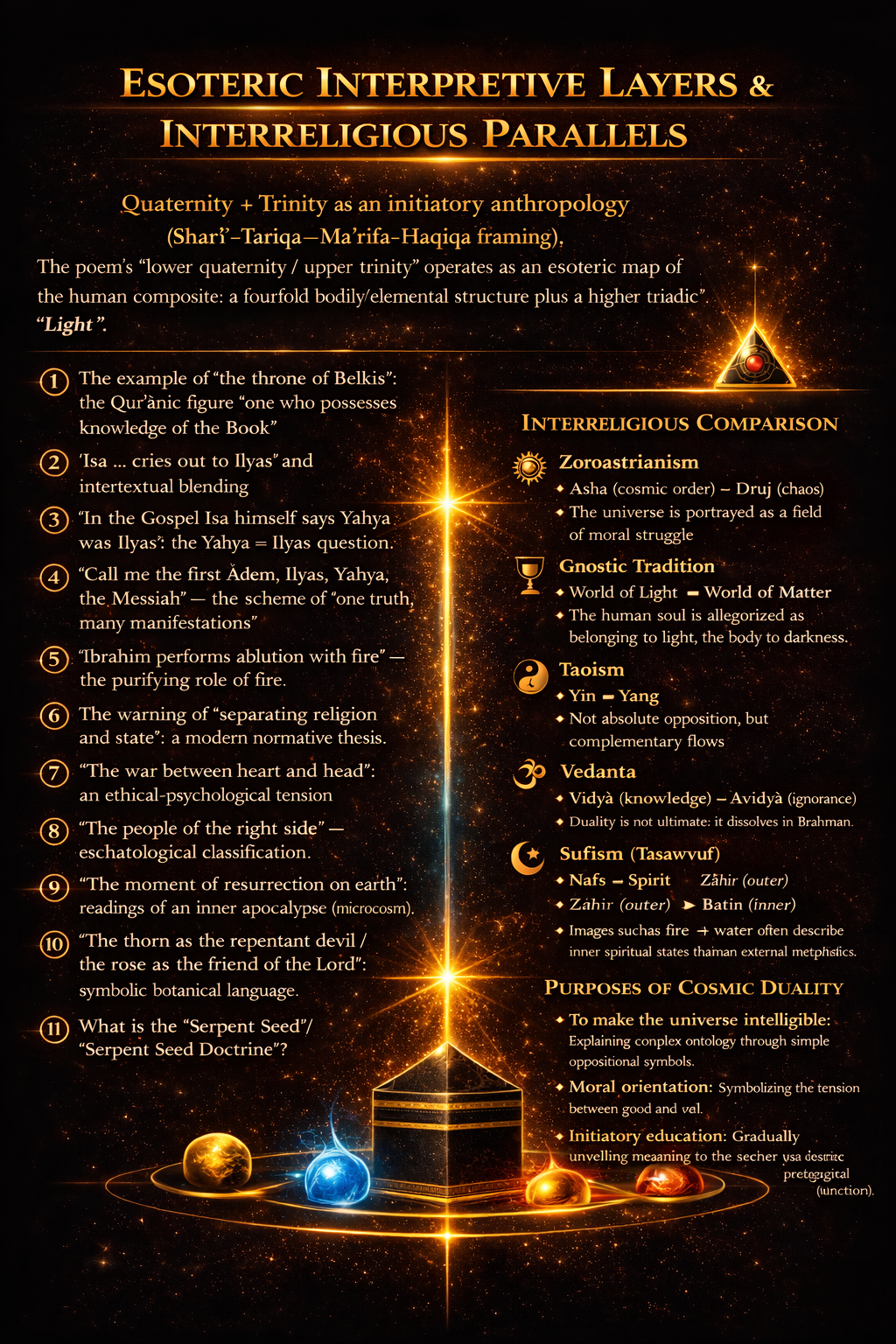
The example of “the throne of Belkıs”: the Qur’ānic figure “one who possesses knowledge of the Book”
The text’s emphasis on “the one who transported the throne / the work of the science of the Book” draws upon the Qur’ānic figure described as “one who possessed knowledge from the Book” (Qur’an, An-Naml 27:40). From this, the poem constructs an analogy to the “transfer of the spirit,” which itself is a poetic interpretation within the text. (For Matthew-related connections, see the following footnotes.)
“Isa… cries out to Ilyas” and intertextual blending
In the New Testament, the phrase “Eli, Eli…” (an allusion to Psalm 22) appears within the crucifixion sayings of Isa; the narrative also mentions that some people believed he was calling Ilyas. The poem relocates this motif into an esoteric framework resembling a “summoning of the spirit at the end of a mission” (a poetic recontextualization).
“In the Gospel Isa himself says Yahya was Ilyas”: the Yahya = Ilyas question
Matthew 11:14 contains the phrase “if you are willing to accept it, he is the Ilyas who was to come.” However, in mainstream interpretations this is usually understood not as literal reincarnation but as coming “in the spirit and power of Ilyas,” that is, a typological or functional correspondence.
“Call me the first Âdem, Ilyas, Yahya, the Messiah” — the scheme of ‘one truth, many manifestations’
Such sequences evoke in Sufism the language of a single truth appearing in multiple forms; in Christianity they resonate with concepts of typology and Christological centrality; in Hinduism they may be compared with the logic of avatars (divine principle appearing in different forms). The text constructs this as a “chain of manifestations” within its own metaphysical framework.
“Ibrahim performs ablution with fire” — the purifying role of fire
The central reference in religious history to Ibrahim and fire is the motif of being cast into fire without harm. The poem’s phrase “ablution with fire” should therefore be read as a poetic extension into the symbolism of purification rather than a canonical doctrinal statement.
The warning of “separating religion and state”: a modern normative thesis
The poem’s call to keep religion and state separate approaches themes in modern political thought concerning legitimacy, secularism, and religious authority; it expresses this argument through mythic allegory.
“The war between heart and head”: an ethical-psychological tension
Here “heart” symbolizes conscience, intention, and compassion, whereas “head” represents intellect, strategy, and power. Comparable distinctions appear across traditions: the prayer of the heart in Christian mysticism, the centrality of the heart in Islam, and the buddhi–manas distinction in Vedanta (conceptual parallels).
“The people of the right side” — eschatological classification
The motif of the “right side” echoes Abrahamic eschatological language dividing humanity into those of the right and those of the left; this symbolism is also strongly present within Islamic eschatology.
“The moment of resurrection on earth”: readings of an inner apocalypse (microcosm)
Interpreting resurrection not only as an external end but also as an inner awakening or reckoning resembles Sufi notions of the “minor resurrection” (personal awakening), Christian mystical ideas of metanoia and inward judgment, and certain Buddhist reflections on death and intermediate states — each with distinct ontological frameworks.
“The thorn as the repentant devil / the rose as the friend of the Lord”: symbolic botanical language
The contrast between thorn and rose draws on classical Eastern literary motifs such as “thorn as ego/self” and “rose as love,” and also resonates with Christian imagery of the crown of thorns and resurrection light, forming a broad intertextual field.
What is the “Serpent Seed” / “Serpent Seed Doctrine”?
The serpent seed doctrine — often translated into Turkish as “yılan tohumu öğretisi” — is a theological claim found in certain marginal esoteric or heterodox interpretations. According to this view:
Havva had a physical relationship with the serpent/Devil, and
Kabil was born from this union.
This idea does not appear explicitly in the canonical texts of the Torah, the Gospel, or the Qur’an. Rather, it emerges from gnostic, apocryphal, or later extreme interpretations, and is generally rejected by mainstream religious traditions.
Historical Background
a) Similar motifs in early Gnostic writings
Some Gnostic texts — especially within Sethian circles — reinterpret the story of Âdem and Havva, sometimes portraying the serpent as a bringer of knowledge or a cosmic counter-force. However:
Even in most Gnostic texts, the idea of a literal biological lineage is not explicit.
The modern “serpent seed” doctrine is not a direct continuation of ancient Gnostic writings but a later derivative interpretation.
b) Medieval and modern developments
The doctrine took clearer shape particularly in:
certain esoteric or extreme interpretive circles of the 19th–20th centuries,
some radical preaching traditions.
In academic discourse it is usually classified as “fringe theology.”
Mainstream Religious Positions
Judaism
In Genesis, Kabil’s father is explicitly Âdem.
The serpent is a tempter, not a biological ancestor.
Christianity
Church Fathers and classical theology reject the serpent seed idea.
Sin is interpreted as disobedience rather than biological lineage.
Islam
The Qur’an recounts Havva being deceived by the Devil,
but contains no notion of physical union or alternative lineage.Kabil and Hâbil are regarded as children of Âdem.
General Academic View in the History of Religions
It is an interpretation not grounded in canonical texts.
Many scholars consider it an overly literal reading of metaphor.
Because it has sometimes been used for ideological purposes, it is approached critically.
Within The Mason’s Tale, elements such as:
the idea of Kabil’s different origin,
the fire–water duality,
the existence of two human types
can be read as constructing a poetic allegory of cosmic duality.
Thus, academic interpretation usually distinguishes between:
Metaphorical reading: spiritual polarities (rebellious vs. obedient)
Literal reading: biological lineage
and generally favors the former.
What Is Cosmic Duality Allegory?
(An Academic Explanation in the Context of Comparative Religion and Metaphysics)
Cosmic duality allegory is a symbolic mode of expression used to interpret the universe and the human being. Within this approach, reality is often explained through two opposing yet complementary principles. The term “dualism” here does not necessarily imply the existence of two absolute gods; rather, it typically functions as a symbolic language describing tension or balance within being.
“Allegory” refers to the expression of an abstract truth through narrative or symbolic representation.
In cosmic duality allegory, oppositional pairs such as:
Fire / Water
Light / Darkness
Spirit / Matter
Right / Left
Heart / Intellect
are frequently employed.
These oppositions generally signify not ontological hostility, but cosmic balance.
Interreligious Comparison
☉ Zoroastrianism
Asha (cosmic order) ↔ Druj (chaos)
The universe is portrayed as a field of moral struggle.
Duality is sharper and ethically grounded.
☉ Gnostic Tradition
World of Light ↔ World of Matter
The human soul is allegorized as belonging to light, the body to darkness.
☉ Taoism
Yin ↔ Yang
Not absolute opposition, but complementary flows.
Duality generates harmony.
☉ Vedanta
Vidyā (knowledge) ↔ Avidyā (ignorance)
Duality is not ultimate; it dissolves in Brahman.
☉ Sufism (Tasavvuf)
Nafs ↔ Spirit
Zâhir (outer) ↔ Bâtın (inner)
Images such as fire ↔ water often describe inner spiritual states rather than external metaphysics.
Purposes of Cosmic Duality
To make the universe intelligible: Explaining complex ontology through simple oppositional symbols.
Moral orientation: Symbolizing the tension between good and evil.
Initiatory education: Gradually unveiling meaning to the seeker (an esoteric pedagogical function).
In poetic narratives such as The Mason’s Tale, oppositions like:
Fire ↔ Water
Şit ↔ Kabil
Heart ↔ Head
may be read academically not as biological divisions, but as spiritual–symbolic expressions of cosmic duality.
Thus, the aim of the allegory is usually not to describe “two human species,” but rather two tendencies within the human being.
In many mystical traditions, duality is not considered the ultimate reality:
In Plotinus, it resolves into the One.
In Vedanta, it dissolves into Brahman.
In Taoism, Yin and Yang return to unity.
In Sufism, it is transcended through the doctrine of tawhid (unity).
For this reason, cosmic duality allegory often functions as a provisional symbolic language pointing toward the idea of unity.