THE MENTAL BODY , PART-4
THE MENTAL BODY , PART-4. Meditation has many objects, of which the principal ones are as follows: [1] It ensures that at least once a day a man shall think of high and holy things, his thoughts being taken away from the petty round of daily life, from its frivolities and its troubles.
THE MENTAL BODY,PART-4
CHAPTER XVI
MEDITATION
Concentration is, of course, not an end in itself, but a means to an end. Concentration fashions the mind into an instrument which can be used at the will of the owner. When a concentrated mind is steadily directed to any object, with a view to piercing the veil and reaching the life, and drawing that life into union with the life to which the mind belongs –then meditation is performed. Concentration is thus the shaping of the organ; meditation is its exercise.
As we have seen, concentration means the firm fixing of the mind on one single point without wandering, and without yielding to any distractions caused by external objects, by the activity of the senses or by that of the mind itself. It must be braced up to an unswerving steadiness and fixity, until gradually it will learn so to withdraw its attention from the outer world and from the body that the senses will remain quiet and still, while the mind is intensely alive and all its energies drawn inwards, to be launched at a single point of thought, the highest to which it can attain. When it is able to hold itself thus with comparative ease it is ready for a further step, and by a strong but calm effort of the will it can throw itself beyond the highest thought it can reach, while working in the physical brain, and in that effort will rise to, and unite itself with, the higher consciousness, and find itself free of the body.
Thus anyone who is able to pay attention, to think steadily on one subject for a little time without letting the mind wander, is ready to begin meditation.
We may define meditation as the sustained attention of the concentrated mind in face of an object of devotion of a problem that needs illumination to be intelligible, of anything, in fact, whereof the life is to be realised and absorbed, rather than the form. It is the art of considering a subject or turning it over in the mind in its various bearings and relationships.
Another definition of meditation is that it consists of the endeavour to bring into the waking consciousness, that is, into the mind in its normal state of activity, some realisation of the super-consciousness, to create by the power of aspiration a channel through which the influence of the divine or spiritual principle –the real man –may irradiate the lower personality.
It is the reaching out of the mind and feelings towards and ideal, and the opening of the doors of the imprisoned lower consciousness to the influence of the ideal. "Meditation", said H.P. Blavatsky, "is the inexpressible longing of the inner man for the Infinite". St. Alphonus de ‘ Liguori spoke of meditation as :"the blessed furnace in which souls are inflamed with Divine Love."
The ideal chosen may be abstract, such as a virtue; it may be the Divinity in man; it may be personified as a Master of Divine teacher. But in all cases it is essentially an uplifting of the soul towards its divine source, the desire of the individual self to become one with the Universal Self.
What food is to the physical life, so is meditation to the spiritual life. The man of meditation is ever the most effective man of the world. Lord Rosebery, speaking of Cromwell, described him as a "practical mystic", and declared that a practical mystic is the greatest force in the world.
The concentrated intellect, the power of withdrawing outside the turmoil, means immensely increased energy in work, more steadiness, self-control, serenity. The man of meditation is the man who wastes not time, scatters no energy, misses no opportunity. Such a man governs events, because within him is the power whereof events are only the outer expression; he shares the divine life, and therefore shares the divine power.
As was said before, when the mind is kept shaped to one image, and the Knower steadily contemplates it, he obtains a far fuller knowledge of the object than he could obtain by means of any verbal description of it.As concentration is performed, the picture is shaped in the mental body, and concentration on rough out-line, derived from, say, a verbal description, fills in more and more detail, as the consciousness comes more closely in touch with the things described.
All religions recommend meditation, and its desirability has been recognised by every school of philosophy. Just as a man who wishes to be strong uses prescribed exercises to develop his muscles, so the student of occultism uses definite and prescribed exercises to develop his astral and mental bodies.
There are, of course, many kinds of meditation, just as there are many types of men: it is clearly not possible that one method of meditation which is most suited to him.
Meditation has many objects, of which the principal ones are as follows:
[1] It ensures that at least once a day a man shall think of high and holy things, his thoughts being taken away from the petty round of daily life, from its frivolities and its troubles.
[2] it accustoms the man to think of such matter, so that after a time they form a background to his daily life, to which his mind returns with pleasure when it is released from the immediate demands of his business.
[3] It serves as a kind of astral and mental gymnastics, to preserve these higher bodies in health and to keep the stream of divine life flowing through them. For these purposes it should be remembered that the regularity of the exercises is of the first importance.
[4] it may be used to develop character, to build into it various qualities and virtues.
[5] It raises the consciousness to higher levels, so as to include the higher and subtler things; through it a man may rise to the presence of the Divine.
[6] it opens the nature and calls down blessings from higher planes.
[7] It is the way, even though it be only the first halting step upon the way, which leads to higher development and wider knowledge, to the attainment of clairvoyance, and eventually to the higher life beyond this physical world altogether.
Meditation is the readiest and safest method of developing the higher consciousness. It is unquestionably possible for any man in process of time, by meditation, say, upon the Logos or the Master, to raise himself first to the astral and then tot he mental levels; but of course, none can say how long it will take, as that depends entirely upon the past of the student and the efforts he makes.
A man occupied in the earnest study of higher things is for the time lifted entirely out of himself, and generates a powerful though-form in the mental world, which is immediately employed as a channel by the force hovering in the world nest above.
When a body of men join together in thought of this nature, the channel which they make is out of all proportion larger in its capacity than the sum of their separate channels. Such a body of men is, therefore, an inestimable blessing to the community amidst which it works.
In their intellectual studies they may be the cause of an outpouring into the lower mental world of force which is normally peculiar to the higher mental.
If their thought deals with ethics and soul-development in its higher aspects, they may make a channel of more elevated thought through which the force of the buddhic world may descend into the mental.
They are thus able to cause influence to be radiated out upon many a person who would not be in the least open to the action of that force if it had remained on its original level.
This, in fact, is the real and greatest function of, for example, a Lodge of the Theosophical Society –to furnish a channel for the distribution of the Divine Life. For every Lodge of the Theosophical Society is a centre of interest to the Masters of the Wisdom and Their pupils; consequently the thoughts of the members of the Lodge, when engaged in study, discussion, etc., may attract the attention of the Masters, a force being then poured out far more exalted than anything deriving from the members themselves.
Members of the Theosophical Society may be reminded that it has been stated by Dr. Besant that a Master has said that when a person joins the Society he is connected with Them by a tiny thread of life. This thread is the line of magnetic rapport with the Master, and the student may by arduous effort, by devotion and unselfish service, strengthen and enlarge the thread until it becomes a line of living light.
It is possible to call down a blessing from a still higher source. The Life and Light of the Deity flood the whole of His system, the force at each level or plane being normally strictly limited to it. If, however, a special channel be prepared for it, it can descend to, and illuminate a lower level.
Such a channel is always provided whenever any thought or feeling has an entirely unselfish aspect. Selfish feeling moves in a closed curve, and so brings it own response on its own level.
An utterly unselfish emotion is an outrush of energy which does not return, but in its upward movement provides a channel for a downpouring of divine Power from the level next above. This is the reality lying at the back of an idea of the answer to prayer. To a clairvoyant this channel is visible as a great vortex, a kind of gigantic cylinder or funnel.
This is the nearest explanation that can be given in the physical world, but it is inadequate, because as the force flows down through the channel it somehow makes itself one with the vortex, and issues from it coloured by it and bearing with it, distinctive characteristics which show through what channel is has come.
By meditation a man's astral and mental bodies gradually come out of chaos into order, slowly expand and gradually learn to respond to higher and higher vibrations. Each effort helps to thin the veil that divides him from the higher world and direct knowledge. His thought-forms grow day by day more definite, so that the life poured into them from above becomes fuller and fuller.
Meditation thus helps to build into the bodies the higher types of matter. It often leads to lofty emotions being experienced, these coming from the buddhic level and being reflected in the astral body. In addition, there is needed also development of the mental and causal bodies, in order to give steadiness and balance; otherwise fine emotions which sway the man in the right direction may very readily become a little twisted and sway him along other and less desirable lines. With feeling alone perfect balance or steadiness can never be obtained. The directing power of mind and will is needed as well as the motive force of emotion.
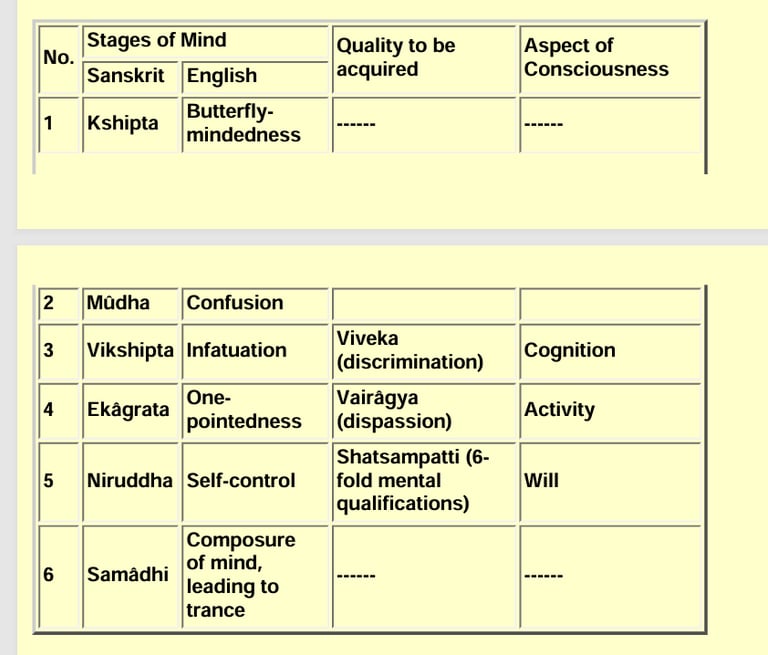
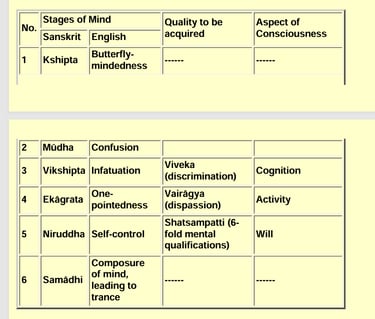
In practising meditation the student may find useful a knowledge of the five stages of mind as expounded by Patanjali. He should recollect, however, that these stages are not confined to the mental plane, but exist, in appropriate form, on every plane. They are:-
[1] Kshipta: the butterfly mind, which darts constantly from one object to another. It corresponds to activity on the physical plane.
[2] Mudha: the confused stage in which the man is swayed and bewildered by emotions; it corresponds to activity in the astral world.
[3] Vikshipta: the state of pre-occupation of infatuation by an idea; the man is possessed, we might say obsessed, by an idea. This corresponds to activity in the lower mental world. The man should learn Viveka [see p. 294], which has to do with the Cognitional aspect of consciousness.
[4] Ekagrata: one-pointedness; the state of possessing an idea, instead of being possessed by it. This corresponds to activity on the higher mental plane.
The man should here learn Vairagya [see p. 295], which has to do with the Activity aspect of consciousness.
[5] Niruddha: self-control; rising above all ideas, the man chooses as he wills according to his illumined Will. This corresponds to activity on the buddhic plane. The man should here learn Shatsampatti [see p. 294], which has to do with the Will aspect of consciousness.
When complete control has been acquired, so that the man can inhibit all motions of the mind, then he is ready for Samadhi, corresponding to Contemplation, with which we shall deal more fully in our next chapter. Meanwhile, for the sake of completeness, it is desirable to give here a preliminary idea of Samadhi.
Etymologically Samadhi means "fully placing together", and may therefore be rendered into English as "com-posing the mind", i.e.,, collecting it all together, checking all distractions.
"Yoga", says Vyasa, "is the composed mind". This is the original meaning of Samadhi, though it is more often used to denote the trance state, which is the natural result of perfect composure.
Samadhi is of two kinds:
[1] Samprajnata Samadhi, i.e.,, Samadhi with consciousness, with consciousness turned outwards towards objects;
[2] Asamprajnata Samadhi, i.e.,, Samadhi without consciousness, with consciousness turned inwards, withdrawn into itself so that it passes into the next higher vehicle.
For convenience of reference these facts are set out in tabular form on page 146. The student may also like to have a brief enumeration of the Four States of Mind spoken of in Yoga. They are:
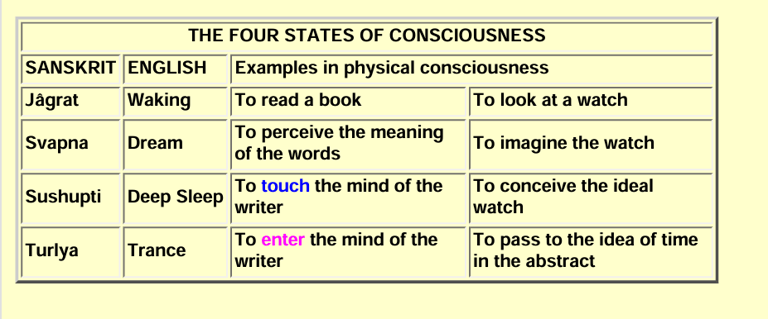
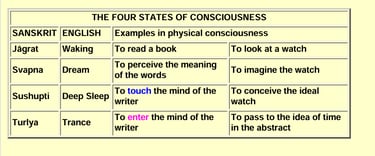
[1] Jagrat : waking consciousness
[2] Svapna : dream consciousness; consciousness working in the astral body and able to impress its experiences upon the brain.
[3] Sushupti : deep-sleep consciousness, working in the mental body, and not able to impress its experiences on the physical brain.
[4] Turiya : trance consciousness, so far separated from the brain that it cannot readily be recalled by outer means.
It is important to note, however, that these four states of consciousness exist on every plane. The following gives examples of the four states in physical consciousness, and is arranged in tabular form for the sake of compactness and clarity:
It should also be noted that the terms are relative; thus, for most people, Jagrat, or waking consciousness, is that part of the total consciousness which is functioning in the brain and nervous system, and which is definitely self-conscious. We may think of consciousness as a great egg of light, of which one end only is inserted into the brain; that end is the waking consciousness.
But, as self-consciousness is developed in the astral world, and the brain develops sufficiently to answer to its vibrations, astral consciousness becomes a part of the waking consciousness; the mental consciousness would then be the svapna, or dream-consciousness.
Similarly, when mental self-consciousness is developed, and the brain answers to it, the waking consciousness includes the mental. And so on, until all the consciousness on the five planes is included in the waking consciousness.
This enlarging of waking-consciousness involves development in the atoms of the brain as well as the development of certain organs in the brain, and of the connections between the cells.
For the inclusion of astral self-consciousness the pituitary body must be developed, and the fourth set of spirillae in the atoms must be perfected.
For the inclusion of mental self-consciousness the pineal gland must be active, and the fifth set of spirillae in thorough working order.
If these physical developments are not achieved, then the astral and mental consciousness remain super-consciousness, and are not expressed through the brain.
Again, if a man possesses no physical body, then his jagrat or waking consciousness is his astral consciousness. Thus a wider definition of jagrat would be that it is that part of the total consciousness which is working through its outermost vehicle.
We may also reconsider, from the point of view of the above analysis, Samadhi. Samadhi is a state of consciousness in which the body is insensible, but the mind is fully self-conscious, and from which the mind returns to the physical brain with the memory of its super-physical experiences.
If a man throws himself into a trance, and is active on the astral plane, then his Samadhi is on the astral. If he functions on the mental plane, then his Samadhi is on that plane.
The man who can practise Samadhi can thus withdraw from the physical body so as to leave it insensitive while his mind is fully conscious.
Samadhi is therefore a relative term. Thus a master begins His Samadhi on the plane of atma, and rises thence to the higher cosmic planes.
The word Samadhi is also sometimes used to denote the condition just beyond the level where a man can retain consciousness. Thus, for a savage whose consciousness is clear only on the physical plane, the astral plane would be Samadhi. It means that when the man comes back to his lower vehicles he would bring with him no definite additional knowledge and no new power of doing anything of use. This kind of Samadhi, is not encouraged in the highest schools of occultism.
Going to sleep and going into Samadhi are largely the same process ; but while one is due to ordinary conditions and has no significance, the other is due to the action of the trained will and is a priceless power.
Physical means of inducing trance, such as hypnotism, drugs, staring at a black spot on a white ground, or at the point of the nose, and other similar practices, belong to the method of Hatha Yoga, and are never employed in Raja Yoga.
To a clairvoyant, the difference between a mesmerised subject and the self-induced trance of a Yogi is at once apparent. In the mesmerised or hypnotised subject all the "principles" are present, the higher manas paralysed, buddhi severed from it through that paralysis, and the astral body entirely subjected to lower manas and kama.
In the yogi on the other hand, the "principles" of the lower quaternary disappear entirely, except for hardly perceptible vibrations of the golden-hued prana and a violet flame streaked with gold rushing upwards from the head and culminating in a point.
The mesmerised or hypnotised person recollects in his brain nothing of his experiences; the yogi remembers everything that has happened to him.
A few practical examples will perhaps best illustrate some of the methods employed in meditation.
The student will do well to commence by cultivating the thought, until it becomes habitual, that the physical body is an instrument of the spirit. He should think of the physical body, how it is possible to control and direct it, and then should separate himself in thought from it, repudiate it, in fact.
Next, perceiving that he can control his emotions and desires, he should repudiate the astral body, with its desires and emotions; then, picturing himself as in the mental body, and again reflecting that he can control and direct his thoughts, he should repudiate his mind, and should then let himself soar into the free atmosphere of the spirit where is eternal peace; resting there for a moment, let him strive with great intensity to realise that That is the real Self.
Descending again in consciousness, he should endeavour to carry with him the peace of the spirit into his different bodies.
Another exercise would be to direct the meditation to character-building, selecting for the purpose a virtue, let us say harmlessness. The attention having been concentrated, the subject is thought about in its many aspect; eg., harmlessness is act, in speech, in thought, in desire; how harmlessness would be expressed in the life of the ideal man; how it would affect his Daily life; how he would treat people if he had fully acquired the virtue, and so forth.
Having thus meditated upon harmlessness, he would carry with him into the daily life a state of mind that would soon express itself in all his action and thoughts. Other qualities could, of course, be similarly treated. A few months of earnest effort along these lines would produce wonderful changes in a man's life, as described in the memorable words of Plotinus. "Withdraw into yourself and look. And if you do not find yourself beautiful as yet, do as does the creator of a statue that is to be made beautiful; he cuts away here, he smoothes there, he makes the line lighter, this other purer, until he has shown a beautiful face upon the statue. So do you also; cut away all that is excessive, straighten all that is crooked, bring light to all that is shadowed, labour to make all glow with beauty, and do not cease chiseling your statue until there shall shine out on you the godlike splendour of virtue, until you shall see the final goodness surely established in the stainless shrine". [Plotinus on the Beautiful, translated by Stephen Mackenna].
Meditation upon a virtue thus causes a man gradually to grow into the possession of that virtue ; as finely said in the Hindu Scriptures : "What a man thinks on, that he becomes; therefore think on the Eternal". And again : "Man is the creation of thought".
An excellent example of what may be done in this manner by meditation is that of a certain man who for forty years meditated daily upon truth; the effect was that he so tuned himself to the mode of truth that he always knew when a man was lying by the jar that he felt in himself. It so happened that the man was a judge, so that his faculty must have stood him in good stead.
In this work a man is employing his imagination – the great tool used in Yoga. If a man imagines in his thought that he has a certain quality, he is half way to possessing that quality; if he imagines himself free from a certain failing, he is half way to being free from that failing. So powerful a weapon is a trained imagination that a man may by its use rid himself of half his troubles and his faults.
It is not wise to brood over faults, as it tends to encourage morbidness and depression which act as a wall, shutting out spiritual influences. In practice it is better to ignore faults of disposition so far as may be done, and to concentrate on building the opposite virtues.
Success in the spiritual life is gained less by fierce wrestling with the lower nature than by growing into the knowledge and appreciation of higher things. For once we have sufficiently experienced the bliss and joyousness of the higher life, by contrast the lower desires pale and lose their attractiveness. It was said by a great Teacher that the best form of repentance for a transgression was to look ahead with hopeful courage, coupled with the firm resolve not to commit the transgression again.
Next, suppose the purpose of the meditation is to be intellectual understanding of an object, and the relation of it to other objects.
It is important for the student to recollect that the first work of the Knower is to observe –accurately, for on the accuracy of the observation depends the thought; if the observation is inaccurate, then out of that initial error will spring a number of consequent errors that nothing can put right save going back to the very beginning.
The object having thus been carefully observed, the stream of thought is played upon it so as to grasp it in all its natural, super-physical and metaphysical aspects, an effort being made to make quite clear and definite that level of the consciousness which is still nebular. Let the subject be, for example, harmony. Consider it in relation to the various senses; consider it in music, in colour, in phenomena of many different kinds; seek to discover the principal features of harmony, and how it differs from other similar and contrasting ideas; what part it plays in the succession of events; what is its use; what results from its absence. Having answered all these, and many other questions, an endeavour should be made to drop all concrete images or thoughts, and to hold in thought the abstract idea of harmony.
The student must bear in mind that mental sight is quite as real and satisfying as is physical sight. Thus it is possible to train the mind to see, say, the idea of harmony, or the square root of two, as clearly and as certainly as one sees a tree or a table with physical vision.
For our third example let us take a devotional meditation. Think of the ideal man, the Master, or, if preferred, the deity, or any manifestation of the deity. Allow the thought to play upon the subject from different aspects, so that it constantly awakens admiration, gratitude, reverence, worship. Ponder upon all the qualities manifested in the subject and take each quality in all its aspects and relationships.
From a general standpoint, an abstract ideal and a personality are equally good for purposes of meditation. A person of intellectual temperament will usually find the abstract ideal the more satisfactory; one of the emotional temperament will demand a concrete embodiment of his thought. The disadvantage of the abstract ideal is that it is apt to fail in compelling aspiration; the disadvantage of the concrete embodiment is that the embodiment is apt to fall below the ideal.
We may here take especial notice of the result of meditating on the Master, this makes a definite link with the Master ,which shows itself to the clairvoyant vision as a kind of line of light. The Master always subconsciously feels the impinging of such a line and sends out along it in response a steady stream of magnetism which continues to play long after the meditation is over.
If a picture is used for purposes of meditation, it may often be observed to change in expression. This is because the will can be trained to act directly upon physical matter, the actual physical particles being unquestionably affected by the power of strong sustained thought.
One other form of meditation may be given, viz., that of mantric meditation. A mantram is a definite succession of sounds arranged by an occultist in order to bring about certain definite results. Those sounds, repeated rhythmically over and over again in succession, synchronise the vibrations of the vehicles into unity with themselves. A mantram is thus a mechanical way of checking vibrations, or inducing the vibrations that are desired. Its efficacy depends upon what is known as sympathetic vibration [vide The Astral Body, pp. 157-8].
The more a mantram is repeated, the more powerful the result. Hence the value of repetition in Church formulae, and of the rosary, which enables the consciousness to be fully concentrated on what is being said and thought, undistracted by the task of keeping count.
In this method of meditation, practised largely in India, the devotee directs his mind, say, to Shri Krishna, the incarnate God, the Spirit of Love and Knowledge in the world. A sentence is taken and chanted over and over again as a mantram, while its deep and varied meaning is intently pondered upon. Thus the devotee brings himself in touch with the Great Lord Himself.
The above constitutes the briefest outline of certain forms of meditation. For further description and detail the student is referred to that excellent manual Concentration by Ernest Wood, to
Meditation For Beginners by J.I. Wedgwood, and to the admirable chapters on ThoughtControl and on Building of Character in The Outer Court, by Dr. Besant.
An excellent "Ego Meditation" is given in Gods In Exile, by J.J. van der Leeuw, LL.D., in the Afterword at the end of that admirable little book.
Many people meditate daily alone, with success; but there are even greater possibilities when a group of people concentrate their minds on the one thing. That sets up a strain in the physical ether as well as in the astral and mental worlds, and it is a twist in the direction which we desire. Thus, instead of having to fight against our surroundings, as is usually the case, we find them actually helpful, provided of course, that all present succeed in holding their minds from wandering. A wandering mind in such a group constitutes a break in the current, so that instead of there being a huge mass of thought moving in one mighty flood, there would be eddies in it, like rocks which deflect the water in a river.
A striking example of the tremendous power of collective meditation and thought was that of the Diamond Jubilee of Queen Victoria. C.W.Leadbeater describes that occasion as one of the most wonderful manifestations of occult force that he ever saw. The crowd became so exalted that people were lifted right out of themselves by their emotions, thus experiencing a tremendous uplift of soul. A similar effect, on a small scale, can be produced by group meditation.
We will now consider the physical adjuncts of meditation. In meditation, posture is not unimportant. The body should be put into a comfortable position, and then forgotten. If it is uncomfortable, it cannot be forgotten, as it would constantly call attention to itself.
Furthermore, just as certain thoughts and emotions tend to express themselves in characteristic movements and gestures of the body, so, by a reversal of the process, positions of the body may tend to induce states of mind and feeling, and so assist the student in dwelling on them.
The majority of Western people will find it most comfortable to sit in an armchair, the back of which does not slope unduly; the hands may be clasped and rest on the legs, or be laid lightly on the knees. The feet may be placed together or crossed with the right over the left. This locking of the extremities of the body helps to prevent the outflow of magnetism from the fingertips, feet, etc. The position should be easy and relaxed, the head not sunken upon the chest but lightly balanced; the eyes and mouth closed, the spinal column [along which there is much magnetic flow] erect.
Eastern people usually sit cross-legged on the floor or a low stool, a position which is said to be slightly more effectual since any magnetism liberated tends to rise around the body in a protective shell.
Another factor to be considered in determining the posture for meditation is the possibility of losing physical consciousness. The Indian who is sitting on the floor simply falls backwards without hurting the body; those who meditate in a chair will do well to make use of an armchair so that, in the event of the body losing consciousness, they may not fall out of it.
Except in very rare cases the lying-down position should not be adopted, on account of its natural tendency towards sleep.
A cold bath or a brisk walk beforehand is useful in order to overcome any tendency to sluggish circulation of the blood, which is obviously detrimental to brain activity.
There is an intimate connection between profound meditation and breathing. It is found in practice that as the body becomes harmonised in meditation the breathing grows deeper, regular and rhythmic, until by degrees it becomes so slow and quiet as to be almost imperceptible. Hatha Yoga reverses the process, and by deliberate regulation of the breathing seeks to harmonise the functions of the body, and finally, the workings of the mind.
The student, however, should be warned against the indiscriminate practice of breathing exercises; he will be far better advised to learn to control of thought along the lines of Raja Yoga , leaving his efforts at meditation to work their natural effect on the physical body.
Whilst some breathing exercises are exceedingly dangerous, there is no objection to simple, deep breathing provided undue strain is not placed upon the heart and lungs, and no attempt is made to concentrate the thought on the various centres, or chakrams, of the body. Good incense is also helpful, as it tends to purify the "atmosphere" from the occult standpoint. The student may also gain assistance from beautiful colours, flowers and pictures in his surroundings, and other means of uplifting the mind and feelings.
He will also find it useful to observe certain dietetic restrictions [vide The Astral Body. p. 65] and, if it can be done without detriment to health, to abstain from flesh-food and alcohol.
If alcohol is taken, meditation is apt to set up inflammatory symptoms in the brain affecting particularly the pituitary body [vide The Astral Body, p. 66].
Early morning is probably the most suitable time for meditation because desires and emotions are usually more tranquil after sleep and before the man plunges into the bustle of the world.
But whatever time is chosen it should be when there is assurance of being undisturbed.
Moreover, as already pointed out, it should always be at the same time, for regularity is of the essence of the prescription.
The times selected by ancient devotees were sunrise, noon and sunset, these being magnetically the most suitable. It is well to cultivate the habit of turning the mind for a moment at the stroke of every hour during the day to the realisation of oneself as the Spiritual Man.
This practice leads to what Christian Mystics called "self-recollectedness", and helps the student to train his mind to revert automatically to spiritual thoughts.
It is not well to meditate immediately after a meal, for the obvious reason that it tends to draw blood away from the digestive organs; neither is meditation at night good, because the bodies are tired and the etheric double is more readily displaceable; in addition, the negative influence of the moon is then operative, so that undesirable results are more liable to occur.
Sometimes meditation may be less successful than usual because of unfavourable astral or mental influences.
It is stated also by some people that at certain times the planetary influences are more favourable than at others. Thus an astrologer has said that when Jupiter had certain relations with the moon this had the effect of expanding the etheric atmosphere and making meditation appear more successful. Certain aspects with Saturn, on the other hand, were said to congest the etheric atmosphere, making meditation difficult.
The system of meditation briefly outlined above has as its object spiritual, mental and ethical development, and control of the mind and feelings. It does not aim at developing psychic faculties "from below upwards"; but its natural result may be to open up a form of intuitive psychism in persons of sufficiently sensitive organisation, which will show itself in increasing sensitiveness to the influence of people and places, in the recalling of fragmentary memories of astral plane experiences in sleep, in greater susceptibility to direct guidance from the ego, in the power to recognise the influence of the Masters and spiritually developed people, and so forth.
Meditation may result in illumination, which may be one of three quite different things:
[1] By intense and careful thinking over a subject a man may himself arrive at some conclusion with respect to it;
[2] he may obtain illumination from his higher self, discovering what his ego really thinks on his own plane about the question;
[3] he may, if highly developed, come into touch with Masters or devas. It is in [1] only that his conclusions would be likely to be vitiated by his own thought-forms; the higher self would be able to transcend these, and so would a Master or a deva.
What we can do in meditation depends upon what we are doing all day long. If we have prejudices, for example, in ordinary life, we cannot escape from them in meditation.
Physical meditation is, of course, for the training of the lower vehicles, not for the ego. During meditation the ego regards the personality much as at any other time –he is usually slightly contemptuous.
If the ego is at all developed he will meditate upon his own level, but that meditation need not, of course, synchronise with that of the personality.
Meditation is one means of acquiring the art of leaving the body in full consciousness. The consciousness being braced up to an unswerving steadiness and fixity, the attention is gradually withdrawn from the outer world and the body, the senses remaining quiet –[page 158]—while the mind is intensely alive, but with all its energies drawn inwards ready to be launched at a single point of thought, the highest to which it can attain. When it is able to hold itself thus with comparative ease by a strong but calm effort of will, it can throw itself beyond the highest thought it can reach while working in the physical brain, and in that effort will rise to, and unite itself with, the higher consciousness and find itself free from the body. When this is done there is no sense of sleep or dream nor any loss of consciousness; the man finds himself outside his body, as though he had slipped off a weighty encumbrance, not as though he had lost any part of himself.
There are other ways of obtaining freedom from the body; for example, by the rapt intensity of devotion, or by special methods that may be imparted by a great teacher to his pupil.
The man can return to his body and re-enter it at will; also, under these circumstances he can impress on the brain, and thus retain while in the physical body, the memory of the experiences he has undergone.
Real meditation means a strenuous effort, not the sensation of happiness which arises from a state of semi-somnolence and bodily luxury. It has, therefore, nothing to do with, and, in fact, is quite different from, the kind of passive mediumship developed in spiritualism.
The student need not be puzzled by the injunction that he should open himself to spiritual influences and at the same time be positive. Positive effort is needed as a preliminary; this uplifts the consciousness the higher levels so that the higher influences can play down; then, and only then, is it safe to relax the upward striving in the realisation of the peace thus attained. The phrase "opening oneself to spiritual influences" may be taken to mean maintaining an attitude of intense stillness at a high spiritual level, much as a bird, though seemingly passive and immobile, poises itself against the gale by a powerful effort continuously maintained in wing and pinion.
CHAPTER XVII
CONTEMPLATION
CONTEMPLATION is the third of the three stages, of which we have already considered two.
The three are :
[1] Concentration –The riveting of the attention on an object.
[2] Meditation –The stirring of the consciousness into activity with reference to that object alone; looking at the object in every possible light, and trying to penetrate its meaning, to reach a new and deep thought or receive some intuitional light upon it.
[3] Contemplation –The active centring of the consciousness on the object, while the lower activities of the consciousness are successfully repressed; the fixation of the attention for a time on the light received. It has been defined as concentration at the top of the line of thought or meditation.
In the Hindu terminology the stages are amplified and named as follows:
[1] Prâtyâhara : the preliminary stage, embracing entire control of the senses.
[2] Dhâranâ : concentration.
[3] Dhyâna : meditation.
[4] Samadhi : contemplation.
Dhâranâ, Dhyâna and Samadhi are known collectively as Sannyama. In meditation we discover what the object is as compared with other things, and in relation to them. We go on with this process of reasoning and argument until we can reason and argue no more about a object: then we suppress the process, stopping all comparing and arguing, with the attention fixed actively upon the object, trying to penetrate the indefiniteness which for us appears to surround it. That is contemplation.
The beginner should bear in mind that meditation is a science of a lifetime, so that he should not expect to attain to the stage of pure contemplation in his earlier efforts.
Contemplation may be described also as keeping the consciousness on one thing and drawing it into oneself so that the thinker and it become one.
When a well-trained mind can maintain its one-pointedness or concentration for some time, and can then drop the object, maintaining the fixed attention, but without the attention being directed to anything, then the stage of contemplation is reached.
In this stage the mental body shows no image; its own materials are held steady and firm, receiving no impressions, perfectly calm, like still water. This state cannot last for more than a very brief period, being like the "critical" state of the chemist, the point between two states of matter.
Expressed in another way, as the mental body is stilled, the consciousness escapes from it and passes into and out of the "laya centre", the neutral points of contact between the mental and the causal body.
This passage is accompanied by a momentary swoon, or loss of consciousness, the inevitable result of the disappearance of objects of consciousness, followed by consciousness in the higher body. The dropping out of objects of consciousness belonging to the lower worlds is thus followed by the appearance of objects of consciousness in the higher world.
Then the ego can shape the mental body according to his own lofty thoughts, and permeate it with his own vibrations. He can mould it after the visions he has obtained of planes even higher than his own, and can thus convey to the lower consciousness ideas to which the mental body would otherwise be unable to respond.
These are the inspirations of genius, that flash down into the mind with dazzling light and illuminate a world. The very man himself who gives them to the world can scarcely tell, in his ordinary mental state, how they have reached him ; but he knows that in some strange way----- "the power within me pealing Lives on my lip and beckons with my hand ".
Of this nature also are the ecstasy and visions of Saints, of all creeds and in all ages; in these cases, prolonged and absorbing prayer, or contemplation, has produced the necessary braincondition. The avenues of the senses have become closed by the intensity of the inner concentration, and the same state is reached, spasmodically and involuntarily, which the Raja Yogi seeks deliberately to attain.
The transition from meditation to contemplation has been described as passing from meditation "with seed" to meditation "without seed". Having steadied the mind, it is held poised on the highest point of the reasoning, the last link in the chain of argument, or on the central thought or figure of the whole process; that is meditation with seed.
Then the student should let everything go, but still keeping the mind in the position gained, the highest point reached, vigorous and alert. That is meditation without seed. Remaining poised, waiting in the silence and the void, the man is in the "cloud". Then suddenly there will be a change, a change unmistakable, stupendous, incredible. This is contemplation leading to illumination.
Thus, for example, practising contemplation on the ideal man, on a Master, having formed an image of the Master, the student contemplates it with ecstasy, filling himself with its glory and its beauty, and then straining upwards towards Him, he endeavours to raise his consciousness to the ideal, to merge himself in it, to become one with it.
The momentary swoon mentioned above is called in Sanskrit the Dharma-Megha, the cloud of righteousness ; Western mystics speak of it as the "Cloud on the Mount", the "Cloud on the Sanctuary", the "Cloud on the Mercy-Seat". The man feels as though surrounded by a dense mist, conscious that he is not alone, but unable to see. Presently the cloud thins, and the consciousness of the higher plane dawns. But before it does so it seems to the man that his very life is draining away, that he is hanging in the void of great darkness unspeakably lonely.
But "Be still, and know that I am God". In that silence and stillness the Voice of the Self shall be heard, the glory of the Self shall be seen. The cloud vanishes and the Self is made manifest.
Before it is possible to pass from meditation to contemplation, wishing and hoping must be entirely given up, at least during the period of practice : in other words, Kâma must be perfectly under control. The mind can never be single while wishes occupy it; every wish is a seed from which may spring anger, untruthfulness, impurity, resentment, greed, carelessness, discontent, sloth, ignorance etc. While one wish of hope remains, these violations of the law are possible.
So long as there are wishes, non-satisfactions, they will call one aside ; the stream of thought is ever seeking to flow aside into little gullies and channels left open by unsatisfied desires and indecisive thought.
Every unsatisfied desire, every un-thought-out problem, will present a hungry mouth ever calling aside the attention ; when the train of thought meets a difficulty it will swing aside to attend to these calls. Tracing out interrupted chains of thought, it will be found that they have their source in unsatisfied desires and unsettled problems.
The process of contemplation commences when the conscious activity begins to run, as it were, at right angles to the usual activity, which endeavours to understand a thing in reference to other things of its own nature and plane ; such movement cuts across the planes of its existence and penetrates into its subtler inner nature. When the attention is no longer divided into parts by the activities of comparing, the mind will move as a whole, and will seem quite still, just as a spinning top may appear to stand still when it is in most rapid motion.
In contemplation one no longer thinks about the object, it is better even not to start with any idea of the self and the object as two different things in relation to one another, because to do so will tend to colour the idea with feeling. The endeavour should be made to reach such a point of self-detachment that the contemplation can start from inside the object itself, the mental enthusiasm and energy being at the same time kept up all along the line of thought.
The consciousness is to be held, poised like a bird on the wing, looking forward and never thinking of turning back.
In contemplation the thought is carried inwards until it can go no further ; it is held in that position without going back or turning aside, knowing that there is something there, although it is unable to grasp clearly what it is. In this contemplation there is, of course nothing in the nature of sleep or mental activity, but an intense search, a prolonged effort to see in the indefiniteness something definite, without descending to the ordinary lower regions of conscious activity in which the vision is normally clear and precise.
A devotee would practise contemplation in a similar manner, but in his case the activity would be mainly feeling rather than thought.
In contemplation on his own nature, the student repudiates his identity with the outer bodies and with the mind. In this process he is not divesting himself of attributes, but of limitations.
The mind is swifter and freer than the body, and beyond the mind is spirit, which is freer and swifter still. Love is more possible in the quietude of the heart than in any outer expression, but in the spirit beyond the mind it is divinely certain. Reason and judgement ever correct the halting evidence of the senses ; the vision of the spirit discerns the truth without organs and without mind.
The key to success at every step of these practices may be stated thus: obstruct the lower activities, while maintaining the full flow of conscious energy. First, the lower mind must be made vigorous and alert; then its activity must be obstructed while the impetus gained is used to exercise and develop the higher faculties within.
An ancient science of Yoga teaches, when the processes of the thinking mind are repressed by the active will, the man finds himself in a new state of consciousness which transcends the ordinary thinking and governs it, just as thought transcends and selects among desires, and just as desires prompt to particular actions and efforts. Such a superior state of consciousness cannot be described in terms of the lower mind, but its attainment means that the man is conscious that he is something above mind and thought even though mental activity may be going on, just as all cultured people recognise that they are not the physical body, even when that body may be acting.
There is thus another state of existence, or rather another living conception of life, beyond the mind with its laboured processes of discernment, of comparisons and causal relations between things. That higher state is to be realised only when the activities of consciousness are carried, in all their earthly fervour and vigour, beyond the groping cave-life in which they normally dwell.
That higher consciousness will come to all men sooner or later; and when it comes all life will suddenly appear changed.
As the student by his meditation grows richer in spiritual experience, he will thus find new phases of consciousness gradually opening up within him. Fixed in aspiration upon his ideal, he will presently become aware of the influence of that ideal raying down upon him, and as he makes a desperate effort to reach the object of his devotion, for a brief moment the floodgates of heaven itself will be opened and he will find himself made one with his ideal and suffused with the glory of its realisation. Having transcended the more formal figures of the mind, an intense effort is made to reach upwards. Then will come the attainment of that state of ecstasy of spirit, when the limits of the personality have fallen away and all shadow of separateness has vanished in the perfect union of object and seeker.
As said in The Voice of The Silence : "Thou canst not travel on the Path before thou hast become that Path itself…Behold ! thou hast become the light, thou hast become the sound, thou art thy Master and thy God. Thou art thyself the object of thy search; the voice unbroken, that resounds throughout eternities, exempt from change, from sin exempt, the seven sounds in one."
It were idle to attempt further description of such experiences, for they are beyond the reach of formulated utterance. Words serve but as signposts pointing out the way to that which is ineffably glorious, so that the pilgrim may know whither to direct his steps.
CHAPTER XVIII
SLEEP-LIFE
Many people find themselves troubled with streams of wandering thought when they are trying to fall asleep. In such cases a mental shell will deliver them from such of these thoughts as come from without. Such a shell need only be temporary, since all that is required is peace for an interval sufficient to allow the man to fall asleep.
The man will carry away with him this mental shell when he leaves his physical body, but its work will then be accomplished, its sole object being to enable him to leave his body.
Whilst he was in the physical body, the mental action on the brain particles may easily have prevented him quitting the body; but when once he is away from the body the same worry or wandering thought will not bring him back to it.
When the shell breaks up, the stream of idle thoughts or mental worry will probably re-assert itself, but as the man will be away from his physical brain this will not interfere with the repose of the body.
It is an extremely rare occurrence for either an ordinary person during sleep, or a psychically developed person in trance condition, to penetrate to the mental plane. Purity of life and purpose would be an absolute pre-requisite, and even when the mental plane was reached there would be nothing that could be called real consciousness, but simply a capacity for receiving impressions.
An example showing the possibility of entering the mental plane during sleep may be given. A person of pure mind and considerable though untrained psychic capacity was approached during sleep, and a thought-picture was presented to her mind. So intense was the feeling of reverent joy, so lofty and so spiritual were the thoughts evoked by the contemplation of the glorious scene that the consciousness of the sleeper passed into the mental body, i.e.,, she rose" to the mental plane. Although she was floating in the sea of light and colour, nevertheless she was entirely absorbed in her own thought, and conscious of nothing beyond it. She remained in that condition for several hours, though apparently unconscious of the passage of time. It is clear in this case, that although the sleeper was conscious on the mental plane, yet she was by no means conscious of it.
It seems probable that a result such as this would be possible only in the case of a person having already some amount of psychic development; the same condition is even more definitely necessary in order that a mesmerised subject could touch the mental plane in trance.
The reason for this, as previously stated, is that in the average man the mental body is not sufficiently developed to be employed as a separate vehicle of consciousness. It can, in fact, be employed as a vehicle only by those who have been specially trained in its use by teachers belonging to the Great Brotherhood of Initiates.
We may repeat here what was said in Chapter XVI, viz., that up to the time of the First Initiation, a man works at night in his astral body; but as soon as it is perfectly under control, and he is able to use it fully, work in the mental body is begun. When this body in turn is completely organised, it is a far more flexible vehicle than the astral body, and much that is impossible on the astral plane can be accomplished therein.
Although a man after death may live in the heaven world, i.e., on the mental plane [as we shall see in later chapters], yet he is shut up in a shell of his own thoughts; this cannot be called functioning on the mental plane, for that involves the ability to move about freely on that plane, and to observe what exists there.
A man who is able to function freely in the mental body has the capacity of entering upon all the glory and beauty of the mental plane, and possesses, even when working on the astral plane, the far more comprehensive mental sense, which opens up to him such marvellous vistas of knowledge, and practically renders error all but impossible.
When functioning in the mental body, a man leaves his astral body behind him along with the physical body; if he wishes to show himself upon the astral plane for any reason, he does not send for his own astral vehicle, but by a single action of his will materialises one for his temporary need. Such an astral materialisation is called a mâyâvirûpa, and to form it for the first time usually needs the assistance of a qualified master. [This subject will be dealt with in our next chapter].
There is another way in which the sleep-life can be usefully employed, viz., for solving problems. The method is, of course, practised by many people, though for the most part unconsciously; it is expressed in the proverb that "The night brings counsel". The problem to be solved should be quietly held in the mind when going to sleep; it should not be debated or argued, or sleep may be prevented; it should be merely stated to the mind and left. Then, when during sleep the Thinker is freed from the physical body and brain, he will take up the problem and deal with it. Usually the thinker will impress the solution on the brain so that it will be in the consciousness on awakening. It is a good plan to keep paper and pencil by the bed in order to note down the solution immediately on waking, because a thought thus obtained is very readily erased by the thronging stimuli from the physical world, and is not easily recovered.
CHAPTER XIX
THE MÂYÂVIRÛPA
MÂYÂVIRÛPA means literally "body of illusion". It is a temporary astral body made by one who is able to function in the mental body. It may, or may not, resemble the physical body, the form given to it being suitable to the purpose for which it is projected. It may be made, at will, visible or invisible on the physical plane; it can be made indistinguishable from a physical body, warm and firm to the touch, as well as visible, able to carry on a conversation, at all points like a physical being.
The advantage of using the MÂYÂVIRÛPA is that it is not subject to glamour on the astral plane, as is the astral body; no astral glamour can overpower the MÂYÂVIRÛPA, or astral illusion deceive it.
With the power to form the mayavirupa, a man is able to pass instantly from the mental plane to the astral and back, and to use at all times the greater power and keener sense on the mental plane; it is necessary to form the astral materialisation only when the man wishes to become visible to people in the astral world. When he has finished his work on the astral plane he withdraws to the mental plane again, and the mayavirupa vanishes, its materials returning to the general circulation of astral matter, whence they had been drawn by the pupil's will.
When in the MÂYÂVIRÛPA, a man may use the mental plane method of thought-transference so far as understanding another man is concerned; but, of course, the power of conveying the thought in that way to another is limited by the degree of development of that other man's astral body.
It is necessary that the Master shall first show His pupil how to make the MÂYÂVIRÛPA, after which, although it is not at first an easy matter, he can do it for himself.
After the Second Initiation, rapid progress is made with the development of the mental body, and it is at or near this point that the pupil learns to use the MÂYÂVIRÛPA.
CHAPTER XX
DEVACHAN : PRINCIPLES
The first portion of the life after death, spent on the astral plane, has already been fully described in The Astral Body. We therefore now take up our study from the moment when the astral body is left behind on its own plane, and the man withdraws his consciousness into the mental body, ie., "rises" to the mental plane, and in so doing enters what is known as the heaven-world. This is usually called by Theosophists Devachan, which means literally the Shining Land; it is also termed in Sanskrit Devasthân, the land of the Gods; it is the Svarga of the Hindus, the Sukhavati of the Buddhists, the Heaven of the Zoroastrian, Christian and Mohammedan; it has been called also the "Nirvana " of the common people." The basic principle of devachan is that it is a world of thought.
A man in devachan is described as a devachanî. [The word Devachan is etymologically inaccurate, and therefore misleading. It has, however, become so firmly embedded in the Theosophical terminology that the present compiler has retained it throughout this volume. At
least it has the merit of being less clumsy than "heaven-world" –A. E. Powell.]
In the older books devachan is described as a specially guarded part of the mental plane, where all sorrow and evil are excluded by the action of the great spiritual Intelligences who superintend human evolution. It is the blissful resting-place of man where he peacefully assimilates the fruits of his physical life.
In reality, however, devachan is not a reserved part of the mental plane. It is rather that each man, as we shall see presently, shuts himself up in his own shell, and therefore takes no part in the life of the mental plane at all; he does not move about freely and deal with people as he does on the astral plane.
Another way of regarding what has been called the artificial guardianship of devachan, the gulf that surrounds each individual there, arises from the fact that the whole of the kâmic, or astral, matter has, of course been swept away, and is no longer there. The man therefore has no vehicle, no medium of communication which can respond to anything in the lower worlds. For practical purposes these are in consequence non-existent for him.
The final separation of the mental body from the astral does not involve any pain or suffering; in fact, it is impossible that the ordinary man should in any way realise its nature; he would simply feel himself sinking gently into a delightful repose.
There is however, usually a period of blank unconsciousness, analogous to that which usually follows physical death; the period may vary within wide limits, and from it the man awakens gradually.
It appears that this period of unconsciousness is one of gestation, corresponding to the pre-natal physical life, and being necessary for the building up of the devachanic ego for the life in devachan. Part of it appears to be occupied in the absorption by the astral permanent atom of everything that has to be carried forward for the future, and part of it in vivifying the matter of the mental body for its coming separate independent life.
When the man awakens again, after the second death, his first sense is one of indescribable bliss and vitality, a feeling of such other joy in living that he needs for the time nothing but just to live. Such bliss is of the essence of life in all the higher worlds of the system. Even astral life has possibilities of happiness far greater than anything that we can know in the physical life, but the heaven-life is out of all proportion more blissful than the astral. In each higher world the same experience is repeated, each far surpassing the preceding one. This is true not only of the feeling of bliss, but also of wisdom and breadth of view. The heaven life is so much fuller and wider than the astral that no comparison between them is possible.
As the sleeper awakens in devachan the most delicate hues greet his opening eyes, the very air seems music and colour, the whole being is suffused with light and harmony. Then through the golden haze appear the faces of those he has loved on earth, etherealised into the beauty which expresses their noblest, loveliest emotions, unmarred by the troubles and the passions of the lower worlds. No man may describe adequately the bliss of the awakening into the heaven-world.
This intensity of bliss is the main characteristic of the heaven-life. It is not merely that evil and sorrow are in the nature of things impossible in that world, or even that every creature is happy there. It is a world in which every being must, from the very fact of his presence there, be enjoying the highest spiritual bliss of which he is capable, a world where power of response to his aspirations is limited only by his capacity to aspire.
This sense of the overwhelming presence of universal joy never leaves a man in devachan; nothing on earth is like it, nothing can image it; the tremendous spiritual vitality of this celestial world is indescribable.
Various attempts have been made to describe the heaven-world, but all of them fail because it is by its nature indescribable in physical language. Thus Buddhist and Hindu seers speak of trees of gold and silver with jewelled fruits; the Jewish scribe, having lived in a great and magnificent city, spoke of the streets of gold and silver; more modern Theosophical writers draw their similes from the colours of the sunset and the glories of the sea and sky.
Each alike tries to paint the truth, too grand for words, by employing such similes as are familiar to his mind.
The man's position in the mental world differs widely from that in the astral. In the astral he was using a body to which he was thoroughly accustomed, having been in the habit of using it during sleep. The mental vehicle however, he has never used before, and it is far from being fully developed. It thus shuts him out to a great extent from the world about him, instead of enabling him to see it.
During his purgatorial life on the astral plane the lower part of his nature burnt itself away; now there remain to him only his higher and more refined thoughts, the noble and unselfish aspirations which he entertained during his earth-life.
In the astral world he may have a comparatively pleasant life, though distinctly limited; on the other hand, he may suffer considerably in that purgatorial existence. But in devachan he reaps the results only of such of his thoughts and feelings as have been entirely unselfish; hence the devachanic life cannot be other than blissful.
As a Master has said, devachan "is the land where there are no tears, no sighs, where there is neither marrying nor giving in marriage, and where the just realise their full perfection."
The thoughts which cluster round the devachani make a sort of shell, through the medium of which he is able to respond to certain types of vibration in this refined matter. These thoughts are the powers by which he draws on the infinite wealth of the heaven-world. They serve as windows through which he can look out upon the glory and beauty of the heaven-world, and through which also response may come to him from forces without.
Every man who is above the lowest savage must have had some touch of pure unselfish feeling, even if it were but once in all his life; and that will be a window for him now.
It would be an error to regard this shell of thought as a limitation. Its function is not to shut a man off from the vibrations of the plane, but rather to enable him to respond to such influences as are within his capacity to cognise.
The mental plane [as we shall see in Chapter XXVII] is a reflection of the Divine Mind, a storehouse of infinite extent, from which the person enjoying heaven is able to draw just according to the power of his own thoughts and aspirations generated during his physical and astral life.
In the heaven-world these limitations –if we may call them that for the moment –no longer exist; but with that higher world we are not concerned in this volume.
Each man is able to draw upon the heaven-world, and to cognise only so much of it as he has by previous effort prepared himself to take. As the Eastern simile has it, each man brings his own cup; some of the cups are large, and some are small. But, large or small, every cup is filled to its uttermost capacity; the sea of bliss is far more than enough for all.
The ordinary man is not capable of any great activity in this mental world; his condition is chiefly receptive, and his vision of anything outside his own shell of thought is of the most limited character. His thoughts and aspirations being only along certain lines, he cannot suddenly form new ones; hence he perforce can profit little from the living forces which surround him, or from the mighty angelic inhabitants of the mental world, even though many of these readily respond to certain of man's aspirations.
Thus a man who, during earth-life, has chiefly regarded physical things, has made for himself but few Windows through which he may contact the world in which he finds himself. A man, however, whose interests lay in art, music or philosophy will find measureless enjoyment and unlimited instruction awaiting him, the extent to which he can benefit depending solely upon his own power of perception.
There is a large number of people whose only higher thoughts are those connected with affection and devotion. A man who loves another deeply, or feels strong devotion to a personal deity, makes a strong mental image of that friend, or of the deity, and inevitably takes that mental image with him into the mental world, because it is to that level of matter that it naturally belongs.
Now follows an important and interesting result. The love which forms and retains the image is a very powerful force, strong enough in fact to reach and to act upon the ego of the friend, which exists on the higher mental plane; for it is of course, the ego that is the real man loved, not the physical body which is so partial a representation of him. The ego of the friend, feeling the vibration, at once and eagerly responds to it, and pours himself into the thought-form which has been made for him. The man's friend is therefore truly present with him more vividly than ever before.
It makes no difference whatever whether the friend is what we call living or dead; this is because the appeal is made, not to the fragment of the friend which is sometimes imprisoned in a physical body, but to the man himself on his own true level. The ego always responds; so that one who has a hundred friends can simultaneously and fully respond to the affection of every one of them, for no number of representations of a lower level can exhaust the infinity of the ego. Hence a man can express himself in the "heavens" of an indefinite number of people.
Each man in his heaven-life thus has around him the vivified thought-forms of all the friends for whose company he wishes. Moreover, they are for him always their best, because he has himself made the thought-images through which they manifest.
In the limited physical world we are accustomed to thinking of our friend as only the limited manifestation which we know on the physical plane. In the heaven world, on the other hand, we are clearly much nearer to the reality in our friends than we ever were on earth, as we are two stages, or planes, nearer the home of the ego himself.
There is an important difference between life after death on the mental plane and life on the astral plane. For on the astral plane we meet our friends [during sleep of their physical bodies] in their astral bodies; i.e., we are still dealing with their personalities. On the mental plane, however, we do not meet our friends in the mental bodies which they use on earth. On the contrary, their egos build for themselves entirely new and separate mental vehicles and, instead of the consciousness of the personalities, the consciousness of the egos work through the mental vehicles. The mental plane activities of our friends are thus entirely separate in every way from the personalities of their physical lives.
Hence any sorrow or trouble which may fall upon the personality of the living man cannot in the least affect the thought-form of him which his ego is using as an additional mental body. If in that manifestation he did know of the sorrow or trouble of the personality, it would not be a trouble to him, because he would regard it from the point of view of the ego in the causal body, viz., as a lesson to be learned, or some karma to be worked out. In this view of is there is no delusion; on the contrary, it is the view of the lower personality which is the deluded one; for what the personality sees as troubles or sorrows are to the real man in the causal body merely steps on the upward path of evolution.
We also see that a man in devachan is not conscious of the personal lives of his friends on the physical plane.
What we may call the mechanical reason for this has already been fully explained. There are also other reasons, equally cogent, for this arrangement. For it would obviously be impossible for a man in devachan to be happy if he looked back and saw those whom he loved in sorrow and suffering, or in the commission of sin.
In devachan there is thus no separation due to space or time; nor can any misunderstanding of word or thought arise; on the contrary, there is a far closer communion, soul with soul, than ever was the case in earth-life. On the mental plane there is no barrier between soul and soul; exactly in proportion to the reality of soul-life in us is the reality of soul-communion in devachan. The soul of our friend lives in the form of him which we have created just to the extent that his soul and ours can throb in sympathetic vibration.
We can have no touch with those with whom on earth the ties were only of the physical and astral bodies, or if they and we were discordant in the inner life. Hence, in devachan no enemy can enter, for only sympathetic accord of mind and heart can draw men together in the heaven-world.
With those who are beyond us in evolution, we come into contact just so far as we can respond to them; with those who are less advanced than we are, we commune to the limit of their capacity.
The student will recollect that the Desire-Elemental re-arranges the astral body after death in concentric layers of matter, the densest outermost, thus confining the man to that sub-plane of the astral world to which belongs the matter in the outermost layer of his astral body. On the mental plane there is nothing to correspond to this, the mental elemental not acting in the manner adopted by the Desire-Elemental.
There is also another important difference between the astral and mental life. On the mental plane the man does not pass through the various levels in turn, but is drawn direct to the level which best corresponds to his degree of development. On that level he spends the whole of his life in the mental body. The varieties of that life are infinite, as each man makes his own for himself.
In devachan, the heaven world, all that was valuable in the moral and mental experiences of the Thinker during the life just ended is worked out, meditated over, and gradually transmuted into definite moral and mental faculty, into powers which he will take with him to his next incarnation. He does not work into the mental body, the actual memory of the past, for the mental body will, as we shall see in due course, disintegrate. The memory of the past abides only in the Thinker himself, who has lived through it and who endures. But the facts of past experience are worked into capacity, so that, if a man has studied deeply, the effects of that study will be the creation of a special faculty to acquire and master that subject when it is first presented to him in another incarnation. He will be born with a special aptitude for that line of study, and will absorb it with great facility.
Everything thought upon earth is thus utilised in devachan; every aspiration is worked up into power; all frustrated efforts become faculties and abilities; struggles and defeats re-appear as materials to be wrought into instruments of victory; sorrows and errors shine luminous as precious metals to be worked up into wise and well-directed volitions. Schemes of beneficence, for which power and skill to accomplish were lacking in the past, are in devachan worked out in thought, acted out, as it were, stage by stage, and the necessary power and skill are developed as faculties of mind to be put into use in a future life on earth.
In devachan, as a Master has said, the ego collects "only the nectar of moral qualities and consciousness from every terrestrial personality".
During the devachanic period the ego reviews his store of experiences, the harvest of the earth-life just closed, separating and classifying them, assimilating what is capable of assimilation, rejecting what is effete and useless.
The ego can no more be always busied in the whirl of earth-life than a workman can always be gathering store of materials, and never fabricating from them goods; or than a man can always be eating food and never digesting and assimilating it to build up the tissues of his body. Thus devachan, except for the very few, as we shall see later, is an absolute necessity in the scheme of things.
An imperfect understanding of the true nature of devachan has sometimes led people to think that the life of the ordinary person in the lower heaven-world is nothing but a dream and an illusion; that when he imagines himself happy amidst his family and friends, or carrying out his plans with such fullness of joy and success, he is really only a victim of a cruel delusion.
This idea results from misconception of what constitutes reality [so far as we can ever know it], and from a faulty point of view. The student should recollect that most people realise so little of their mental life, even as led in the body, that when they are presented with a picture of mental life out of the body, they lose all sense of reality, and feel as though they had passed into a world of dream. The truth is, however, that physical life compares unfavourably, as regards reality, with life in the mental world.
During ordinary earth-life it is obvious that that average person's conception of everything around him is imperfect and inaccurate in very many ways. He knows, for example, nothing of the etheric, astral and mental forces which lie behind everything he sees, and form in fact by far the most important part of it.
His whole outlook is limited to that small portion of things which his senses, his intellect, his education, his experience, enable him to take in. Thus he lives in a world very largely of his own creation. He does not realise that this is so, because he knows no better. Thus, from this point of view, ordinary physical life is at least as illusory as is life in devachan, and careful thought will show that it is really far more so.
For, when a man in devachan takes his thoughts to be real things, he is perfectly right; they are real things on the mental plane, because in that world nothing but thought can be real. The difference is that on the mental plane we recognise this great fact in nature, whereas on the physical plane we do not. Hence we are justified in saying that, of the two, the delusion is greater on the physical plane. Mental life, in fact, is far more intense, vivid, and nearer to reality than the life of the senses.
Hence, in the words of a Master: "we call the posthumous life the only reality, and the terrestrial one, including the personality itself, only imaginary." "To call the devachan existence a ‘dream' in any other sense than that of a conventional term, is to renounce for ever the knowledge of the Esoteric Doctrine, the sole custodian of truth".
One reason for the feeling of reality in earth-life, and of unreality when we hear of devachan, is that we look at earth-life from within, under the full sway of its illusions, while we contemplate devachan from outside free for the time from its particular grade of mâyâ or illusion.
In devachan itself the process is reversed; for its inhabitants feel their own life to be the real one, and look on earthlife as full of the most patent illusions and misconceptions. On the whole, those in devachan are nearer the truth than their physical critics in earth-life, but of course the illusions of earth, though lessened, are not wholly escaped from in the lower heavens, in spite of the fact that contact there is more real and more immediate.
In more general terms, the truth is that the higher we rise through the planes of being, the nearer we draw to reality; for spiritual things are relatively real and enduring, material things illusory and transitory.
The student may usefully pursue this thought a little further, and regard the life in devachan as the natural and inevitable result of the earlier life spent on the physical and astral planes. Our highest ideals and aspirations are never realised on the physical plane, nor can they ever be realised there, because of the narrowness of its possibilities and the comparative grossness of its matter.
But by the law of karma [of which that known as the conservation of energy is another expression] no force can ever be lost or robbed of its due effect; it must produce its due and full effect, and until its opportunity arises it remains as so much stored-up energy. In other words, much of the higher spiritual energy of man cannot bring about its due result in earth-life, because his higher principles cannot respond to such fine and subtle vibrations until the man is free from the incubus of the flesh. In the heaven-life, for the first time, all this hindrance is removed, and the accumulated energy pours forth in the inevitable reaction which the law of karma demands. "On the earth the broken arcs", says Browning, "in the heaven a perfect round". So perfect justice is done, and nothing is ever lost, even though in the physical world it may seem that much has missed its aim and come to nothing.
Devachan is thus by no means a dream, or lotus-land of purposeless idling. On the contrary, it is a land, or better, a condition of existence, where the mind and heart develop, unhindered by gross matter or by trivial cares, where weapons are forged for the struggles of earth-life, and where, in fact, the progress of the future is secured.
The student may perceive also that the system upon which nature has arranged the life after death is the only conceivable one which could fulfil its object of making everyone happy to the fullest extent of his capacity for happiness. If the joy of heaven were of one particular type only [as it is according to certain orthodox theories] some would weary of it, some would not be able to participate in it, either from want of taste in that particular direction, or from want of the necessary education.In Captain Stormfield's Visit to Heaven, Mark Twain has made of the old-fashioned idea of heaven such a reductio ad absurdum as to make it [one would think] forever untenable, thereby incidentally affording a classic example of the uses of humorous analysis even in matters of profound religion and philosophy.
Returning to our main theme, what other arrangement with regard to relatives and friends could be equally satisfactory? If the departed were permitted to follow the fluctuating fortunes of their friends on earth, happiness would be impossible for them. If, without knowing what was happening to them, they had to wait until the death of those friends before meeting them, there would be a painful period of suspense, often extending over many years, while in many cases friends would arrive so changed as to be no longer sympathetic.
Nature has avoided all these difficulties. Each man decides for himself, both the length and character of his heaven-life, by the causes which he has himself generated during his earth-life; therefore he cannot but have exactly the amount which he has deserved, and exactly that quality of joy which is best suited to his idiosyncrasies.
Those whom he loves he has ever with him, and always at their noblest and best; no shadow of discord or change can ever come between them, since he receives from them all the time exactly what he wishes. In fact, nature's method is infinitely superior to anything which the wit or imagination of man has ever been able to offer in its place.
It is, perhaps, difficult on the physical plane to realise the creative nature of the powers exercised by the Thinker, clad in his mental body, and untrammelled by the physical vehicle. On earth, an artist may create visions of exquisite beauty, but when he seeks to embody them in the materials of earth he finds they fall short of his mental conceptions. In devachan, however, all that a man thinks is at once reproduced in form, out of the rare and subtle matter of mind-stuff itself, the medium in which the mind normally works when free from passion, and which responds to every mental impulse. Thus the beauty of man's surroundings in devachan is indefinitely increased to the wealth and energy of his mind.
The student should strive to realise that the mental plane is a vast and splendid world of vivid life in which we are living now, as well as in the periods between physical incarnations. It is only our lack of development, the limitations imposed by the physical body, that prevent us from fully realising that all the glory of the highest heaven is about us here and now, and that influences flowing from that world are ever playing upon us, if we will only understand and receive them. As the Buddhist teacher said: "the light is all about you, if you will only cast the bandage from your eyes and look. It is so wonderful, so beautiful, so far beyond what any man has dreamt of or prayed for, and it is forever and ever.". [The Soul of a People, p.163.]
In other words, devachan is a state of consciousness, and may be entered at any time by one who has learned to withdraw his soul from his senses. We may consider that what devachan is to each earth-life, so is Nirvana to the finished cycle of reincarnation.
CHAPTER XXI
DEVACHAN : LENGTH AND INTENSITY
In view of the fact that man makes for himself his own purgatory and his own heaven, it is clear that neither of these states of consciousness can ever be eternal, for a finite cause cannot produce an infinite result.
The apportionment of time that a man spends in the physical, astral and mental worlds varies considerably as he evolves. The primitive man lives almost exclusively in the physical world, spending only a few years on the astral plane after death. As he develops, his astral life becomes longer, and as his intellect unfolds he begins to spend a little time on the mental plane as well.
The ordinary man of civilised races remains longer in the mental world than in the physical and astral. In fact, the more a man evolves, the shorter becomes his astral, and the longer his mental life.
Hence we see that, except in the very earliest stages of his evolution, a man spends by far the greater part of his time on the mental plane. As we shall see presently in detail, except in the case of the very undeveloped, the proportion of the physical life to the mental life is rarely more than 1 in 20, and in the case of fairly well-developed people it would sometimes fall as low as 1 in 30. The student must ever bear in mind that the true home of the real man, the ego, is the mental plane; each descent into incarnation is merely a short, though important, episode in his career.
The tables on pp. 186-187, give an idea of the approximate average intervals between lives, according to the class of man concerned, together with the average portion spent on the astral, mental and causal levels.
The student is asked not to attach too literal or too rigid an interpretation to this classification by social rank, which is in some ways objectionable. At best the grouping should be taken as a rough and ready approximation. For it is obvious, for example that there may be specimens of the "drunkard and unemployable" class at any social level; or a person who is by his social position belongs to the "country gentlemen" class may truly be nothing higher than an unskilled labourer –though he may omit the labour! It would have been better if, instead of social grade, some method of classification by moral and mental development could have been devised; but even this method might have proved just as difficult as that which has been adopted. Individualised in Moon-Chain Round No.
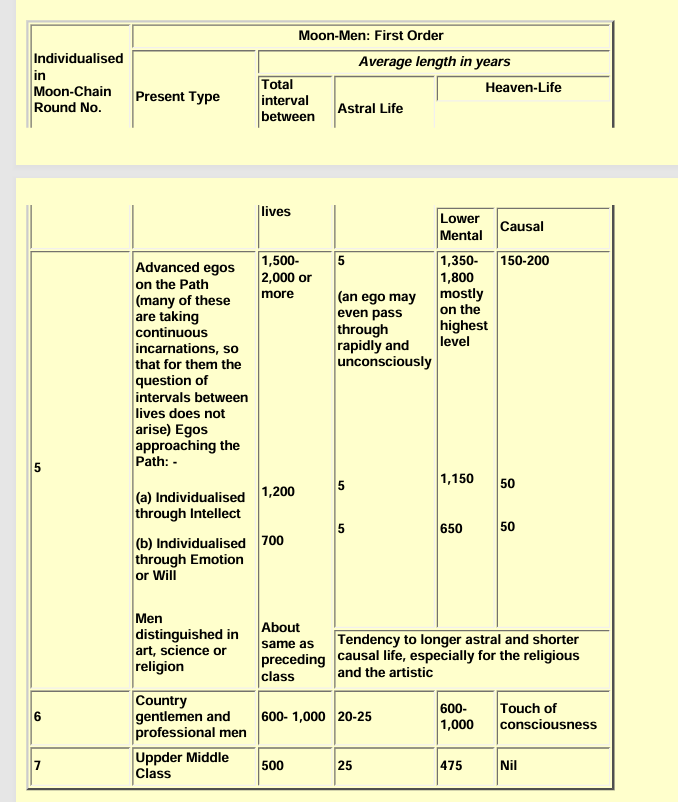
It must be understood that the above figures are only averages, a wide range on each side of them being possible.
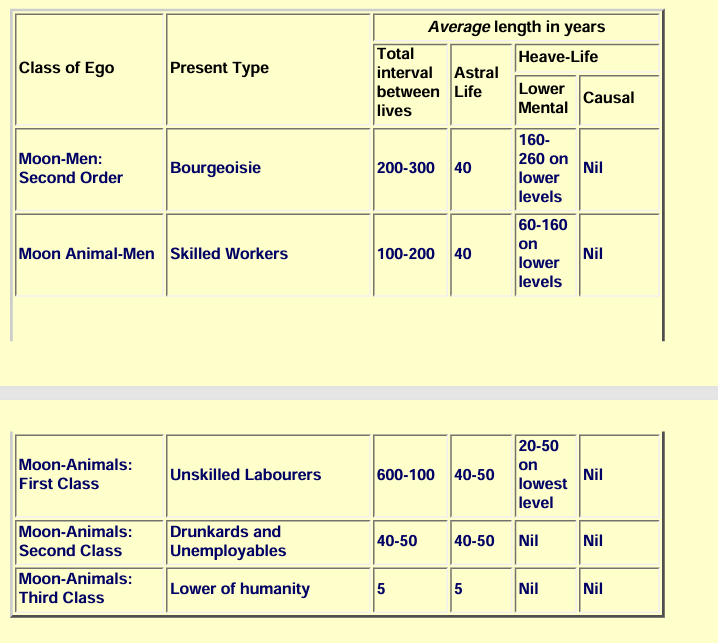
A certain difference is produced by the mode of the individualisation, but this difference is much less, in proportion, in the lower classes. Those individualised through intellect tend to take the longer of the two intervals mentioned, whereas those individualised in other ways tend to take the shorter interval. We shall return to this point and explain it in fuller detail presently.
Generally speaking, a man who dies young tends to have a shorter interval than one who dies in old age, but is likely to have a greater proportion of astral life, because most of the strong emotions which work themselves out in the astral life are generated in the earlier part of physical life, whereas the more spiritual energy, which finds its result in the heaven-life, is likely to continue until the end or near the end of the earth-life.
Thus, as we have seen, the total time spent in devachan depends upon the materials which the man has brought with him from earth-life; that is to say, everything which is capable of being worked up into mental and moral faculty –all the pure thoughts and emotions generated during earth-life, all the intellectual and moral efforts and aspirations, all the memories of useful work, and plans for human service. Not one is lost, however feeble or fleeting; but selfish animal passions cannot enter, there being no material in which they can be expressed.
Nor does evil in the past life, though it may largely preponderate over the good, prevent the full reaping of whatever scant harvest of good there may be; the devachanic life may be very brief, but the most depraved, if he has any faint longings after the right, any stirrings of tenderness, must have a period of devachanic life, in which the seed of good may put forth its tender shoots, in which the spark of good may be fanned into a tiny flame.
In the past, when men lived with their hearts fixed on heaven, and directed their lives with a view to enjoying its bliss, the period spent in devachan was very long, lasting sometimes for many thousands of years. At the present time, however, men's minds being so much more centred on earth, and so few of their thoughts being directed towards the higher life, their devachanic periods are correspondingly shortened.
Similarly, the time spent in the lower mental and the causal heaven-worlds are proportional to the amount of thought generated severally in the mental and the causal bodies. All that belongs to the personal self, with its ambitions, interests, loves, hopes and fears, have their fruition in the lower mental world, the world of form; those belonging to the higher mind, to the regions of abstract, impersonal thinking, have to be worked out on the causal levels, the formless world. As the above tables show, the majority of people only just enter the causal heavenworld, and pass out swiftly again; some spend a large portion of their devachanic life there; a few spend there almost the whole.
Thus, just as a man makes for himself his astral or purgatorial existence, so he decides for himself both the length and character of his heaven-life, by the causes which he generates during his earth-life. Hence he cannot but have both the amount which he has deserved, and also exactly the quality of joy which is best suited to his idiosyncrasies.
Another factor of great importance and interest, is that of the intensity of the devachanic life, which varies with the different classes of egos, and which of course produces a considerable effect upon the length of the heaven-life.
In the table on p. 186, within the same group of egos, two types are shown which, though equal in development, differ greatly in their intervals between lives, one of them taking about 1,200, and the other about 700 years between lives. Now the amount of spiritual force generated is roughly equal in the two cases, but those who take the shorter interval compress a double amount of bliss into their heaven-lives, working as it were, at high pressure, concentrating their experience, and so getting through nearly twice as much in any given period as the members of the other class.
This difference, as was briefly mentioned a few pages back, is due to the way in which individualisation was attained. Without entering into the details of individualisation [which would be beyond the scope of the present volume], it may be explained that those who individualise gradually by intellectual development, generate a different kind of spiritual force, which gives them a longer devachanic life, than those who individualise through an instantaneous uprush of affection or devotion, and who take their bliss in a much more concentrated or intense form. If there be any difference in the amount of force generated, it appears to be slightly more in the case of those who take the shorter interval.
Investigations have shown that there is great flexibility regarding intervals between lives, resulting in much variation in the rate at which egos work out their heaven-lives.
One important reason for this is the necessity of bringing together groups of people into incarnation at the same time, not only in order that they may work out mutual karmic inter-relations, but also that they may learn to work together for certain great ends.
There are, for example, certain groups of egos, known as "servers", who come together life after life, in order that they may pass through similar preparatory experiences, that the bonds of affection between them may be knit so strongly that they will be incapable of misunderstanding or mistrusting one another, when the strain of the real work they are destined to do comes upon them in the future. The one great fact that the group is devoted to service overpowers all other considerations, and the group is thus brought together in order that it may perform that service as a body of people.
In this, needless to say, there is no injustice; no one can escape one jot of the karma legitimately due to him. But the rate at which karma is worked out is adjusted to meet the particular circumstances of each case. Thus it sometimes happens that certain past karma would be cleared up rapidly in order that the person may be free to do higher work without hindrance from it; to this end it sometimes happens that a considerable accumulation of karma may descend upon a man at once in some great catastrophe; he thus gets rid of it rapidly, and his way is cleared before him.
Of course, in the case of the great bulk of humanity, there is no special interference of this nature, and their heaven-life works itself out at its ordinary rate.
Differences in the time of working out karma, involving a difference in intensity in the life, are shown by a greater or lesser brilliancy in the light of the mental body.
CHAPTER XXII
DEVACHAN : FURTHER PARTICULARS
Having studied some of the general features of devachan, and its broad purpose, it will now be necessary to go over the ground again, filling in more details, and adding other particulars which could not, without overloading, be included in the first description.
In spite of devachan being to a certain extent illusory, as indeed is all manifested life, in varying degree, nevertheless there is much greater reality in the heaven-life than there is in the earth life. This is clearly seen when we consider the conditions requisite for the attainment of devachan. For, in order that an aspiration or a thought- force should result in existence on the mental plane, its dominant characteristic must be unselfishness.
Affection for family or friends takes man a man into the heaven-life, as also does religious devotion; but only if the affection or the devotion is unselfish. Affection which is an exacting, selfish kind of passion, which desires mainly to be loved, which thinks of what it receives rather than of what it gives, and which may so easily degenerate into the vice of jealousy, has in it no seed of the mental development; the forces which it sets in motion will never rise above the astral plane, the plane of desire, to which they so clearly belong.
Where there is no grasping, no drawing towards the self, no thought of return, there is a tremendous outpouring of force, which no astral matter can express, nor could the dimensions of the astral plane contain it. It needs the finer matter and the wider space of the mental plane, the energy generated belonging to that higher world.
Similarly the devotion of the religious devotee whose main thought is, not the glory of the deity, but how he may save his own soul, cannot lead to devachan. But on the other hand real religious devotion, which never thinks of self, but only of love and gratitude towards the deity or leader, and is inspired by ardent desire to do something for him or in his name, often leads to a prolonged heaven-life of a comparatively exalted type.
This would be the case whoever the deity or leader might be, and hence followers of the Buddha, of Krishna, of Ormuzd, Allah, or the Christ, would all equally attain their meed of celestial bliss, its length and quality depending not in the least upon its object, but upon the intensity and purity of the feeling.
It is an error to suppose that a man on the astral and mental planes after death is merely working out the results of his past earth-life; broadly speaking, this is true of the ordinary man, yet nevertheless even whilst he is enjoying the bliss of his devachan, he is at the same time affecting others, and he is therefore producing results, i.e., he is generating karma.
This must be so, in the very nature of things, because thought is the most potent factor in the creation of human karma. Every force has the characteristic of the plane on which it is generated, and the higher the plane the more potent and the more persistent the force.
In those cases, at present rare, in which, by raising the consciousness to the causal level, the higher mind and lower selves are unified, the consciousness of the ego is at the disposal of the man throughout the whole of his physical, astral and mental lives. Hence it follows that he is generating karma just as much at one period as at another, and he is able to modify the conditions of his life by the exercise of thought and will.
But, apart from such cases of well-developed men, even an ordinary man produces, quite unintentionally and unconsciously to himself, three separate results during the whole of his heaven-life.
First: The affection which he pours upon the thought-image he has made of his friend is a mighty power for good, which bears no inconsiderable part in the evolution of the ego of that friend. Affection is evoked from the friend, thus tending to intensify that admirable quality in him. Such an act is obviously one which generates karma.
It is even possible that the effect of this action may be manifested in the personality of the friend on the physical plane. For, if the ego be modified by the affection showered upon the thought-form it en-souls, it is possible that that modification may show itself in the personality, which is of course another manifestation of the same ego.
Second : A man who pours out a great flood of affection, and evokes in response other floods from his friends, is clearly distinctly improving the mental atmosphere of his neighbourhood. This atmosphere plays upon all the inhabitants of the world who are living in that atmosphere –devas, men, animals, plants, etc. This will clearly produce a karmic result.
Third : A thought of unselfish affection or devotion not only calls forth a response from the Logos to the individual who originated the thought, but also helps to fill the reservoir of spiritual force, which is held by the Nirmanakayas at the disposal of the Masters of Wisdom and Their pupils for the helping of humanity [vide The Astral Body , p. 57]. Magnificent as may be the result of such affection or devotion during physical life, it is easy to see that the response to the thought of an entity in devachan, sustained perhaps for a thousand years, will make to t he reservoir a considerable contribution, bringing to the world a benefit which is not calculable in any terms that we use upon the physical plane.
From all these considerations it should be clear that even quite an ordinary man, who has yet no special development of consciousness, is nevertheless capable of doing a great deal of good during his life in devachan.
Hence he is during that time actually making fresh karma for himself, and may even modify his heaven-life while it is in progress.
In the physical world, many of our thoughts are mere fragments. In devachan the dreamer contemplates such fragments and patiently works them out in every detail, in every possibility of splendid performance, living through them with a vividness which nothing on earth can rival. He builds, shapes, moulds them into all their varied possibilities and tosses them into the world of form . Others may then pick them up, and be inspired by them to undertake schemes of reform, works of philanthropy, and so forth. Thus from the radiant thought-stuff of some solitary dreamer may arise wonderful changes, his "dreaming" helping to re-create the world.
It must however, be borne in mind that, owing to the limitations which the ordinary man imposes upon himself in devachan, he cannot originate a fresh line of affection or devotion. But his affection and devotion, along the lines which he has already decided, will be distinctly more powerful than they ever could have been while he was labouring under the heavy limitations of the physical body.
This point will bear a little further elaboration. In order to understand the relation of a man in devachan to his surroundings, we have to think [1] of the matter of the plane as moulded by his thought, and [2] of the forces of the plane as evoked in answer to his aspirations.
We have already seen how the man moulds the matter of the plane into thought-images of his friends, and how egos of the friends express themselves through the images.
There are also other living forces about him, mighty angelic inhabitants of the plane; of these, many are very sensitive to certain aspirations of man, and readily respond to them.
But the main point to bear in mind is that both his thoughts and his aspirations are along those lines only which he has already prepared during earth-life.
It might perhaps have been imagined that when a man rises to a plane of such transcendent force and vitality, he would be stirred to entirely new activities along new lines; but this is not the case. His mental body [as we saw previously] is not by any means in the same order as his lower vehicles, neither is it so fully under control. It has in the past been accustomed to receive its impressions and incitements to action from below, chiefly from the physical, and sometimes from the astral. It has done very little in this way of receiving direct mental vibrations at its own level; consequently it cannot suddenly begin to accept and respond to them. Practically, thus, the man does not initiate any new thoughts, but is limited to those which he has previously entertained, and which form the only windows through which he can look out on his new world. Hence, a colourless, flavourless personality necessarily has a colourless, feeble devachanic state.
A man thus takes into devachan just the mental furniture he has –neither less nor more. It is clearly, therefore, of great importance that during physical life he should make his thinking as accurate and as precise as possible, otherwise he will very much limit the usefulness of his devachan.
From this point of view, devachan is a world of effects, not causes, each man being limited to his own individual shades of perception and his capacity to appreciate. The more points of contact he has with the outer world, the more will be the starting-points or foci for development in devachan.
On the other hand, devachan, from the point of view of the next life, is essentially a world of causes, because in it all experiences are worked up into the character which will be brought forward when the man returns into incarnation. Devachan is thus the direct result of one life on earth, and prepares the way for the next life on earth.
The way in which man's vision is determined and limited by the windows through which perforce he must look, may best be studied by taking an actual example. Let us take that of music. A man who has no music in his soul has no window at all in that direction. A man, however who has a musical window is in the presence of a stupendous power. The degree to which he is able to respond will be determined by three factors.
Pursuing the analogy of the glass in a window, we may call these three factors;
[1] the size of the glass;
[2] its colour;
[3] the quality of its material.
Thus, if while on earth the man was able to appreciate only one class of music, he will obviously now be limited to that extent. His ideas of music may also be coloured, so as to admit only certain vibrations of music, or they may be of such poor material as to distort and darken everything that reaches him.
Assuming however, that his window is a good one, he will receive through it three distinct sets of impressions.
First: He will sense that music which is the expression of the ordered movement of the forces of the plane. There is truth behind the poetic idea of the "music of the spheres", for on these higher planes all movement and action produce harmonies of sound and colour. All thought –both his own and that of others –expresses itself in this way, in a lovely yet indescribable series of ever-changing chords, as of a thousand Aeolian harps. The musical manifestation of the glowing life of the heaven-world forms a background to all his other experiences.
Second : Among the inhabitants of the mental plane there is an order of devas, or angels, who are specially devoted to music and who habitually express themselves by its means to a fuller extent than the rest. They are known to the Hindus as Gandharvas . The man who has musical appreciation will certainly attract their attention, will come into contact with them, and with the music they create, and will assuredly acquire much from that intercourse, for they will use all kinds of overtones and variations which were previously unknown to him. In this way he will eventually emerge from the heaven-life far richer than he entered it.
Third : He will listen with keen appreciation to the music made by his fellow-men in the heaven world.
Many of the great composers are there, pouring forth far greater music than any which they knew on earth. Much of the inspiration of earthly musicians is, in fact, but a faint echo of the music on the mental plane which they have dimly sensed.
The experience of a man who was a painter would be similar. He also would have the same three possibilities:
[1] He would perceive the natural order of the plane expressing itself in colour as well as sound;
[2] he would perceive the colour-language of the devas, an order of beings who communicate with one another by flashings of splendid colour ;
[3] he would perceive the colour-creations of great artists on the mentalplane.
The same possibilities, mutatis mutandis , are open to a man in devachan, in all other directions of art or thought, so that there is an infinity for him to enjoy and to learn.
In considering the action and reaction between the man in devachan and the thought-image he makes of his friend, there are two factors to be taken into account:
[1] The degree of development of the man himself;
[2] the degree of development of the friend.
If the man himself is undeveloped, the image he makes of his friend will be imperfect, many of the higher qualities of the friend not being represented. Consequently the ego of the friend may be able to make but little use of the image, there being nothing through which he can express some of his qualities.
Nevertheless, even at the worst the expression of a friend through an image is much fuller and more satisfying than it ever was in the physical life. For in earth-life we see our friends but partially; our knowledge of them must always be exceedingly defective, and our communion with them imperfect; even when we do believe we know our friend truly and wholly, it is still only part of him which is in incarnation that we can know, there being far more behind in the real ego which we cannot reach at all.
In fact, if it were possible for us to see with mental vision, the whole of our friend, the probability is that he would be quite unrecognisable; certainly he would not be the one whom we thought we had known before.
If, on the other hand, it is the friend who is undeveloped, even when a good image is made, there may not be sufficient development in the friend to enable him to take due advantage of the image ; i.e., he may be unable to fill completely the image of him that has been made. This however, is unlikely, and could take place only when a quite unworthy object had been unwisely idolised. Even then the man who made the image would not find any change or lack in his friend, for the friend is now better able to fulfil his ideal than he ever was during physical life. Hence the joy of the man in devachan is not in any way diminished.
Whilst an ego can fill hundreds of images with those qualities which he possesses, he cannot suddenly evolve and express a quality which he has not developed, merely because someone has imagined him to have developed it.
Hence the enormous advantage of forming images of those [such as the Masters] who are capable of rising above even the highest conception that the lower mind can form of them. In the case of a Master, a man is drawing upon a depth of love and power which his mental plummet can never sound.
But in every case, the ego of the friend is reached by affection, and whatever may be its stage of development it at once responds by pouring itself into the image which has been made. Even the feeblest image that can be made is at any rate on the mental plane, and, therefore, is far easier for the ego to reach than is a physical body two planes lower down.
If the friend is still living in the physical body, he will of course be entirely unaware in his physical consciousness that his true self, or ego, is enjoying the additional manifestation; but this in no way affects the fact that the manifestation is a more real one and contains a nearer approximation to his true self than the one on the physical plane, which is all that most of us can as yet see.
From all these considerations it follows that a man who has made himself generally beloved, who has many real friends, will have a large number of thought-images in the devachans of his friends, and will thus evolve with far greater rapidity than a more ordinary man. This result is obviously the result of the karma of his development within himself of the qualities which make him so loveable.
The student will now clearly perceive why the personality, which we know on the physical plane, does not converse with its friends in devachan. But the real man, the ego, does do so, acting through the thought-image, which has been created on the mental plane.
The principle may perhaps be rendered still more clear by a practical example. Suppose that a mother, being somewhat narrow in her religious views, died, leaving behind her a well-loved daughter, and that the daughter later on broadened her religious ideas. The mother would continue to imagine that her daughter was still orthodox , and she would be able to see only as much of her daughter's thought as could be expressed by orthodox ideas; she would be unable to grasp the wider religious views which her daughter had now adopted.
But in so far as the ego of the daughter profited by what the personality had learned, there would be a tendency on her part gradually to widen out and perfect the conceptions of the mother, though always along the lines to which the mother was accustomed. There would be between them no sense of difference of opinion, and no avoidance of subjects of religion.
The above considerations apply to a person of ordinary development. In the case of a more advanced man, who was already conscious in the causal body, he would put himself down consciously into the thought-image provided for him by a friend in devachan, as into an additional mental body, and work through it with definite intention. If he happened to acquire additional knowledge he could thus directly and intentionally communicate to this friend. In this way the Masters work on such of Their pupils as take the heaven-life, and alter their characters immensely.
A man who makes for himself an image of a Master is thus able to benefit enormously from the influence which the Master is able to pour down into it, and to receive definite teaching and help.
Two friends may know far more of each other at the mental level, than they ever could when physically alive, because each has now only the one veil, that of the mental body, cast over his individuality. If a man in devachan has known only one side of his friend during physical life, it will be only through that side that the friend can express himself in the heaven world. But, although he is largely confined to that side, he can express that aspect of himself much more fully and satisfactorily than ever before; the expression, in fact, is fuller than the man now in devachan was ever able to see on the lower planes.
We have already seen that an ordinary man in devachan is living in a shell of his own thoughts; he has thus shut himself off absolutely from the rest of the world, i.e., both from the mental plane and from the lower planes. But, although he is shut away from the full enjoyment of the possibilities of the mental world, he is not in the slightest degree conscious of any curtailment of his activities or his feelings. On the contrary, he is filled with bliss to the very utmost of which he is capable, and it is to him incredible that there can be any greater joy than that which he is himself experiencing.
Thus, although he has shut himself within certain limits, he is quite unconscious of those limits, and within them he has all that he can possibly desire or think. He has surrounded himself with images of his friends, and through those images he is actually in closer contact with his friends than he has ever been on any other plane.
The man in devachan by no means forgets that there is such a thing as suffering, because he remembers clearly his last life; but he understands now many things that were not clear when he was on the physical plane, and the delight of the present is for him so great that sorrow seems to him almost a dream.
The shell on the mental plane may be compared to the shell of an egg on the physical plane. The only way to get anything into the shell of the egg, without breaking it, would be to pour it in from a higher dimension, or to find a force whose vibrations are sufficiently fine to penetrate between the particles of the shell without disturbing them.
The same is true of the mental shell; it cannot be penetrated by any vibrations of matter of its own level, but the finer vibrations which belong to the ego can pass through it without disturbing it in the least; i.e., it can be acted upon freely from above, but not from below.
From this follows two effects :
[1] vibrations sent out from the mental body of the man in the shell cannot strike directly upon the mental body of his friend, nor can he generate a thought-form which could travel through space and attach itself to the friend in the ordinary way. This could happen only if the man were able to move freely and consciously about the mental plane, which of course he cannot do;
[2] the thoughts of his friend cannot reach the man in his devachanic shell, as they do in ordinary life on the physical or astral plane.
We see, therefore, that all the difficulties produced by the mental shell round a man in devachan are completely overcome by nature'' method of the direct action of the ego on the thought-image which the man has created.
It follows also from the conditions of man in devachan that he can no longer be recalled to earth by Spiritualistic methods.
In spite of men in devachan being not readily accessible to influence from without, nevertheless one who can pass into the mental world in full consciousness can affect those in devachan to some extent. Thus he could flood them with thoughts of affection, for example, and although these thoughts may not be able so far to penetrate the shells as to make those within the shells conscious of the author of the thoughts, yet the stream of affection can act on the occupants of the shells much as the warmth of the sun can operate upon the germ within the egg, hastening its fructification and intensifying any pleasurable sensations it may be supposed to have.
If a man is an agnostic or a materialist, his disbelief in a future life does not in the least prevent him from experiencing astral or mental life just the same as anyone else; for a man's disbelief in a future existence clearly cannot alter facts in nature. If a man has lived an unselfish life, the forces which he has generated must work themselves out, and this can take place only on the mental plane, ie., in devachan.
There is, of course, no fatigue in devachan; it is only the physical body that ever becomes tired. When we speak of mental fatigue, it is the brain and not the mind that is tired.
The fact that our minds can grasp three dimensions only, whereas there are four dimensions on the astral plane, and five on the mental plane, makes it difficult to describe exactly the position in space of those who have left physical life. Some tend to hover round their earthly homes, in order to keep in touch with their friends of the physical life and the places which they know; others, on the other hand, have a tendency to float away and to find for themselves, as if by specific gravity, a level much further removed from the surface of the earth.
Thus, for example, the average person passing into heaven-life, tends to float to a considerable distance above the surface of the earth, although on the other hand, some of such people are drawn to our level. Still, broadly speaking, the inhabitants of the heaven-world may be thought of as living in a sphere or zone round the earth.
For all but very highly advanced persons the heaven-life is absolutely necessary, because it is only under its conditions that aspirations can be developed into faculty, and experiences into wisdom. The progress which is thus made by the soul is far greater than would be possible if by some miracle the man was enabled to remain in physical incarnation for the entire period.
But for the advanced man who is making rapid progress it is sometimes possible to give up the life of bliss in the heaven-world –to renounce devachan, as it is sometimes called –between two incarnations, in order to return more rapidly to carry on work on the physical plane. But no man is permitted to renounce blindly that of which he is ignorant, nor to depart from the ordinary course of evolution unless and until it is certain that such a departure will be for his ultimate benefit.
The general rule is that no one may renounce devachan until he has experienced it during earth-life, ie., until he is sufficiently developed to be able to raise his consciousness to that plane and bring back with him a clear and full memory of its glory.
The reason for this is that it is the life of the personality, with all its familiar personal surroundings, which is carried on in the lower heaven-worlds, and therefore, before the renunciation can take place, the personality must realise clearly what it is that is being given up; the lower mind must be in accord with the higher on this subject.
To this general rule there is an apparent exception. In the one-sided and artificial condition which we call modern civilisation, people do not always develop quite regularly and normally; cases are to be found in which a considerable amount of consciousness on the mental plane has been acquired, and duly linked on to the astral life, yet no knowledge of it ever gets through into the physical brain at all.
Such cases are very rare, though they undoubtedly exist. They are not however, exceptions to the principle embodied in the general rule, viz., that the personality must make the renunciation. For in these cases, the astral life would be one of full and perfect consciousness for the personality, even though no memory of it ever penetrated into the purely physical consciousness. Thus the renunciation is made by the personality, but through the astral consciousness instead of through the physical, as in most instances. Such cases would be unlikely to occur except among those who were at least probationary pupils of a Master.
A man who wishes to perform the great feat of renouncing devachan must work with intense earnestness to make himself a worthy instrument in the hands of Those who help the world, and must throw himself with devoted fervour into labour for the spiritual good of others.
A man sufficiently advanced to be permitted to "renounce his devachan" would clearly have enjoyed an extremely long heaven-life; he is then able to expend this reserve of force in quite another direction, for the benefit of humanity, thus taking a part, however small, in the work of the Nirmânakâyas.
When a pupil has decided to do this, he waits upon the astral plane until a suitable incarnation can be arranged for him by his Master. Before the attempt can be made, permission of a very high authority must be obtained. Even when this is granted, so strong is the force of natural law, that it is said the pupil must be careful to confine himself to the astral plane, lest if once, even for a moment, he touched the devachanic plane, he might be swept as by an irresistible current into the line of normal evolution again.
In some cases, though these are rare, the man is enabled to take an adult body whose previous tenant has no further use for it, but naturally it is not often that a suitable body is available.
An animal that has attained individualisation, after his death on the physical and astral planes, has usually a very prolonged, though often somewhat dreamy life in the lower heaven-world. His condition is sometimes called "dozing" consciousness, and is analogous to that of a man on the same level, though with far less mental activity.
He is surrounded by his own thought-images, even though he may be but dreamily conscious of them, and these will of course include images of his earth-friends in their very best and most sympathetic moods. These images will of course awaken response from the egos of his friends in the usual way. The animal will remain in the condition described until in some future world he assumes the human form. Individualisation, by means of which an animal rises to the human kingdom, is attained by association with men, the intelligence and affection of the animal being developed to the degree necessary by his close relationship with his human friend. But we have already dealt with this matter in Chapter XIII.
CHAPTER XIII
THE FIRST HEAVEN : SEVENTH SUB-PLANE
Although, as we shall see presently, each of the four lower heavens has its own characteristic, it must not be supposed that a man divides his heaven-life between the various levels, according to the characteristics which he may have developed. On the contrary, as was mentioned briefly before, a man awakens to consciousness in devachan on that level which best corresponds to the degree of his development; and on that level he spends the whole of his life in the mental body. The reasons for this is that the higher level may always include the qualities of the lower, as well as those peculiar to itself; and when it does so its inhabitants almost invariably have these qualities in fuller measure than the souls on the lower level.
The lowest heaven, that on the seventh sub-plane, has for its principal characteristic that of affection for family and friends; that affection must, of course, be unselfish, but it is usually somewhat narrow. It must not however, be supposed that love is confined to the lowest heaven, but rather that this form of affection is the highest of which those who find themselves on the seventh level are capable. On the higher levels love of a far nobler and grander type is to be found.
It may be useful to describe a few typical examples of the inhabitants of the seventh sub-plane. One was that of a small tradesman, honest and respectable, but of no intellectual development or religious feeling.
Although he had probably attended church regularly, religion had been to him a sort of dim cloud which he did not really understand which had no connection with the business of everyday life, and which was never taken into account in deciding its problems. Whilst he had, therefore, no depth of devotion, he had nevertheless warm affection for his family. They were constantly in his mind, and he worked in his shop far more for them than for himself. His surroundings in devachan would not be of a very reined type; but nevertheless he would be as intensely happy as he would be capable of being and he would be developing unselfish characteristics which would be built into his soul as permanent qualities.
Other typical cases were that of a man who had died while his only daughter was still young. In his devachan she was always with him, and at her best, while he was continually weaving all sorts of beautiful pictures of her future.
Another case was that of a young girl who was always absorbed in contemplating the manifold perfections of her father, and planning little surprises and fresh pleasures for him. Another was a Greek woman who was marvellously happy with her three children, one of them a beautiful boy, whom she delighted in imagining as the victor in the Olympic games.
A striking characteristic of this sub-plane for the last few centuries has been a very large number of Romans, Carthaginians, and Englishmen found there, this being due to the fact that among men of these nations the principal unselfish activity found its outlet through family affection. Comparatively few Hindus or Buddhists are on this sub-plane, because in their case real religious feeling usually enters more immediately into their daily lives, and consequently takes them to a higher level.
Among the cases observed, there was an almost infinite variety, their different degrees of advancement being distinguishable by varying degrees of luminosity, while differences of colour indicate the qualities which the persons had developed. Some were lovers who had died in the full strength of their affection, and so were always occupied with the one person they loved, to the entire exclusion of all others. Others there were who had been almost savages, yet who had had some touch of unselfish action.
In all these cases, the only element in the activity of their personal lives which could have expressed itself on the mental plane, was affection. In most cases observed on this level, the thought-images are very far from perfect, and consequently the egos of the friends concerned can express themselves but poorly through them. But even at the worst, as explained in a previous chapter, that expression is fuller and more satisfying than it ever was in physical life.
For those on this lowest level of the heaven-world there is not much material out of which faculty can be moulded, and their life is but very slightly progressive. Their family affections will be nourished and a little widened, and they will be re-born with a somewhat improved emotional nature, with more tendency to recognise and respond to a higher level.
CHAPTER XXIV
THE SECOND HEAVEN : SIXTH SUB-PLANE
The dominant characteristic of the sixth sub-plane of the heaven-world may be described as anthropomorphic religious devotion. There appears to be some correspondence between this level of the heaven-world and the second astral sub-plane, the difference being that on the astral there is invariably an element of selfishness, of bargaining, in the religious devotion, whereas in the heaven-world the devotion is of course entirely free from any such taint.
On the other hand, this phase of devotion, which consists essentially in the perpetual adoration of a personal deity, must be distinguished from those still higher forms which find their expression in performing some definite work for the deity's sake. A few examples will show these distinctions.
A fairly large number of entities on this level are drawn from oriental religions, only those being included whose devotion is pure, but comparatively unreasoning and unintelligent. Worshippers of Vishnu, and a few of Shiva, are found here, each wrapped up in a cocoon of his own thoughts, alone with his god, and oblivious of the rest of mankind except in so far as his affections may associate those whom he loved on earth with his adoration of his deity. A Vishnavite was observed wholly absorbed in the ecstatic worship of the very image of Vishnu to which he had made offerings during earth-life.
Women form a very large majority of the inhabitants of this sub-plane, and afford one of its most characteristic examples. Among others, there was a Hindu woman who had glorified her husband into a divine being, and who also thought of the child Krishna as playing with her own children; but while these latter were thoroughly human and real, the child Krishna was obviously nothing but the semblance of a blue wooden image galvanised into life.
Krishna also appeared in her heaven as an effeminate young man playing a flute; but she was not in the least confused by this double manifestation. Another woman, a worshipper of Shiva, looked upon her husband as a manifestation of her god, so that the one seemed to be constantly changing into the other. Some Buddhists are also found on this level, but apparently only those less instructed ones who regard the Buddha rather as an object of adoration than as a great teacher.
Many Christians are found here; an illiterate Roman Catholic peasant, for example, full of unintellectual devotion, or an earnest or sincere "soldier" of the Salvation Army. An Irish peasant was seen absorbed in the deepest adoration of the Virgin Mary, whom he imaged as standing on the moon, but holding out her hands and speaking to him. A mediaeval monk was observed in ecstatic contemplation of Christ crucified, and the intensity of his yearning love and pity was such that, as he watched the blood dropping from the wounds of the figure of his Christ, the stigmata reproduced themselves upon his own mental body.
Another man thought of his Christ only as glorified on his throne, with the crystal sea before him, and all around a vast multitude of worshippers, among whom he himself stood with his wife and family. Although his affection for his relatives was very deep, yet his thoughts were more occupied in adoration of the Christ, though his conception of his deity was so material that he imaged him as constantly changing kaleidoscopically backwards and forwards between the form of a man and that of a lamb bearing the flag, as often represented in church windows.
An interesting case was that of a Spanish nun who had died at about the age of nineteen. In her heaven she imagined herself accompanying the Christ in his life as recounted in the gospels, and after his crucifixion taking care of the Virgin Mary. Her pictures of the scenery and costumes of Palestine were entirely inaccurate, the
Saviour and his disciples wearing the dress of Spanish peasants, while the hills round Jerusalem were mountains clothed with vineyards, and the olive trees were hung with grey Spanish moss. She thought of herself as eventually martyred for her faith and ascending into heaven, but yet only to live over and over again this life in which she so delighted.
A child who had died at the age of seven was occupied in re-enacting in the heaven-world the religious stories which his Irish nurse had told him. He loved to think of himself as playing with the infant Jesus, and helping him to make those clay sparrows which the power of the Christ is fabled to have brought o life and caused to fly.
Even if a man is a materialist and agnostic, he will still have a heaven-world, provided he had been capable of devotion. For deep unselfish family affection, as well as earnest philanthropic effort, are also great outpourings of energy, which must produce their result, and can produce it nowhere but on the mental plane.
It will be seen that blind unreasoning devotion, of which examples have been given, does not at any time raise its votaries to any great spiritual heights; but of course they are entirely happy and fully satisfied, for they receive the highest which they are capable of appreciating. Nor is such a heaven-life without a very good effect on their future career. For although no amount of mere devotion will ever develop intellect, yet it does produce an increased capacity for a higher form of devotion, and in most cases it leads also to purity of life. A person, therefore, who enjoys a heaven, such as has been described, is not likely to make rapid progress, yet he is at least guarded from many dangers; for it is improbable that in his next birth he will fall into any of the grosser sins, or be drawn away from his devotional aspirations into a merely worldly life of avarice, ambition, or dissipation.
Nevertheless a survey of the sixth sub-plane distinctly emphasises the desirability of following the advice of St. Peter: "Add to your faith - virtue, and to virtue knowledge.
CHAPTER XXV
THE THIRD HEAVEN : FIFTH SUB-PLANE
The chief characteristic of this level of the heaven-world may be described as devotion expressing itself in active work. It is especially the plane for the working out of great schemes and designs unrealised on earth, of great organisations inspired by religious devotion, and usually having for their object some philanthropic purpose.
It must however, be borne in mind that as we rise higher, greater complexity and variety are introduced, so that many variations and exceptions occur which do not so rapidly range themselves under the general heading for the plane as a whole.
A typical case, somewhat above average, was that of a deeply religious man who was found carrying out a grand scheme, which he had himself devised, for the amelioration of the condition of the poorer classes.
The scheme comprised amalgamation of businesses in order to effect economies, high wages, the provision of cottage and gardens, and profit sharing. He hoped that this demonstration of the practical side of Christianity would win many to his own faith, out of gratitude for the material benefits they had received.
A somewhat similar case was that of an Indian prince who had tried to model his life and methods of government, while on earth, on the example of the divine hero-king Rama. On earth many of his schemes had failed, but in his heaven-life everything went well, Rama himself personally advising and directing the work, and receiving perpetual adoration from all his devoted subjects.
A curious case of personal religious work was that of a nun, who had belonged to a working order. In her heaven, she was constantly occupied in feeding the hungry, healing the sick, clothing and helping the poor, the peculiarity of each case being that each person, to whom she administered, at once changed into the appearance of Christ, whom she then worshipped with fervent adoration.
An instructive case was that of two intensely religious sisters, one of them a cripple, the other having devoted herself to tending her. On earth they had often discussed and planned the religious and philanthropic work they would carry out if they were able to do so. In the heaven-world, each is the most prominent figure in the heaven of the other, the cripple being well and strong, while each thinks of the other as working with her in carrying out the unrealised wishes of her earth life. In these cases the only difference that death has made is to eliminate disease and suffering, and to render easy the work which before had been impossible.
On this plane are found the higher type of sincere and devoted missionaries, engaged in the congenial occupation of converting multitudes of people to the particular religion which they advocated.
There occur also on this plane some cases of devotees of art, who follow it for its own sake, or regard it as an offering to their deity, not thinking of its effect on their fellows.
Artists who pursued art, for the sake of fame and self-gratification, would not of course find their way to this plane at all. On the other hand, those who regarded their faculty as a great power entrusted to them for the spiritual elevation of their fellows would reach a heaven even higher than the one we are now considering.
As an example, mention may be made of a musician of very religious temperament who regarded all his labour of love simply as an offering to the Christ, knowing nothing of the magnificent display of sound and colour which his compositions produced on the mental plane. His enthusiasm would not, of course be wasted, for, without his knowledge, it brought joy and help to many, and its results would certainly be to give him increased devotion and greater musical capacity in his next birth. But without the still wider aspiration to help humanity this kind of heavenlife might repeat itself almost indefinitely.
The student will perceive that the three lower heavens - on the seventh, sixth, and fifth sub-planes - are concerned with the working out of devotion to personalities, either to one's family and friends, or to a personal deity, rather than the wider devotion to humanity for its own sake, which, as we shall see, finds its expression on the next subplane.
CHAPTER XXVI
THE FOURTH HEAVEN : FOURTH SUB-PLANE
The Fourth Heaven, on the fourth sub-plane, is on the highest of the lower rûpa levels. Its activities are so varied that it is difficult to group them under a single characteristic. They may best be arranged into four main divisions:
[1] Unselfish pursuit of spiritual knowledge
[2] High philosophic or scientific thought
[3] Literary or artistic ability, exercised unselfishly
[4] Service for the sake of service
A few examples of each of these classes will make them more readily comprehensible.
[1] Unselfish pursuit of spiritual knowledge.
Most of the inhabitants of this class are drawn from those religions in which the necessity of obtaining spiritual knowledge is recognised. Thus, of Buddhists, there are found here those more intelligent followers who looked upon the Buddha as a teacher, rather than as a being to be adored, and whose supreme aspiration was to sit at his feet and learn.
In their heaven-life their wish is fulfilled; for the thought-image which they have made of the Buddha is no mere empty form; through it shines the wonderful wisdom, power and love of that greatest of earth's teachers. They are therefore acquiring fresh knowledge and wider views, the effect of which on their next life cannot but be most marked. They will not perhaps remember any individual facts, though when such facts are presented to them in a subsequent life, they will grasp them readily, and intuitively recognise their truth. Furthermore, the result of the teaching will be to build into the ego a strong tendency to take broader and more philosophical views on all such subjects.
The effect of such a heaven-life is to hasten considerably the evolution of the ego. Hence the enormous advantage gained by those who accepted the guidance of living and powerful teachers.
A similar result, in lesser degree, accrues to a man who followed the teachings of a great and spiritual writer, and made of that writer an ideal figure. The ego of the writer will enter into the student's heaven-life and, by virtue of his own developed power, vivify the mental image of himself, thus being able further to illuminate his written teachings.
Many Hindus find their heaven on this level, as also a few of the more advanced Sufis and Parsis, and some of the early Gnostics. But, except for a few Sufis and Gnostics, neither Mohammedanism not Christianity seems to raise its followers to this level; some, however, who nominally follow these religions may be carried to this sub-plane by the presence in their character of qualities which do not depend upon the teachings peculiar to their own religion.
Here are found also earnest students of Occultism, who are not yet sufficiently advanced to be permitted to "renounce" their devachan [see p. 203]. These include students of schools of occultism other than that which is best known to most members of the Theosophical Society.
An interesting case was observed, where a person who had fallen into an attitude of unworthy and unjustifiable distrust of the motives of her old friend and teacher, had thereby shut out to a considerable extent the higher influence and teaching, which otherwise she might have enjoyed in her heaven-life. The influence and teaching were in no way withheld from her, but her own mental attitude had rendered her to some extent unreceptive of them, although she herself was quite unconscious of this. A wealth of love, strength and knowledge lay at her and, but her own ingratitude had sadly crippled her power to accept it.
[2] High Philosophic or Scientific Thought.
This class does not include those philosophers who spend their time in verbal argument and hair-splitting, for that is a form of discussion which has its roots in selfishness and conceit, and can therefore never help towards a real understanding of the facts of the universe, not produce results that can work themselves out on the mental plane.
We find here rather those noble and unselfish thinkers who seek insight and knowledge only for the purpose of enlightening and helping their fellows.
A typical example was that of a later follower of the neo-platonic system, who was occupied in unravelling the mysteries of that school of thought, and in endeavouring to understand its bearing upon human life and development.
Another case was that of an astronomer whose studies had led him to Pantheism. He was still pursuing his studies with reverence, and was gaining knowledge from those orders of devas, through whom on this plane the majestic cyclic movement of the stellar influences seems to express itself in ever-changing coruscations of living light. He was lost in contemplation of a vast panorama of whirling nebulae and gradually-forming systems and worlds, and striving to form some idea of the shape of the universe. His thoughts surrounded him, shaped as stars, and he listened with joy to the stately rhythm of the music that pealed out in mighty chorales from the moving orbs.
Scientists such as this astronomer would return to earth as great discoverers, with unerring intuitions of the mysterious ways of nature.
[3] Literary or Artistic Effort exercised unselfishly.
On this level are found our greatest musicians. Mozart, Beethoven, Bach, Wagner and others are still flooding the heaven-world with harmony far more glorious than they were able to produce when on earth.
Streams of divine music pour into them from the higher regions, to be specialised by them and made their own, and then to be sent forth through all the plane in a tide of melody which adds to the bliss of all around. Both those who are functioning in full consciousness on this plane, and disembodied entities of this level, each of whom is wrapped up in his own thought-cloud, are deeply affected by the ennobling influence of this music.
Painters and sculptors are here constantly making, by their thought, artificial elementals in all kinds of lovely forms, which they send forth for the delight and encouragement of their fellow-men.
These beautiful conceptions may also in many cases be grasped by the minds of artists still in the flesh, acting as inspirations to them.
An interesting figure seen on this level was that of a chorister who had died young. He had little save the one great gift of song, but he had used that gift worthily, trying to be the voice of the people to heaven, and of heaven to the people, and ever longing to know more music, and render it more worthily, for the Church's sake. In his heaven-life his wish was bearing fruit, and over him was bending the quaint angular figure of St. Cecilia, formed by his thought of the picture of her in a stained glass window. This thought-form was vivified by one of the archangels of the celestial hierarchy of song, and through it he taught the chorister a grander strain of music than ever earth has known.
Another example was that of a man who had on earth refused to use his literary power merely to earn a living for himself, but had instead written a book which none would read; he had been alone all his life, and eventually died of sorrow and starvation. In his heaven-life he was also in solitude, but he saw stretching before him the Utopia of which he had dreamed, and the vast impersonal multitudes whom he had longed to serve. The joy of their joy surged back to him and made his solitude a heaven.
[4] Service for the sake of service.
On this level are found many who have rendered service for the sake of service, rather than because they desired to please any particular deity. They are engaged in working out with full knowledge and calm wisdom, vast schemes of beneficence, magnificent plans of world improvement, and at the same time they are maturing Powers with which to carry them out in the future on the lower plane of physical life.
CHAPTER XXVII
THE MENTAL PLANE
It is the function of mental matter to vibrate in response to the modes of the Spirit working as intellect, just as astral matter plays a similar part for desire and emotion, and as buddhic matter responds to the Spirit working as intuition. Hence the mental plane is that part or aspect of nature which belongs to consciousness working as thought; not to mind working through the physical brain, but to mind working in its own world, unencumbered with physical matter.
The five lower planes of nature correspond to the five "Elements" of the ancients as follows:
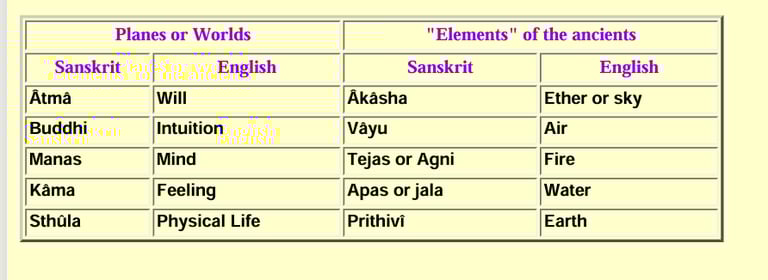
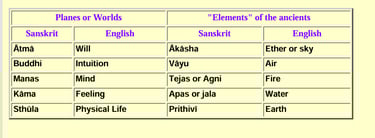
In certain Hindu books there is another classification, in which the mind is grouped with the elements. The Hindu has a way of looking at things from a very high standpoint, often, apparently, from that of the Monad, and to him the mind is but an instrument of consciousness. Thus, in the seventh chapter of the Gîtâ, Shri Krishna says: "Earth, water, fire, air, ether, manas, buddhi, and ahamkâra –these are the eightfold divisions of my manifestation". (Prakriti) A little later on she speaks of these eight as "my lower manifestation".
The mental world is the world of the real man, the very word man deriving from the Sanskrit root man, the root of the verb "to think": thus man means thinker: he is named by his most characteristic attribute, intelligence.
The mental world is thus the land of our birth, the realm to which in truth we belong, for our native atmosphere is that of ideas, not of physical phenomena.
When man, the Thinker, became incarnate in the physical vehicle built for his reception, the senseless animal became the thinking being by virtue of the Manas which entered into and dwelt in him. Thus man became clothed in his "coat of skin" after his fall into physical matter, in order that he might eat of the Tree of Knowledge and thus become a "God". Hence man is the link between the Divine and the animal.
The mental world is of peculiar interest, not only because man, after the mind is fairly developed, spends here nearly all his time, dipping down into the physical world only for brief snatches of mortal life, but also because it is the meeting ground of the higher and lower consciousness.
In English the word "mind" stands both for the intellectual consciousness itself, and also for the effects produced on the physical brain by that consciousness. In occultism however, we must conceive of the intellectual consciousness as an individual entity, a being, the vibrations of whose life are thoughts, expressed not as physical words, but as images.
The real man is Manas, the Thinker, working on the higher or causal levels of the mental plane. Only a small section of his vibrations, and even that very imperfectly, can be reproduced in the comparatively coarse physical materials, the physical brain and nervous system being able to reproduce but a small fragment of the vast series of mental vibrations set up by the Thinker in his own world.
Very receptive brains respond up to the point of what we call great intellectual power; exceptionally unresponsive brains respond up to the point of what we call idiocy; exceptionally responsive brains up to the point of what we call genius. The so-called mental powers of each man thus represent the degree of sensitiveness of his brain to the millions of thought-waves from the Thinker to which it can respond.
Thus consciousness working in the brain is illuminated, from above, by ideas that are not fabricated from materials supplied by the physical world, but are reflected into it directly from the Universal Mind [see below]. The great "laws of thought" regulate all thinking, and the very act of thinking reveals their pre-existence, as it is done by them and under them, and is impossible without them.
Taking a still wider view of the mental plane, it may be described as that which reflects the Universal Mind in Nature, the plane which, in our little system, corresponds with the Great Mind in the Kosmos. This Great Mind is Mahat, the Third Logos, or Divine Creative Intelligence, the Brâhma of the Hindus, the Mandjusri of the Northern Buddhists, the Holy Spirit of the Christians.
The Universal Mind is that in which all archetypically exists; it is the source of beings, the fount of fashioning energies, the treasure-house in which are stored up all the archetypal forms which are brought forth and elaborated in lower kinds of matter during the evolution of the universe. These are the fruits of past universes brought over as seeds for unfoldment in the present universe.
It is on the higher part of the mental plane that exist the archetypal ideas which are now in course of concrete evolution. In its lower regions these are worked out into successive forms, to be duly reproduced in the astral and physical worlds.
An example of these ideas is that of the small artificial elementals, which may sometimes be seen hanging around a plant or flower, all through the time that the buds are forming. These are thought-forms of the great devas who supervise the evolution of the vegetable kingdom, and are created for the special purpose of carrying out their ideas connected with the plants and flowers. Such an elemental usually takes the form of an etheric model of the flower itself, or of a little creature which gradually builds the flower into the shape and colour of which the deva has thought. When the work is done, the power of the elemental is exhausted, and the matter of which it is composed dissolves into the general store of such matter.
These artificial elementals must not, of course, be confused with nature-spirits [see The Astral Body p. 181], which are frequently seen playing about flowers.
Before the Manu of a Chain or Round commences the task appointed for Him, He examines the part of that mighty thought-form of the Logos which refers to His work, and brings it down to some level within easy reach for constant reference. The same thing is done at a lower level by the Manu of each World and of each Root-Race. Each Manu then builds as nearly as He can to the model He has before Him, usually approaching the perfection required by degrees, the earlier efforts at the formation of a race, for example, being often only partially successful.
At the beginning of the present – [fourth]- round, all the archetypes for humanity were brought down, including those races which have not yet come into existence. From an examination of these, it is possible to see what the men of the future will be like. They will have finer vehicles in every way, and will be distinctly more beautiful in appearance, expressing in their forms the spiritual forces.
It was on Globe A in the fourth round that mind became definite on the lower mental level, and so we may say that it is in this round man began really to think. The result at first was by no means good. In previous rounds he had not been sufficiently developed to originate thought-forms to any great extent, and so the elemental essence of the globes had been affected only by the thoughts of the devas, who left everything harmonious and peaceful. But when man began to interject his selfish and jarring thoughts, this comfortable condition was very largely disturbed.
Strife, unrest and disharmony were introduced, and the animal kingdom drew decisively apart from man, and began to feel fear and hatred towards him.
On Globe A there were also the group-souls of animals and vegetables, and even minerals. It is, of course, difficult for us to conceive what a mineral could be on the mental plane; it would correspond to our thought of a mineral; but the thought-form which exists there is that of the Manu, and is moulded by a power altogether beyond comparison with that of our mentality.
As we saw in Chapter II, in the natural course of events, the present fourth round should be devoted chiefly to the cultivation of the emotions; the next round, the fifth, should be that of intellectual advancement. We are, however, a long way in advance of the programme marked out for us. This advance is entirely due to those august Beings variously called the Lords of the Flame, the Children of the Fire-Mist, the Lords of Venus, who came to this earth from the planet Venus.
Most of them stayed with us only through that critical period of our history; a few still remain to hold the highest offices in the Great White Brotherhood, until the time when men of our own evolution shall be able to relieve Them of Their high office.
As was explained in Chapters VII and VIII, the materials of the mental plane are capable of combining, under the impulse of thought-vibrations, and can give rise to any combination which thought can construct. Just as iron can be made into a spade or a sword, so can mental matter be shaped into thought-forms to help or to injure. In this region, thought and action are thus one and the same thing; matter is the obedient servant of life, adapting itself to every creative impulse.
The mental plane, being that of thought itself, the very home of thought, is thus far nearer reality than any lower plane. For everything that is material is buried and hidden in matter, whatever of reality it may possess being far less obvious and recognisable than it would be when regarded from a higher standpoint.
The whole of our Solar System being a manifestation of the Logos, every particle in it is part of His vehicles. Hence all the mental matter in the system constitutes His mental body.
This, of course, comprises not only the mental world belonging to each of the physical planets, but also those belonging to each of the astral planets, and in addition, the purely mental planets, usually called, in our Chain of worlds, globes A and G.
It may be noted, parenthetically, that the man of globe A in the First Round can hardly be called a man at all; he is a thought; he is what will some day be a mind-body –the germ of a mind-body, bearing perhaps the same relation to its later possibilities as the embryonic form of an infant after the first month bears to the fully developed human body. At this early stage he has marvellously little consciousness.
The matter described above as composing the mental body of the Solar Logos also composes the mental bodies of the seven Planetary Logoi, which are centres of force within the Solar logos.
Now in every man's mental body there are particles belonging to each one of the seven Planetary Logoi, but the proportions vary infinitely, these proportions determining the type of each person.
In the seven Planetary Logoi certain psychic changes periodically occur, and these changes are bound to affect the bodies of every man in the world, because the materials of his bodies are also the materials of the Planetary Logoi. The degree to which he will be affected will, of course, depend upon the proportion in his bodies of the type of matter appropriate to that particular Logos. Hence the importance to man of the motions of these Planetary Spirits –and the ultimate rationale of astrological science.
The influences belonging to these great types affect, amongst other things, the elemental essence which, as we have seen [see p. 6], is vividly active in the astral and mental bodies of men. Hence any unusual excitement of any of these types must affect to some extent either man's emotions or his mind, or both, to a degree corresponding to the amount of the particular type of essence concerned which he possesses in his vehicles. Such influences in themselves are no more good nor evil than any other natural force; they may be helpful or hurtful according to the use we make of them.
It is important to realise that any pressure these influences may bring to bear on man cannot dominate his will in the slightest degree. The most it can do is in some cases to make it easier, or more difficult, for that will to act along certain lines. A man of iron determination, or a student of occultism, may put these influences aside as a negligible quantity; for men of weaker will it may sometimes be worth while to know at what moment this or that force can most advantageously be applied. "The wise man rules his stars: the fool obeys them".
Whilst each physical globe has its physical, astral and mental planes, all inter-penetrating one another, and therefore occupying the same space, all of these are yet quite apart, and do not communicate with the corresponding planes of any globe. [ It is only at and beyond the buddhic level that there is a condition common to all the planets of our chain].
Notwithstanding the above, there is a condition of the atomic matter of each of these planes which is cosmic in its extent. In fact, the seven atomic-sub-planes of our system, taken apart from the rest, may be said to constitute the lowest cosmic plane, sometimes called the cosmic-prakritic. Thus our mental plane is the third sub-division of the lowest cosmic plane.
Regarded in another way, the atomic part of our mental plane is also the lowest sub-plane of the mental body of the Planetary Logos.
The astral plane of the earth extends to a little less than the mean distance of the moon, the earth and the moon being nearly 240,000 miles apart; the mental plane of the earth, which is of course a definite globe, extends still further into space than does the astral plane, bearing about the same proportion to the astral as does the astral to the physical.
Only that portion of the atomic matter of the astral and mental planes which is in an entirely free condition is coextensive with the interplanetary ether [which consists of ultimate physical atoms in their normal and uncompressed state]. Consequently a person can no more pass from planet to planet of our chain in his astral or mental body than he can in his physical body. In the causal body, when very highly developed, this achievement is possible, though not with the ease and rapidity with which it can be done at the buddhic level.
Furthermore, the detailed sight of other planets would not be possible for any system of clairvoyance connected with the mental or any lower plane, though a good deal of information could be obtained by exercising a high magnifying power ,[see p. 116].
Matter of the lower planes is never carried over from planet to planet. When, for example, we leave this planet in order to incarnate upon Mercury, only the egos will be carried over. Those egos will draw round themselves mental and astral matter belonging to their new planet, and will obtain physical bodies provided by those who are already inhabiting Mercury.
The matter of the mental plane is divided into seven grades of fineness, precisely as is that of the astral and the physical planes. For want of other terms these must for the present be denoted by the terms given to the seven grades of physical matter, i.e., solid, liquid, gaseous, etc. The highest or finest sub-division consists, of course, of ultimate mental atoms.
An ultimate mental atom contains 49 to the 4th or 5,764,801 [roughly five and three quarter million] "bubbles in koilon".
The three higher grades of mental matter are called arûpa, or formless; the four lower grades are termed rûpa, or having form. The distinction is a real one, being related to the divisions on the mind itself.
In the rûpa levels the vibrations of consciousness give rise to images or pictures, every thought appearing as a living shape; in the arûpa levels consciousness seems rather to send out flashes or streams of living energy, which does not body itself into distinct images, while it remains on its own levels, but which, when it rushes into the lower mental levels, sets up a variety of forms, all linked by some common condition. In other words, the arûpa levels are concerned with the expression of abstract thoughts, ideas, principles, and the rûpa levels with concrete thoughts and particular ideas.
Words being largely symbols of images, and belonging to the workings of the lower mind in the brain, it follows that it is almost, if not quite, impossible to describe in words the workings of abstract thought. For the arûpa levels pertain to the pure reason, which does not work within the narrow limits of language.
Another broad distinction between the rûpa and the arûpa levels of the mental plane is that on the rûpa levels a man lives in his own thoughts, and fully identifies himself with his personality in the life which he has recently quitted. On the arûpa levels he is simply the reincarnating ego who, provided he is sufficiently developed on that level to know anything at all, understands, at least to some extent, the evolution upon which he is engaged, and the work that he has to do.
Mental matter being so much finer than either astral or physical matter, it follows that the life-forces on the mental plane are enormously increased in activity. Mental matter is in constant, ceaseless motion, taking form under every thrill of life and adapting itself readily to every change of motion. Even astral matter seems relatively heavy and lustreless. The vibrations of mental matter are as much more rapid than physical vibrations as vibrations of light are more rapid than physical vibrations as vibrations of light are more rapid than those of sound.
We might say that mental matter moves actually with thought; astral matter moves so quickly after thought that the ordinary observer can scarcely note any difference; etheric matter, of course, does not obey thought as rapidly as does astral matter.
The student will of course realise that just as each particle of physical ether floats in a sea of astral matter, so each astral particle floats in a mental ocean.
In spite of the idea, entertained by many people, that it is easier to deal with things on the physical plane than with those on the astral or mental planes, the reverse is the truth. For the very fineness of mental matter, and its ready response to mental impulses, makes it far easier to move, and to direct, by the action of the will, than either astral or physical matter.
In The Voice of the Silence, three Halls are spoken of –the Hall of Ignorance; the Hall of Learning; the Hall of Wisdom. It seems probable that the Hall of Ignorance stands for the physical plane; the Hall of Learning for the astral and lower mental planes; and the Hall of Wisdom for the planes of higher mind and buddhi.
On the four lower levels of the mental plane, some degree of illusion is still possible; but less it appears, for the man who can function there in full consciousness during physical life than for the undeveloped person after death, as was explained in the Chapters on Devachan.
The lower mental plane is thus still a region of personality and error; in it, as well as in the astral world, there is a serpent coiled under every flower; for if personal and foolish desires infest the one, pride and prejudice inhabit the other.
On the higher mental plane, though there will be much that the ego does not know, what he does know he knows correctly. With the life of the causal body, however, we are not directly concerned in this volume.
There is a radical difference between the lower and higher mental planes. In the lower mental, matter is dominant; it is the first thing that strikes the eye; and consciousness shines with difficulty through the forms. But in the higher planes, life is the prominent thing, and forms are there only for its purposes. The difficulty in the lower plane is to give life expression in the forms, but in the higher it is quite the reverse –to hold and give form to the flood of life. It is only above the line that divides the lower from the higher mental plane that the light of consciousness is subject to no wind, and shines with its own power. Hence the symbol of a spiritual fire is very fitting for consciousness at the higher levels, as distinguished from the lower planes, where the symbol of fire burning fuel is more appropriate.
In the case of the astral plane, it is possible to give some account of its scenery; but this cannot be done for the mental plane, because the mental plane has no scenery, except such as each individual chooses to make for himself by his thought; we do not, of course, include as "scenery" other mental entities who are themselves in many cases objects of great beauty.
The conditions of the mental plane, however, are so difficult to describe in words that it would perhaps be more accurate to say that all possible scenery exists there; there is nothing conceivable of loveliness which is not there with a fullness and intensity beyond all power of imagination. But out of this splendour of living reality each man sees only that which his development enables him to perceive.
It is said to be difficult to describe the difference between the matter of the various sub-planes of the mental world, because the scribe bankrupts himself of adjectives in his attempt to describe the lowest sub-plane, and thus has no words left for the description of the higher sub-planes. All that can be said is, that as we ascend, the material becomes finer, the harmonies fuller, the light more living and transparent. There are more overtones in the sound, more delicate shades in the colours, more and new colours appear, as we rise through the sub-planes. It has been said poetically, and truly, that the light of a lower plane is darkness on the one above it.
On the highest sub-plane the matter is ensouled and vivified by an energy which flows like light from above, from the buddhic plane. As we descend through each sub-plane, the matter of each sub-plane becomes the energy of the sub-plane immediately below; more accurately, the original energy, plus the matter of the higher sub-planes, becomes the ensouling energy of the next lower sub-plane. Thus the seventh or lowest sub-plane consists of the original energy six times enclosed or veiled, and therefore by so much, weaker and less active.
The first impressions of one who enters the mental plane in full consciousness will be very much as described in Chapter XX, when dealing with a man awakening, after astral death, in devachan. He will experience intense bliss, indescribable vitality, enormously increased power, and the perfect confidence which flows from these. He finds himself in the midst of what seems to him a whole universe of ever-changing light, colour and sound. He will seem to be floating in a sea of living light, surrounded by every conceivable variety of loveliness in colour and form, the whole changing with every wave of thought that he sends out from his mind, and being indeed, as he will discover, only the expression of his thought in the matter of the plane and its elemental essence. Concrete thoughts, as we saw previously, take the shapes of their objects, while abstract ideas usually represent themselves by all kinds of perfect and most beautiful geometrical forms. In this connection it should be remembered that many thoughts, which to us on the physical plane are little more than mere abstractions, are on the mental plane concrete facts.
The feeling of freedom in the mental world is so great that in comparison with it astral life seems a state of bondage.
Anyone who wishes to abstract himself from his surroundings on the mental plane and devote himself to quiet thought, may live in a world of his own without possibility of interruption; he will also have the additional advantage of seeing all his ideas, and their consequences, full worked out, passing before him in a sort of panorama.
If, however, he wishes instead to observe the plane upon which he is, he must very carefully suspend his own thought for a time, so that he may not influence the readily impressible matter around him [see p. 114].
Having attained to that condition in which he is no longer himself the centre of radiation of that light, colour, sound and form, it has not therefore ceased to exist: on the contrary, its harmonies and coruscations are grander than ever. Presently he will perceive that he is seeing the colour-language of the devas, the expression of thought or conversation of beings far higher than himself in the scale of evolution. By experiment and practice he will also find that he can himself use this mode of expression, and thus hold converse with, and learn from, these lofty nonhuman entities, whom we shall describe in a later chapter.
For, as the student will recollect, a thought-form, composed of rapidly vibrating particles of mental matter, sets up vibrations all around it; and these vibrations give rise to sensations of sound and colour in any entities adapted to translate them thus.
It is possible also for a visitor to the mental plane to form round himself a huge shell, through which none of the thought or conversation of other entities can penetrate, Then holding his own mind perfectly still, he can examine the conditions inside his shell.
He is now able to perceive another, and entirely different, series of regular pulsations, which the other more artificial phenomena had obscured. These are universal, and cannot be checked or turned aside by any Shell made by human power. They produce no colour or form, but flow with resistless regularity through all the matter of the plane, outwards and in again, like the exhalations and inhalations of a great breath.
There are several sets of these, clearly distinguishable from one another by volume, period of vibration, and the tone of the harmony which they bring. Grander than them all sweeps one great wave which seems the very heartbeat of the system –a wave which, welling up from unknown centres on far higher planes, pours out its life through all our world, and then draws back in its tremendous tide to That from which it came.It comes in one long undulating curve, and the sound of it is like the murmur of the sea. Yet in it and through it there echoes a ringing chant of triumph, the very music of the spheres.
A man who has once heard that glorious song of nature never quite loses it again. Even in the physical world, so dreary by comparison, he hears it always as a kind of undertone.
If the man has reached a certain degree of spiritual development, it is possible for him to merge his consciousness with the sweep of the wave and let it bear him upward to its source. But it is not wise to do this, unless a Master stands beside him to draw him back at the right moment; for otherwise its irresistible force will carry him away into still higher planes, whose far greater glories his ego is as yet unable to sustain. He will lose consciousness, with no certainty as to when and where he will regain it.
Whilst the attainment of such unity is the ultimate object of man's evolution, he must reach that goal in full and perfect consciousness, and not drift into absorption in a state of blank unconsciousness but little removed from annihilation.
On the mental plane a man may circle the world with the speed of thought; he is at the other side of it even as he formulates the wish to be there, for the response of mental matter to thought is immediate, and it is very readily controlled by the will.
On the mental plane there is no alternation of day and night, and nothing to correspond to sleeping or waking, except of course on first entering the plane and on finally leaving it.
As the physical world is three-dimensional, and the astral world four-dimensional, so is the mental world fivedimensional. But, as was explained in The Astral Body, p. 165, it is probably more accurate to say that consciousness on each plane is able to appreciate the world in which it is functioning in the number of dimensions given above.
The three known forms of energy have their appropriate manifestations on every plane which our students have yet reached. Hence Fohat, Prana and Kundalini all exist on the mental plane, thought at present little is known of the details of their workings.
A man in full consciousness on the mental plane will, of course, see the whole of humanity, excepting those who are living in their causal bodies only, for every man who is in physical or astral life must also possess a mental body. Those, however, who are confined in their own shells of thoughts in their heavens can scarcely be considered as companions, for reasons explained in the chapters on Devachan.
Between those who are fully conscious on the mental plane there is far closer union than is possible at any lower level. A man can no longer deceive another with regard to what he thinks, for all mental operations lie open for every one to see. Opinions or impressions can now be exchanged, not only with the quickness of thought, but also with perfect accuracy, for each now receives the exact idea of the other, clean, clear-cut, instantaneous, without having to puzzle his way through the maze of words.
The student will recollect that on the astral plane difference of language is a barrier to communication, as thoughts must be definitely formulated in words in order to be comprehensible to another entity on that plane. On the mental plane, however, men communicate directly by thought-transference, whatever their language may be.
Space is no barrier, for a man can come into touch with any other man merely by directing his attention to him. The real barrier between men are those due to the difference in their evolution. The less evolved can know only as much of the more evolved as he is able to respond to, and such limitations can obviously be felt, only by the more evolved, as the lesser has all he can contain.
The method of finding a man on the mental plane, whether he be living or dead, is as follows.
For each of a man's vehicles there is what may be called a keynote, a sort of average tone of the man's various forces and qualities on the plane concerned. There have never been found two persons whose keynotes were identical at all levels, ie., etheric, astral, mental and causal, so as to make the same chord, when struck simultaneously.
Thus the chord of each man is unique, and whether he be sleeping or waking, living or dead, his chord is always the same, and he can always be found by it.
If the man is in the higher world, in his causal body alone, he still has his chord with him, because his permanent atoms are quite sufficient to give out the distinctive sound.
The trained seer, who is able to sense the chord, attunes his own vehicles for the moment exactly to its notes, and then by an effort of will sends forth its sound. Wherever in the three worlds the man sought may be, there is an instantaneous response from him. His causal body lights up instantly, like a great flame, and this is at once visible to the seer, so that a magnetic line of communication is established.
The seer can use that line as a kind of telescope, or, if he prefers, he can send his consciousness flashing along it with the speed of light, and see from the other end of it, as it were.
The man's chord is his true occult name. Some vague tradition of this is probably the origin of the belief among certain savages that a man's real name must be concealed, lest magic be worked upon him.
Thus also it is said, that at each Initiation the man's true name is changed, since each Initiation is at once the official recognition, and the fulfilment of a progress by which the man, as it were, has raised himself into a higher key, so that thenceforward his chord must be sounded differently.
This name of the man must not be confused with the name of the Augoeides [see below [, for that is the chord of the three principles of the ego, produced by the vibrations of the âtmic, buddhic and mental atoms, and the monad behind them.
The chord is not actually either heard or seen; it is received by a complex perception which requires the practically simultaneous activity of the consciousness in the causal body and in all the lower vehicles.
Thus every man pronounces his own true name. Just as he has his own odour materially, by which a bloodhound can track him, so he has his sound spiritually. Those who can hear that sound of his in the inner worlds know where he stands on the ladder of evolution, and what he can and cannot do. Freemasons will recognise the chord as the man's own "knock", his own "report", made by the t… of the inner self, that opens for the man the way into the true Lodge.
The Augoeides, the glorified man, is a name sometimes given to the three higher principles of a man, viz., ÂtmâBuddhi-Manas, which constitute the ego, in the causal body. This, of course, is not an image of any one of the man's past vehicles, but contains within itself the essence of all that was best in each of them; it is the body which indicates more or less perfectly, as through experience it grows, what the deity means that man shall be.
From that vehicle, on the causal levels, it is possible to see not only what the man's past history has been, but also to a considerable extent the future that lies before him.