THE MENTAL BODY , PART-6
THE MENTAL BODY , PART-6. When the time for reincarnation comes, the ego turns his attention outwards, whereupon a thrill of life from him arouses the mental unit and the life-web begins to unfold itself; this life-web consists of buddhic matter, and appears as shimmering gold of inconceivable...
CHAPTER XXXII
REBIRTH
We now take up the story of the ego and his vehicles at the point where, the period of life on the higher mental plane being ended, the time comes for a fresh incarnation to be undertaken. It will be recollected that when the ego withdraws into the causal body, he takes with him his physical and astral permanent atoms, and his mental unit or molecule. These particles of matter, one only of each of the three lower planes, remain with the ego throughout the whole of his human incarnations. Whilst they are withdrawn into the causal body they are in a quiescent or latent condition.
When the time for reincarnation comes, the ego turns his attention outwards, whereupon a thrill of life from him arouses the mental unit and the life-web begins to unfold itself; this life-web consists of buddhic matter, and appears as shimmering gold of inconceivable fineness and delicate beauty; it is formed of a single thread, which is a prolongation of Sutrâtmâ. Into further details of these matters, however, we cannot enter here; the writer hopes to deal with them in a later volume. The mental unit now resumes activity, because the ego seeking to express himself once more on the lower mental plane, so far as the plasticity of its matter will permit. Accordingly, the mental unit acts as a magnet, drawing round itself mental matter and mental elemental essence, with vibratory powers resembling, or accordant with, its own, and thus fitted to express its latent mental qualities.
The process is in a certain sense automatic, though devas of the Second Elemental Kingdom assist in the process by bringing suitable materials within reach of the mental unit. The matter is first shaped into a loose cloud around the mental unit; it is not as yet a mental body, but merely the materials out of which the new mental body will be built. Neither are the qualities as yet in any way in action. They are simply the germs of qualities, and for the moment their only influence is to secure for themselves a possible field of manifestation, by providing matter suitable for their expression in the mental vehicle of the child.
The germs or seeds, brought over from the past, are known by the Buddhists as the Skandhas; they consist of material qualities, sensations, abstract ideas, tendencies of mind, mental powers. As we have seen, in the course of our study, the pure aroma of these passed with the Ego into devachan; all that was gross, base and evil, remained in the state of suspended animation spoken of. These are taken up by the Ego as he passes outwards towards terrestrial life, and are built into the new "man of flesh", which the true man is to inhabit.
The experiences of the past do not, of course exist as mental images in the new mental body; as mental images they perished long ago when the old mental body perished; only their essence, their effects on faculty, remain. Precisely the same thing happens when the ego turns his attention to the astral permanent atom, and puts into it his will. Thus the mental unit and the astral permanent atom attract to themselves material capable of producing a mental and an astral body of exactly the same type as the man had at the end, respectively, of his last mental and astral lives. In other words, the man resumes his life in the mental and astral worlds just where he left it last time. A man's mental and astral bodies, taken on for his new life-period, being thus the direct result of his past, form a most important part of his "ripe" or Prârabda karma.
The mental matter is at first evenly distributed throughout the ovoid. Only as the little physical form comes into existence are the mental and astral matter attracted to it; they then begin to mould themselves to its shape, and thereafter steadily grow along it. At the same time, with this change in arrangement, the mental and astral matter is called into activity, and emotion and thought appear. It should be noted that the coarser the kinds of mental matter built into the mental body, the more intimate becomes the association between the mental and astral matter, thus strengthening the element of Kâma-Manas [see Chapter VI]. A young child thus cannot be said to have a definite mental or a definite astral body; but he has around and within him the matter out of which these bodies are to be constructed. He possesses tendencies of all sorts, some good, some evil.
Whether these germs will develop once more in the new life into the same tendencies as in the last life will depend very largely upon the encouragement or otherwise given to them by the surroundings of the child during his early years. Any of them, good or bad, may be readily stimulated into activity, or, on the other hand, may be starved out for lack of that encouragement. If stimulated, it becomes a more powerful factor in the man's life this time than it was in his previous existence; if starved out it remains merely as an unfructified germ, which presently atrophies and dies out, and does not make its appearance in the succeeding incarnation at all. During his early years the ego has but little hold over his vehicles, and he therefore looks to his parents to help him to obtain a firmer grasp, and to provide him with suitable conditions. Hence the enormous responsibility resting upon parents.
It is impossible to exaggerate the plasticity of the child's unformed vehicles. Plastic and readily impressible as is the physical body of a young child, his astral and mental vehicles are far more so. They thrill in response to every vibration which they encounter, and are eagerly receptive with regard to all influences, whether good or evil, which emanate from those around them. As in the case of the physical body, whilst the mental and astral bodies are in early youth susceptible and easily moulded, they soon set and stiffen and acquire definite habits which, once firmly established, can be altered only with great difficulty. To a far larger extent than is ever realised by even the fondest parents, the child's future is under their control. If we can imagine our friends with all their good qualities enormously intensified, and all the less desirable features weeded out of their characters, then we can picture to ourselves the results which parents can produce in their children if they will do their full duty by them.
The extraordinary sensitiveness to the influence of his surroundings commences as soon as the ego descends upon the embryo, long before birth takes place; it continues, in most cases, up to about the period of maturity. The mental body, or rather the material out of which the mental body will be built, becomes involved with the lower vehicles during the pre-natal life; the connection becomes more and more close until, at about the end of the seventh year, the lower vehicles are as closely in touch with the ego as the stage of evolution permits.
The ego then, if sufficiently advanced, begins slightly to control his vehicles, what we call conscience being his monitory voice. During the pre-natal period the ego broods over the human mother in whom his future body is building, but the ego can affect the embryo but little, save through a feeble influence from the physical permanent atom; the embryo cannot respond to, and therefore does not share, the thoughts and emotions of the ego expressed in his causal body. The Hindus had various ceremonies by which they surrounded with pure influences both mother and child before and after birth. The object was to create special conditions which warded off the lower influences and brought in the higher influences. Such ceremonies were very valuable.
The "seeds" of evil which are brought by a child in his permanent atoms have often been called "original sin" though they are wrongly connected with the fabled action of Adam and Eve. In the Christian Church the sacrament of baptism is intended specifically to help in reducing to a minimum the effects of the seeds of evil. To this end magnetised or "holy" water is employed; by its means the priest is able to set strongly in vibration the etheric matter of the child's body, to stimulate the pituitary body, and through it affect the astral body and through that in turn the mental body. The force which is poured in rushes down and up again until, like water, it finds its own level. The "exorcism" performed by the priest is intended to bind down the germs of evil in their present condition, and to prevent them being fed or encouraged in any way, so that eventually they atrophy and fall out.
In addition, in the ceremony as performed in the Liberal Catholic Church at least, the priest making the sign of the cross down the whole length of the front and back of the child's body, builds a thought-form or artificial elemental [which has given rise to the idea of the baptismal guardian angel], which is filled by the divine force, and which is also ensouled by a higher kind of nature-spirit known as a sylph. The thought-form is a kind of cuirass of white light before and behind the child. Incidentally, through association with the thought-form which is permeated by the life and thought of the Christ Himself, the sylph eventually individualises and becomes a seraph. Even if the child dies almost immediately, the baptism may be of value to it on the other side of death.
For it would be quite possible for the germs of evil to be stimulated into activity in the astral world, and the thought-form may be of assistance in preventing such action. Thus, in baptism, not only are certain centres or chakrams in the child aroused and opened to spiritual influence, but also the germs of evil are to some extent repressed, and the child is endowed with what is practically a guardian angel, a new and powerful influence for good. It may be added that the cross which is made on the forehead of the child with the consecrated oil is visible in the etheric double all through the life of the person; it is the sign of the Christian, precisely as the tilaka spot, or caste mark in the case of the Hindu, is the sign of Shiva or the trident of Vishnu.
The aura of a child is often a most beautiful object, pure and bright in colour, free from the clouds of sensuality, avarice, ill-will and selfishness which so frequently darken all the life of the adult. It is pathetic to perceive the change which almost invariably comes over the child-aura as the years pass on; to note how persistently evil tendencies are fostered and strengthened by his environment, and how entirely good ones are neglected. With such object-lessons before one, one ceases to wonder at the extraordinary slowness of human evolution, and the almost imperceptible progress which most egos make for life after life spent in the lower world. The remedy lies with parents and teachers, the effect of whose personal character, behaviour and habits on the development of children is almost incalculable.
It should be unnecessary, at this stage of our study, again to emphasise the great importance of the thoughts and emotions of parents and teachers on their charges. This subject is dealt with at length by C.W.Leadbeater in The Hidden Side of Things, Vol. II, p. 287-312. In the Atlantean civilisation the importance of the office of the teacher was so fully recognised that none was permitted to hold it but a trained clairvoyant, who could see all the latent qualities and capabilities of his charges, and could therefore work intelligently with each, so as to develop the good and amend the evil.
In the distant future of the Sixth Root-Race this principle will be applied even more completely. With whatever care parents may surround a child, it is practically inevitable that the child will some day encounter evil influences in the world, which will tend to stimulate evil tendencies in himself. But it makes a vast difference whether the good or the evil tendencies are stimulated first. In most cases the evil is awakened into activity before the ego has any hold upon the vehicles, so that when he does grasp them he finds that he has to combat a strong predisposition to various evils.
When the germs of good are tardily aroused they have to struggle to assert themselves against evil tendencies already firmly established. On the other hand, if the parents by exceeding care before birth, and for several years after it, have been able to excite only good tendencies, then, as the ego gains control, he finds it easy to express himself along those lines, a habit having been established. If then an evil excitation comes, it finds a strong momentum in the direction of good, which it strives in vain to overcome.
The ego, unless he is unusually advanced, has but little command over his vehicles at first; but it must be borne in mind that his will is always for good, because he desires to evolve himself by means of his vehicles, and such power as he is able to throw into the balance will always therefore be on the right side. During the embryonic and infantile life the ego is carrying on his own wider, richer life, and, as said, gradually comes more and more closely into touch with the embryo. We may note here that the relation of the Monad to the universe, in which his consciousness is evolving, is analogous to that of the ego in relation to his new physical body. Since the mental body is a new one, it naturally cannot contain the memory of previous births, in which it had no part.
Such memory clearly belongs to the ego, in the causal body, who, together with his permanent atoms, alone persists from one incarnation to another. Hence a man functioning in the physical world cannot remember his past lives, so long as he remembers only by means of his mental body. In the development of the human body the gestation period corresponds to the downward course of the elemental kingdoms; from birth to the age of seven it is considered by many educationists that the child's physical nature should receive most attention ; up to the age of about fourteen the development of emotions should have chief consideration; up to the age of about twenty-one the teacher should appeal especially to the unfolding of the mind.
These last three ages may be taken to correspond to a certain extent to the mineral, vegetable and animal kingdoms. In the first, consciousness is on the physical plane; in the second, on the emotional plane; in the third, the lower mind gradually gains ground, and leads on to the stage when man becomes the true thinker. The long period of middle life is the real human career. The epoch of old age should bring wisdom; this is as yet imperfect in most people, being but an adumbration of the superhuman heights of future attainment. It is necessary to mention here a curious eventuality which, in certain rare cases, may occur when a man is re born.
In Chapter VI we saw how, if a man leads a thoroughly degraded life, identifying himself entirely with the lower, animal nature, and neglecting the higher, the lower nature is severed wholly from the higher, and the incarnation is a total loss to the ego. Under such conditions the ego has become so disgusted with his vehicles that, when death relieves him of the physical body, he casts the others aside also; in fact, he may even during physical life leave the desecrated temple. After death, such an ego, having no astral or mental body, will reincarnate quickly. This being so, the old mental and astral vehicles may not yet have disintegrated, but may, by natural affinity, be drawn to the new mental and astral bodies; they then become the most terrible form of what is known as the "dweller on the threshold".
CHAPTER XXXIII
DISCIPLESHIP
The control, training and development of the mental body [as well, of course, as the astral] form an important part of the work of one who aims at becoming a pupil, or chela, of a Master and, later, an Initiate of the Great White Brotherhood.
The following is a table of the four well-known "Qualifications" for the Path which leads to Initiation. It will be seen that in practically all of these there is a mental element.
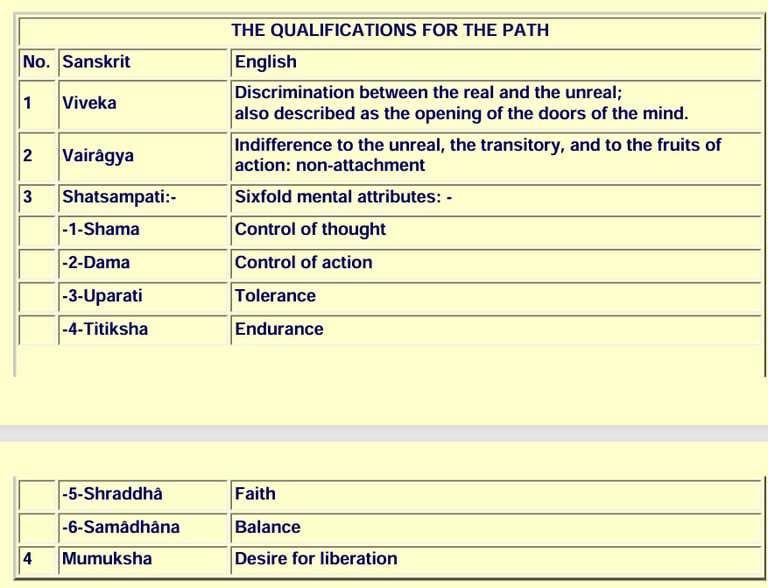
Volumes have been written on the Qualifications: here space will permit of the briefest description only. They are not expected in perfection, but they must be at least partially possessed before Initiation is possible. Vivekâ: The aspirant must learn that the inner life, the life of and for the ego, is the real life; he must learn, as C.W. Leadbeater succinctly puts it, that "few things matter much: most things do not matter at all".
Needless to say, this does not mean that worldly duties and responsibilities, once undertaken, may or should be neglected; on the contrary, they should be performed by the occultist even more scrupulously and carefully than by other men. It is the spirit in which they are done which matters, the recognition of the aspect of them which is important, and those aspects which are not important.
This "opening of the doors of the mind", or "conversion" as it has been called, is precisely that which is spoken of in the bible: "Set your affection on things above and not on things of the earth…for the things which are seen are temporal, but the things which are not seen are eternal." Discrimination is much stimulated by the rapidly changing circumstances into which the disciple is generally thrown, with a view to impressing on him the instability of all external things. The life of a disciple is generally one of storm and stress, in order that qualities and faculties may be forced into swift growth and speedily brought to perfection. Vairagyâ: From a recognition of the instability and unsatisfying nature of external things, indifference to them naturally follows.
The aspirant becomes indifferent to things that come and go, and more and more he fixes his attention on the changeless reality that is ever present. Shama: The need for control of thought has already been amply emphasised in this present volume. The pupil must reduce the chaos of his emotions and thoughts to order ; he must eliminate the host of minor interests, and control wandering thoughts. Whilst he still lives in the world, the difficulty of the undertaking is multiplied manyfold by the ceaseless pressure of disturbing waves of emotion and thought, which give him no rest, no opportunity to collect his forces in order to make a real effort. Steady, daily practice in concentration and meditation is a method that many find suitable.
The aspirant must work with great energy and perseverance to reduce the mental rebel to order and discipline, knowing that the great increase in thought-power which will accompany his rapid growth will prove a danger to others and to himself, unless the force be thoroughly under his control. Better give a child dynamite to play with, than place the creative powers of thought in the hands of the selfish and the ambitious. Dama: To inner control must be added the control of outer actions. As the mind obeys the soul so must the lower nature obey the mind. Carelessness in the lower part of human activity must be eliminated. Uparati : The sublime and far-reaching virtue of tolerance means the quiet acceptance of each man, each form of existence , as it is, without demand that it should be something different, shaped more to one's own liking.
Respect for the individuality of others is one of the marks of the disciple. Titiksha: Endurance means an attitude of mind that cheerfully bears all and resents nothing, going straight onwards unswervingly to the goal. The aspirant knows that nothing can come to him but by the Law, and the Law is good. He must realise that as he is paying in a few short lives the karmic obligations accumulated during the past, the payments must be correspondingly heavy. Shraddhâ: The very struggles, in which the aspirant is plunged, develop in him faith in his Master, and in himself, a serene, strong confidence that is unshakeable.
Sâmadhâna: Balance, or equilibrium, grows to some extent without conscious effort during the striving after the previous five qualifications. The soul gradually disentangles itself from ties that knit it to the world of sense, the objects in which "turn away from abstemious dweller in the body", and soon lose all power to disturb his balance. Balance amid mental troubles of every kind is also necessary, this balance being further taught by the swift changes, mentioned above, through which his life is guided by the ever-watchful care of his Master.
Mumuksha: The deep, intense longing for liberation, that yearning of the soul towards union with the Divine, follows on the attainment of the other Qualifications. This adds the last touch to the readiness to enter into full discipleship. Once the longing has definitely asserted itself, the soul that has felt it can never again quench its thirst at earthly fountains. The attainment of this stage makes the man ready for Initiation, an Adhikari, ready to "enter the stream" that cuts him off forever from the interests of earthly life, save as he can serve his Master in them and help forward the evolution of humanity.
This hunger for the things of the spirit appears to be represented in Freemasonry by the inner attitude of the Candidate in "humbly soliciting to be admitted to the mysteries and privileges of Ancient Freemasonry". In this attitude, as every Freemason knows, the emphasis is on the urge from within the Candidate himself; no man can tread the occult path on the inspiration of another. In the Buddhist system the names given to the stage are somewhat different, though the qualifications themselves are the same in effect.
The following is the Pali nomenclature:
1. Manodvâravajjana. The opening of the doors of the mind, or perhaps escaping by the doors of the mind. A conviction of the impermanence and worthlessness of mere earthly aims.
2. Parikamma. Preparation for action. Doing right for right's sake, with complete indifference to the enjoyment of the fruit of action.
3. Upacharo. Attention or conduct.-----[1] Samo. Quietude of thought that comes from control of mind.-----[2] Damo. Subjugation; mastery over words and actions.-----[3] Uparati. Cessation from bigotry or belief in the necessity of ceremonies. Hence, independence of thought and tolerance.-----[4] Titikshâ. Endurance or forbearance, including complete absence of resentment.-----[5] Samadhana. Intentness, one-pointedness, involving the incapability of being turned aside by temptation. -----[6] Saddha. Faith; confidence in one's Master and one's self.
4. Anuloma. Direct order of succession, signifying that it follows naturally from the other three; intense desire for liberation.
5. Gotrabhû. The condition of fitness for Initiation. The student will readily perceive that these Qualifications necessarily follow from ego-consciousness.
For if we can look on life from the world of the ego, we see it in true perspective, i.e., with discrimination; and the ego consciousness being disentangled from the lower bodies, desirelessness is inevitable. Further, since conduct will be that of the ego himself, instead of that of the bodies, shatsampatti or control of conduct will necessarily follow. And, as the world of the ego is the world of unity, of love in its widest sense, ego-consciousness implies love, a word which is sometimes used to designate, from a somewhat different angle, the last of the four qualities, Mumuksha, or longing for liberation. When a man appears to be reasonably near the possession of the necessary qualifications, a Master may take him upon "probation". This means that the man will remain for a period under very close observation.
During the period of probation, the pupil is not in any sense in any kind of direct communication with the Master; he is little likely to hear or to see anything of him. Nor as a general rule are any special trials or difficulties put in his way. He is simply carefully watched in his attitude towards all the little daily troubles of life. For convenience of observation, the Master makes what is called a "living image" of the probationary pupil, that is to say an exact duplicate of the man's etheric, astral, and causal bodies. This image He keeps in a place where He can easily reach it, and He places it in magnetic rapport with the man himself, so that every modification of thought or feeling in the man's own vehicles is faithfully reproduced in the image.
These images are examined daily by the Master, who in this way obtains with a minimum of trouble a perfectly accurate record of His prospective pupil's thoughts and feelings, from which He is able to decide when He can take him into the far closer relationship of the Accepted pupil, which relationship we shall describe presently. There is not generally much ceremony in this step. The master gives a few words of advice, tells the new pupil what will be expected of him, and often, in His gracious way, he may find some reason to congratulate the pupil on the work that he has already accomplished. The living image records not only defects or disturbances; it mirrors the whole condition of the pupil's consciousness.
It must be remembered that the pupil must achieve not only a passive, but also an active goodness, as a pre-requisite for advancement. If a pupil on probation does something unusually good, for the moment the Master flashes a little more attention on him, and may even send a wave of encouragement of some sort, or he may put some work in the pupil's way, and see how he does it. Generally however, He delegates that to some of His senior pupils. Thus the link between the pupil and his Master is chiefly one of observation, and perhaps occasional use of the pupil.
It is not the custom of the adepts to employ special or sensational tests; the pupil is usually left to follow the ordinary course of his life, the living image affording sufficient indication of his character and progress. The average time for probation is said to be seven years; but it may be indefinitely lengthened, or on the other hand it may be very much shortened. It has been known to extend for thirty years, and it has been known to be reduced to a few weeks. On the probationary path, the man's highest consciousness works upon the higher mental plane.
When a pupil is "accepted", he is taken into his Master's consciousness to so great an extent that whatever he sees or hears is within the knowledge of his Master. Not that the Master sees or hears it at the same moment, though that often happens, but that it lies within the Master's memory, exactly as it lies within the memory of the pupil, so that He could recollect it at any time that He chose to do so. Whatever the pupil feels or thinks is thus within the astral and mental bodies of his Master. The master in this way blends the aura of the pupil with His own, so that His forces may be constantly acting, without special attention on His part, through the pupil.
It must not be thought that a mere unconscious channel is required; on the contrary, the pupil must become a keenly intelligent co-operator. If, unfortunately, it should happen that there comes into the mind of the pupil some thought which is not fit to be harboured by the Master, as soon as He feels it, he at once erects a barrier, and shuts off from himself that vibration. To do this of course diverts His attention for a moment from His other work, and takes a certain amount of energy.
The union between the pupil and the Master, that begins with Acceptance, is permanent, so that the higher vehicles of the pupil are always vibrating in common with those of his Master. The whole time he is being tuned up, thus growing more and more like the Master. At all times the thoughts of the pupil are largely preoccupied with thoughts of his Master and His influence, so that, while he is sensitively open to Him, he is to a considerable extent closed to lower influences. It is not, however, expected that a pupil shall be actively thinking of nothing else but his Master; but it is expected that the form of the Master shall always be in the background of his mind, always within the immediate reach, always there when needed in the vicissitudes of life. Whilst reasonable relaxation and change of thought are necessary to mental health, the pupil should, of course, be scrupulously careful to permit no thought, even for a moment, which he would be ashamed for his Master to see.
The process of attuning can take place only slowly; a living being is being moulded, and it is essential that the slow growth from within should adapt the form to the outside influence, much as a gardener gradually directs the limbs of a tree. Although the Master is working upon thousands of people simultaneously, as well as doing other and much higher work, yet the effect is as though He were watching the pupil and thinking of no one else, for the attention that He can give to one among hundreds is greater than ours when we concentrate it entirely upon one. The Master often leaves to some of His older pupils the work of tuning the lower bodies, though He Himself is allowing a constant flow between His vehicles and those of the pupil. It is in this way that he does most for His pupils, without their necessarily knowing anything about it.
The accepted pupil thus becomes an outpost of the Master's consciousness, so that whatever is done in his presence is done in the Master's presence. Although the Master may be unconscious of such events at the time when they happen, nevertheless they are, as said, in His memory afterwards. The experiences of the pupil are thus in the master's mind among His own knowledge, as soon as He turns His attention to the subject concerned. Even purely physical things, such as a slight shock or noise, in the consciousness of the pupil, are also in the consciousness of the Master.
A wise pupil, therefore, tries to avoid any kind of shock, and for that reason he is usually a gentle and quiet sort of person. A pupil is always connected with His Master by a constant current of thought and influence, which expresses itself on the mental plane as a great ray or stream of dazzling light of all colours, violet and gold and blue. When however, the pupil sends a thought of devotion to his Master, the result is a sudden intensification of the colours of this bar of light, and a distinct flow of spiritual influence from the Master towards the pupil.
The reason for this is that the Master's power is flowing outwards always and in all directions like the sunlight. The touch of the pupil's thought vivifies his connection with the Master and simply gives a wider opening through which the great ocean of the Master's love can find vent. So intimate is the union between the consciousness of the pupil and his Master that [as mentioned in Chapter XI] the pupil can at any time see what His Master's thought is upon any given subject, and in that way often save himself from error. This privilege must not be misused.
It is a power of ultimate reference in questions of great difficulty; it is not intended that the pupil should save himself the trouble of thinking, or of deciding ordinary matters which he is quite competent to determine for himself. In a similar manner, at a higher level, the Initiate may place his thought beside that of the Brotherhood, and draw into himself just as much of that tremendous consciousness as he, at his level, is able to respond to. The Initiate, similarly, must strive never to introduce anything discordant into that mighty consciousness, which is acting as a whole.
We may repeat here what was said in Chapter XI, viz., that the Master can at any moment send a thought through the pupil, either in the form of a suggestion or a message, e.g., when the pupil is writing a letter or delivering a lecture. In earlier stages the pupil is often unconscious of this, but he very soon learns to recognise the thought of the Master. In fact, it is eminently necessary that he should learn to recognise it, because there are many other entities on the astral and mental planes who may make similar suggestions, and it is well that the pupil should learn to distinguish from whom they came. The use by a Master of His pupil's body is entirely different from what is ordinarily understood by mediumship.
The mechanism and rationale of mediumship has already been explained in The Etheric Double and The Astral Body, together with the objections to it. To the use by a Master of a pupil's body there can, of course, be no objections. The influence of a Master is so powerful that it may well shine through to almost any extent, and a sensitive person might be conscious of His presence even to the extent of seeing His features or hearing His voice instead of those of the pupil. It is improbable that there will be any purely physical change, though this of course frequently happens in mediumship. Neither is the relationship between Master and pupil in any way one of coercion, or one in which the pupil's individuality is submerged in the flood of power from the Master.
On the contrary, the Master's influence is not a hypnotic force from without, but an inexpressibly wonderful illumination from within, irresistible because so deeply felt as in perfect accord with the pupil's highest aspiration, and as the self-revelation of his own spiritual nature. The Master being Himself in fullest measure a channel of the Divine life, that which flows from Him awakens into activity the seed of Divinity within the pupil. The process is somewhat analogous to that of electrical induction. It is because of the identity of nature in the two that the influence of the Master stimulates in the highest degree all the noblest and highest qualities in the pupil.
The love of the Master for a disciple may be likened to the sunshine which opens the lotus bud to the morning air; it may in truth be said that one smile from the Master will call forth from the pupil such an outburst of affection as would be gained only by months of scholastic meditation on the virtue of love. From the above it is clear that any disturbance in the lower bodies of the pupil will affect also those of the Master.
Should such disturbance occur, the Master drops a veil that shuts the pupil off from Himself, lest there be interference with His own work. Such an unfortunate incident does not usually last longer than forty-eight hours, but in extreme, and very rare, cases, it may endure for years, or even for the remainder of that incarnation. Practically all ordinary people turn their forces inward upon themselves, and thus become a jangling mass of self centred forces. One who would become an accepted pupil must learn to turn himself outwards, concentrating his attention and strength upon others, pouring out helpful thoughts and good wishes upon his fellow-men.
Thus the disciple, and even the aspirant for discipleship, is taught to hold all powers entirely for the service of the world. The sharing by the lower consciousness of the knowledge of the higher is determined mainly by the needs of the work that is being done. Whilst it is necessary that the disciple should have the full use of his vehicles on the higher planes, the conveyance of a knowledge of that work to the physical body [which is in no way concerned with it] is usually a matter of no importance.The strain upon the physical body, when the higher consciousness compels it to vibrate responsively, is very great, at the present stage of evolution, and unless external circumstances are very favourable, this strain is apt to cause nervous disturbance and hyper-sensitiveness, with its attendant evils. Hence most of those whose higher vehicles are developed, and whose most important work is done out of the physical body, remain apart from the busy haunts of men, thus preserving the sensitive physical body from the rough usage and clamour of ordinary life. Furthermore, as soon as a pupil shows any signs of psychic faculty, full instructions are always given to him as to the limitations which are placed on its use.
Briefly, these restrictions are that such faculty shall not be used [1] to satisfy mere curiosity, [2] for selfish purposes, [3] in order to display phenomena.
That is to say, the same considerations which govern the actions of a man of right feeling on the physical plane are expected to apply also on the astral and mental planes; the pupil is never under any circumstances to use his additional power to promote his own worldly advantage, or in connection with gain in any way; and he is never to give what is called in spiritualistic circles a "test" i.e., any indisputable physical plane proof of abnormal power.
There is always a gentle radiation of the Master's influence flowing through the pupil, even though the pupil be not conscious of it. At certain times the pupil may feel a greatly increased flow of force, although he may not know where it is going. With a little careful attention he can learn in which direction it is going, and a little later he can follow it more definitely with his consciousness and trace it to the actual people who are being affected by it. The pupil, however, cannot direct it, being simply a channel. Later, the Master may tell the pupil to seek out a person and give him some of the force. As the pupil increases in usefulness, more and more of the work is placed in his hands, thus relieving, even only in small degree, the strain upon the Master.
Occasionally a pupil may even be given a definite message to deliver to a particular person. It is possible to obtain constant contact with the Master in another way. Just as images of persons made by a man in devachan are filled with life by the egos of the persons concerned, so the Master fills with His real presence the thought-form produced by His pupil. Through that form real inspiration and sometimes instruction may be given. An example of this was that of a Hindu yogi in the Madras Presidency, who claimed to be a pupil of the Master Morya. Having met his Master physically and become His pupil, the yogi claimed that he did not lose his Master after he went away, for he used frequently to appear to him and instruct him through a centre within himself.
There is yet a third stage of even more intimate union, when a pupil becomes the "son" of the Master. The link is such that not only the lower mind, but also the ego in the causal body of the pupil, is enfolded within that of the Master; the Master can then no longer draw a veil to cut off the pupil, so as to separate the consciousness even for a moment. An accepted pupil has the right, and the duty, to bless in the name of the Master, and a splendid outpouring of the Master's power will assuredly follow his effort to do so. The Son of the Master can give the very touch of the Master's intimate presence.
He who is a Son of the Master either is or soon will be a member of the great White Brotherhood also; that, of course, confers the power of blessing in the name of the Brotherhood. In the Greater Mysteries, celebrated principally at Eleusis, the initiates were named epoptai, that is "those whose eyes were opened". Their emblem was the golden fleece of Jason, the symbol of the mental body. The pupil was shown the effect in the heaven-world of a certain line of life, study and aspiration on earth; he was also taught the whole history of the evolution of the world and of man, in its deeper aspect.
The pupil further received not only teachings about the conditions of the mental plane, but also instruction as to the development of the mental body as a vehicle. Freemasons will be interested to note that an ear of corn was shown to the aspirant as symbolical of the supreme mystery at Eleusis, and is probably connected with the fact that a sheaf of corn is often carved on the chair of the S.W. in a Masonic Lodge. When a man is Initiated, the influence to which he has tuned himself on higher planes rushes through every part of his being.
Though there is little effect in the solids, liquids, and gases of the physical plane, there is a great deal of radiation from the etheric double, and from his astral and mental bodies, and this is felt both by the kingdom of nature, and by such men as are in a condition to respond. A very great expansion and development of the mental body takes place in connection with the Second Initiation, but it is usually some years before the effects can show themselves in the physical brain. They unquestionably put a great strain on the brain, as it cannot be instantaneously tuned to the necessary pitch.
The period after the Second Initiation is in many ways the most dangerous anywhere on the Path, the danger in nearly all cases coming through pride. When a man gets a glimpse of what his intellect will be in the future, he must guard against and kill out every trace of pride, selfishness and prejudice. This danger-point in the life on the Initiate is indicated in the Gospel story by the temptation in the wilderness, which followed the Baptism of Christ by John. The forty days in the wilderness symbolise the period during which the expansion of the mental body is being worked down into the physical brain, though for the ordinary candidate some forty years might well be required for its accomplishment.
The "I-making" faculty, the Ahamkâra [see p. 266] which is generally described as mâna, pride, since pride is the subtlest manifestation of the "I" as distinct from others, is the last fetter of separateness which the Arhat casts off before he takes the Fifth Initiation and becomes a Master, an Asekha. Ahamkara was born with the soul, is the essence of individuality, and persists till all that is valuable in it is worked into the Monad; it is finally dropped on the threshold of liberation. In that survival of the Ancient Mysteries known as Freemasonry, the E.A. corresponds to the stage of the Probationary pupil, and is required to practise the three qualities of discrimination, desirelessness, and good conduct or self-control [Viveka, Vairâgya and Shatsampatti].
Discrimination will give him mental power; desirelessness emotional power; self-control will-power. Discrimination enables the candidate to pass unscathed through the lower regions of the astral world, represented [in Co-Masonry] in the First Symbolical Journey. Desirelessness enables him to pass through the allurements of the higher astral world, represented in the Second Symbolical Journey. Good conduct will enable him to master the highest part of the astral world, on the very borders of the heaven world, represented in the Third Symbolical Journey. The g… of the First Degree indicates the necessity of conquering the desire nature.
The general effect of the First Degree is to widen somewhat the channel of connection between the ego and the personality of the candidate. The master-colour of the First Degree is crimson. The E.A. in Freemasonry corresponds to the Sub-Deacon in the Christian Church. The p … g… between the First and the Second Degree indicates the necessity of conquering that peculiar entanglement of the lower mind in the meshes of desire which we know as Kâma-Manas. In the Second Degree, the idea of illumination is put before the candidate, the special object being the development of the intellectual, artistic and psychic faculties, and the control of the lower mind. The effect of the Degree is a more decided widening of the link between the ego and the personality.
The g… of the Second Degree indicates the need of full control of the lower mind. The master-colour of the Second Degree is yellow. The F.C. in Freemasonry corresponds to the order of deacon in the Christian Church, for just as the F.C is preparing himself for the work of the M.M., so is the deacon preparing himself for the work of the Priesthood. The p…g… between the Second and the Third Degree indicates the necessity of gaining some mastery over the strange intermediate tract beyond the lower mind which in a certain school of thought, is denominated the subliminal consciousness.
In the Third degree, the work is principally on the higher mental plane. The predominant colour is a blue tinge. The M.M. corresponds to the Priest in the Church. In the First Degree, the Idâ, or feminine aspect of the etheric force, is stimulated, thus making it easier for the man to control passion and emotion. The Idâ starts from the base of the spine on the left of a man, and the right of a woman, and ends in the medulla oblongata. It is crimson in colour. In the Second degree, the Pingalâ or masculine aspect of the force is strengthened, thus facilitating the control of mind. Pingalâ starts from the base of the spine on the right of a man, and the left of a woman, ending in the medulla oblongata. It is yellow in colour.
In the Third degree, the Sushumnâ, the central energy itself, is aroused, thus opening the way for the influence of the pure spirit from on high. It is deep blue in colour. The E.A., as a personality, should organise his physical life for higher use; as an ego he should be developing active intelligence in his causal body. For this he must use his will, the First Person of the Trinity, the power of Shiva [to employ the Hindu terminology], reflected by his outward-turned power, or shakti, Devî Girijâ or Parvatî, who gives self-control, and who blesses the physical body and makes its powers holy. The F.C., as a personality, is organising his emotional life; as an ego he is unfolding intuitional love in his buddhic body.
This he does with the power of the Second Person of the Trinity, the love that comes from Vishnu, through Lakshmi, who fulfils desires and makes life rich and full, sanctifying material prosperity and transmuting the passions of the astral body. The M.M., as a personality, is arranging his mental life; as an ego he is strengthening his spiritual will –âtmâ. To conquer the wavering mind he must use the power of thought, or kriyîshakti, the divine activity of the Third Person of the Trinity, Brahmî, reflected by Saraswati, the patroness of learning and practical wisdom. At the same time, the E.A. should also be learning to control his emotions, the F.C. should be mastering his mind, and the M.M. should be developing on higher planes. For the convenience of the student, most of the above facts, together with some further ones, are tabulated as follows :
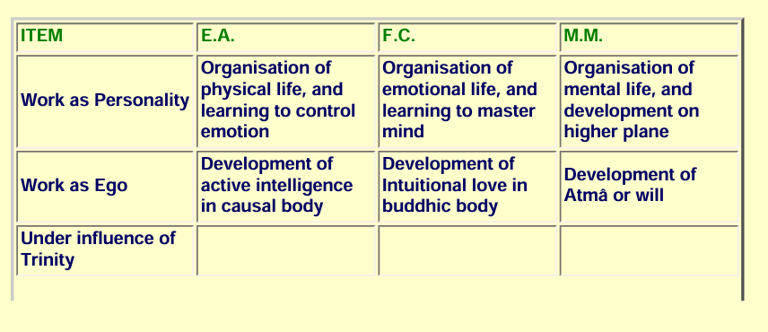
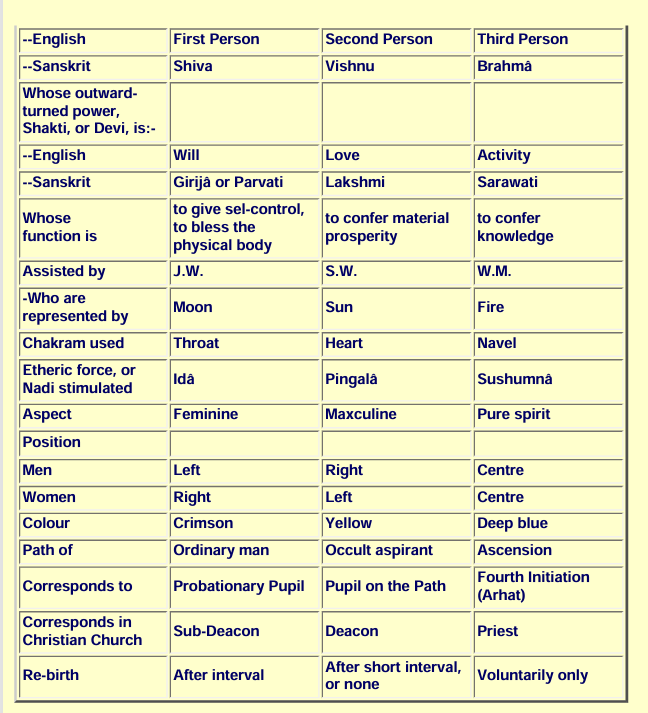
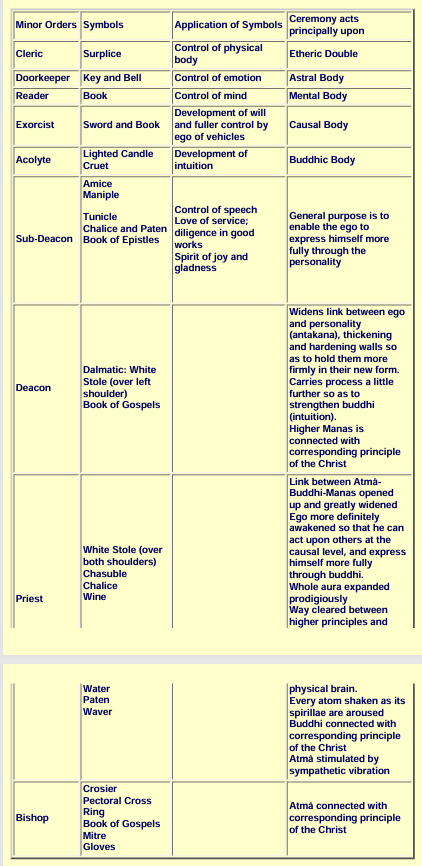
In the various Degrees in Freemasonry, not only is the link between the personality and ego widened, but also a link is formed between certain principles of the candidate and the corresponding vehicles of the H.O.A.T.F. The changes induced are somewhat of the same nature as those that occur in the Christian Church, as will be mentioned presently. The Lord Buddha was once asked by a disciple to sum up the whole of His teaching in one verse. He replied:------Cease to do evil-----Learn to do well-----Cleanse your own heart;-----This is the religion of the Buddha The student will recognise here a correspondence with the Masonic system, as well indeed as with other systems. The teaching of the First Degree is that of purification. The Second Degree instructs him to acquire knowledge. The Third degree instructs the man to rise to a higher level and to consider not merely the outward action, but also the inner condition of which all outer manifestation should be an expression. For purposes of reference and comparison the student may like to examine the following table, which sets out the main features of the system in Christianity, as followed in the Liberal Catholic Church
CHAPTER XXXIV
CONCLUSION
Few words are necessary in bringing to a close this study of man's mental body and the lower mental plane. It may, however, be useful to look back over the ground we have covered and endeavour to obtain a perspective view of the relative importance and significance of our subject matter, it its setting amongst the totality of our knowledge of modern Theosophy.
The student cannot help being struck by the great difference between the "atmosphere" of the mental world and that of the astral world –let alone that of the physical. By comparison with the mental world, the astral world is heavy, crude, turgid, and unsatisfying, even at its loftiest levels. However pure and refined the state of feeling to which it may raise us, we feel that we are still far from our true home.
The dignity of man's soul demands more than feeling, however pure and unselfish. The mental plane –even its four lower levels - conveys the impression that we are distinctly nearer "home". Here there is more of freedom; we feel that we are more the masters of our own consciousness, less the servants of our vehicles. The mental world seems a cleaner and more wholesome world, where we can shape our destiny nearer to our will than seems possible in the worlds we have left below us. Consciousness is freer to roam where it will, far less restricted by the limitations of space and time.
Nevertheless, mastery of even the lower mental world, of the totality of concrete thinking, leaves us still unsatisfied, for through it and beyond it we can plainly sense that there are yet fresh and greater worlds to conquer. This world of concrete thought is as far as we can go while we still belong to the lower planes. To plant our feet firmly on this thought-world, and reach upwards to the very abstractions of thought - his surely will bring us to the threshold of a world higher and purer, not only in degree, but in kind, than any of the lower worlds.
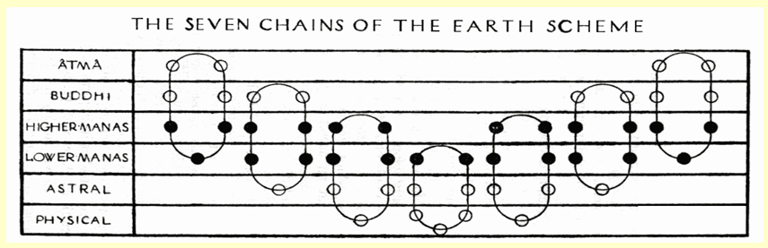
Through those abstractions we shall rise to the world of the spirit, and draw appreciably nearer to the God consciousness from which we feel and know ourselves to be temporarily exiled. But we must not minimise the vast importance of the lower mental world, especially at the present juncture in man's psychological history. Let us, therefore, recapitulate in briefest form the outstanding features which emphasise the importance of mind, and of the mental world, to men in their evolution. In the Scheme of seven Chains, to which we belong, every Chain has globes on the lower mental plane, while six of the seven Chains have also globes on the higher mental plane.
Of the forty-nine globes in all, twenty-four, or practically half, are on the mental plane. The following diagram sets out these facts clearly, the mental globes being blacked-in solid, in order to emphasise the points mentioned. The habitat of the ego, the Thinker, the one who endures throughout all reincarnations, is on the higher mental plane. The mental plane is the meeting-ground between the Higher and the Lower Selves.
The "Ray", which the higher or divine part of man projects into the lower worlds in order to carry out the purposes of evolution, is a ray of lower mind, emerging from the higher mind. The battleground of life to-day, for most men, is kâma-manas, the intermingling of mind with desire. The consciousness of most men to-day is centred in their feelings, in the astral body. Hence, the next immediate step for them is to learn to master feelings, to control the astral body; and this, as we have seen, can be achieved only from the plane above, from the mind.
The next step will be to raise the centre of consciousness from the astral to the mental world. The very name "man" means the thinker, the being possessing mind. Man, in Occultism, has been defined as that being in the universe, in whatever part of the universe he may be, in whom highest Spirit and lowest Matter are joined together by Intelligence. The development of mind in man has been expedited a whole Round by the influence of the Lords of the Flame.
In the next Round, the Fifth, the progress to be made in mental development must clearly be prodigious, and, to our limited minds as at present developed, in the nature of things inconceivably lofty. These few considerations, it is submitted, constitute a formidable array, and scarcely call for further comment; they are their own emphasis of the crucial importance to man, at his present stage, of the mind and the mental body - not indeed as a final achievement, but as a necessary stepping-stone to that future of man which, in the words of a Master, "is the future of a thing whose growth and splendour have no limit."
Nevertheless, whilst emphasizing one aspect of our work, and that an aspect unquestionably of great importance, it is necessary to preserve a careful sense of proportion and balance, giving to each element its due weight, and no more. Hence, as Annie Besant, and C.W.Leadbeater have writen, so far as the Theosophical Society is concerned, its great object is not so much to provide mental development as to raise those who are ready into responsiveness to buddhic influences, to re-awaken the sensitiveness of its members on a higher turn of the spiral, and to prepare them for the new race, now starting on its way in the world. The Society "does not deprecate mental development - far from it - but it prepares for the next stage, when intuitional love will produce harmony and brotherhood, and will emply the developed intellect to build a new civilisation, based on those ideals."