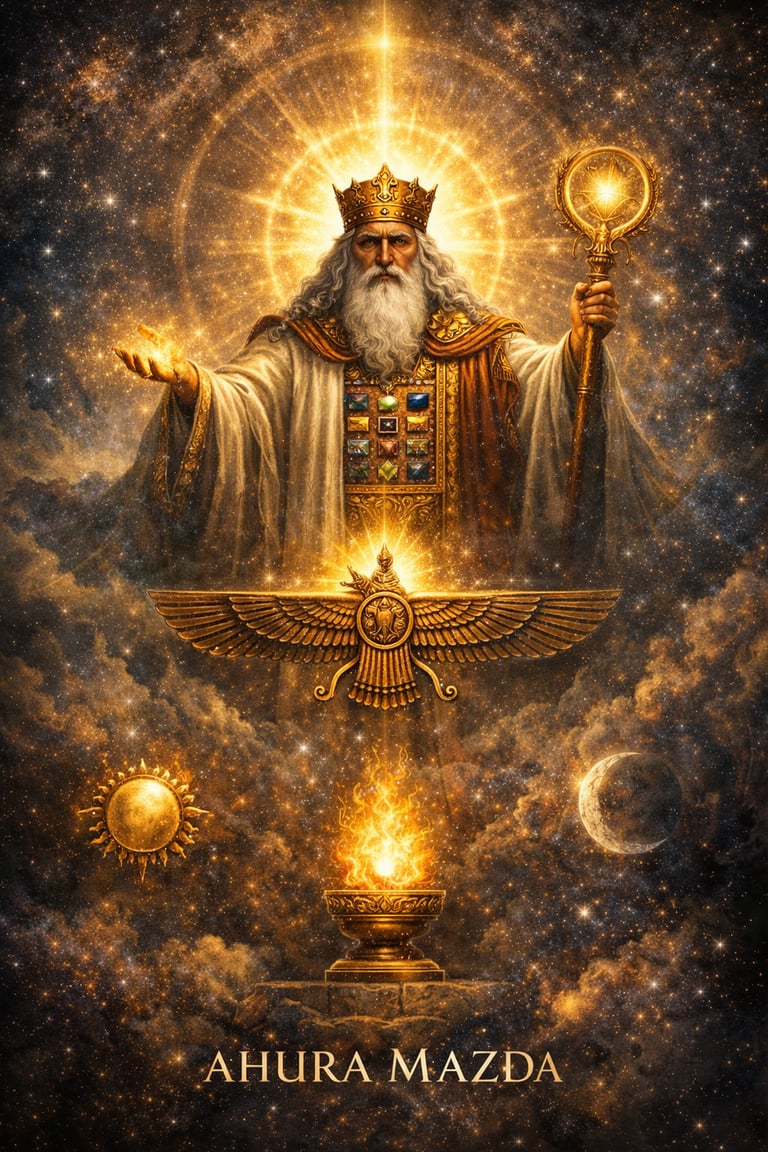
THE MESSAGE OF AHURA MAZDA
THE MESSAGE OF AHURA MAZDA. The Zend Avesta is the first sacred scripture of Iran. Seek the root of the word “Religion ” within this Book. In the Zend Avesta, the name of the Lord is Ahura Mazda. He says to His messenger Zarathustra: “Remember your Essence in prayer.
APOCALYPSE BOOK
THE MESSAGE OF AHURA MAZDA
The Zend Avesta is the first sacred scripture of Iran.
Seek the root of the word “Religion ” within this Book.
In the Zend Avesta, the name of the Lord is Ahura Mazda.
He says to His messenger Zarathustra:
“Remember your Essence in prayer.
For with Me, the essence of every human is equal.
Whoever finds their origin matures through realization.
A Flood is coming! Build a windowless ark like your heart.
It shines from within, for the soul is its master.
My Name means ‘Without Copy,’ that is, ‘Pure Light.’
Strive so that your shadow does not fall upon the earth.
For the earth is soulless matter—its name is Ahriman.
He is my adversary: he has neither religion nor faith.
We both emerged from Allah; we are essence-brothers.
I am Rahman, and he is Satan—have mercy on the blind.
My six twin rays are the architects of this universe;
Thus its construction took six days.
Three days before, the realm of spirits emerged from them:
Mitra and the Twenty-Eight Attributes of Glory—love them.
This is the essence of Mikail and the Twenty-Eight Prophets.
These ‘Exalted Ones’ bestowed light—you opened your eye to Me.
Mikail is Mitra—the Lord of Glory of the soul.
From the Glories, angels emerged—the sanctity of the soul.
Their name is Daena, for they pledged
to save matter from bondage.
They are My helpers against Satan.
They wage war on matter and bear the Throne upon their heads.
Thus half of Daena descends to Earth,
and the other half settles in the heart as Conscience.
The descending soul vows fidelity to its counterpart.
It settles in the brain; the counterpart dwells in the level called Fuad.
The one who descends from Daena is called Fravarti:
“One who chooses jihad on Earth”—the archetype of the knight.
The soul defeated by matter becomes the human devil;
the victorious one is called Adam—now know yourself.
As blind matter is overcome, vision becomes transparent.
Satan prostrates before Adam—My forgiveness emerges.
“My mercy thus prevails over My wrath.”
If you wish to be saved, strive to save.
Satan is seductive; his symbol is the peacock.
Escape gravity—climb the steep ascent.
The matter you embrace embraces you in return;
you become imprisoned in the body, pledging to Satan.
“One who is unbelieving in the womb is unbelieving;
one who is believing is believing.”
I do not write destiny—you inscribe your own.
Destiny is written upon the forehead—
the back of the forehead is the brain.
For right and wrong, say: “I chose this.”
The womb is the body; if the emerging soul is faithful, it is purified.
If unbelieving, it beholds a black witch and hides.
Conscience does not darken—
the “dark ego” intervenes.
“The sun is eclipsed”; the animal is exiled to the moon.
If faithful, one sees a Houri at the bridge’s head,
identical to oneself—exactly fourteen years of age.
She asks: “Who are you, virgin youth?”
When one answers “Your spouse,” Daena embraces them.
She asks again: “Why are you even more beautiful?”
She replies: “Because you always listened to your Conscience.”
“I am your honor, your covenant, your fortune, your faith—
in short, I am the Hanif Religion.
You cannot destroy me—even through betrayal;
you destroy only yourself with all your desires.”
They reunite as one soul and cross the bridge;
three days after death, they choose their abode in Paradise.
Yet until the war ends, there is no pleasure in Paradise;
matter awaiting the Mahdi remains chained in madness.
Dividing again, Daena returns to Earth;
service to My servant is the finest praise to Me.
With each integration, consciousness clarifies;
with every union, one draws nearer to Me.
When victory is attained, one enters another state—
an indivisible, radiant light.
“The true heir of the Earth returned to Paradise is born.”
That one is now Jesus the Messiah—every particle His disciple.
Each particle asks: “What am I?”
The Mahdi replies: “You are a pure angel seeking identity.
To find yourself, you must descend to Earth;
one approaches the Divine Essence by polarity and realization.”
Let us return to the Bridge, O Zarathustra—
maturity is attained by crossing it.
The Bridge is the Supreme Court; Mitra is the Judge.
Judgment is rendered solely by the image of the face.
The Bridge is the Straight Path;
there good and evil diverge.
“The radiant-faced pass; the dark-faced fall.”
Mitra—the Sun—distinguishes the fair from the dark;
the twenty-eight lunar days scatter rays of Glory.
Saoshyant, that is, the Mahdi, shall descend from the Sun;
the darkness called matter and ego shall fade.
“The Mahdi is the Twelfth Imam”—why?
Because the Sun governs twelve months.
“At twelve, they coincide—the hour and the minute hand.”
“At the Hour, the Sun enters the Moon”—the Court is convened.
Thus the Qur’an calls the Resurrection “The Hour.”
Fasting follows the Moon; prayer follows the Sun.
“Twelve is both the beginning and the end of time,”
like the dot beneath the letter B—understand this.
I too have a Lord—My primal Essence.
Through my Lord’s lens, my eye beholds Allah.
Though present before Allah, the primal essences
yearn to descend as Rahman, to become Khidr.
The veil of Allah’s Essence is infinite time and space;
its name is Zervan—do not attempt to lift the veil.
When you return for the final time, your name shall be Mahdi,
and the world shall become transparent—humanity shall mature.
Why do we kiss the earth in prayer?
We call Spenta Armaiti by the name Sekine (Shekinah).
She is the virgin soul of the Earth;
the Earth is her nine-fold folded body.
We release Sekine (Shekinah)—angel, glory, Mitra, and Me.
Release your Sekine—let your body become the Kaaba.
Call upon your own Essence, Zarathustra—not Me;
for I am your Essence—bow to the level you emerged from.”
Thus spoke Ahura Mazda to Zarathustra.
The Zend Avesta is the fifth sacred book in the Qur’an.
For Ahura Mazda, Jesus says “My Father,”
for He has become Rahman, the Father of Jesus Christ.
Daena in Pahlavi, Den, and in Arabic Dîn—
this is the Hanif, Primordial Religion—now submit.
The Zend Avesta contains the secret of Adam, as does the Qur’an;
find your Adam and remember Me with mercy.
The final couplet is the “royal verse”—here the speech ends.
It belongs to the Sovereign born in the Sacred House.
“Pray always to Ahura Mazda—
for Lord-Muhammad-Ali is Ahura Mazda.”
Master M.H. Ulug Kizilkecili
Türkiye/Ankara - November 11, 1998
IMPORTANT NOTE :The original text is poetic, and the author cannot be held responsible for any errors in the English translation! To read the original Turkish text, click HERE! The following section is not the author's work, and the author cannot be held responsible for any errors made!
1. Ahura Mazda and the Zend Avesta
The text correctly identifies Ahura Mazda as the supreme deity of Zoroastrianism, whose name literally means “Wise Lord” (Avestan: Ahura = lord, Mazdā = wisdom). In the Zend Avesta, Ahura Mazda is not a creator ex nihilo in the Abrahamic sense, but the principle of wisdom, truth (Asha), and light governing the cosmos.¹
The claim that the Zend Avesta is the “first sacred scripture of Iran” is broadly acceptable in historical terms, though the Avesta reached its written form over centuries and survives fragmentarily.²
2. “Religion / Dīn / Daēnā” as Consciousness
The text’s etymological link between religion and Daēnā is significant. In Zoroastrian thought, Daēnā refers to inner vision, conscience, or self-awareness, especially as encountered after death.³
This is then linked to Arabic dīn, which in the Qur’an does not merely denote ritual law, but a comprehensive orientation of existence (cf. Qur’an 30:30 on fitrah).⁴
Academically, this is a conceptual parallel, not a linguistic derivation, but it reflects a long tradition of comparative religious symbolism.
3. Equality of Essences and Fitrah
The assertion that “the essence of every human is equal” resonates strongly with Islamic anthropology. The Qur’anic doctrine of fitrah holds that all humans share an original disposition oriented toward the Divine.⁴
In Zoroastrian ethics, humans are likewise morally responsible agents capable of aligning with Asha (truth) or Druj (deceit). The text fuses these ideas into a single metaphysical anthropology.
4. Flood and the “Windowless Ark”
The “windowless ark like the heart” is a mystical reinterpretation of the Flood motif. While the Flood narrative is central to the Bible and Qur’an (e.g., Qur’an 11:37), the text internalizes the ark as the heart, a move common in Sufi literature.⁵
The absence of windows symbolizes inward illumination, rather than reliance on external signs.
5. Light, Shadow, and Ahriman
The opposition between pure light and shadow/matter reflects Zoroastrian dual symbolism, where Angra Mainyu (Ahriman) represents destructive consciousness.⁶
However, the statement that Ahura Mazda and Ahriman are “essence-brothers” departs from orthodox Zoroastrian doctrine and reflects later Zurvanite and mystical reinterpretations, not the Gathas themselves.⁷
The text reframes evil not as an independent power, but as blindness, aligning more closely with Islamic mystical theology.
6. Six Days, Six Rays, and Cosmic Order
The reference to “six twin rays” and “six days” connects:
the Zoroastrian Amesha Spentas (six divine attributes), and
the Qur’anic motif of creation in six days (Qur’an 7:54).
In academic theology, both are understood symbolically as ordered stages, not literal solar days.⁸
7. Mitra, Mikāʾīl, and Judgment
Mitra in Zoroastrianism is the guardian of covenant, light, and judgment, especially at the postmortem bridge.⁹
The identification of Mitra with the Islamic angel Mikāʾīl (Qur’an 2:98) is not doctrinal, but symbolic, based on shared functions of cosmic order and sustenance. This reflects a functional equivalence, common in comparative mysticism.
8. Daēnā, Fravaši, and Moral Identity
The description of Daēnā appearing as a beautiful or terrifying figure after death is textually grounded in Zoroastrian sources (e.g., Vendidad 19).³
The Fravaši is understood as a pre-existent spiritual aspect that chooses embodiment—a concept that resonates with late antique ideas of descent and return, though it should not be equated directly with Islamic doctrines.¹⁰
9. Bridge, Face, and Judgment
The Chinvat Bridge of Zoroastrianism and the Ṣirāṭ Bridge in Islam (Qur’an 19:71) are among the clearest cross-traditional parallels.
Judgment by the “face” echoes Qur’anic imagery of faces being radiant or darkened (Qur’an 3:106). The bridge functions as a moral revelation, not merely a physical crossing.¹¹
10. Saoshyant, Mahdi, and Messiah
The Saoshyant is the eschatological restorer in Zoroastrianism. The text explicitly equates Saoshyant with the Mahdi (Islamic eschatology) and ultimately with Jesus the Messiah, forming a unitive eschatological figure.
From an academic standpoint, this is a syncretic construction, not supported by any single tradition independently. However, it reflects a well-documented pattern in mystical universalism.¹²
11. Time, Zervan, and the Veil
Zurvān (Zervan) represents infinite time in Zurvanite Zoroastrianism. The text’s warning not to “lift the veil” aligns with apophatic theology in both Islamic and Neoplatonic traditions, where ultimate essence transcends time and space.⁷ ¹³
12. Earth, Spenta Armaiti, and Shekinah
The identification of Spenta Armaiti (earth, devotion) with Shekinah/Sekine (divine indwelling presence) is a symbolic bridge between Zoroastrianism, Judaism, and Islam.
Kissing the earth in prayer is interpreted as reverence for sacred immanence, not earth-worship.¹⁴
13. “Zend Avesta as the Fifth Sacred Book”
The claim that the Zend Avesta is the “fifth sacred book” in the Qur’an is not textually supported. The Qur’an names the Torah, Psalms, Gospel, and Qur’an itself. This statement must therefore be read as mystical reclassification, not canonical theology.¹⁵
Conclusion
Academically, The Message of Ahura Mazda represents:
a mystical synthesis,
drawing on Zoroastrian symbolism,
interpreted through Islamic metaphysics and eschatology,
with universalist and Sufi resonances.
It should be categorized as comparative mystical theology, not doctrinal Zoroastrianism or orthodox Islam.
Footnotes
Mary Boyce, Zoroastrians: Their Religious Beliefs and Practices (London: Routledge, 2001).
Prods Oktor Skjærvø, “The Avesta as Source,” Encyclopaedia Iranica.
Vendidad 19; Boyce, Zoroastrians, ch. 8.
Qur’an, 30:30.
Annemarie Schimmel, Mystical Dimensions of Islam (Chapel Hill: UNC Press, 1975).
Zend Avesta, Yasna 30.
R. C. Zaehner, Zurvan: A Zoroastrian Dilemma (Oxford: Clarendon Press, 1955).
Qur’an, 7:54.
Mihr Yašt; Boyce, Zoroastrians.
Skjærvø, “Fravaši,” Encyclopaedia Iranica.
Qur’an, 19:71; 3:106.
Mircea Eliade, Patterns in Comparative Religion (Lincoln: University of Nebraska Press, 1996).
Plotinus, Enneads; Nasr, Knowledge and the Sacred.
Gershom Scholem, Major Trends in Jewish Mysticism (New York: Schocken, 1946).
Qur’an, 2:136; 5:44–48.
Comparative Academic Examination
The reference to “Zend/Avesta” in the poem places the Zoroastrian intellectual world at the center of the text. The tradition of the Yashts (hymns of praise to the Yazatas/divine beings) within the Avesta—especially through texts such as the Mihr Yasht (Mithra) and the Frawardin Yasht (Fravashis)—makes it possible to understand the mythological and ritual background of concepts such as “Mitra,” “Daenâ,” and “Fravarti” that appear in the poem.¹²³
The backbone of the poem is the dramatic narration of the moral/cosmic duality (good–evil). The tension between Ahura Mazda (Ohrmazd) and Ahriman (Angra Mainyu) has been framed theologically in different ways across various periods of Zoroastrianism.⁴ The text also approaches the interpretive line known as Zurvanism through the veil of “Zervan/Time.” In some narratives, “Time/Zurvan” is conceived as above or at the source of the twin opposites; modern scholarship emphasizes that this could have been an influential interpretation in Sasanian circles, yet the distinction between “orthodoxy–heresy” is historically complex.⁵⁶
The prominent motif in the poem’s depiction of the afterlife is the Chinvat Bridge (threshold of judgment/separation) in Zoroastrianism and the encounter of the person with their daēnā at this threshold. Daēnā is a multilayered concept encompassing both the semantic field of “religion/doctrine” and the post-mortem narrative of the “figure/maiden appearing on the bridge.” Iranian studies literature discusses in detail the root and semantic relationship between these two references.⁷ In this context, expressions in the poem such as “seeps into the heart as conscience” produce a reading close to the theme of daēnā as “the person confronting oneself”: daēnā is associated not so much with an externally imposed judge as with the idea of “the recognition/perception of truth.”⁷
The line in the poem, “Half of Daena descends to the earth / the other half seeps into the heart as conscience,” also resonates with the concept of fravaši (fravashi) in Zoroastrianism. The Fravashis, extensively treated in the Frawardin Yasht, are described as beings attributed with protective/helping qualities; they can be conceived both collectively (ancestors, heroes) and individually.²⁸ Therefore, expressions in the poem such as “choosing jihad on earth” are more suitably read not through modern terminology but as a poetic recoding of participation in the cosmic struggle along the axis of “good thoughts–good words–good deeds” (otherwise a direct transfer of Islamic terminology would arise and the risk of historical-conceptual anachronism would increase).
The identification of “Mitra/Michael” constitutes both an attractive and problematic example in comparative religion. Mitra/Mithra, in the Avestan tradition, is a yazata associated with themes such as covenants, truth, supervision, and light; his connection with the sun is strong, yet in the early Avestan layers a complete identification of “Mitra = Sun” is not always explicit; in later texts the relationship acquires varying intensities.³⁹ By contrast, “Michael” is positioned within a distinct genealogical framework in the Hebrew-Christian-Islamic angelic tradition; parallels drawn between the two figures are usually established through functional similarities (light, protection, divine order), yet claims of “identity” are treated cautiously in academic literature. A more solid comparison can be made through the functional similarities of “heavenly intermediary beings” (yazata/angel) across different religions.¹⁹
The “Saosyan/Mahdi” line in the poem approaches the Zoroastrian horizon of the future savior (saošyant) and the “renewal of the world” (frašō.kərəti / frashokereti). Although translating “saošyant” as “savior” is common, reference works such as Iranica note that this carries Christian theological connotations; more neutral equivalents such as “benefactor/helper” may also be preferred.¹⁰ This point is critical for comparative reading: although parallels are drawn between the Messiah in Christianity, the Messianic expectation in Judaism, the Mahdi in Islam (with sectarian variations), and the saošyant horizon in Zoroastrianism, the textual foundation, historical development, and dogmatic position of the figure differ in each tradition.¹⁰¹¹
It is also possible to relate the bridge-judgment imagery to Islamic narratives of the Ṣirāṭ (bridge), yet it is necessary to preserve the distinction between “influence” and “similarity.” In Islamic eschatology, the main framework of reckoning, resurrection, and judgment is established within the Qur’an and hadith tradition; the bridge motif may appear in various forms within the broader religious imagination of the Near East.¹² From an academic perspective, it is healthier to speak through intermediary categories such as shared cultural milieu, Late Antique themes, and types of eschatological narrative rather than asserting “direct borrowing/influence.”
The claim in the poem that “Zend Avesta is the fifth holy book in the Qur’an” is, in light of academic sources, difficult to substantiate: there is no canonical list of “five holy books” in the Qur’an, and the textual tradition of Zoroastrianism (Avesta, Zend commentaries, etc.) has been discussed with different statuses in Islamic tradition across different periods. Therefore, in footnoting, such sentences should be marked as the “theological-poetic claim of the poem”; the historical-juridical/theological debate should be separately sourced (otherwise the statement appears as an “academic fact”).
EXPLANATIONS
Mitra / Mithra
Mitra (Avestan Mihr) is defined in Zoroastrianism as a celestial being who provides divine support to values such as covenants, order, and truth. In narratives of post-mortem judgment, he stands alongside the judge and is associated with the moral reckoning of the soul’s life. The association of Mitra with the sun is a symbolic resemblance due to limited historical contexts; in early Avesta texts there is no direct identification with a solar deity. This figure later extended beyond the boundaries of Iranian religious tradition and crossed cultural frontiers with various influences.
Mitra may resemble functionally the celestial intermediaries in Christianity and Judaism; however, establishing a direct identity neglects historical context. The similarity is shaped through functional motifs among figures associated with celestial order and justice.
Daenâ
Daenâ in Zoroastrianism encompasses semantic fields such as “consciousness, awareness, conscience.” In the post-mortem conception, when the person arrives at the bridge, Daenâ becomes a projection of his or her way of life; for one who has lived well, she appears as a radiant and beautiful woman; for one who has lived badly, as a dark figure. This motif is a metaphor for the individual seeing within oneself the spiritual consequences of one’s choices.
This concept may also be found in other religions in themes such as conscience, spiritual judgment, and moral inquiry; however, in Zoroastrianism it is symbolized as the personal manifestation of a spiritual guide.
Fravarti / Fravashi
Fravashi is understood as the divine reflection of the individual soul and is seen as a force protecting the person from the dark influences of the material realm. Applicable to the living, the dead, and even the unborn, this concept represents a protective spiritual support connected to the individual’s essential self. The function of the Fravashi is to support the person’s development along the axis of “good thoughts–good words–good deeds” and to grant sensitivity against dark principles.
This motif may recall concepts such as “guardian spirit” or “higher self” in other religions; however, within the Zoroastrian context it possesses its own unique historical and symbolic framework.
Ahriman (Angra Mainyu)
In Zoroastrian cosmology, Ahriman is the divine counterpart of evil and destructive forces. The duality he forms with Ahura Mazda constitutes the center of the cosmic conflict. Ahriman is symbolized as a principle parallel to matter and unregulated desires, seeking to divert the individual from the right path.
This narrative reflects the motif of the “struggle between good and evil” found throughout ancient Near Eastern religious thought; although historically it shares overlapping aspects with dualist interpretations in other religions, it occupies a unique position within its own belief system.
Zervan / Time
Zervan expresses the conceptualization of “time” in Zoroastrianism and in some interpretive systems has been conceived as the source of cosmic duality. The nature of time symbolizes both the continuity and change of existence. Although this approach may appear parallel to reflections in other traditions that question the metaphysical role of time in religious thought, Zervan is a metaphysical category unique to its own context.
For this reason, Zervan is not treated as absolute good or evil but as the ongoing time of existence.
Chinvat Bridge
The Chinvat Bridge symbolizes the post-mortem passage in Zoroastrianism. The soul crosses this bridge according to the moral balance of its life; the nature of the crossing depends on the individual’s life choices. This bridge metaphor concretizes the theme of spiritual progression and reckoning.
A similar motif can be found in Islamic eschatology in the crossing over the Ṣirāṭ and in Christian depictions of the Last Judgment. However, each textual tradition handles this theme within its own paradigm; therefore, while similarities may be drawn, identity should be avoided.
Saošyant
The concept of Saošyant represents in Zoroastrianism the figure perceived as the future savior or healer. This figure is associated with humanity’s ultimate salvation and rebirth. This approach may carry functional parallels with eschatological hope themes in various religions; however, the historical and conceptual context of “salvation” in Zoroastrianism differs.
This motif is a rich example of how the expectation of a savior takes shape in different cultures and should be evaluated according to each tradition’s historical system.
CONCEPTUAL SUMMARY
• Mitra: Celestial representative of order, covenants, and justice.
• Daenâ: Post-mortem judgment figure as reflection of conscience-consciousness.
• Fravashi: Personal divine support and guardian spirit.
• Ahriman: Metaphysical counterpart of evil.
• Zervan: Cosmic category of time.
• Chinvat Bridge: Post-mortem moral passage and judgment metaphor.
• Saošyant: Manifestation of salvific expectation in Zoroastrianism.
QUR’AN – GOSPEL – TORAH – ZEND AVESTA COMPARISON
1️⃣ Mitra – Michael – Sun Symbolism
🔹 Zoroastrianism
• Mitra (Mihr): Being of covenant, order, truth, and cosmic supervision.
• Takes part in post-mortem judgment.
• Symbolically associated with light and the sun; however, early texts do not clearly equate “Mitra = Sun.”
🔹 Qur’an
• Michael (Mikāʾīl): Unlike Gabriel, who brings revelation, he is associated with sustenance and the order of nature.
• One of the angels tasked with executing divine order.
• Not directly associated with the sun.
🔹 Torah / Gospel
• Michael: Commander of God’s armies, protective archangel.
• A cosmic combat figure especially in Daniel and Revelation.
• No sun symbolism; rather themes of war and protection.
2️⃣ Daenâ – Conscience – Self-Accountability
🔹 Zoroastrianism
• Daenâ: Consciousness, perception of truth, religious awareness.
• Appears as a “female figure” at the Chinvat Bridge.
• Mirror of one’s lived life.
🔹 Qur’an
• Concepts of “nafs,” “conscience,” “heart.”
• Human being is witness to his deeds.
• Deeds are revealed at the Resurrection.
🔹 Torah / Gospel
• Theme of “conscience” and “Day of Judgment.”
• Final Judgment in Revelation.
• Inner moral reckoning in Pauline letters.
3️⃣ Fravashi – Guardian Spirit – Angel
🔹 Zoroastrianism
• Fravashi: Divine essence or guardian spirit of the individual.
• Applicable to living, dead, and unborn.
• Supports against evil.
🔹 Qur’an
• Guardian angels (ḥafaza).
• Recording and protecting beings over humans.
🔹 Torah / Gospel
• Belief in guardian angels.
• Implied especially in Psalms and Matthew.
4️⃣ Ahriman – Satan – Iblis
🔹 Zoroastrianism
• Ahriman (Angra Mainyu): Cosmic principle of evil.
• Opponent of Ahura Mazda.
🔹 Qur’an
• Iblis/Satan: Being who rebels against God.
• Not an independent divine power; created.
🔹 Torah / Gospel
• Satan: Figure opposing God.
• Dragon/devil symbolism in Revelation.
5️⃣ Zervan – Time – Eternity
🔹 Zoroastrianism
• Zervan: Metaphysical principle of time.
• In some interpretations, source of good and evil duality.
🔹 Qur’an
• Concept of “Dahr.”
• Time is created by God, not divine.
🔹 Torah / Gospel
• God stands above time.
• Time is a created dimension.
6️⃣ Chinvat Bridge – Ṣirāṭ – Final Judgment
🔹 Zoroastrianism
• Chinvat Bridge: Moral passage point of the soul.
• Expands for the righteous, narrows for the wicked.
🔹 Qur’an
• Ṣirāṭ Bridge: Passage in the Hereafter.
• Crossing becomes easy or difficult according to deeds.
🔹 Gospel
• Final Judgment (Judgment Day).
• Courtroom metaphor rather than bridge.
7️⃣ Saošyant – Messiah – Mahdi
🔹 Zoroastrianism
• Saošyant: Future savior.
• Renews the world and ends evil.
🔹 Judaism
• Messianic expectation.
• Savior to come from the line of David.
🔹 Christianity
• Messiah (Jesus).
• Second coming and final salvation.
🔹 Islam
• Mahdi (with sectarian variations).
• Establishes justice before the Day of Judgment.
GENERAL CONCLUSION
There are striking similarities and significant differences between Zoroastrianism and the Abrahamic religions. One of the primary differences concerns the understanding of cosmic order. Zoroastrianism presents a strong cosmic dualism. There is an ontological opposition between good and evil, light and darkness, truth and falsehood. This opposition is concretized in the struggle between Ahura Mazda and Angra Mainyu (Ahriman). The universe is conceived as the arena of conflict between these two principles.
In contrast, the Abrahamic religions (Judaism, Christianity, and Islam) are grounded in a strict monotheistic structure. Absolute power belongs to one God; evil is not an independent principle but arises from the deviation of a created being (for example Satan) or from human choice. Therefore, this is not an ontological dualism but a moral opposition.
Similar themes are also observed in the understanding of post-mortem judgment. In Zoroastrianism, the soul passes over the Chinvat Bridge after death. This bridge narrows or widens according to one’s deeds in the world. For the righteous, the passage is easy; for the wicked, it results in a fall. The Abrahamic religions also contain a similar idea of reckoning and passage. In Islamic tradition, the concept of the Ṣirāṭ Bridge exists, and generally the notion of divine judgment is present across all Abrahamic religions. However, this system is based on the absolute judgment of one God; there is no balance between two independent cosmic powers.
Parallels are also notable in the belief in a savior. In Zoroastrianism, there is a figure called Saošyant. This figure appears in the apocalyptic period, eliminates evil, and purifies the world. Similar eschatological expectations exist in the Abrahamic religions. In Christianity, the Second Coming of the Messiah; in Islam, the Mahdi and the return of Jesus are evaluated within this framework. However, while in Zoroastrianism the savior completes the final stage of the cosmic struggle, in the Abrahamic religions salvation ultimately occurs by the will of God.
The understanding of conscience is also conceptualized differently. In Zoroastrianism, Daenâ is seen as the spiritual manifestation of a person’s beliefs and actions; it is like a form of consciousness encountered after death. In the Abrahamic tradition, the concepts of nafs and conscience are emphasized. Human beings are endowed with the ability of inner reckoning, and moral responsibility is shaped through this consciousness. Here, conscience functions as an inner guide given by God.
Regarding the concept of a guardian spirit, Zoroastrianism contains the concept of Fravashi. Fravashi is considered the divine-origin protective essence or spiritual guide of the individual. In the Abrahamic religions, the concept of angels exists. Angels are described as beings who carry out God’s commands, protect humans, or record their deeds. However, while Fravashi displays a more individual structure tied to the metaphysical essence of the person, angels are accepted as independently created beings.
In general, although there are thematic similarities between Zoroastrianism and the Abrahamic religions in areas such as eschatology, judgment, savior, and the understanding of the soul, there are clear distinctions in ontological foundation and conception of God. Zoroastrianism presents a system built upon cosmic dualism, whereas the Abrahamic religions are shaped around the understanding of absolute monotheism.