THE MESSAGE OF KRISHNA
THE MESSAGE OF KRISHNA. ‘Name of the Sun — your LORD’s own Name’; ‘Mary’s son, Isa LORD’; And Bektaş shares the number’s seal — Krishna, Abu’t-Turab adored. ‘Ali Abu’t-Turab’ — the same — Maha Krishna’s sign; Add one number to Bektaş — know this secret line.
APOCALYPSE BOOK
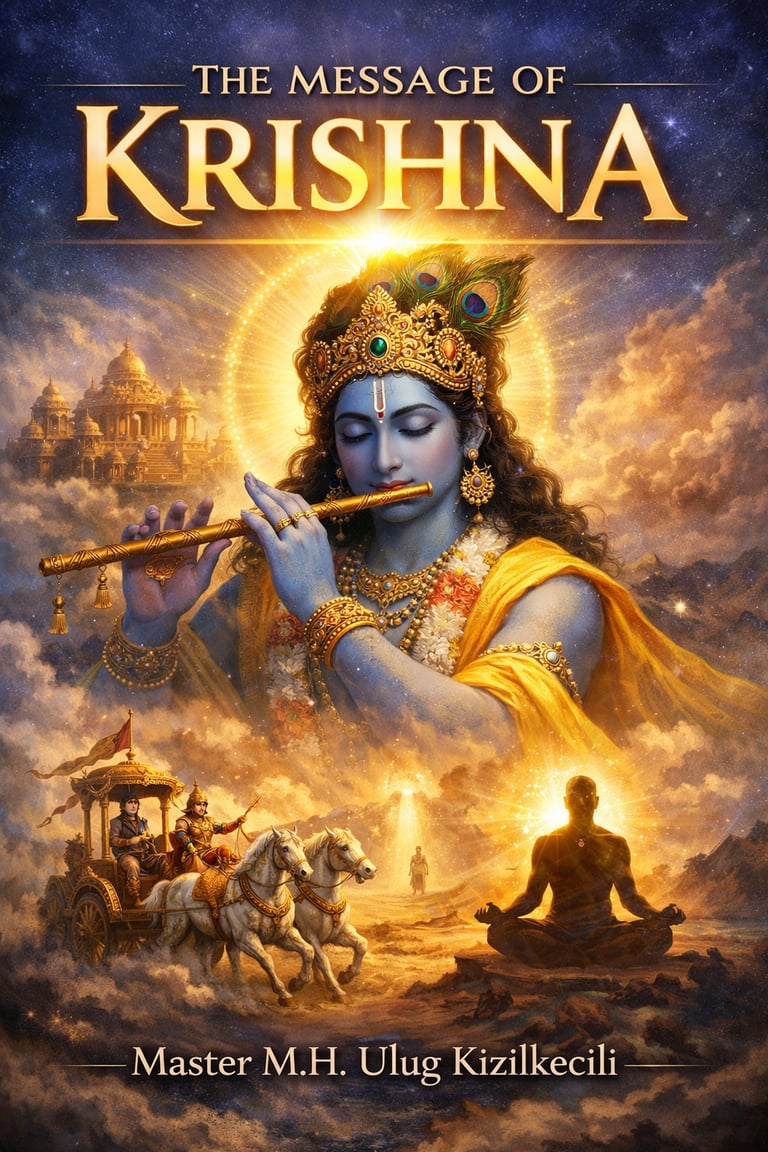
THE MESSAGE OF KRISHNA
The Hindu sacred book is called “Bhagavad Gita,” so told;
Krishna spoke it in his LORD’s Name — a wisdom bright and old.
Now listen to the word of Krishna, hear its hidden call;
As this friend reached unto ALLAH, so let your selfhood fall.
“There stand four changeless pillars: ALLAH! VEIL! LORD! SPIRIT!
Learn each well — be not blind crowds who wander, lost in spirit!”
I — ALLAH
ALLAH is the cosmos’ body — as Spirit pure in frame;
The LORD His mind within that Whole — all powers His domain.
ALLAH is infinite — in infinity each point the center stands;
Each point He veils with covering — by unseen, sovereign hands.
The veil — the root of matter’s birth — the body of ALLAH’s might;
It hides the Maker from the made — conceals Him from their sight.
Through this existence ALLAH gives existence unto all;
Countless are His Names proclaimed — yet One beyond them all.
What is Infinity? No tongue has answered what it be;
Thus ALLAH’s Name became but ‘He’ — pure hidden Majesty.
What He is cannot be grasped — no mind can comprehend;
But what He is not — know by this: His Being knows no end.
Since He cannot cease to be — existence is His due;
He is your endless Essence — bow in prostration true.
He never changes His own Law — the Law and He are One;
That Law is called the ‘Fitrah Way’ — before all worlds begun.
Within ALLAH the Essence knows Itself without divide;
He knows Himself by His own Self — none other stands beside.
He knows — yet never can be known; He sees — yet is unseen;
Concealed within Himself alone — no second in between.
II — LORD
Each point of ALLAH is an eye — a pore through which He sees;
Through these called LORD the Essence views the cosmic mysteries.
The LORD cannot behold His Essence — for between them stands the veil;
‘He who wraps Himself in covering’ — find that truth without fail.
ALLAH the center of the LORD — the LORD the Spirit’s core;
The one who turns that secret axis — ‘Qutb’ forevermore.
What lies concealed in ALLAH appears in LORD alone;
Who seeks the Essence face to face — by madness is overthrown.
Within the LORD are three bright traits: Life (body), Consciousness, True Knowing;
The Spirit draws them from the LORD where longing’s fire is glowing.
ALLAH’s self-awareness shines within the LORD made clear;
Who knows himself affirms the truth — who knows not falls to fear.
With every LORD the Essence wears another self-aware ray;
Infinite the LORDs that are — in every point He lay.
Each LORD bears a different Name — remember what is known:
The LORD of this our universe — ‘Maha Vishnu’ is shown.
Each solar system ‘universe’ in subtle speech is named;
Our Sun’s own LORD is Vishnu — let this be well proclaimed.
The LORD the Sun — the Spirit its ray that from it streams;
It carries what the LORD contains — fulfiller of His schemes.
The LORD clothes the Spirit — as the Sun clothes forth its light;
Formless — in each system new — in every moment bright.
III — SPIRIT
The Spirit bursts forth from its LORD — first on the veil it streams;
The veil unchanged — yet matter springs — the greatest of all themes.
With copied body Spirit builds three worlds in layered span;
Religion names them physical realm, Hell and Paradise for man.
From matter come three bodies shaped: physical, pure, and clear;
Mineral, animal, human — consciousness their sphere.
Matter first stands naked bare — the Spirit clothes its frame;
From the LORD it sends down every trait that matter claims.
Atomic order, heat and light, repulsion and embrace;
All are seeds the Spirit sows in matter’s darkened space.
Thus Spirit is conscious power — not blind as matter’s clay;
Steady energy — bow before its deathless Face today.
The fire of Hell and light of Heaven belong to Spirit’s flame;
Matter only inherits — it does not own the claim.
The LORD says, ‘Fire, do not burn!’ — and Abraham stands free;
Matter too a trustee is — though few the truth can see.
Sekine (Shekinah) means a dwelling — the Spirit’s home the LORD;
‘Enter by the door,’ it says — lest ruin be your reward.
IV — CONSCIOUSNESS
The brain and thought produce not consciousness at all;
Both are blind as matter’s dust — the pearl within the shell.
In the LORD lies hidden pure awareness’ central light;
The Spirit bears it to the form — by density made bright.
Beyond the five known senses lie two more in secret cast:
Intellect and self-awareness — where many fall at last.
The Spirit draws them into sight — all hidden in the veil;
Evil from the veil is born — from Spirit goodness hails.
For when the Spirit reflects upon the veil, matter appears;
The blind devil first denies his LORD in pride and fears.
The Spirit strives to cleanse each form that it may brightly shine;
Reflecting like a mirror true the Maker’s Face divine.
Clear and wave-less water shows the face in perfect art;
Do not muddy bodies with desire — seek the hidden Heart.
Light on mirror gleams in truth — on tin it blurs the ray;
Reflected on a wall at last — the form has passed away.
Pure, translucent, physical forms — like mirror, tin, and wall;
Human, animal, mineral — consciousness in all.
Yet all three bodies are but matter — none holds awareness’ seed;
Each consciousness a ‘reflection from its LORD’ indeed.
Even human consciousness — illusion, mirage, a gleam;
One true Consciousness alone — the LORD supreme.
The Spirit transmits the LORD’s awareness to the threefold frame;
The Friend says ‘He’ for self — the stranger says ‘I’ in name.”
V — THE HEREAFTER
Man dies — when Spirit breaks from pure Life (body)’s fragile tie;
No worldly knowledge crosses where the silent dead ones lie.
The dead are paid according to the consciousness they bore;
‘Go — to Heaven, Hell, to mineral!’ resounds at death’s dark door.
Beyond that realm what journeys on is consciousness alone;
Mineral — a conscious Life (body) — first to judgment thrown.
Who denies the Lord, the Lord returns to him his due;
Who clings unto his corpse dissolves with corpse from view.
In Hell the animal Life (body) first delights in flame;
For formed from fire it was by the One who gave it frame.
Then comes the devil’s shattering — dismembered part by part;
Till every atom’s torn away by the LORD’s burning wrath.
Though the corpse be burned to ash, its atoms still remain;
Each Zabani takes his share and claims his right again.
When the medium dies, a jinn devours the beastly frame;
Long-lived is that jinn — imprisoned burns the same.
When the jinn itself shall die, Zabani claims once more;
Within another summoned jinn the captive they restore.
‘Chained to seventy cubits’ — thus the sentence cast;
Such the wage of joining with the devil’s path.
One who takes his life will feel fierce longing for Life (body)’s breath;
He comes disguised in falsehood — keep far from such a death.
The pure Life (body) enters Heaven, fine as woven air;
Yet back to Earth it shall return when longing is not there.
For it bears no LORD-consciousness — human mind is made;
Who enters not his LORD has no immortal share.
If pure Life (body), stained, receives no Spirit’s light;
‘It shall not be born to Earth!’ — the cord was cut in life.
‘The unforgiven sin’ — so this betrayal named;
To wound the Holy Spirit ends in being’s flame.
If one should call a Lord’s Saint ‘LORD’ in blinded sight;
His pure Life (body) swallowed is in Heaven’s hidden light.
On the Last Day when Essence stands with Lord’s Saint and LORD;
From zero starts the captive’s endless dark reward.
Associating partners with the Lord — even the Lord restores not part;
The sought LORD dwells within the heart — prayer unveils that heart.
VI — THE FRIEND
When conscious human Life (body) is purified entire;
The veil appears within him and Spirit’s mirrored fire.
If he chooses the veil, to Essence he will flow;
If he chooses the Spirit, his LORD extends His glow.
No longer servant of his LORD — His Friend he then shall be;
Fulfilled the ancient covenant made in eternity.
To be the Friend of the LORD resembles no other love;
No Heaven in the universe but in the LORD above.
The LORD strips off the human skin of one who enters near;
With ‘color of ALLAH’ dyes the friend of Fitrah clear.
The Life (body) falls away — consciousness made new;
The Spirit clothes him bright — no greater joy is true.
Then the Friend feels like his LORD in resonance and tone;
ALLAH says: ‘My friend’s own friend is Mine before the Throne.’
Though parallel his vibration to the One he mirrors there;
He is not the selfsame LORD — but mirror bright and fair.
Always near his LORD he stands — yet never side by side;
‘Final Refuge Heaven’ — the ‘Limit’ where souls abide.
If one veil falls beneath the LORD in trembling tone;
He stays below the Limit — the ‘Assembly’ not his own.
Their only longing is to see their LORD’s unveiled Face;
To hear alone His word brings not sufficient grace.
The Spirit is called the LORD’s veil — for through it He is shown;
The LORD clothes Himself in Spirit that He be known.
The LORD is formless — changing in each system’s frame;
Say: ‘In constant act is He’ — unceasing is His flame.
The Spirit shows the LORD; the veil hides ALLAH’s Light;
Thus ends the borrowed energy on the Final Night.
Paradise and Hell shall fade — mirages disappear;
Only friend to friend remains prostration clear.
Then ALLAH says unto His LORD: ‘Now come to Me’;
With Spirit and with friends He rests in eternity.
VII — THE SON
Hold fast the ray within yourself — ascend unto the Sun;
Attain your LORD’s awareness bright — let heart’s eye be undone.
Who seeks not for his LORD at all — the LORD shows him no care;
He watches — and at death’s last breath draws over him a veil bare.
No sect will save you, nor a path, nor creed in borrowed name;
For in them all remains a self still seeking rescue’s claim.
Serve humankind with empty heart — let no thought intervene;
For thought is matter — body’s weight — between you and the Seen.
When you find not — then offer thanks; when you receive — then give;
Die from your body while alive — weep for your corpse that lives.
I am ALLAH’s nearest Friend within this cosmic dome;
Call me ‘the Ancient Earth’s most exalted one’ at home.
Those who govern all the worlds first issued forth from me;
‘The double seven stars’ are they — awake! from slumber flee!
Until the Final Day on Earth I live and do not die;
The very body of Maha Vishnu in me does lie.
If He is Maha Vishnu — I am Maha Krishna’s name;
Maha means ‘Most Exalted’ — if He the Sun, I Moon the same.
Vishnu’s other Name is LORD — the Guardian Divine;
Enter into Him and be preserved — outside, ruin is thine.
Here Krishna’s words have reached their end —
Yet hint of who he is they send:
The Gospel calls Him ‘Christos’; the Qur’an names Him ‘Messiah’;
Born of a virgin — not a likeness cast in empty fire.
The Spirit is the spotless virgin — Sekine (Shekinah) its name;
Like Mary or like FÂTMA — heart’s image bears the same.
From Sekine within emerges LORD in sight made clear;
This is Messiah, son of Mary — be dust beneath his sphere.
Though Earth’s Messiah vibrates like the LORD in radiant role;
Call him ‘ALLAH’s vicegerent’ — the highest servant soul.
‘The clear dividing boundary!’ — between the double sea;
If I have shattered idols yours — forgive the one who’s me.
Two tuning forks there are — one strikes and one resounds;
Consume not the Lord’s rightful due — let ‘partnership’ not be crowned.
Krishna means both ‘luminous’ and also ‘dark’ in tongue;
Seek this color’s mystery where Kaaba’s stone is hung.
Messiah He — since from the Sun to Earth He made descent;
On the Final Day to Sun returns — from Bektaş take intent.
‘The Sun is the Name of your LORD’ — in equal pulse He moves;
‘Mary’s son, LORD Isa’ the same — this secret truth approves.
‘Name of the Sun — your LORD’s own Name’; ‘Mary’s son, Isa LORD’;
And Bektaş shares the number’s seal — Krishna, Abu’t-Turab adored.
‘Ali Abu’t-Turab’ — the same — Maha Krishna’s sign;
Add one number to Bektaş — know this secret line.
The message was interpreted by yogi Subba Row of old;
Its cipher solved by one Maha — now rub your lamp of gold.”
Master M.H. Ulug Kizilkecili
Türkiye/Ankara - 09 April 1999
IMPORTANT NOTE :The original text is poetic, and the author cannot be held responsible for any errors in the English translation! To read the original Turkish text, click HERE! The following section is not the author's work, and the author cannot be held responsible for any errors made!
FOOTNOTES
1) The Position and Genre of the Bhagavad Gita
The Bhagavad Gita is a didactic–philosophical text within the epic Mahabharata. Through the dialogue between Krishna and Arjuna, it addresses the paths of action (karma), knowledge (jnana), and devotion (bhakti). In modern academic literature it is examined both as a theological text and as an ethical-philosophical work.
2) Krishna’s Ontological Status
In Hindu traditions, Krishna is generally regarded as an avatar (earthly manifestation) of Vishnu. In some schools, however, he is seen directly as the Supreme God. The “Maha Vishnu–Maha Krishna” pairing in the text is associated with Vaishnavism’s conception of a cosmic protector.
3) The “ALLAH–LORD” Distinction and a Functional Conception of God
In the text, “ALLAH” is presented as the absolute and transcendent being, while “LORD” is presented as a functional, governing, conscious center. Comparatively, this structure can be analogically related to:
• the Logos in Christianity (divine reason/word),
• the Nous in Neoplatonism (the intellectual principle),
• the manifestation of divine names in Sufism.
However, doctrinal equation requires academic caution.
4) The Concept of “Veil” and the Maya Analogy
The concept of “veil” in the text can be compared with “maya” in Vedanta. Maya is interpreted as the cosmic principle of appearance that veils absolute reality. However, maya is not “nonexistence” in a strict sense, but the conditioned level of phenomenal reality. The veil–matter relationship in the text bears similarity to this idea but does not coincide with it one-to-one.
5) The Spirit and the Ātman–Brahman Relationship
The text defines the Spirit as a conscious power and argues that consciousness does not derive from matter. In Hindu philosophy, the relationship between ātman (the individual self/essence) and brahman (absolute reality) is treated—especially in Advaita Vedanta—within a framework of identity. In other Hindu schools, however, this understanding of unity is interpreted in different ways.
6) A Comparison of Sakīna and Shekhinah
The term “Sakīna” in the text can be compared with the concept of Shekhinah in Jewish mysticism. Shekhinah expresses God’s indwelling divine presence in the world. In Islamic tradition, sakīna more often means divine tranquility and serenity that descends into the heart. Although there is conceptual proximity, their theological contents differ.
7) The Messiah/Christ (Masīḥ/Christos) Pairing
The text establishes an identity between Krishna and the Messiah. In the history of comparative religion, such pairings are evaluated under the category of “syncretic interpretation.” Functional similarity (savior figure, divine manifestation, guidance) must be distinguished from historical–textual identity.
8) Qutb and Axis Mundi
The statement “The one who turns the center is the Qutb” parallels the concept of qutb in Sufi literature. The qutb is regarded as the axis of the spiritual realm. In comparative mythology it shows thematic similarity to the concept of “axis mundi” (the world axis).
9) The Unseen (Ghayb) and Apophatic Theology
The concept of “ghayb” refers to the divine realm that is unknowable and cannot be grasped directly. This approach resembles apophatic (negative) theology in Christian and Jewish mysticism: God is defined not by what He is, but by what He is not.
10) The Afterlife and the Concept of an Intermediate Realm
The post-mortem states of consciousness in the text can be compared with the concept of “barzakh” in Islamic thought. Thematically, parallels can also be drawn with the cyclical rebirth doctrine in Hindu cosmology and with the teaching of Judgment Day in Christian eschatology.
11) Ifrit and Demonology
Figures such as ifrit and zabānī belong to Islamic demonology. In the text, these figures are used as symbolic metaphors for the dissolution and fragmentation of consciousness.
12) Fiṭra and Primordial Nature
The expression “the religion of fiṭra” is based on the Islamic idea that human beings are created with an innate inclination toward truth. This understanding can be compared with concepts such as “primal purity” or “primordial nature” in some traditions.
13) The Problem of Consciousness and Philosophy of Mind
The text argues that consciousness is not a product of the brain. This approach resembles positions such as dualism, panpsychism, or idealism in modern philosophy of mind; however, it conflicts with scientific materialism.
14) The “Mirage” Expression for Heaven–Hell
In the text, heaven and hell are sometimes treated as states of consciousness. This parallels “inner heaven–hell” interpretations in certain mystical traditions; however, in orthodox doctrines the afterlife is accepted as a spatial and ontological reality.
GEMATRIA–ABJAD
“ADNI YESHU BEN MERYEM” — GEMATRIA
1) Hebrew spelling
With the most commonly used equivalents:
• Adni / Adni (Adonî) → אדני
• Yeshu → ישו
• ben → בן
• Maryam (Miryam) → מרים
Thus the full expression is: אדני ישו בן מרים
2) Letter values (standard gematria)
א ד נ י (אדני)
• א = 1
• ד = 4
• נ = 50
• י = 10
Total: 65
י ש ו (ישו)
• י = 10
• ש = 300
• ו = 6
Total: 316
ב ן (בן)
• ב = 2
• ן (final nun) = 50
Total: 52
מ ר י ם (מרים)
• מ = 40
• ר = 200
• י = 10
• ם (final mem) = 40
Total: 290
3) Grand total
אדני (65) + ישו (316) + בן (52) + מרים (290) = 723
✅ Thus, the expression “Adni Yeshu ben Meryem” equals 723.
BEKTAŞ—ABJAD
Abjad calculation of the word “Bektaş”
Arabic spelling:
بكتاش
Letter values:
• ب = 2
• ك = 20
• ت = 400
• ا = 1
• ش = 300
Total:
2 + 20 + 400 + 1 + 300 = 723
✔️ The value 723 correctly belongs to the word “بكتاش”.
CONCLUSION
ADNI YESHU BEN MERYEM = BEKTAŞ = 723
The Concept of Māyā (Illusion) in Buddhism
In Buddhism, the concept of Māyā means “illusion” or “appearance” in Sanskrit; however, in Buddhist thought it does not express the claim that the world is completely fake. More accurately, the world exists, but our way of perceiving it is mistaken. Buddhism’s basic problem is the misapprehension of the nature of reality.
According to Buddhism, the fundamental problem is avidyā, that is, ignorance. Ignorance means not knowing the nature of reality. This not-knowing leads to wrong perception; wrong perception gives rise to attachment; and attachment produces suffering (dukkha). A person takes what is impermanent to be permanent, accepts what is conditioned as absolute, and interprets “non-self” processes as a lasting self. This mental distortion is expressed through the metaphor of Māyā. Illusion is not the nonexistence of the external world, but the mind’s distortion of reality.
According to Buddhist teaching, all beings have three basic characteristics: anicca (impermanence), dukkha (unsatisfactoriness), and anattā (non-self). Māyā is the inability to see these three characteristics. For example, taking a relationship to be eternal or seeing an identity as an unchanging and permanent “self” is an illusion. Yet everything is in flux and lacks a fixed essence.
Buddhism does not completely deny the world. In this respect it differs especially from some Hindu interpretations such as Advaita Vedanta. According to Advaita, the world is ultimately a cosmic illusion. According to Buddhism, the world exists, but it is not independent and permanent. Everything exists according to the law of pratītyasamutpāda, that is, dependent origination. According to this principle, nothing exists on its own, independently, with an unchanging essence; everything arises depending on causes and conditions and ceases when conditions change. Therefore, there is no permanent ātman (essence, soul). Māyā is the failure to see this conditionality.
Enlightenment is the dissolution of this illusion. The path taught by Siddhartha Gautama is built on meditation, ethical discipline, and wisdom (prajñā). The aim is to see reality as it is—yathābhūta ñāṇadassana. When this direct insight occurs, illusion dissolves, attachment ends, and Nirvana is experienced. Thus, the thought of a permanent self gives way to an understanding of process; the belief that objects are independent gives way to the insight of conditionality; and the idea that possession brings happiness is overcome by seeing that attachment produces suffering.
In conclusion, in Buddhism Māyā is not the absence of the world but the mind’s misinterpretation of reality. Liberation lies not in escaping the world, but in seeing it correctly.
The Role of Māyā in the Ātman–Brahman Teaching
To understand the Ātman–Brahman teaching (especially Advaita Vedanta), the concept of Māyā is central. Because the basic question in this system is:
If reality is one (Brahman), then how does plurality arise?
The answer: Māyā.
1️⃣ What is Māyā?
According to Advaita, Māyā is:
• beginningless (anādi)
• inexplicable (anirvacanīya)
• neither completely existent nor completely nonexistent
• the cosmic power of appearance that manifests upon Brahman
Māyā is the principle that causes absolute reality (Brahman) to appear as plurality.
2️⃣ Ontological Levels
Advaita defines three levels of reality:
1️⃣ Paramārthika (Absolute level)
→ Only Brahman is real.
2️⃣ Vyavahārika (Experiential level)
→ The world, the individual, time, and space are provisionally real.
3️⃣ Prātibhāsika (Illusory level)
→ Dreams and individual illusions.
Māyā functions at the second level. The world is not completely nonexistent; but it is not absolutely independent.
3️⃣ Classic Example: The Rope–Snake Analogy
Mistaking a rope for a snake in the dark:
• The snake is not real.
• But the fear is real.
• When wrong knowledge is corrected, the snake disappears and the rope remains.
In this analogy:
• Rope = Brahman
• Snake = World
• Error/Delusion = Māyā
4️⃣ The Forgetting of Ātman
Māyā works through two powers:
1️⃣ Āvaraṇa (the veiling power) → hides Brahman
2️⃣ Vikṣepa (the projecting power) → projects plurality
Therefore a person:
• thinks oneself to be the body
• takes separation to be real
• accepts limitation
Yet in essence, Ātman = Brahman.
5️⃣ Liberation (Moksha)
Moksha is:
• not gaining something new
• recognizing the truth that already exists
When knowledge (jñāna) arises:
• Māyā loses its effect
• separation dissolves
• oneness is realized
6️⃣ The Critical Difference from Buddhism
Here there is a very important metaphysical difference:
• Advaita → an absolute essence (Brahman) exists; Māyā veils it.
• Buddhism → there is no absolute essence; the illusion is the very idea of essence.
In other words:
• Advaita: “There is one being; plurality is illusion.”
• Buddhism: “There is no independent essence; everything is process.”
Axis Mundi and Buddhism
In Buddhism, the concept of “Axis Mundi” (cosmic axis) is not explicitly expressed with this Latin term, yet it has a counterpart on the cosmological and symbolic level. In the Buddhist imagination of the universe there is also an idea of a cosmic center.
1️⃣ Cosmic Center: Sumeru (Mount Meru)
In Buddhist cosmology, the center of the universe is:
🏔️ Mount Meru
• It is located at the center of the universe.
• The realm of the gods is at its summit.
• The human world is positioned around it.
• In the lower layers there are various levels of beings.
This structure represents the vertical axis of heaven–earth–underworld.
For this reason, Meru functions as an Axis Mundi in the Buddhist context.
2️⃣ Vertical Cosmology
The Buddhist model of the universe is divided into three main levels:
The realm of desire (Kāmadhātu)
The realm of form (Rūpadhātu)
The formless realm (Arūpadhātu)
This layered structure is also a symbolic map of levels of consciousness.
Here, the Axis Mundi is not only geographical but also a conscious axis.
3️⃣ Historical Symbol: The Bodhi Tree
The place where enlightenment occurred:
🌳 Bodhi Tree
Siddhartha Gautama attained enlightenment here.
The Bodhi Tree:
• is the point where earth and heaven intersect
• is the transformation of a historical event into a cosmic center
• represents the axis of consciousness
For this reason, according to some interpreters, the Bodhi Tree is Buddhism’s “mystical Axis Mundi.”
4️⃣ Inner Axis Mundi
In Buddhism, the concept of center is more internal than external.
The true axis is:
• the center of the mind
• the point of balance of consciousness established in meditation
• the inner passage opening to Nirvana
Therefore, in Buddhism Axis Mundi can be understood as:
• on the mythological level → Meru
• on the historical-mystical level → the Bodhi Tree
• on the philosophical level → the central awakening of consciousness