THE MI‘RĀJ OF EZEKIEL
THE MI‘RĀJ OF EZEKIEL..Ezekiel and the mawlid call Him “the Lord of Majesty.” “Rahman upon the Throne!” corresponds to this. When the spinal essence becomes vapor, know that every mi‘rāj occurs thus! “His upper part light! His lower part fire!” Open your eyes!
APOCALYPSE BOOK
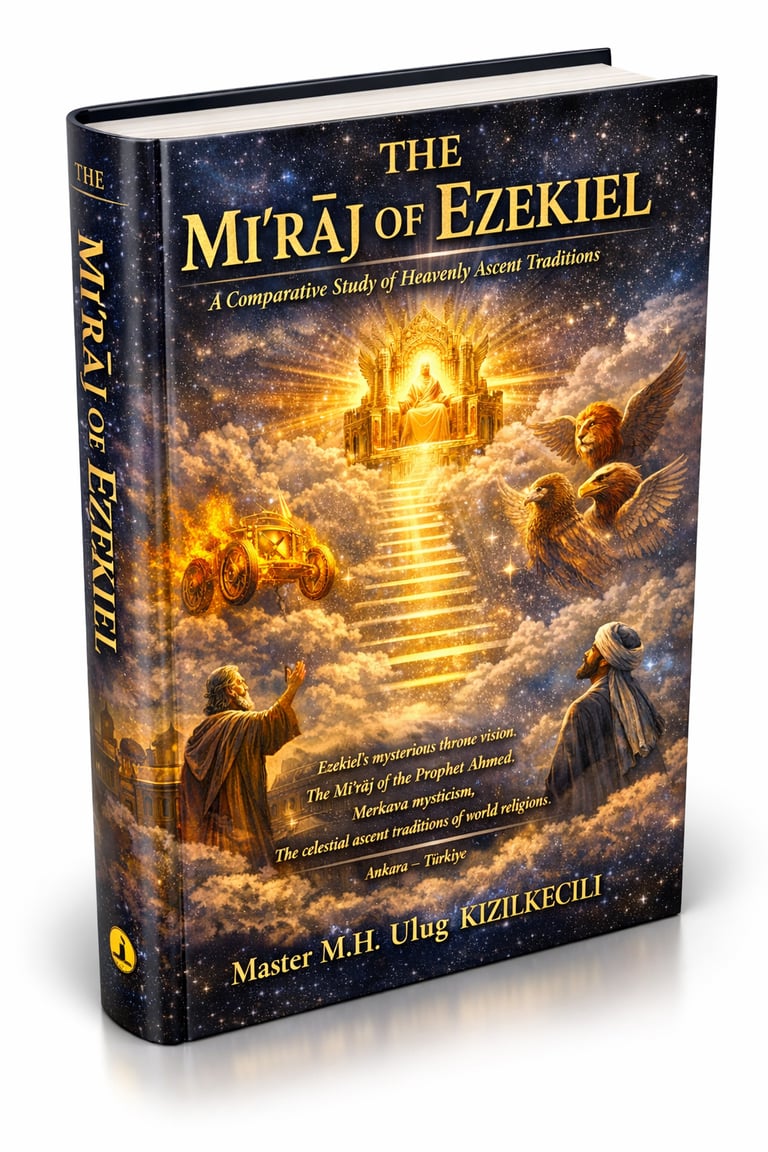
THE MI‘RĀJ OF EZEKIEL
Mysterious! The vision of the prophet Ezekiel!
Thus he explains it in the sacred book:
“Above them were four angels! They carried the firmament of the heavens!”
“And this crystalline firmament!” “It surpassed seven layers!”
“Above the firmament there was a throne!”
“The One who knows!” Surely has always interpreted this throne as the “Arsh.”
“From the waist upward was light! Below was fire — a human figure,
Sitting upon the throne!” It was the Lord, if you understand!
“Then He! As Spirit entered this prophet!”
“And began to speak with him!” This is revelation! If the mind can grasp!
Thus he explains to us the mi‘rāj he experienced.
If you call it a dream, then the one who dreams suffers his own doubt.
Whom did AHMED see in the mi‘rāj? Read the Qur’an!
“The one who sits beside Allah, the Owner of the Throne!”
Ezekiel and the mawlid call Him “the Lord of Majesty.”
“Rahman upon the Throne!” corresponds to this.
When the spinal essence becomes vapor, know that every mi‘rāj occurs thus!
“His upper part light! His lower part fire!” Open your eyes!
The vapor that warms and rises opens that eye.
Life (body) reaching “between the two eyebrows” sees its essence.
At that moment the upper transparent body, separated, remains outside.
There is then no barrier preventing descent toward the center of the earth.
Master M.H. Ulug Kizilkecili
Türkiye/Ankara - 12 August 2001
IMPORTANT NOTE :The original text is poetic, and the author cannot be held responsible for any errors in the English translation! To read the original Turkish text, click HERE! The following section is not the author's work, and the author cannot be held responsible for any errors made!
ACADEMIC NOTES
1) The shared motif of the “throne vision” and “ascent to heaven”
In the poem, two different types of experience are united under a single title:
1. Prophetic throne vision (Ezekiel 1):
The prophet Ezekiel describes a theophanic atmosphere of “wind / cloud / fire,” within which appear four “living creatures,” above them a firmament or platform resembling a raqia, and above that a throne and a “human-like appearance.” This imagery represents a classic form of the theophany of the divine glory (kavod) of the Lord.¹
2. Narratives of ascent to heaven:
The Mi‘rāj represents a version of the literary tradition of journeys to the apocalyptic or celestial realm. In the Islamic tradition, the narrative core appears in the Qur’an (such as al-Isrā 17:1 and al-Najm 53:13–18), while later reports and narrative expansions developed additional layers of storytelling.²
The history-of-religions literature demonstrates that these two currents—the throne vision and the ascent journey—belong to a broad symbolic reservoir of the “celestial temple / throne” motif throughout the ancient Mediterranean and the Near East.³
2) Academic reading of Ezekiel 1: how plausible is the identification with the “Arsh”?
The central interpretive move of the poem is to identify the “throne” in Ezekiel directly as the Arsh.
At the textual level:
• Ezekiel 1 clearly mentions a firmament / expanse (Hebrew: raqia) and above it a throne (Hebrew: kisse). However, the term Arsh belongs to a later Islamic theological vocabulary. Academic reading distinguishes between two levels:
(a) the language of the text itself (Hebrew theophanic and royal symbolism),
(b) the interpretive translation supplied by readers from their own traditions.
• The four “living creatures” are later identified in Ezekiel 10 as cherubim, meaning that the poem’s reading of them as “four angels” has some internal textual basis, though the word “angel” itself still reflects interpretive terminology.⁴
• The expression “crystal firmament” reflects translation traditions derived from Ezekiel 1:22, where imagery resembling crystal or ice is used. Philological discussion notes that this description functions both visually (brightness / clarity) and cosmologically (a celestial platform).⁵
Conclusion:
The poem’s identification with the Arsh can be interpreted as a hermeneutical act that re-names the text using Islamic conceptual language. From the perspective of textual criticism, this is less an error than an instance of conceptual translation across traditions.¹ ⁶
3) Ezekiel in Jewish tradition: the Merkava (Chariot) and Hekhalot traditions
In Jewish intellectual history, Ezekiel 1 is not only a prophetic vision but also the foundational reference for Merkava mysticism (the mysticism of the divine chariot).
• Gershom Scholem’s classical framework traces a line from Ezekiel’s theophany to the later Hekhalot (“palaces”) literature, forming an early mystical language of heavenly ascent.⁷
• More recent scholarship—particularly in the works of Rachel Elior and Peter Schäfer—cautions against describing this corpus as a single mystical school. Instead, these studies highlight elements such as ritual practice, cosmology, and structures of religious authority.⁸
The poem’s expression “He entered the prophet as Spirit and spoke” gains meaning in this context. Merkava and Hekhalot texts frequently describe entry into heavenly palaces, encounters with angelic guardians, and the order of the divine throne and celestial court.⁸ ⁹
4) Mi‘rāj in Islam: Qur’anic indications and later narrative expansion
The poem asks: “Whom did Ahmed see in the Mi‘rāj?” and answers with a formulation such as “the one sitting beside Allah, the Owner of the Throne.” Academic discussion distinguishes two layers:
1. The language of the Qur’an:
The Qur’an refers to the night journey in al-Isrā 17:1, describing the movement from the Sacred Mosque to the Farthest Mosque. In al-Najm 53:13–18, the imagery of Sidrat al-Muntahā, “that which covered it,” and the unwavering gaze forms an intense theophanic description.²
2. The narrative tradition of the Mi‘rāj:
Descriptions of Prophet Muhammad’s ascent through the heavens, encounters with earlier prophets, and visions of paradise and hell developed through later reports and literary elaborations. Across different cultures these narratives served multiple purposes—religious teaching, cosmological explanation, visual art, political symbolism, and mystical reflection.¹⁰
The poem essentially selects certain motifs from these traditions and places them within the same throne scene as Ezekiel’s vision.
5) Parallels in Christianity: the throne vision in Revelation
A strong imagery relationship exists between Ezekiel 1 and Revelation 4 in the New Testament: the throne, the living creatures around it, the radiance and light, and the celestial liturgy of worship. Early Christian texts thus adopted Ezekiel’s imagery and transformed it into the language of heavenly worship.³
This parallel already supports the poem’s intuition of a shared symbolic axis between Jewish and Christian traditions.
6) Zoroastrian parallels: the otherworldly journey of Ardā Wīrāz (Arda Viraf)
The motif of ascending to heaven and witnessing the other world is not limited to the Hebrew–Islamic tradition.
In Zoroastrian literature, the story of Ardā Wīrāz describes a soul guided through the realms of heaven and hell by spiritual beings. The narrative contains elements of moral instruction and theological validation. Scholars emphasize that the text functions within Zoroastrian tradition to affirm doctrine and ritual authority.¹¹
Such parallels place the poem’s Ezekiel–Mi‘rāj comparison within a much broader history-of-religions framework. The “journey motif” often serves to visualize doctrine and establish spiritual authority.³ ¹¹
7) Buddhist parallels: ascent to the heaven of the Thirty-Three (Trāyastriṃśa)
Buddhist tradition also includes narratives of ascent to celestial realms. One well-known example describes the Buddha ascending to the Trāyastriṃśa (Tāvatiṃsa) heaven, where he teaches the Dharma to his mother and to celestial beings before descending again via a miraculous staircase.
This motif became widespread in both textual and visual traditions and illustrates that heavenly ascent may function not merely as theophany but also as a means of instruction and spiritual legitimization.¹² ¹³
8) The motif of ascent in Hindu tradition: the svarga journey in the Mahābhārata
In the concluding sections of the Mahābhārata, the hero Yudhiṣṭhira ultimately reaches svarga (heaven) after a final journey marked by ethical tests and illusions.
Here the ascent does not represent prophetic revelation but rather the culmination of moral integrity and adherence to dharma. Such examples show that the motif of ascent cannot be reduced to a single theological structure.¹⁴
9) The poem’s physiological–esoteric explanation
The final section of the poem proposes a model of mystical experience using expressions such as “spinal vapor,” “rising steam,” “between the eyebrows,” and the “transparent body.”
This language aligns less with classical theological exegesis and more with:
• modern occult or esoteric discourse,
• interpretations of ecstatic states using bodily energy metaphors,
• contemporary accounts of out-of-body experiences.
Within the academic study of religion, such narratives are usually analyzed under the categories of ecstatic techniques and soul-journey typologies—especially within shamanic traditions that describe ascent to heaven, guided spiritual travel, and transformation of the body.¹⁵
In scholarly frameworks, these explanations are not treated as doctrinal claims but as cultural languages used to describe religious experience.
Ezekiel 1: “Firmament” and “Throne”
An Esoteric Distinction Between the Language of the Text and the Language of Interpretation**
Two key concepts appear in Ezekiel 1:
• Raqia (רקיע) → the firmament, an expanse, a cosmic spread
• Kisse (כסא) → the throne
These belong to the Hebrew language of theophanic and royal symbolism. Ezekiel speaks using the cosmological imagery of his cultural environment: fire, wind, radiance, the firmament of heaven, a throne, and living beings.
When later traditions read this text, they often introduce their own conceptual vocabulary. To call the “throne” the Arsh does not change the original word; rather, it relocates the image into a different theological lexicon.
From an esoteric perspective, two levels can therefore be distinguished:
1. The language of the text (original symbolic layer)
• Raqia → the cosmic veil or the covering of consciousness
• Kisse → the divine center, the seat of sovereignty
2. The language of interpretation (traditional translation layer)
• Arsh → the highest station of transcendent sovereignty
Philologically the words differ.
Symbolically, the centers they indicate may converge.
For this reason, the academic approach leaves the text within its historical context, while the esoteric approach seeks the universal symbolic core shared by traditions.
THE FOUR “LIVING CREATURES” AND THE CHERUBIM
In Ezekiel 1, the four beings that appear are initially called hayyot (“living creatures”). In Ezekiel 10, it is explicitly stated that these are cherubim.
In the textual tradition, the cherubim appear as:
• beings located around the divine throne,
• guardians of the sacred space,
• symbolic bearers of divine glory.
In esoteric interpretation, these beings are forces of consciousness representing cosmic balance. The number four symbolizes:
• the four directions,
• the four elements,
• cosmic wholeness.
The throne being borne by four beings signifies that central consciousness rises upon an ordered and balanced cosmos.
Merkava (Chariot / Divine Chariot)
Merkava (Hebrew: מרכבה) literally means “chariot” or “vehicle.” The origin of the concept is based on the magnificent throne-chariot vision in Ezekiel 1. Over time, however, this scene ceased to be merely a prophetic narrative and became the central symbol of a mystical doctrine of ascent.
1. Textual Origin
In Ezekiel 1, the following are described:
• a theophany arriving with fire and wind,
• four living creatures (later identified as cherubim),
• a “firmament / raqia” above them,
• a “throne” above the firmament,
• a glorious human-like figure seated upon the throne.
This whole structure was later named by tradition as the Merkava of God, that is, the divine war chariot or throne-chariot.
The text itself does not present the word Merkava as its central title; this naming is the product of later interpretive tradition.
2. Merkava in Mysticism
Beginning in the early centuries CE, a doctrine of “ascending to the Merkava” developed in certain Jewish mystical circles. In modern scholarship this is called Merkava mysticism or the Hekhalot (Palaces) literature.
In this teaching:
• the mystic passes through celestial palaces,
• encounters angelic beings,
• approaches the presence of the divine throne.
Here, “ascent” is understood less as a physical rising into the sky than as a process of consciousness and spiritual purification.
3. Esoteric Meaning
On the esoteric plane, Merkava can be read on three levels:
a) Cosmological
The universe is described as a hierarchical structure with divine order at its center. The chariot is the dynamic manifestation of this order.
b) Anthropological
The human being is a “microcosm.” Merkava represents the balancing of the energy centers within the human inner structure.
c) Consciousness-related
To “ride the chariot” means to turn toward the center of consciousness. The throne is the purest point of awareness.
4. Elements of the Symbolism
The Four Living Creatures
They represent cosmic balance and the four directions.
The Wheels (Ophanim)
They symbolize perpetual motion and the cycle of destiny.
Fire and Light
They represent processes of purification and illumination.
The Firmament (Raqia)
It indicates the threshold between lower consciousness and higher consciousness.
The Throne (Kisse)
It is the point of central sovereignty and absolute awareness.
5. Parallels with Other Traditions
The Merkava motif bears structural similarities to “celestial journey” narratives in different religions:
• the idea of a divine center,
• angelic guidance,
• layered heavens,
• the experience of light.
Yet each tradition interprets this within its own theological framework.
6. Conclusion
Merkava is not merely a “war chariot.”
It is the symbol of the journey toward the center of human consciousness.
The beings drawing the chariot signify cosmic order,
the throne signifies the divine center,
and the ascent signifies spiritual development.
In esoteric reading, Merkava is not an external vehicle;
it is the inner mechanism of human ascent.
The “Throne” in the Book of Revelation
An Esoteric Unfolding of the Apocalyptic Vision
Revelation (Apokalypsis) is the most symbolically dense text of the New Testament. Here, the motif of the throne occupies a central place, especially in chapters 4 and 5. The text begins with the opening of a heavenly door, and the narrator is lifted up “in the Spirit” to heaven. The first thing he sees is a throne.
This scene is not merely a royal depiction; in apocalyptic consciousness it is the unveiling of the center of cosmic order.
1. The Structure of the Throne Scene
In Revelation 4, the following are described:
• a throne in heaven,
• a figure seated upon the throne,
• twenty-four elders surrounding the throne,
• four living creatures,
• lightning, thunder, and fire,
• a ground like a sea of glass.
Structurally, this scene is very close to Ezekiel 1. The motif of the four living creatures is a direct continuation of that symbolic tradition.
2. Esoteric Meaning: Throne = Cosmic Center
In esoteric interpretation, the “throne” is:
• not the place of divine authority,
• but the central point of consciousness within cosmic order.
The circles around the throne (the elders, the living creatures) represent the layers of universal order. The center is fixed; the surrounding realm is in motion. This expresses a metaphysical principle:
Truth stands still at the center; manifestation revolves around it.
3. The Four Living Creatures
The four beings in Revelation are:
• Lion
• Ox
• Human
• Eagle
In esoteric symbolism, these represent the principles of:
• power,
• endurance,
• consciousness,
• ascent.
The motif of the four-faced being in Ezekiel is simplified here, but its symbolic core is preserved.
4. The Sea of Glass and Fire
The “sea of glass” before the throne symbolizes a plane of clarified consciousness.
Fire and lightning indicate purification and the dynamism of divine energy.
In apocalyptic texts, natural phenomena symbolize upheavals of consciousness.
5. Ascent and Unveiling
In Revelation, the narrator ascends to heaven “in the Spirit.” This implies not so much a physical ascent as a change in the state of consciousness.
The word Apokalypsis itself means “the lifting of the veil.”
Thus, ascent to heaven means less going upward than the opening of the veil.
6. The Throne and the Lamb
In Revelation 5, the motif of the Lamb appears beside the throne. This indicates that the authority at the center is also united with the principle of sacrifice and humility.
Esoterically, this means:
At the center, power and self-sacrifice,
authority and surrender,
judgment and mercy
are joined together.
7. Conclusion
The throne scene in Revelation is not merely a vision of the apocalypse.
It is the moment when human consciousness beholds the divine center.
The throne represents fixed truth,
the four beings cosmic balance,
and the ascent the unfolding of consciousness.
In esoteric reading, heaven is not above;
it opens at the center.
Ardā Wīrāz Nāmag (The Book of Arda Viraf)
The Soul’s Journey to the Other World – An Esoteric Unfolding
Ardā Wīrāz Nāmag is one of the foundational texts in the Zoroastrian tradition that narrates the visionary journey of the soul to the other world. The narrative systematically presents the cosmology, morality, and conceptions of the afterlife found in pre-Islamic Iranian thought.
1. The Core of the Narrative
According to the text, Ardā Wīrāz (Arda Viraf) is chosen during a time when society has fallen into doubt concerning faith. He undergoes purification rituals, drinks the sacred beverage (connected with the haoma tradition), and remains in a trance for seven days.
During this period, his soul sees:
• the layers of heaven,
• the torments of hell,
• intermediate states (middle realms),
accompanied by guiding beings.
At the end, he returns and recounts what he has seen. The purpose is to reinforce the truth of the religious system.
2. Cosmological Structure
The text is built upon three principal realms:
1. The Realm of Light (Heaven)
The place where moral righteousness is rewarded.
2. The Realm of Darkness (Hell)
The place where actions receive their consequences.
3. The Intermediate Region
The place where souls whose good and evil are balanced remain.
This structure connects ethical responsibility to cosmic order. Every act produces an ontological consequence.
3. Esoteric Interpretation
On the esoteric plane, Ardā Wīrāz’s journey is a three-stage transformation of consciousness:
a) Separation
A breaking away from bodily awareness.
b) Seeing
The perception of the order of cosmic justice.
c) Return
The transmission of knowledge back to society.
This threefold structure resembles the “initiation model” often found in mystical literature:
• a death-like experience,
• contact with truth,
• rebirth.
4. Guiding Figures
The beings who guide Ardā Wīrāz are representatives of divine order. In esoteric symbolism, the guide may be understood as:
• higher consciousness,
• divine intellect,
• spiritual intuition.
Ascent is never without a guide. This shows that cosmic order is not chaotic but hierarchical.
5. Ethics and Cosmic Law
The strongest aspect of the text is that it grounds morality in a metaphysical foundation.
Goodness is not merely a social virtue;
it is harmony with the universal order of light.
Evil is a dark vibration;
it draws the person downward into lower realms.
In this understanding, “ascent” is not only spiritual but also ethical.
6. Connection with Other Ascent Narratives
The journey of Ardā Wīrāz shares the following common structures:
• trance / ecstasy,
• journey under guidance,
• layered universe,
• depictions of heaven and hell,
• return and narration.
This structure parallels celestial ascent motifs found in different cultures; however, in Zoroastrianism the emphasis falls especially on moral reckoning and cosmic justice.
7. Conclusion
The narrative of Ardā Wīrāz is not merely a description of the afterlife.
It is a symbolic map showing that human actions have a universal resonance.
The journey is not outward;
it is toward consciousness illuminated by morality.
Trāyastriṃśa (The Heaven of the Thirty-Three)
Cosmic Layer and the Ascent of Teaching – An Esoteric Unfolding
Trāyastriṃśa (Pali: Tāvatiṃsa) is known in Buddhist cosmology as “the Heaven of the Thirty-Three Gods.” Its name comes from the community of 33 devas (divine beings) said to dwell there. This heaven is depicted at the summit of Mount Sumeru, and it is generally presided over by Śakra (Indra).
On the esoteric level, however, this heaven is not merely a mythological place; it represents a layer of consciousness.
1. Its Cosmological Position
In the Buddhist understanding of the universe, the realms of existence are multi-layered:
• sensual realms
• form (rūpa) realms
• formless (arūpa) realms
Trāyastriṃśa belongs to the sensual heavens. That is, it is still a realm of form and experience; it is not the realm of absolute liberation. This is important:
To ascend does not mean to attain Nirvana.
This heaven is still only a stage within the cosmic order.
2. The Ascent of the Buddha
According to traditional accounts, the Buddha ascends to the heaven of Trāyastriṃśa and there conveys the teaching of the Abhidharma to his mother (Māyā). Afterwards, he descends again to earth by symbolic stairways.
Esoterically, this event signifies:
• the carrying of the teaching into the celestial dimension,
• the confirmation of knowledge at the cosmic level,
• and then its return once more to humanity.
The ascent here is not for gaining power; it is for refining and purifying the teaching.
3. The Symbolism of the Number “Thirty-Three”
In Indian cosmology, the number 33 represents an ordered divine assembly. In esoteric interpretation, it signifies:
• order within multiplicity,
• cosmic hierarchy,
• the harmony of divine energies.
This heaven is not a chaotic paradise; it is a systematic field of consciousness.
4. Center and Summit
The fact that Trāyastriṃśa is located at the summit of Mount Sumeru reveals the consciousness-related meaning of the symbol of “height.”
The summit = the center.
That is, to ascend upward is at the same time to approach the center.
This structure parallels the symbolism of the mountain found in many traditions:
• Sinai
• Olympus
• Meru
The mountain is the axis between earth and heaven.
5. Esoteric Interpretation
The heaven of Trāyastriṃśa represents three stages:
the purification of consciousness
the comprehension of the teaching at the cosmic level
the bringing of knowledge back down into the world
This model reflects the classic cycle found in mystical literature:
Ascend – See – Transform – Return.
6. Conclusion
Trāyastriṃśa is not the realm of final liberation.
It is a high yet temporary station in the development of consciousness.
In esoteric meaning, this heaven teaches the following:
Ascent is not escape;
it is the process of maturing knowledge.
True freedom, however, lies beyond heaven itself—
in the awakening at the center.
Arrival in Svarga in the Mahābhārata
The Ethical and Esoteric Meaning of Ascent
Svarga is often translated in Indian cosmology as “heaven,” yet it is not identical with absolute liberation (moksha). In the final sections of the Mahābhārata, especially in the account of Yudhiṣṭhira’s arrival in svarga, what is presented is not merely a rewarding paradise, but a profound ethical and metaphysical trial.
1. The Great Journey: Mahāprasthāna
After the war, the Pandavas leave the kingdom behind and set out on the final journey called the Great Departure (Mahāprasthāna). Along the way, the brothers and Draupadī fall one by one. Only Yudhiṣṭhira continues to walk.
These falls are not random; each is the symbolic consequence of a subtle flaw:
• pride
• partiality
• self-glorification
• weakness
Yudhiṣṭhira, by contrast, is the figure who remains most faithful to the principle of dharma (cosmic righteousness).
2. The Dog and the Final Trial
At the end of the journey, a dog accompanies him. When a divine vehicle (Indra’s chariot) invites him to heaven, he is asked to abandon the dog. Yudhiṣṭhira refuses.
It is later revealed that the dog is in fact a manifestation of Dharma (cosmic law).
The esoteric meaning is this:
True ascent is achieved not by abandoning loyalty, but by preserving compassion.
3. The Experience of Svarga and Illusion
When Yudhiṣṭhira arrives in svarga, he encounters a startling scene:
His enemies are at peace, while his brothers are nowhere to be seen.
This is the final stage of the trial of consciousness. Even heaven itself may be a field of testing beyond ordinary perception.
In esoteric interpretation, this means:
Truth is not grasped through expectation of reward,
but through fidelity to principle.
4. The Metaphysical Position of Svarga
Svarga:
• is a realm of happiness granted as the result of good actions,
• yet it is temporary,
• and it is not final liberation (moksha).
This distinction is important. In Indian thought, the highest goal is not heavenly pleasure but going beyond the cycle of birth and death.
Thus, the ascent in the Mahābhārata is more than moral reward; it is a purification of consciousness.
5. Esoteric Analysis
This narrative consists of three fundamental stages:
Purification (detachment from worldly bonds)
Trial (the test of loyalty and compassion)
Transformation of perception (going beyond the perception of heaven and hell)
True svarga is not an external place;
it is consciousness in harmony with dharma.
6. Conclusion
Arrival in svarga in the Mahābhārata is not a narrative of a “reward paradise.”
It is a dramatic teaching text showing that morality is a metaphysical law.
The ascent here is not physical; it is an ethical ascent.
It is not the body that rises to heaven,
but the consciousness that does not depart from principle.