THE MI‘RĀJ OF SAINT IBRAHÎM
THE MI‘RĀJ OF SAINT IBRAHÎM. Thus one becomes the child of the “Father of Earth,” And learns what the most exalted Name of ALLAH truly was. Ibrâhîm too descended to the “central point” upon the earth; Completing his Mi‘rāj, he embraced Islâm as the path of religion.
APOCALYPSE BOOK
THE MI‘RĀJ OF SAINT IBRAHÎM
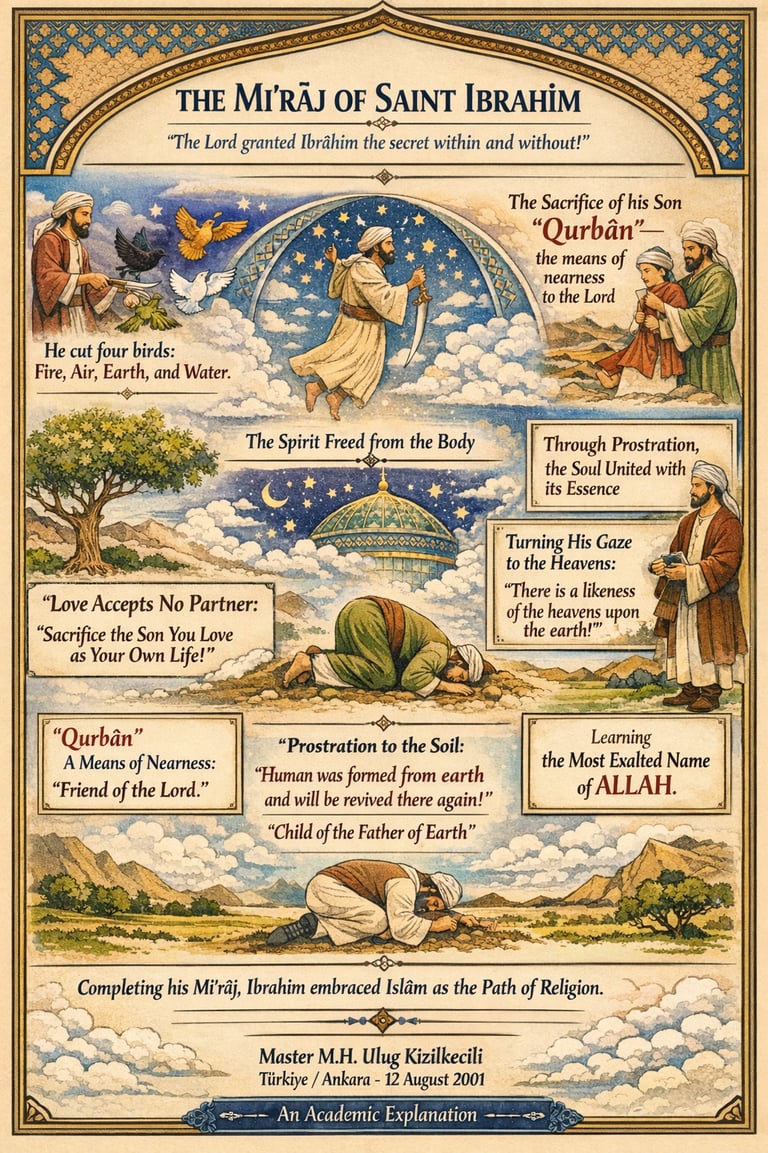
“The Lord granted Ibrâhîm the secret within and without!”
At that moment, he reached the complete reality of the Mi‘rāj.
“First he cut four birds: fire, air, earth, and water!”
The spirit freed from the body became truly liberated.
And it was said: “Sacrifice the son you love as much as your own life!”
Love accepts no partner; the Lord is jealous — let everyone beware!
The soul at once raised its blade beneath the heavenly dome;
“Qurbân,” that is, the spirit descended, and he became known as the “friend of the Lord.”
The word “Qurbân” means a means of nearness;
Nothing is closer to the soul than the spirit — gratitude to the essence!
Through prostration, the soul united with its own essence;
With every breath it felt excitement as if performing Mi‘rāj.
“Then he turned his gaze to the heavens beyond himself!”
“There is a likeness of the heavens upon the earth!” — let the intellect grasp!
“Human was formed from earth and will be revived there again!”
By prostrating to the soil, acknowledgement is given to the earth.
Thus one becomes the child of the “Father of Earth,”
And learns what the most exalted Name of ALLAH truly was.
Ibrâhîm too descended to the “central point” upon the earth;
Completing his Mi‘rāj, he embraced Islâm as the path of religion.
Master M.H. Ulug Kizilkecili
Türkiye/Ankara - 12 August 2001
IMPORTANT NOTE :The original text is poetic, and the author cannot be held responsible for any errors in the English translation! To read the original Turkish text, click HERE! The following section is not the author's work, and the author cannot be held responsible for any errors made!
FOOTNOTES
• The Motif of the “Four Birds” and Resurrection Symbolism
The expression “four birds” mentioned in the poem is based on Qur’ān al-Baqarah 2:260. In the verse, upon HZ. Ibrâhîm’s request to witness the resurrection of the dead, the taking and calling of birds is described. Classical tafsir literature interprets this event as a representative miracle of resurrection.
Modern academic interpretations note that differing views exist as to whether the birds were literally divided or whether the act represents a symbolic “training/calling.”
👉 From an interreligious perspective, the interpretation of the four elements (fire, air, water, earth) should be noted as a reading connected more with ancient cosmology and Hermetic symbolism than with classical Islamic exegesis.
• The “Sacrifice Your Son” Scene and the Akedah (Binding) Tradition
The sacrificial narrative in the poem parallels the story of Abraham and Isaac known as the “Akedah” in Jewish sacred texts. In the Torah, God asks Abraham to sacrifice his son, and at the last moment a ram is provided.
In the Qur’ānic narrative, the son’s name is not specified; within Islamic tradition he is most often interpreted as Ishmael, and the sacrifice is understood as a test of faith.
👉 Academic studies frequently evaluate this narrative in all three traditions as an archetype of obedience and faith.
• The Interpretation “Qurbân = Nearness”
The Arabic root of “Qurbân” is related to the meaning of “drawing near.” In Islamic thought, sacrifice represents not merely a physical act but a symbol of surrender to the divine will of Allah. This understanding is comparatively studied alongside the self-offering of Christ in Christianity and Akedah interpretations in Judaism.
• The Concept of the “Inner Mi‘rāj” and Mystical Traditions
In the poem, Mi‘rāj is used not as a historical celestial journey but as an inner spiritual ascent in the Sufi sense. Within Sufi literature, prophetic narratives are commonly interpreted as allegories of individual spiritual transformation. Such interpretations may be compared with the notion of “spiritual ascent” in Christian mysticism and the metaphor of the spiritual ladder in Jewish Kabbalah.
• “Earth” and the Idea of Resurrection
The theme “human was formed from earth and will be revived there again” reflects a foundational element of Qur’ānic anthropology. The concept of humanity being created from earth also exists in Jewish and Christian sacred texts; therefore, this motif establishes a shared theological ground among the three religions.
• The Symbolism of the “Central Point”
The phrase “central point” in the final part of the poem may signify the heart or the metaphysical center in Sufi texts. In the history of religions, the idea of a sacred center (axis mundi) appears in different traditions, such as the Jerusalem Temple, the Ka‘bah, or the symbol of a celestial axis.
• The Ethical Dimension of the Sacrifice Narrative (Comparative Theology)
Modern studies in the history of religions treat the Abrahamic story not merely as a historical event but as a symbolic narrative that explores the tension between human dignity, violence, and faith.
For this reason, the dramatic language of the poem reflects a mystical interpretation of the themes of trial and surrender found in classical texts.
• “Sacrifice in a Dream” and Symbolic Interpretation
Some academic interpretations emphasize that the command for Ibrâhîm to sacrifice his son occurred through a dream and that this dream should be understood not literally but as a symbolic call to submission.
The Story of Ibrâhîm in the Qur’an
Ibrâhîm said to his father Âzer and to his people: “What are these statues to which you are devoted?” They said, “We found our forefathers worshipping them.” Ibrâhîm replied that they were in clear error and declared that he turned only toward the One who created the heavens and the earth.
When night fell, he saw a star and said, “Is this my Lord?” But when it set, he said, “I do not love those that set.” Then he saw the moon and reflected in the same way; when it also set, he turned his face to the Creator of the heavens and the earth. When he saw the sun, he said it was greater; yet when it set, he said to his people: “I am free from what you associate. I turn, as a hanîf, only to Allah.”
His people argued with him, but he said that Allah had guided him. He broke the idols, leaving only the largest so that they might reflect. They asked him, “Did you do this to our gods?” He replied, “Perhaps the largest one did it; ask them if they can speak.” For a moment they turned back to themselves and thought, yet soon returned to their old beliefs.
They prepared a great fire to punish him. When Ibrâhîm was cast into the fire, Allah said: “O fire, be coolness and peace for Ibrâhîm,” and thus no harm came to him.
Ibrâhîm spoke gently many times to his father, explaining that idols could neither hear nor benefit. His father threatened him, so Ibrâhîm withdrew from him and turned to his Lord.
Later, messengers came to Ibrâhîm as guests and gave him the good news of a son. Ibrâhîm and his wife were astonished, but the messengers said this was the decree of Allah. The same visitors also brought news about the punishment of the people of Lût.
Ibrâhîm asked his Lord to show him how the dead are brought to life. Allah instructed him to take four birds, place them upon mountains, and then call them; they came back to him alive, and his heart found reassurance.
Allah tested Ibrâhîm with various trials, and he fulfilled them. Allah made him a leader for humanity. Ibrâhîm asked that leaders also arise from his descendants, and Allah declared that the unjust would not attain this covenant.
When Ibrâhîm and his son raised the foundations of the Sacred House, they prayed: “Our Lord, accept from us. Make us among those who submit to You, and from our descendants raise a submitting community. Send among them a messenger who will recite Your signs and teach the Book and wisdom.”
Ibrâhîm prayed for Mecca: “My Lord, make this city secure. Keep me and my sons away from idol worship. I have settled part of my family near Your sacred House so that they may establish prayer. Turn hearts toward them and provide for them so that they may give thanks.”
Then Ibrâhîm saw in a dream that he was sacrificing his son. He told his son, who said: “Do what you are commanded; you will find me among the patient.” When both submitted, Allah ransomed him with a great sacrifice and made this act of surrender a remembrance for later generations.
Ibrâhîm was neither Jewish nor Christian; he was a hanîf devoted to Allah. Allah took him as a close friend and brought forth prophets and scriptures from his lineage. Humanity was commanded to follow the way of Ibrâhîm and to turn only to Allah.