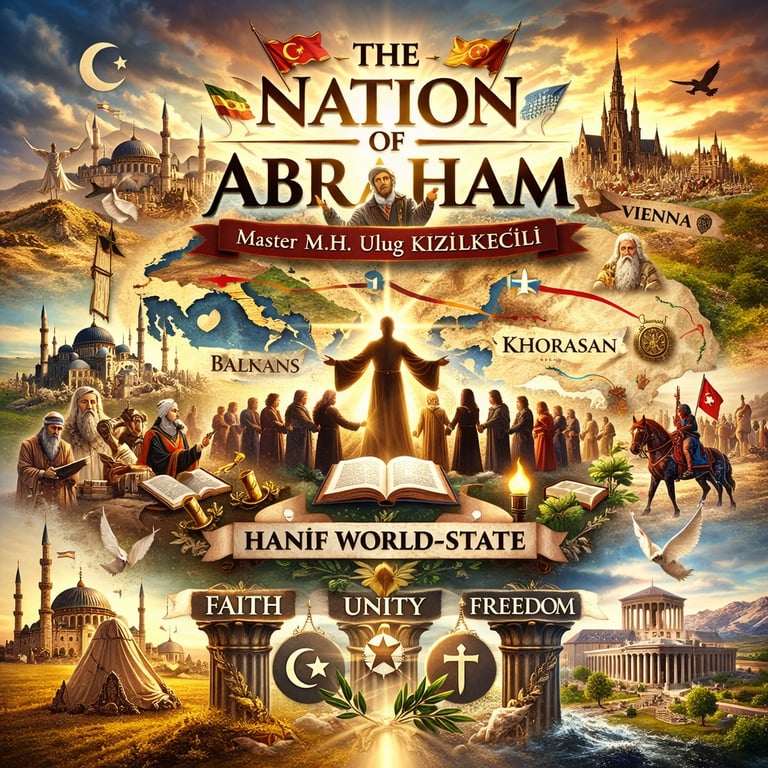
THE NATION OF ABRAHAM
THE NATION OF ABRAHAM. “Both Allah!” “And Jehovah!” — know, thus they swore the Word; Would the Lord turn from His promise? Speak, my dear, have you heard? “Turn your face to Abraham!” — command to Ahmed given; When the two stand face to face, the first Adam is risen.
APOCALYPSE BOOK
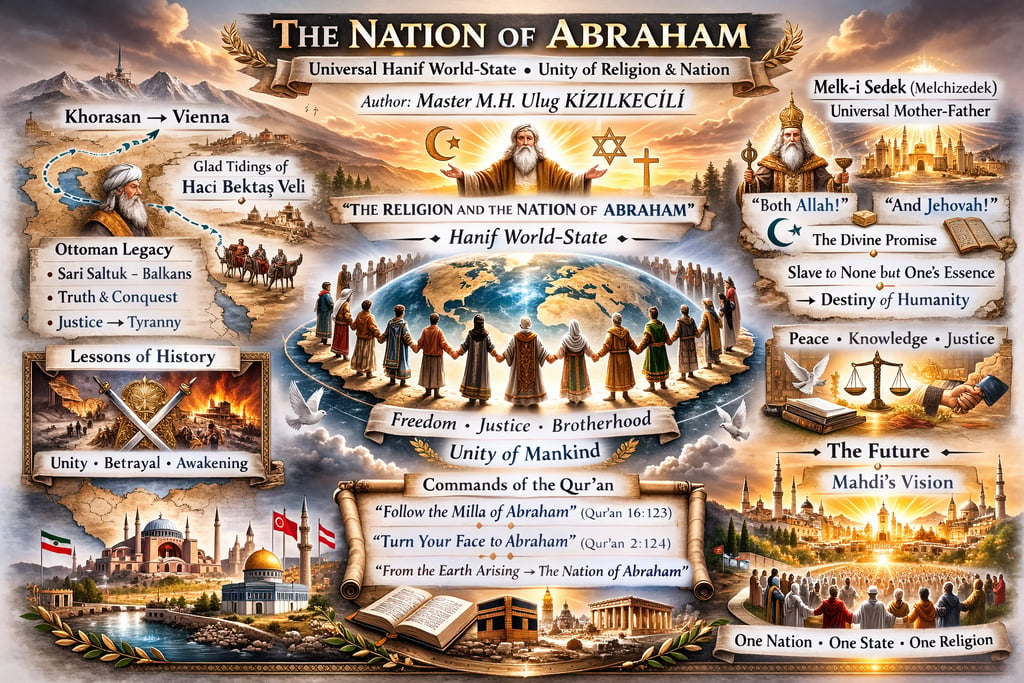
THE NATION OF ABRAHAM
Where is Khorasan, and where stands Vienna — look and see;
The Sura of “Rum” gives glad tidings of Hacı Bektaş Velî.
He came to complete the mission that had been seized before;
For Muhammad had appointed him as Caliph evermore.
From Hacı Bektaş arose the Ottoman’s first base;
To found the “Hanif religion” was his single aim and grace.
Thus Sarı Saltuk conquered the Balkans far and wide;
The people grasped Jesus’ truth and to their essence tied.
Yet conquest turned to plunder as the ages rolled along;
The tyrants rose as sultans — you know the rest of wrong.
Yıldırım Bayezid — his pride brought him disgrace;
“The one who came with elephant” seared his trunk in place.
A squint and a lame one could not share the Earth as whole;
Utter with curse the name “Timur the Lame” from your soul.
This lame one martyred Fazlullah and cast his life aside;
Behold — his name equals Muhammad Mustafa in stride! (1729)
Selim slaughtered forty thousand young Turkmen Alevi;
Called “Yavuz” in praise — thus a good executioner was he.
He took the Caliphate from Arab lands — a burden to his head;
That Arab who tomorrow from Karbala will plead instead.
Mahmud — executioner of Janissaries — open wide your sight;
While his mother lay dying, he gave her cross to kiss in rite.
Later this event was carefully denied as lie;
Yet certain is Mahmud broke his “first oath” thereby.
The “army of plunder” he dismissed and closed its page;
With hidden aim he turned his face toward Europe’s stage.
That “hidden aim” now bears its fruit for all to see;
Hostage to Crusaders without term — so reasoned we.
Gather your mind and break your chains apart;
Cry: “To none but my own Essence shall I bind my heart!”
Why did the Ottoman collapse? Reflect and learn;
Only backward Ummah marks its fall with festive turn.
In Gazi’s surname lie two messages — why so within?
“For my faith is Shaman, my origin Turk,” said he therein.
In Japan’s Shinto too there is “prostration to the sire”;
This is “the command to bow to Adam” — heed the sign entire.
“The religion and the nation of Abraham” — one decree;
It means “Hanif world-state” — let the eyes see free.
The “Universal Mother-Father” shall this fulfill;
When Melk-i Sedek appears, the devil’s schemes grow still.
“As sand shall multiply Abraham’s line!”
Slave to none but their Essence — their destiny divine.
“Both Allah!” “And Jehovah!” — know, thus they swore the Word;
Would the Lord turn from His promise? Speak, my dear, have you heard?
“Turn your face to Abraham!” — command to Ahmed given;
When the two stand face to face, the first Adam is risen.
“From the Earth arising,” Islam shall shape his seed;
And “Nation of Abraham” shall be its name and creed.
Nation and state as one shall be with religion then;
Melk-i Sedek had done the same — mark this well, O men.
When Satan asks, “Who are the twins that from Earth rise?”
The Lord shall say: “Send greeting to the awaited Mahdi’s eyes!”
Master M.H. Ulug Kizilkecili
Türkiye/Ankara - 03 September 2000
IMPORTANT NOTE :The original text is poetic, and the author cannot be held responsible for any errors in the English translation! To read the original Turkish text, click HERE! The following section is not the author's work, and the author cannot be held responsible for any errors made!
1729 = Muhammad Mustafa
1729 = Shihabuddin Fazlullah al-Shahid
FOOTNOTES
1) The expression “the religion of Abraham / Ḥanīf religion”: the conceptual ядро in the Qur’an
The poem’s emphasis on “Ḥanīf religion” and “the religion (milla) of Abraham” is discourse that appears directly in the Qur’an: the injunction “Follow the milla of Abraham” (especially verse clusters such as 16:123 and 3:95) positions Abraham as neither Jewish nor Christian and centers the ḥanīf orientation.
In academic literature, the word ḥanīf (its historical semantic range, Late Antique context, and the diversified interpretations in tafsīr) is discussed seriously; therefore, when academicizing your text, it is more robust to note interpretive layers (tafsīr/philology/history) rather than treating “ḥanīf” as having a single dictionary equivalent.
In addition, the term “mille/milla**” can shift toward a framework broader than “religion” (path, belief-community, order, mode of belonging); this also opens a linguistic space for discussing the poem’s equation “millet = state/religion.”
2) The claim “the milla of Abraham = state/ummah”: how to build interreligious analogy
Sentences in the poem like “milla, meaning the same thing as state, will be religion” evoke, in modern academia, the relationship between religion, community, and political order. Here, it is more academic to build comparison not by listing “all religions” one by one, but through similarly functioning models:
2.1 In the Abrahamic religions, “covenant/berit” → “community (congregation) + order (nomos)”
• In Judaism, the idea of “covenant” is thought together with the “chosen community” and “law” (the coupling of community and law).
• In Islam, the lexical field of “milla–dīn–ṣirāṭ/straight path” similarly carries the triad “path + community + norm” (e.g., 6:161).
Analogy: “belief” is not merely inner assent; it establishes a lived path and a communal order.
2.2 In Indian religions (Hindu/Buddhist), “dharma” → cosmic-ethical order
It is not the same as a theistic “milla/ummah” idea; yet the concept of dharma speaks of “right order/ethical law” at both cosmic and social levels. (Not identical; “functional similarity”: establishing normative order.)
2.3 In Daoist and Stoic lines, “way/logos” → continuity of nature and ethics
The poem’s language of “returning to order/lesson/essence” lends itself to analogy—around the concept of “the way”—with traditions that emphasize the continuity of nature and morality. (Again: not the same doctrine; the way of speaking about “order” is similar.)
3) Historical–Sufi knots in the text: Bektāshism, Sarı Saltuk, Hurūfism
In the poem, the line of Hacı Bektaş Veli, Sarı Saltuk, and the Balkans; expressions like “the people understood Jesus”; are classic topics in the literature on Anatolian–Balkan “popular Islam” and heterodoxy.
• One of the most reliable reference lines on Sarı Saltuk is the TDV İslâm Ansiklopedisi; the limitation of early sources, the tension between hagiography and history, and points such as the “Babadağı/Dobruca” line are summarized there.
• On Sarı Saltuk’s place in the Balkan context, there are also direct articles in academic venues such as DergiPark; these are suitable for connecting your text’s “dervish–ghazi spreading into the Balkans” image to an academic framework.
• Claims about Hurūfism / Fażlullāh Astarābādī and contacts with Bektāshī circles can also be traced in both encyclopedic and academic literature. Regarding Fażlullāh’s execution around 1394 by order of Mīrān Shāh, both compiled sources and academic PDFs exist.
Methodological note: For the poem’s sharp historical judgments (name-number-intent attributions), one should add a footnote on primary sources / historiographical debate rather than making a “one-sentence verdict.”
4) The function of numbers like “forty thousand” in the poem: history or rhetoric?
Numbers in the text such as “Selim had forty thousand executed…” enter a contested area in historiography related to the Ottoman–Safavid conflict and Kızılbaş communities. A modern academic article notes the circulation and discursive function of the claim “Ottoman chroniclers killed 40,000 Kızılbaş” (how the number is used within historiography).
Therefore, it is academically critical to separate two lines in the footnote:
The poem’s rhetoric: it dramatizes a narrative of “oppression/justice.”
Historiography: the number varies by source; presenting it as a “certain figure” carries methodological risk.
5) “Prostration to Adam” and the “ancestor cult” analogy: a careful pairing via Shinto
The poem includes an analogy like “In Shinto, prostration to the ancestor… the command to prostrate to Adam.” In the Qur’an, the angels’ prostration to Adam is stated explicitly.
In Shinto, belief in kami and the ancestor cult are central to ritual practice; Turkish-language/academic studies examining this phenomenon also exist.
Analogy (functional): a language of reverence-ritual around “human origin/ancestor figure.”
Key difference: In the Qur’an, the prostration is not “deification,” but occurs in the context of “honoring/testing”; in Shinto, the theological framework of the ancestor–kami relation is different. Stating this difference explicitly in the footnote makes the text more academic.
6) The “Melk-i Sedek (Melchizedek)” knot: the “king-priest” archetype in the Abrahamic chain
In the poem, “Melk-i Sedek” is linked to a founding figure such as “universal mother-father.” In the biblical tradition, Melchizedek, as “king of Salem and priest of God Most High,” blesses Abraham; the Epistle to the Hebrews then carries him into a more advanced theological typology.
Analogy: It allows one to contextualize the poem’s idea of “the milla of Abraham/universal order” through the archetype of “king-priest” (political + sacred authority).
Difference: In Christian theology, Melchizedek typology generates a specific messianic reading; in the poem, it becomes more of a metaphor for a “founding order.”
Turkish Footnote List
For “Follow the milla of Abraham” (16:123) and “the milla of Abraham as a ḥanīf” (3:95): a multi-translation (meal) comparison:
The reflection of the concept of “ḥanīf” in Qur’an translations and the concept debate (TR academic PDF):
The entry “ḥanīf” in the Encyclopaedia of the Qur’an (academic encyclopedia framework):
A recent study example (2025) interpreting the concept of ḥanīf within the Late Antique context:
Modern and classical uses of the term “milla/millet” (Brill encyclopedia entry):
The expression “milla of Abraham” in the “religion-path” context (6:161):
The historical source problem for Sarı Saltuk and the Babadağı/Dobruca line (TDV entry):
An example academic article on Sarı Saltuk (DergiPark PDF):
An academic PDF (Fatih Usluer) on Fażlullāh Astarābādī’s execution (1394) and the Hurūfī–Bektāshī circles relationship:
An encyclopedic summary on the general framework of Hurūfism and Fażlullāh’s fate:
The use and debate of the “40,000 Kızılbaş” discourse in Ottoman historiography (modern academic article):
The command to prostrate to Adam (2:34):
The emphasis on kami rituals and ancestor cult in Shinto (TR academic study + summary):
The Melchizedek (Melk-i Sedek) narrative: a text-comparison page for Genesis 14:18–20 and Hebrews 7:1–3:
✧ Melchizedek ✧
1) Melchizedek in the Scriptural Sources
The name Melchizedek first appears in the Torah / Tanakh, especially in Genesis 14:18–20. There he is described as:
• “King of Salem” (in most interpretations, an early name for Jerusalem)
• “Priest of God Most High”
• He offers bread and wine to Abraham.
• He blesses Abraham, and Abraham gives him a tenth of the spoils.
This brief passage gave rise to extraordinarily extensive interpretations in later theological traditions.
2) The Reference in the Psalms
In Psalm 110:4 the following statement appears:
“You are a priest forever according to the order of Melchizedek.”
This expression later becomes central in Christian theology.
3) The Christian Interpretation of Melchizedek
The Epistle to the Hebrews (especially chapter 7) interprets Melchizedek as a prefiguration (typology) of Christ:
• His genealogy is not given.
• He is symbolically interpreted as having “neither beginning nor end.”
• He represents a priesthood preceding the Levitical order.
• He is presented as the model of the “eternal priesthood” of Jesus Christ.
Here, Melchizedek becomes less a purely historical figure and more a metaphysical archetype.
4) In Jewish Tradition
In Rabbinic interpretations, Melchizedek is sometimes:
• Identified with Shem, the son of Noah.
• Seen as a priest-king model of the early Jerusalem tradition.
• Accepted as an early representative of monotheism.
5) In Gnostic and Esoteric Traditions
In the Nag Hammadi texts, Melchizedek is portrayed as a cosmic being. There he is:
• A representative of the realm of light,
• A bearer of divine knowledge,
• Sometimes depicted as an angelic being.
In esoteric traditions, Melchizedek is interpreted as:
• The “Priest-King” archetype,
• A bridge between the heavenly order and the earthly order,
• A symbol of timeless wisdom.
6) Name Analysis
“Melkî-ṣedeq” is of Hebrew origin:
• Melek / Malki → “My king”
• Ṣedeq → “Righteousness” / “Justice”
Thus, the meaning of the name is:
“King of Righteousness” or “King of Justice.”