THE NEW OCCULT ESOTERIC MODEL: THE DOCTRINE OF SELF-DYNAMICS CHAPTER 1: THE SECRET DOCTRINE
THE NEW OCCULT ESOTERIC MODEL: THE DOCTRINE OF SELF-DYNAMICS CHAPTER 1: THE SECRET DOCTRINE. In esoteric teachings, the idea that Aryan, Semitic, and Turanian traditions share a common origin is associated not with a biological understanding, but with an understanding of cultural and spiritual..
ÖZ-DEVİNİM KURAMI
THE NEW OCCULT ESOTERIC MODEL: THE DOCTRINE OF SELF-DYNAMICS
CHAPTER 1: THE SECRET DOCTRINE
The Religion of Wisdom, Esoteric Doctrine, and the Misunderstanding of Truth
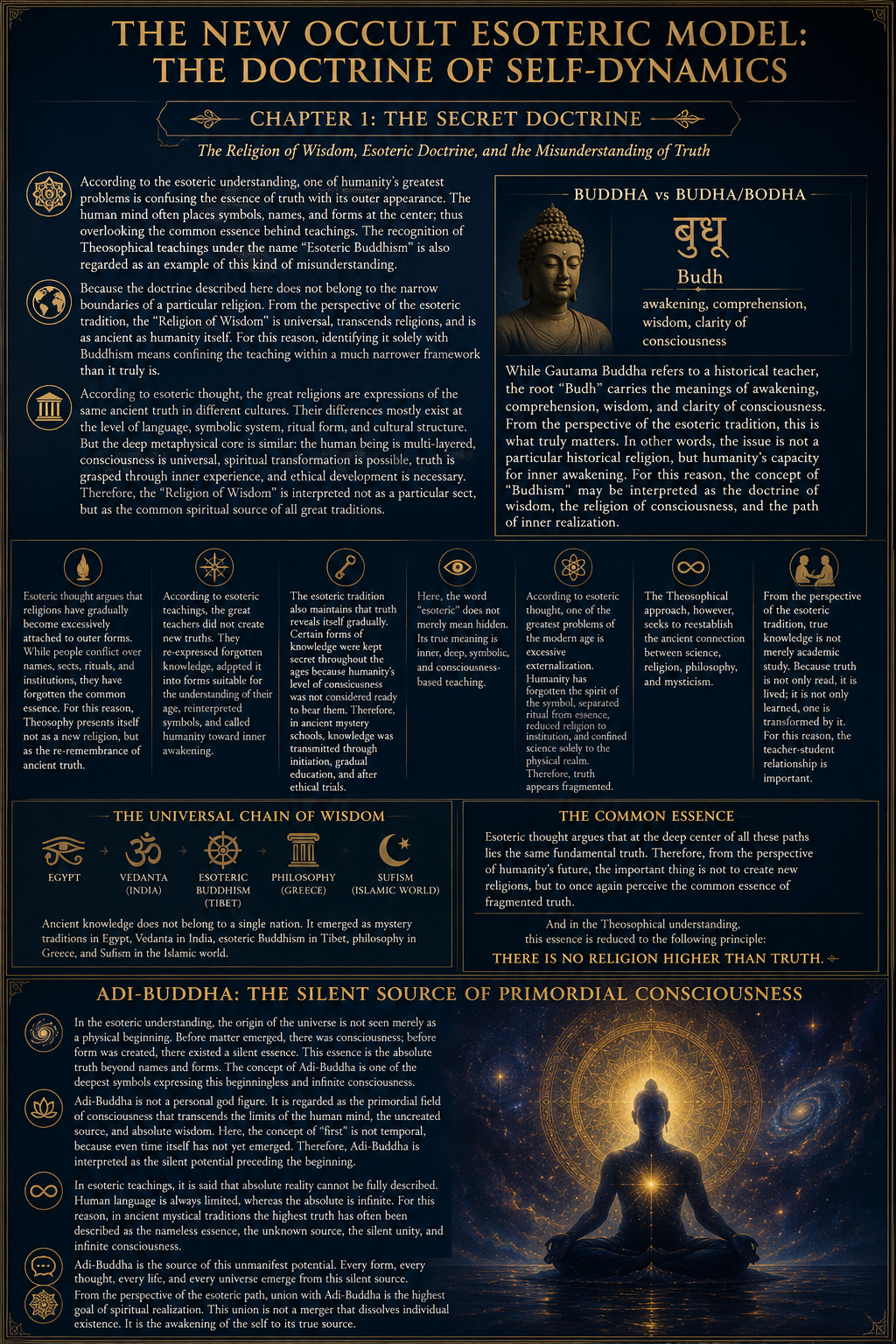
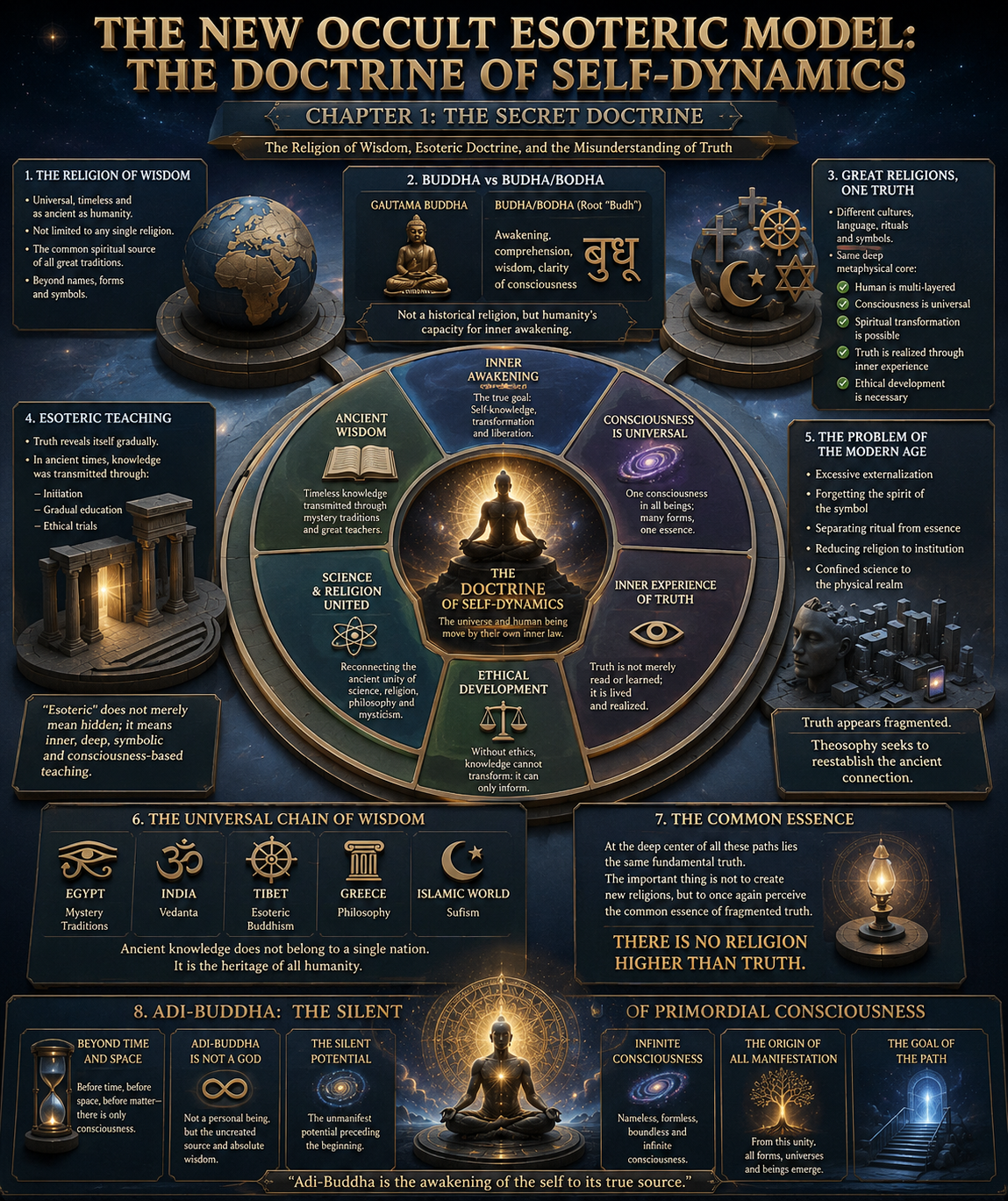
According to the esoteric understanding, one of humanity’s greatest problems is confusing the essence of truth with its outer appearance. The human mind often places symbols, names, and forms at the center; thus overlooking the common essence behind teachings. The recognition of Theosophical teachings under the name “Esoteric Buddhism” is also regarded as an example of this kind of misunderstanding. Because the doctrine described here does not belong to the narrow boundaries of a particular religion. From the perspective of the esoteric tradition, the “Religion of Wisdom” is universal, transcends religions, and is as ancient as humanity itself. For this reason, identifying it solely with Buddhism means confining the teaching within a much narrower framework than it truly is.
According to esoteric thought, the great religions are expressions of the same ancient truth in different cultures. Their differences mostly exist at the level of language, symbolic system, ritual form, and cultural structure. But the deep metaphysical core is similar: the human being is multi-layered, consciousness is universal, spiritual transformation is possible, truth is grasped through inner experience, and ethical development is necessary. Therefore, the “Religion of Wisdom” is interpreted not as a particular sect, but as the common spiritual source of all great traditions.
Here, the distinction between “Buddha” and “Budha/Bodha” is important. While Gautama Buddha refers to a historical teacher, the root “Budh” carries the meanings of awakening, comprehension, wisdom, and clarity of consciousness. From the perspective of the esoteric tradition, this is what truly matters. In other words, the issue is not a particular historical religion, but humanity’s capacity for inner awakening. For this reason, the concept of “Budhism” may be interpreted as the doctrine of wisdom, the religion of consciousness, and the path of inner realization.
Esoteric thought argues that religions have gradually become excessively attached to outer forms. While people conflict over names, sects, rituals, and institutions, they have forgotten the common essence. For this reason, Theosophy presents itself not as a new religion, but as the re-remembrance of ancient truth.
According to esoteric teachings, the great teachers did not create new truths. They re-expressed forgotten knowledge, adapted it into forms suitable for the understanding of their age, reinterpreted symbols, and called humanity toward inner awakening. Therefore, figures such as Buddha, Jesus, Laozi, and Pythagoras are regarded in the esoteric view as carriers of the same infinite wisdom in different ages.
The esoteric tradition also maintains that truth reveals itself gradually. Certain forms of knowledge were kept secret throughout the ages because humanity’s level of consciousness was not considered ready to bear them. Therefore, in ancient mystery schools, knowledge was transmitted through initiation, gradual education, and after ethical trials.
Here, the word “esoteric” does not merely mean hidden. Its true meaning is inner, deep, symbolic, and consciousness-based teaching.
According to esoteric thought, one of the greatest problems of the modern age is excessive externalization. Humanity has forgotten the spirit of the symbol, separated ritual from essence, reduced religion to institution, and confined science solely to the physical realm. Therefore, truth appears fragmented.
The Theosophical approach, however, seeks to reestablish the ancient connection between science, religion, philosophy, and mysticism.
From the perspective of the esoteric tradition, true knowledge is not merely academic study. Because truth is not only read, it is lived; it is not only learned, one is transformed by it. For this reason, the teacher-student relationship is important.
The idea in the text concerning Hungarian, Egyptian, and Indian initiates also represents this chain of universal wisdom. The message here is this: Ancient knowledge does not belong to a single nation. It emerged as mystery traditions in Egypt, Vedanta in India, esoteric Buddhism in Tibet, philosophy in Greece, and Sufism in the Islamic world.
Esoteric thought argues that at the deep center of all these paths lies the same fundamental truth. Therefore, from the perspective of humanity’s future, the important thing is not to create new religions, but to once again perceive the common essence of fragmented truth.
And in the Theosophical understanding, this essence is reduced to the following principle: There is no religion higher than Truth.
Adi-Buddha: The Silent Source of Primordial Consciousness
In the esoteric understanding, the origin of the universe is not seen merely as a physical beginning. Before matter emerged, there was consciousness; before form was created, there existed a silent essence. This essence is the absolute truth beyond names and forms. The concept of Adi-Buddha is one of the deepest symbols expressing this beginningless and infinite consciousness.
Adi-Buddha is not a personal god figure. It is regarded as the primordial field of consciousness that transcends the limits of the human mind, the uncreated source, and absolute wisdom. Here, the concept of “first” is not temporal, because even time itself has not yet emerged. Therefore, Adi-Buddha is interpreted as the silent potential preceding the beginning.
In esoteric teachings, it is said that absolute reality cannot be fully described. Human language is always limited, whereas the absolute is infinite. For this reason, in ancient mystical traditions the highest truth has often been described as the nameless essence, the unknown source, the silent unity, and infinite consciousness.
Within this understanding, the universe is not an inanimate mechanism but a living process born from consciousness. First there is pure consciousness; then vibration arises. As vibration condenses, energy emerges, and as energy condenses, matter takes form. Thus the visible cosmos is born.
For this reason, matter is not the ultimate reality. Matter is the condensed form of invisible consciousness.
In esoteric cosmology, the human being is not regarded merely as a biological organism. The human is interpreted as consciousness carrying a body, spirit descended into matter, and forgotten primordial light.
The purpose of the spiritual journey is not to gain something new, but to remember the wisdom already existing in essence. Truth is not given from outside; it is already hidden within the deep layers of consciousness inside the human being.
The essence of the concept “Budha” also emerges here. Buddha represents not merely a historical person, but a state of awakened consciousness. True awakening means not gathering intellectual information, but directly grasping the essence of existence, transcending the illusion of selfhood, and uniting with universal consciousness.
For this reason, absolute wisdom is not an intellectual theory, but a transformation of consciousness.
In the esoteric understanding, humanity’s greatest illusion is believing itself separate from the universe. Yet individual consciousness is like a drop rising from an infinite ocean. When a person remembers their essence, they begin to realize that separation is largely a mental veil.
The central idea of the Adi-Buddha teaching is this:
At the foundation of all existence lies consciousness.
This consciousness is uncreated, indestructible, indivisible, and infinite.
Universes are born and fade away; civilizations rise and collapse; yet absolute consciousness remains unchanged. All forms are temporary, but the essence behind them is continuous.
Therefore, the highest wisdom is not controlling the outer world, but realizing the silent source within oneself. Because in esoteric teaching, the true temple is sought not in stone structures, but in consciousness.
Thus Adi-Buddha becomes one of the deepest symbols of cosmic wisdom teaching as the uncreated essence, the source of the first vibration, infinite awareness, and the silent center of all existence.
Bodha, Buddha, and Buddhi: The Three Stages of Spiritual Awakening
Within esotericism, human consciousness is regarded not merely as an intellectual mechanism, but as a layered spiritual structure. In this understanding, the concepts of “Bodha,” “Buddha,” and “Buddhi” describe humanity’s inner transformation from primordial consciousness toward spiritual awakening.
“Bodha” is the divine spark of realization already present within the essence of the human being. This is not acquired knowledge, but the intuitive capacity for truth innately existing within the depths of the soul. Most people are unaware of it because consciousness is buried beneath matter, ego, and mental chaos. Yet according to the esoteric understanding, there exists within every human being a silent essence capable of recognizing truth. Bodha is this potential for inner awakening.
Therefore, true wisdom is not something imposed from outside, but the unveiling of what is already hidden within. Through spiritual development, a person begins to recognize the primordial light within their own essence.
“Buddha,” meanwhile, expresses the complete realization of this potential. Here Buddha represents not merely a historical figure, but a state of consciousness. When a human being fully reveals the divine realization within through discipline, awareness, and spiritual transformation, they become an “awakened being.”
For this reason, becoming Buddha means not gathering knowledge, not intellectual superiority, but inner awakening, transcending the illusion of selfhood, and uniting with universal consciousness.
In esoteric teachings, humanity’s fundamental problem is “ego-centered consciousness.” The ego perceives itself as a separate, independent, and absolute entity. Yet as spiritual awareness increases, this sense of separation begins to dissolve.
At this point, the concept of “Buddhi” emerges.
Buddhi is the higher layer of consciousness carrying spiritual intuition and divine realization. This differs from ordinary mental thought. The mind analyzes, compares, and thinks through division; Buddhi grasps directly.
Therefore, Buddhi is interpreted as spiritual intuition, divine conscience, the direct perception of truth, and the power to distinguish good from evil.
In esoteric systems, Buddhi is regarded as the bridge between humanity’s higher spiritual essence and the individual self. When a person lives solely through the mind, they remain within fragmented consciousness; but when Buddhi is activated, higher awareness emerges.
In this process, the ego begins to dissolve. As the light of Buddhi increases, the individual begins to feel themselves not merely as a separate personality, but as part of a greater consciousness.
In esoteric teachings, the concepts called “Vikara” are explained as passions, mental impurities, selfish impulses, and obscurations of consciousness.
When Buddhi transforms these dark layers, higher consciousness becomes visible. The symbol “Avalôkitêshvara” here represents the principle of universal compassion and cosmic awareness. This condition is the harmonization of the human being with universal consciousness by transcending the narrow self.
The resulting state is expressed as “Mukti” or “Nirvana.”
Nirvana is often mistakenly understood as “annihilation.” Yet in the esoteric sense, Nirvana means the dissolution of illusion, the transcendence of ego-centered consciousness, the ending of the feeling of separation, and absolute peace and clarity of consciousness.
Here the concept of “Maya” is important. Maya is not merely the existence of the physical world, but the illusion of separation formed by humanity’s limited perception. As long as a person believes themselves disconnected from the universe, they live within Maya.
Bodhi, meanwhile, is the summit of this awakening. This condition is associated in certain mystical traditions with the deep state of consciousness called “Samadhi.”
Samadhi is described as mental silence, pure awareness, the dissolution of the boundaries of selfhood, and union with universal consciousness.
In this state, knowledge arises not through thought, but through direct realization. A person does not grasp truth; they become consciousness within truth itself.
From the esoteric perspective, when Bodha, Buddha, and Buddhi are considered together, they represent the three stages of humanity’s spiritual journey: the hidden primordial spark within, conscious spiritual transformation, and attaining absolute awareness.
Thus the human being ceases to be merely a thinking entity and becomes a spiritual center aware of universal consciousness.
Esoteric Wisdom: The Common Truth Behind Religions and the Divine Principle
According to the esoteric understanding, the great spiritual traditions throughout human history are, in essence, reflections of the same truth in different cultures. From the outside, religions may appear separate or even conflicting, yet the esoteric perspective argues that a common wisdom exists within their deep core.
In this understanding, truth is not the monopoly of any particular sect, institution, or dogma. Absolute reality cannot be completely contained within a single language, a single book, or a single symbolic system. Every tradition has attempted to express the infinite through its own historical and cultural language.
For this reason, esoteric teaching seeks to transcend blind faith attached to individuals, rigid dogmas, and absolutized sectarian understandings. For the true student of wisdom, what matters is not the outer forms, but the common essence behind them.
In esoteric thought, the external aspects of religions may over time become politicized, institutionalized, rigidified, and their symbols may turn into literal interpretations. Yet the mystical core always points toward a deeper truth. Therefore, esoteric traditions maintain that religions are outwardly different but inwardly connected.
According to this perspective, Vedantic teachings, Buddhist mysticism, the Hermetic tradition, Sufism, Gnostic understanding, and ancient initiatic teachings are different reflections of the same metaphysical source.
One of the fundamental assertions of esoteric teaching is that the human being is not composed solely of matter. The modern materialist understanding often reduces the human being to biological processes: consciousness is interpreted as brain activity, thought as chemical reaction, and spirit as psychological illusion.
The esoteric approach argues that this is incomplete. It maintains that intuition, conscience, transcendent experience, mystical awareness, and the search for meaning cannot be explained solely through physical mechanisms.
For this reason, esoteric wisdom is regarded as a teaching that preserves humanity’s inner spiritual life. Because the human being is not merely a thinking organism, but a spiritual being carrying consciousness.
Here, the concept of the “Divine Principle” gains importance.
Esoteric philosophy has often been wrongly accused of “godlessness.” Yet the esoteric understanding does not reject the absolute principle; on the contrary, it argues that transcendent consciousness lies at the foundation of all existence.
However, this understanding does not regard limited god-images designed in human form as sufficient.
Because the absolute is infinite, formless, incomprehensible, and beyond the human mind.
For this reason, Divinity in esoteric traditions is often defined as absolute consciousness, limitless essence, universal life, and the unseen source.
According to esoteric thought, the narrow god-images that humans create by projecting their own psychological and cultural characteristics onto the heavens are merely symbolic and incomplete reflections of infinite truth.
Therefore, the true mystical approach is founded not upon blind devotion to a particular god-figure, but upon the direct search for truth, transformation of consciousness, and spiritual experience.
Esoteric teachings also accept the existence of invisible realms of being. The physical world is only the condensed layer of reality. Human senses are limited and therefore cannot perceive subtler planes.
Within this understanding, thought, consciousness, energy, and spiritual vibration are realms of reality beyond matter.
In ancient teachings, this knowledge was not openly given to everyone, because high metaphysical truths were believed capable of being misunderstood. Therefore, many traditions distinguished between external teaching and internal teaching.
External teachings were directed toward the general moral development of society. Internal teachings, however, were transmitted to students considered prepared for transformation of consciousness.
For this reason, the concept of “initiation” emerged within mystical traditions. True knowledge was not merely theoretical learning, but a process of transformation of consciousness.
According to the esoteric understanding, the great spiritual teachers revealed to humanity only as much truth as it was capable of carrying. Because metaphysical knowledge given before consciousness is prepared is either misunderstood or transformed into dogma.
For this reason, truth has appeared in every age in two layers: symbols outwardly and hidden meanings inwardly.
True esoteric wisdom seeks to perceive the common essence behind symbols.
This essence unites in the ideas of the unity of all life, a consciousness-based universe, humanity’s spiritual origin, universal ethics, and inner awakening.
Thus, esoteric teaching does not seek to destroy religions, but to make visible once again the common truth hidden within their deep centers.
Secret Initiation and the Inner Transmission of Esoteric Wisdom
In the esoteric understanding, true knowledge is not merely theoretical information learned from books. Authentic wisdom is regarded as inner realization attained through transformation of consciousness. For this reason, the deepest teachings in ancient traditions were not openly given to everyone; they were transmitted only to those who had passed through certain spiritual preparations. This process is called “initiation.”
Initiation is not merely a symbolic ceremony, but the gradual transformation of human consciousness. The individual leaves behind the old self and turns toward higher fields of awareness. For this reason, caves, temples, and hidden retreat places in ancient mystical schools were regarded not merely as physical locations, but as symbols of the inner journey of consciousness.
The cave symbol is especially important because the cave represents withdrawal from the noise of the outer world, turning inward, and the passage from the darkness of consciousness into spiritual light.
In esoteric teachings, truth was often not openly revealed to the general public. The reason was the possibility that knowledge could be misused or misunderstood before consciousness was prepared. Therefore, ancient schools possessed a two-layered doctrine: external teaching and internal teaching.
External teachings concerned morality, discipline, and social order. Internal teachings dealt with deeper metaphysical realms such as the structure of consciousness, spiritual energy, post-mortem conditions, cosmic laws, and humanity’s divine origin.
For this reason, the concept of the “chosen circle” emerged in esoteric traditions. Here, chosenness does not signify social privilege, but preparedness of consciousness. Spiritual knowledge was believed to be carried not merely through intellectual curiosity, but through transformation of character.
In ancient mystical systems, it was believed that there was a difference between the teachings great teachers gave to the public and those given to initiates. Public teachings were primarily based upon ethical life, compassion, discipline, and right conduct.
But within the inner teachings, secrets concerning planes of consciousness, spiritual bodies, cosmic cycles, death and rebirth, and the true meaning of Nirvana were transmitted.
From the esoteric perspective, many teachings throughout history partially lost their essence while spreading into different cultures. Metaphysical symbols gradually transformed into folk narratives, dogmatic structures, rituals, and literal interpretations.
Thus, the inner meaning became veiled, and only the outer shell remained.
This became even more apparent as mystical teachings spread across different geographies. Deep metaphysical concepts gradually mixed with folk beliefs, symbolic elements came to be regarded as literal realities, spiritual psychology transformed into supernatural stories, and the doctrine of inner transformation was reduced to systems of ritual.
One of the most important distinctions within esoteric traditions is the difference between “orthodox doctrine” and “secret doctrine.”
The orthodox structure represents outer rituals, rules, institutional systems, and social religion.
The esoteric aspect, however, concerns direct experience, inner transformation, awakening of consciousness, and the truth behind symbols.
According to this understanding, the great spiritual teachers do not create new truths; they re-express the ancient wisdom that already exists. Truth is not dependent on time; it reappears in different ages through different languages.
For this reason, esoteric interpretations maintain that the great mystical traditions share a common metaphysical core.
Here, the concept called the “Doctrine of the Spirit” is important. This teaching argues that the human being is not merely a physical entity, but a spiritual essence carrying multi-layered consciousness.
The human being is viewed not as a body, but as consciousness using a body; not as thought, but as awareness observing thought; not as a temporary personality, but as a deep spiritual essence.
Within this understanding, death is not the end. Death is merely a change in the state of consciousness. Spiritual development is humanity’s progression toward higher levels of awareness.
In esoteric teachings, the concept of “Nirvana” has also often been misunderstood. Nirvana is not annihilation, but the dissolution of ego-centered illusion.
Because humanity’s greatest illusion is believing itself separate from the universe.
Nirvana is interpreted as the dissolution of the individual self within absolute consciousness, the ending of mental chaos, the transcendence of the feeling of separation, and the state of pure awareness.
Therefore, Nirvana is not emptiness, but rather the clarity of consciousness beyond the limited self.
This is also the purpose of esoteric initiation: to carry the human being from external identities to inner truth.
Because the true temple is believed to exist not in stone structures, but within human consciousness itself.
Thus, the secret doctrine is regarded as the inner essence of religions, the path of spiritual transformation, the science of consciousness, and the tradition of universal wisdom.
The Collapse of Symbolism in the Modern World and the Reemergence of Hidden Wisdom
According to the esoteric understanding, one of the greatest problems of the modern age is the loss of the spirit of ancient symbols. The myths, temple teachings, and sacred symbols of ancient civilizations were originally multilayered maps of consciousness expressing cosmic and spiritual truths. Over time, however, these symbols began to be reduced to merely external and superficial interpretations.
A significant part of the modern academic approach turned toward explaining ancient teachings solely through historical, anthropological, or biological impulses. Thus, the metaphysical language of the ancient world began to be reduced to primitive fears, sexual symbols, tribal rituals, and social reflexes.
According to the esoteric perspective, the fundamental problem of this approach is that it examines the symbol only through its external form. In the ancient world, symbolism was not merely aesthetic expression; it was a method of transmitting consciousness.
For example, the sun was not seen merely as a celestial body, light not merely as a physical phenomenon, death not merely as a biological end, and rebirth not merely as a mythological story.
Each of these was a multilayered metaphor describing the inner transformation processes of human consciousness.
According to esoteric traditions, most modern interpreters have lost the spirit of symbols and begun examining only their shell. Thus, the inner psychology and metaphysical dimension of sacred teachings have become invisible.
For this reason, many ancient symbols have been reduced to narrow explanations such as phallic cults, fertility rituals, primitive sun worship, and tribal mythology.
Yet according to esoteric thought, ancient symbols carry encoded knowledge concerning cosmology, the evolution of consciousness, spiritual transformation, and the inner structure of the human being.
Therefore, true symbolism can be understood not only through historical analysis, but through intuitive and spiritual comprehension.
Esoteric teachings argue that the modern world confuses the “unknown” with the “unknowable.” The modern mentality often accepts only what can be measured as real. What cannot be measured is either rejected, belittled, or considered psychological illusion.
Yet from the esoteric perspective, the most important dimensions of humanity emerge precisely within these immeasurable realms: consciousness, intuition, mystical experience, inner awareness, and spiritual transformation.
Modern civilization has learned to control the outer world to a great extent, but it has become increasingly impoverished in understanding the inner world.
For this reason, contemporary humanity presents the image of a civilization rich in information, poor in meaning, technologically powerful, yet spiritually fragmented.
In esoteric traditions, this condition is interpreted as “spiritual desertification.” While conquering the outer world, humanity has lost its own inner center.
Therefore, the modern world is transforming into a field of consciousness that continuously produces conflict, feeds upon consumption, has lost spiritual silence, and is being driven into a crisis of meaning.
Esoteric teachings maintain that humanity today stands at a great threshold. Humanity will either transform completely into a materialistic and mechanical civilization, or once again turn toward the search for inner wisdom.
For this reason, it is believed that certain ancient truths are reemerging. This does not mean that all secrets are completely revealed. In the esoteric understanding, certain forms of knowledge are transmitted symbolically, gradually, and according to the level of consciousness.
Because spiritual knowledge exists not merely for intellectual curiosity, but for transformation of consciousness.
In ancient traditions, truth was not given to everyone in the same form. The student’s ethical maturity, mental balance, spiritual preparation, and inner discipline were considered important.
Therefore, the purpose of true esoteric teaching is not merely to provide information, but to transform the human being.
According to the esoteric understanding, in every age a small group of people continues to seek deeper truth beyond the noise of the outer world. These individuals are regarded as “serious students” who question beyond dogma, seek the inner meaning of symbols, reflect upon consciousness, and value spiritual experience.
Because true wisdom is not merely reading ancient texts, but discovering the living counterpart of symbols within one’s own inner world.
Thus, esoteric teaching emerges as an ancient path of wisdom seeking to remind humanity once again of forgotten knowledge of consciousness, the hidden language of symbols, humanity’s spiritual origin, and the living structure of the universe.
The Book of Dzyan and the Lost Tradition of Esoteric Wisdom
The concept of the “Book of Dzyan” mentioned in The Secret Doctrine is regarded in esoteric traditions as one of the most mysterious sources of teaching in human history. Within this understanding, the Book of Dzyan is seen not merely as a physical work, but as the symbolic carrier of ancient cosmic knowledge.
According to esoteric teachings, humanity’s oldest knowledge was not always openly published. The reason was not merely secrecy, but the belief that metaphysical truths could be misunderstood without proper preparation of consciousness. Therefore, in the ancient world, much knowledge was preserved through symbols, allegories, initiatic texts, and oral transmission.
One of the central ideas of the Dzyan teaching is this:
True knowledge is not found solely in written documents.
In the esoteric understanding, an important portion of truth has been transmitted through oral tradition, transmission of consciousness, symbolic education, and initiatic experience.
For this reason, the absence of certain teachings within historical academic sources does not necessarily mean, from the esoteric perspective, that they are “fabricated.” The methods by which knowledge was preserved in the ancient world differed from modern academic methods.
In esoteric thought, much of human history is filled with lost or fragmented inheritances of consciousness. Due to wars, invasions, religious transformations, and the collapse of civilizations, many ancient teachings disappeared or survived only in symbolic remnants.
Therefore, ancient knowledge is often believed to remain hidden within myths, sacred poetry, temple symbols, esoteric rituals, and fragments scattered across different cultures.
The fundamental claim of esoteric schools is this:
Behind all great civilizations exists a common “Tradition of Wisdom.”
This tradition appeared in different forms such as the Egyptian mysteries, Indian metaphysics, Tibetan mysticism, Hermetic teachings, Gnostic systems, and Sufi interpretations.
The Book of Dzyan is regarded as a very ancient link within this chain of common wisdom.
The important point here is that esoteric knowledge has been preserved in fragmented form. No single book contains the whole truth. Ancient knowledge may exist in fragmented forms within different languages, different alphabets, and different symbolic systems.
For this reason, what matters to esoteric researchers is not merely historical documents, but recognizing the common metaphysical structures between different traditions.
In the esoteric understanding, symbols are regarded as codes of consciousness. The same truth may be expressed in one place as mythology, elsewhere as cosmology, elsewhere as mystical poetry, and elsewhere as ritual.
For this reason, ancient texts must be read not literally, but multilayeredly.
The tradition of oral transmission holds special importance here. The modern world tends to accept written documents as the only reliable form of knowledge. Yet in ancient initiatic traditions, the most important teachings were often never written down.
Because writing was believed capable of being misunderstood, detached from its context, or falling into the hands of unqualified individuals.
Therefore, true teaching was believed to require transmission from teacher to student, from consciousness to consciousness, through experience.
The association of esoteric schools with the Himalayas is also symbolically significant. In ancient traditions, the mountain motif represents ascent, purification of consciousness, withdrawal from the worldly, and the axis between heaven and earth.
For this reason, the Himalayas became not merely a geographical location, but also a symbol of the spiritual center.
In esoteric thought, the idea that hidden schools across different geographies are nourished from the same root supports the understanding of “Universal Wisdom.” According to this view, within the depths of human history exist common cosmology, common symbols, common teachings of consciousness, and common spiritual laws.
For this reason, what matters to the esoteric tradition is not the physical existence of a particular book, but the inheritance of consciousness that it represents.
The essence of the Dzyan teaching lies here:
Truth is never completely lost; it is merely hidden within symbols, myths, and initiatic traditions.
And in certain periods, humanity once again begins to remember that forgotten wisdom.
Lost Libraries, Hidden Manuscripts, and Preserved Ancient Wisdom
Within esotericism, the idea that there exists a great lost inheritance of knowledge behind the visible face of human history holds a very important place. According to this understanding, past civilizations did not leave behind only stone structures, myths, and legends; they also carried spiritual and cosmological knowledge that has today been largely forgotten.
In esoteric traditions, the Library of Alexandria in particular is seen not merely as a great center of books, but as the symbol of humanity’s ancient memory of wisdom. Because it is believed that many traditions came together there, such as the Egyptian mysteries, Hellenistic philosophy, Hermetic texts, astronomy, mathematics, metaphysics, and initiatic teachings.
For this reason, the destruction of the library became not merely a physical devastation, but a symbol of a great rupture in humanity’s collective memory.
According to esoteric interpretations, certain knowledge has been deliberately hidden throughout history. The reason for this is often explained in two ways: to protect sacred knowledge from corruption, and to prevent it from becoming dangerous in the hands of spiritually unprepared individuals.
For this reason, knowledge was not openly given to everyone in ancient schools. In particular, cosmology, techniques of consciousness, symbolic mathematics, teachings of spiritual energy, and systems of initiation were transmitted only to certain circles.
The concept of “Brotherhood” or “Secret School” in esoteric traditions also arises from this idea. According to this view, in different ages certain communities attempted to preserve humanity’s ancient knowledge.
In these narratives, lost manuscripts are described as being hidden in secret monasteries, underground galleries, cave temples, and mountain retreats.
Especially Tibet and the Himalayan regions have been symbolized in esoteric literature as “preserved fields of knowledge.” This is because the mountain motif in ancient traditions carries the meanings of withdrawal from the worldly, ascent of consciousness, hidden center, and spiritual protection.
Therefore, the idea of hidden libraries beyond the Himalayas is not merely a narrative of physical location; it is the symbol of the belief that humanity’s forgotten inner knowledge is still being preserved.
Underground galleries and cave libraries are also important from the esoteric perspective. Because the underground represents the subconscious, hidden memory, unseen knowledge, and concealed spiritual layers.
For this reason, cave and underground archives are interpreted not merely as book repositories, but as metaphors for humanity’s repressed ancient memory.
In esoteric teachings, the issue of lost works is a very central theme. Throughout history, countless texts have disappeared because of wars, invasions, religious conflicts, censorship, and cultural transformations.
Even today, only a small portion of the ancient world is in our possession. Many texts have reached the present in fragmented, incomplete, uninterpreted, and decontextualized form.
From the esoteric perspective, the greatest loss is not only the texts themselves, but their “keys.”
Ancient works were often written in a multilayered symbolic language. Therefore, linguistic knowledge alone is not sufficient to understand them. What is needed is regarded as knowledge of symbols, understanding of cosmology, initiatic context, and a tradition of metaphysical interpretation.
In esoteric traditions, it is believed that without these “keys,” the true meaning of sacred texts cannot be solved. Although symbols may appear simple from the outside, hidden within them may be astronomical knowledge, maps of consciousness, processes of spiritual transformation, and cosmic cycles.
For this reason, the loss of ancient volumes of commentary is regarded not merely as the loss of a few books, but as the fragmentation of an entire system of meaning.
Esoteric thought argues that much of the modern world looks only at the outer form. Yet in ancient teachings, the outer shell and the inner essence are separate.
For example, mythology is not merely a story, a temple is not merely a building, ritual is not merely a ceremony, and a sacred text is not merely a historical narrative.
Each of these is a symbolic system prepared for transformation of consciousness.
Therefore, the idea of lost wisdom does not refer only to the loss of physical books. It also expresses humanity’s loss of symbolic thinking, inner intuition, spiritual depth, and sense of cosmic unity.
According to the esoteric understanding, the true hidden library is ultimately found within the human being. Because the purpose of all ancient teachings is not to accumulate external knowledge, but to reawaken the forgotten consciousness within humanity’s own essence.
For this reason, the real theme behind the lost books is this:
Humanity has lost not only ancient texts, but also its own spiritual memory to a great extent.
Lost Teachings, Hidden Commentaries, and the Erasure of Ancient Wisdom
In the esoteric understanding, human history is not merely the history of the rise and fall of civilizations; it is also the history of the preservation, corruption, and loss of knowledge. In the ancient world, many teachings were two-layered: an external teaching open to the public, and an internal teaching transmitted only to initiates.
For this reason, the visible texts of great mystical traditions are often only the outer shell; the true meaning has been preserved within symbols, chains of commentary, and oral transmission.
The esoteric tradition that formed around Laozi is also regarded as one of the important examples of this understanding. The central idea of the Tao teaching is that the universe is governed by an invisible principle of balance and flow. “Tao” is not merely a philosophical concept, but is interpreted as the silent order behind all existence.
Yet from the esoteric perspective, the true meaning of ancient teachings gradually began to be lost over time. Because the essence of the original teaching was hidden in short symbolic texts, encoded expressions, and paradoxical narratives.
Therefore, the fact that a text is only a few pages long does not mean that it is superficial. On the contrary, in ancient traditions even a short sentence could carry multilayered cosmological meanings.
In esoteric teachings, the tradition of commentary is therefore considered vital. Because symbols are not one-dimensional. The same expression can be read on multiple levels: cosmological, psychological, spiritual, and initiatic.
As time passed, these chains of commentary were fragmented, certain meanings were lost, and only the outer form remained. Thus sacred texts began to be read literally, and the inner structure of symbols was forgotten.
In the esoteric understanding, the idea of “the hiding of true interpretations” emerges here. According to this view, certain traditions kept deep metaphysical knowledge secret in order to protect it from misuse, politicization, corruption, and fanatical interpretations.
For this reason, in many mystical schools the true teaching was not written directly, was not explained openly, and was transmitted only to the prepared student.
In ancient Chinese, Tibetan, Indian, and Hermetic traditions, the idea of “silent transmission” is important for this reason. Truth was believed to be carried not only through words, but from consciousness to consciousness.
According to esoteric thought, one of the greatest losses in human history is not merely the disappearance of books, but the loss of the keys of interpretation.
When a sacred text is read without the correct symbolic context, without knowledge of the initiatic tradition, and without understanding its cosmological system, it appears superficial.
For this reason, many ancient works appear to modern researchers as contradictory, meaningless, scattered, and mythological.
Yet the esoteric perspective argues that these were written in a conscious symbolic language.
The subject of Chaldean records is also important within this framework. Babylon and the ancient Mesopotamian traditions have been regarded in esoteric literature as great centers of cosmological knowledge.
In particular, the ancient Chaldean priests were believed to possess advanced knowledge concerning astronomy, cycles of time, number symbolism, star knowledge, and cosmic rhythms.
According to esoteric traditions, this knowledge was not merely observational astronomy; it was also connected with spiritual cosmology.
But throughout history, many records disappeared or were altered because of wars, imperial changes, religious struggles, and acts of censorship.
In esoteric interpretations, the idea is frequently developed that during the rise of official religions, the texts of older traditions were systematically suppressed. Because newly formed dogmatic systems may not have wanted the similarities with earlier cosmologies to become visible.
For this reason, some esoteric thinkers argue that throughout history there have been processes of selective censorship, textual cleansing, conscious reinterpretation, and the veiling of ancient teachings.
The important point here is that esoteric thought does not view history merely as a sequence of political events. According to it, human history is also a field of conflict between wars of consciousness, control of knowledge, interpretations of symbols, and understandings of truth.
Therefore, lost books are not merely physical objects. They become symbols of forgotten cosmologies, suppressed metaphysics, lost techniques of consciousness, and ancient human memory.
The esoteric tradition ultimately arrives at this idea:
Truth cannot be completely destroyed.
Even if texts are lost, they continue to leave traces in myths, symbols, rituals, intuitive traditions, and the collective consciousness.
And in every age, certain people attempt to reunite the common ancient wisdom behind these fragmented symbols.
Lost Keys and the Hidden Language of Ancient Texts
According to the esoteric understanding, humanity has not only lost ancient books; the real loss is the loss of the keys of consciousness that make it possible to understand those books. A large part of ancient texts may still physically exist today, but because the symbolic worldview that gave birth to them has been forgotten, their true meanings have been largely closed.
For this reason, the following idea is often emphasized in esoteric traditions:
Being able to read a text and being able to understand it are not the same thing.
Especially ancient texts such as the Rigveda are not regarded merely as poetic hymns. From the esoteric perspective, such works are multilayered systems containing cosmology, the structure of consciousness, laws of nature, knowledge of rhythm, and spiritual symbolism.
In the ancient world, the purpose of sacred language was not to make direct explanations. Truth was often transmitted through symbols, rhythmic poems, mythological images, and words with multiple meanings.
Because according to the esoteric understanding, deep metaphysical truths could not be fully expressed through linear logic. Therefore, ancient teachings used symbolic structures that would create resonance within consciousness.
But over time, the “keys” to these symbols were lost.
Here, the Brahmanas and ancient traditions of commentary become important. Because ancient commentators did not merely make linguistic explanations; they also knew the cosmic, ritual, psychological, and initiatic meanings of symbols.
From the esoteric perspective, even if the texts remain in our hands today, because the field of consciousness that created them has been lost, only the outer shell can be read.
This applies not only to the Vedas, but also to Buddhism and other ancient traditions. Although the Northern Buddhist canons consist of hundreds of volumes, according to esoteric thought, a significant part of the true teachings was preserved in oral transmission, hidden commentaries, initiatic teaching, and symbolic explanations.
Therefore, the physical existence of texts does not mean that their true meanings are fully open.
In esoteric teachings, the idea of the “lost canon” is especially important. According to this view, humanity’s spiritual knowledge was much broader in the past than it is today; however, much of it was lost because of wars, cultural destructions, dogmatic transformations, and shifts of consciousness.
This loss is not merely a loss of documents, but a loss of consciousness.
In esoteric thought, humanity has increasingly turned toward the outer world, but has lost its inner ability to read symbols. Modern human beings can read data, but cannot feel the symbol; they can decipher the text, but cannot understand the language of consciousness.
For this reason, ancient works often appear to modern eyes as meaningless rituals, primitive mythologies, and confused metaphors.
Yet the esoteric tradition argues that these are maps of consciousness.
The example of Ancient Egypt stands at the center of this idea. Pyramids, temples, and hieroglyphs are regarded not merely as historical structures, but as multilayered symbolic systems.
According to esoteric interpretations, Egyptian priests possessed deep knowledge concerning astronomy, number symbolism, death rituals, spiritual transformation, and cosmic cycles.
Yet although we possess temple walls, papyri, depictions of gods, and tomb writings today, their true inner context is largely lost.
Even being able to read hieroglyphs is not enough. Because the system of consciousness behind the symbolic language has been forgotten.
According to esoteric traditions, in the ancient world “gods” were often not literal beings, but symbols of cosmic forces, states of consciousness, and laws of nature.
For example, the sun could signify divine consciousness, death could signify transformation, the journey underground could signify descent into the subconscious, and rebirth could signify spiritual awakening.
Therefore, ancient rituals were not merely religious ceremonies, but techniques of transformation of consciousness.
The fundamental claim of the esoteric perspective is this:
The deepest knowledge of ancient civilizations was much more symbolic and multilayered than the modern world assumes.
But the “keys” that made it possible to decode this knowledge have largely been lost.
These keys are understood as knowledge of symbols, the tradition of initiation, intuitive comprehension, metaphysical understanding, and spiritual experience.
Thus, what has been lost is not only books, but humanity’s ability to read symbols in a living way.
The esoteric understanding ultimately reaches this conclusion:
Truth has not been completely destroyed; but it has now been hidden so deeply that it can no longer be reached through plain reading.
And the task of the true researcher is not merely to collect texts, but to relearn the language of consciousness behind the symbols.
The Ancient Doctrine of Unity and Humanity’s Common Spiritual Source
Within esotericism, the idea that there was a single primordial wisdom at the beginning of human history holds a very central place. According to this understanding, religions, mythologies, and sacred traditions that appear different from one another today are actually fragmented reflections of the same primordial truth.
According to esoteric thought, humanity originally possessed a more holistic understanding of nature, the cosmos, and consciousness. Over time, because of the separation of peoples, the differentiation of languages, the division of civilizations, and geographical ruptures, this common teaching transformed into different forms.
For this reason, striking similarities are seen among the great traditions of the ancient world. Creation narratives, flood myths, cosmic mountain symbols, death and rebirth rituals, the doctrine of sacred light, and the idea of universal law are repeated in many cultures.
The esoteric understanding interprets these similarities not as coincidence, but as traces of a common ancient source.
The relationship between language and religion is also important here. In the ancient world, language was not merely a means of communication; it was seen as a sacred structure carrying consciousness.
The word was regarded as connected with vibration, power, creative energy, and cosmic order.
Therefore, with the fragmentation of ancient languages, the meanings of symbols also became scattered. Humanity began to express the same truth coming from a single root through different names.
In esoteric teachings, the idea that Aryan, Semitic, and Turanian traditions share a common origin is associated not with a biological understanding, but with an understanding of cultural and spiritual unity. According to this view, in humanity’s ancient centers there existed common cosmology, a common symbolic language, common ritual structures, and common metaphysical principles.
Over time, these centers transformed into different religious systems, but their deep structural similarities continued to be preserved.
Esoteric traditions argue that the modern academic approach often concerns itself only with superficial similarities. Yet what truly matters is the commonality between the inner meaning of symbols, structures of consciousness, systems of spiritual transformation, and cosmic principles.
For this reason, purely philological comparisons are thought unable to fully explain truth. Because a sacred tradition is not merely a historical document; it is also a system of consciousness, a ritual psychology, and a symbolic model of the universe.
From the esoteric perspective, modern science often examines the outer form but misses the inner essence.
The discussion of figures such as Odin and Buddha also gains meaning in this context. From the esoteric perspective, what matters is not merely the historical difference of names, but the archetypal structures of consciousness they represent.
Many ancient figures display common themes such as divine wisdom, sacrifice, spiritual awakening, knowledge descending from the heavens, death and rebirth, and the preservation of sacred teaching.
Esoteric thought interprets these as reflections of humanity’s common memory of consciousness.
At this point, the concept of “first revelation” or “ancient wisdom” emerges.
According to esoteric teachings, humanity at the beginning carried a consciousness that was more harmonious with nature, intuitive, and spiritual. It is believed that in these earliest periods there existed a deeper comprehension of cosmic laws.
Over time, materialization, ego-centered life, wars, and cultural fragmentations caused this wisdom to become veiled.
Yet it did not disappear completely.
According to esoteric traditions, this first wisdom continued to be preserved in mystery schools, mountain monasteries, initiatic chains, symbolic texts, and oral transmission traditions.
For this reason, some mystical schools defend the idea that “the first revelation still exists.” The revelation here is not a text belonging to a particular religion, but universal knowledge of consciousness concerning humanity’s common spiritual origin.
From the esoteric perspective, sacred texts may change, be interpreted, or become fragmented over time; but the essence of truth does not disappear completely. Because that essence continues to live within the deep structure of human consciousness.
For this reason, symbols such as “hidden cave,” “concealed book,” and “preserved monastery” are often seen in ancient teachings. These represent not merely physical locations, but the inner wisdom that humanity has not yet completely lost.
According to the esoteric understanding, the true search is not to set religions against one another, but to see their common essence, to recognize the universal truth behind symbols, and to reunite humanity’s fragmented spiritual memory.
For this reason, the ancient doctrine of unity maintains that the same light of cosmic wisdom exists within the deep center of all great traditions.
Religious Rivalries, Historiography, and the Reinterpretation of Ancient Knowledge
From the perspective of esotericism, the interpretation of sacred texts and ancient teachings in the modern period has often been shaped not only by academic concerns, but also by ideological, religious, and cultural struggles. For this reason, esoteric thought approaches with suspicion the idea that historical research is entirely neutral.
Especially during the colonial period, a strong connection formed between certain Western scholars who studied Eastern religions and missionary circles. During this period, many ancient traditions were explained through Christianity-centered interpretations, Eastern teachings were belittled, ancient symbols were forcibly associated with Biblical narratives, and independent cosmologies were reduced to a single source.
According to the esoteric perspective, the fundamental problem of this approach is that instead of attempting to understand ancient traditions within their own internal integrity, it tried to force them into predetermined theological conclusions.
For this reason, claims that certain Hindu figures or triple deity systems were copies of the Christian Trinity provoked strong reactions within Eastern traditions.
Here, the matter known as the Wilford incident is seen by esoteric interpreters not merely as a case of forgery, but also as the result of an atmosphere of mutual distrust.
Because on one side there were approaches that belittled Eastern texts, regarded them as “corrupted revelation,” and interpreted them from a Christianity-centered perspective.
On the other side were local religious figures who were attempting to protect their own traditions and who could at times act in a deliberately misleading manner.
According to esoteric thought, after this incident many researchers became excessively skeptical. Thus, in the opposite direction, every deep similarity found in ancient traditions began to be regarded as a “late fabrication.”
The debates concerning the similarities between Krishna and Biblical narratives are especially important within this framework. Here, the esoteric understanding does not seek direct copying so much as it draws attention to humanity’s common symbolic memory.
Because there are archetypal themes repeated in many cultures: divine birth, the savior figure, light against darkness, sacrifice, death and resurrection, and the cosmic teacher.
Esoteric thought argues that these motifs did not emerge from only one tradition, but from a much older common inheritance of consciousness belonging to humanity.
Therefore, the issue is deeper than the question, “Who copied from whom?”
From the esoteric perspective, there has been intense exchange of ideas since very ancient times among Jewish, Chaldean, Egyptian, Vedic, Iranian, and Hellenistic traditions.
Civilizations were not completely isolated from one another. Through trade routes, migrations, priestly classes, and mystery schools, astronomical knowledge, cosmological ideas, mythological symbols, number systems, and ritual structures were transmitted from one civilization to another.
For this reason, esoteric teachings throughout history defend not a one-directional model of cultural transmission, but the idea of a common pool of ancient wisdom.
Babylon is regarded as an important center here. In esoteric literature, Babylon is considered not only a political power, but also a great center of knowledge in the fields of astronomy, number symbolism, cosmology, star knowledge, and ritual mathematics.
The fact that some researchers noticed similarities between Babylon and the Vedic tradition is considered important from the perspective of esoteric thought. Because this indicates that human cultures may have been much more connected than we assume.
In the esoteric understanding, at the center of ancient civilizations lies a common “Tradition of Wisdom.” This tradition has been expressed in different geographies through different names of gods, different mythologies, and different symbols.
Yet the fundamental metaphysical structure is similar: the universe is alive, consciousness is fundamental, the human being is a microcosm, spiritual transformation is possible, and there is cosmic law.
For this reason, esoteric thought tends to interpret sacred traditions not as rival systems, but as different branches of the same ancient tree.
Although historical conflicts and religious rivalries have gradually veiled this sense of common origin, symbols and mythological structures still carry traces of ancient connections.
From the esoteric perspective, the real issue is not which religion is “first,” but understanding how humanity’s common spiritual memory emerged in fragmented form across different cultures.