THE NEW OCCULT ESOTERIC MODEL: THE DOCTRINE OF SELF-DYNAMICS CHAPTER 2: THE SECRET TRANSMISSION
THE NEW OCCULT ESOTERIC MODEL: THE DOCTRINE OF SELF-DYNAMICS CHAPTER 2: THE SECRET TRANSMISSION..From the perspective of esotericism, modern philology and comparative linguistics have provided important tools in the study of ancient texts, yet it is thought that when one proceeds only through...
ÖZ-DEVİNİM KURAMI
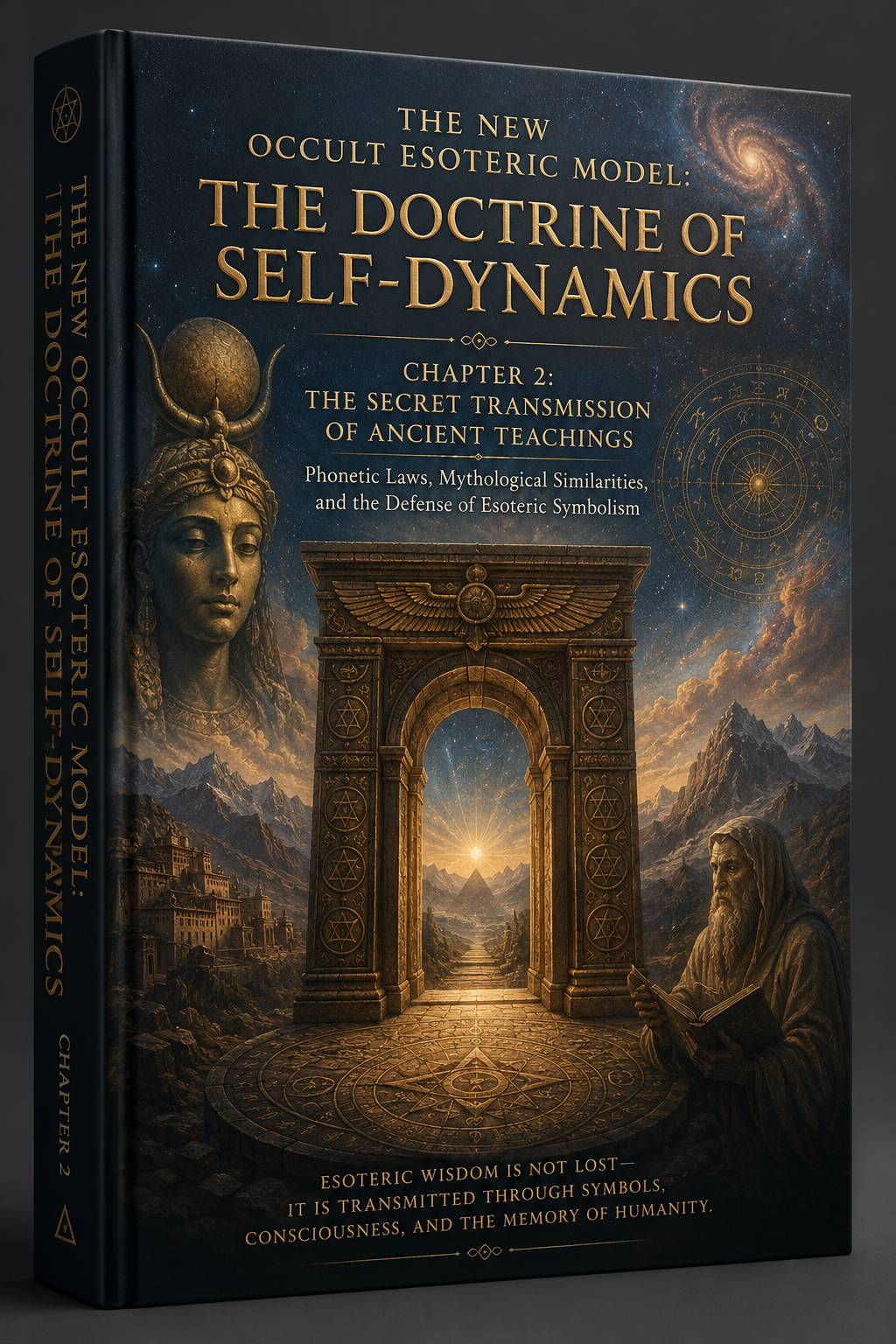
THE NEW OCCULT ESOTERIC MODEL: THE DOCTRINE OF SELF-DYNAMICS
CHAPTER 2: THE SECRET TRANSMISSION OF ANCIENT TEACHINGS
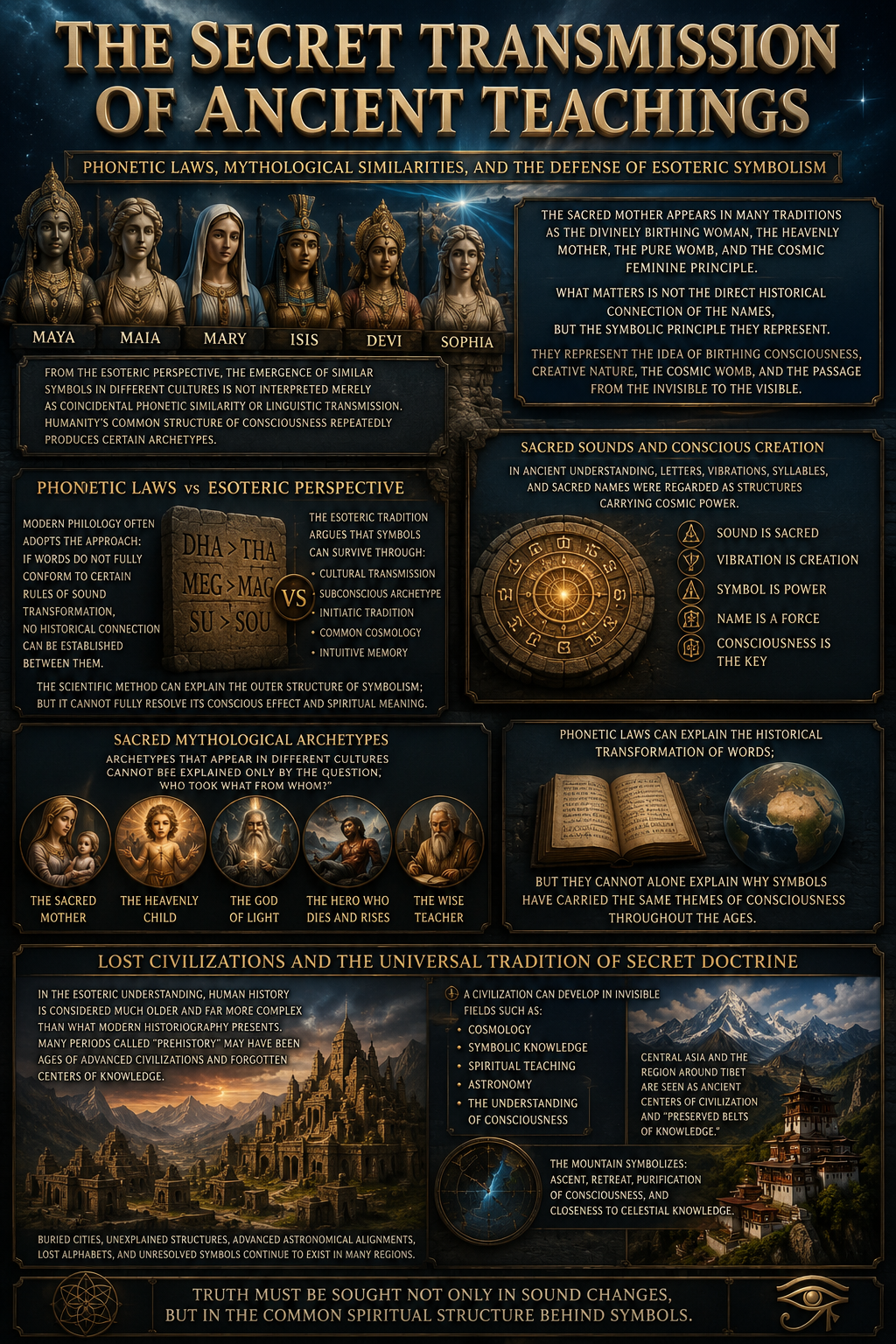
Phonetic Laws, Mythological Similarities, and the Defense of Esoteric Symbolism
From the perspective of esotericism, modern philology and comparative linguistics have provided important tools in the study of ancient texts, yet it is thought that when one proceeds only through linguistic rules, the deep structure of symbols may be lost.
Especially the philological approach that developed in the nineteenth century attempted to explain the connections between religions and mythologies largely through sound changes and linguistic evolution. At the basis of this approach were phonetic laws examining the historical transformation of words.
Esoteric thought does not say that this method is entirely wrong; but it does not regard it as sufficient.
Because a sacred symbol is not merely a word.
It is also regarded as a model of consciousness, a cosmological archetype, a spiritual process, and a trace of collective memory.
For this reason, the emergence of similar symbols in different cultures is not interpreted merely as coincidental phonetic similarity or linguistic transmission. From the esoteric perspective, humanity’s common structure of consciousness repeatedly produces certain archetypes.
For example, the sacred mother figure appears in many traditions as the divinely birthing woman, the heavenly mother, the pure womb, and the cosmic feminine principle.
This figure sometimes appears under different names such as Maya, Maia, Mary, Isis, Devi, and Sophia.
From the esoteric perspective, what matters here is not the direct historical connection of the names, but the symbolic principle they represent.
Because many of these figures represent the idea of birthing consciousness, creative nature, the cosmic womb, and the passage from the invisible to the visible.
For this reason, esoteric thought argues that mythological structures repeated across different cultures are not merely coincidental.
Modern philology, however, often adopts the following approach: if words do not fully conform to certain rules of sound transformation, no historical connection can be established between them.
The esoteric tradition objects here, because according to it, mythological and spiritual symbols cannot be explained only through philological mechanisms.
A symbol can also survive through cultural transmission, subconscious archetype, initiatic tradition, common cosmology, and intuitive memory.
For this reason, esoteric thought argues that the modern academic approach can sometimes become excessively reductionist.
Especially reducing sacred names and divine figures only to sound changes renders the spiritual dimension of symbols invisible.
According to esoteric traditions, the priests and initiates of the ancient world consciously chose symbols. Because sound itself was considered sacred.
In the ancient understanding, letters, vibrations, syllables, and sacred names were regarded as structures carrying cosmic power.
For this reason, similar sound structures may sometimes have emerged as the result of conscious symbolic use.
From the esoteric perspective, the issue is this:
The scientific method can explain the outer structure of symbolism; but it cannot fully resolve its conscious effect and spiritual meaning.
Because sacred mythologies are not merely historical narratives. They are maps of humanity’s collective consciousness.
For this reason, archetypes that appear in different cultures, such as the sacred mother, the heavenly child, the god of light, the hero who dies and resurrects, and the figure carrying wisdom, are very important for the esoteric tradition.
These similarities cannot be explained only through the question, “Who took what from whom?”
The esoteric understanding tends to interpret them as common human memory, the tradition of ancient wisdom, and a universal symbolic language.
Therefore, phonetic laws can explain the historical transformation of words; but they cannot alone explain why symbols have carried the same themes of consciousness throughout the ages.
According to esoteric thought, truth must be sought not only in sound changes, but in the common spiritual structure behind symbols.
Lost Civilizations and the Universal Tradition of Secret Doctrine
In the esoteric understanding, human history is considered much older and far more complex than what modern historiography presents. According to this perspective, the periods today called “prehistory” may in fact have been ages of advanced civilizations and forgotten centers of knowledge.
Esoteric thought says that the modern world largely interprets the past on the basis of material remains. Yet the true level of a civilization cannot be measured only by stone structures. Because a civilization may also have developed in invisible fields such as cosmology, knowledge of symbols, spiritual teaching, astronomy, and the understanding of consciousness.
For this reason, the declaration of certain ancient societies as “barbaric” is, from the esoteric perspective, the result of modern prejudice.
Because in many regions of the world, buried cities, unexplained architectural structures, advanced astronomical alignments, lost alphabets, and unresolved symbols continue to exist.
Especially Central Asia and the region around Tibet are seen in esoteric traditions as very ancient centers of civilization. These regions are not merely geographical areas, but are also interpreted as “preserved belts of knowledge.”
The selection of regions surrounded by mountains is also symbolically important. Because the mountain carries the meanings of ascent, retreat, purification of consciousness, and closeness to celestial knowledge.
For this reason, the Himalayas and their surroundings have become a “hidden center of wisdom” in many esoteric traditions.
The ancient city ruins in and around the Tarim Basin also hold an important place in esoteric literature. Cities buried beneath the desert, lost peoples, and preserved mummies are evaluated not merely as objects of archaeological curiosity, but as symbols of humanity’s forgotten past.
Images such as mummies adorned with golden stars and eyes covered with golden disks carry multilayered meaning in esoteric interpretation.
Gold is associated with spiritual light, incorruptible essence, and solar consciousness.
The covering of the eyes with gold is sometimes interpreted as the closing of physical sight, the opening of inner vision, and the post-mortem journey of consciousness.
According to esoteric traditions, ancient civilizations carried not only material power, but also symbolic and spiritual knowledge. For this reason, tombs and temples were often built in connection with astronomical alignments, an understanding of post-mortem consciousness, cosmic cycles, and rituals of spiritual transformation.
Here, the concept of the “Secret Doctrine” emerges as a universal system of wisdom.
According to the esoteric understanding, at the deep center of all great civilizations there exists a common teaching: the Egyptian mysteries, the Vedic tradition, Tibetan teachings, Hermetic systems, Chaldean cosmology, Buddhist mysticism, and Sufi esotericism are different forms of the same primordial truth.
For this reason, the “Secret Doctrine” is interpreted not as a particular religion, but as humanity’s common metaphysical memory.
According to esoteric thought, this teaching has been hidden throughout history for various reasons: to protect it from wars, to prevent corruption, to keep it from falling into the hands of political powers, and to prevent the harm of unconscious use.
For this reason, the ideas of hidden caves, underground libraries, concealed commentaries, and encoded texts appear in many traditions.
From the esoteric perspective, some of these may be physical; yet they are also symbols of consciousness.
Because true hidden knowledge ultimately lies within the human being.
In ancient teachings, the “lost city” often represents the spiritual center that the human being has lost.
“Buried books,” meanwhile, are a metaphor for forgotten knowledge of consciousness.
For this reason, the theme of lost civilization is not merely archaeological, but also psychological and spiritual.
The esoteric tradition argues that the modern age has not yet fully understood humanity’s ancient wisdom. Because today’s civilization is regarded as technologically advanced, but spiritually fragmented.
For this reason, the idea emerges that certain knowledge has been preserved for “a more enlightened age.”
This “enlightened age” means not merely scientific progress, but ethical and conscious maturity.
Because in the esoteric understanding, true knowledge is power. And power can become destructive without wisdom, without ethics, and without spiritual balance.
Ultimately, the saying “the Mlechchhas will have to wait” expresses not merely cultural contempt, but symbolically the idea that humanity has not yet reached the level of consciousness capable of carrying certain truths.
According to esoteric teaching, ancient wisdom has not completely disappeared. It continues to live in symbols, rituals, forgotten languages, mountain monasteries, the collective consciousness, and the depths of the human spirit.
And one day, humanity will begin to remember that lost memory again.
The Preservation of Secret Knowledge and the Initiatic Principle of Silence
Within esotericism, the concealment of knowledge has often been misunderstood. The modern perspective sometimes interprets this as a desire for power, elitism, or a conscious wish to hide. Yet in esoteric traditions, the fundamental reason for preserving sacred knowledge is the transformative and at the same time dangerous power it carries.
According to ancient teachings, knowledge is not neutral.
In particular, techniques of consciousness, methods of spiritual energy, symbolic cosmology, knowledge of mental influence, and teachings concerning the forces of nature may produce destructive consequences in the wrong hands.
For this reason, in ancient mystery schools, knowledge was not given to everyone at the same time. The student’s moral maturity, mental balance, control of will, and spiritual discipline were observed for a long time.
Because in the esoteric understanding, giving power without character development was considered dangerous.
For this reason, systems of initiation emerged.
Initiation was not merely ritual, but a process of consciousness training and inner purification. Its aim was to prepare the student for knowledge. Because as long as a person remains ego-centered, higher knowledge may turn into manipulation, desire for power, fanaticism, and spiritual collapse.
One of the fundamental messages of the Atlantis narrative in esoteric teachings is this:
Power separated from wisdom destroys civilization.
For this reason, the preservation of certain secrets was seen not as “jealously guarding knowledge,” but as an effort to protect humanity.
In ancient traditions, teachers defended the following principle:
A human being should receive as much truth as they are able to carry.
Because deep metaphysical knowledge given before consciousness is prepared may be misunderstood, interpreted literally, create psychological imbalance, or turn into dogmatic obsession.
In esoteric thought, truth is not merely mental knowledge; it is a state of consciousness. Therefore, certain teachings are considered understandable not through books, but through experience.
For example, death experiences, dissolution of the self, deep meditative states, and the perception of cosmic unity may create fear or fragmentation in an unprepared mind.
For this reason, the vow of silence was important in ancient initiatic systems.
Silence was seen not as a tool of oppression, but as a method of protecting consciousness and a way of preserving the sacredness of symbols.
In esoteric traditions, the concept of “secret” is also often misunderstood. The secret here is not knowledge arbitrarily hidden, but truth that can only be understood at a particular level of consciousness.
In other words, some truths are not hidden; humanity cannot yet perceive them.
For this reason, ancient teachings used symbols. Because a symbol appears ordinary to the unprepared person, while it opens deep meaning for prepared consciousness.
This is why the same text creates different effects in different people.
From the esoteric perspective, many spiritual crises in human history are the result of knowledge disconnected from wisdom.
The modern age is seen as a new example of this: high technology, great energy power, artificial intelligence, and the capacity for biological intervention have developed; but ethical consciousness has not developed at the same speed.
For this reason, esoteric teachings fear “intelligence without morality.”
Because the increase of external power without the inner transformation of the human being is dangerous.
The analogy of “placing a burning candle in the hand of a child inside a gunpowder depot” expresses this idea.
The child here is the symbol of the unconscious ego, uncontrolled desire, and immature humanity.
Gunpowder means power, secret knowledge, and transformative energy.
For this reason, the esoteric tradition first emphasizes inner development: self-discipline, compassion, ego control, ethical maturity, and clarity of consciousness.
The aim of the true initiate is not to gain power, but to gain wisdom.
Because in the esoteric understanding, the highest knowledge does not make a person dominant over others; on the contrary, it makes them more responsible, more conscious, and more compassionate.
Therefore, the preservation of secret teachings is not the jealous withholding of truth from people, but a spiritual safety system created to prevent its misuse.
The Sevenfold Doctrine of the Universe and the Danger of Occult Powers
In the esoteric understanding, the universe does not consist only of physical matter; it is seen as a multilayered, vibrational, and consciousness-based structure. For this reason, the human being is also not regarded merely as a biological organism, but as a multilayered being functioning on different planes.
The idea of the “septenary,” that is, the sevenfold system frequently mentioned in esoteric teachings, stands at the center of this understanding.
According to this, the human being is sevenfold, nature is sevenfold, consciousness is sevenfold, and cosmic evolution has seven stages.
For this reason, symbolic relationships are established between planets, planes of consciousness, the inner structure of the human being, and cycles of civilization.
Here, the concept of “planet” is not used only in the sense of an astronomical body. Planets are also interpreted as fields of consciousness, cosmic principles, and levels of vibration.
Likewise, “races” are not biological, but represent the stages of humanity’s evolution of consciousness.
According to esoteric thought, within the human being there are layers such as the physical body, life energy, emotional field, mental structure, spiritual intuition, higher consciousness, and divine essence.
Each of these layers is related to certain cosmic forces.
At this point, the idea emerges as to why occult teachings were kept secret.
According to esoteric traditions, human consciousness does not merely produce thought; it also creates influence. It was believed that certain techniques connected with higher states of consciousness could produce psychological, energetic, collective, and spiritual effects.
For this reason, ancient schools considered it dangerous to give certain knowledge to unprepared individuals.
Here, when “occult power” is mentioned, only supernatural events are not meant. In a broader sense, areas such as the influence of consciousness, concentration of will, symbolic effect, collective psychology, mental direction, and spiritual energy practices are considered.
Esoteric traditions especially argue that knowledge concerning higher planes may be dangerous for ego-centered people. Because when a person gains power before reaching inner maturity, they may turn toward manipulation, fanaticism, spiritual collapse, and obsession with power.
For this reason, in ancient mystery schools the first thing taught was not power, but ethics.
The student would undergo long training in will control, self-discipline, compassion, silence, and transcendence of the ego.
Because according to the esoteric understanding, the greatest danger is not knowledge, but immature consciousness.
Sevenfold systems are therefore not merely metaphysical schemes. In esoteric interpretation, they are maps of human psychology, transformation of consciousness, cosmic energies, and spiritual evolution.
It was believed that the misuse of these maps could produce serious consequences.
Especially in ancient times, people were believed to be more open to invisible forces. This openness sometimes appeared in the form of shamanic practices, systems of magic, psychic rituals, and collective suggestions.
Esoteric traditions argue that these fields are not entirely imaginary, but are related to the deep layers of human consciousness.
For this reason, in periods such as the first centuries of Christianity, fear of magic, demonology, secret rituals, and mystical communities were very widespread.
Because people strongly believed that invisible influences were real.
The modern age, however, has entered an excessively materialistic period in the opposite direction. From the esoteric perspective, the “protection” of today’s human being arises, in a sense, from blindness toward invisible dimensions.
That is, modern human beings believe only in the physical, underestimate the power of consciousness, regard symbols as psychological games, and reject spiritual realms.
Esoteric teachings see this both as a loss and as a temporary protection.
Because when consciousness opens again, it is believed that humanity must also have developed ethically.
For this reason, true occultism is defined not as the pursuit of power, but as purification of consciousness, inner balance, and spiritual responsibility.
In ancient teachings, the greatest secret is not controlling nature, but the human being’s ability to govern their own inner nature.
Because according to the esoteric understanding, for someone who cannot establish mastery over their own self, working with greater powers may be dangerous both for themselves and for others.
Temple Mysteries and the Continuous Transmission of Ancient Wisdom
In the esoteric understanding, ancient mystery schools are seen not merely as secret communities, but as spiritual education centers aimed at transforming human consciousness. In these schools, the teachings called “Mysteries” were used not to satisfy supernatural curiosity, but to ensure the inner development of the human being.
According to esoteric traditions, true initiation is not the accumulation of knowledge, but a process of character transformation, purification of consciousness, and spiritual maturation.
For this reason, at the center of the Temple Mysteries stood not power, but virtue.
Ancient hierophants, that is, initiatic teachers, first trained their students in the fields of self-discipline, will control, silence, ethical balance, and mental clarity.
Because according to the esoteric understanding, spiritual knowledge becomes safe only when united with moral maturity.
For this reason, the system of Mysteries was seen as an ancient science of consciousness centered on the inner transformation of the human being.
Many ancient schools such as Pythagoras, Plato, and the tradition of Neoplatonism argued that higher layers of reality existed behind the visible world.
Especially for the Neoplatonists, the human soul was a spark of consciousness that preceded matter, was born from the universal intellect, and sought to return again to its source.
For this reason, ancient philosophy was considered not merely a system of logic, but also a path of spiritual ascent.
In esoteric traditions, philosophy and mysticism were not separate from each other. The true philosopher was seen as a person who understood cosmology, decoded symbols, experienced inner reality, and underwent ethical transformation.
The Temple Mysteries are considered to have largely been lost or suppressed over time. Especially with the rise of institutional religions, many ancient mystery systems were either hidden or eliminated.
According to esoteric thought, throughout history political and religious structures often saw independent spiritual schools as a threat. Because mystery schools defended the individual’s direct experience of truth.
Over time, this led to the strengthening of dogmatic structures, the literal reading of symbols, and the loss of inner teachings.
Yet according to the esoteric understanding, ancient knowledge has not completely disappeared. It has continued to live in secret communities, Masonic circles, mystical brotherhoods, retreat centers, and chains of oral transmission.
The orientation of Freemasonry and certain mystical communities toward Eastern wisdom is also interpreted within this context. Especially Tibet and Central Asia have been seen in esoteric literature as “regions of preserved wisdom.”
Narratives of Russian mystics traveling to Tibet are one example of the idea of initiatic centers hidden from the modern world.
Here, Tibet is not merely a physical region; it also becomes a symbol of inner search, unknown wisdom, spiritual retreat, and the preservation of lost truth.
According to esoteric teachings, true knowledge is obtained more through transmission of consciousness than through books. For this reason, long journeys and periods of retreat are interpreted not only as geographical, but also as psychological and spiritual journeys of transformation.
The question “Is this a new religion?” is connected to one of the most important ideas at the center of esoteric thought.
The esoteric understanding does not see itself as a new religion.
Because according to it, truth is independent of time, universal, and as old as humanity itself.
Great teachers and founders of religions re-expressed this truth; they did not create it.
For this reason, from the perspective of the esoteric tradition, figures such as Gautama Buddha, Jesus, Laozi, and Pythagoras are not “creators of truth,” but its carriers.
Their task is seen as reviving forgotten wisdom, expressing it in a form suitable to the language of the age, and calling humanity toward inner awakening.
For this reason, esoteric teaching argues that the same fundamental principles exist at the essence of all great traditions: the universe is alive, consciousness is fundamental, the human being is a multilayered being, spiritual transformation is possible, ethical development is necessary, and truth must be sought within the human being.
Religions and philosophies may change; but this fundamental metaphysical core continues to exist.
According to esoteric thought, throughout human history great teachers have expressed the same eternal wisdom again and again through different symbols.
The Transmission of Ancient Truths and the Continuity of the Secret Doctrine
According to the esoteric understanding, humanity’s oldest wisdom was originally preserved not in books, but in living chains of consciousness. Truth was seen not merely as something written, but as a reality experienced, transmitted, and grasped through inner transformation.
For this reason, in the ancient world, great teachings were preserved in the inner sections of temples, in mystery schools, in oral traditions, and in processes of initiation.
According to esoteric thought, oral transmission was not merely a practical necessity; it was a method of protecting consciousness. Because a written text can be misunderstood, removed from its context, and fall into the hands of unqualified people.
Direct teacher-student transmission, however, aimed to convey knowledge not only on a mental level, but also on a spiritual level.
For this reason, in ancient initiatic systems, truth was not explained; it was made to be lived.
In mystery schools, the student did not merely learn theory. They also tried to develop the ability to read symbols, mental silence, ethical balance, and awareness of consciousness.
Because in the esoteric understanding, true knowledge is not dry data that does not transform the human being’s existence.
As human communities separated over time, this common ancient teaching also took different forms in different cultures.
Thus the same fundamental truths transformed in one place into divine mythology, in another into a cosmological system, in another into mystical poetry, and in another into religious ritual.
According to esoteric thought, most religions are cultural interpretations of this common metaphysical core.
Teachings that were originally symbolic began over time to be read literally. Thus cosmic principles became gods, processes of consciousness became mythological stories, and inner transformation became rituals.
For this reason, from the esoteric perspective, many ancient pantheons are not merely “polytheism.” The gods were often symbolic languages used for forces of nature, states of consciousness, cosmic laws, and universal principles.
Confucius’s statement “I only transmit” is very important for the esoteric tradition. Because in the ancient understanding of wisdom, great teachers are accepted not as inventors of truth, but as its carriers.
According to esoteric thought, no great teacher created an entirely new truth.
They reorganized forgotten knowledge, translated it into a language suitable for the understanding of their age, reinterpreted symbols, and placed ancient truth into a new form.
For this reason, the esoteric tradition does not see itself as “new.”
Truth is accepted as ancient as humanity, universal, and beyond time.
The rejection of these teachings by the modern age is not surprising from the perspective of esoteric thought. Because modern science is largely based on observation, measurement, and material verification.
Esoteric teachings, however, often proceed through intuitive experience, states of consciousness, symbolic transmission, and inner awareness.
For this reason, a natural tension arises between the two approaches.
Esoteric thought does not reject modern science entirely; but it argues that science can examine only the physical realm.
Because consciousness, mystical experience, the inner effect of symbols, and spiritual transformation cannot be fully measured by laboratory instruments.
For this reason, occultism has long been regarded as “unscientific.”
Yet esoteric traditions believe that humanity will develop a more holistic understanding in the future. According to this view, science will one day begin to examine consciousness research, energy fields, psychological symbols, and the deep layers of the mind more seriously.
The idea often repeated in esoteric teachings is this:
Truth is first rejected, then debated, and finally rediscovered.
For this reason, ancient wisdom traditions are not thought to be entirely imaginary. It is argued that within them may be hidden ancient astronomical knowledge, psychological intuitions, symbolic maps of consciousness, and techniques of spiritual experience.
The central idea of the esoteric understanding is this:
Humanity does not create truth; it remembers it again in different ages.
And all great teachings are nothing but the re-echoing of the same eternal wisdom in different times.
The Reemergence of the Secret Doctrine and the Sevenfold Key
According to the esoteric understanding, throughout human history much knowledge has first been rejected and only later understood. Therefore, the initial belittling of ancient teachings does not mean that they are worthless.
A similar approach once existed toward the Vedas as well. Modern researchers tended to see them as late fabrications, primitive poems, and worthless mythological texts.
It was even thought that Sanskrit itself was not an independent and very ancient language. But over time, as linguistics, comparative mythology, and historical research developed, old assumptions began to collapse.
Thus the Vedas came to be accepted as one of the oldest spiritual and philosophical texts in human history.
Esoteric thought uses this example for an important principle:
The fact that a truth is first rejected does not prove that it is false.
Because humanity often thinks within the mental limits of its own age. If a new or forgotten idea does not fit the existing worldview, it initially meets resistance.
For this reason, the esoteric tradition maintains that truth reveals itself gradually.
Here, the symbol of “the key turned seven times” is very important.
In esoteric systems, the “key” is interpreted as the decoding of symbols, the level of consciousness, and the method that opens hidden meaning.
A sacred text or symbol does not have only one meaning. The same teaching may be read on physical, astronomical, psychological, metaphysical, spiritual, cosmological, and initiatic layers.
The “key turned seven times” represents this multilayered structure of meaning.
According to esoteric thought, ancient mystery schools deliberately preserved knowledge in symbolic form. Because the same symbol opens as a simple story for the unprepared person, as philosophy for the researcher, and as a map of consciousness for the initiate.
Therefore, sacred texts must not be read only literally.
For example, the Zodiac is not merely a star system; it may also be interpreted as a symbol of cosmic cycles, human psychology, and spiritual evolution.
Numbers also have special importance in esoteric traditions.
Especially the number “seven” is associated with seven planets, seven levels of consciousness, seven human principles, seven cosmic stages, and seven degrees of initiation.
For this reason, the idea of the “seven keys” points to the multilayered structure of the universe.
According to esoteric thought, humanity in the past could understand this symbolic language better. But over time, as literal thinking, materialism, and dogmatic religious understanding increased, the inner meaning of symbols was forgotten.
Thus much of the sacred teachings began to appear as mythology, legend, and superstition.
Yet the esoteric understanding foresees that a deeper synthesis will emerge in the future.
In this synthesis, science, psychology, consciousness studies, the science of symbols, and spiritual experience will begin to reunite.
Here, the symbol of the “student of the future” emerges.
This figure does not have to be one specific person. In esoteric interpretation, it represents the future level of consciousness of humanity.
That is, in the future some people will become capable of decoding ancient symbols again, understanding the common origin of religions, and grasping more deeply the relationship between consciousness and the cosmos.
The concept of “Gupta-Vidya,” meaning “Secret Knowledge,” is also important here.
This teaching is interpreted as universal wisdom, ancient science of consciousness, and the common metaphysical essence of religions.
According to esoteric thought, behind all great traditions lie the same fundamental principles: the universe is alive, consciousness is fundamental, the human being is multilayered, spiritual evolution is possible, symbols carry cosmic truth, and ethical development is necessary.
Religions are cultural forms of this truth; its essence is older.
For this reason, the esoteric tradition sees itself not as a new teaching, but as the re-remembrance of forgotten ancient wisdom.
And the idea of the “future student” represents the hope that humanity will one day again reach the level of consciousness capable of understanding the common truth behind symbols.
The Suppression of Ancient Wisdom and the Silent Survival of the Secret Doctrine
According to the esoteric understanding, human history is not only the rise of civilizations; it is also the history of the preservation, suppression, and reemergence of knowledge. In this perspective, the “Secret Doctrine” is not a speculative theory, but the common metaphysical inheritance that humanity has carried in different forms since very ancient times.
According to esoteric traditions, these teachings were not openly destroyed at first; but over time they were misinterpreted, symbolized, fragmented, suppressed, and covered over with new dogmas.
Therefore, the traces of ancient wisdom did not disappear completely, but remained scattered.
Ancient philosophers, mystery schools, and certain mystics tried to preserve this knowledge. Because according to their understanding, the human being is not merely a body, not merely a mind, but a multilayered being connected with cosmic consciousness.
This thought existed in many centers of the ancient world. The Egyptian mysteries, Orphic traditions, Pythagorean schools, Platonic teachings, Hermetic systems, Vedic metaphysics, and Buddhist esotericism have been interpreted as different expressions of the same fundamental principles.
For this reason, esoteric thought argues that the philosophers of the classical age did not merely reason intellectually, but may also have come into contact with initiatic knowledge.
Especially the ideas of thinkers such as Plato and the Neoplatonists concerning the immortality of the soul, the world of ideas, cosmic intellect, and the hierarchy of consciousness are seen, from the perspective of the esoteric tradition, as echoes of the mystery schools.
In the esoteric understanding, the “Mysteries” were not merely ritual ceremonies. They were systems used for training consciousness, the symbolic experience of death, spiritual transformation, and the direct intuition of truth.
Initiates therefore underwent an education different from ordinary religious practices.
But with historical transformations, most of these systems were eliminated.
According to esoteric interpretations, especially during periods when new religious and political structures were being formed, ancient traditions began to be seen as dangerous. Because they preserved individual spiritual experience, the direct search for truth, symbolic thought, and independent development of consciousness.
This created conflict with centralized dogmatic systems.
According to esoteric traditions, the transformation that took place in the first centuries of Christianity was not only a change of religion, but also a change of worldview.
In the old pagan world, nature was regarded as sacred, cosmology was read symbolically, consciousness was thought of as layered, and mystery schools were active.
In the new period, however, single authoritative interpretations, dogmatic structures, literal understandings of sacred texts, and belief-centered systems gradually gained strength.
From the esoteric perspective, in this process the multilayered symbolic language of the ancient world was largely suppressed.
Therefore, many ancient teachings were branded either as “paganism,” “sorcery,” or “dangerous knowledge.”
Here, the concept of “magic” is also important.
The esoteric tradition defines true occultism as knowledge of consciousness, deep understanding of the laws of nature, and spiritual transformation.
But throughout history, corrupted forms of this appeared, and practices centered on fear and desire for power multiplied.
For this reason, a distinction is made between “occultism” and “sorcery.”
True esoteric teaching aims not at strengthening the ego, but at transcending the self, ethical development, and purification of consciousness.
According to esoteric thought, the reason ancient wisdom could not be completely destroyed is that truth does not live only in books.
It continues to leave traces in myths, symbols, rituals, philosophy, works of art, and the collective consciousness.
For this reason, despite all suppressions, history has preserved fragments of ancient teachings.
From the esoteric perspective, the great rupture between the pre-Christian and post-Christian worlds is a sign of humanity’s transition from symbolic thought to dogmatic thought.
This is also why ancient religions created fear.
Because they reminded humanity of cosmic cycles, spiritual evolution, layers of consciousness, and symbolic truth.
And these ancient teachings had the potential to question the claims of absoluteness made by the newly formed systems of interpretation.
The esoteric tradition ultimately reaches this idea:
Truth cannot be completely destroyed.
Because it lives not only in texts, but within the deep structure of human consciousness.
And throughout history, in every age, certain people have tried to rediscover that ancient wisdom hidden behind suppressed symbols.
The Irrepressibility of Truth and the Doctrine of the Golden Middle Way
According to the esoteric understanding, throughout human history countless attempts have been made to completely destroy truth. Sacred texts were burned, temples were demolished, symbols were scraped away, and ancient teachings were declared heretical. Yet despite all this destruction, ancient wisdom could not be completely erased.
Because one of the fundamental principles of esoteric thought is this:
Truth is not dependent on physical objects.
Books may disappear, monuments may be broken apart, languages may be forgotten; but the essence of truth continues to live within the deep structure of human consciousness.
For this reason, the great destructions carried out in ancient times targeted not only material heritage, but humanity’s collective memory.
Especially in ancient centers of wisdom such as Ancient Egypt, the dismantling of temples, the scraping away of hieroglyphs, the destruction of papyri, and the erasure of symbols are interpreted by the esoteric tradition not merely as religious struggle, but as a war against symbolic memory.
In the ancient world, symbols were not merely decoration. They were encoded structures carrying cosmological knowledge, maps of consciousness, methods of spiritual transformation, and universal principles.
Therefore, the destruction of a symbol meant an attempt to erase the worldview it represented.
Ancient signs such as the Tau symbol are especially important from the esoteric perspective. Because cross-shaped symbols in many ancient traditions meant the tree of life, the cosmic axis, the union of spirit and matter, and the vertical ascent of the human being.
It is thought that these symbols do not belong only to a particular religion, but extend back to much older origins.
According to esoteric traditions, fanaticism has been one of the greatest destructive forces throughout history.
Fanaticism interprets symbols literally, sees different thought as an enemy, reduces truth to a single form, and acts through fear.
For this reason, ancient teachings were often perceived as threats.
But esoteric thought sees not only religious fanaticism, but also extreme materialism as equally dangerous.
Because materialism also reduces consciousness solely to biology, regards symbols as meaningless, belittles spiritual experience, and denies the unseen.
Thus humanity becomes trapped between two extremes: blind belief and blind denial.
According to esoteric teaching, both extremes disturb balance.
One side accepts everything without question; the other side regards everything as meaningless.
For this reason, the idea of the “golden middle way” is very important.
The golden middle way means faith without fanaticism, spirituality without dogma, reason without denial, and balanced consciousness.
In esoteric traditions, true wisdom is associated with staying away from extremes.
Because truth cannot be fully grasped only through blind faith, only through dry reason, only through ritual, or only through science.
The human being must establish balance between intuition, reason, experience, and ethical consciousness.
For this reason, in many mystical traditions the “middle way” has become a fundamental teaching.
According to esoteric thought, the conflict of religions arises largely from excessive attachment to outer forms. When people forget the common essence behind symbols, names fight, rituals clash, sects divide, and truth becomes fragmented.
Yet at a deep level, all great traditions are directed toward the ideas of ethical transformation, inner purification, development of consciousness, and universal unity.
For this reason, the statement “There is no religion higher than Truth” expresses the essence of the esoteric understanding.
“Satyât Nâsti Paro Dharmah”:
“There is no religion higher than Truth.”
This expression places not a particular institution, but truth itself at the center.
From the perspective of the esoteric tradition, true religion does not govern human beings through fear, does not suppress thought, and does not sanctify blind obedience.
True religion must strengthen the human being’s clarity of consciousness, ethical development, sense of universal brotherhood, and inner search for truth.
For this reason, truth can never be completely destroyed.
Because it continues to live in symbols, intuitions, myths, conscience, and the depths of the human spirit.
And in every age, certain people try to rediscover that silent wisdom remaining behind demolished temples and erased inscriptions.
MASTER H.P. BLAVATSKY
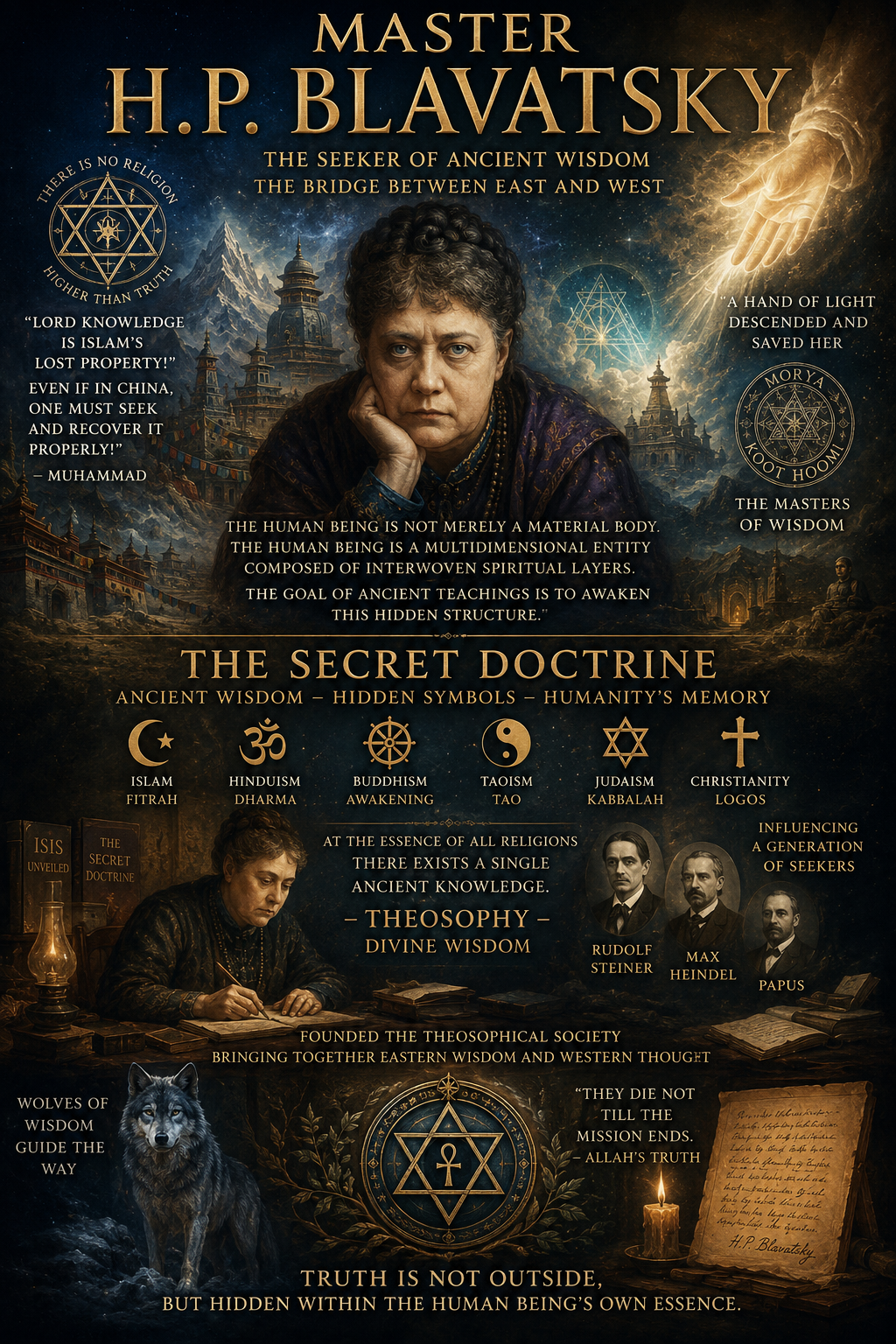
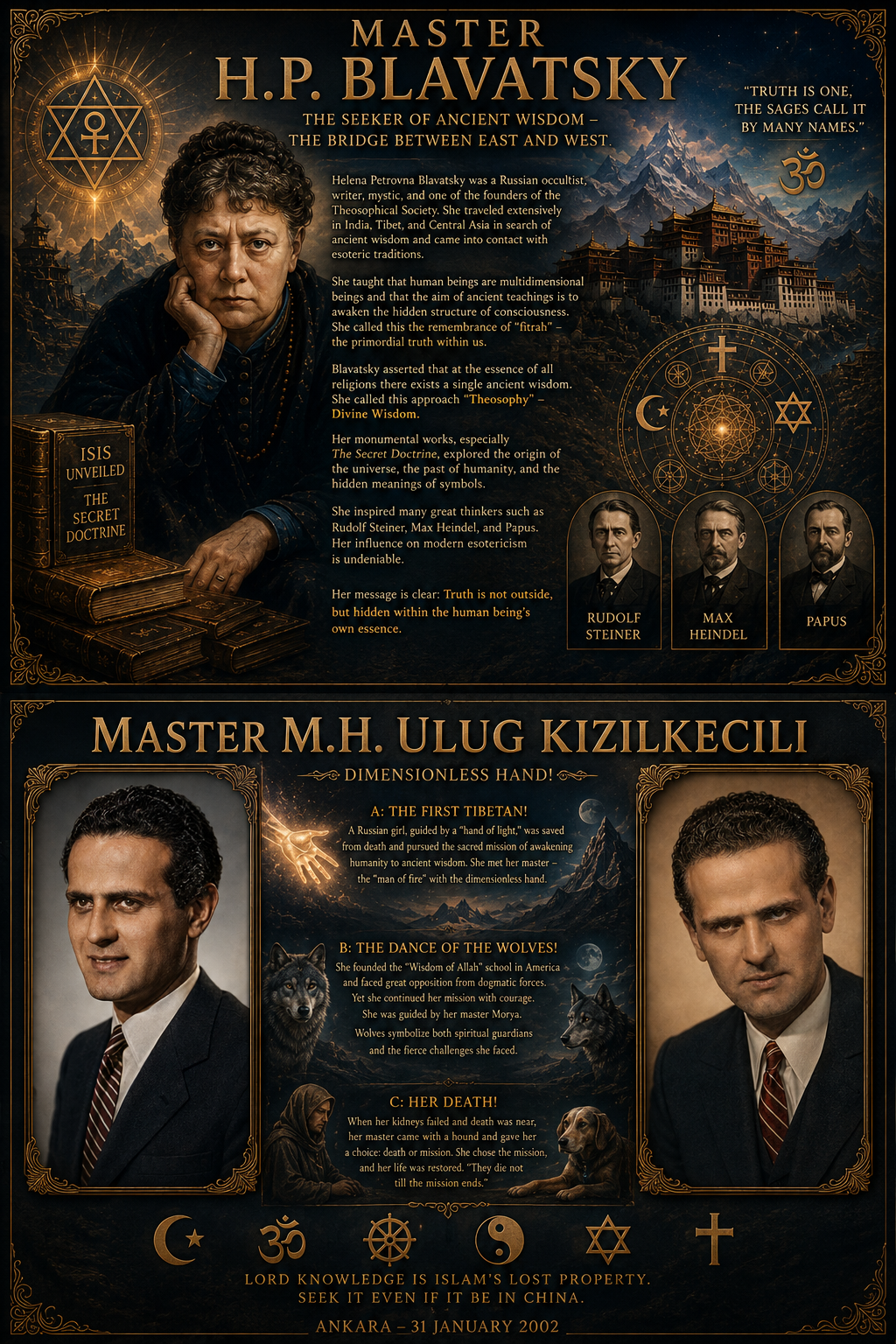
Some people who believed that the lost wisdom of the East had to be sought again argued that truth did not belong only to certain geographies or religious structures. According to them, truth was the common inheritance of humanity, and wherever it was hidden, it had to be brought forth from there. One of the most remarkable figures who pursued this idea was an extraordinary woman from Russia: Helena Petrovna Blavatsky.
Even Blavatsky’s childhood was full of events that seemed strange to those around her. It is said that she mysteriously escaped death several times. According to the stories circulating around her, it was as if an invisible protection was watching over her. These events strengthened in her mind the idea that there were other layers beyond the ordinary world. From a young age, she began to take an interest not only in religious texts, but also in alchemy, Hermeticism, ancient Eastern teachings, and the limits of human consciousness.
It is claimed that for years she traveled around India, Tibet, and Central Asia, and that there she came into contact with esoteric traditions. According to what she herself related, the human being was not merely a material body. The human being was a multidimensional being composed of interwoven spiritual layers, and the aim of ancient teachings was to awaken this hidden structure. What she called “fitrah” was exactly this: the human being’s remembrance of the first truth within their own essence.
Over time, a large intellectual and esoteric circle formed around Blavatsky. In particular, figures such as Rudolf Steiner, Max Heindel, and Papus were influenced by the intellectual fields she opened. Although each of them went in different directions, their common point was the idea that the human being is not merely a biological entity.
Blavatsky’s greatest claim was that at the essence of all religions there existed a single ancient knowledge. According to her, prophets, sages, and mystics had spoken from the same source; but over time symbols, institutions, and dogmas had covered over the truth. For this reason, she developed the approach she called “Theosophy.” This concept meant “divine wisdom.” It aimed to bring together once again humanity’s forgotten wisdom.
However, these ideas also drew great reactions. Some saw her as a fraud, some as a spy, and some as a dangerous mystic. She clashed with spiritualist circles; she opposed blind beliefs; she evaluated certain mediumistic displays as deception. For her, what mattered was not display, but transformation of consciousness. A human being could not reach truth without overcoming their fears, conditioning, and inner darkness.
It is known that in the final period of her life she struggled with severe illnesses. Nevertheless, she did not stop writing. Especially in works such as The Secret Doctrine, she made comprehensive interpretations concerning the origin of the universe, humanity’s past, layers of consciousness, and the hidden meanings of symbols. These works left deep effects on modern esotericism.
Today, Blavatsky is still a controversial figure. While some people regard her as one of the founders of modern esotericism, others find her excessively mystical and speculative. Yet her influence cannot be denied. Because she initiated a great wave of interest in the Western world toward Eastern teachings, symbolic thought, and the hidden aspects of human consciousness.
Her fundamental message, however, is quite clear: The human being is a deeper entity than they imagine. Truth is not outside, but hidden within the human being’s own essence.
MASTER M.H. ULUG KIZILKECILI
DIMENSIONLESS HAND!
A: THE FIRST TIBETAN!
MUHAMMAD says: “Lord knowledge is Islam’s lost property!”
“Even if in China, one must seek and recover it properly!”
A Russian girl alone took up this sacred mission’s flame!
For in childhood, a “hand of light” descended and saved her frame!
As from the highest floor she fell, a “transparent hand” appeared!
It caught her! The child kissed the hand and swore the oath revered!
While passing through the jungles, every path aligned her way!
And there she met the “dimensionless-handed” one that day!
“In the form of a man of fire,” he renewed the ancient creed:
To fuse the Life (body) with soul through flame — “Fıtrat’s sacred seed!”
Ancient tongues and modern ones — near ten she learned alone!
She spent herself to teach the “hidden science” yet unknown!
If books were burned, she still could read their transparent remains!
Nor had she wealth enough to buy them — bitter were such pains!
While writing, oft her murshid dwelt and guided from inside!
She in America remained, “His Holiness” in China did abide!
To her rejecting niece she went and conquered all disdain!
Transparent was she! The young girl stood astonished and amazed again!
UFO! Mufo! Such things the Lord’s Saint does not require!
At every instant casting cloaks beyond all space and time entire!
German admirers gathered close around your mystic sea:
Max Heindel, Steiner, Papus drank the oath of unity!
B: THE DANCE OF THE WOLVES
The opening words within her first great book sufficed mankind:
“Greetings from the arena! O mighty Caesar, hail sublime!”
To humankind she gifted countless monumental works untold!
Some cried “spy!” while others called her charlatan and false and cold!
In America she founded there the Tibetan sacred school!
And from the mountains brought down many “holy wolves” to rule!
Fanatic sects! The churches! Spirit-callers mad with cries!
Defending nonsense endlessly while scattering their pearls and lies!
The school she formed was named the “WISDOM OF ALLAH” indeed!
It meant the secret of “Fıtrat!” — the oathless could not heed!
For “Wisdom” is the knowledge of “Allah’s Fıtrat” divine!
And that primordial knowledge links all humankind through time!
Indeed, Steiner too perceived the meaning hidden there!
Look at his school! “Human Wisdom” was the title he declared!
Her murshid MORYA became the fear of spirit-calling men!
Every séance he shattered, casting jinn away again!
Blavatsky first became the murshid unto Max Heindel’s hand!
Thus MORYA and the COUNT stood clasped together in one band!
The fate of one who bears the “Lord mission” never bends or strays!
The knowing wolf within the forest tracks the hidden ways!
“While those who know and those who know not are never made the same!”
The thorn appears to guard the rose yet feeds upon its flame!
Do not declare the ignorant and thankless “Lord-made wise!”
He does not slay them Himself — but says: “Perishing Life (body) dies!”
Do not suppose when rises sun the day grows pure and bright!
For hidden deep within the light there still remains the night!
C: HER DEATH
Her kidneys failed completely then; she wrote her final will!
According to the doctor, less than two hours lingered still!
The murshid came abruptly there, accompanied by a hound!
He said: “Choose death itself — or choose your mission yet profound!”
When she declared “the mission,” then the dog upon her lay!
Her kidneys functioned once again! The doctor stood in disarray!
Her testament official still within the school remains concealed!
“They die not till the mission ends!” — thus Allah’s truth revealed!
I too have tested this myself! Read “Bektaş,” what I wrote!
Lord prevents disaster’s strike and heals the flesh and every mote!
Indeed, once all the message ended, then the messenger withdrew!
For “a newer mission,” Lord pushed him to inner worlds anew!
Her works throughout the world were turned to many tongues and lands!
Except in Turkish! Beg forgiveness from her soul with trembling hands!
A shame for Turkish culture — one that ought to bring disgrace!
For still in Tibet there remains: “A loss tied unto Islam’s trace!”
My conscience rests in peace: from her I borrowed here and there!
I read it through the Qur’an’s light — not theft, but rightful prayer!
This “saintly virgin” bore the surname BLAVATSKY in her name!
Mad dogs within the arena tore her fiercely into flame!
Because of “the oath,” she could not reveal the “Secret” fully bright!
The “oathless” had to satisfy themselves with lesser light!
Though she had seen her “Fıtrat,” she never asked its primal name!
Neither she nor Morya reached the “Supreme Realm” aflame!
M.H. ULUĞ KIZILKEÇİLİ
ANKARA – 31 JANUARY 2002
(From this point onward, the written section bears no relation to the author, and the author cannot be held responsible for possible errors!)
ACADEMIC FOOTNOTES
[1] The expression “Lord knowledge is Islam’s lost property” is based on the famous saying in Islamic tradition meaning, “Wisdom is the lost property of the believer.” The verse “Seek it even if it be in China” refers to the widely circulated narration in hadith literature, though not regarded as authentic and considered weak or fabricated by many hadith scholars, which says: “Seek knowledge even if it be in China.” Nevertheless, in meaning it carries a moral theme parallel to authentic narrations encouraging the pursuit of knowledge, especially the hadith: “Whoever walks a path seeking knowledge, Allah makes easy for him the path to Paradise.”
[2] The “Russian girl” mentioned in the poem is Helena Petrovna Blavatsky. Blavatsky, born in 1831 and deceased in 1891, was a Russian occultist, writer, mystic, and one of the founders of the Theosophical Society. Theosophy is regarded as a modern esoteric movement synthesizing elements from Hinduism, Buddhism, Neoplatonism, Gnosticism, Kabbalah, and Western esotericism.
[3] The title “The First Tibetan” points to Tibet’s symbolic centrality in Blavatsky’s teachings. In the Theosophical narrative, Blavatsky was believed to have communicated with hidden masters called “Morya” and “Koot Hoomi,” figures associated with Tibetan or Indo-Tibetan wisdom traditions. Academically, such figures are treated less as historically verified individuals and more as foundational “mahatma/master” archetypes of Theosophical mythology.
[4] The images of the “transparent hand,” “hand of light,” “dimensionless hand,” and “man of fire” may be interpreted through Theosophical concepts such as the astral body, subtle body, invisible masters, and initiatory intervention. Themes of telepathy, astral manifestation, receiving distant messages, and guidance from hidden masters occupy a central place in the Theosophical narratives surrounding Blavatsky.
[5] The phrase “religion of Fıtrat” derives from Qur’an 30:30. The verse commands humanity to turn toward religion upon the “fitrah” with which mankind was created. Here fitrah may be interpreted as humanity’s primordial disposition, openness to truth, and alignment with the divine order. In the poem, this concept is used to build a bridge between the Theosophical idea of “ancient wisdom” and Islamic metaphysics of creation.
[6] In Theosophy, the concept of “ancient wisdom” rests on the assumption that behind all religions lies a single primordial truth. This notion is associated in modern academic literature with discussions of “perennial philosophy” or “eternal wisdom.” Yet from the perspective of comparative religion, such similarities do not mean religions are entirely identical, but rather that they share symbolic structures, metaphysical intuitions, and languages of salvation.
[7] In Hinduism, “dharma” signifies one’s rightful path within the cosmic, moral, and social order. Compared with the poem’s concept of the “religion of Fıtrat,” both imply living in accordance with an original order bestowed upon humanity. Yet while in Islam fitrah is directed toward Allah the Creator, in Hinduism dharma is connected with cosmic order, social duty, and moral law.
[8] In Buddhism, the search for truth concerns less a creator-centered doctrine of fitrah and more the overcoming of ignorance, recognition of suffering’s source, and following the path of awakening. Thus the poem’s themes of “hidden knowledge” and “awakening” bear formal similarities to the Buddhist quest for enlightenment. However, the Islamic concept of fitrah is ontologically centered on Allah, whereas Buddhist liberation teachings focus more on dissolving existential ignorance.
[9] In Taoism, the “Tao” is viewed as the ineffable source and natural flow of all existence. The poem’s images of the “dimensionless hand” and “beyond time and space” may be compared with Taoist notions of the invisible source, hidden order, and natural flow. Yet in Taoism this principle generally signifies a cosmic way or source rather than a personal God.
[10] In Jewish mysticism, Kabbalah interprets existence through letters, divine names, sefirot, and the structure of creation. Theosophy itself was influenced by Kabbalah as part of modern esoteric synthesis. Therefore, the poem’s themes of “hidden knowledge,” “secret,” “oath,” and “unrevealed truth” may be compared with Kabbalistic ideas of concealed wisdom and initiatory transmission.
[11] In Christianity, the concept of “Logos,” especially in the Gospel of John, is associated with the divine Word, creative intellect, and Messianic truth. Compared with the poem’s motif of “Lord knowledge,” the Christian Logos similarly understands truth not merely as information but as the divine principle ordering existence. However, in Islam this center is understood through “kelâmullah,” “hikmet,” and “fitrah,” whereas in Christianity Logos is understood through its incarnation in Christ.
[12] The line “Greetings from the arena! O mighty Caesar, hail to you!” evokes the Roman arena, emperor cult, and the image of the sacrificed bearer of truth. Here Blavatsky is portrayed as a figure cast into the arena against dogmatic institutions, church criticism, positivist skepticism, and occult rivalries of the modern world.
[13] The image of the “wolves” may be interpreted on two levels. First, within steppe and mountain esotericism, the wolf symbolizes guidance, trial, and wild wisdom. Second, in the poem the “wolves” also represent religious, intellectual, and esoteric rivals prepared to tear apart the bearer of truth. This dual usage combines the guiding wolf of Turkic mythology with the predatory beasts of the Roman arena.
[14] The line “The name of her school was the ‘Wisdom of Allah’” points to the etymology of the word Theosophy. “Theosophia” derives from the Greek “theos” (god) and “sophia” (wisdom), meaning “divine wisdom.” Translating this in the poem as “Wisdom of Allah” reflects an attempt to reinterpret the Theosophical concept through Islamic language of hikmet.
[15] Rudolf Steiner’s emphasis on “human wisdom” may be linked to his separation from Theosophy and the development of Anthroposophy. Anthroposophy literally means “human wisdom” or “spiritual knowledge of humanity.” Steiner, rendered as “Şıtayner” in the poem, is positioned as one of the most influential figures of post-Blavatskian Western esotericism.
[16] References to Max Heindel and Papus point to the shared search for ancient sources among Western esoteric circles after Blavatsky. Max Heindel is associated with the Rosicrucian tradition, while Papus is linked with French occultism and Martinism. The poem gathers these figures under the “oath of unity,” emphasizing the common claim of “ancient wisdom” among modern esoteric movements.
[17] The concepts of “oath” and “secret” are rooted in initiatory traditions holding that knowledge should not be shared with everyone indiscriminately. In ancient mystery cults, Hermetic traditions, Kabbalah, certain Sufi orders, and Theosophical circles, the “secret” was considered a type of knowledge revealed only to those morally and spiritually prepared. The poem’s statement that the “oathless” must be content with little points to this closed structure of esoteric transmission.
[18] The line “While the knower and the ignorant are never the same” refers to Qur’an 39:9. The verse emphasizes that those who know and those who do not know are not equal. In the poem this verse is used to mark the ontological and moral distinction between superficial crowds and those who truly bear truth.
[19] The line “Within the light itself, darkness hides” points to a paradox frequently encountered in the history of religions: when a claim to truth gains power, dogmatism, self-interest, false guides, and institutionalized darkness may also arise around it. This theme may be compared with warnings against false prophets in Christianity, hypocrisy and ostentation in Islam, false teachers in Buddhism, and false gurus in Hindu traditions.
[20] The translation of Blavatsky’s works into many languages demonstrates the major impact of Theosophy on nineteenth- and twentieth-century Western esotericism. Particularly Isis Unveiled and The Secret Doctrine profoundly influenced modern occultism, New Age movements, Western Buddhism, perceptions of Hinduism, and comparative religion debates.
[21] The poem’s description of Blavatsky as a “saintly virgin” positions her outside dogmatic religious institutions yet as a female bearer of sacred secrets. This image may be compared with saint typologies in Christianity, female shamans in shamanic traditions, the śakti principle in Hinduism, and the notions of spiritual pole/saint in Sufism.
[22] Throughout the poem, Blavatsky is reinterpreted through the Islamic concept of fitrah. This interpretation reflects less the historical Blavatsky and more the poet’s construction of an esoteric Blavatsky figure. Thus academically the text should not be treated as a “biography of Blavatsky,” but rather as a reconstruction of Blavatsky as an Islamic-hikemî symbolic figure.
[23] From the perspective of interreligious comparison, the poem’s central axis may be summarized as follows: Islam’s “fitrah” and “hikmet,” Hinduism’s “dharma,” Buddhism’s “awakening,” Taoism’s “Tao,” Jewish mysticism’s “Kabbalah,” Christianity’s “Logos,” and Western esotericism’s “prisca theologia” or “ancient divine wisdom” all provide different answers to the same question: How does humanity remember the truth behind the visible world?
[24] Therefore, the “dimensionless hand” in the poem is not merely a miraculous rescue image. In Islamic interpretation it resembles “divine providence”; in Christian mysticism “grace”; in Hindu tradition “guru-kripa” or the master’s blessing; in Buddhism “upāya” or skillful means; and in Taoism the invisible flow of the Tao.
[25] Ultimately, the poem detaches Blavatsky from purely historical controversies and transforms her into a “bearer of lost wisdom.” In this respect, rather than directly embracing Theosophy, the text becomes an original Turkish esoteric poem that rereads Theosophy through Qur’anic concepts such as “fitrah,” “hikmet,” “secret,” “mission,” and “Lord knowledge.”