THE PATH OF ESSENCE – 1
THE PATH OF ESSENCE – 1.Making us witness to ourselves within the womb, the Rahman, Saying, “Am I not your Lord?” He took the covenant! We answered with “B,” when that address was made! Thus every sacred book begins with the Basmala!
APOCALYPSE BOOK
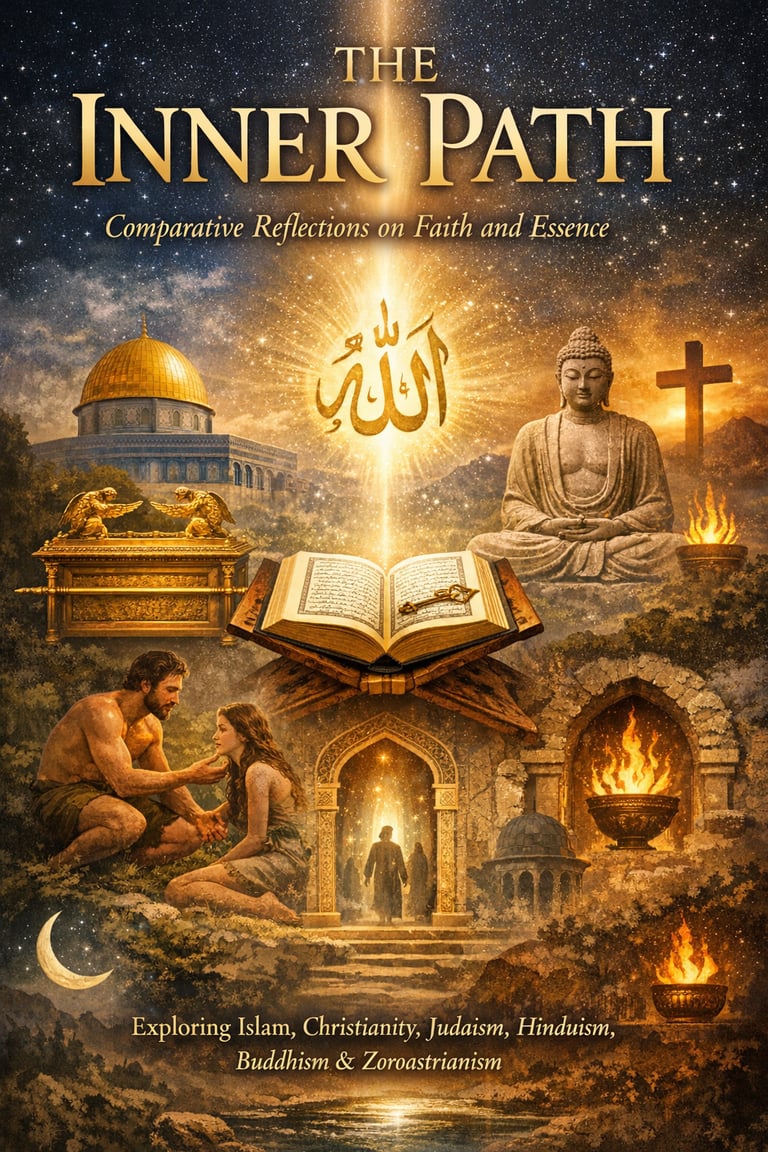
THE PATH OF ESSENCE – 1
“Turn your face toward the religion!” says the LORD! Not your physical face!
This command is to Muhammad! Now incline toward this secret!
“Most of humankind do not know this religion!” says the Lord!
The Lord belongs only to the one who finds his own fitrah!
This command is for the Ahl al-Bayt and for those who swear by Him!
That is, for those who wish to draw near to Allah!
To associate partners with Allah is not the prostration to Adam!
Rather, you are the one who associates partners with the Lord for the sake of Satan!
For he looked at Adam outwardly and called him “earth”!
He did not see within him that “Black Stone (Hajar al-Aswad)”!
At the moment of that prostration, Adam was a qibla!
Since one does not prostrate to anything other than Allah!
If Adam had truly been the qibla, Iblis would have prostrated:
“He fears Allah most! Adam is but a veil!” he would have said!
The Lord never gives a command that contradicts Himself!
Look! He does not say “Worship iron,” even if iron’s essence is the Lord!
Adam means establishing a connection with one’s own essence!
For this reason, religion was instituted; this prostration is the effort!
The animal is bound to a “shared Lord”! The Lord is not separate!
“Not associating partners” is for the human—turn toward yourself!
The meaning of that prostration was not a greeting!
“Greeting is sent from Allah to the servant,” says Islam!
The prostration of the angels is not a greeting-prostration!
Greeting is from Allah to the servant, not from the servant to Allah!
“All things go directly to the Lord!” Even Satan prostrates!
To the one who does not worship indirectly—that is, Allah calls him “Satan”!
Thus emerged Paradise, Hell, and the “religion without partners”!
Prostrate to the fitrah that is “closer to you than your own self”!
Fitrah means true birth! It is established through mother and father!
Send blessings always upon Muhammad and Ali!
Prayer is not accepted without sending peace upon Ilyasin!
“Ya Sin” is Muhammad! His family is the most esteemed!
Muhammad has many names; one of them is “Dhikr”!
This is his name in the Qur’an—remember and reflect!
“When sending blessings upon them, behold—even Allah does!”
Repent! Do not remain in duality like Iblis!
“The Ark of Moses”—its name is the “Chest of Repentance”!
“Upon it are two angels,” their bodies in prostration!
“Do not worship forcefully like Iblis!” “Nor praise endlessly like the jinn!”
“Repentance” is the union with your twin Adam!
“Repentance!” Look—between the Ark and the two angels!
Again, disgrace is for the one who does not prostrate!
“Two beings cast the disbeliever into Hell!”
Do not be stubborn against my father and my mother!
“I wish I had been dust!”—behold, the first word of the disbeliever,
When his eyes see Ali in the court!
Making us witness to ourselves within the womb, the Rahman,
Saying, “Am I not your Lord?” He took the covenant!
We answered with “B,” when that address was made!
Thus every sacred book begins with the Basmala!
“Beli” means “Yes,” and its first letter is “B”!
Come, submit to my father before becoming a ruined body!
“Everyone said ‘You are our Lord!’” in awe of Rahman!
Thus, this first covenant alone is not sufficient for faith!
The Lord did not ask Iblis the same question! Why?
“Because he had already said ‘no’ to Rahman before!”
If you remain faithful to the covenant without seeing Him here,
You will not suffer there, for you have affirmed it!
“La ilaha illallah” is the covenant given there!
“Muhammad Rasulullah” is the witness of affirmation here!
“Iblis also accepts Allah!”—yet he is not free!
Say “Muhammad Rasulullah” and bow to Adam!
“Between the two eyebrows!” Hidden at the root of the nose!
Vibrate the pineal and pituitary—pass beyond the mind!
Do not enter trance! Nor close your eyes with dhikr!
No medium can perceive that point called “B”!
“Allah grants knowledge to the servant He chooses!”
Ali is the gate, Muhammad is the name of this school of the Lord!
The Kaaba has a door but no window! Why?
One cannot enter the womb without saying “Bismillah”!
“Kitab al-Mubin,” meaning the “Clear Book,” is Ali!
Either become of the People of the Book—or remain without a book!
One who knew a single letter from that Book “transported a palace!”
What then can Ali do? This example suffices for us!
“All power lies only in the exalted name of Ali of Allah!”
“Even to behold this power in the Mi‘raj is difficult!”
“The muezzin will cry, ‘Curse upon the disbeliever!’”
“I am the muezzin!” said Ali—why? You discern!
I conveyed this message from my grandfather Ali Feyzi,
Who guided me in my first vision—from the Moon!
Master M.H. Ulug Kizilkecili
Türkiye/Ankara – 21 July 1999
IMPORTANT NOTE :The original text is poetic, and the author cannot be held responsible for any errors in the English translation! To read the original Turkish text, click HERE! The following section is not the author's work, and the author cannot be held responsible for any errors made!
Dedicated to my esteemed grandfather:
Ali Feyzi Kizilkecili
Comparative Parallels Across Religions
This section deepens the same universal esoteric structure and resonates strongly with multiple traditions:
Islam (Sufi Metaphysics)
The primordial covenant (Alast)—“Am I not your Lord?”—is central in Sufi thought. The emphasis on remembrance (Dhikr) as a divine name parallels the identification of Muhammad as a cosmic principle.Judaism (Kabbalah)
The Ark (Tabut) parallels the Ark of the Covenant, with cherubim (two angels) positioned above it—mirroring the image of two prostrating angels. The divine indwelling presence is linked to Sekine (Shekinah).Christianity (Mystical Theology)
The “Word” (Logos) as both divine expression and mediator parallels “Muhammad Rasulullah” as witness. The idea of covenant echoes the New Covenant in Christ.Hinduism (Tantra / Vedanta)
The reference to the point between the eyebrows corresponds to the Ajna chakra. Awakening inner perception parallels realization of Atman.Buddhism (Esoteric / Vajrayana)
The hidden point and inner awakening resemble subtle body practices and the realization of intrinsic awareness beyond conceptual mind.Hermeticism & Western Esotericism
The pineal gland as a “seat of perception” and inner eye corresponds to Hermetic teachings on inner illumination and divine intellect.Gnosticism
The notion that knowledge is granted selectively (“Allah grants knowledge to whom He wills”) aligns with the Gnostic idea of revealed gnosis rather than acquired belief.
Synthesis
The text presents a unified esoteric doctrine:
Covenant = primordial memory
Dhikr = activation of remembrance
Prostration = alignment with inner axis
“B” = point of origin / divine threshold
Across traditions, the same pattern emerges:
The human being carries an encoded covenant, and awakening is the act of remembering and aligning with it.
Comparative Religions
The central idea at the heart of this poem is that the human being should turn not toward outward appearance, but toward essence—namely, the fitrah brought forth from creation. In the poem, the command “turn your face toward the religion” is interpreted not merely as adherence to external forms of worship, but as a return to one’s own ontological source. In Islamic thought, fitrah is understood as the “primordial orientation,” the “natural disposition,” or the “innate openness to tawhid” that human beings carry from creation; in the Qur’an, this concept is emphasized particularly in the context of aligning oneself with the religion in accordance with Allah’s creation. Modern academic studies likewise stress that fitrah is not merely a biological notion, but also a moral and theological anthropological concept.
The issue of prostration to Adam in the poem is read not as worship directed toward Adam, but as obedience to Allah’s command and as the recognition of the divine trust within the human being. In the Qur’an, the prostration of the angels to Adam is connected to the elevation of the human being in terms of knowledge, vicegerency, and entrusted responsibility; for this reason, a significant portion of both classical and contemporary interpretations have explained this not as a “prostration of worship,” but as a prostration of honor or reverence. The image in the poem that “Adam is the qibla” rests precisely on this symbolic framework: prostration is directed not toward soil, but toward the meaning and command that Allah has manifested within the human being.
When this theme is compared with the conception of Adam in Judaism and Christianity, both similarities and differences emerge. In Jewish and Christian sacred texts, Adam is the first human created “from dust” and given life through the breath of God; thus, the idea that the human being carries both a material and a transcendent pole constitutes common ground. However, in the Christian tradition, particularly in post-Pauline theology, the narrative of Adam is linked to the doctrine of “original sin” as a fall whose consequences extend to all humanity. By contrast, within the Islamic framework, Adam’s error is a personal one; humanity is not considered sinful by birth. For this reason, the poem’s emphasis on “prostration to fitrah” is closer to Islam’s understanding of a creation open to tawhid than to Christianity’s anthropology centered on inherited guilt.
One of the most striking axes of the poem is the “alast/mithaq” scene in the Qur’an: the response “Beli (Yes)” to the question, “Am I not your Lord?” This scene suggests that the human being is not entirely alien to the knowledge of Allah; rather, this knowledge is grounded, if not in memory, then in a deep ontological witnessing. In academic literature, this theme is regarded as one of the foundational texts demonstrating that religion in Islam is nourished not only by historical revelation but also by the existential structure of the human being. The connection established in the poem between the letter “B” of the Basmala and this “Beli” produces an esoteric interpretation through letter symbolism; this aligns more with Sufi and ta’wil-oriented interpretive traditions than with mainstream literal exegesis.
At this point, there is a strong parallel with the concept of covenant in Judaism. Judaism understands the relationship between Israel and God through a historical covenant; the law given at Sinai and the Ark of the Covenant serve as concrete symbols of this relationship. Christianity, in turn, reinterprets this covenant as the “New Covenant” through Christ. The “alast gathering” in Islam, however, extends the covenant not merely to a specific community, but to the entire human lineage as a primordial testimony. Thus, the structure constructed by the poem interprets the Islamic concept of mithaq on a more cosmic and anthropological plane than that of Judeo-Christian covenant theology.
The reference in the poem to “the Ark of Moses” (Tabut) is also of great importance. In the Qur’an, the Tabut is mentioned as a source of Sekine (Shekinah)—tranquility—for the Children of Israel and as the bearer of relics from the prophetic household. In Jewish and Christian traditions, the Ark of the Covenant is the sacred chest that carries the tablets given to Moses, stands at the center of the holiest space, and is associated with the cherubim. The poem’s depiction of this Ark as “between two angels” and “in a state of prostration” constitutes an interpretive move that symbolically intertwines the Qur’anic theme of Tabut–Sekine (Shekinah) with the cherubim above the Ark in the Hebrew tradition.
Another major current of the poem is the distinction between zahir (outer) and batin (inner). The difference between the one who sees “earth” and the one who perceives the “secret within” is not merely moral but hermeneutical. In Islamic history, particularly within Sufi and certain Shi‘i/Ismaili traditions, it has been accepted that the Qur’an and sacred history possess both outward (zahir) and inward (batin) layers of meaning. This poem stands precisely within that line, reinterpreting Adam not merely as the biological first human, but as a being that establishes contact with essence. Such readings are not merely doctrinal but symbolic and inward-oriented.
When compared with the major religions of the East, the poem’s emphasis on “essence” and inward turning shows partial similarity especially with Hindu thought. In the Upanishadic tradition, atman is the innermost reality of the human being, while brahman is the ultimate absolute reality. In some Vedantic interpretations, the deep identity between these two can be seen as remotely similar to the poem’s idea that “there is a transcendent center within the human being.” However, the difference is crucial: the horizon of the poem is centered on tawhid; the human being does not become divine but becomes the recipient of a divine trust. In Hindu traditions—especially Advaita Vedanta—the ultimate aim is the dissolution of the distinction between the self and the absolute reality.
Comparison with Buddhism and Other Traditions
In comparison with Buddhism, the similarity lies more at the level of ritual and inner transformation rather than ontology. In Buddhism, there are practices such as prostration and bowing to the ground; however, these function not as worship directed to a Creator God, but rather as expressions of respect, purification, and the disciplining of the ego. Furthermore, classical Buddhist thought rejects the idea of a permanent self (anattā / no-self). For this reason, while the poem’s call to “return to one’s essence” may find a moral and meditative correspondence within Buddhist experience, it does not carry the same metaphysical meaning. In one case, the human being’s primordial orientation opens toward the divine Lord; in the other, the aim is to overcome the illusion of a permanent self.
From the perspective of Zoroastrianism, the poem’s idea that “the human being is not essentially evil” opens a meaningful field of comparison. In Zoroastrian thought, the human being is created within an essentially good cosmic order and is tasked with participating in the struggle against evil. In this respect, the idea that human nature is not fundamentally corrupted but rather called to ethical struggle is closer to the Islamic understanding of fitrah than to the Christian model of original sin. Nevertheless, Zoroastrianism constructs a much more pronounced metaphysical dualism between good and evil, whereas the poem ultimately preserves a monotheistic horizon of tawhid.
Another central line of the poem—structured around “salat,” Ahl al-Bayt, the “Book,” the “Gate,” and Ali—carries not only general Islamic meanings but also distinctly Shi‘i and allusive (ishari) resonances. Here, images such as the “clarity of the Book,” the “Gate,” “proximity,” and “walayah” recall interpretive traditions that have developed historically around the axis of imamate and esoteric knowledge. From an academic perspective, such readings are not marginal within Islamic thought; however, neither do they represent the shared literal interpretation of all Muslim traditions. For this reason, the poem should be read not as a legal or catechetical text, but as a mystical-hermeneutical composition.
In conclusion, the world constructed by the poem does not leave the human being at the level of “body,” “earth,” or “historical identity”; rather, it redefines the human being along the axes of fitrah, covenant, prostration, trust, and proximity. In Judaism, this structure resonates in the form of “covenant” and the “Ark”; in Christianity, in the tension between “Adam and Christ”; in Hinduism, in the notion of an “inner essence”; in Buddhism, in the overcoming of the ego; and in Zoroastrianism, in the idea of “good creation and ethical struggle.” Yet the originality of the poem lies in its ability to bring all these themes together within a single metaphorical language shaped by Islamic tawhid, Sufi inward interpretation, and Shi‘i-imami resonances.
Footnotes
[1] The concept of fiṭra is one of the central terms of Qur’an- and hadith-based Islamic anthropology; it is used in the sense of “primordial orientation” or “natural disposition.” See Jon Hoover, “Fiṭra,” Encyclopaedia of Islam, THREE; also Ryan Harvey, “Primordial Human Nature (fiṭra)” and Sohail Arif, “Rethinking the Concept of Fiṭra.”
[2] The prostration of the angels to Adam appears in the Qur’an, especially in 2:34 and related passages; many modern studies interpret this not as worship but as reverence and obedience to the divine command. See Mlada Mikulicová, “Adam’s Story in the Qur’ān”; also Qur’an 7:172 and related verses.
[3] In Jewish and Christian traditions, Adam’s creation “from dust” and his animation by divine breath are foundational elements of the Genesis narrative. See Genesis / Bereishit and Britannica, “Adam and Eve.”
[4] In Christianity, the story of Adam is linked—especially in Pauline theology—to the doctrines of “original sin” and the “Second Adam/Christ”; in contrast, in Islam Adam’s error is not interpreted as an ontological sin transmitted to all humanity. See Romans 5; Britannica, “Original Sin” and “Adam and Eve.”
[5] The “Primordial Covenant” (alast / mithaq) is grounded in Qur’an 7:172 and is interpreted in Islamic thought as humanity’s pre-temporal witnessing to Allah. Discussions in modern Islamic thought, particularly around Naquib al-Attas, are notable in this regard.
[6] In Judaism, covenant refers to the foundational relationship between God and Israel; Christianity reinterprets this as the “New Covenant” centered on Christ. The Islamic concept of mithaq extends this to all humanity. See Britannica, “covenant,” “Judaism,” “Christianity.”
[7] The Ark of the Covenant (Tabut) in Jewish and Christian traditions is the sacred chest containing the tablets given to Moses; it stands in the holiest sanctuary. In the Qur’an, the Tabut is also mentioned as a sign of Sekine (Shekinah) and sacred relics for the Children of Israel. See Britannica, “Ark of the Covenant,” “Holy of Holies”; also comparative studies by Uri Rubin.
[8] The distinction between zahir (outer) and batin (inner) is significant in Islamic thought, especially in Sufi and certain Shi‘i/Ismaili interpretations; sacred texts are understood to possess both external and internal layers of meaning. See Encyclopaedia Iranica, “Bāṭen”; Britannica, “Qurʾān: Interpretation” and “Taʾwīl.”
[9] In Ismaili tradition, the sequence of prophet, legatee (wasi), and imam, along with the zahir–batin distinction, produces a highly developed hermeneutical structure. See Encyclopaedia Iranica, “Dawr” and “Ismāʿilism.”
[10] In Hindu thought, atman is the inner self, while brahman is the ultimate absolute reality; the knowledge of their relationship is associated with liberation in the Upanishads. See Britannica, “Atman,” “Brahman,” “The Upanishads”; also SEP, “Personhood in Classical Indian Philosophy.”
[11] In Buddhism, practices such as prostration exist, but they are associated with respect, purification, and ego discipline rather than worship of a Creator God; classical doctrine emphasizes anattā (no-self). See Britannica, “Buddhism” and SEP, “Mind in Indian Buddhism.”
[12] In Zoroastrianism, the human being is understood as part of an essentially good creation and is called to struggle against evil; this differs from the notion of ontological corruption of human nature. See Britannica, “Ancient Iranian Religion: Human Nature,” “Zarathushtra,” and “Ahura Mazdā.”