THE PHOENIX
THE PHOENIX.The original cells of none are ever scattered; The soul says to these four cells: “Descend again to the earth!” Into the realm of the four bodies descend the soul and the four cells; With four new plans, the soul mounts upon these four cells!
APOCALYPSE BOOK
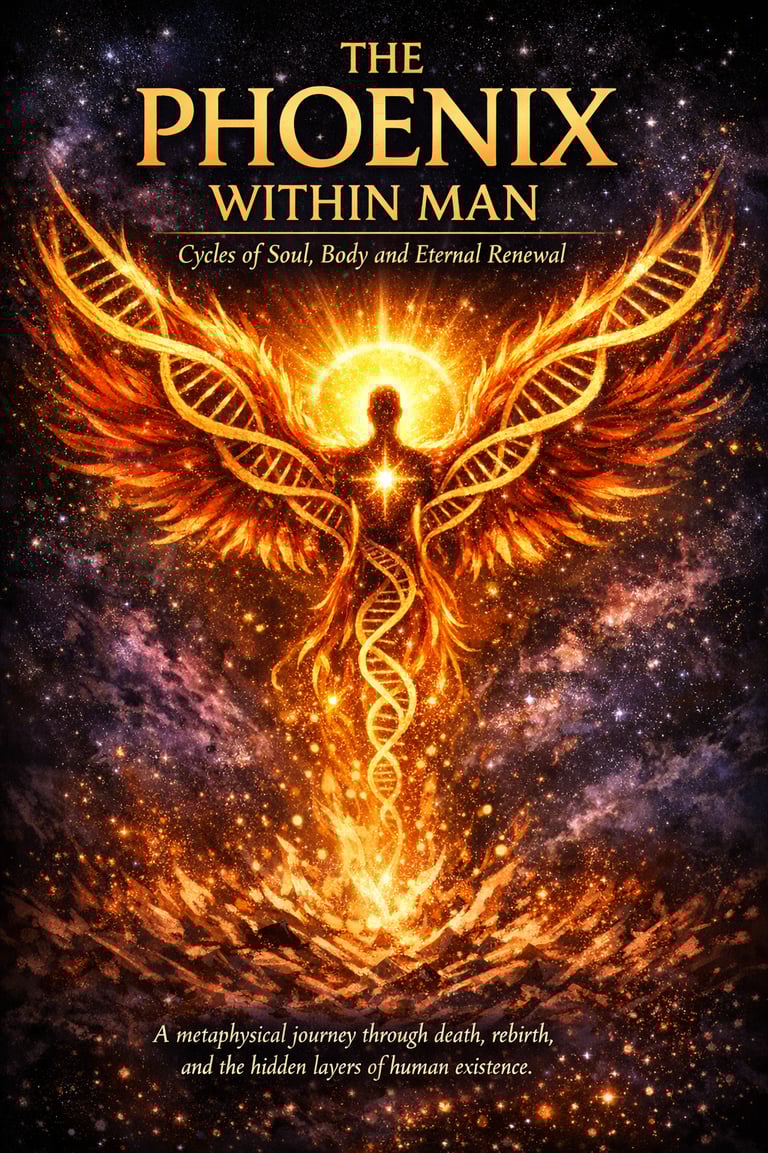
THE PHOENIX
There is a legendary being: the one called the Phoenix,
It is said its body burns and is reborn from its own cells!
The Lord says: “Even if you are decayed bones, even if you become dust,
I will create you again!” with every one of your cells!
“So precisely that even your fingerprints will be the same!”
I will not allow even a single strand of you to be lost!
There are four bodies: thought, desire, translucent, and physical;
Each vibrates differently in everyone, producing a distinct melody!
When one dies, passing through the realms of these four bodies,
Each body transforms into energy, in a most subtle way!
The original cells of none are ever scattered;
The soul says to these four cells: “Descend again to the earth!”
Into the realm of the four bodies descend the soul and the four cells;
With four new plans, the soul mounts upon these four cells!
The plan of the new body is bound to the previous life;
Each life is a stage to find oneself!
The four cells draw your energy like a magnet;
From your former particles, the body takes shape!
Everything is put back into its place—one is left astonished;
The Lord takes into trust the power within every cell!
“There is nothing new under the sun!” says the proverb;
The sun is the soul—beneath it are the four bodies; find the essence!
What belongs to you is to purify your former four bodies;
Only a purified soul pleases its Creator!
As the purified body’s vibration rises toward the soul,
It says: “I must perfectly reflect the one I have worn!”
But when the body becomes too impure to be worn,
It is burned in a pit—a pit that is very deep!
The soul takes for itself four new bodies once again,
And sends down to the world the one who wears the body!
Understand now! Even if its ashes are burned in a certain way,
Every single particle becomes a DNA molecule!
So it turns out the legendary Phoenix is the human being;
Either it flies and settles upon the Throne, or it climbs the steep path!
That means, from pre-eternity, the one being copied has always been you;
The first of what is copied is called “Adam” by the Hanif religion!
Your pure soul is Eve—she is your mother, pure aspiration;
Adam and Eve: spirit and soul—Ali and Muhammad!
M.H. ULUĞ KIZILKEÇİLİ
Ankara – 05 May 1999
IMPORTANT NOTE :The original text is poetic, and the author cannot be held responsible for any errors in the English translation! To read the original Turkish text, click HERE! The following section is not the author's work, and the author cannot be held responsible for any errors made!
Footnoted Commentary from the Perspective of Comparative History of Religions
The image of the “Phoenix” in the poem is not merely a folk legend; it is a multilayered symbol encompassing rebirth after death, renewal, personal continuity, and cosmic transformation.¹ The Bennu bird in ancient Egypt and the phoenix narratives in Greco-Roman culture led to the association of this bird with the sun, burning, rising from ashes, and immortality; in late antiquity, this symbol was also interpreted—especially in Christianity—as an allegory of resurrection.²
The expressions found in the second and third couplets of the poem—“decayed bones,” “even if you become dust,” “fingerprints,” and the idea that not even a single hair will be lost—are most clearly related to the concept of resurrection in the Qur’an. In particular, Qiyāmah 75:3–4 emphasizes that human bones will be reassembled and even the fingertips will be precisely restored.³ In this respect, although the poem carries modern biometric associations, it is fundamentally rooted in classical Islamic eschatology.⁴
However, the doctrine of the “four bodies” mentioned later in the poem—“thought, desire, translucent, and physical body”—is not a standard doctrine in mainstream Sunni or Shi‘i theology.⁵ This schema is closer to modern esoteric, theosophical, or various mystical-anthropological body theories. In classical Islamic kalām, the human being is generally discussed through the relationship between body and nafs/soul; the fourfold structure in this poem presents a more syncretic cosmology.⁶ Nevertheless, similar intuitions regarding subtle bodily layers appear in various forms in Indian religions and certain mystical traditions.
The phrase “each body transforms into energy” should be read not as scientific theology, but rather as a language of metaphysical poetry.⁷ Academically speaking, most religions do not use the concept of “energy” in the modern physical sense; instead, they refer to categories such as life principle, soul, breath, vitality, or subtle substance. Therefore, what the poem does here is to merge a contemporary term with ancient conceptions of the afterlife.⁸
The lines “the plan of the new body is bound to the previous life” and “each life is a stage” depart from the Abrahamic model of a single life followed by resurrection and judgment, and instead approach the idea of reincarnation/samsara.⁹ In Hinduism, samsara refers to the cycle of birth and death through which the soul (ātman/jīva) moves due to karma; in Bhagavad Gita 2.22, changing bodies is described as “discarding old garments and putting on new ones.”¹⁰ In this respect, the image in the poem that “the soul wears new bodies” shows a striking parallel with this classical Gita analogy.¹¹
In contrast, although Buddhism accepts samsara, it rejects the doctrine of a permanent self or soul. According to the doctrine of anatta (anatman), there is no eternal essence in a human being; personality is a flow of constantly changing components.¹² Therefore, the poem’s idea of “it is always you” and “the same subject being repeatedly embodied” aligns more closely with Hinduism and partially with Jainism/Sikhism, while standing in tension with Buddhism.¹³ From the Buddhist perspective, there is continuity—but it is not structured as the migration of an unchanging “self.”¹⁴
Jainism, however, is closer to the poem in this respect than Buddhism. In Jain thought, the living essence called jīva is reborn due to the material bonds of karma; through purification and liberation from karmic burdens, it reaches moksha.¹⁵ The expressions in the poem such as “purifying your former four bodies” and “pure soul,” while not identical to Jain terminology, can be read as compatible with Jain and partially with Indian mystical traditions in terms of purification-centered salvation.¹⁶
Sikhism also accepts karma and rebirth; however, the goal is not the استمرار of the cycle, but attaining liberation (mukti) through the name of God and the path of truth.¹⁷ In this sense, the poem’s emphasis on “purification,” “finding the self,” and “ascent” can also be compared with Sikh thought; nevertheless, the poem’s multi-layered body model is more complex and esoteric than mainstream Sikh doctrine.¹⁸
In Abrahamic traditions, however, the main model is not reincarnation but resurrection. In Judaism, belief in resurrection became more explicit in later periods; particularly from the Second Temple period onward, the concepts of judgment and the world to come became more pronounced.¹⁹ Christianity made this a central doctrine, considering the resurrection of Christ as the foundation for the resurrection of all the dead; 1 Corinthians 15 presents a conception of resurrection in which personal identity is preserved while the body is transformed.²⁰ Islam similarly upholds a doctrine of re-creation and judgment that preserves individual identity, but this essentially follows a single earthly life.²¹ At this point, the poem strikingly combines Islamic resurrection language with a Hindu-style language of multiple births.²²
The phrase “There is nothing new under the sun” clearly recalls Ecclesiastes 1:9.²³ However, the poem does not use this statement merely in the sense of historical repetition; it transforms it into a cyclical ontology by combining it with the doctrine of “the soul and four bodies.” Thus, a Biblical expression becomes part of a cyclical understanding of existence.²⁴ This demonstrates the typically syncretic character of the text.
The expression “The Lord takes into trust the power within every cell” conveys the idea of divine memory and the preservation of being. From an Islamic perspective, this aligns with Allah’s all-encompassing knowledge and power of re-creation; however, the poem’s language of “cells” and “DNA” employs modern biological metaphors rather than classical exegetical terminology.²⁵ Academically, the important point here is that the poem is not a scientific article, but a poetic synthesis that makes religious imagery speak through the language of contemporary biology.²⁶
The line “Every particle becomes a DNA molecule” should be especially distinguished. This line is poetically powerful as a metaphor; however, it cannot be accepted as literally accurate in scientific terms. Forensic science literature shows that DNA in remains exposed to high heat—especially at cremation levels—is often severely degraded or completely destroyed; partial recovery is limited and condition-dependent.²⁷ Therefore, in the poem, DNA functions not only as a biochemical datum but also as a metaphor for the material trace of personal identity.²⁸
The judgment expressed in the final stanzas—“So it turns out that the legendary Phoenix is the human being”—is the central thesis of the poem: the human being experiences death not as an end, but as a threshold of transformation.²⁹ This idea can be compared with symbolic immortality in the Egypt–Bennu/Phoenix tradition; resurrection in the Islamic–Jewish–Christian line; rebirth in the Hinduism–Jainism–Sikhism line; and, to some extent, the idea of cosmic renewal in Zoroastrianism.³⁰ In Zoroastrianism, frašō.kərəti / frashokereti—the final renewal of the universe, the end of evil, and the transformation of creation—exists as a belief; this is related to the poem’s metaphysics of “reconstitution,” though it is not identical with individual reincarnation.³¹
The emphasis in the poem’s conclusion—“Adam–Eve, spirit and soul”—connects the text, despite its syncretic nature, back to the origin narrative of humanity in the Abrahamic religions.³² Here, the poem builds a bridge between Islamic/Adamic anthropology, the Indian-type cyclical journey of the soul, and the Anka/Phoenix myth. Academically, the most distinctive feature of the text is that it is not a pure expression of a single religious tradition, but rather a mystical-syncretic poem of death and re-existence.³³
Turkish Footnotes
The “Anka / phoenix” motif is one of the most widespread mythological symbols of death and rebirth. It has different variants in ancient Egypt, Greek, and Roman cultures.
According to Britannica, the phoenix was associated with immortality in the ancient world; in late antiquity, it was also interpreted in Christianity as an allegory of resurrection.
Qur’an, Qiyāmah 75:3–4: It is stated that human bones will be reassembled and even the “fingertips” will be restored.
Therefore, the emphasis on “fingerprints” in the poem carries a modern forensic identity association, but its textual root lies in the Qur’anic expression “banān / fingertips.”
In mainstream Islam, there is no established belief system of “four bodies”; this is closer to esoteric-modern spiritualist schemas. This observation is made in comparison with classical Islamic anthropology and contemporary discussions of personal identity.
The structure in the poem functions like an interreligious compilation; that is, it is not purely dogmatic, but interpretive and mystical.
The term “energy” here should be understood not as a physical scientific concept, but as a poetic-metaphysical expression. In the history of religions, post-mortem existence is usually expressed through concepts such as “soul,” “essence,” or “life principle.”
Therefore, the language of the poem does not equate science and religion, but rather establishes a contemporary metaphorical field.
Reincarnation and resurrection are not the same: reincarnation refers to multiple cycles of birth, whereas resurrection refers to re-creation after death.
In Bhagavad Gita 2.22, changing bodies is described as removing old garments and putting on new ones.
In Bhagavad Gita 2.20, it is also emphasized that the soul is unborn, does not die, and does not perish when the body dies.
In Buddhism, the doctrine of anatta/anatman states that there is no permanent, unchanging soul or essence in a human being.
Therefore, the idea in the poem of “the same subject being repeatedly embodied” is closer to Hinduism, Jainism, and partly Sikhism than to Buddhism.
In Buddhism, rebirth exists; however, it is understood not as the transfer of a permanent “self,” but as causal continuity.
In Jainism, the soul (jīva) is reborn due to karmic bonds; through purification and discipline, it moves toward liberation.
In the Jain tradition, gradual development and purification from karmic burdens are essential for the soul’s refinement.
Sikhism accepts karma and rebirth; the goal is liberation from this cycle through turning toward God.
Thus, while the poem’s theme of “purification” and “ascent” resonates with Sikhism, the schema of bodily layers remains a unique synthesis of the poem.
According to Britannica, explicit belief in post-mortem resurrection in Judaism became particularly clear in later periods.
In Christianity, 1 Corinthians 15 is one of the foundational texts of resurrection doctrine; personal identity is preserved, but the body is conceived as transformed.
In Islam, resurrection is understood as the re-creation of the individual by divine power and their being brought to account.
The originality of the poem lies in making Islamic resurrection language and Indian-origin rebirth language speak within the same structure.
The phrase “There is nothing new under the sun” clearly alludes to Ecclesiastes 1:9; the poem reinterprets it within a new metaphysical framework.
Here, the idea of historical repetition is transformed into an ontological-cyclical doctrine of the soul.
Words such as “cell,” “particle,” and “DNA” represent the addition of modern biological metaphors to classical religious language.
Therefore, the text should be evaluated not as a scientific explanation, but as an example of modernized religious imagination.
According to forensic studies, high heat—especially at cremation levels—largely degrades DNA; although partial recovery is possible in some cases, this does not change the general rule.
Thus, DNA in the poem functions less as strict scientific truth and more as a powerful metaphor for the material trace of identity.
The main argument of the poem is that the human being is not merely one who dies, but one who transforms and is reconstituted. This appears in different forms across many religious traditions.
This common theme manifests as resurrection, rebirth, cosmic renewal, and mythic rising from ashes.
In Zoroastrianism, frashokereti refers to the final renewal of the world and the elimination of evil; it differs from individual reincarnation but is close to the theme of renewal.
The reference to Adam and Eve preserves the poem’s connection to the Abrahamic religions.
In conclusion, the text is not a purely sectarian work, but a mystical, syncretic poem open to comparative interpretation.
Bennu and the Phoenix: From Cosmic Renewal to Rising from the Ashes
Bennu in Ancient Egypt
In ancient Egyptian mythology, Bennu is an important figure, especially within the solar theology centered in Heliopolis. It is generally depicted as a heron and is associated with the sun god Ra. In creation narratives, Bennu is considered one of the “first to emerge” beings and symbolizes the beginning of cosmic order by alighting upon the benben stone.
The essential meaning of Bennu is not a dramatic death and rebirth, but rather the idea of continuity and cyclical renewal, like the daily rebirth of the sun. For this reason, Bennu represents the uninterrupted continuation of existence, the persistence of cosmic order, and the repetition of the divine rhythm.
The Phoenix in the Greco-Roman World
The Phoenix is one of the most striking symbols of immortality and rebirth in the ancient Greek and Roman world. It is depicted as a magnificent and colorful bird that, at the end of a certain life cycle, sets itself on fire or burns through the scorching power of the sun and is reborn from its ashes.
This narrative, especially during the Roman period, became associated with the continuity of the empire and the ideal of immortality; later, it was interpreted in Christian thought as a symbol of resurrection. The most distinctive feature of the Phoenix is that renewal occurs through a sudden and dramatic transformation.
Comparative Evaluation
The relationship between Bennu and the Phoenix is a clear example of cross-cultural mythological transformation. While Bennu represents the continuity of cosmic order and the first moment of creation, the Phoenix transforms this continuity into an individual and dramatic narrative, placing the idea of rebirth after death at its center.
In this context, Bennu can be seen as a cosmic principle symbolizing the uninterrupted continuity of existence; the Phoenix, on the other hand, as an existential metaphor emphasizing renewal after destruction.
In conclusion, although these two figures share the same root symbolism, different aspects are emphasized in different civilizations:
In Bennu, continuity; in the Phoenix, transformation and rebirth come to the forefront.
Interpretation of Cyclicality and Cosmic Continuity in the Context of Ecclesiastes 1:9
The expression “There is nothing new under the sun” is based on Ecclesiastes 1:9 in the Bible. In this verse, it is emphasized that events and experiences in human history essentially repeat themselves, meaning that existence unfolds within a certain cycle and continuity. In this sense, the expression not only conveys the idea of historical repetition but also opens the door to a broader ontological continuity, implying that existence manifests itself again under different forms.
In the poem, however, this statement is partially detached from its classical Judeo-Christian context and placed within a broader metaphysical framework. While in Ecclesiastes the phrase carries a wisdom-oriented emphasis on the transience of human effort and the limits of worldly novelty, here it is reinterpreted as a cyclical and recurring structure of existence by being associated with the ideas of soul, body, and cosmic cycles.
This approach establishes a conceptual bridge between the Abrahamic traditions, which adopt a linear understanding of time, and the Indian religions, which center on cyclical time. Thus, a single scriptural expression is expanded across different religious and philosophical systems into a multilayered field of meaning.
Samsara and the Change of Bodies: Continuity and Transformation in Hindu Thought
In Hinduism, samsara refers to the continuous movement of the individual essence (ātman or jīva) within the cycle of birth, death, and rebirth, governed by the law of karma. This cycle represents not only the change of the physical body but also the continuation of existence within a moral and causal order. One’s actions, intentions, and life experiences are regarded as the determining factors shaping the next form of existence.
This understanding is expressed through a powerful and concrete analogy in Bhagavad Gita 2.22: the abandonment of an old body and the acquisition of a new one is likened to removing worn-out garments and putting on new ones. This analogy clearly demonstrates that the body is temporary and variable, while the essence is a reality that carries continuity.
Within this framework, the change of bodies is not the ultimate goal but a part of the process through which the soul gains experience, undergoes purification, and matures. The ultimate aim is moksha—liberation from the cycle of samsara and union with absolute reality.
Frashokereti in Zoroastrianism: Cosmic Renewal and Final Transformation
One of the fundamental concepts comparable to the idea of cosmic renewal in Zoroastrianism is the doctrine known as frašō.kərəti (frashokereti). This concept refers to the final process of renewal and perfection that will occur at the end of the universe. According to Zoroastrian cosmology, the world is the stage of a struggle between good and evil; this struggle will end at the end of time, and the order of Ahura Mazda (Asha) will definitively prevail.
In the process of frashokereti, the universe is completely purified; evil is eliminated, and existence returns to its original pure state. In this context, the dead are also resurrected, and humans, passing through a process of purification, attain an immortal and perfect existence. This purification is sometimes symbolically described as passing through molten metal; for the righteous, this process is harmless, while for the wicked, it is purifying.
This understanding is based not on individual reincarnation but on the idea of a universal and one-time transformation. Therefore, renewal in Zoroastrianism is not a continuously repeating cycle like samsara in Hinduism, but a cosmic completion that unfolds within a historical process and reaches a final outcome.
In this respect, frashokereti can be compared both with the beliefs of apocalypse and resurrection in the Abrahamic religions and with themes of rebirth and purification in mythological traditions; however, it uniquely represents a universal restoration in which all existence is transformed once and definitively.
Bennu, Phoenix, Resurrection, Rebirth, and Cosmic Renewal: A Comparative Religious Reading
The poem’s symbolic universe stands at the intersection of several major religious grammars of survival after death: Egyptian cosmic renewal, Greco-Roman phoenix imagery, Jewish-Christian-Islamic resurrection, Hindu-Jain-Sikh rebirth, Buddhist continuity without a permanent self, and Zoroastrian final renovation. Read comparatively, its strongest claim is not merely that human beings “continue,” but that identity is preserved, transformed, purified, or reconstituted through a metaphysical process that exceeds ordinary biological death. That claim does not belong neatly to a single tradition; rather, it belongs to a syncretic religious imagination that borrows from several traditions at once.
In the Egyptian background, the closest analogue is Bennu, the Heliopolitan bird associated with the sun, creation, and periodic renewal. Bennu is less a symbol of spectacular destruction followed by rebirth from ashes than of cosmic continuity, comparable to the daily reappearance of the sun and the persistence of divine order. The later phoenix of Greek and Roman literature intensifies this symbolism into a more dramatic image: the singular bird burns and rises again, turning cyclical renewal into a narrative of death, rupture, and restoration. In late antiquity, that image became available for new theological uses, including Christian readings of resurrection.
That distinction matters. Bennu symbolizes continuity of cosmic rhythm; Phoenix symbolizes renewal through crisis. The poem moves between these two logics. On one level, it presents continuity: nothing is truly lost, being persists, and form can be reassembled. On another, it presents a transformative break: the self passes through dissolution and is constituted again. This double structure helps explain why the poem can sound at once Abrahamic and Indic, at once about resurrection and about repeated embodiment.
The poem’s references to decayed bones, dust, fingertips, and the preservation of bodily identity align most clearly with the Qur’anic doctrine of resurrection. The Qur’an explicitly answers skeptics who ask how decomposed remains could be restored, insisting that the Creator can reassemble the human being with exactness, even to the fingertips. In Islamic doctrine more broadly, the Last Day involves a bodily resurrection and judgment of each person according to their deeds. Here the poem draws from a recognizably Islamic eschatological grammar: personal identity is not erased by death, and divine knowledge secures continuity beyond decomposition.
At the same time, the poem departs from mainstream Islamic theology when it introduces a schema of multiple bodies and a process resembling serial embodiment. Neither Sunni nor Shi‘i orthodoxy teaches a standard doctrine of “thought, desire, translucent, and physical bodies” in this form. That fourfold anthropology is closer to modern esoteric or theosophical body theories than to classical kalām. As a result, the poem should not be read as a simple doctrinal statement of Islam, but as a comparative mystical synthesis using Islamic resurrection language alongside non-Islamic models of subtle embodiment.
The poem also resonates with Jewish and Christian ideas of resurrection, though with important distinctions. In Jewish tradition, resurrection became increasingly explicit in later strata of belief, especially in the Second Temple and rabbinic worlds, where the raising of the dead became tied to messianic hope and divine justice. Christianity radicalized this theme by making resurrection central: Christ’s resurrection becomes the basis for the resurrection of the dead, while transformed embodiment remains continuous enough to preserve personal identity. The poem shares with these traditions the conviction that death is not annihilation, but it diverges when it turns from a single eschatological restoration toward something closer to repeated return.
Its strongest non-Abrahamic parallel is with Hinduism, especially the doctrine of samsara. In Hindu thought, the embodied self passes through repeated births and deaths according to karma. The Bhagavad Gita’s famous analogy compares bodily change to changing worn-out garments: the body is abandoned, but the enduring bearer of embodiment continues. The poem’s language of the soul taking on “new bodies” strongly echoes that logic. The resemblance is especially close where bodily change is treated not as final defeat, but as a stage in a larger process of self-discovery, purification, and eventual liberation.
Yet the poem is not simply Hindu either, because it preserves a much stronger sense of same-person continuity than some traditions would allow, and it blends that continuity with imagery of exact bodily restoration. In Hindu terms, one might say it fuses karmic rebirth with a kind of resurrectional memory. That is precisely why its metaphysics feels syncretic: it wants both the Abrahamic insistence that this person is restored and the Indic insistence that the self moves through multiple embodiments.
The contrast with Buddhism is especially important. Buddhism accepts rebirth, but rejects a permanent, underlying soul-substance. The doctrine of anatta/anatman denies an abiding self; what continues is not an immutable essence but a causal stream of aggregates conditioned by karma. Therefore, wherever the poem says, in effect, “it is always the same you,” it moves away from Buddhist metaphysics and toward Hindu, Jain, or Sikh understandings. A Buddhist comparison is still useful, but mostly as a contrast: Buddhism allows continuity without endorsing a permanent self identical across embodiments.
In Jainism, by contrast, the comparison becomes much tighter. Jain thought affirms jīva as a real, enduring living substance bound by karmic accretions. Rebirth continues until karmic matter is exhausted through discipline, restraint, and purification. The poem’s insistence on cleansing prior layers of being and refining the self before ascent has a distinctly Jain-like structure, even if its terminology is not technically Jain. It imagines embodiment as morally consequential and liberation as dependent on purification.
Sikhism also provides a relevant comparison. Sikh tradition accepts karma and rebirth, yet emphasizes liberation through orientation to God rather than metaphysical speculation for its own sake. The end of the cycle is not endless migration but union, release, and truth. In that respect, the poem’s ascent-language and purification-language resonate with Sikh themes, though its multi-body cosmology is much more elaborate than mainstream Sikh doctrine.
A further comparison arises in Zoroastrianism, especially the doctrine of frašō.kərəti / frashokereti: the final renovation of creation after the defeat of evil. This is not reincarnation. It is a universal, eschatological restoration in which the world is purified, evil is overcome, and creation is renewed in perfected form. The poem shares with this vision the idea that existence can pass through purification into a renewed state. But Zoroastrianism’s framework is decisively linear and final, not cyclical in the Indic sense. For that reason, the poem’s metaphysics of repeated embodiment and the Zoroastrian doctrine of cosmic renovation are analogous only at the level of renewal, not at the level of mechanism.
The poem’s quotation of “There is nothing new under the sun” adds another important layer. In its Biblical setting, Ecclesiastes emphasizes the repetitiveness and limits of worldly life. In the poem, however, that phrase is reinterpreted metaphysically: not merely history, but being itself appears cyclical. This reinterpretation is significant because it creates a bridge between Biblical wisdom literature, which generally assumes a more linear historical horizon, and Indic-style cyclical ontologies, where recurrence is built into the fabric of existence. The poem therefore does not merely quote scripture; it transposes scripture into a new metaphysical register.
Its modern language of cells, particles, and DNA should also be read carefully. In academic terms, these are not scientific propositions so much as biological metaphors for continuity of identity. The poem is not doing forensic genetics; it is translating older religious intuitions about divine memory, bodily trace, and restoration into the vocabulary of modern biology. That strategy is common in contemporary religious writing: scientific language is recruited not to prove doctrine strictly, but to give ancient metaphysical intuitions a contemporary idiom.
Taken as a whole, the poem is best described not as the pure expression of one creed but as a comparative mystical anthropology. It combines:
an Egyptian solar-symbolic logic of renewal,
a Greco-Roman dramatic myth of rebirth,
an Abrahamic insistence on personal accountability and restoration,
an Indic model of repeated embodiment and purification,
a Buddhist challenge to fixed selfhood, and
a Zoroastrian horizon of final cosmic renovation.
Its originality lies precisely in refusing to choose only one of these frameworks.
English Footnotes
On the phoenix as a symbol of immortality, late antique renewal, and resurrection allegory, see Encyclopaedia Britannica, “Phoenix.”
On Bennu’s Egyptian background and its association with solar and renewal symbolism, see the comparative discussion in Britannica, “Phoenix,” which traces the Egyptian connection behind later phoenix traditions.
On resurrection of the dead in Jewish tradition as a developed theological doctrine, see “Jewish Resurrection of the Dead,” My Jewish Learning.
On Islamic eschatology, including bodily resurrection and judgment on the Last Day, see Encyclopaedia Britannica, “Islam: Eschatology, doctrine of last things,” and Britannica, “Qurʾān: Origin and compilation.”
On Hindu rebirth and the persistence of the embodied self across successive lives, see Stanford Encyclopedia of Philosophy, “Afterlife.”
For the classical garment analogy of bodily change, see Bhagavad Gita 2.22.
On anatta/anatman as the Buddhist denial of a permanent, underlying soul-substance, see Encyclopaedia Britannica, “Anatta,” and “Anicca.”
On jīva as an enduring living substance in Indian traditions, including its importance in Jain thought, see Encyclopaedia Britannica, “Jiva,” and the overview article “Jainism.”
On Sikh acceptance of karma and rebirth together with the goal of liberation, see Encyclopaedia Britannica, “Sikhism,” and “Reincarnation.”
On frašō.kərəti / frashokereti as final cosmic renovation in Zoroastrianism, see Encyclopaedia Iranica, “FRAŠŌ.KƎRƎTI.”
On Greek philosophical traditions of transmigration, especially Pythagorean reincarnation, see Stanford Encyclopedia of Philosophy, “Pythagoras,” and “Dualism.”
The uploaded Turkish draft already frames Bennu, Phoenix, samsara, and frashokereti in comparative terms; the present English version expands that framework with additional academic sourcing.
Methodologically, the poem is best treated as a syncretic text: it draws on more than one doctrinal system without fully matching any one of them. This conclusion follows from comparing its Islamic resurrection language, Indic rebirth patterns, and esoteric multi-body anthropology.