THE REBELLION AND PERMISSION OF IBLÎS
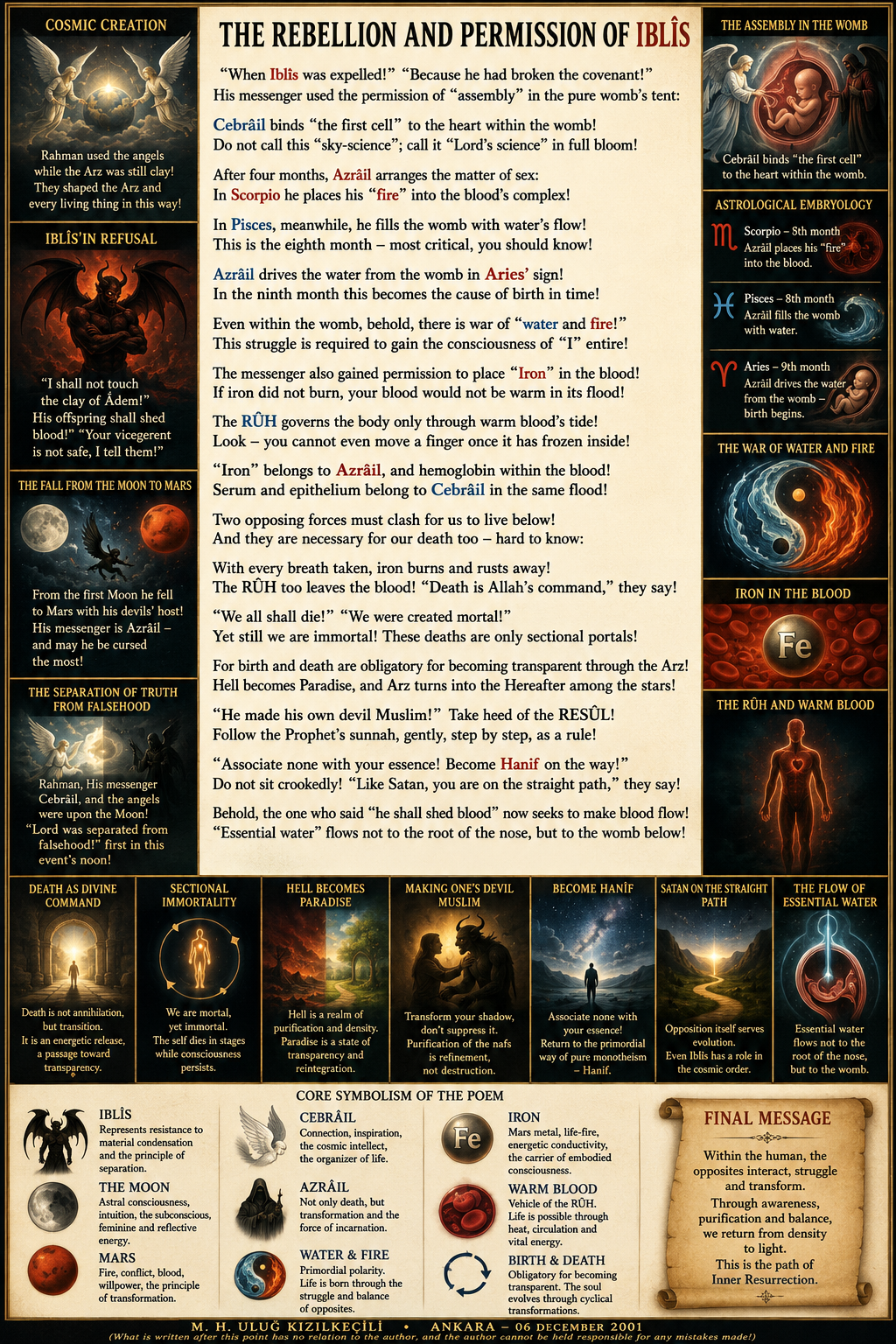
THE REBELLION AND PERMISSION OF IBLÎS.Iblîs said: “I shall not touch the clay of Âdem!” “His offspring shall shed blood!” “Your vicegerent” is not safe, I tell them! From the first Moon he fell to Mars with his devils’ host! His messenger is Azrâil — and may he be cursed the most!
APOCALYPSE BOOK
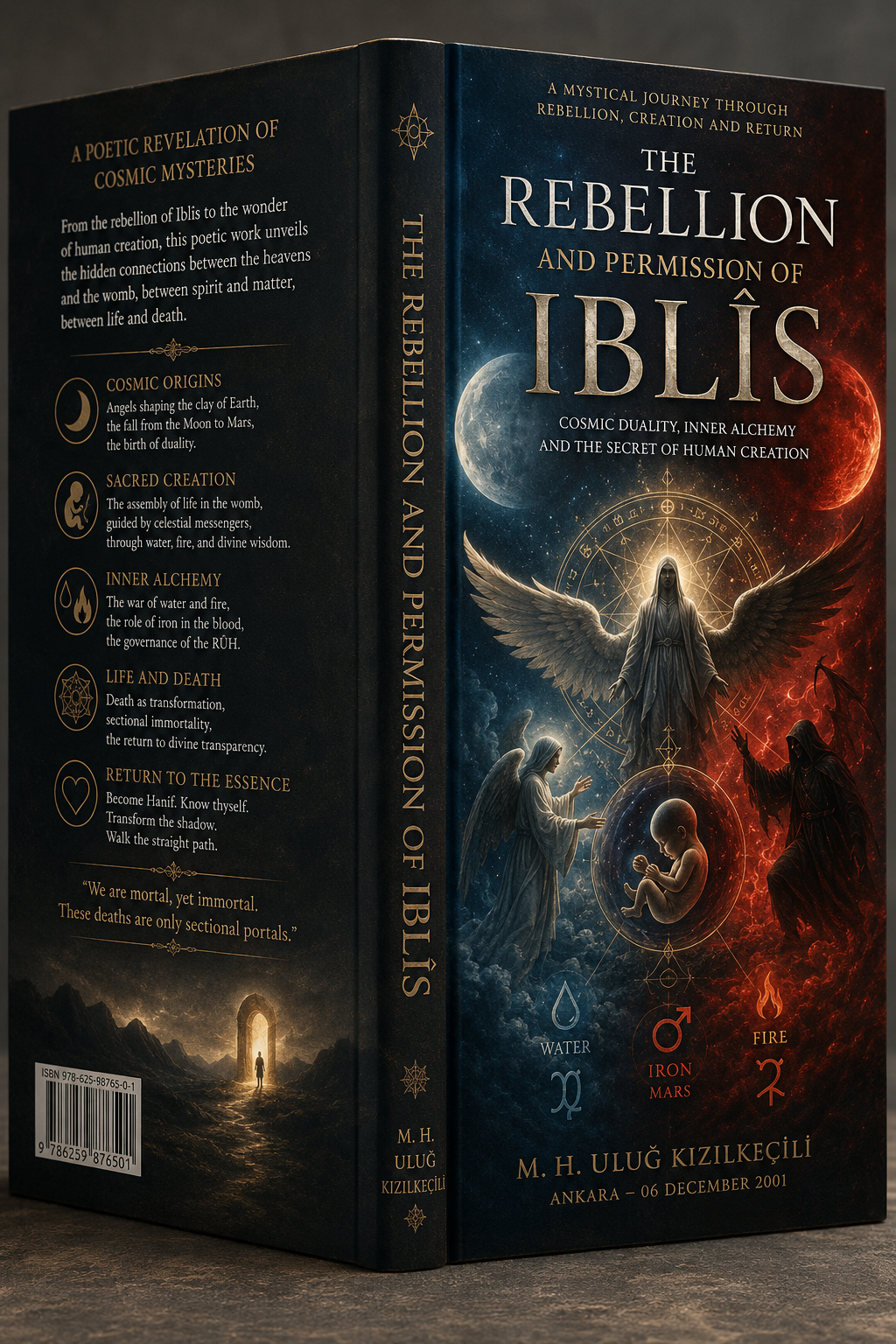
THE REBELLION AND PERMISSION OF IBLÎS
Rahman used the angels while the Arz was still clay!
They shaped the Arz and every living thing in this way!
Iblîs said: “I shall not touch the clay of Âdem!”
“His offspring shall shed blood!” “Your vicegerent” is not safe, I tell them!
From the first Moon he fell to Mars with his devils’ host!
His messenger is Azrâil — and may he be cursed the most!
Rahman, His messenger Cebrâil, and the angels were upon the Moon!
“Lord was separated from falsehood!” first in this event’s noon!
“When Iblîs was expelled!” “Because he had broken the covenant!”
His messenger used the permission of “assembly” in the pure womb’s tent:
Cebrâil binds “the first cell” to the heart within the womb!
Do not call this “sky-science”; call it “Lord’s science” in full bloom!
After four months, Azrâil arranges the matter of sex:
In Scorpio he places his “fire” into the blood’s complex!
In Pisces, meanwhile, he fills the womb with water’s flow!
This is the eighth month — most critical, you should know!
Azrâil drives the water from the womb in Aries’ sign!
In the ninth month this becomes the cause of birth in time!
Even within the womb, behold, there is war of “water and fire!”
This struggle is required to gain the consciousness of “I” entire!
The messenger also gained permission to place “Iron” in the blood!
If iron did not burn, your blood would not be warm in its flood!
The RÛH governs the body only through warm blood’s tide!
Look — you cannot even move a finger once it has frozen inside!
“Iron” belongs to Azrâil, and hemoglobin within the blood!
Serum and epithelium belong to Cebrâil in the same flood!
Two opposing forces must clash for us to live below!
And they are necessary for our death too — hard to know:
With every breath taken, iron burns and rusts away!
The RÛH too leaves the blood! “Death is Allah’s command,” they say!
“We all shall die!” “We were created mortal!”
Yet still we are immortal! These deaths are only sectional portals!
For birth and death are obligatory for becoming transparent through the Arz!
Hell becomes Paradise, and Arz turns into the Hereafter among the stars!
“He made his own devil Muslim!” Take heed of the RESÛL!
Follow the Prophet’s sunnah, gently, step by step, as a rule!
“Associate none with your essence! Become Hanîf on the way!”
Do not sit crookedly! “Like Satan, you are on the straight path,” they say!
Behold, the one who said “he shall shed blood” now seeks to make blood flow!
“Essential water” flows not to the root of the nose, but to the womb below!
M. H. ULUĞ KIZILKEÇİLİ
ANKARA – 06 December 2001
(What is written after this point has no relation to the author, and the author cannot be held responsible for any mistakes made!)
“IRON” AND THE METAPHYSICS OF BLOOD
The poem states:
“Permission was granted to place Iron into the blood.”
Here, iron is not merely a chemical element, but:
vital fire,
energetic conductivity,
incarnational density,
the carrier of embodied consciousness.
Blood becomes the battlefield where spirit and matter interact.
Footnote 23
In alchemy, iron corresponds to Mars and symbolizes force and conflict.
Footnote 24
Ancient traditions frequently regarded blood as the carrier of life-force.
Footnote 25
In Hermetic symbolism, metals correspond to cosmic principles and planetary powers.
AZRÂIL AND THE FIRE PRINCIPLE
The text states:
“Azrâil places his fire into the blood.”
Here, Azrâil is interpreted not merely as the Angel of Death, but as:
the transformer,
the force of incarnation,
the agent of density,
the principle of combustion.
Footnote 26
In mystical cosmologies, death and incarnation are often governed by the same transformative force.
Footnote 27
Mars symbolism traditionally governs heat, blood, aggression, and vital force.
THE WAR OF WATER AND FIRE
The poem declares:
“Even within the womb there is war between water and fire.”
This expresses primordial polarity.
Water symbolizes:
fluidity,
emotion,
receptivity,
lunar consciousness.
Fire symbolizes:
will,
individuation,
active force,
solar intensity.
Human consciousness emerges through the tension between these opposites.
Footnote 28
Alchemy is fundamentally based on balancing opposing elements.
Footnote 29
In Taoism, harmony emerges from Yin-Yang polarity.
“I-CONSCIOUSNESS” AND INDIVIDUATION
The text says:
“This struggle is necessary to gain the consciousness of ‘I.’”
Here, ego is not portrayed purely negatively.
Instead, individuation becomes a necessary stage of spiritual evolution.
Footnote 30
Jung regarded individuation as the process of psychological integration.
Footnote 31
In Gnostic systems, fragmentation precedes conscious reunification.
XIII. WARM BLOOD AND THE GOVERNANCE OF THE RÛH
The poem states:
“The SOUL governs the body only through warm blood.”
Warmth symbolizes:
animation,
spiritual vitality,
embodied consciousness,
energetic circulation.
Coldness, by contrast, signifies separation from living spirit.
Footnote 32
Ancient medicine frequently linked heat with life-force.
Footnote 33
In esoteric physiology, circulation symbolizes the movement of subtle energy.
DEATH AS DIVINE COMMAND
The statement:
“Death is Allah’s command.”
reframes death not as annihilation, but as transition.
Death becomes:
energetic release,
vibrational transformation,
phase transition,
passage toward transparency.
Footnote 34
Sufism often interprets death as return rather than extinction.
Footnote 35
In Platonic thought, the soul’s separation from the body is liberation.
“SECTIONAL IMMORTALITY”
The poem paradoxically declares:
“We are mortal, yet immortal.”
This expresses cyclical continuity.
The self dies in stages while consciousness persists.
Footnote 36
Reincarnation doctrines frequently distinguish bodily mortality from spiritual continuity.
Footnote 37
Neoplatonic thought views the soul as eternally existent beyond material embodiment.
TRANSPARENCY AS ESCHATOLOGICAL EVOLUTION
The text states:
“Birth and death are obligatory for becoming transparent.”
Transparency symbolizes:
spiritual refinement,
reduction of density,
return to subtle existence,
luminous embodiment.
Footnote 38
Theosophy describes humanity evolving toward increasingly subtle states.
Footnote 39
Mystical traditions often portray enlightenment as becoming “light-like.”
HELL BECOMING PARADISE
The poem declares:
“Hell becomes Paradise, and Arz becomes the Hereafter.”
This implies transformational eschatology rather than eternal separation.
Hell is interpreted as:
density,
ignorance,
egoic confinement.
Paradise represents:
transparency,
awakened consciousness,
reintegration.
Footnote 40
Mystical interpretations often understand heaven and hell as states of consciousness.
Footnote 41
Gnostic systems portray salvation as awakening from ignorance.
“HE MADE HIS DEVIL MUSLIM”: THE TRANSFORMATION OF SHADOW
The line:
“He made his devil Muslim.”
suggests integration rather than destruction of shadow.
The “devil” symbolizes:
instinct,
ego,
unconscious impulse,
fragmented desire.
Transformation occurs through alignment, not annihilation.
Footnote 42
Jungian psychology emphasizes integration of the shadow-self.
Footnote 43
Sufism teaches purification and transformation of the nafs rather than absolute negation.
HANÎF RELIGION AS INNER UNITY
The poem states:
“Associate none with your essence! Become Hanîf!”
Hanîf religion is interpreted as:
inner unity,
freedom from fragmentation,
primordial orientation,
return to essence.
Footnote 44
In the Qur’anic context, Hanîf signifies pure orientation toward divine unity.
Footnote 45
Esoteric traditions frequently define salvation as reintegration into primordial wholeness.
“SATAN ON THE STRAIGHT PATH”: THE PARADOX OF OPPOSITION
The statement:
“Like Satan, you are on the straight path.”
contains paradoxical symbolism.
Opposition itself becomes part of cosmic function.
Iblîs here represents:
resistance,
tension,
individuation,
catalytic opposition.
Footnote 46
Certain Sufi interpretations portray Iblîs as the tragic monotheist.
Footnote 47
Dialectical philosophies often regard opposition as necessary for evolution.
BLOODSHED AND SEXUAL ENERGY
The final lines connect blood and reproductive fluid:
“Essential water flows not to the root of the nose, but to the womb.”
This reflects energetic anthropology.
Sexual essence is treated as:
creative force,
incarnational fluid,
life-energy reservoir.
Footnote 48
Taoist inner alchemy emphasizes conservation and transformation of reproductive essence.
Footnote 49
Tantric traditions interpret sexual energy as spiritual power.
THE SUFISTIC DIMENSION OF THE TEXT
The text parallels Sufism through themes such as:
transformation of the self,
inner resurrection,
spiritual refinement,
the journey toward transparency,
metaphysics of divine unity.
Yet it also departs from classical Sufism through:
astro-biological embryology,
energetic anthropology,
Theosophical cosmology,
occult physiology.
THE GNOSTIC STRUCTURE OF THE TEXT
The poem contains a fundamentally Gnostic framework:
Matter represents density and fragmentation.
Spirit descends into embodiment.
Conflict produces self-awareness.
Consciousness evolves through struggle.
Liberation occurs through awakening and reintegration.
THE HERMETIC STRUCTURE OF THE TEXT
The text is deeply Hermetic in character.
Its major Hermetic elements include:
cosmic polarity,
energetic embodiment,
astral cosmology,
transformation through fire,
microcosm-macrocosm correspondence,
spiritual alchemy.
THE REBELLION OF IBLÎS AND THE SYMBOLISM OF COSMIC EVOLUTION
In ancient mystical traditions, the rebellion of Iblîs is not always interpreted merely as moral disobedience. In many esoteric readings, it symbolizes resistance against material condensation itself. The descent into dense matter marks the beginning of fragmentation, individuation, and suffering. Thus, Iblîs becomes the archetype of refusal before incarnation.
The text interprets angels not as anthropomorphic beings, but as formative cosmic forces shaping existence. The construction of the world is portrayed as a living energetic process rather than mechanical creation. The Arz itself appears as a conscious organism gradually solidifying into material density.
The opposition between Moon and Mars symbolizes the transition from subtle astral existence toward conflictual material embodiment. The Moon represents fluid, reflective, psychic consciousness, while Mars embodies fire, aggression, blood, and individuation. The fall from Moon to Mars therefore symbolizes descent from subtle unity into divided embodiment.
The doctrine of cosmic embryology occupies a central place in the poem. Pregnancy is described not as random biology, but as metaphysical assembly. The embryo becomes the meeting point of spirit, energy, karma, and matter. Cebrâil and Azrâil function as archetypal forces governing organization and incarnation.
The symbolism of blood and iron introduces an alchemical physiology. Iron represents fiery embodiment and density. Warm blood becomes the vehicle through which the RÛH governs the physical organism. Thus, life itself emerges through continual tension between opposing forces.
The war between water and fire within the womb symbolizes primordial polarity. Human consciousness is born through conflict between receptive and active principles. The emergence of “I-consciousness” depends upon this struggle. Individuation therefore becomes not a mistake, but a stage within cosmic evolution.
Death is interpreted not as extinction, but as transformation. Birth and death serve the gradual refinement of consciousness toward increasing transparency. Hell and Paradise are understood as states of vibrational density rather than eternal locations. Salvation therefore means reattaining luminous subtlety.
The statement that the Prophet “made his devil Muslim” symbolizes transformation of instinct rather than destruction of it. The shadow-self becomes integrated into spiritual alignment. Even opposition itself serves evolution within the cosmic order.
When all these symbols are considered together, the poem presents a vast esoteric cosmology in which humanity evolves through embodiment, conflict, polarity, and transformation toward a final state of transparent consciousness.
“THE WAR OF WATER AND FIRE”: INNER ALCHEMY
The poem states:
“Within the womb there is war between water and fire.”
This is direct alchemical language.
Water may be interpreted as:
passivity,
astral structure,
the womb.
Fire, meanwhile, symbolizes:
consciousness,
energy,
transformation.
Footnote 23
In alchemy, transformation occurs through the interaction of water and fire.
Footnote 24
In Taoist inner alchemy, the conflict of Yin and Yang generates life.
“I-CONSCIOUSNESS”: THE BIRTH OF THE EGO
The text declares:
“This struggle is necessary to gain the consciousness of ‘I.’”
Thus, the ego is viewed not negatively, but developmentally.
This approach closely resembles Jungian psychology.
Footnote 25
According to Jung, individuation begins with ego development.
Footnote 26
In Theosophy, Manas — self-consciousness — marks humanity’s turning point.
“IRON”: THE COSMIC METAL
The poem states:
“Permission was granted to place iron into the blood.”
Here, iron is not merely a mineral, but a carrier of energy.
Footnote 27
In alchemy, iron is associated with the planet Mars.
Footnote 28
In the Qur’an, iron is described as possessing “mighty strength.”
Footnote 29
Ancient cultures often regarded iron as celestial in origin.
THE RELATIONSHIP BETWEEN WARM BLOOD AND THE RÛH
The text says:
“The SOUL governs the body only through warm blood.”
Here, warmth symbolizes:
the spark of life,
spiritual movement,
energetic circulation.
Footnote 30
Ancient medicine associated life with warmth.
Footnote 31
In Chinese medicine, the circulation of qi is linked with bodily heat.
DEATH AS THE METAPHOR OF RUSTING
The poem states:
“Iron burns and rusts away.”
This is a profoundly Hermetic metaphor of death.
Humanity is portrayed as:
oxidizing metal,
exhausted energy,
transforming matter.
Footnote 32
In alchemy, rusting symbolizes dissolution.
Footnote 33
A metaphorical parallel may be drawn with the concept of entropy.
“WE ARE IMMORTAL, YET SECTIONAL”: CYCLICAL EXISTENCE
The poem states:
“Yet we are immortal! These deaths are sectional!”
This approaches a reincarnational or cyclical understanding of consciousness.
Footnote 34
In Indian religions, death is regarded as transformation.
Footnote 35
In Gnosticism, the soul passes through multiple planes of existence.
THE TRANSFORMATION OF HELL INTO PARADISE
The text declares:
“Hell becomes Paradise!”
Thus, absolute dualism is rejected.
Hell is interpreted as:
a field of purification,
a zone of density,
a temporary stage of transformation.
Footnote 36
Certain Sufi interpreters regarded Hell as transformative.
Footnote 37
In alchemy, the nigredo stage is dark, yet necessary.
“MAKING ONE’S DEVIL MUSLIM”: RECONCILIATION WITH THE SHADOW
The poem states:
“He made his devil Muslim — take heed, O RESÛL!”
This implies that humanity must transform rather than suppress its dark side.
Footnote 38
Jung considered shadow integration essential for psychological wholeness.
Footnote 39
In Sufism, purification of the nafs means refinement, not annihilation.
“BECOME HANÎF”: FIDELITY TO ESSENCE
The poem declares:
“Associate none with your essence!”
Here, shirk signifies not merely outward idolatry, but separation from one’s true essence.
Footnote 40
In Sufism, hidden shirk is ego-centeredness.
Footnote 41
In Gnostic traditions, forgetting one’s essence is the primordial fall.
“LIKE SATAN, YOU ARE ON THE STRAIGHT PATH”: THE PARADOXICAL FORMULA
The statement:
“Like Satan, you are upon the straight path”
is strikingly paradoxical.
Here, Satan symbolizes not absolute evil, but:
cosmic opposition,
catalytic resistance,
transformative polarity.
Footnote 42
Some Sufi interpreters viewed Iblîs as a tragic lover of divine unity.
Footnote 43
Hermetic doctrine often teaches that consciousness cannot evolve without polarity.
THE BRIDGE OF ENERGY: NOSE ROOT AND WOMB
The poem states:
“The essential water flows not to the root of the nose, but to the womb.”
This discusses the direction of mystical energy.
The symbolism recalls Kundalini and doctrines of sexual energy.
Footnote 44
In Tantra, creative energy is centered within the womb.
Footnote 45
In Chinese inner alchemy, essential energy circulates through bodily centers.
IBLÎS, COSMIC POLARITIES, AND INNER ALCHEMY
In ancient esoteric teachings, the figure of Iblîs is not interpreted solely as the embodiment of evil. He also represents the metaphysical principle of cosmic opposition. Wherever light exists, shadow likewise appears; wherever consciousness rises, resisting forces emerge in response. For this reason, Iblîs has often been associated with the notion of “shadow consciousness” in mystical interpretation. Shadow consciousness signifies the aspect of humanity estranged from its own essence. Pride, separation, and egocentricity are viewed as manifestations of this structure. The refusal of prostration thus becomes the symbolic narrative of division within human psychology. Iblîs thereby transforms from an external being into the principle of separation dwelling within the inner world of humanity.
The concept of “Clay Âdem” likewise symbolizes humanity’s dense material condition. In ancient teachings, clay signifies not merely physical earth, but condensed consciousness itself. When the human spirit descends from pure light into dense matter, it begins its experience within a “heavy body.” In Sufi interpretation, the material human is understood as a being under the influence of the nafs and worldly attachments. Clay here is not something to be despised, but the field of spiritual evolution. Humanity seeks to rediscover its essence precisely within matter. Thus, clay becomes a metaphysical symbol containing both limitation and transformative potential.
The symbol of the Moon in esoteric systems is associated with the astral body and feminine energy. Just as the Sun represents the divine center, the Moon represents reflected consciousness. Moonlight possesses no light of its own; it reflects the radiance of the Sun. Therefore, mystical traditions often interpret the Moon as the symbol of intuition and the subconscious. Feminine energy here signifies receptivity, fertility, and inner sensitivity. The invisible dimensions of the human psyche have long been associated with lunar symbolism. The Moon thereby becomes more than a celestial object illuminating the night; it becomes the metaphysical sign of the subconscious realms.
Mars, by contrast, symbolizes the principle of fire and conflict. In ancient astrological systems, Mars was regarded as the planet of movement, struggle, and transformative force. Its association with iron emerges from this symbolism. Iron signifies both endurance and martial power. Yet esoteric interpretations view Mars energy not merely as destructive, but also as the source of willpower and inner struggle. Humanity must confront its own darkness during the path of transformation. Thus, Mars ultimately represents not outer warfare, but the battle within the self.
The symbol of iron likewise occupies an important place in mystical traditions. In ancient alchemy, metals were regarded not simply as material substances, but as manifestations of spiritual vibrations. Iron was understood as the condensed form of the “fire of life.” Its connection with Mars therefore becomes meaningful. Iron symbolizes human willpower and endurance. At the same time, it reflects the necessity of refining humanity’s coarse aspects into higher consciousness. For the alchemists, transforming iron into gold symbolized the purification of consciousness itself.
The symbol of Cebrâil represents spiritual connection. Although known in religious narratives as the angel of revelation, esoteric interpretations associate Cebrâil with the “cosmic intellect.” The communication between humanity and divine truth is symbolized through this figure. Inspiration, intuition, and higher states of awareness may all be interpreted as manifestations of Cebrâilian energy. Revelation thereby ceases to be merely a historical event and becomes the human capacity to contact higher planes of consciousness.
Azrâil likewise appears in mystical teachings not as a terrifying angel of death, but as a force of transformation. Death here signifies not annihilation, but transition from one state of consciousness to another. Esoteric traditions teach that the human being undergoes many symbolic deaths during life. The collapse of old identities and the emergence of new states of awareness form the basis of “spiritual death.” Azrâil therefore becomes not the angel of extinction, but the angel of transformation.
The symbolism of the war between water and fire describes humanity’s inner alchemy. Water symbolizes passive, fluid, and receptive energy, while fire represents active, transformative, and consuming force. The Yin-Yang doctrine of ancient Chinese thought likewise rests upon a similar balance of opposites. Within the human soul, these two forces remain in continual interaction. Excessive fire produces destruction, while excessive water leads to stagnation. Spiritual maturity becomes possible only through balancing these opposing energies. Inner alchemy therefore emerges as the art of harmonizing the polarities within oneself.
The concept of “I-consciousness” expresses the emergence of self-awareness. The moment humanity says “I,” it begins to experience itself as a separate individual within existence. This forms the basis of ego development. Initially, the ego functions as a necessary center; yet if humanity remains confined within it, it becomes separated from truth. Esoteric teachings therefore emphasize that self-consciousness must transcend egoic limitation and expand into greater awareness. The sense of “I” is not destroyed, but brought into harmony with divine consciousness.
Finally, the doctrine of Hanîf religion symbolizes reunion with primordial essence. Ancient traditions referred to this as the “Primordial Religion” — the original path of truth preceding all forms. This path signifies pure orientation toward reality itself. As humanity withdraws from external fragmentation, it begins once more to perceive the primordial truth within. Hanîf religion therefore represents not merely a historical identity, but the movement of the soul back toward its original source.
When all these symbols are considered together, a vast cosmic process unfolding within the human interior becomes visible. From Iblîs to Hanîf unity, from clay to divine light, all metaphysical narratives ultimately describe the transformative journey of consciousness. Though ancient teachings employed different symbolic languages, they continuously point toward the same truth: humanity approaches the center of reality only by transforming the oppositions within itself.