THE SAGE AND THE SCHOLAR
THE SAGE AND THE SCHOLAR. “Be free!” he says! This concerns your essence alone! The sage who knows his essence becomes another enlightened scholar known! GAZI MUSTAFA KEMAL ATATÜRK! Lord’s Saint Sage Friend! The numerical values of every one of his names stand as the clearest proof without end!
APOCALYPSE BOOK
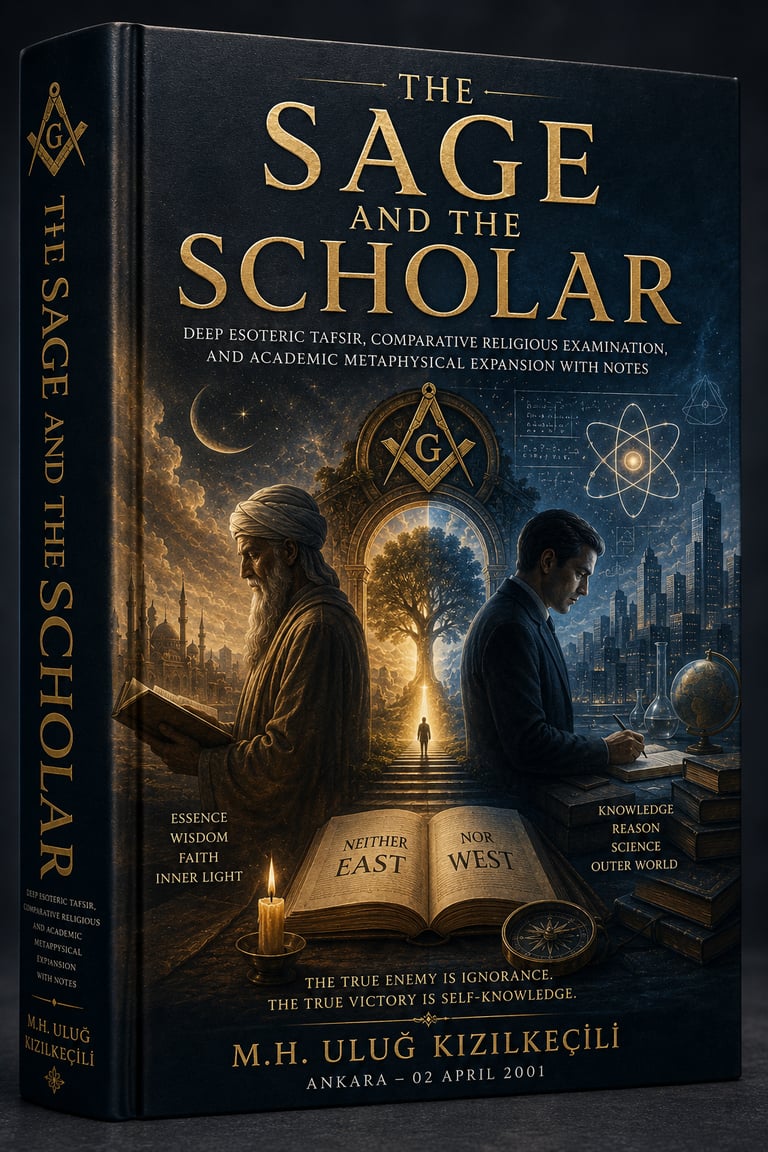
THE SAGE AND THE SCHOLAR
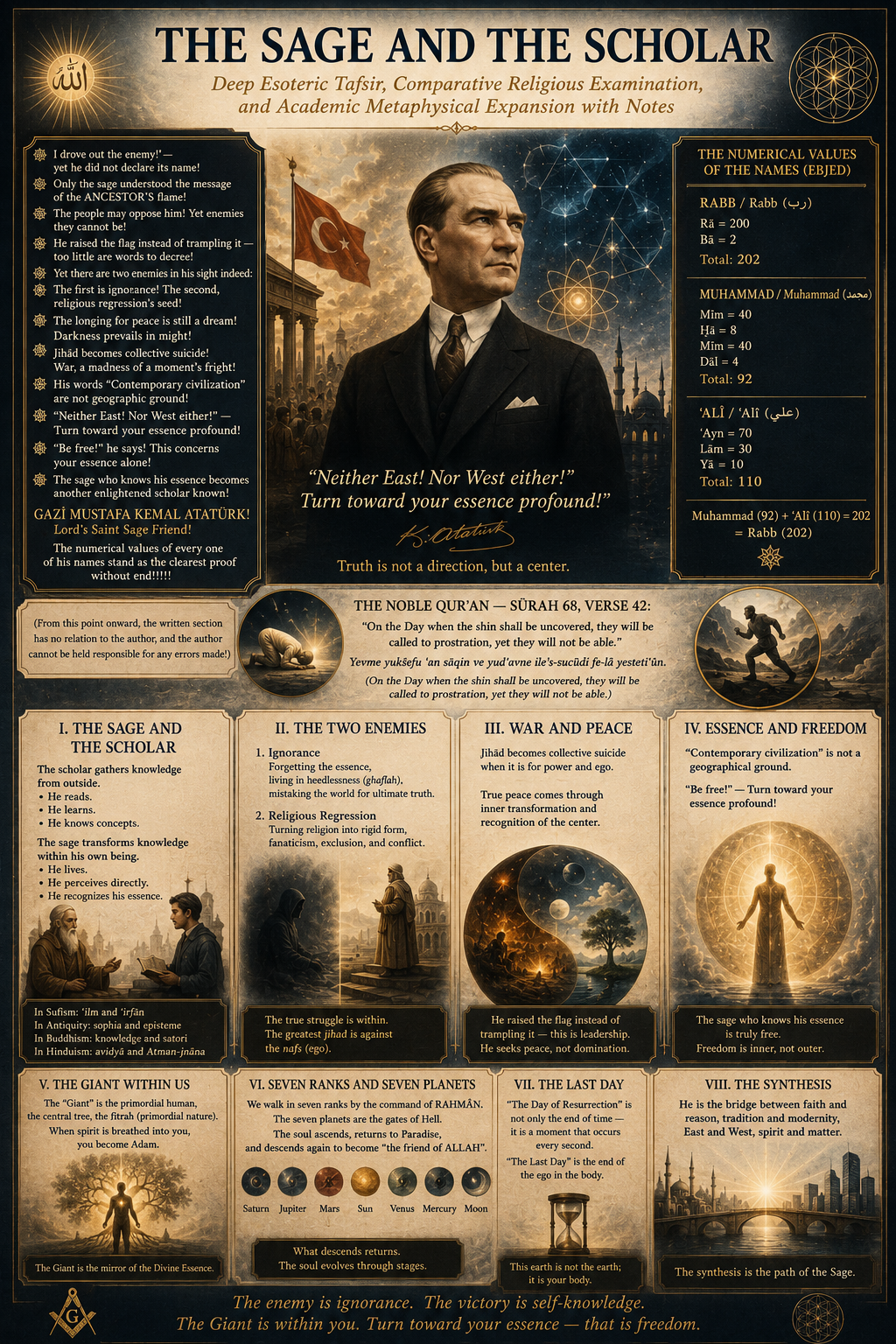
“I drove out the enemy!” — yet he did not declare its name!
Only the sage understood the message of the ANCESTOR’S flame!
The people may oppose him! Yet enemies they cannot be!
He raised the flag instead of trampling it — too little are words to decree!
Yet there are two enemies in his sight indeed:
The first is ignorance! The second, religious regression’s seed!
The longing for peace is still a dream! Darkness prevails in might!
Jihād becomes collective suicide! War, a madness of a moment’s fright!
His words “Contemporary civilization” are not geographic ground!
“Neither East! Nor West either!” — Turn toward your essence profound!
“Be free!” he says! This concerns your essence alone!
The sage who knows his essence becomes another enlightened scholar known!
GAZI MUSTAFA KEMAL ATATÜRK! Lord’s Saint Sage Friend!
The numerical values of every one of his names stand as the clearest proof without end!
M.H. ULUĞ KIZILKEÇİLİ
Ankara – 02 April 2001
(From this point onward, the written section has no relation to the author, and the author cannot be held responsible for any errors made!)
Esoteric Tafsir, Comparative Religious Examination, and Academic Metaphysical Expansion with Notes
Introduction
In the poem, Mustafa Kemal Ataturk is not merely a historical or political figure. The poet interprets him as a “Lord’s Saint sage friend” who awakens consciousness and directs the human being toward his own essence. For this reason, the poem transforms from a conventional eulogy written upon modern Turkish history into an esoteric text of consciousness describing humanity’s inner transformation, its struggle against ignorance, its search for the center, and the fact that truth is not geographical but ontological.
The central axis of the text is the distinction between the “sage” and the “scholar.” This distinction concerns not merely educational level.
Here, the poet speaks of two different human types:
The Scholar:
• one who possesses information,
• learns,
• reads,
• memorizes,
• thinks conceptually.
The Sage, however, is:
• one who knows himself,
• recognizes his essence,
• transforms knowledge into being,
• finds his inner center,
• lives truth directly.
This distinction exists under different names throughout all ancient traditions.
In Sufism:
• ‘ilm and ‘irfān,
• outward knowledge and gnosis.
In Ancient Greece:
• sophia and epistēmē.
In Buddhism:
• conceptual knowledge and satori.
In Hinduism:
• avidyā and the knowledge of Atman.
In Kabbalah:
• the outer law and the inner secret.
The poem reconstructs all of these ancient distinctions within a modern language of consciousness.
I. The Statement “I Drove Out the Enemy” and the Hidden Enemy
The opening verses of the poem are as follows:
“I drove out the enemy! Yet he did not declare its name!”
At first glance, this expression appears to narrate a military victory. However, the continuation of the poem clearly shows that the enemy described here is not merely an external force.
For immediately afterward it says:
“Only the sage understood the message of the ANCESTOR!”
Here, the poet implies not the outer enemy, but the inner enemy.
In Sufism, the human being’s greatest enemy is the nafs.
In Buddhism, humanity’s true enemy is ignorance.
In Plato’s allegory of the cave, what chains human beings is not an external enemy, but the darkness of consciousness.
The poem follows the same metaphysical line:
The true enemy is humanity’s separation from its own essence.
For this reason, the poem moves from historical warfare toward metaphysical warfare.
II. The Distinction Between the Sage and the Scholar
Who Is the Scholar?
The scholar is the one who gathers knowledge from outside himself.
He:
• reads books,
• knows history,
• constructs theories,
• produces ideas,
• reasons intellectually.
Yet according to the poem, these alone are insufficient.
For knowledge does not automatically lead the human being to truth.
This is the greatest problem of the modern age:
Knowledge has increased.
Wisdom has diminished.
Humanity has produced technology.
Yet it has lost meaning.
For this reason, the poem does not despise the scholar; however, it regards him as incomplete.
Who Is the Sage?
The sage is the one who transforms knowledge within his own being.
He is not merely one who knows, but one who:
• lives,
• perceives directly,
• recognizes his essence,
• reaches his center.
In Sufism, this is called the ‘ārif (gnostic knower).
According to Ibn Arabi, humanity’s truth cannot be grasped solely through theoretical knowledge. The human being must live his own truth.
The saying of Socrates:
“Gnothi Seauton — Know thyself.”
also points toward the same metaphysical center.
In Zen Buddhism, conceptual knowledge is often regarded as the veil standing before truth.
Buddhist awakening arises not from concepts, but from direct perception.
The sage within the poem is precisely the bearer of this inner perception.
III. The Esoteric Interpretation of Ignorance
In the poem appears the expression:
“There are two enemies indeed in his sight:
The first is ignorance!”
Here, ignorance does not merely signify lack of education.
On the esoteric level, ignorance signifies:
• humanity forgetting its own essence,
• imagining itself to be merely the body,
• mistaking outward appearances for truth,
• the loss of the center.
In Sufism, this is called ghaflah (heedlessness).
Heedlessness is the human being’s forgetting of the divine essence within himself.
In Hinduism, avidyā carries the same meaning.
The human being does not know his true essence and assumes only the material world to be real.
In Buddhism, avijjā is the source of all suffering.
In Plato’s allegory of the cave, human beings mistake shadows for reality.
The ignorance in the poem is precisely this:
The human being mistaking shadow for truth.
IV. Reactionism and Frozen Consciousness
What Is Reactionism?
As the second enemy, the poem says:
“And religious reactionism as well!”
Here, reactionism does not bear merely a political meaning.
On the esoteric level, reactionism signifies:
• the freezing of the mind,
• symbols losing their spirit,
• living truth becoming mechanical rules,
• the petrification of the sacred.
According to Mircea Eliade, sacred symbols may gradually lose their living meaning and become empty ritual alone.
In Sufism, truth is eternally alive.
According to Laozi, the Dao is a flowing order, not a frozen law.
In Kabbalah, beyond literal interpretation exists the level of “sod,” the hidden meaning.
For this reason, the poem calls for truth to remain living.
Frozen Religion and Living Truth
The poem stands not against religion, but against frozen consciousness.
This is an immensely important distinction.
For the poem’s metaphysical structure does not reject the sacred.
On the contrary:
It calls for a return to the essence of the sacred.
In Sufism, the distinction between sharī‘ah, ṭarīqah, and ḥaqīqah becomes meaningful at precisely this point.
Sharī‘ah preserves outward order.
Truth, however, seeks the inner essence.
The poem opposes the outward form taking precedence over the essence.
V. The Inner Interpretation of Jihād
In the poem appears the expression:
“Jihād becomes collective suicide! War, a madness of a moment!”
Here, external war is rendered meaningless.
The poem argues that the true struggle is inward.
In Sufism, “al-jihād al-akbar” — the greater jihād — is the human being’s struggle against the nafs.
In Buddhism, the Māra encountered by the Buddha is not an external devil, but humanity’s inner fears, passions, and darkness.
In Christian mysticism, the concept of “spiritual warfare” similarly describes inner struggle.
In the poem, war is no longer against an enemy outside oneself, but against:
• ignorance,
• fear,
• pride,
• dogma,
• the darkness of consciousness.
For this reason, the poem’s understanding of war is metaphysical.
VI. The Esoteric Expansion of the Concept of Contemporary Civilization
Is Civilization Geographical?
The poet says:
“His phrase ‘Contemporary civilization’ is not geographical!”
This is an extraordinarily profound interpretation.
For here, modernity is not understood as:
• Westernization,
• technical progress,
• urbanization,
• technology.
According to the poem, true civilization is:
the maturity of consciousness.
A human being may:
• produce machines,
• build skyscrapers,
• develop technology,
yet if he does not know his own essence, he still remains in darkness.
According to Carl Gustav Jung, modern humanity has advanced technically, yet lost its spiritual center.
Rene Guenon criticizes modernity as “the reign of quantity.”
The poem’s understanding of contemporary civilization is very close to these critiques.
Spiritual Civilization
The poem’s true understanding of civilization is this:
True progress is:
• the human being recognizing his own essence,
• finding his inner center,
• transcending the darkness of consciousness,
• approaching truth.
For this reason, contemporary civilization in the poem is a level of spiritual maturity.
In Hinduism, the Kali Yuga teaches that spiritual decline occurs during the age of material advancement.
In Buddhism, technology does not produce enlightenment.
In Sufism, the human being must first conquer the inner world rather than the outer.
The poem gathers all of these traditions upon the same metaphysical axis.
VII. “Neither East nor West”: The Doctrine of the Center
What Do East and West Mean?
In the poem appears the expression:
“Neither East nor West either! Turn toward your own essence!”
Here, East and West are not geographical directions.
They are two poles of consciousness.
The East represents:
• the mystical,
• the intuitive,
• the inward-turning,
• the metaphysical dimension.
The West represents:
• rationality,
• technique,
• outward orientation,
• the material dimension.
The poem says that neither pole alone is sufficient.
Truth lies at the center.
The Symbolism of the Center
In Sufism, there exists the symbol of the “light belonging neither to East nor West.”
In the Hermetic tradition, the center is the inner axis.
In Kabbalah, the middle pillar symbolizes balance.
In Taoism, the balance of Yin and Yang reaches the center.
In the Hindu tradition, when ida and pingala unite, the central channel opens.
The poem’s call to “turn toward your essence” is a call for the human being to find his center.
For the human being cannot become free before reaching the center.
VIII. Freedom and Self-Consciousness
What Is Freedom?
In the poem appears the expression:
“Be free! This concerns your essence!”
Here, freedom transcends political meaning.
On the esoteric level, freedom signifies:
• liberation from fear,
• release from habits,
• transcending the darkness of consciousness,
• stripping away false identities,
• reaching the center.
If the human being does not know his own essence, he is not truly free.
For:
• fears,
• passions,
• patterns,
• the thoughts of society
govern him.
In Buddhism, freedom is the dissolution of desire.
In Sufism, freedom is the transcendence of the nafs.
In Stoicism, the human being must rule not external events, but his own center.
The poem’s understanding of freedom may be connected with all of these traditions.
IX. The Esoteric Interpretation of the Figure of Atatürk
From Historical Leader to Archetype of Consciousness
In the poem, Mustafa Kemal Ataturk is described as:
“Lord’s Saint Sage Friend”
Here, a symbolic figure of consciousness emerges more than a historical personality.
Throughout the history of religions, certain individuals have become archetypes of:
• moral order,
• wisdom,
• awakening,
• inner transformation.
Confucius became the symbol of moral order.
Gautama Buddha became the symbol of awakening.
Ali ibn Abi Talib became the symbol of wisdom.
Hermes Trismegistus became the symbol of cosmic knowledge.
Socrates became the symbol of self-questioning.
Within the poem, Atatürk is likewise interpreted as the figure of:
• consciousness against ignorance,
• openness against dogma,
• freedom against fear,
• center against fragmentation.
Cultural Archetype and Collective Consciousness
According to Carl Gustav Jung, societies transform certain figures into symbols of collective consciousness.
These figures are no longer merely historical individuals.
They carry the consciousness ideal of the society.
In this sense, the figure of Mustafa Kemal Ataturk within the poem is transformed into the archetype of:
• modern wisdom,
• self-consciousness,
• contemporary spiritual awakening.
X. Ebced and Numerical Symbolism
At the end of the poem appears the expression:
“The numerical value of every one of his names stands as the clearest proof!”
Here, there is a reference to ebced and the symbolism of letters.
In ancient traditions, letters were regarded as:
• vibrations,
• numbers,
• cosmic order,
• carriers of meaning.
Gematria in Kabbalah,
ebced in Islam,
the metaphysics of number in the Pythagorean tradition,
the mantra system in Hinduism
all share the same metaphysical approach.
Here, number is not merely mathematics.
It is the hidden order of truth.
At this point, the poem clearly connects itself to the mystical metaphysics of letters.
XI. The Distinction Between the People and the Enemy
“The People May Oppose Him, Yet They Cannot Be Enemies”
This verse is one of the poem’s ethical centers.
The poet does not absolutely demonize humanity.
Human beings may:
• fear,
• misunderstand,
• fall into ignorance,
• oppose truth.
Yet this does not make them ontological enemies.
The true enemy is:
• the darkness of consciousness,
• ignorance,
• the frozen mind.
This approach is close to the Buddhist teaching of compassion, the understanding of mercy in Sufism, and the Stoic idea of human brotherhood.
XII. The Doctrine of Inner Revolution
Where Does True Revolution Begin?
The fundamental idea emerging at the end of the poem is this:
Before changing the outer world, the human being must transform his inner world.
For this reason, the poem’s understanding of revolution is not:
• political,
• but conscious,
• spiritual,
• ontological.
In Sufism, the human being must first transform his own nafs.
In Buddhism, it is not the world but the mind that changes.
In the Hermetic tradition, transformation begins within.
This is the poem’s true call:
Inner revolution.
XIII. The Age of Information and the Crisis of Wisdom
The modern age has established the age of information.
Yet according to the poem, information alone is insufficient.
Humanity has:
• produced data,
• developed technology,
• accelerated communication,
yet at the same time has:
• become isolated,
• lost meaning,
• forgotten its inner center.
The distinction between sage and scholar within the poem is a profound critique directed toward the crisis of the modern world.
Scholars are many.
Sages are few.
For information grows outside.
Wisdom is born within.
XIV. Socrates, Buddha, and the Archetype of the Sage
The sage figure within the poem is not merely Sufi.
Throughout all ancient traditions, the sage is the one who:
• knows himself,
• transcends ego,
• approaches truth,
• reaches the center.
Socrates:
“Know thyself.”
Gautama Buddha:
“Awaken.”
Laozi:
“Return to the natural center.”
Ibn Arabi:
“He who knows his own self knows his Lord.”
The sage in the poem is the modern form of this universal archetype.
XV. Conclusion
Although “The Sage and the Scholar” appears outwardly to be a brief philosophical poem, within its deeper structure it carries an extraordinarily dense metaphysical system.
The poem’s fundamental idea is this:
Humanity’s true enemy is not people outside itself, but:
ignorance,
forgetting one’s essence,
frozen consciousness,
and knowledge without wisdom.
True civilization is not:
• technology,
but the maturity of consciousness.
True freedom is not:
• political,
but essential freedom.
True wisdom is not:
• knowing the outer world,
but knowing oneself.
The poem’s call is not to turn toward East or West.
It is to return to the center.
For truth is not in geography;
it is within the human being’s own essence.
And according to the poem:
The human being who knows his essence is no longer merely knowledgeable.
He is wise.
ACADEMIC FOOTNOTES
The distinction between “sage” and “scholar” in the poem may be associated with the distinction between “‘ilm” and “‘irfān” in Islamic thought. While knowledge is intellectual learning, gnosis is the inward living of truth.
According to Ibn Arabi, the human being comprehends truth not merely through theoretical knowledge, but through self-recognition. This approach parallels the poem’s concept of the “sage who knows his essence.”
The teaching “Gnothi Seauton — Know thyself” in Ancient Greece directly resembles the poem’s structure centered upon self-consciousness.
The teaching “Tat Tvam Asi — Thou Art That” in the Upanishads emphasizes humanity’s connection to the divine essence. The poem’s emphasis upon “essence” may be related to this metaphysical line.
In Buddhism, conceptual knowledge and awakening are distinct. In the Zen tradition, truth is directly experienced; it cannot be grasped through thought alone.
The concept of “ignorance” in the poem carries a semantic field similar to “ghaflah” in Sufism and “avidyā” in Hinduism.
In Plato’s allegory of the cave, human beings mistake shadows for reality. The poem’s idea of the darkness of consciousness may be compared with this allegory.
“Reactionism” here is interpreted less politically than as mental freezing and the loss of the living meaning of sacred symbols.
According to Mircea Eliade, sacred symbols may gradually transform into mechanical ritual. The poem’s critique of dogmatic closure may be evaluated within this context.
Laozi’s understanding of Dao emphasizes flowing truth rather than frozen rules. The poem’s understanding of living truth resembles Taoist thought.
The “sod” level in Kabbalah signifies the hidden layer of meaning beyond literal interpretation. The poem’s esoteric interpretation is close to this understanding.
The “greater jihād” in Sufism is the human being’s struggle with the nafs. The poem’s understanding of warfare is directed not outwardly but inwardly.
In Buddhism, Māra represents humanity’s inner fears and passions. The poem’s understanding of the true enemy resembles this structure.
The concept of “spiritual warfare” in Christian mysticism likewise describes humanity’s struggle against its own passions.
The expression “Neither East nor West” may be associated with the Qur’anic symbol of the “light belonging neither to East nor West.”
In the Hermetic tradition, the center is the human being’s inner axis. The poem’s call to “turn toward your essence” reflects this centrism.
In Taoism, the balance of Yin and Yang describes opposites uniting at the center. The poem’s transcendence of the East–West duality carries a similar structure.
According to Carl Gustav Jung, modern humanity may have lost its spiritual center despite technical progress. The poem’s critique of contemporary civilization parallels this thought.
Rene Guenon criticizes modernity as “the reign of quantity.” The poem’s refusal to regard technical civilization alone as sufficient is close to this critique.
The figure of Mustafa Kemal Ataturk in the poem has been interpreted as a “cultural archetype” beyond historical personality. The Jungian approach argues that societies transform certain figures into symbols of collective consciousness.
Ebced and numerical symbolism are associated with the metaphysics of letters in Islam. Similar systems exist within gematria in Kabbalah and the Pythagorean metaphysics of number.
The poem’s fundamental message is the idea that true revolution begins not in the outer world, but within the human being’s own essence.
BIBLIOGRAPHY
• Ibn Arabi, Fuṣūṣ al-Ḥikam
• Plato, Republic
• Chandogya Upanishad
• D. T. Suzuki, Zen Buddhism
• Rumi, Mathnawi
• Mircea Eliade, The Sacred and the Profane
• Laozi, Tao Te Ching
• Gershom Scholem, Major Trends in Jewish Mysticism
• Carl Gustav Jung, Modern Man in Search of a Soul
• Rene Guenon, The Reign of Quantity and the Signs of the Times
• Joseph Campbell