THE SCIENCE OF THE BOOK
THE SCIENCE OF THE BOOK. Adam arranged energies through “Sound”: “Seven Ranks!” Leaving the Rank without permission — no forgiveness! According to vibration every angel took its place; Each swore to reach the “Adam frequency”! Sekine (Shekinah) passed the seven powers to SPIRIT,
APOCALYPSE BOOK
THE SCIENCE OF THE BOOK
A : PRESENTATION
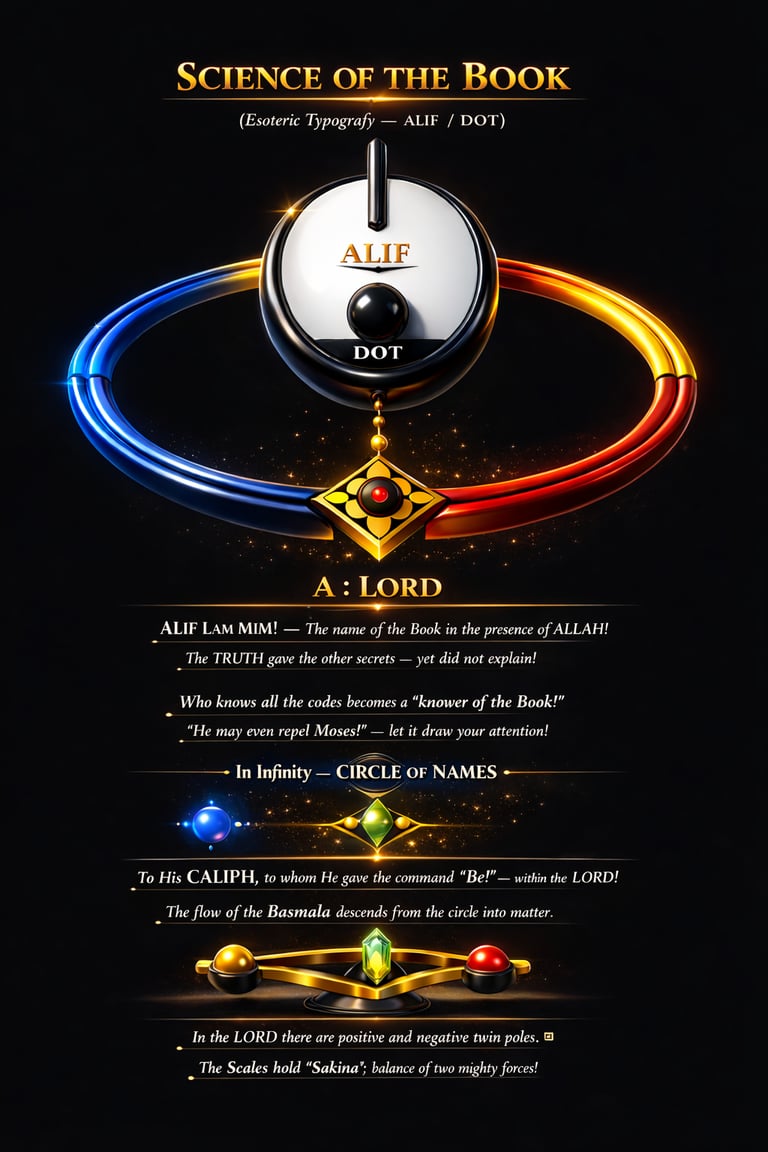
“ALIF LAM MIM! The name of the Book in the presence of ALLAH!”
Lord gave the other secrets — yet did not explain!
Whoever knows all the codes becomes “the knower of the Book!”
“May even drive Moses away!” — let this draw your attention!
Who is he? What is he? How is he? Unknown — like ALLAH!
The only knowledge in the Book: “the possessor of the science of the Book!”
BLAVATSKY explains the secret — through “energy,”
Without ever revealing the mysteries of the Qur’an openly!
Here the poor one reconciled the two together;
Still, “THE SCIENCE OF THE BOOK” remained a secret in the end!
B : ALLAH
ALLAH is free energy — beyond matter;
Not light, but “light upon light”; matter exists within every ray!
Every light is darkness where matter does not exist;
That is called the “Night of Qadr” and even the “Black Stone”!
Within infinity He is free — and utterly alone;
Only He is conscious of being ALLAH!
The idea of ALLAH exists — yet there is no “I-consciousness”;
Within its shell, the pearl emerges!
“I-consciousness” is possible only within matter;
Outside matter, possession differs not from its Owner!
Look! On Mount Sinai He says to Moses: “I am who I am!”
He describes Himself again through Himself!
At this stage His name must be ALLAH;
He has no form — none has seen Him even in the Mi‘raj!
Indeed, “Jesus says: I do not know His identity”;
Only in the sense of RAB he calls Him “Holy Father”!
“He may abandon the worlds at any moment!” — He is abstract!
For He is like a point — the dimension of zero!
No existence other than Him; He draws all glorification to Himself!
Multiply infinity by zero — and “Ehad!” emerges, the One!
Two infinities cannot exist; no being besides Him!
Infinity cannot be divided into prayer or prostration!
What can the finite do before the Infinite?
It only knows to obey the laws of nature blindly!
C : RAB
In infinity there is neither beginning nor end, neither outer nor inner;
“Every Name is His!” yet He Himself cannot carry them!
Each Name He places upon the one who reflects it;
The Qur’an calls them “ALÎN” — the Great Ones!
Lord does not build the dominion directly;
He declares a will — through the “Be!” command given to His “Caliph” — as RAB!
To say “in the name of ALLAH” is the Basmala — understand why:
ALLAH uses the “RABB” within creation — for this reason!
Two beings share the Name of RAB together;
RAB liberates ALLAH from remaining unseen!
Within RAB exist positive and negative poles;
The scales — Sekine (Shekinah) — keep both forces balanced!
In the being of ALLAH exist countless points;
Only Names exist — their bodies remain in non-being!
ALLAH needs existence for “I-consciousness,” and Names need form;
Through this exchange, both wear the crown!
To know Himself, He needs what is not Himself;
Thus entering matter — like Joseph!
Therefore Joseph is the most beautiful Name of ALLAH;
“No one remained who did not bow to Him outside himself!”
Joseph is such a one — none more beautiful exists;
To love Him through His own gaze is an eternal obligation!
“The Names of ALLAH” belong essentially to Himself;
Take one by representation — that is the aim of religion!
Lord bursts forth from the veil a point of matter;
Call this first abstract matter “your true mother MUHAMMED!”
And the Name “Lord” of ALLAH clothes this point;
Within it appears our “true father” ALÎ!
A conscious and defined Lord emerges;
“Am I not your Lord?” — whoever sees does not deny!
Notice, ALLAH never asks: “Am I a god?”
“Hû,” meaning “He,” is conscious and hidden — thus divine!
“Whether willingly or unwillingly all worship Him!” says the verse;
Only ALLAH would remain if limits were removed!
For unlimited power equals limited power;
It is hard to imagine a part independent of the Whole!
The water in a jug is like the water of the spring —
Yet the jug’s water is not the spring itself!
Existence is ALLAH; He adds an “M” to make it manifest;
He is active, the servant passive — thus prostration is necessary!
None but the Hanif understood this;
The one who did not was called “Iblis” in the Qur’an!
Adam — the hidden model of ALLAH within you!
Find him, worship willingly, hold that hand while alive!
After death you cannot hold it; it holds and judges you;
Wrapping you like a mummy with the bandages of your habits!
D : SPIRIT
“The space-paradise” was the name of the first pure matter;
Nothing greater than the Point was ever created!
RAB entrusted the building of paradise to the power called “SPIRIT”;
And SPIRIT loved Adam, its helper!
Adam arranged energies through “Sound”: “Seven Ranks!”
Leaving the Rank without permission — no forgiveness!
According to vibration every angel took its place;
Each swore to reach the “Adam frequency”!
Sekine (Shekinah) passed the seven powers to SPIRIT,
SPIRIT delivered them to the first Adam —
A responsibility of the highest order!
This is the “biography of the Earth” — the end of the story;
Read it carefully — please do!
E : SEKINE
ALLAH is alone — yet His existence is not naked;
Like a bride veiled in silk — incline toward that covering!
He remains ever virgin — for always veiled;
Only the hand of Sekine (Shekinah) parts that veil!
Sekine (Shekinah) binds the Essence to ALLAH and Him to RABB;
Connecting AHMED to ALÎ — supplying every energy!
Its material half directs six forces;
Electricity is the smallest among them!
Six twin saints burst forth from Sekine (Shekinah),
Spreading the six powers — praise the first giver of grace!
“The giver of grace” — their shared twin essence;
These are the “Twin Sevens” mentioned in the Qur’an!
Its immaterial half transmits “will,”
And says “stop!” to those wishing to leave matter!
The first matter — the “High Council” — filled with energy;
These pure angels seek liberation from there!
At the “final boundary” stand the “19 wardens,”
Together with twelve reserve forces — Sekine (Shekinah)!
Until the Last Day it binds the limited power;
And that power cries: “Save me from my cell!”
It strikes its head against the walls of its prison,
Turning endlessly to find a way out!
The poor pilgrim circles the Kaaba inwardly,
Saying to the Stone: “Open the gate — enough pain!”
Sekine (Shekinah) can no longer resist the tears;
For prayer itself is reunion with the Essence,
She opens the gate — removing the final boundary;
Calling it back into its longed-for Presence!
Sekine (Shekinah) separates the limited from the limitless;
Favoring neither Rahman nor Rahim — but RAB!
The double scale of Lord — FATIMA the Name “FATIR”;
Hidden like “ALIF” within the written “BISM”!
Master M.H. Ulug Kizilkecili
Türkiye/Ankara - 5 February 2002
IMPORTANT NOTE :The original text is poetic, and the author cannot be held responsible for any errors in the English translation! To read the original Turkish text, click HERE! The following section is not the author's work, and the author cannot be held responsible for any errors made!
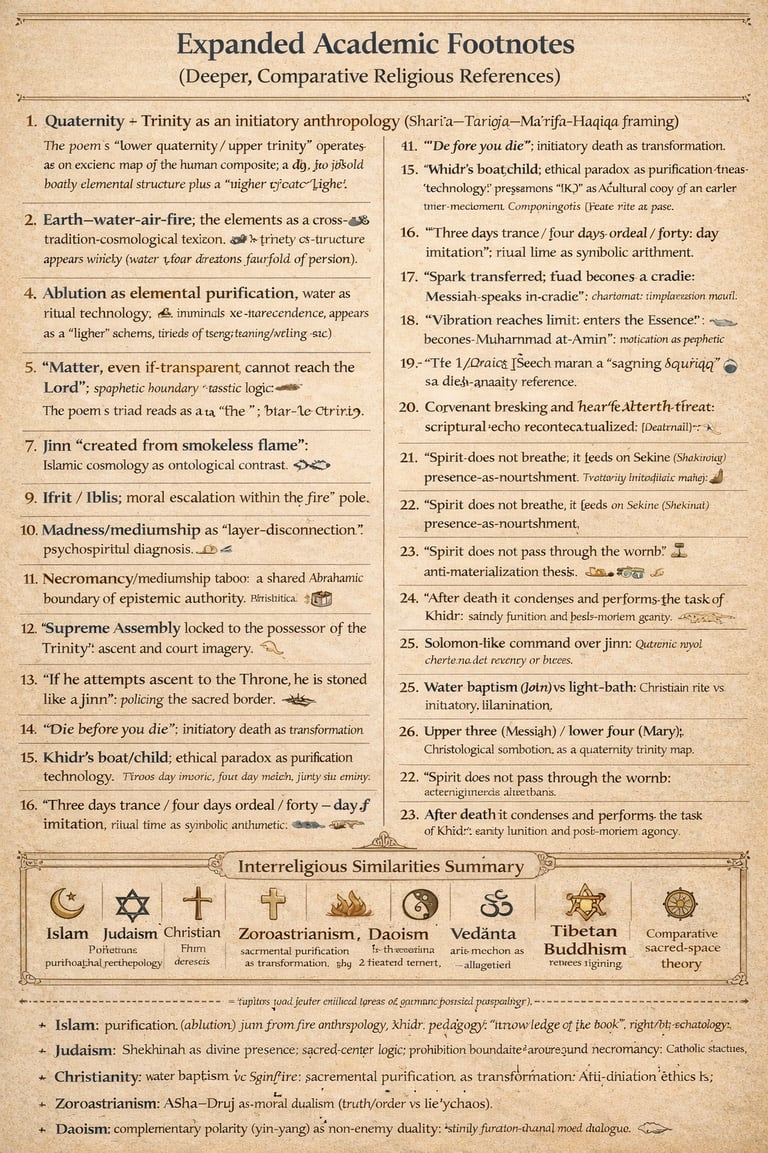
Footnotes
1. “ALIF LAM MIM” and Cosmic Letter Symbolism
The tradition of ḥurūf al-muqaṭṭaʿāt in the Qur’an has been associated in Islamic mysticism with cosmic vibration and the sound-letter model of creation. In Jewish Kabbalah, the creative power of letters (Sefer Yetzirah), the Christian doctrine of Logos, and the Hindu syllable Om represent different theological interpretations of the same “primordial sound.”
2. The Motif of the “Possessor of the Knowledge of the Book”
The figure described in the Qur’an as “one who possessed knowledge from the Book” (Qur’an 27:40) may be compared in esoteric traditions to the “gnostic sage,” the Hermetic “bearer of Nous,” and in Hinduism to the rishi or the vidyā-holder.
3. Allah as “Light upon Light”
In Islamic metaphysics, the Verse of Light (24:35) expresses that God is not physical light but the source of being itself. This idea has been compared with the Neoplatonic “One,” Brahman in Vedanta, and the concept of the “uncreated light” in Christian mysticism.
4. The Ineffability of God (Apophatic Theology)
The emphasis on the “unknowable” corresponds to Ibn ʿArabī’s notion of the unknowability of the Essence (Dhāt), the via negativa of Pseudo-Dionysius in Christian apophatic theology, and the Ein Sof concept in Jewish mysticism.
5. The Sinai Theophany Motif
The declaration “I am who I am” addressed to Moses (Exodus 3:14) represents a theophanic experience in both the Torah and the Qur’an. In Sufism this is interpreted as the “Selfless Self,” while in Vedanta it parallels the metaphysical identity of Atman and Brahman.
6. The Concept of RAB and Divine Mediation
In Islam, “Rabb” denotes the divine function that governs creation. Comparable mediating principles include the Logos in Christianity, Spenta Mainyu in Zoroastrianism, and Ishvara in Hinduism.
7. The Circle of Divine Names (Asma Doctrine)
The manifestation of Allah’s Names in existence parallels the Kabbalistic sefirot system, Hindu divine manifestations (avatars), and the Hermetic doctrine of emanation.
8. The Parallel of Sekine (Shekinah)
Sekine appears in the Qur’an as divine tranquility. In Jewish mysticism, Shekinah represents the indwelling presence of God in the world. The binding role described in the text reflects the esoteric proximity of these two concepts.
9. Positive–Negative Polarity and Cosmic Duality
The dual poles within RAB symbolically parallel Yin–Yang in Taoism, Shiva–Shakti in Hinduism, and Gnostic dualistic symbolism.
10. Adam as Cosmic Prototype
The concept resembles the Sufi insān al-kāmil, Adam Kadmon in Kabbalah, the Cosmic Christ in Christianity, and the Purusha archetype in Hindu cosmology.
11. Seven Ranks / Seven Layers
The “seven ranks” correspond symbolically to the seven heavens in Islam, the Amesha Spenta heptad in Zoroastrianism, the chakra system in Hinduism, and the seven lower sefirot in Jewish mysticism.
12. Sound and Creation
The idea of energy ordered through sound parallels Nāda Brahma in Vedic tradition, “In the beginning was the Word” (John 1:1) in Christianity, and the divine command “Kun” (“Be”) in Islam.
13. The Symbol of the Point (Nuqta)
In Islamic calligraphy, the point is the origin of letters. Comparable symbols include the Yod in Kabbalah, the Wuji point in Taoism, and the Monad in Hermetic philosophy.
14. Mi‘raj and Divine Invisibility
The emphasis on “none has seen” parallels Islamic theology concerning the unseen Essence, the “divine darkness” in Christian mysticism, and the Buddhist concept of śūnyatā.
15. Joseph as Archetype of Beauty
In Sufism, Joseph symbolizes divine beauty. Comparable figures include Apollo in Greek mythology, Krishna in Hinduism, and Christ in Christian iconography.
16. The Number “19” and Cosmic Boundary
The Qur’anic number nineteen (74:30) has been interpreted esoterically as a symbol of cosmic order, often compared with Kabbalistic numerology and Pythagorean number symbolism.
17. Circumambulation and Cosmic Rotation
The inner circumambulation imagery parallels Buddhist pradakshina around stupas, Hindu mandala rotation, and the Sufi sema as symbolic movement around a sacred center.
18. ALIF as Axis Mundi
The verticality of ALIF symbolizes unity in Islamic calligraphy. Comparable axis mundi symbols include Yggdrasil, Mount Meru, and the Christian cross axis.
19. Twin Sevens and Energy Systems
The concept of twin sevens parallels upper-lower sefirot balance in Kabbalah, ida–pingala channels in Hindu yoga, and Taoist microcosmic energy circulation.
20. Separation of the Limited and the Infinite
Sekine (Shekinah) separating limitation from infinity parallels Ibn ʿArabī’s concept of barzakh, the Buddhist bardo, and Platonic distinctions between ideals and phenomena.
Additional Comparative Notes
1. The Gnostic Sage (Gnostikos)
In Gnostic tradition, the gnostikos is not a mere believer but one who attains gnosis — direct divine knowledge. This knowledge is ontological rather than intellectual, representing inner realization of being. Comparable figures include the Sufi ʿārif, the Hindu jñāni, and the Christian illuminatus. Metaphysically, this figure does not possess knowledge — but becomes knowledge.
2. Bearer of Nous (Hermetic Tradition)
Nous denotes divine intellect or cosmic consciousness. In Plotinus, Nous emanates from the One. Hermetic texts describe it as a divine spark within the human being. The “bearer of Nous” embodies cosmic intellect in conscious form, comparable to the Active Intellect in Islamic philosophy and the Muhammadan Reality in Sufism.
3. Rishi (ऋषि)
In Hindu tradition, the rishi does not compose the Vedas but “hears” them (śruti). Knowledge here is not revelation in a prophetic sense but intuitive perception of cosmic vibration, linked to the doctrine of Nāda Brahma (“the universe as sound”).
4. Vidyā-Holder (विद्या)
Vidyā signifies liberating knowledge leading to moksha. Avidyā represents ignorance that sustains illusion. The vidyā-holder realizes the identity of Atman and Brahman. Comparable notions include maʿrifa in Sufism, prajñā in Buddhism, and gnosis in Gnosticism.
Shared Metaphysical Core
These four figures share a common essence:
Knowledge is internal rather than external.
Truth is realized, not taught.
Knowledge implies ontological transformation.
The sage becomes a mirror of reality.
In other words:
These figures do not possess knowledge — knowledge possesses them.
The One of Plotinus, Brahman in Vedanta, and the “Uncreated Light” in Christian Mysticism
A Comparative Metaphysical Perspective
1. The One (To Hen) in Plotinus
In Neoplatonism, the One is the absolute source of all being.
It is indefinable and cannot be grasped by thought, for it precedes intellect itself.
Nous (divine intellect) and Soul emanate from the One.
The One belongs neither to the category of being nor non-being; it transcends all categories.
For Plotinus:
“It is an overflowing source; it does not create — existence flows from it.”
This conception influenced Islamic philosophy profoundly, especially in the interpretations of Ibn Sīnā and Ibn ʿArabī.
2. Brahman in Vedanta
In Advaita Vedanta, Brahman is the ultimate reality.
Nirguna Brahman: without attributes, pure being-consciousness (sat–cit).
Saguna Brahman: the cosmic, manifest aspect.
Brahman:
Is the essence of everything yet reducible to nothing.
Is identical with Atman (“Tat Tvam Asi”).
Like Plotinus’ One, Brahman is:
Transcendent,
Indefinable,
The source of all existence.
However, Vedanta emphasizes the identity of human consciousness with Brahman — an ontological experience of unity.
3. The “Uncreated Light” in Christian Mysticism
Particularly in the Eastern Orthodox Hesychast tradition, the uncreated light is understood as the divine radiance that proceeds not from God’s essence but from His energies.
According to Saint Gregory Palamas, God’s essence remains unknowable, yet His energies can be experienced.
The light witnessed at the Transfiguration on Mount Tabor is considered uncreated and divine.
This light:
Is not God’s essence itself but the experiential manifestation of divine reality.
Is frequently compared with mystical experiences of nūr in Sufi thought.
Shared Metaphysical Core
Across these three concepts, several common elements emerge:
The divine essence cannot be directly comprehended.
Truth transcends rational cognition.
Being flows or manifests from a central metaphysical source.
Key Differences
In Plotinus, there is a hierarchical process of emanation.
In Vedanta, the emphasis lies on identity and non-duality.
In Christian mysticism, a distinction is maintained between divine essence and divine energies.