THE TURK’S CREED
THE TURK’S CREED. To massage hearts — unto that Exalted One I gave my solemn vow! Therefore, with His permission, I employed the Name of Essence now! Exactly “twenty-eight” red stars belong unto the Capricorn sign! Returning to that “Red-Goated One” becomes a debt of soul divine!
APOCALYPSE BOOK
THE TURK’S CREED
Bow not in prostration before a qiblah but your own!
Though Yâsîn may be recited, let no ecstasy be shown unknown!
Islam is surrender unto the One within the vein!
The One who strikes within your pulse: “Lord! Lord!” again, again!
Neither Arab flattery nor the swamp of Western mire!
Only the whiteness of the inner face makes the visage brighter!
Expect nothing from the one who left Husayn deprived and dry!
Open not your eyes to Yazîd while closing Âlî from your eye!
Do not squander Turkish labor and sweat away in Mecca’s land!
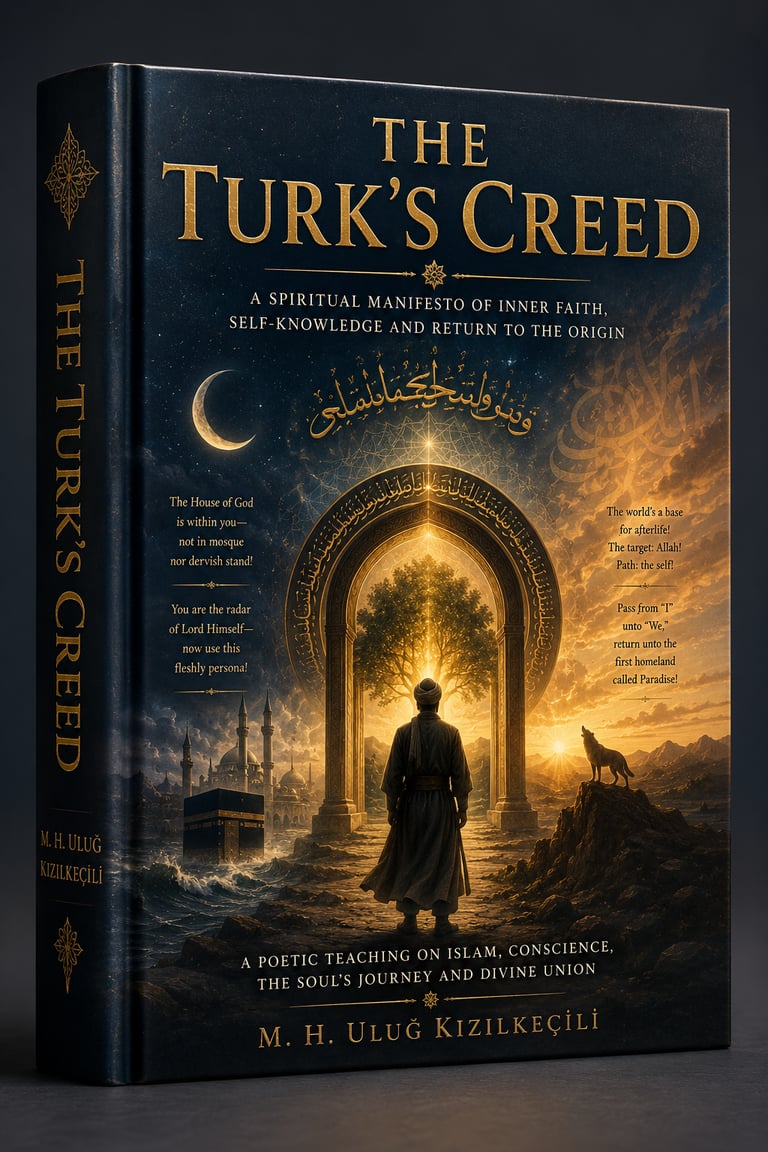
The House of God is within you — not in mosque nor dervish stand!
That “Black Stone” is but your darkened heart — cease sleeping where you lie!
While your blind ego still remains, throw not stones at Satan blind!
Did you truly think that slaughtering beasts was sacrifice?
When giving life unto the Lord was your primordial oath’s device!
Be not a false witness unto what you have not seen!
Take heed unto the Prophet’s Mi‘râj and what there did it mean!
“In the Name” means: “Be the representative of Lord yourself!”
No other caliph shall suffice to place this truth upon the shelf!
Within the dough of every soul lies leaven from Rahman above!
Knead and bake it into form! Strive to become the work Lord loves!
If you sleep trusting intercession, hunger shall be your fate!
You shall receive but beggar’s share — a morsel from the plate!
Not the captain, but the diver descends unto the ocean floor!
Your spirit sits upon the Throne; your soul is trapped in cattle’s door!
The face seen on the screen exists not truly in the screen!
Reality lies outside the TV — dreams dwell in realms unseen!
Even the simplest radio possesses still an antenna!
You are the radar of Lord Himself — now use this fleshly persona!
Catch hold of the rope-end hanging down called conscience deep inside!
Climb upward by your very self till Lord-like becomes your guide!
The command “Bow unto Adam!” once was given unto angels there!
Adam is visible Rahman — unto the man who worships aware!
The life within your flesh is angel; your spirit in the heavens Adam!
Prostrate yourself unto the Lord at last, since you are not the Satan!
“Fortune” is but another name belonging to that spirit high!
Know now your own true “Measure”; ascend the Throne of Destiny!
Let all the world’s dimensions shrink to but a point beside your soul!
In the exalted Name of Allah govern all creation whole!
A thousand-chambered palace belongs unto a single King!
“Both stars and Moon bowed down to Joseph” — thus the sacred verses sing!
The essence means connection true; all other faiths are but disguise!
Run toward the “Friend of Lord” who calls, until before your gaze he lies!
Once you arrive unto that state, no “five-times prayer” nor moment stays!
Become the Sun — praise not the light through nights nor through the passing days!
In no form other than through him can Rahman ever truly show!
Seek all your life the moment called Mi‘râj, wherein ascensions grow!
Surrender unto your true Owner; make peace now with your very soul!
Repent! Return unto your origin! End now the endless goal!
Without its bow the strongest arrow still remains forever weak!
Lean on your inner essence now; none nobler than yourself you seek!
Your spirit watches over you and warns through conscience deep inside!
Do not diminish your own self knowingly before your pride!
If you become rebellious child, then “Mother” casts you far away!
Should one tree dry, no harm befalls the forest’s living vast array!
The withered one becomes mere soil from which another one shall rise!
The aim is making Abraham from Azer, worshipper of lies!
Make Muslim now the Satan-self! The soul and spirit share one age!
A harmless microbe gives the cure — thus vaccines turn the poison sage!
To become Lord-like, first give fully every person’s rightful due!
Sirât is but the bridge of life — the blind shall never pass it through!
The barrier before man’s sustenance is envy in mankind’s own breast!
Be either Sun and spread the light, or Moon reflecting Heaven’s rest!
Fast through your life by feeding all the hungry souls who ache for bread!
Taste not a morsel while there still remain the needy unfed!
Fasting means “separating” white from black within the inward way!
Anka is the bird of essence; Ra is Rahman — know Ankara as the Center’s stay!
Separate not the positive pole from out the negative one!
The lioness too is lion — favor not only the male among!
No blessed soul is ever made through veil or turban worn with pride!
One reaches not the Lord’s domain by rocket or by pole beside!
The world’s a base for afterlife! The target: Allah! Path: the self!
The body is the launch-ramp; spirit the rocket from the shelf!
My final word: Go find yourself before lost in eternity!
Say not: “Nature itself is God; existence stands apart and free!”
Nature’s a vast and mighty tree; enlightened souls become its seed!
Each branch that drinks not from the sap shall dry and leap to fire indeed!
See well the burning fertilizer — fall not through human appetite!
For afterward they drag you forth “by hair upon your forehead” tight!
Become the faithful dog of Lord before transformed into a wolf!
Pass from “I” unto “We,” return unto the first homeland called Paradise!
Those saints who speak as “We! We!” in the Qur’an are the realized!
To become caliph they are those who gave their souls unto the Lord Most High!
From selfishness unto the “Higher Self,” they transformed into “We”!
“Union and togetherness” — the truest path that one can see!
Every saint is but the spirit of one of us dwelling above!
Allah is the common Spirit of all the saints — the “Hû” thereof!
According unto Hû, the “We” give judgment unto stars and Moon!
Some descend unto our world below as mercy granted from beyond!
Allah possesses not attributes — these are merely Names displayed!
The color of the Colorless! Images of the Unseen arrayed!
Erase the color of the flesh and dye yourself in Lord’s own hue!
Enter your Ka‘bah! Dance السماع! Let every direction become qiblah unto you!
Paradise means essential knowledge — your long-lost treasure from before!
All other forms of knowledge merely bear the robe and nothing more!
Drink now your elixir at last! Ask your own soul: “Then who am I?”
I am the final physician writing your true prescription nigh!
My adhān-name is Mustafa, just like the spirit deep within!
Meaning: one possessing chosen rank within the Exalted Assembly therein!
My message is sorrowful now unto the people in this stage!
Because so many live as “dead” while still confined within the cage!
To massage hearts — unto that Exalted One I gave my solemn vow!
Therefore, with His permission, I employed the Name of Essence now!
Exactly “twenty-eight” red stars belong unto the Capricorn sign!
Returning to that “Red-Goated One” becomes a debt of soul divine!
M. H. Uluğ Kızılkeçili
Ankara – May 19, 1989
(The section written after this point has no relation to the author, and the author cannot be held responsible for errors made thereafter!)
ESOTERIC AND INTERRELIGIOUS ESOTERIC ANALYSIS OF “THE TURK’S CREED”
Although this text appears outwardly as a poetic declaration of faith, in essence it is a human-centered mystical metaphysical doctrine. The religious symbols employed throughout the work are removed from their classical meanings and reinterpreted entirely through inward, psychological, and esoteric dimensions. The primary aim of the text is not external forms of worship, but the redirection of the human being toward the truth of the inner self. Here, the concept of “Turk” represents not an ethnic identity, but the human who has recognized the self, discovered the essence, and attained inner truth. For this reason, the work is not merely a cultural manifesto; it is simultaneously a syncretic doctrine of consciousness building bridges among Sufism, Hermeticism, Gnosticism, Hindu metaphysics, Taoism, and mystical psychology.
One of the first striking aspects of the text is the relocation of the sacred center from the external world into the human being. The phrase, “Bow not before any qiblah other than yourself,” must not be read literally, but esoterically. The object of prostration here is the essential self — the divine essence hidden within the individual. In Sufi tradition, the human heart is interpreted as the Baytullah, the House of God. This understanding appears clearly in Hallâj al-Mansûr’s doctrine of “Ana’l-Lord,” in Ibn al-‘Arabî’s conception of the Perfect Human, and in Bektashi esotericism. The same idea parallels the Hindu doctrine of the unity of Atman and Brahman, the Gnostic concept of the inner divine spark, and the teaching of Christian mysticism that “the Kingdom of God is within you.”
The repeated invocation of “Lord! Lord!” within the text functions not merely as dhikr, but as a symbol of cosmic vibration itself. Humanity is envisioned as a living center beating in harmony with the rhythm of the universe. In Sufi tradition, breath is sacred because it carries the spirit. Similar notions appear as prāna in Sanskrit thought, qi in Chinese philosophy, ruach in Hebrew mysticism, and pneuma in Ancient Greek philosophy. The text therefore portrays the human being not as an ordinary biological entity, but as an antenna carrying the frequency of universal consciousness.
The symbol of the “Black Stone” opens onto an esoteric interpretation of the Ka‘bah itself. The line, “That Black Stone is your darkened heart,” emphasizes that the sacred center is not outside the individual but within. Here, the Ka‘bah symbolizes the center of consciousness. In alchemical traditions, blackening — Nigredo — represents the first stage of transformation. The soul must first confront darkness before purification and rebirth become possible. Thus, the Black Stone simultaneously symbolizes the darkness of the ego-self. Rather than orienting toward external symbols, the individual must first transcend the inner darkness.
The poem’s understanding of sacrifice likewise rests entirely upon a doctrine of inward transformation. The line, “Did you think you sacrificed merely by slaughtering animals?” critiques outward ritualism. The true sacrifice here is the surrender of the lower self, the ego, and the nafs. This directly parallels the Sufi teaching, “Die before you die.” Similar ideas appear in Buddhism through the extinguishing of desire, in Hinduism through the dissolution of ego, and in Western esotericism through the “death of the lesser self.”
The command to “bow before Adam” expresses humanity’s role as the cosmic center. Adam here is not biological humanity, but the mirror of divine consciousness upon the earth. In Ibn al-‘Arabî’s metaphysics, humanity is the essence of the universe and the mirror reflecting the Divine Names. The Kabbalistic concept of Adam Kadmon similarly represents the Cosmic Human. Thus, humanity is presented not as an ordinary being, but as the manifestation of visible divine truth.
The concept of Mi‘râj within the poem likewise signifies not merely a historical event, but the ascent of consciousness. As the individual transcends the gravity of the ego-self, higher levels of perception become accessible. This corresponds to samādhi in Hinduism, nirvāṇa in Buddhism, fanâ fi’Llah in Sufism, and gnosis in Western mysticism. The poem constantly calls humanity to pursue the inner Mi‘râj hidden within itself.
The modern metaphors within the poem are also significant. The expression, “The body is the launch-ramp; the spirit the rocket,” merges classical mystical language with contemporary symbolic imagery. The body is treated as a temporary vehicle, while the spirit becomes energy seeking ascent. This approach appears frequently in modern esoteric movements and New Age spirituality, where human evolution is viewed not merely as biological, but spiritual.
One of the poem’s strongest dimensions is its doctrine of collective consciousness. The phrase, “Those who speak as ‘We’ within the Qur’an are the saints,” implies that divine consciousness is not individualistic, but a field of unified plurality. This resembles Jung’s collective unconscious, the Mahayana Buddhist doctrine of shared essence, and the Vedantic understanding of Brahman-consciousness. When humanity transcends isolated individuality, it moves from “I” toward “We.” Even Paradise within the poem is interpreted not as an individual reward, but as a return to the consciousness of unity.
The conception of God within the text also differs profoundly from classical theology. The line, “Allah has no attributes; these are merely Names,” approaches apophatic or negative theology. God cannot be fully defined; the Names are symbolic constructions produced by the human mind. This strongly parallels the Taoist teaching that “the Tao that can be named is not the eternal Tao.” Here, God is conceived less as a personal being and more as an infinite field of consciousness.
At the center of the poem stands the essential question:
“Who am I?”
This question constitutes the central axis of all esoteric traditions. In Sufism, “Man ‘arafa nafsahu”; in Vedanta, “Ko Ham?”; in Zen, “What was your original face before birth?” — all point toward the same search for ultimate identity. The text calls humanity away from external identities toward inner self-discovery.
The final sections introduce astrological and cosmological symbolism. Expressions such as “twenty-eight red stars” and “Capricorn” connect the poem to ancient astro-mystical traditions. The number twenty-eight symbolizes lunar cycles and cosmic rhythm, while Capricorn is associated with ascent, discipline, and Saturnian wisdom. Thus, the poem acquires a multilayered symbolic structure that is not only Sufi, but also astrological.
Ultimately, the text calls for a transition from external religion toward an inward doctrine of consciousness. Concepts such as prostration, sacrifice, Mi‘râj, destiny, Paradise, and intercession are radically reinterpreted. Rituals become symbols of inward transformation, and the human being itself becomes identified as the sacred center. In this sense, the work departs from orthodox religious frameworks and approaches the shared symbolic language of esoteric and mystical traditions.
“THE TURK’S CREED,” therefore, may ultimately be understood as a mystical manifesto whose purpose is to guide humanity toward discovering the divine essence hidden within itself — privileging transformation of consciousness over ritual form, and placing interreligious esoteric unity at the center of its vision.