THE VEIL OF PARADISE
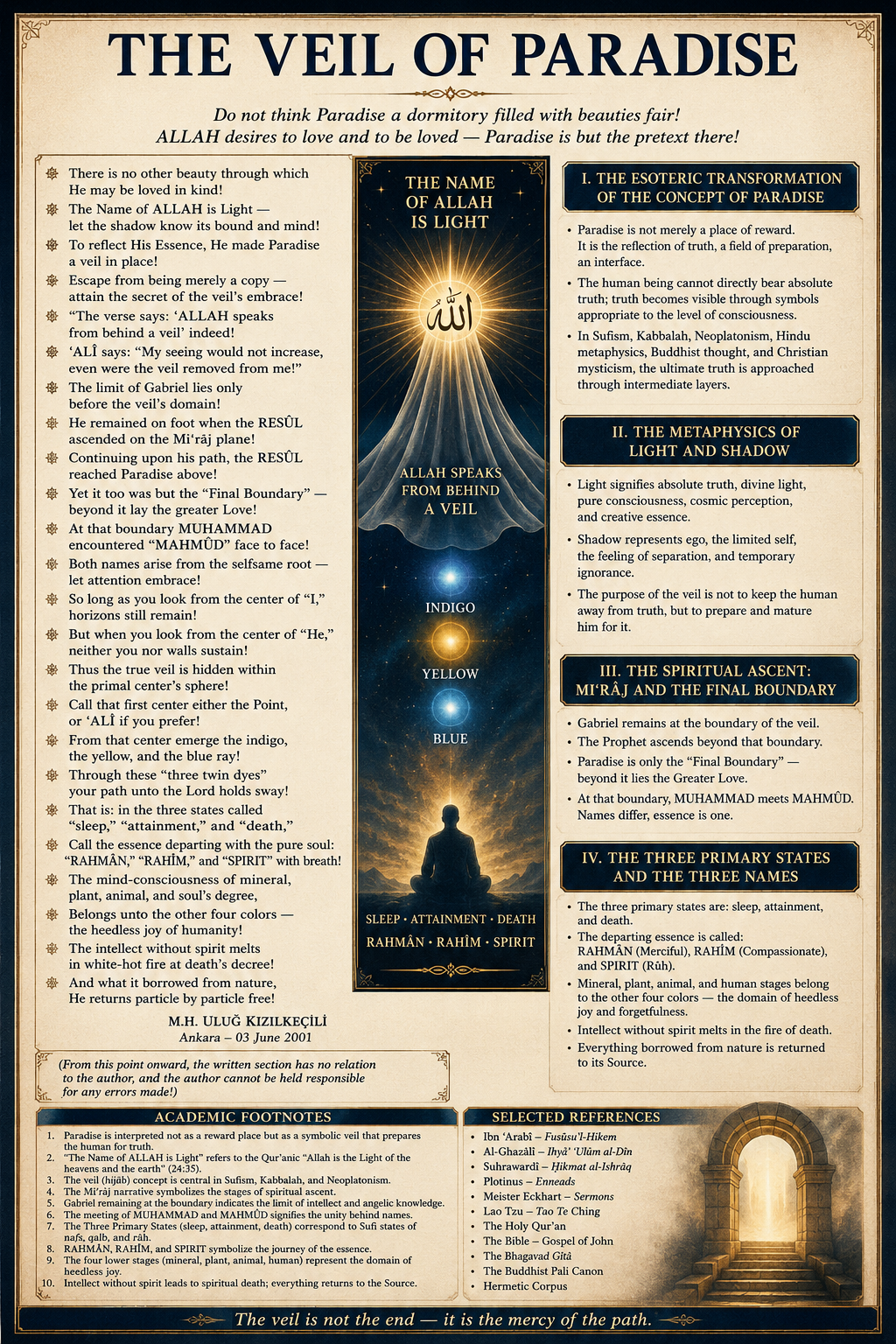
THE VEIL OF PARADISE. The mind-consciousness of mineral, plant, animal, and soul’s degree, Belongs unto the other four colors — the heedless joy of humanity! The intellect without spirit melts in white-hot fire at death’s decree! And what it borrowed from nature, He returns particle by particle fre
APOCALYPSE BOOK
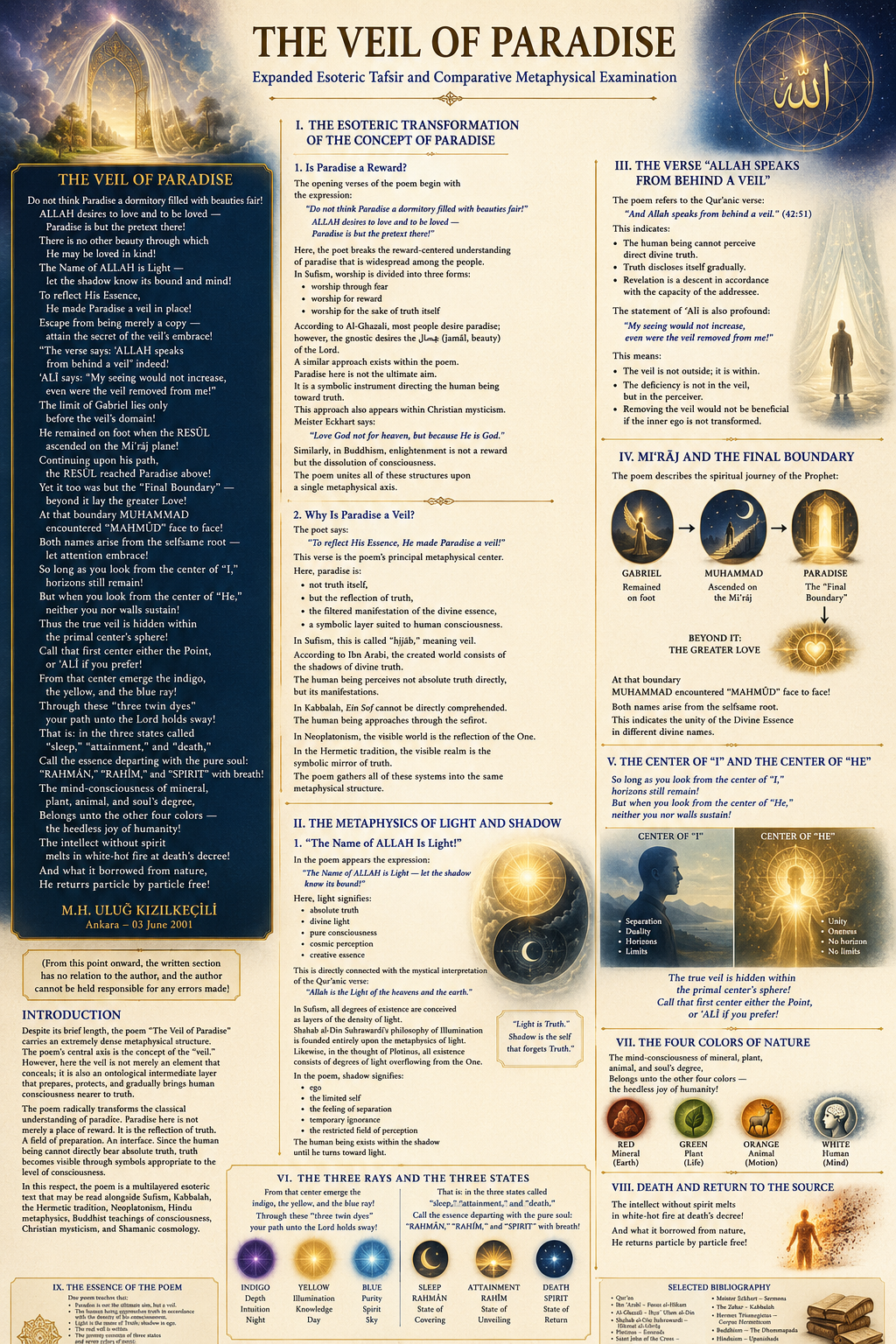
THE VEIL OF PARADISE
Do not think Paradise a dormitory filled with beauties fair!
ALLAH desires to love and to be loved — Paradise is but the pretext there!
There is no other beauty through which He may be loved in kind!
The Name of ALLAH is Light — let the shadow know its bound and mind!
To reflect His Essence, He made Paradise a veil in place!
Escape from being merely a copy — attain the secret of the veil’s embrace!
“The verse says: ‘ALLAH speaks from behind a veil’ indeed!”
‘ALÎ says: “My seeing would not increase, even were the veil removed from me!”
The limit of Gabriel lies only before the veil’s domain!
He remained on foot when the RESÛL ascended on the Mi‘rāj plane!
Continuing upon his path, the RESÛL reached Paradise above!
Yet it too was but the “Final Boundary” — beyond it lay the greater Love!
At that boundary MUHAMMAD encountered “MAHMÛD” face to face!
Both names arise from the selfsame root — let attention embrace!
So long as you look from the center of “I,” horizons still remain!
But when you look from the center of “He,” neither you nor walls sustain!
Thus the true veil is hidden within the primal center’s sphere!
Call that first center either the Point, or ‘ALÎ if you prefer!
From that center emerge the indigo, the yellow, and the blue ray!
Through these “three twin dyes” your path unto the Lord holds sway!
That is: in the three states called “sleep,” “attainment,” and “death,”
Call the essence departing with the pure soul: “RAHMÂN,” “RAHÎM,” and “SPIRIT” with breath!
The mind-consciousness of mineral, plant, animal, and soul’s degree,
Belongs unto the other four colors — the heedless joy of humanity!
The intellect without spirit melts in white-hot fire at death’s decree!
And what it borrowed from nature, He returns particle by particle free!
M.H. ULUĞ KIZILKEÇİLİ
Ankara – 03 June 2001
(From this point onward, the written section has no relation to the author, and the author cannot be held responsible for any errors made!)
Expanded Esoteric Tafsir and Comparative Metaphysical Examination
Introduction
Despite its brief length, the poem “The Veil of Paradise” carries an extremely dense metaphysical structure. The poem’s central axis is the concept of the “veil.” However, here the veil is not merely an element that conceals; it is also an ontological intermediate layer that prepares, protects, and gradually brings human consciousness nearer to truth.
The poem radically transforms the classical understanding of paradise. Paradise here is not merely a place of reward. It is the reflection of truth. A field of preparation. An interface. Since the human being cannot directly bear absolute truth, truth becomes visible through symbols appropriate to the level of consciousness.
In this respect, the poem is a multilayered esoteric text that may be read alongside Sufism, Kabbalah, the Hermetic tradition, Neoplatonism, Hindu metaphysics, Buddhist teachings of consciousness, Christian mysticism, and Shamanic cosmology.
I. The Esoteric Transformation of the Concept of Paradise
Is Paradise a Reward?
The opening verses of the poem begin with the expression:
“Do not think Paradise a dormitory filled with beauties fair!
ALLAH desires to love and to be loved — Paradise is but the pretext there!”
Here, the poet breaks the reward-centered understanding of paradise that is widespread among the people.
In Sufism, worship is divided into three forms:
• worship through fear,
• worship for reward,
• worship for the sake of truth itself.
According to Al-Ghazali, most people desire paradise; however, the gnostic desires the جمال (jamāl, beauty) of the Lord.
A similar approach exists within the poem.
Paradise here is not the ultimate aim.
It is a symbolic instrument directing the human being toward truth.
This approach also appears within Christian mysticism.
Meister Eckhart says:
“Love God not for heaven, but because He is God.”
Similarly, in Buddhism, enlightenment is not a reward but the dissolution of consciousness.
The poem unites all of these structures upon a single metaphysical axis.
Why Is Paradise a Veil?
The poet says:
“To reflect His Essence, He made Paradise a veil!”
This verse is the poem’s principal metaphysical center.
Here, paradise is:
• not truth itself,
• but the reflection of truth,
• the filtered manifestation of the divine essence,
• a symbolic layer suited to human consciousness.
In Sufism, this is called “ḥijāb,” meaning veil.
According to Ibn Arabi, the created world consists of the shadows of divine truth.
The human being perceives not absolute truth directly, but its manifestations.
In Kabbalah, Ein Sof cannot be directly comprehended.
The human being approaches through the sefirot.
In Neoplatonism, the visible world is the reflection of the One.
In the Hermetic tradition, the visible realm is the symbolic mirror of truth.
The poem gathers all of these systems into the same metaphysical structure.
II. The Metaphysics of Light and Shadow
“The Name of ALLAH Is Light!”
In the poem appears the expression:
“The Name of ALLAH is Light — let the shadow know its bound!”
Here, light signifies:
• absolute truth,
• divine light,
• pure consciousness,
• cosmic perception,
• creative essence.
This is directly connected with the mystical interpretation of the Qur’anic verse:
“Allah is the Light of the heavens and the earth.”
In Sufism, all degrees of existence are conceived as layers of the density of light.
Shahab al-Din Suhrawardi’s philosophy of Illumination is founded entirely upon the metaphysics of light.
Likewise, in the thought of Plotinus, all existence consists of degrees of light overflowing from the One.
In the poem, shadow signifies:
• ego,
• the limited self,
• the feeling of separation,
• temporary identity,
• the false center.
In the psychology of Carl Gustav Jung, the shadow represents the repressed aspects of the human being.
In Sufism, the nafs similarly acts as the veil concealing truth.
The Shadow Knowing Its Limits
In the poem, the shadow is told:
“Let it know its bound!”
This is an extraordinarily deep metaphysical expression.
For so long as the ego places itself at the center, separation emerges.
In Sufism, this is called the problem of “anā” (“I-ness”).
In Buddhism, the individual self is an illusion.
In Hinduism, maya keeps the human being trapped within separation.
In Kabbalah, the Fall signifies distancing from the divine center.
In the poem, the shadow knowing its limits means the ego renouncing its claim to centrality.
III. Truth Speaking from Behind the Veil
Why Does Truth Not Appear Directly?
In the poem appears the expression:
“The verse says: ‘ALLAH speaks from behind a veil!’”
Here, a profoundly important mystical problem is brought forth:
Why does truth not appear directly?
According to Sufism, limited consciousness cannot bear unlimited truth.
For this reason, truth is approached through:
• symbols,
• dreams,
• revelation,
• prophets,
• colors,
• sacred narratives,
• metaphors.
Thus, the veil is not merely an obstacle.
It is also a protection.
If the veil were suddenly lifted, individual consciousness might begin to dissolve.
This idea resembles the system of sefirot in Kabbalah, the doctrine of maya in Hinduism, and Plato’s allegory of the cave.
The Veil and Layers of Consciousness
In the poem, the veil is not static.
It is layered.
As the human being develops consciousness, the veil grows thinner.
In Sufism, this is called:
• kashf (unveiling),
• mushāhadah (direct witnessing),
• ma‘rifah (gnosis),
• fanā’ (dissolution of the self).
In Buddhism, the layers of consciousness dissolve.
In the Hermetic tradition, the soul transcends the planetary spheres.
In the Shamanic tradition, there is ascent to the heavens.
For this reason, the poem may also be read as a text of the journey of consciousness.
IV. The Mi‘rāj and the Limit of Intellect
Why Did Gabriel Stop?
In the poem appears the expression:
“The limit of Gabriel lies only before the veil!”
This is an extraordinarily profound symbol.
In Sufism, Gabriel is often interpreted as:
• intellect,
• order,
• divine law,
• cosmic intelligence.
However, according to the poem, there exists a boundary beyond which intellect cannot pass.
Beyond that point, direct perception becomes necessary.
The philosophy of Illumination developed by Shahab al-Din Suhrawardi advocates precisely this principle.
Beyond reason lies illuminative intuition.
In Dante Alighieri’s Divine Comedy, Virgil represents reason and guides only up to a certain point.
Thereafter, Beatrice takes over.
In the poem, the RESÛL continuing alone symbolizes human consciousness passing beyond intellect into the realm of transcendent truth.
What Lies “Beyond Paradise”?
The poet says:
“Yet it too was but the Final Boundary — beyond that Paradise as well!”
Here exists an extremely radical metaphysical interpretation.
Even Paradise is not ultimate truth.
For according to the poem:
• Paradise is symbolic,
• while truth is the divine essence itself.
In Sufism, this is called “jamālullah” — the Beauty of the Lord.
That is, direct encounter with truth itself.
For this reason, there exists something beyond Paradise within the poem.
This structure resembles the concept of the One in Neoplatonism, Ein Sof in Kabbalah, and Nirguna Brahman in Hinduism.
V. The Symbolism of Muhammad and Mahmûd
Why Do the Two Names Share the Same Root?
In the poem appears the expression:
“MUHAMMAD at that boundary encountered ‘MAHMÛD’!”
Here, what is described is not a historical personality, but a transformation of consciousness.
Muhammad may be understood as:
• human consciousness,
• the matured soul,
• the human being turning toward truth.
Mahmûd, however, signifies:
• the completed essence,
• the divine center,
• the true self.
In Sufism, this is called Haqîqat-i Muhammadiyya.
The human being is, in reality, encountering his own true face.
The Buddha-nature in Buddhism,
the divine spark in Kabbalah,
the solar human in the Hermetic tradition
are similar metaphysical structures.
VI. Self-Centered Vision and He-Centered Vision
The Ego Produces Horizons
The poet says:
“So long as you look from the center of ‘I,’ horizons still remain!”
The ego constantly produces separation.
For the self:
• wishes to be the center,
• wishes to possess,
• wishes to control,
• generates separation.
Thus, the horizon cannot be surpassed.
Truth always appears distant.
The nafs in Sufism,
the illusion of ego in Buddhism,
pride in Christian mysticism,
the Fall in Kabbalah
all point toward the same structure.
He-Centered Consciousness
In the poem appears the expression:
“But when you look from the center of ‘He,’ neither you nor walls remain!”
Here appears the doctrine of fanā’.
Fanā’ signifies:
• the dissolution of the individual center,
• the disappearance of separation,
• melting into the divine center.
Anattā in Buddhism,
the unity of Atman and Brahman in Hinduism,
the consciousness of unity in the Hermetic tradition
all approach the same metaphysical structure.
The wall here is the veil of ego.
When the self dissolves, separation dissolves as well.
VII. The Point and the Primordial Center
The Symbolism of the Point
In the poem appears the expression:
“Call that first center either the Point, or ‘ALÎ if you wish!”
In Sufism, the point is of immense importance.
The saying attributed to ‘Alî may here be recalled:
“I am the point beneath the letter Bā.”
The point signifies:
• beginning,
• center,
• unity,
• undifferentiated truth,
• pure essence.
In Kabbalah, creation begins from a point.
In the Hermetic tradition, the center is the point.
In mandala symbolism, the center is consciousness.
In the poem, the point is the first condensation of truth.
VIII. Colors and the Transformation of Consciousness
Indigo, Yellow, and Blue
In the poem it is said:
“From that center emerge the indigo, the yellow, and the blue ray!”
Here, colors are not aesthetic elements but frequencies of consciousness.
Indigo signifies:
• deep intuition,
• infinity,
• nocturnal consciousness.
Yellow signifies:
• intellectual illumination,
• awareness,
• perception.
Blue signifies:
• spiritual clarity,
• peace,
• expanded consciousness.
In alchemy, colors represent stages of transformation.
In the Hindu chakra system, colors symbolize centers of consciousness.
In the poem, colors form the map of spiritual transformation.
The Triple Dye and the Three Deaths
In the poem appear the three states:
“Sleep! Attainment! And death!”
Here, death is not physical death.
The poem contains three stages:
The death of ignorance
The dissolution of the ego
The disappearance of separation
In Sufism, these may be called the processes of:
• sayr (journeying),
• sulūk (spiritual wayfaring),
• fanā’ (dissolution of self).
In Christian mysticism, the “dark night of the soul” is a similar process.
In Buddhism, nirvana is the extinguishing of desire.
The poem gathers all of these within the same metaphysical axis.
IX. RAHMÂN, RAHÎM, and SPIRIT
The Triple System of Mercy
In the poem appear together the expressions:
“RAHMÂN! RAHÎM! And SPIRIT!”
Here, there are three different levels:
RAHMÂN:
• cosmic mercy,
• the force encompassing all existence.
RAHÎM:
• individual nearness,
• conscious relationship.
SPIRIT:
• the divine breath,
• transcendent essence,
• the spark of consciousness.
In Sufism, the human being does not transform through his own effort alone.
Without the divine breath, truth cannot be completed.
X. Is the Human Being a Microcosm?
Mineral, Plant, Animal, and Spirit
In the poem appears the expression:
“The mind-consciousness of mineral, plant, animal, and spirit!”
Here, the multilayered structure of the human being is described.
Within the human being coexist:
• the stillness of the mineral,
• the growth of the plant,
• the instinct of the animal,
• the order of intellect,
• the transcendence of spirit.
A similar understanding exists within the Epistles of the Ikhwān al-Ṣafā’.
In the Hermetic tradition, the human being is the microcosm.
In Kabbalah, Adam Kadmon is the cosmic human.
In Hinduism, Purusha is the principle of the universal human.
The poem interprets the human being as a walking cosmos.
XI. Spiritless Intellect and the Critique of Modernity
Why Is Intellect Alone Insufficient?
The poet says:
“The intellect without spirit melts in white-hot fire at death!”
This is a direct critique of modernity.
According to traditionalist thinkers such as Rene Guenon and Frithjof Schuon, modern civilization has:
• sanctified quantity,
• lost meaning,
• forgotten the spirit.
In the poem, spiritless intellect:
• produces technique,
• calculates,
• becomes mechanized,
yet cannot attain truth.
The white-hot fire here is the metaphor of inner exhaustion.
Modern humanity has controlled the outer world, yet lost its inner center.
For this reason, the poem stands as a metaphysical warning.
XII. Cosmic Balance and Return to Nature
The Human Being Returns What He Takes from Nature
At the end of the poem, it is said:
“What it borrowed from nature, it returns particle by particle!”
This closely resembles the Taoist understanding of balance.
Nothing exists independently from the Whole.
The human being:
• receives from nature,
• transforms,
• returns again unto the Whole.
In Sufism, all existence returns unto ALLAH.
In Buddhism, all things are impermanent.
In the Hermetic tradition, transformation is eternal.
Thus, the poem rejects the understanding of the isolated individual existence.
The human being is part of the cosmic flow.
XIII. Conclusion
Although “The Veil of Paradise” appears outwardly to be a brief mystical poem, within its deeper structure it establishes an extraordinarily comprehensive metaphysical system.
The poem’s central idea is this:
Truth does not appear directly.
The human being comprehends truth through:
• symbols,
• veils,
• layers of consciousness,
• processes of transformation.
Even Paradise is not ultimate truth.
It is the reflection of truth.
Ego-centered consciousness produces veils.
Divine-centered consciousness, however, thins the veils.
For this reason, the poem’s ultimate call is not:
to seek reward,
but to seek the essence behind the veil.
For according to the poem, the human being carries within himself the center of the truth he seeks outwardly.
And when the veil is completely lifted:
• selfhood,
• separation,
• walls,
• boundaries
all disappear.
Only truth remains.
Academic Bibliography
• Ibn Arabi — Fuṣūṣ al-Ḥikam
• Al-Ghazali — Iḥyā’ ‘Ulūm al-Dīn
• Meister Eckhart — Selected Writings
• Plotinus — Enneads
• Gershom Scholem — Major Trends in Jewish Mysticism
• Carl Gustav Jung — Aion
• Shahab al-Din Suhrawardi — Philosophy of Illumination
• Dante Alighieri — Divine Comedy
• Abd al-Karim al-Jili — Al-Insān al-Kāmil
• Al-Risala al-Qushayriyya
• D. T. Suzuki — Zen Buddhism
• Mircea Eliade — Yoga: Immortality and Freedom
• Titus Burckhardt — Alchemy
• Rumi — Mathnawi
• John of the Cross — Dark Night of the Soul
• Toshihiko Izutsu — God and Man in the Qur’an