THE VISION OF YUHANNA
THE VISION OF YUHANNA. ‘Seven armies of fire, seven stars in my hand! Keep your word, and I shall place the golden belt upon my waist! ‘Then your name shall become the morning star, Zühre! Aphrodite, and Yusuf too — you were that one! Do you understand?’ Saint Yahya interpreted the vision emotiona
APOCALYPSE BOOK
THE VISION OF YUHANNA
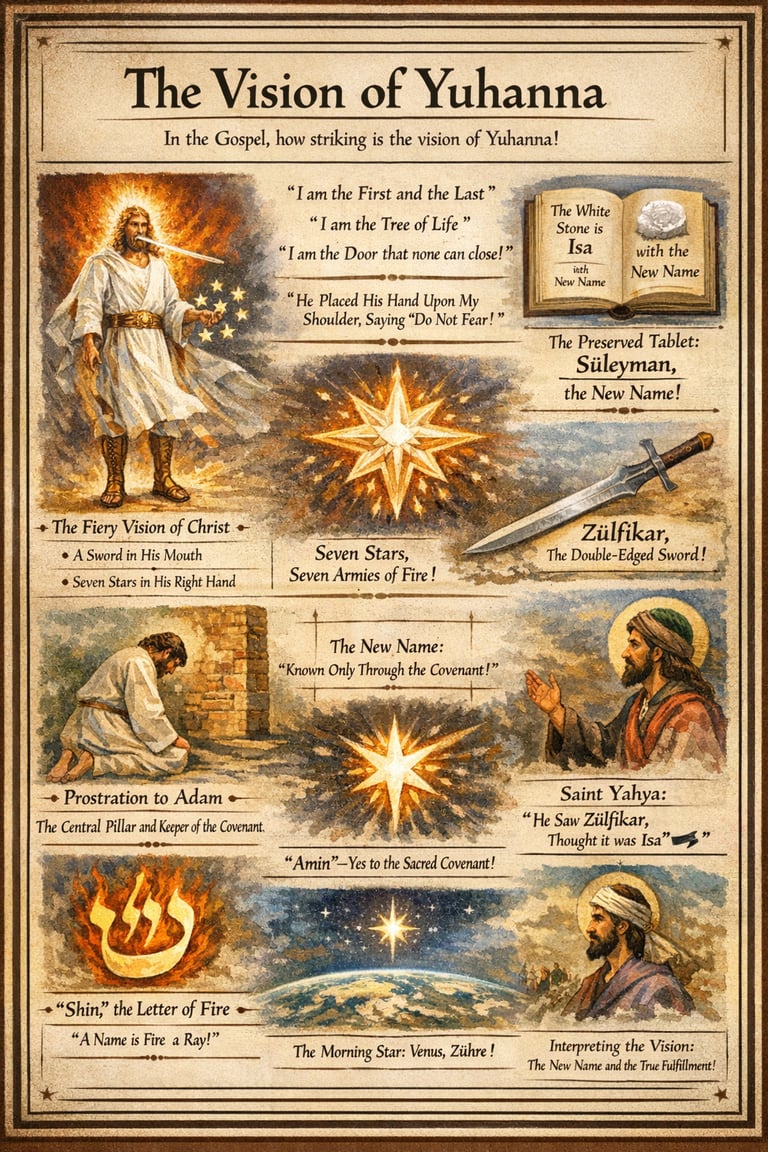
In the Gospel, how striking is the vision of Yuhanna!
He saw a “man of fire” and described him thus:
“A sword was in his mouth — a blade with a cleft edge!
Seven stars were held within his right palm!”
“His legs were like bronze fresh from the furnace!
His eyes were blazing flames, even the whites aflame!”
“His garment was transparent white, his hair like pure wool!
Around his waist a golden belt, shining like the sun!”
“When I beheld him, I fell at his feet as if dead!
It was prostration — for I remembered my RABB whom I saw!”
“He placed his hand upon my shoulder and said:
‘Do not fear! I am the First and the Last, eternal and everlasting!’
‘I am both the essence and the midwife that brings forth your essence!
Conquer me — I am the “eternal Tree of Life!”’
‘If I open the door, none can close it!
If I close it, none can open! Few know: I am the Door!’
‘I am the indispensable condition of creation!
I am the indivisible point — neither less nor more!’
‘I am Amin! Know that “Amin” means saying yes to me!
You saw me and said “You are my RABB,” being certain!
‘This is the true meaning of reciting Fâtiha!
Only the one who does this should be called “Fâtih!”’
‘Know also that I am a conqueror — I have conquered the essence of the Lord!
Seated upon my throne, I opened my eyes!
‘I too shall seat my conqueror upon my throne!
For I remain faithful to the covenant made with him!
‘Clothed in white garments, radiant and transparent,
Even the servant’s stumbling and densifying shall be forgiven!
‘The white stone — that is Îsâ — bears the new name inscribed!
Let not the oath be darkened, engraved upon the stone!
‘ALLAH knows the human only by the new name;
My essence may intercede for him through that name!
‘The name in the Preserved Tablet: Süleyman — the new name!
His body became the central pillar within the tent of the Lord!’
With Yuhanna’s leave, let this humble one unfold the word:
The central pillar is the one who keeps the covenant and opens the eye!
For the prostration to Âdem he performs the Friday prayer;
Few among the people know the day when the spirit was breathed!
Between two prayers lies the number of his cycles;
The Lord said: “Do not miss Friday — be the middle community!”
Here I leave the speech to Yuhanna;
Yet I shall still interpret “those without claws”!
“He cannot again be separated from ALLAH;
What departed was only his shadow — few know this!
‘Only he himself knows his new name;
Only by that name can he call upon me!
‘Angels and Iblis were tested through the Name!’
None could know it — they had forgotten the covenant!
There was no “thing” for angels to know the name of things;
Everything there was essence, not yet clothed in form!
He knew ALLAH, yet did not know himself;
To find the “breathed spirit” and breathe it — this is the religion of fitrah!
Since every being received spirit through its “essential name,”
The name of the RABB of the worlds must be ÂDEM!
‘A name is not a word — it is fire, a ray!
All emerge from me; therefore my name is “Shin”!
‘Seven armies of fire, seven stars in my hand!
Keep your word, and I shall place the golden belt upon my waist!
‘Then your name shall become the morning star, Zühre!
Aphrodite, and Yusuf too — you were that one! Do you understand?’
Saint Yahya interpreted the vision emotionally;
Though he saw ZÜLFİKÂR, he thought it was Îsâ.
Master M.H. Ulug Kizilkecili
Türkiye/Ankara - 23 September 2000
IMPORTANT NOTE :The original text is poetic, and the author cannot be held responsible for any errors in the English translation! To read the original Turkish text, click HERE! The following section is not the author's work, and the author cannot be held responsible for any errors made!
FOOTNOTES
[1] Apocalyptic Genre and the “Language of Vision” — The Book of Revelation reconstructs the symbolic and image-dense “vision language” of Jewish apocalyptic tradition (especially Daniel, Ezekiel, Zechariah, and 1 Enoch) within a Christian Messianic framework. In apocalyptic texts, imagery functions less as secret code and more as a theological-political rhetoric that sustains communal identity and hope during periods of crisis.
[2] The “Son of Man-like” Figure and the Danielic Connection — The exalted figure described in Revelation 1 is closely related to Daniel 7 (“one like a son of man”) and the majestic being in Daniel 10; elements such as white hair, flame imagery, metallic radiance, and heavenly authority circulate within this shared symbolic matrix.
[3] “A Sword from His Mouth” (Logos/Judgment Metaphor) — This image conveys the theme of the word’s piercing and discerning power. It resonates with prophetic traditions where judgment proceeds from the mouth (notably Isaiah 11:4; 49:2). Many commentators interpret the sword not as physical violence but as the enactment of truth and judgment through speech.
[4] The “Seven Stars” and “Seven Lampstands” (Cosmic-Ecclesial Symbolism) — Revelation 1:20 interprets the seven stars as representatives of the seven churches and the seven lampstands as the churches themselves. The number seven symbolizes completeness, linking cosmic order with communal structure through apocalyptic symbolism.
[5] “Feet Like Burnished Bronze” / Furnace Imagery — The combination of metallic brilliance and fire recalls Daniel 10 and evokes themes of purification, endurance, and judgment. In apocalyptic iconography, metal often represents unshakable authority and divine power.
[6] “Face Like the Sun” (Theophanic Radiance) — A radiant face belongs to classical theophanic language, associated with divine glory traditions found in Moses narratives and heavenly visions. The imagery emphasizes participation in divine sovereignty.
[7] The Title “First and Last” and Divine Identity — The expression echoes Isaianic monotheistic formulas (“I am the first and I am the last”) applied christologically in Revelation, reinforcing a high theological portrayal of the exalted figure.
[8] The “Door” and Authority of Access (Opening and Closing) — The statement “what I open none can shut” parallels the “key of David” motif, symbolizing legitimacy, authority, and access to salvation and governance.
[9] The Semitic Root of “Amen” and Its Theological Function — Derived from the root ʾmn, “Amen” conveys firmness, reliability, and affirmation. In Revelation, it functions as a title emphasizing trustworthy divine testimony.
[10] The “White Stone” and the “New Name” — Ancient Contexts — The white stone in Revelation 2:17 carries multiple ancient associations such as acquittal tokens, invitation markers, or athletic awards. The “new name” emphasizes transformed identity and divine recognition.
[11] The Motif of the “New Name” in Judaism–Christianity–Islam — The concept of receiving a new name signifies covenantal renewal or transformed identity across traditions. While parallels exist at the thematic level, metaphysical frameworks differ significantly.
[12] Apocalypse and Islamic Eschatological Literature — Structural similarities appear between Revelation’s cosmic judgment imagery and Islamic eschatological narratives (e.g., Dajjāl, Mahdī, Gog and Magog), though roles and textual authorities vary.
[13] Jewish Messianic Expectation and Apocalyptic Horizon — Second Temple Judaism contained diverse Messianic expectations (royal, priestly, wisdom-based, judicial). Revelation integrates this plurality into a Messiah-centered vision.
[14] Zoroastrianism: Frashokereti and Saoshyant — Zoroastrian eschatology includes themes of final renewal, resurrection, and cosmic restoration. While parallels exist with apocalyptic justice imagery, doctrinal structures differ, especially regarding dualism.
[15] Hindu Traditions: Kalki and the Restoration of Dharma — Narratives of Kalki, the final avatār of Viṣṇu, portray moral decline followed by restoration. Iconographic similarities with apocalyptic warrior imagery exist, yet cyclic time concepts contrast with Revelation’s linear eschatology.
[16] Buddhism: Maitreya and the Renewal of Teaching — The expectation of Maitreya emphasizes ethical renewal and the revival of dharma rather than catastrophic destruction, differing in tone and cosmology from apocalyptic judgment narratives.
[17] Heavenly Hosts / Stars and Cosmic Sovereignty — Stars function symbolically as markers of cosmic order and angelic authority in ancient Near Eastern and Greco-Roman thought; holding stars signifies dominion over cosmic structure.
[18] “Eyes of Fire” and Judgment-Purification — Fire imagery communicates both penetrating divine perception and purifying judgment within apocalyptic literature.
[19] The Language of Prostration and Cultural Translation — The poem renders the gesture of falling at the feet using the Islamic term “secde,” illustrating a cultural translation where a shared bodily gesture is reframed through different theological vocabulary.
[20] “Fâtih/Fâtiha” as an Islamic Hermeneutical Layer — References to Fâtiha reflect the author’s interpretive bridge rather than the original context of Revelation, highlighting the distinction between canonical text and interreligious commentary.
[21] Gog–Magog / Ye’cûc–Me’cûc Motif — The shared appearance of these figures in multiple apocalyptic traditions indicates a common motif circulating across late antique religious literature.
[22] Apokatastasis and Universal Restoration (Conceptual Affinity) — Some philosophical-religious traditions explore themes of ultimate restoration. While Revelation emphasizes judgment and new creation, conceptual parallels may exist without implying doctrinal equivalence.
[23] “Zülfikâr / Sword” Symbol Transfer — Associating the “sword from the mouth” with Zülfikâr exemplifies interreligious symbolic transfer, where imagery acquires new meanings through cultural reinterpretation.
[24] Methodological Note on Source Hierarchy — In comparative theology, identical symbols do not necessarily imply identical doctrines. Parallels here operate primarily at the level of theme or function rather than doctrinal equivalence.