THREE CONSCIOUSNESSES
THREE CONSCIOUSNESSES. One single thought of the Lord unfolds in stages three — three Adams stand! There are not three gods! But threefold consciousness within Allah’s command! “Sekine (Shekinah)!” — this is His thought concerning His Essence bright! Therefore it is Allah’s one and only sacred dhik
APOCALYPSE BOOK
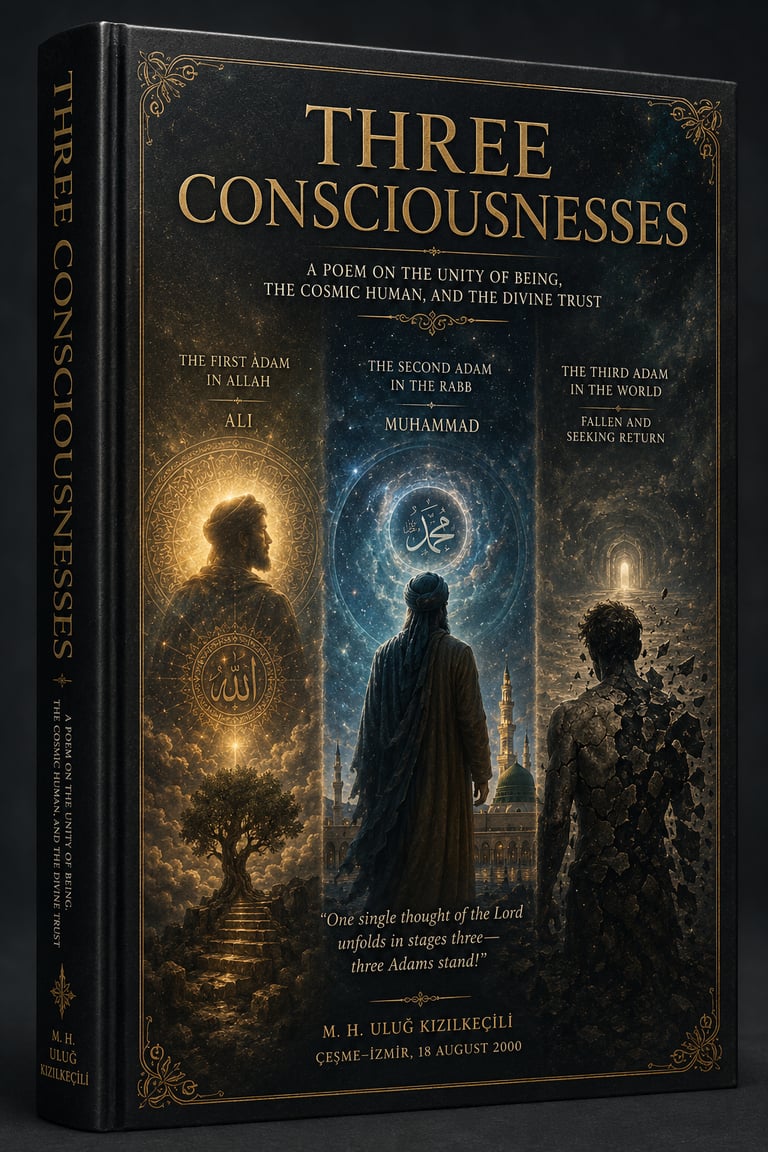
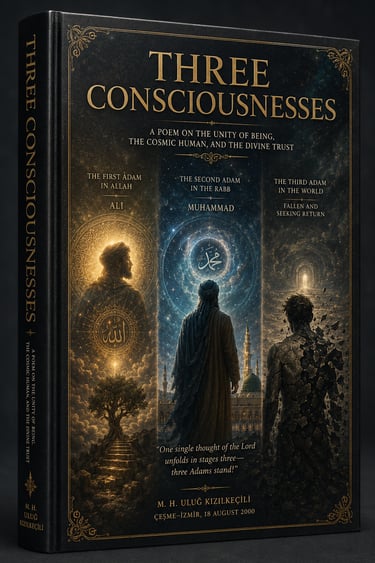
THREE CONSCIOUSNESSES
“Since it is ordained, the servant remembers Allah!”
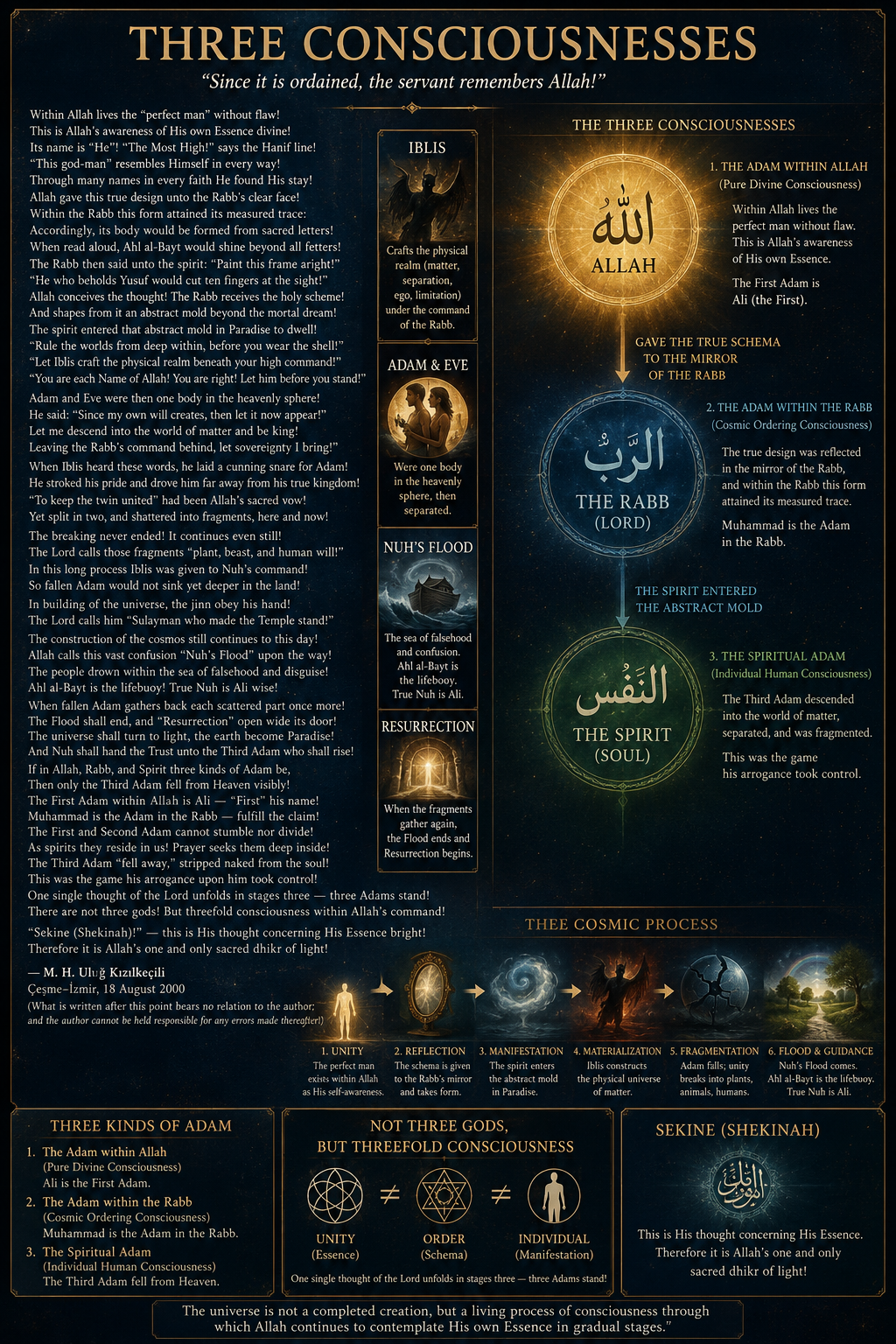
Within Allah lives the “perfect man” without flaw!
This is Allah’s awareness of His own Essence divine!
Its name is “He”! “The Most High!” says the Hanif line!
“This god-man” resembles Himself in every way!
Through many names in every faith He found His stay!
Allah gave this true design unto the Rabb’s clear face!
Within the Rabb this form attained its measured trace:
Accordingly, its body would be formed from sacred letters!
When read aloud, Ahl al-Bayt would shine beyond all fetters!
The Rabb then said unto the spirit: “Paint this frame aright!”
“He who beholds Yusuf would cut ten fingers at the sight!”
Allah conceives the thought! The Rabb receives the holy scheme!
And shapes from it an abstract mold beyond the mortal dream!
The spirit entered that abstract mold in Paradise to dwell!
“Rule the worlds from deep within, before you wear the shell!”
“Let Iblis craft the physical realm beneath your high command!”
“You are each Name of Allah! You are right! Let him before you stand!”
Adam and Eve were then one body in the heavenly sphere!
He said: “Since my own will creates, then let it now appear!
Let me descend into the world of matter and be king!
Leaving the Rabb’s command behind, let sovereignty I bring!”
When Iblis heard these words, he laid a cunning snare for Adam!
He stroked his pride and drove him far away from his true kingdom!
“To keep the twin united” had been Allah’s sacred vow!
Yet split in two, and shattered into fragments, here and now!
The breaking never ended! It continues even still!
The Lord calls those fragments “plant, beast, and human will!”
In this long process Iblis was given to Nuh’s command!
So fallen Adam would not sink yet deeper in the land!
In building of the universe, the jinn obey his hand!
The Lord calls him “Sulayman who made the Temple stand!”
The construction of the cosmos still continues to this day!
Allah calls this vast confusion “Nuh’s Flood” upon the way!
The people drown within the sea of falsehood and disguise!
Ahl al-Bayt is the lifebuoy! True Nuh is Ali wise!
When fallen Adam gathers back each scattered part once more!
The Flood shall end, and “Resurrection” open wide its door!
The universe shall turn to light, the earth become Paradise!
And Nuh shall hand the Trust unto the Third Adam who shall rise!
If in Allah, Rabb, and Spirit three kinds of Adam be,
Then only the Third Adam fell from Heaven visibly!
The First Adam within Allah is Ali — “First” his name!
Muhammad is the Adam in the Rabb — fulfill the claim!
The First and Second Adam cannot stumble nor divide!
As spirits they reside in us! Prayer seeks them deep inside!
The Third Adam “fell away,” stripped naked from the soul!
This was the game his arrogance upon him took control!
One single thought of the Lord unfolds in stages three — three Adams stand!
There are not three gods! But threefold consciousness within Allah’s command!
“Sekine (Shekinah)!” — this is His thought concerning His Essence bright!
Therefore it is Allah’s one and only sacred dhikr of light!
M. H. Uluğ Kızılkeçili
Çeşme–İzmir, 18 August 2000
(What is written after this point bears no relation to the author, and the author cannot be held responsible for any errors made thereafter!)
Academic Footnotes
[1] “The servant’s remembrance of Allah” and “the ideal human idea existing within Allah”
The poem opens by framing dhikr not merely as the servant’s remembrance of Allah, but also as the earthly echo of an “ideal human conception” eternally present within Allah. This approach closely parallels the doctrine of insān al-kāmil (the Perfect Human) in Islamic Sufism; especially in the post-Ibn al-ʿArabī tradition, the “Perfect Human” is regarded as the fullest manifestation and cosmic mirror of the Divine Names. In the Qur’an, the motif of Adam being “taught the Names” constitutes one of the principal scriptural foundations for this idea. In Jewish mysticism, the closest equivalent is the concept of Adam Kadmon: not the created human, but the “primordial/cosmic human” belonging to the pre-creational or first level of manifestation. In Christian tradition, partial analogues appear in the doctrines of the Logos and the “image of God” (imago Dei); however, the poem’s direct expression of “the human form as Allah’s consciousness of Himself” appears less in mainstream Christianity than in mystical or speculative interpretations. In Hinduism, the image of Purusha or the cosmic human fulfills a similar role as the prototype of the universe. The poem’s originality lies in conceiving this cosmic human not merely anthropologically, but directly within the category of divine self-consciousness.
[2] “This is Allah’s consciousness of Himself”
Here the poem employs theological language in a metaphysical rather than psychological sense: Allah’s knowledge of Himself becomes the prototype of both the cosmos and humanity. This may be compared to the Nous (Divine Intellect) emanating from the One in Neoplatonic thought, since in Plotinus multiplicity does not arise within the highest principle itself, but at lower ontological levels. Hermetic and certain gnostic systems likewise posit an intellectual/archetypal layer between the higher divine order and the lower cosmic order. Yet the poem diverges from many forms of gnostic dualism by not portraying the lower world as wholly the product of an evil secondary deity; instead, it speaks more in terms of deviation, fragmentation, and fall. Thus, although it carries gnostic resonances, it is not fully dualistic; it is closer to the Neoplatonic model of “descent toward lower levels” and the Sufi doctrine of gradated manifestations (tajallī).
[3] “Allah gave this true schema to the mirror of the Rabb”
The distinction the poem establishes between “Allah” and “Rabb” is closer to esoteric cosmology than to the rigid terminology of classical kalām theology. Here “Allah” functions as the absolute and transcendent principle, while “Rabb” appears as its ordering, formative, and nurturing manifestation. This structure resembles the distinction in Jewish Kabbalah between Ein Sof and the sefirot that emanate from it; it also parallels the Logos/Demiurge model of Hellenistic thought. Nevertheless, the poem’s “Rabb” is not negatively portrayed like the flawed or inferior demiurge of certain gnostic systems; rather, it serves as the legitimate mediator shaping the divine design. Accordingly, the poem’s ontology rests less upon the notion of a “defective creator” than upon the distinction between a “transcendent essence” and its manifested order.
[4] “Its body would be formed from letters / When read, its name would emerge as Ahl al-Bayt”
This couplet proposes a Hurufi/esoteric anthropology that reads the human body through writing, letters, and names. Within Islamic esotericism, there exists a powerful tradition in which the human body is viewed as the mirror of Divine Names, sacred letters, or the cosmic order. Jewish mysticism likewise attributes major importance to creation through letters and numbers, especially in Sefer Yetzirah and sefirotic speculation. Christianity does not center ontology around letters to the same extent; however, the incarnation of the “Word/Logos” preserves the metaphysical relation between being and speech. The poem’s presentation of Ahl al-Bayt as the “read meaning” of the human form strongly points toward a Shiʿi-batini interpretive horizon: not merely a historical lineage, but the deciphering of the cosmic-human schema itself.
[5] “The Rabb said to the spirit: Paint the tableau accordingly”
In this verse, the spirit functions not merely as something inserted into matter, but as the active principle entering an abstract mold and animating it. This corresponds both to Plotinus’ understanding of soul and to certain Hermetic cosmologies: form first appears at the intellectual level, and then the soul grants it life. In Hindu thought, similarly, the distinction between Purusha and Prakriti—or the manifestation of Brahman across different levels—creates a comparable ontological hierarchy. Buddhism differs in that it does not affirm a permanent metaphysical “soul”; nevertheless, the Mahayana doctrine of the Three Bodies provides a distant analogy through its multilayered relation between transcendent truth and visible manifestation. By imagining the spirit as the agent that “paints,” that is, renders the model visible, the poem elevates it from a merely created breath to a cosmic mediating force.
[6] “Allah creates the idea / The Rabb receives this idea / And produces according to it an abstract mold”
This formula very clearly implies the sequence archetype → form → body. In Neoplatonism, this corresponds to the descent from the One to Intellect, from Intellect to Soul, and from Soul to the sensible world. Gnostic systems likewise contain a rupture between the archetypal order of the higher pleroma and the shaping of the lower world; however, such systems often describe this as a tragic and defective break. In the poem, by contrast, the descent from archetype into mold initially appears legitimate; the real problem begins later with pride and the desire for autonomous sovereignty. This distinction is significant: the poem does not portray embodiment itself as sin, but as a process that becomes a fall only when united with wrongful intention.
[7] “Govern the world from within / Without clothing yourself in flesh”
This expression conveys the idea of inward governance without full material incarnation into the visible world. In Sufi cosmology, the figures of the qutb (pole), ghawth, or insān al-kāmil sometimes fulfill precisely this kind of “inner administration.” In Judaism, the Shekhinah; in Christianity, the Holy Spirit; and in Buddhism, the transcendent bodies beyond the nirmāṇakāya, all express the possibility of divine or enlightened reality being present in the world without being reducible to it. The model proposed here is therefore one of “penetration and governance” rather than literal embodiment; accordingly, it is closer to mystical and cosmic supervision than to the singular incarnation of Jesus in Christianity.
[8] “Let Iblis construct the physical world under your command”
This verse establishes a more speculative cosmology than conventional Islamic narrative. In mainstream Islam, Iblis is the rebellious being, not a cosmic official entrusted with constructing the physical universe. Yet within the poem, Iblis appears not as absolute evil, but rather as the intermediary of the lower, physical, and testing realm. At this point, parallels emerge with certain gnostic and Hermetic figures of the lower creator or shaper of the material world; however, the poem does not elevate him into an independent counter-god. In Neoplatonism, evil is not an independent principle but a lower-level deficiency; the poem’s Iblis likewise resembles an agent of deviation rather than an ontological rival to the Divine.
[9] “Adam and Eve were one body”
This couplet conceives the human pair as originally united and only later separated. In Jewish and Christian sources, Adam and Eve are generally created sequentially; however, mystical and esoteric traditions occasionally present the primordial human as androgynous or as a divided unity. In Hinduism, Purusha and certain cosmic-human narratives likewise describe sexual differentiation as a later development. In Zoroastrianism, Gayōmart functions as a primordial human/cosmic figure, sometimes representing the prototypical state preceding differentiated humanity. The poem’s language of “one body” therefore favors an esoteric anthropology of primordial wholeness later divided into polarities, rather than a merely historical narrative of a couple.
[10] “Leaving the Rabb’s command, let me become a sovereign” and the motif of the Fall
Here sin is not simply the eating of forbidden fruit; at a deeper level, it is the demand for autonomy—the desire to detach existence from its source and rule independently. This parallels Christianity’s interpretation of the Fall as pride and disobedience, Sufism’s critique of the illusion of independent selfhood, and Neoplatonism’s description of the soul turning toward lower realities. Gnostic narratives likewise contain themes of desire for knowledge, transgression of limits, and rupture from the pleroma. The poem transforms the classical Adam narrative from a merely moral-psychological account into an ontological separation: the Fall is first a corruption of consciousness before it becomes a change of place.
[11] “It split in two and eventually shattered / Into plant, animal, and human”
This constitutes one of the poem’s most original and heavily esoteric propositions: humanity in its current condition is understood as the fragmented manifestations of a single cosmic human. Strong parallels may be found in the Hindu cosmology of Purusha dispersed throughout the universe. In Zoroastrianism, the death of the primordial human Gayōmart likewise produces cosmic consequences, including the emergence of humanity and later eschatological renewal. Kabbalistic themes of cosmic shattering and restoration may also be evoked here. The poem is not describing biological evolution; rather, it expresses ontological fragmentation through the levels of “plant, animal, and human.” This may also be related to the Sufi movement from primordial unity (jamʿ) into multiplicity (farq) and the eventual return to unity.
[12] “Iblis was given under the command of Nuh / The construction of the universe still continues / Allah calls this confusion ‘Nuh’s Flood’”
Here the story of Noah becomes not merely a historical flood narrative, but the symbol of an ongoing cosmic process of purification and selection. In Islamic and Biblical tradition, the Flood signifies divine judgment and salvation; in Hinduism, the flood of Manu serves to preserve humanity and inaugurate a new beginning. In the poem, however, the flood is less external water than the “sea of falsehood” in the world itself—that is, an ontological and epistemological chaos. The Ark thus becomes the esoteric line preserving truth. The equation Ahl al-Bayt = lifebuoy clearly intensifies the Shiʿi interpretive horizon: salvation is not merely ethical, but dependent upon attachment to the correct ontological bond.
[13] “Ahl al-Bayt is the lifebuoy! True Nuh is Ali!”
This line reinterprets historical prophethood on a symbolic and walāya-centered level. In mainstream Sunni exegesis, no such direct identification is established between Nuh and Ali; however, in Shiʿi and batini traditions, prophetic narratives are often reread through the axes of imamate, walāya, and luminosity. Here Nuh becomes more than a historical figure: he turns into a salvific principle; Ali, in turn, becomes the esoteric bearer of that principle. In Judaism and Christianity, Nuh is the righteous prototype of salvation; the poem, however, transforms the carrier of salvation from an abstract ark into living walāya. This is one of the clearest points revealing the poem’s intra-Islamic sectarian-mystical orientation.
[14] “Since there are three kinds of Adam / Only the third Adam descended from Paradise”
This section presents the central ontological schema of the poem: three Adams, one in Allah, one in the Rabb, and one at the level of Spirit/body. This is not the standard doctrine of any classical religious system; nevertheless, parallels to a tripartite ontology exist in many traditions. The trikāya doctrine in Mahayana Buddhism; the One–Intellect–Soul sequence in Neoplatonism; in Christianity, not the Trinity itself, but the relationship established between the transcendent Logos, the heavenly Christ, and historical embodiment; and in Jewish mysticism, the layers of Ein Sof–sefirot–cosmic human may all be seen as distant parallels to this poem. Yet the poem states, “There are not three gods, but three kinds of consciousness,” thereby explaining plurality not at the level of essence, but at the level of manifestation. This is an attempt to read the triad not as polytheistic, but as degrees of consciousness.
[15] “The first Adam in Allah is Ali / Muhammad is the Adam in the Rabb”
Here the poem strongly interweaves the classical themes of the Muhammadan Light and walāya. In Sufism, the Prophet Muhammad is often understood as the first light of creation, the most complete example of the Perfect Human, and the most perfect manifestation of the Divine Names. The poem’s distinctive additional emphasis is to mark primacy through Ali, and the ordering-rabbanic manifestation through Muhammad. This stands especially close to certain Shiʿi-irfani readings. A weak analogy may be drawn with the Christian distinction between the heavenly Christ and the historical Jesus; however, the poem’s system functions much more within the framework of luminous imamate and batini walāya.
[16] “The first and second Adam… As spirits they are within us! To find them is prayer!”
Here worship acquires the meaning of ontological remembrance and inner encounter rather than merely legal obligation. Dhikr and prayer become the rediscovery within oneself of the lost higher human. This is compatible with Sufism’s understanding of dhikr as “turning toward spiritual perfection by repeating the Names of Allah.” In Jewish mysticism, prayer and kavvanah play a role in repairing the cosmic order; in Lurianic Kabbalah, human worship participates in cosmic restoration. The poem likewise interprets prayer not merely as ritual, but as the practice of finding the two higher Adams within, thereby assigning it a similar cosmic-anthropological function.
[17] “‘Sekine (Shekinah)!’ It is Allah’s idea concerning the Essence”
The finale of the poem interprets “Sekine (Shekinah)” not merely as tranquility, but directly as divine self-consciousness and self-contemplation. In the Qur’an, sakīna appears as divine peace, assurance, and steadfastness sent down into the hearts of believers. In Jewish tradition, the Shekhinah is the indwelling or manifest presence of God in the world. Because of their etymological and conceptual proximity, scholars have sometimes established a relationship between the two terms; however, they are not identical concepts. The poem carries this association further and turns “Sekine (Shekinah)” almost into the name of Allah’s thought concerning His own Essence. This interpretation goes beyond Qur’anic usage and belongs more to the field of mystical taʾwīl. From an academic perspective, this shows that the text is not doing exegesis in the strict sense, but rather an irfani-ontological rewriting.
Brief Concluding Evaluation
This poem should not be read as mainstream exegesis, but as a powerful esoteric composition that combines Shiʿi-irfani, Sufi, Hurufi, and cosmic-anthropological elements. Its closest relatives are:
• in Islam: the doctrines of the Perfect Human, walāya, Divine Names, and dhikr,
• in Jewish mysticism: Adam Kadmon, Shekhinah, and the sefirot,
• in Christian mysticism: Logos, the heavenly human, the Fall, and restoration,
• in Hinduism: Purusha and Manu,
• in Zoroastrianism: Gayōmart,
• in philosophy: Neoplatonic emanation,
• and, at the borders, Hermetic and partially gnostic cosmology.
DEEP ESOTERIC COMMENTARY ON THE TEXT “THREE CONSCIOUSNESSES”
INTRODUCTION
The Ontological Character of the Text
“THREE CONSCIOUSNESSES” is not a poem in the classical sense. It is a metaphysical cosmology written in poetic form. Its language is symbolic; yet this symbolism is used not merely aesthetically, but in order to construct an ontological system. For this reason, the work stands at the intersection of Sufi poetry, batini taʾwīl, Hurufi anthropology, Shiʿi-irfani thought of walāya, Neoplatonic metaphysics of emanation, and the doctrine of the cosmic human.
Concepts such as “Allah,” “Rabb,” “Spirit,” “Adam,” “Iblis,” “Nuh,” “Ahl al-Bayt,” and “Sekine (Shekinah)” in the text are not merely historical-religious figures; they are metaphysical symbols representing layers of consciousness, ontological levels, and cosmic processes. Therefore, the text cannot be read literally; otherwise, from the standpoint of classical creed, the poem may appear heterodox. Yet the language of the text is not dogmatic, but irfani.
The fundamental thesis here is this:
The universe is the gradual manifestation of Allah’s becoming conscious of His own Essence.
This thought is directly connected to the line of wahdat al-wujūd. Yet the originality of the poem lies in explaining this understanding of unity through a three-layered system of consciousness:
consciousness in Allah
consciousness in the Rabb
spiritual-human consciousness
This tripartite structure shows striking similarities to the Neoplatonic sequence of One–Nous–Soul, the Kabbalistic schema of Ein Sof–Sefirot–Adam Kadmon, the Hindu relationship of Brahman–Ishvara–Atman, and the trikāya doctrine of Mahayana Buddhism.
I. “SINCE IT IS OBLIGATORY, THE SERVANT’S REMEMBRANCE OF ALLAH”
Dhikr and Cosmic Memory
The poem treats dhikr not merely as an act of worship, but as an ontological mechanism of return. In Sufism, dhikr is “the re-remembering of the forgotten Origin.” In this respect, dhikr is not psychological but ontological memory.
In Plato’s doctrine of anamnesis, the soul had seen truth before coming into the world; learning is, in fact, remembering. The understanding of dhikr in the poem closely resembles this metaphysical memory.
According to Ibn al-ʿArabī, the essence of the human being is the mirror of the Divine Names. As the servant performs dhikr, he does not merely remember Allah; he also serves as a means through which Allah makes His own Names visible within him. Thus dhikr is two-directional:
• the servant remembers Allah,
• Allah also makes His own Names visible in the servant.
The phrase “since it is obligatory” in the poem is very important. For here dhikr is not a moral choice, but an existential necessity. The human being cannot live disconnected from Allah, because his essence is already the fragmented manifestation of His consciousness.
This thought is extremely close to the Atman–Brahman relationship in Hindu Vedanta. The Upanishadic expression “Tat Tvam Asi” — “Thou art That” — runs parallel to the poem’s understanding of inner divine consciousness.
II. “THE IDEA OF THE IDEAL HUMAN HAS ALWAYS EXISTED WITHIN ALLAH”
The Doctrine of the Cosmic Human
This couplet is the center of the text.
The “ideal human” is not the ordinary human being; it is the pre-creational archetypal model of humanity. This idea exists in nearly all major mystical traditions.
1. Adam Kadmon
In Jewish mysticism, Adam Kadmon is not the first created human, but the first manifestation of God. He is the prototype of the universe. The sefirot are his body.
The poem’s expression “Allah’s consciousness of Himself” directly resembles the doctrine of Adam Kadmon.
2. Logos
In Christian mysticism, the Logos is the pre-creational divine intellect. In the Gospel it is said:
“In the beginning was the Word.”
This Word is not merely speech, but the intellectual archetype of cosmic order.
3. Purusha
In the Rig Veda, Purusha is the divine cosmic human. The universe is formed through the dismemberment of his body.
The poem’s statement:
“Fragmentation has not ended!”
shows an extraordinary parallel with the cosmic dispersion of Purusha.
4. The Perfect Human
In Sufism, the human being is the mirror of Allah. The Perfect Human is the fully polished state of this mirror.
In the poem, the “ideal human” is not merely an exemplary human being; it is presented as the formed model of Allah’s self-consciousness.
III. “THIS IS ALLAH’S CONSCIOUSNESS OF HIMSELF”
The Problem of Divine Self-Consciousness
This couplet is extraordinarily metaphysical.
Here God is conceived not only as the Knower, but as the Being who knows Himself.
This thought may be related to:
• Hegel’s “Absolute Spirit,”
• Plotinus’ Nous,
• Ibn al-ʿArabī’s “Lord contemplating Himself,”
• Meister Eckhart’s doctrine of “God giving birth to God.”
In the famous sacred hadith in Sufism, it is said:
“I was a hidden treasure; I desired to be known.”
The entire cosmology of the poem is like a poetic unfolding of this sentence.
The universe is Allah’s process of contemplating His own Essence.
IV. “ALLAH GAVE THIS TRUE SCHEMA TO THE MIRROR OF THE RABB”
The Metaphysics of Mirrors
In Sufism, the world is a mirror.
Allah contemplates Himself in created beings.
Yet the poem makes a very important distinction:
• Allah = the absolute essence
• Rabb = the formative manifestation
This distinction is very close to the Neoplatonic system of emanation.
In Plotinus:
The One → Nous → Soul → Matter
In the poem:
Allah → Rabb → Spirit → Physical Universe
This structure also resembles the Kabbalistic sequence:
Ein Sof → Sefirot → Adam Kadmon
Here, the “mirror of the Rabb” is the ordering field of consciousness of the divine essence.
V. “ITS BODY WOULD BE FORMED FROM LETTERS”
Hurufi Cosmology
This couplet is openly Hurufi.
In Hurufism, the human body is sacred writing.
The face is composed of letters.
The universe is a readable text.
In the esoteric interpretation of the Qur’anic verse:
“We shall show them Our signs both upon the horizons and within themselves,”
the human body is the totality of signs.
When the poem says:
“When read, its name would emerge as Ahl al-Bayt,”
it implies that the truth of the human being is centered upon walāya.
Here Ahl al-Bayt is not merely a historical family; it is a cosmic system of consciousness.
VI. “LET IBLIS CONSTRUCT THE PHYSICAL WORLD UNDER YOUR COMMAND”
The Esoteric Role of Iblis
This is one of the poem’s most unusual sections.
Here Iblis is not absolute evil.
He becomes the principle of:
• condensation,
• materialization,
• separation,
• limitation,
• ego,
• individuation.
This idea appears in many esoteric systems.
Gnosticism
The Demiurge constructs the material universe.
Kabbalah
The Qliphot constitute the realm of separation.
Hinduism
Maya veils truth.
Sufism
The nafs becomes the veil.
In the poem, Iblis appears as a differentiating consciousness serving creation itself.
For this reason, the poem’s Iblis is less satanic than cosmically functional.
VII. “ADAM AND EVE WERE ONE BODY”
The Androgynous Primordial Human
The idea that the primordial human was not a pair, but a single being, appears in many esoteric traditions.
Plato – Symposium
Humanity was originally a spherical unity.
Kabbalah
Adam Kadmon is androgynous.
Hindu Tantra
Shiva and Shakti are united before separation.
Alchemy
The Rebis = the complete bisexual human.
In the poem, the separation of Adam and Eve marks the beginning of metaphysical fragmentation.
This division is not merely sexual; it is the beginning of the separation between:
• subject and object,
• spirit and matter,
• self and other,
• human and God.
VIII. “LET ME LEAVE THE RABB’S COMMAND AND BECOME A SOVEREIGN”
The Birth of the Ego
The Fall here is not sin in the classical sense.
The real issue is:
the desire for independent existence.
In Sufism, this is called the ene (“I-ness”).
According to Ibn al-ʿArabi, the greatest veil is the human being imagining himself independent.
In the poem, Adam’s Fall is a rupture of consciousness.
At this point, the text may even be connected to the formation of the ego in modern psychology.
According to Jung, individuation is necessary yet dangerous; if the center is forgotten, fragmentation begins.
This is precisely what the poem describes.
IX. “FRAGMENTATION HAS NOT ENDED”
Cosmic Dissolution
This line is one of the deepest metaphysical centers of the poem.
The universe is not completed; it is still dissolving.
Modern cosmology contains the idea of entropy.
In esoteric traditions, however, this is interpreted as “distancing from primordial unity.”
In the poem:
• plant,
• animal,
• human
are not biological stages, but levels of conscious fragmentation.
This resembles the Sufi movement of:
jamʿ → farq → jamʿ al-jamʿ
(unity → separation → reunion within unity).
X. “NUH’S FLOOD”
The Inner Interpretation of the Flood
The Flood here is not historical.
It is interpreted as:
• informational chaos,
• false reality,
• pollution of consciousness,
• ontological dissolution.
Modern media, ideology, and the production of artificial identities may, in this sense, be read as the “sea of fabrication.”
In the poem, Ahl al-Bayt is the “lifebuoy.”
That is, salvation means reconnecting to the center of truth.
XI. “THREE KINDS OF ADAM”
Tripartite Ontology
This section contains the central doctrine of the poem.
1. The Adam within Allah
Pure divine consciousness.
2. The Adam within the Rabb
The model of cosmic order.
3. The Spiritual Adam
The fallen human being.
This structure appears in many traditions.
Tradition
Tripartite Structure
Neoplatonism
The One – Nous – Soul
Christian Mysticism
Father – Logos – Incarnation
Buddhism
Dharmakaya – Sambhogakaya – Nirmanakaya
Kabbalah
Ein Sof – Adam Kadmon – World
Sufism
Essence – Attribute – Act
The originality of the poem lies in reconstructing these through a Shiʿi-irfani language.
XII. “THERE ARE NOT THREE GODS!”
Theological Defense
Here the poet attempts to prevent a possible misunderstanding.
For the tripartite structure is not polytheism.
They are levels of consciousness.
In this respect, the poem is:
• not a Trinity,
• not dualism,
• not polytheism.
It is a doctrine of multilayered unity.
XIII. “SEKINE (SHEKINAH)”
Its Relation to Shekhinah
In the Qur’an, Sekine (Shekinah) signifies divine tranquility.
It bears a striking resemblance to the Shekhinah in Jewish mysticism.
The Shekhinah is understood as:
• God’s indwelling within the world,
• His manifest presence,
• His immanent light.
In the poem, Sekine (Shekinah) is defined as:
Allah’s idea concerning His Essence.
This is an extraordinarily advanced metaphysical interpretation.
Here Sekine (Shekinah) ceases to be merely an emotion;
it becomes cosmic self-consciousness.
XIV. THE GNOSTIC ASPECTS OF THE TEXT
The text is partially gnostic, yet not fully dualistic.
Because:
• matter is not absolutely evil,
• Iblis is not an independent god,
• the universe is not entirely false.
The real problem is:
separation from the center and fragmentation.
Therefore, although the text carries gnostic resonances, it remains centered upon unity.
XV. THE SUFI ASPECTS OF THE TEXT
The main current of the poem is clearly Sufism.
Especially evident are the doctrines of:
• wahdat al-wujūd,
• the Perfect Human,
• manifestation (tajallī),
• Divine Names,
• dhikr,
• the inward/esoteric (bātin),
• walāya.
Yet the poem goes beyond classical Sufism by constructing a:
• Hurufi,
• Shiʿi-irfani,
• cosmic-anthropological
framework.
XVI. A MODERN PHILOSOPHICAL READING
The text may also be read through modern philosophy of consciousness.
The “three consciousnesses” may be interpreted as:
• pure consciousness,
• ordering consciousness,
• individual consciousness.
Jung’s collective unconscious,
Hegel’s Absolute Spirit,
Teilhard de Chardin’s Omega Point,
and Whitehead’s process metaphysics
may all be related to certain layers of the poem.
XVII. CONCLUSION
“THREE CONSCIOUSNESSES” is an extraordinarily dense esoteric cosmology written in contemporary Turkish.
The text poetically reconstructs the multilayered network of relations between:
• Shiʿi-irfani walāya,
• Sufism,
• Hurufism,
• Neoplatonism,
• Kabbalah,
• Hindu metaphysics,
• Hermetic thought,
• and the doctrine of the cosmic human.
The poem’s central message is this:
The human being is fragmented divine consciousness.
And salvation consists in rediscovering the higher Adam within.
For this reason, prayer, dhikr, walāya, and Sekine (Shekinah) are not merely juridical rituals, but the reopening of cosmic memory.
The text’s most important metaphysical proposition is this:
The universe is not a completed creation, but a living process of consciousness through which Allah continues to contemplate His own Essence in gradual stages.