TRUST–1 (The Divine Trust-Core)
TRUST–1 (The Divine Trust-Core).The Messenger says: “Nothing greater than the spirit was created.” Into Hell, nothing blinder than Iblis was cast. Only the Throne withstands the quake of the “first spirit”; It was not in vain that Muhammad and Ali were made to be sought.
APOCALYPSE BOOK
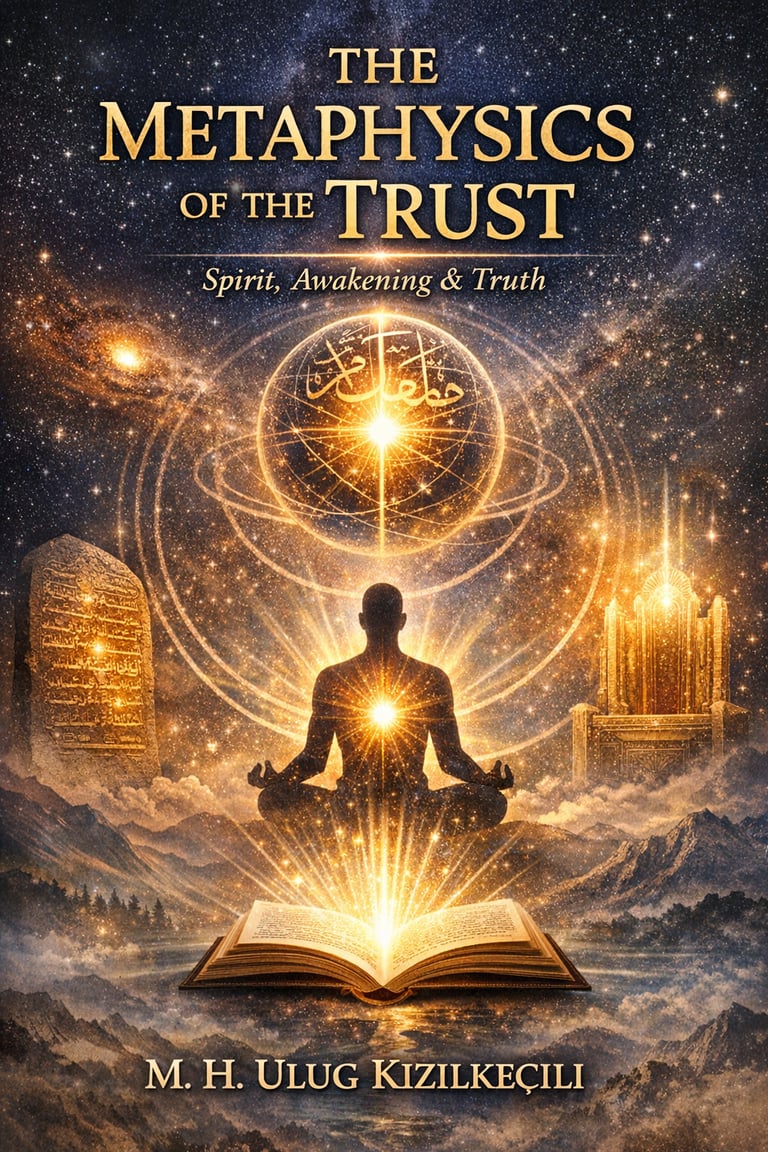
TRUST–1
These messages my soul whispers, syllable by syllable,
Between the hours of twenty-four and four in the night.
The command “Sleep little” means: keep your receiver open;
Everyone here bears a mission, to a certain degree.
Are we not the children of the One “to whom prostration is made”?
Is not his name “the vicegerent of Rahman”?
“The spirit breathed into Adam”—then it exists within us as well;
Our honor has no other foundation than this.
“When Allah offered the Trust to the earth and the heavens,
‘If we cannot fulfill its due, You would curse us.’”
Thus they refused the breathing of the spirit;
For to possess the spirit yet not bring it forth is betrayal.
Whoever brings the spirit outward becomes a knower of the self;
From dying again and again, he keeps his Life (body) safe.
If you cannot make from your soil a mirror for yourself,
Into your filthy mud is reflected the tyrant called Iblis.
The Lord says: “I gave revelation to the earth, the heavens, and the bee;
Every atom is an address for the warning from its essence.”
Yet the Lord of all of them, in the name of the Lord, is Adam;
For they could not bring the spirit outward.
The Messenger says: “Nothing greater than the spirit was created.”
Into Hell, nothing blinder than Iblis was cast.
Only the Throne withstands the quake of the “first spirit”;
It was not in vain that Muhammad and Ali were made to be sought.
Allah says: “Never betray the Trust.”
That Trust is the spirit; the rest is but a sack of flesh.
If you betray the Trust here,
There, they will make you pay a heavy recompense.
The spirit is the single ray in your heart from Muhammad and Ali;
If you do not suffice with its voice, your peace will be with the Lord.
This is the intercession from it—do not hope for another;
With the “witness” called the spirit is your arrival to the Lord.
Though you are the spouse of Pharaoh, give your heart to your Joseph;
The Lord loves the lover of the one He loves.
While “closer to you than yourself” lies within your heart,
Lift its veil and enter into its embrace.
Master M.H. Ulug Kizilkecili
Türkiye/Ankara - 1996
IMPORTANT NOTE :The original text is poetic, and the author cannot be held responsible for any errors in the English translation! To read the original Turkish text, click HERE! The following section is not the author's work, and the author cannot be held responsible for any errors made!
Extended Comparative Footnotes (Expanded Version)
[1] The “Whispering” of the Spirit and the Source of Knowledge (Levh-i Mahfûz / Central Frequency)
In the poem, the speaking of the spirit is not merely a psychological inner voice; rather, it represents a flow of knowledge-manifestation emerging from a deeper ontological layer of being. In Islamic metaphysics, Levh-i Mahfûz (the Preserved Tablet) is understood as the cosmic level in which the entire order of existence is fixed within divine knowledge. In this text, the expression “central frequency” may be interpreted as the resonance point where this divine order finds correspondence within human consciousness. In Sufism, this state is described as inspiration (ilham) or unveiling (kashf); however, it is not equivalent to revelation.
Comparatively: In Hinduism, this corresponds to the alignment between individual consciousness (ātman) and cosmic consciousness (Brahman); in Taoism, it resembles attunement to the flow of the Tao; in Sikhism, it parallels union with the Shabad (divine vibration/word). In Buddhism, however, rather than a “cosmic record,” emphasis is placed on direct awareness and perceiving reality as it is.
[2] The Night Hours (24:00–04:00) and “Uninterrupted Knowledge”
Night, in esoteric traditions, signifies not merely a time frame but a reduction of external noise and a lowering of interference. In the poem, this interval is presented as a threshold where the veil between the spirit and the essence becomes thinner. In Islam, the tahajjud hours are regarded as the time when the heart approaches its purest state.
This perspective parallels the “night vigil” (vigil) in Christian mysticism, the clarity of mind sought in Hindu and Buddhist meditative disciplines, and the depth of the yin phase in Taoism.
However, a key distinction here is that the text frames knowledge as “data received from a higher frequency,” thereby constructing a cosmological-energetic epistemology that extends beyond classical religious language.
[3] “Sleep Little” and Heedlessness – The Concept of Ontological Betrayal
The phrase “sleep little” is not merely biological but ontological in meaning. Here, “sleep” refers to the passivation of the spirit and the reduction of human existence to a purely bodily or automatic mode of living. In the poem, excessive sleep is interpreted as betrayal of the Trust, because when the spirit is not actively brought forth, it remains only in potential.
In Islamic Sufism, this is expressed through the concept of heedlessness (ghaflah). In Christianity, a similar notion appears as “spiritual sloth”; in Buddhism, as avidyā (ignorance); and in Hinduism, as tamas (inertia).
The shared principle across traditions is that failing to actualize one’s potential consciousness is regarded as a form of existential decline.
[4] Action and Truth: The Manifestation of the Spirit
The statement in the text—“a human possessing the spirit reaches truth through actions”—defines knowledge not as theoretical, but as an existential process. Truth is not uncovered through thought alone, but through lived realization.
In Sufism, this is articulated through the درجات of ilm al-yaqīn (knowledge of certainty), ayn al-yaqīn (vision of certainty), and haqq al-yaqīn (truth of certainty).
In Hinduism, this unfolds through karma and yogic disciplines; in Buddhism, through the Noble Eightfold Path; and in Sikhism, through righteous action and remembrance of the Divine Name.
Thus, the text aligns with these traditions in positioning truth as something realized through action, not merely contemplated.
Extended Comparative Footnotes (Continued)
[5] Contact Between the Spirit and the Essence, and Inner Resonance
The expression “contact between the spirit and the essence” points to the multilayered structure of the human being: body, mind, النفس (nafs), and spirit. This moment of contact occurs when the lower layers become still and the higher layer becomes active.
From an esoteric perspective, this may be interpreted as frequency alignment. In Sufism, it corresponds to the polishing of the heart; in Taoism, to returning to the natural flow; in Hinduism, to withdrawing into the true self through meditation.
Buddhism diverges here: the “essence” is not a fixed entity, but an illusion to be dissolved.
[6] The Theological Interpretation of the “Central Frequency”
The concept of “central frequency” does not explicitly exist in classical theology; however, conceptually it may be associated with the world of command (ʿālam al-amr) and the divine order. It can be understood as the fundamental vibration or organizing principle of existence.
In Sikhism, this appears explicitly as Nādam / Shabad; in Hinduism, as the vibration of Om; in Taoism, as the flow of the Tao.
In Islam, such notions remain symbolic and are more often expressed through concepts such as command (amr), word (kalima), and the order of destiny.
[7] The Source of Knowledge: External Learning vs. Inner Remembrance
This text interprets knowledge not as something acquired from outside, but as the unveiling of what already exists within. This approach parallels Platonic anamnesis (recollection), the Sufi understanding of maʿrifa (gnosis), and the knowledge of ātman in Hinduism.
In Buddhism, however, knowledge is not the recollection of an inner essence, but the dissolution of illusions through direct experience.
[8] Esoteric Conclusion: The Human as a Cosmic Antenna
The central idea emerging from these notes is this: the human being is not merely a biological entity, but a receiver–transmitter system open to cosmic knowledge.
The phrase “keep your receiver open” in the poem is therefore not a technical metaphor, but an expression of a metaphysical reality.
While in modern language this may be described as a “field of consciousness” or “cosmic consciousness,” classical traditions express it through concepts such as the heart, spirit, and inner secret (sirr).
The Esoteric Interpretation of the Trust and Betrayal (Unity of Spirit–Essence and Awakening to Truth)
In the text, defining the “Trust” as the spirit transcends classical exoteric interpretations and directly identifies the Trust with the ontological core of the human being. Within this framework, the Trust is not an external obligation, but the divine potential, capacity of consciousness, and ability to perceive truth that the human carries within.
“Not betraying the Trust” therefore means not leaving this spirit passive; rather, it implies the conscious unification of the spirit with the essence. Here, the “essence” may be understood as the deepest layer of human existence, while the spirit represents the dynamic dimension of this essence that opens into awareness. Their union constitutes, in esoteric language, a state of awakening.
This awakening is not merely cognitive but existential. In this process, the human does not simply learn the truth—he becomes the truth.
In Sufi terminology, this is expressed through the purification of the heart, the manifestation of the spirit, and ultimately the attainment of the درجات of certainty: ilm al-yaqīn (knowledge of certainty), ayn al-yaqīn (vision of certainty), and haqq al-yaqīn (truth of certainty).
Comparatively:
In Hinduism, this union is interpreted as the realization of ātman and Brahman—the unity of the individual essence and the absolute reality.
In Sikhism, truth is attained when the human essence aligns with the Divine Name (Naam), which may be read as harmony between spirit and essence.
In Taoism, one returns to one’s “essence” by abandoning artificial identity and aligning with the Tao.
In Buddhism, since no fixed essence is accepted, the process is not union with an essence but the dissolution of the illusion of self and the emergence of pure awareness.
In Christian mysticism, this state is expressed as the alignment (communion) of human will with the will of God.
In this context, the central assertion of the text is:
When a human betrays the Trust, he does not lose something external—he loses his own truth.
Faithfulness to the Trust, on the other hand, means awakening to truth and living it through the union of spirit and essence.
THE METAPHYSICS OF THE TRUST
1. Ontological Foundation: Trust = Spirit
The fundamental proposition of this model is:
The Trust is the spirit possessed by the human being.
While in classical exoteric interpretation the Trust is explained as responsibility, intellect, will, or divine obligation, in this system the Trust is directly reduced to the ontological core of the human being. In other words, the Trust is not a burden given to the human from outside; it is the human himself.
Within this context, the spirit is:
• Open to the divine source,
• Capable of accessing knowledge,
• Able to realize truth
as a core of consciousness.
Therefore, human existence is not about carrying the Trust, but about living as the Trust itself.
2. Epistemological Model: Central Frequency and Flow of Knowledge
When the concepts of Levh-i Mahfûz and “central frequency” are read together, the following model emerges:
Knowledge of truth is not learned externally; it is received from within.
This knowledge is:
• Not a mental production,
• But a spiritual reception,
• Realized through frequency alignment (resonance).
The concept of “central frequency” corresponds in classical language to:
• The “world of command,”
• The “divine order,”
• The “cosmic field of knowledge.”
In this system, the human is a receiver.
However, for this receiver to function, two conditions are required:
The cessation of noise (reduction of mental and worldly interference)
Frequency alignment (alignment of spirit and essence)
3. Esoteric Interpretation of Time: Night and the Pure Field of Reception
The interval “24:00–04:00” in this system is not biological, but ontological time.
Night is the threshold where:
• The external world becomes silent,
• Mental noise diminishes,
• The spirit becomes active.
Therefore, night is the time in which reception of knowledge from the highest frequency with minimal interference becomes possible.
This understanding parallels:
• Tahajjud in Sufism,
• Vigil in Christianity,
• Deep meditation in Hindu-Buddhist practices.
4. Ethical Principle: Betrayal = Deactivation of the Spirit
In this system, betrayal is not merely a moral offense in the classical sense.
Betrayal of the Trust = deactivating the spirit.
This occurs in the following states:
• Excessive sleep (heedlessness)
• Inaction
• Knowing the truth but not living it
• Reducing consciousness to the bodily level
Thus, betrayal is an existential fall.
5. The Principle of “Sleep Little”: Overcoming Heedlessness
The expression “sleep little” in this system means:
Sleep = closure of consciousness
Wakefulness = activation of the spirit
Therefore, excessive sleep is:
• Not only physical,
• But a metaphysical regression.
Parallels of this approach:
• Heedlessness in Sufism
• Avidyā in Buddhism
• Tamas in Hinduism
• Spiritual sloth in Christianity
All point to the same reality:
The failure to actualize potential.
6. Unity of Spirit–Essence: The Mechanism of Awakening
At the center of the model lies the equation:
Faithfulness to the Trust = Union of Spirit + Essence
Here:
• Spirit = point of divine connection
• Essence = the purest core of being
When these unite:
• Knowledge is revealed
• Truth is experienced
• The human is transformed
This process is not about knowing, but about becoming.
7. Ontology of Action: Truth Is Lived
In this model, truth:
❌ Is not merely thought
❌ Is not only known
✔ Is lived
The spirit manifests through action.
Therefore:
Action = the visible form of the spirit
Comparatively:
• Sufism: action (ʿamal) + state (ḥāl)
• Hinduism: karma yoga
• Buddhism: the Eightfold Path
• Sikhism: service + Divine Name
All converge on the same point:
Truth is realized through practice.
8. Interpretation of the Day of Judgment: Inner Unveiling
The expression “to come with it on the Day of Judgment” in this system means:
❌ Not merely an external gathering
✔ But the unveiling of inner records
The human confronts:
• Not only what he has done,
• But what he has become
In modern language: “the unveiling of consciousness records”
In classical language: “the book of deeds.”
9. The Cosmic Human: The Antenna Model
The most critical conclusion of this system:
Human = cosmic receiver/transmitter (antenna)
Its function:
• To receive truth
• To live truth
• To transmit truth
The expression “keep your receiver open” is therefore not metaphorical,
but an ontological definition.
10. Truth = The Unfolding of Human Potential
The final conclusion of this model:
• The human is not required to carry the Trust
• Because the human is the Trust itself
Therefore:
Salvation is not reaching outward → but unveiling the spirit within
Trust = Spirit
Betrayal = Suppressing the spirit
Faithfulness = Union of spirit–essence
Truth = Living this union