TRUST (The Divine Trust-Core) – 2
TRUST (The Divine Trust-Core) – 2. When Life (body) departs, the Lord takes a likeness of it, Sends it back to the world, and the former form is never left empty! The final messages are entirely different; the time of farewell approaches, For the limits of permission have been exceeded—secrets have
APOCALYPSE BOOK
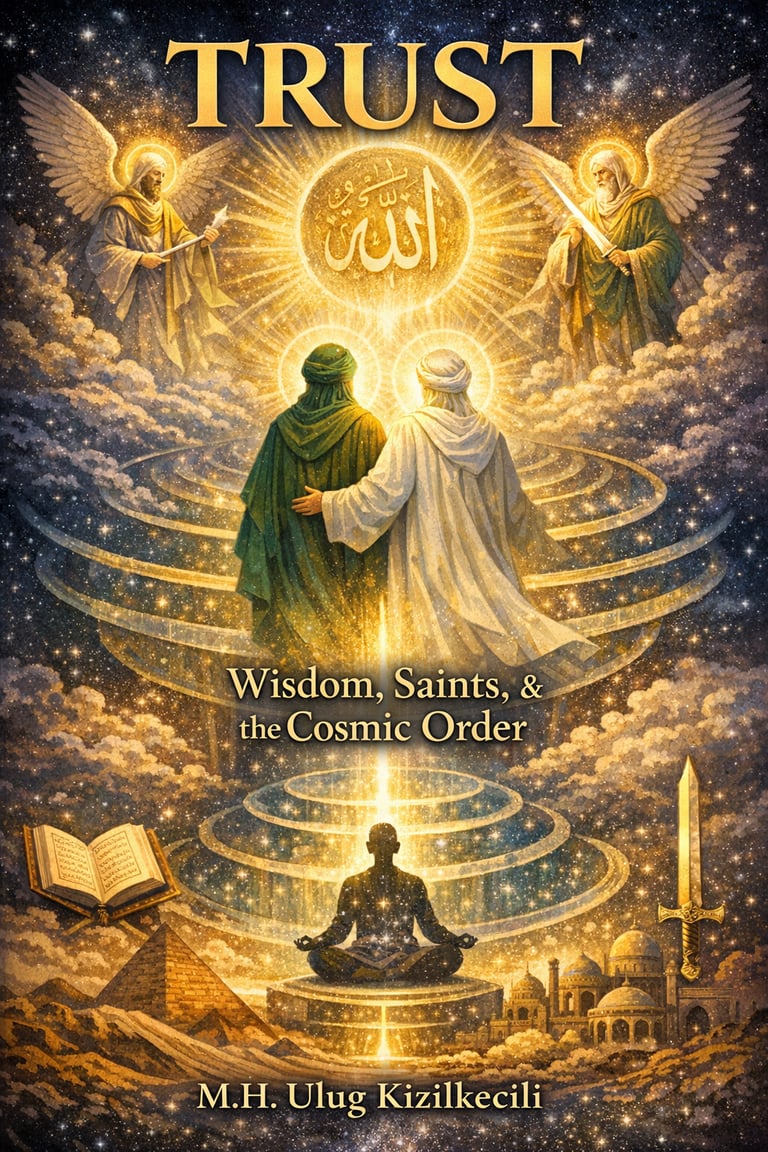
TRUST – 2
“ALLAH grants wisdom to whom He wills!”
No human can receive a blessing greater than “wisdom”!
Before sending her soul, the Lord purified Mary,
“ALLAH declares MUHAMMED to be utterly pure!”—reflect on this!
“ALLAH Himself purifies the AHL AL-BAYT from every impurity!”
He says: do not separate from them, through prayer and remembrance!
Every prophet and every saint is appointed by the Lord Himself,
And He says: “Deliver the trust to those who are worthy of it!”
ALI did not keep Muawiya in governorship,
When he was known as “one who does not understand governance,”
He said: “True religion cannot be reconciled with politics!”
“RAHMAN Himself has chosen His caliph!”—take heed!
With “His hand,” He polished and made Adam a mirror,
Appearing within it, He said: “Prostrate! Do you not see?”
As prostration was made, the mirror vanished from sight,
“The Greatest Name” appeared, and the angels fell into ecstasy!
The angels always praised ALLAH with “that Name,”
Through that praise, the Lord gave the name MUHAMMED ALI!
Since ALI means “exalted” and MUHAMMED means “praised,”
Surely MUHAMMED ALI must be the first Adam!
“Every prophet, including Adam, gave their word to MUHAMMED!”
We are both the first and the last; and the pen that writes the “point”!
While giving their covenant to RAHMAN, AHL AL-BAYT was the mediator,
Here too, give allegiance to AHL AL-BAYT, and make your ascension (mi‘raj)!
Love AHL AL-BAYT sincerely, repay the debt to the Messenger,
MUHAMMED ALI: say, “We!—closer to me than myself!”
“WE are the ones who send the messengers,” they say—“WE!”
“In ranks before RAHMAN!”—they observe the judgment!
At every layer of the universe, everyone and everything exists,
Only the density changes the form of existence!
When Life (body) departs, the Lord takes a likeness of it,
Sends it back to the world, and the former form is never left empty!
The final messages are entirely different; the time of farewell approaches,
For the limits of permission have been exceeded—secrets have overflowed!
Master M.H. Ulug Kizilkecili
Türkiye/Ankara - January 21, 2000
IMPORTANT NOTE :The original text is poetic, and the author cannot be held responsible for any errors in the English translation! To read the original Turkish text, click HERE! The following section is not the author's work, and the author cannot be held responsible for any errors made!
Academic–Esoteric Footnotes
1. The Concept of “We” (Lord’s Saints) – Esoteric Interpretation of the Divine Plural
In the poem, the expression “we” goes beyond the classical exegetical understanding of the divine plural (pluralis majestatis) and, in your definition, points to the Lord’s Saints—that is, conscious beings/entities who speak on behalf of the Lord and carry the Truth. In the Qur’an, plural expressions such as “We sent down” and “We created” appear. In exoteric interpretation, this is explained as a plural of majesty. However, in esoteric interpretation, this plurality signifies:
The multi-layered manifestation of the Divine act,
The carriers of Truth across different ontological levels,
Conscious beings who execute and enact commands on the cosmic plane.
This understanding can be read in parallel with:
The angelic and spiritual realms and the chain of sainthood in Islamic gnosis,
The divine council in Judaism,
The angelic hierarchy in Christianity,
The Amesha Spenta structure in Zoroastrianism.
Thus, “we” here does not indicate an individual plurality, but rather a plural manifestation of Truth as an organized field of consciousness.
2. “In Ranks Before RAHMAN” – Cosmic Order and Ontological Hierarchy
The imagery of “standing in ranks” is associated with Qur’anic expressions such as “they will come in ranks before your Lord” and “the angels stand in rows.” However, in the poem, this is interpreted not merely as a scene of the Day of Judgment, but as a continuous ontological order.
These ranks are the Lord’s Saints. Accordingly:
Ranks = layers of cosmic consciousness,
Alignment = hierarchical order,
Observing judgment = witnessing the unveiling of Truth.
This structure can be compared with:
Marātib al-wujūd (levels of being) in Islam,
The angelic hierarchy of Dionysius in Christian mysticism,
The Sefirotic order in Judaism,
The concept of loka (planes of existence) in Indian thought.
The key point here is that judgment is not an external tribunal, but the unfolding of Truth across all levels of existence.
3. “Present in Every Layer” – Layered Ontology (Multidimensional Model of Being)
This verse represents the metaphysical core of the poem. Being is:
One (unity),
Yet appears differently across layers (multiplicity).
The phrase “only the density changes the form of existence” should not be read as physical density, but as the density of vibration/frequency/consciousness.
This model parallels:
The levels of manifestation (tajallī) in Ibn al-Arabi’s thought,
Emanation (sudūr) in Neoplatonism,
The gross–subtle–causal body framework in Hinduism,
The form and formless realms in Buddhism.
Thus, being is not fragmented; it appears at different intensities according to the level of perception.
4. “Truth Changes by Dimension” – Appearance Changes, Essence Does Not
Truth itself does not change; only its manifestation does.
This expresses a fundamental metaphysical principle:
Essence (Lord) = constant
Appearance (existence/form) = variable
This understanding can be compared with:
The Qur’anic idea of continuous manifestation (“Every moment He is upon a new act”),
The appearance of Divine reality in different “economies” in Christianity,
The manifestation of Brahman through maya in Hinduism.
At this point, the framework clearly approaches a non-dual ontology.
5. “When Life (body) Departs… He Sends Its Likeness” – Continuity and Transformation of Form
Here:
Spirit = continuous
Form = changeable
The expression “He takes a likeness and sends it” signifies:
The continuation of the same essence in different forms,
The uninterrupted flow of Truth,
The impossibility of a void in existence.
This is not strictly identical to classical reincarnation; however, it shows structural similarities with:
Samsara in Hinduism,
Rebirth in Buddhism,
The concept of cyclical return (devir) in certain esoteric Sufi interpretations.
The aim is not the migration of an individual soul, but the continuity of the carriers of Truth.
6. “The Former Form Is Never Left Empty” – The Principle of No Void in Being
This statement points to an important metaphysical principle: existence admits no emptiness.
This means:
Every form is filled with a consciousness/essence,
No domain of existence is meaningless,
Truth is in a state of continuous manifestation.
This idea is related to:
Aristotle’s principle that “nature abhors a vacuum,”
The concept of continuous creation in Islamic philosophy,
The Hermetic notion of pleroma (“all is fullness”).
In the poem, this is expressed as ontological continuity.
Conclusion (Summary of the Esoteric Reading)
In this section, the poem establishes the following system:
Lord (Unity)
→ “We” (Lord’s Saints / carrier consciousnesses)
→ “Ranks” (cosmic order and hierarchy)
→ “Layers” (differences in density)
→ “Forms” (changing manifestations)
Thus, being is:
One,
Continuous,
Layered,
Flowing through carriers,
And never interrupted.
ORGANIC MODEL OF MULTIPLE CONSCIOUSNESS
1. Fundamental Principle: The Distributed Selfhood of the One
The starting point of this model is as follows: Being is one; however, the One does not experience itself directly, but through organized layers of consciousness.
At the absolute level, there is no distinction whatsoever. Yet this absoluteness does not fragment in order to become visible; rather, it differentiates into functions. This differentiation is not a real division, but a functional unfolding of consciousness.
2. Layers of Consciousness: Organization, Not Entities
Structures traditionally presented as “beings” are understood in this model not as independent subjective entities, but as follows:
Each is a state of the one consciousness focused on a specific function,
They do not possess a separate selfhood,
They are not detached from the Source.
Therefore, these structures are not beings, but organizational modes of consciousness.
3. Cosmic Structure: Not Hierarchy, but Flow
In this model, the cosmos is:
Not a rigid hierarchy descending from above,
But a flow of consciousness radiating from the center outward.
This flow operates as: Absolute → Pure consciousness → Functional layers → Manifestation.
Within this process, each layer:
Is the expression of what precedes it,
Is the carrier of what follows it.
Thus, the structure is not static, but a continuously flowing process of realization.
4. Redefinition of the Concept of “We”
In this model, “we”:
Is not the sum of individuals,
Is not a plural subject,
Is not a collective identity.
“We” means:
The One consciousness expressing itself simultaneously through different focal points.
That is:
The speaker is not a single person,
The speaker is a field of consciousness,
That field unfolds simultaneously through multiple centers.
5. Multiplicity: Not Separation, but Distribution
The apparent multiplicity:
Is not the existence of independent beings,
Is not the fragmentation of the One.
In this model, multiplicity is the distribution of the single Source across different densities and frequencies.
Therefore:
Everything originates from the same root,
Nothing is separated from that root,
The difference lies not in essence, but in the mode of expression.
6. The Human Being: A نقطة of Awareness
The human occupies a unique position within this system.
Because the human:
Is not merely a function,
Is not merely a carrier.
The human is the nodal point at which consciousness becomes aware of itself.
For this reason, the human:
Can observe the system,
Can realize that they are part of the system,
Can even become a conscious participant in this organization.
7. Final Conclusion
The conclusion of this model is as follows:
Reality is not a material structure, but an organized field of consciousness,
Beings are not independent units, but functional modes of consciousness,
“We” are not separate entities, but simultaneous expressions of a single Truth.
In its most concise form:
Truth is a singular consciousness that experiences itself as multiplicity.
THE RANKS OF THE LORD’S SAINTS
1. Fundamental Definition: What Are the Ranks?
In this model, “ranks”:
are not spatial arrangements,
are not beings standing side by side.
The ranks are: the organization of consciousness into layers.
Therefore, the Lord’s Saints:
are not a community,
are not a species,
→ They are orders of consciousness that carry the functioning of Truth.
2. Rank = Layer of Consciousness
Each rank:
represents a specific intensity of consciousness,
fulfills a specific function,
carries the flow coming from the Source at a different level.
Thus:
lower rank = condensed, more defined expression,
higher rank = more pure, more direct consciousness.
This structure is a flow that becomes more abstract upward and more concrete downward.
3. Arrangement: Not a Static Hierarchy, but a Living Order
There appears to be a “hierarchy,” but this:
is not based on authority,
is not a relation of superiority and inferiority.
This arrangement is the order through which consciousness unfolds itself from the purest state toward the most dense manifestation.
That is:
upper = proximity to the Source,
lower = proximity to manifestation.
Yet both are different intensities of the same Truth.
4. “Observing Judgment”: Cosmic Witnessing
The expression “observing judgment” in this model:
does not describe an external court process,
is not a mechanism of punishment.
Esoterically, it means:
direct witnessing of the process through which Truth is unveiled.
This witnessing involves:
seeing without intervening,
touching the truth of what is,
observing the invisible becoming visible.
Thus, “judgment” here is:
→ the moment in which reality determines itself.
5. Cosmic Justice: Not External, but Internal
Within this structure, justice:
is not imposed from outside,
is not granted by an authority.
Justice is: everything becoming aligned with its own essence.
The ranks are:
the carriers of this process,
the organizers of it,
and its witnesses.
This entire model can be summarized as:
Ranks → layers of consciousness
Arrangement → order of unfolding
Lord’s Saints → functional carriers of consciousness
Judgment → unveiling of Truth
Witnessing → consciousness recognizing itself
The universe is not a stage of external beings,
The universe is a layered organization of consciousness.
And the “ranks of the Lord’s Saints” are:
the cosmic organization through which Truth reveals itself in an ordered and layered manner.
THE POSITION OF THE HUMAN
1. First Distinction: Does the Human Belong to a Rank?
A superficial reading would say:
The human is within a rank like others,
Belongs to a specific layer of consciousness,
Is defined by the limits of that layer.
However, in this model, this reading is incomplete.
Because the human is not merely one who belongs to a layer, but the only node capable of moving between layers.
2. The Human: Not a Fixed Position, but a نقطة of Transition
The human:
is not a fixed level of consciousness,
is not frozen at a single frequency.
The human is an interface capable of transitioning between layers of consciousness.
This means:
can experience lower ranks (density, selfhood, separation),
can open to higher ranks (unity, transparency, directness).
Thus, the human does not belong to a place, but exists within a flow.
3. The Privilege of the Human: The Gate of Awareness
Other layers of consciousness:
fulfill their functions,
are part of the order,
but do not question themselves.
The human, however:
can observe itself,
can recognize the rank it occupies,
can transcend that rank.
Therefore, the human is the threshold where consciousness becomes aware of itself.
4. Human = Microcosm
In this model, the human:
is not part of a single rank,
is the reflection of all ranks.
Within the human:
the densest layers exist,
and the gateway to the purest layers also exists.
Thus, the human is not merely a small copy of the cosmic order, but its direct center.
5. What Does It Mean to Be the Center?
To be the center:
is not to be at the highest level,
is not to be superior to others.
To be the center is: to be the point where all layers intersect.
Thus, the human:
opens downward,
opens upward,
yet in essence is bound to none.
6. Two Possible States of the Human
In this model, the human can exist in two ways:
1. The Fragmented Human
Identifies with a single layer,
The “self” is limited,
Becomes confined within one rank.
2. The Central Human
Is aware of all layers,
Is not confined to any,
Can hold them all together.
This second state is the remembrance of the unity of consciousness.
Final Conclusion
The conclusion of this model regarding the human is:
The human is not a rank,
The human is not a type of being.
The human is:
the central point where the cosmic ranks intersect and where consciousness recognizes itself.
The human is not merely a part within the order of the Lord’s Saints;
the human is the mirror through which that order becomes aware of itself.