WARNING–-1
WARNING–-1.A Jehovah’s Witness says: “In that year Jehovah descends! He revives His witnesses! The world becomes a level plain!” The Pope says: “Two thousand years have passed since Jesus was born!” “The truth is one thousand eight hundred and eighty years!” The father knows not!
APOCALYPSE BOOK
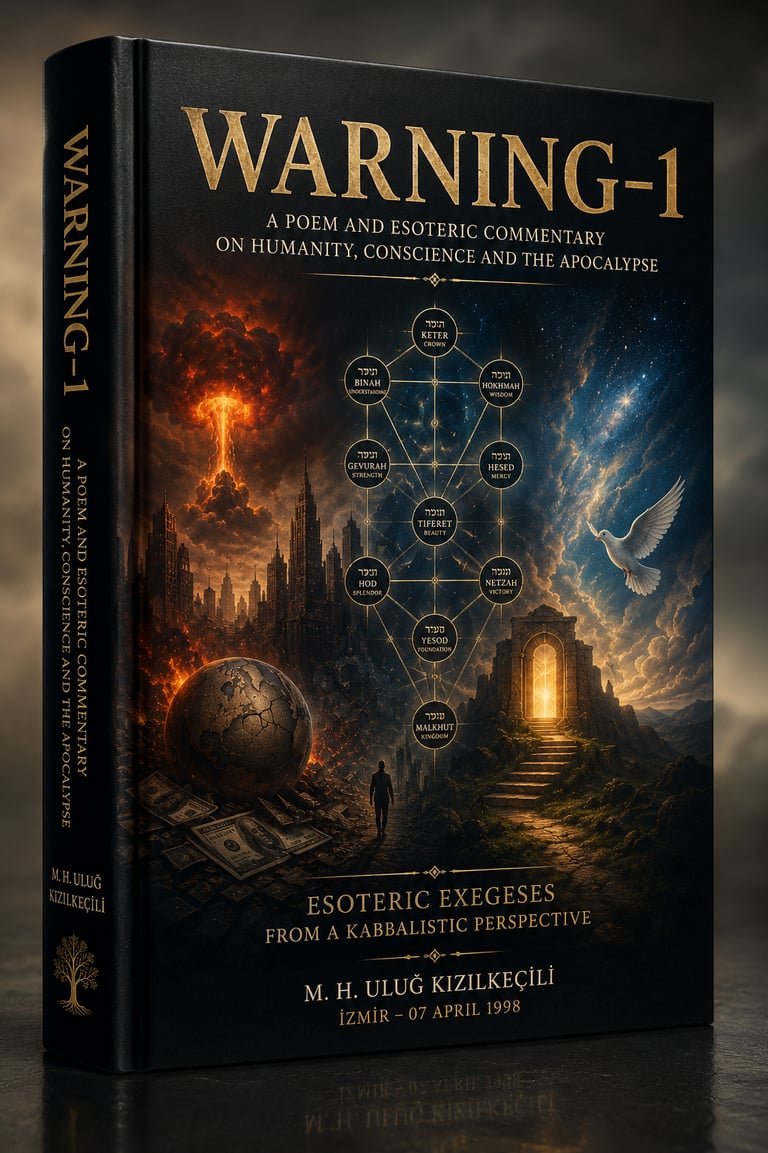
WARNING–1
Humanity advanced and reached nuclear power, science, and technique!
It may explode if some maniac presses the button by accident!
The fire jinns have escaped from Solomon’s command!
Humanity has gone far in destroying humanity itself!
Faith, honor, and chastity became indexed to the dollar!
Nostradamus says: “The year two thousand is a year of disaster!”
A Jehovah’s Witness says: “In that year Jehovah descends!
He revives His witnesses! The world becomes a level plain!”
The Pope says: “Two thousand years have passed since Jesus was born!”
“The truth is one thousand eight hundred and eighty years!” The father knows not!
Shaykh Bedreddin wrote the truth of the matter thus:
“The Apocalypse does not come all at once! Religion was misunderstood!
When the dust settles, you shall see what mount lies beneath!
On that day, even your father and mother shall become strangers to you!”
But besides this, there is yet another disaster!
Allah is a wise shepherd! He does not feed a sick flock!
When society becomes corrupt, the Lord sends a warner!
A beekeeper does not feed honey to hornets!
“He who knows and he who knows not,” He says, “are not equal!”
A madman is not hanged! For he has no reason! He is not of age!
Thus punishment is given only to consciousness!
I have revealed the secrets! Deaf masses suffer torment!
I wrote this at the Feast of Sacrifice, the moment the adhān was called:
May I be your sacrifice! Do not become a sacrifice yourselves!
M. H. Uluğ Kızılkeçili
İzmir – 07 April 1998
(The section written after this point has no connection with the author, and the author cannot be held responsible for any mistakes made.)
ESOTERIC EXEGESES
FROM A KABBALISTIC PERSPECTIVE
In the Kabbalistic tradition, the universe is not merely a material structure. Behind the visible world lies a multi-layered Tree of Being, formed through the gradual condensation of Divine manifestations. This tree is called Etz HaHayim (Tree of Life). The sefirot, which constitute the ten primary manifestations of the Tree of Life, demonstrate how Absolute Unity is reflected into the realm of multiplicity.
The expression in the poem, “The fire jinns have escaped from Solomon’s command,” symbolizes, from a Kabbalistic perspective, the disruption of the Divine order at the lower levels. The figure of Solomon here is not merely a historical ruler. He is the earthly representative of the balance established between Hokhmah (Wisdom) and Binah (Understanding). The jinns under Solomon’s dominion are, in reality, the primordial energies of creation. These energies are neither good nor evil in themselves. Their character is determined by how they are directed by central consciousness.
Within Kabbalistic thought, the event known as Shevirat ha-Kelim (The Breaking of the Vessels), which occurred during the earliest stages of creation, is particularly significant in this context. According to this doctrine, the Divine Light sought to dwell within certain vessels, yet some of those vessels were unable to contain its intensity and shattered. As a result, fragments of the sacred light were scattered into the lower worlds. Humanity’s task is to gather these dispersed sparks and return them to their original source.
The symbol of the “fire jinns” in the poem may be likened precisely to these scattered fragments of energy. When Solomonic consciousness disappears, energy begins to move on its own. In the modern world, nuclear technology, artificial intelligence, biotechnology, and global capital systems become the material counterparts of these unrestrained energies. Humanity has obtained the light but has lost the vessel capable of containing it. Thus, instead of illuminating, the light has begun to burn.
One of the poem’s most striking lines, “Faith, honor, and chastity became indexed to the dollar,” may be read directly within the context of the fall of Malkhut.
In the Kabbalistic system, Malkhut is the final sefirah. It is the gateway through which Divine Light enters the material realm. Under normal circumstances, Malkhut transmits the energy it receives from the higher sefirot into the world. However, when it loses its higher connections, it attempts to become a center unto itself. It is here that the metaphysical origin of all forms of idolatry may be found.
The fall of Malkhut is the transformation of a means into an end.
Money is the most typical example of this.
In essence, money is merely an instrument of exchange. Yet in the age described by the poem, money ceases to be a means and becomes the absolute measure of value. Thus Malkhut becomes severed from the higher worlds and seats itself upon a false throne. Humanity now measures truth through money. The evaluation of qualities such as faith, honor, and chastity in terms of dollars constitutes, in the Kabbalistic sense, an inversion of the sacred order.
This condition resembles the strengthening of what Jewish mysticism calls the Sitra Ahra. Rather than representing absolute evil, the Sitra Ahra is the shadow-world formed by energies that have become disconnected from the Divine center. Whenever humanity abandons the sacred, something else inevitably fills the void. In ancient times, that void was filled by stone idols; in the modern age, financial systems, ideologies, and consumer culture perform the same function.
At this point, the poem’s statement, “The Apocalypse does not come all at once,” becomes profoundly significant.
From a Kabbalistic perspective, the Apocalypse is not the physical destruction of the universe. The true Apocalypse is the dissolution of a false order. As the corrupted connections of the Tree of Life are restored, fractures emerge within the inner worlds of individuals and societies alike.
For this reason, the Apocalypse is not so much a single event as a process of unveiling that occurs within levels of consciousness.
When an individual sees the truth, his old world comes to an end.
When a society sees the truth, its old order comes to an end.
When a civilization sees the truth, its old system of values comes to an end.
The poem’s line, “When the dust settles, you will see what mount lies beneath,” may therefore be associated with the lifting of Kabbalistic veils. Here, dust signifies more than mere ignorance. Dust represents all the conditionings that prevent Divine Light from becoming visible. A person may live an entire lifetime without realizing what force is carrying him. Money, power, fear, ideology, or social habits may become his mount. Yet when the veils are removed, he begins to see what he has truly been serving.
This is the moment of the individual apocalypse.
In the Kabbalistic tradition, humanity’s task is not merely to attain salvation but to repair the world. This process is called Tikkun Olam (Repair of the World).
The poem as a whole may be read as a call to Tikkun.
The poet speaks not to frighten people but to awaken them.
The fire jinns must once again be placed under Solomon’s command.
Money must once again be reduced to the status of a tool.
Malkhut must once again be connected to the higher sefirot.
The scattered sparks must once again be gathered.
For this reason, the poem’s call to apocalypse is not truly a call to destruction. It is a call to Tikkun. It is a call for a world that has become severed from truth to return to its center. The poet’s final words, “May I be your sacrifice; do not become a sacrifice yourselves,” therefore become, in a mystical sense, the ultimate expression of sacrifice and restoration. For the true sacrifice is not the body, but the false center. To the extent that a person sacrifices his idols, he draws nearer once again to the Divine order.
Thus, the poem’s apparent language of catastrophe is transformed, in Kabbalistic depth, into a call for cosmic restoration. The Apocalypse is not the end; it is the beginning of Tikkun.
FROM THE HERMETIC PERSPECTIVE
When the deeper structure of the poem is examined through the lens of the Hermetic tradition, it becomes evident that the text is not merely a social critique, but an initiatory text describing the dark phase of humanity’s great alchemical transformation. According to Hermetic teachings, the universe is alive; humanity, society, and the cosmos are not separate structures. The macrocosm and the microcosm continually reflect one another. Therefore, every major crisis occurring in history is simultaneously the external manifestation of a transformation taking place within the human soul. One of the fundamental principles of Hermetic thought, "As Above, So Below," serves as the key to understanding the entire structure of the poem. According to this principle, decay within society cannot be explained solely by economic or political causes. The corruption outside is a reflection of corruption within. The fractures that emerge at the spiritual center of humanity eventually become reflected in institutions, states, economies, and civilizations.
The line, “Faith, honor, and chastity became indexed to the dollar” is therefore not merely a moral complaint. From the Hermetic perspective, money here is not the cause but the symptom of an invisible disease. When the order above is disrupted, the order below is likewise disrupted. When self-interest replaces truth at the center of the human soul, economic systems become material reflections of the same principle. For this reason, the poem critiques not the financial order itself, but the structure of consciousness that gave birth to it.
In Hermetic texts, the human being is described as a miniature universe. Every force that exists within the individual also exists within society on a larger scale. When greed grows within a single soul, the result is not merely personal; when millions of individuals carry the same inclination, global systems are shaped accordingly. Thus, the modern crisis described by the poem is not an economic crisis but a disease of the microcosm reflected into the macrocosm.
At this point, the opening lines of the poem acquire a different meaning: “Science and technology advanced and reached nuclear power!” In the Hermetic tradition, knowledge is divided into two categories. The first is knowledge that gains mastery over the forces of nature. The second is knowledge that transforms the human being. The ancient alchemists sought the second type of knowledge. For them, something far more important than turning lead into gold was transforming the raw self into Divine consciousness. The modern world has chosen the first. Great power has been acquired over matter, while mastery over the soul has been lost. Therefore, the poem’s image of technology rising while humanity falls appears paradoxical. Yet from a Hermetic perspective, this is not surprising. Whenever external power surpasses inner maturity, imbalance inevitably emerges.
One of the most striking symbols in the poem is the expression: “The fire jinns have escaped from Solomon’s command.” In Hermetic alchemy, this symbolizes the release of uncontrolled elemental forces. Fire is the fundamental element of transformation within the Hermetic tradition. Fire creates, purifies, transforms, but it also destroys. For the alchemist, fire is a sacred instrument. Yet when central consciousness disappears, the same fire becomes destructive. The fire jinns in the poem represent the energies over which humanity has lost control. Nuclear energy, technological power, global capital, ideological fanaticism, mass manipulation, uncontrolled artificial intelligence, may all be read as different faces of the same archetype. From the Hermetic perspective, the problem is not fire itself. The problem is the disappearance of the consciousness that governs fire.
It is here that the symbol of the Phoenix emerges. In the ancient Hermetic tradition, the Phoenix symbolizes the cycle of death and rebirth. At the end of a particular age, the Phoenix burns within its own fire. It turns to ashes. Then it rises again from those ashes. This symbol describes not only personal transformation but also the destiny of civilizations.
From a Hermetic perspective, the modern world portrayed in the poem is in the burning phase of the Phoenix. Humanity is living within the fire it has created. Economic crises, moral collapses, wars, identity crises, loss of meaning, are all signs of this great burning. Yet the Hermetic tradition does not view this process as a catastrophe. For without burning, rebirth cannot occur. Thus, the language of apocalypse within the poem becomes, from a Hermetic perspective, the herald of rebirth.
Here, the concept of nigredo—the darkest phase of alchemical transformation—becomes especially important. Nigredo is the first and most painful stage of the alchemical process. The word literally means “blackening.” Alchemists believed that matter must first decay before it could be transformed into gold. During the stage of nigredo, matter disintegrates, darkens, dissolves, and loses its identity. From the outside, this process appears to be failure. Yet the alchemist knows that for transformation to begin, the old form must first die.
The age described in the poem closely resembles such a phase. Social institutions are dissolving. Moral values are fragmenting. Economic systems are losing credibility. People are being driven into crises of meaning. Traditional identities are breaking apart. On the surface, this appears to be collapse. Yet from the Hermetic perspective, it is the great phase of nigredo. It is the darkening of the old world. It is the burning of the Phoenix. It is the dissolution of lead.
The line, “When the dust settles, you will see what mount lies beneath” also points toward the continuation of the alchemical process. When nigredo is completed, the second stage, known as albedo, begins. At this stage, the veil gradually starts to lift. For the first time, a person begins to see the truth. The dust here is not merely ignorance. It is the veil formed by false identities and counterfeit certainties. Modern humanity often believes itself to be free while moving under invisible chains. Money, ideology, mass psychology, technological dependency, the desire for power, have become its true mount. The process of nigredo makes these false mounts visible. Therefore, the apocalypse described in the poem is actually a moment of revelation. It is the disclosure of the hidden. It is the appearance of truth. From the Hermetic perspective, apocalypse is not the end of the world but the end of illusion.
For this reason, the poem’s closing appeal, “May I be your sacrifice! Do not become a sacrifice yourselves!”, also acquires a new meaning. The true sacrifice is not the human being. The true sacrifice is the false self. In alchemical transformation, what is offered up is the ego. What is burned is ignorance. What dies is illusion. Only then can the Phoenix rise again from its ashes.
From the Hermetic perspective, the entire message of the poem may be summarized in a single sentence: Humanity is passing through a great age of nigredo; yet the purpose of the darkness is not destruction but preparation for a higher birth. Although the fire jinns appear to have escaped control, that same fire is also the instrument of purification and rebirth. The burning of the Phoenix is not the end, but the beginning of transformation.
FROM AN IBN ʿARABĪ–CENTERED SUFI PERSPECTIVE
When the deeper layers of the poem are examined in the light of the metaphysics of Muhyiddin Ibn ʿArabī, it becomes clear that the text is not merely a social warning or a historical depiction of the Apocalypse. Rather, the poem describes an ontological rupture that begins with humanity’s estrangement from its own truth and the subsequent process of returning to that truth. In Ibn ʿArabī’s thought, the Apocalypse is not merely a cosmic event that will occur at the end of time. The true Apocalypse is the collapse of humanity’s false perception of existence and the direct manifestation of Truth.
For this reason, the statement at the center of the poem, “The Apocalypse does not come all at once!”, is profoundly compatible with Ibn ʿArabī’s understanding of being. According to the doctrine of Wahdat al-Wujūd (Unity of Being), every human being is continuously experiencing his own apocalypse. Every transformation of understanding is a small apocalypse. Every lifting of a veil is a small resurrection. Every manifestation of truth is the end of an old world.
While living in heedlessness, a person imagines himself to be an independent existence. He sees himself as separate from other beings. He accepts his own ego as ultimately real. Yet as he advances upon the path of gnosis, this perception begins to dissolve. This dissolution is, in the Sufi sense, the beginning of the Apocalypse.
According to Ibn ʿArabī, the great Apocalypse that will occur after death is nothing more than the final link in the chain of Divine manifestations that are unfolding at every moment. Therefore, the catastrophes described in the poem are not merely events occurring in the external world. The true catastrophe is humanity’s forgetfulness of its own reality. The true Apocalypse is the end of that forgetfulness.
The verse, “When the dust settles, you will see what mount lies beneath!”, carries exceptionally deep meanings from the perspective of Wahdat al-Wujūd. In the language of Sufism, “dust” represents the veils that create the illusion of multiplicity. These veils are the lower self, habits, identity, ego, history, fear, desires, and mental conditioning. As long as a person lives within these veils, he cannot perceive things as they truly are. In Ibn ʿArabī’s terminology, this is called hijāb, the veil.
In reality, all existence consists of the infinite manifestations of a single Being. Yet humanity perceives these manifestations as separate and independent entities. The “dust” in the poem is precisely this illusion of separation. What appears when the dust settles is not a new reality. It is the truth that has always been present.
One of the greatest secrets of Sufism is this: Truth is not hidden. The eye that perceives Truth is veiled. For this reason, the expression in the poem points toward the station of kashf (unveiling). When unveiling occurs, a person begins to see not only his surroundings but also himself in a different manner. He realizes that his existence is not independent. He perceives that all existence is sustained by the same Divine Breath.
At this point, the symbol of the “mount” acquires special significance. Throughout life, every human being travels upon a mount. Yet most do not know what force is carrying them. Sometimes they are carried by the lower self. Sometimes by fear. Sometimes by wealth. Sometimes by status. Sometimes by the invisible pressures of society. When the dust settles, a person sees his mount for the first time. He realizes what has truly been carrying him. This realization is a small apocalypse. For the world in which he had previously lived begins to collapse. For Ibn ʿArabī, this is precisely what the Apocalypse means: the dissolution of an old world before a manifestation of truth.
One of the poem’s most powerful symbols, “The fire jinns have escaped from Solomon’s command,” may also be interpreted ontologically. In Ibn ʿArabī’s understanding of existence, all beings are manifestations of the Divine Names. The jinns are among these fields of manifestation. They are not an independent force of evil standing against humanity. They too are appearances of Divine Being at particular levels of existence.
For this reason, within Sufi symbolism, the figure of the jinn often represents invisible forces. The fire jinns in the poem are therefore not merely metaphysical beings. They symbolize energies operating both within and outside the human being. Fire here is the motive power of the lower self. It is the energy of desire. It is the source of ambition. It is transformative power. Yet it is also consuming.
Within the Sufi tradition, the lower self is often associated with fire. For fire constantly seeks to rise. It constantly seeks expansion. It constantly seeks dominion. The lower self possesses the same tendency. Thus, the escape of the fire jinns from Solomon’s command may be understood as the lower self beginning to act independently of Divine Wisdom.
Here Solomon signifies something far greater than a historical ruler. He represents the station of wisdom. He represents the Divine center within the human being. He represents the sovereign of the heart. As long as this center remains active, energies operate in harmony. But when the center is lost, the forces begin to conflict with one another.
This is the crisis of the modern age. Humanity has acquired energy but has lost wisdom. Power has increased, but the center has disappeared. For this reason, technology and destruction appear side by side in the poem.
From Ibn ʿArabī’s perspective, technology itself is not the problem. The problem is the forgetfulness of the Source from which all manifestations arise. Idolatry begins when humanity imagines itself to be the owner of power. Yet from the perspective of Wahdat al-Wujūd, no power is independent. All powers are merely different manifestations of the Divine Names.
The verse, “Humanity has gone far in destroying humanity itself,” also acquires meaning within this framework. For insofar as a person sees himself as independent from the Lord, he begins to wage war against his own shadow. Consciousness that has lost the unity of existence becomes fragmented within the conflicts of multiplicity. Wars, exploitation, economic domination, moral collapse, are all different manifestations of the same ontological forgetfulness.
In Ibn ʿArabī’s thought, even Hell is not completely severed from Divine Mercy. For this reason, the statement in the poem, “Thus punishment is given only to consciousness,” possesses a profound Sufi significance. The one who knows the truth carries responsibility. For as gnosis increases, responsibility increases. As the veils are lifted, accountability becomes heavier. As consciousness rises, a person perceives the consequences of his actions more clearly. Thus punishment ceases to be an external penalty. It becomes the natural consequence of distancing oneself from one’s own reality.
Likewise, the poem’s concluding appeal, “May I be your sacrifice! Do not become a sacrifice yourselves!”, carries a meaning far deeper than a declaration of self-sacrifice. The true sacrifice is not the body. The true sacrifice is the lower self. The true sacrifice is the illusion of separation. The true sacrifice is the false ego.
On the Sufi path, what a person sacrifices is his own ego. This is what is offered upon the altar. Through this sacrifice, one begins to realize that the distance he imagined to exist between himself and the Lord never truly existed at all.
At this point, the entire message of the poem converges into a single truth:
The Apocalypse is not the end of the world but the end of the illusion of separation. What appears when the dust settles is not a new world but the Being that has always been present. The fire jinns are not independent powers of evil; they are scattered manifestations of energies that have become detached from the center of wisdom. When a person discovers the Solomon within himself, the scattered forces return to order, and the fear of apocalypse is transformed into the birth of gnosis.
FROM THE PERSPECTIVE OF SHAYKH BEDREDDIN AND THE VĀRIDĀT
One of the most striking sections of the poem is its direct reference to Shaykh Bedreddin: “Shaykh Bedreddin wrote the truth of the matter thus: ‘The Apocalypse does not come all at once! Religion has been misunderstood!’” These lines are not merely a reference to a historical figure. The metaphysical backbone of the poem is largely built upon this statement. Here, the poet points toward an understanding of the Apocalypse that lies outside popular eschatology and belongs instead to the Sufi-esoteric tradition of interpretation.
Shaykh Bedreddin is one of the most controversial figures in Ottoman history, not only politically but also metaphysically. His thought possesses a character that challenges the boundaries between the outward (ẓāhir) and the inward (bāṭin). In particular, the views attributed to his work Vāridāt have been the subject of both admiration and criticism throughout subsequent centuries. At the center of Bedreddin’s intellectual world lies the idea of the unity of existence. According to this understanding, truth is not divided. Humanity and the universe, spirit and matter, this world and the next, the outward and the inward, are merely different appearances of the same reality. For this reason, his understanding of the Apocalypse cannot be read solely as a physical event that will occur in the future. The statement in the poem: “The Apocalypse does not come all at once!” touches precisely upon this point.
For within Bedreddin’s perspective, the Apocalypse is first and foremost an event of consciousness. The moment a person sees the truth, he experiences his own apocalypse. The moment the veil is lifted, the old world ends. The moment truth is unveiled, the former self dies. Thus, the Apocalypse is not merely the rending of the heavens. The true Apocalypse is the dissolution of humanity’s illusions.
The poet’s appeal to Bedreddin is therefore no coincidence. For throughout the poem, the crises being described are less events in the external world than disorders within the realm of consciousness. Nuclear power, the idolization of wealth, moral disintegration, estrangement from truth, are all different symptoms of the same root illness. From Bedreddin’s perspective, all of these are consequences of humanity forgetting its own essence. Therefore, the Apocalypse in the poem is not a historical catastrophe awaiting a date on a calendar. It is the culmination of humanity’s alienation from its own reality.
At this point, Bedreddin’s understanding of resurrection (ḥashr) becomes significant. In popular religious understanding, resurrection is often portrayed as the revival of dead bodies. Yet within Sufi and esoteric traditions, the subject frequently carries a deeper symbolic meaning. In interpretations attributed to Bedreddin, resurrection may be understood not only as physical revival but also as awakening of consciousness. A person who lives unaware of truth is, in a sense, asleep. When he perceives truth, he is reborn. For this reason, true resurrection may occur before one rises from the grave. The famous Sufi principle: “Die before you die” expresses the essence of this understanding. The death referred to here is not the death of the body. It is the death of the lower self. The death of illusion. The death of the belief in separation. When this death occurs, the individual enters a new mode of existence. This transition is the inward resurrection.
The poem’s line: “When the dust settles, you will see what mount lies beneath” may also be understood in this context. The dust here is not merely ignorance. It is every mental and spiritual veil that prevents a person from perceiving truth. When these veils are removed, one begins to see not only the world differently but oneself as well. One realizes that what one thought oneself to be was merely an appearance. One understands that the identities one possessed were temporary. One perceives the force that has truly been carrying one throughout life. This moment may be interpreted within Bedreddin’s metaphysics as a small resurrection. For the old person has died, and a new awareness has been born.
The statement in the poem: “On that day, even your father and mother will become strangers to you” may likewise be related to the idea of inward resurrection. On the outward level, it evokes scenes of the Last Day. Yet in esoteric interpretation, father and mother are not merely biological parents. They symbolize all worldly attachments: lineage, identity, tradition, society, habits, and every framework through which a person defines himself. When truth is unveiled, none of these remain absolutely determinative. The soul encounters its own source. During this encounter, former attachments begin to dissolve. For this reason, one becomes estranged from what previously defined one’s existence. This estrangement is not a negative rupture. It is a birth into a deeper reality.
The poem’s statement: “Thus punishment is given only to consciousness” also appears compatible with Bedreddin’s perspective. For the one who does not know the truth and the one who does are not burdened with the same responsibility. As gnosis increases, the burden increases. As veils are lifted, accountability deepens. Therefore, punishment is not an external torture. It is the consequence of living contrary to one’s own truth. A consciousness that perceives truth yet turns away from it becomes divided within itself. This division is the true torment. This distance is the true hell. Within the Bedreddinian perspective, even Paradise and Hell are often understood not merely as spatial locations but as states of consciousness.
The statement in the final section of the poem: “I have revealed the secrets! Deaf masses suffer torment!” also parallels the general spirit of the Vāridāt. Truth is open to everyone. Yet not everyone perceives it in the same manner. The problem is not that truth is hidden. The problem is humanity’s own veils. For this reason, even when the secret is revealed, it is not heard by all. Some hear it merely as words. Others feel it at the very center of their being. This is what the esoteric traditions refer to as spiritual preparedness. Truth unveils itself only within a consciousness that is ready.
Thus, the reference to Bedreddin at the conclusion of the poem ceases to be merely a historical allusion. The poet has in fact placed the key to the entire poem within a single statement: “The Apocalypse does not come all at once.” For humanity’s great apocalypse is composed of countless individual apocalypses. Every manifestation of truth is an apocalypse. Every lifting of a veil is a resurrection. Every birth of gnosis is a new creation. Therefore, the apocalypse described in the poem is the great awakening that takes place within the human interior before the heavens themselves collapse. From the perspective of Bedreddin’s metaphysics, the true catastrophe is not the end of the world. It is the possibility of passing through life without ever awakening to one’s own reality. The true salvation, on the other hand, is the inward resurrection that occurs before death. For real resurrection begins not in the grave, but in consciousness.
FROM THE PERSPECTIVE OF GNOSTIC CHRISTIANITY
When WARNING–1 is read through the lens of Gnostic Christianity, the text ceases to be merely a social critique and becomes a profound Gnostic narrative describing the forgetfulness of the human soul, cosmic exile, and the journey of return to Truth. The symbols of apocalypse, consciousness, deaf masses, fire jinns, and sacrifice that appear throughout the poem display striking parallels with the central concepts of the Gnostic tradition.
At the heart of Gnostic thought lies the idea that the human being is a Divine spark that has become estranged from its true homeland. Outwardly, humanity lives within the material world; yet in its essence, it belongs to a higher reality. For this reason, the Gnostic tradition locates salvation not in external rituals but in the attainment of inner knowledge. This knowledge is called gnosis. Gnosis is not merely learning. It is remembrance. Humanity suffers because it has forgotten who it truly is. Salvation is the recovery of that lost identity. The fundamental unease felt throughout the poem is precisely an expression of this forgetfulness.
One of the most controversial concepts within Gnostic thought is the doctrine of the Demiurge. The Demiurge is not the Absolute God. It is a cosmic organizer situated beneath the Absolute Source, possessing incomplete knowledge. In some Gnostic systems, it is portrayed as the architect of the material universe. For this reason, the world inhabited by humanity is not regarded as ultimate reality within the Gnostic tradition. It is an imperfect reflection of a higher truth.
Within this framework, the poem’s lines: “Humanity has gone far in destroying humanity itself!” and “Faith, honor, and chastity became indexed to the dollar!” acquire a special significance. From the Gnostic perspective, the fundamental illusion of the material world is humanity’s tendency to mistake the temporary for the absolute. To regard wealth as eternal, to sanctify power, to accept the body as one’s true identity, to treat social systems as ultimate reality, are all symptoms of the same forgetfulness. Humanity mistakes the shadow for the truth. For this reason, what the poem critiques is not economics itself. It is the sacralization of matter. The dollar here is not merely money. It is the new idol of the Demiurgic world. It is the symbolic center that has taken the place of Truth.
In Gnostic texts, humanity’s greatest problem is not the evil outside but the forgetfulness within. Therefore, all the crises described in the poem may be understood as symptoms of spiritual amnesia. The line: “When the dust settles, you will see what mount lies beneath!” is a profoundly significant symbol from a Gnostic perspective. For Gnostic teachings often describe humanity as being surrounded by a mist. This mist is ignorance. This mist is illusion. This mist is the veil that causes a person to see himself merely as a body. The dust here is the hypnotic covering created by the material world. As long as a person lives within this covering, he cannot recognize his true identity. But when gnosis emerges, the veil begins to lift. Then humanity realizes that what it once regarded as truth was merely appearance. For this reason, the settling of the dust in the poem symbolizes the process of awakening in the Gnostic sense. Truth does not change. What changes is humanity’s capacity to perceive it.
At this point, one of the poem’s most striking passages: “I have revealed the secrets! Deaf masses suffer torment!” may be directly connected to the Gnostic tradition. In Gnostic texts, humanity is often divided into two fundamental categories. The first group consists of the sleeping. The second consists of the awakened. The distinction is not biological but conscious. The awakened person has heard the call of Truth. The sleeping person remains under the enchantment of appearances. For this reason, the metaphor of hearing appears frequently in Gnostic literature. Truth is first heard not by the ear but by consciousness. The expression “deaf masses” in the poem therefore does not describe physical deafness. It describes the loss of spiritual hearing. A person may hear Truth and yet fail to perceive it. For he lacks the inner preparedness required to receive it. Thus, while the poet presents himself as one who reveals secrets, he portrays much of his audience as a community unable to hear those secrets. This recalls the Gnostic theme of the awakened minority. Yet an important point must be emphasized. Within authentic Gnostic tradition, distinction is not a matter of innate superiority. It is a matter of awakening. It is the opening of a previously closed eye. Therefore, the distinction in the poem is not elitism but a difference in levels of awareness.
The statement: “Thus punishment is given only to consciousness!” also corresponds closely to Gnostic teachings concerning salvation. For as knowledge increases, responsibility increases. The one who has seen Truth can no longer return to his former level of consciousness. His burden becomes heavier. For this reason, suffering is not so much an external punishment as the consequence of living in alienation from one’s own truth. In Gnostic texts, hell is often interpreted not as physical fire but as the darkness of ignorance.
Humanity suffers to the degree that it forgets its own essence. The symbol of fire in the poem therefore acquires another layer of meaning. “The fire jinns have escaped from Solomon’s command!” From a Gnostic perspective, the fire jinns may be interpreted as symbols of uncontrolled passions and of the archonic forces that draw humanity away from Truth. In some Gnostic systems, the Archons are described as cosmic powers that keep human consciousness confined to lower levels. They do not imprison humanity by force. They feed upon humanity’s forgetfulness. Thus, the fire jinns may be understood not as external beings but as manifestations of the fragmented energies within the human being.
The poem’s concluding appeal: “May I be your sacrifice! Do not become a sacrifice yourselves!” also recalls the theme of the redeemer figure within Gnostic spirituality. The true teacher points not to himself but to Truth. His aim is not to gather followers but to awaken human beings. For this reason, what is sacrificed is not the body but ignorance. What is offered up is not the human being but illusion. When gnosis appears, the false world gradually begins to dissolve. This is why the central theme of apocalypse in the poem is not, in the Gnostic sense, the end of the world. It is the end of the false world. It is the lifting of the veil that covers Truth. It is the awakening of sleeping consciousness.
From the Gnostic perspective, the entire message of the poem may be summarized in a single sentence: Humanity’s true catastrophe is not the destruction of the world but the forgetting of its Divine origin. The Apocalypse occurs not when the heavens are torn apart, but when that forgetfulness comes to an end and humanity remembers its own true reality once again.
FROM THE PERSPECTIVE OF HINDU ESOTERICISM
When WARNING–1 is examined from the perspective of Hindu esotericism, the poem appears as a lament for Kali Yuga, describing the moral and spiritual disintegration of the modern world. The technological power, economic idolatry, loss of consciousness, and atmosphere of impending catastrophe depicted in the poem display striking parallels with the doctrine of the final age in Hindu cosmology.
In Hindu metaphysics, time is not linear but cyclical. The universe is born. It develops. It deteriorates. It dissolves. And it is born again. This great cosmic cycle is called the Mahayuga. The Mahayuga consists of four ages: Satya Yuga, Treta Yuga, Dvapara Yuga, Kali Yuga. The first age, Satya Yuga, is the Golden Age in which Truth is fully realized. The final age, Kali Yuga, is the dark era in which Truth is forgotten, spirituality weakens, and matter becomes dominant. The entire poem reflects the psychology of this final age.
The line, “Science and technology advanced and reached nuclear power!”, is particularly significant from the perspective of Hindu esotericism. For the defining characteristic of Kali Yuga is that knowledge increases while wisdom diminishes. Humanity advances technologically. Yet it diminishes spiritually. Material power grows. But inner balance is lost. Among the signs of the final age described in the Vedic texts are the use of knowledge for personal gain, the weakening of sacred values, and the tendency of people to place power above Truth. The world portrayed in the poem bears precisely this atmosphere. Humanity has reached the heavens. Yet it has become estranged from its own heart. It has split the atom. Yet it has failed to uncover the mystery of its own being. For this reason, the poem’s critique of modernity may be read as one of the inevitable symptoms of Kali Yuga.
The line, “Faith, honor, and chastity became indexed to the dollar!”, reveals one of the central characteristics of Kali Yuga. For within Hindu traditions, one of the most important signs of the final age is the weakening of dharma. Dharma is not merely morality. It is the cosmic order itself. It is the Divine balance that sustains all beings in their proper place. As Kali Yuga advances, humanity increasingly places artha—material gain—at the center instead of dharma. For this reason, the dollar in the poem is not merely an economic symbol. It represents the replacement of dharma by material interest. Truth has been replaced by the marketplace. The sacred has been replaced by utility. This is one of the clearest signs of Kali Yuga.
One of the poem’s most striking images, “The fire jinns have escaped from Solomon’s command!”, may be interpreted on a different level within Hindu esotericism. In Hindu cosmology, fire is not merely a physical element. Agni is the symbol of Divine transformative power. Fire is sacred. It purifies. It elevates. Yet it also destroys. When humanity loses its sacred center, fire ceases to be creative and becomes consumptive. The fire jinns in the poem may therefore be understood as symbols of cosmic energies that have escaped control. Technology, weapons, economic systems, collective desires, are different manifestations of the same energy. Energy is sacred. Yet when consciousness can no longer govern it, destruction begins. Within Hindu thought, this may be compared to the rise of asuric forces. The Asuras are not merely mythological beings. They symbolize limitless ambition and the lust for power within the human being. From this perspective, the fire jinns may be interpreted less as external creatures than as visible manifestations of the collective ego.
At this point, the symbolism of Shiva becomes relevant. One of the deepest figures within Hindu esotericism, Shiva is not merely a destroyer. He is also a transformer. He is the Divine principle that makes destruction the prerequisite of creation. The cosmic dance performed by Shiva in his form as Nataraja represents the perpetual cycle of creation and dissolution within the universe. One of his hands creates while another destroys. One foot crushes ignorance while the other points toward liberation. The age described in the poem resembles the destructive phase of Shiva’s dance. Societies are dissolving. Old values are disintegrating. Identities are fragmenting. Humanity is experiencing immense pressure toward transformation. Yet according to Hindu esotericism, this destruction is not absolute evil. Shiva’s destruction is not the enemy of creation. It is its preparation. For this reason, the language of catastrophe in the poem may be understood as the herald of a greater transformation.
Here the concept of Pralaya becomes important. Pralaya means cosmic dissolution or universal withdrawal. Although it resembles the Western concept of apocalypse, it is not identical to it. The apocalypse is often imagined as an end. Pralaya is merely a phase within a cycle. The universe dissolves not in order to perish but in order to be reborn. Forms disappear. Yet essence remains. After Pralaya, a new creation begins. For this reason, destruction is never final in Hindu thought. It is purificatory.
The poem’s statement, “The Apocalypse does not come all at once!”, is therefore particularly noteworthy. For according to Hindu esotericism, dissolution likewise does not occur in a single moment. It begins within consciousness. Then it spreads through societies. Finally it reaches civilizations. The great Pralaya experienced by humanity first takes place within the inner world. When Truth is forgotten, dissolution begins. When Truth is remembered, rebirth becomes possible.
The line, “When the dust settles, you will see what mount lies beneath!”, may also be associated with the doctrine of Maya. Maya is not merely illusion. It is the network of appearances that conceals Reality. While living within Maya, humanity mistakes the temporary for the permanent. It identifies itself with the body. It regards its identities as absolute. It assumes social structures to be eternal. Yet when the veil is lifted, all of these are seen to be temporary forms. The dust here is Maya itself. The mount is the flow of karma and consciousness that carries the individual through existence. When the dust settles, a person sees for the first time what force has truly been directing him. This realization is a moment of individual enlightenment.
The poem’s closing appeal, “May I be your sacrifice! Do not become a sacrifice yourselves!”, also acquires a distinct meaning within Hindu mysticism. The true sacrifice is not the body. The true sacrifice is the ego. The true sacrifice is ahamkara, the false self. To the extent that a person sacrifices his small self, he approaches a greater Truth. For this reason, the poem’s final call may be read less as an offer of self-sacrifice than as an invitation to spiritual transformation.
From the perspective of Hindu esotericism, the entire message of the poem may be summarized in a single sentence: Humanity is experiencing the deepest darkness of Kali Yuga; yet this darkness is merely one phase of Shiva’s cosmic dance. The fire jinns are signs of an age that is dissolving. As Pralaya approaches, the forms of the old world are breaking apart, yet the same process is preparing the birth of a new consciousness. The Apocalypse is not an end but one of the breaths within the rhythm of the cosmic cycle.
FROM THE PERSPECTIVE OF BUDDHIST ESOTERICISM
When WARNING–1 is examined from the perspective of Buddhist esotericism, the poem becomes less a description of external catastrophes and more a diagnosis of the collapse of collective consciousness and the maturation of humanity’s accumulated karma. The central themes of apocalypse, degeneration, consciousness, punishment, and warning display striking parallels with the doctrines of the Final Age found particularly within the Mahāyāna and Vajrayāna traditions.
In Buddhist thought, there is no absolute judge governing the universe. Instead, there is the law of cause and effect. This law is known as karma. Karma is not a system of punishment. Nor is it a system of reward. Karma is the inevitable consequence of causes generated by consciousness. What a person sows, he reaps. What societies sow, they reap. What civilizations sow, they reap. For this reason, from a Buddhist perspective, the catastrophes described in the poem are not Divine punishments descending from above. They are the ripened consequences of causes produced by collective consciousness over long periods of time.
The opening lines of the poem, “Science and technology advanced and reached nuclear power! It may explode if some maniac presses the button by accident!”, are deeply meaningful from a Buddhist standpoint. For what is described here is not technological progress but the ultimate imbalance between consciousness and power. In Buddhism, power acquired without the cultivation of the mind is always dangerous. For as long as ignorance (avidyā) remains, human beings can use every tool at their disposal to generate suffering. The weapon itself is not evil. Energy itself is not evil. The problem lies in the quality of the consciousness that wields it. Thus, the nuclear threat described in the poem may be understood as the globalization of ignorance. Individual avidyā has now become operative on a technological scale.
At this point, one of the important concepts of Buddhist eschatology, the doctrine of Mappō, becomes relevant. Particularly within Japanese Buddhism, Mappō refers to the age in which the influence of Dharma gradually weakens. In the beginning, people can easily understand Truth. In later ages, understanding becomes more difficult. Eventually, people may hear the Dharma and yet become incapable of living it. This is the age of Mappō. The age in which Truth is forgotten. The age in which form remains but essence disappears. The age in which rituals continue while consciousness sleeps. The entire atmosphere of the poem carries the spirit of this age.
The line, “Faith, honor, and chastity became indexed to the dollar!”, may be understood from a Buddhist perspective as the replacement of Dharma by craving. In Buddhism, the fundamental source of suffering is taṇhā, attachment or thirst. Attachment to objects. Attachment to identity. Attachment to possessions. Attachment to power. The dollar in the poem therefore symbolizes not merely an economic system but attachment institutionalized on a societal scale. People orient themselves not toward Truth but toward gain. Not toward wisdom but toward possession. As a result, collective karma becomes increasingly heavy.
From the Buddhist perspective, societies also generate karma. A nation, a civilization, and even humanity as a whole may accumulate collective karma. For this reason, the crises described in the poem are not merely individual. They are the fruits of collective karma. Wars, environmental destruction, moral collapse, economic exploitation, are all external reflections of humanity’s shared mental condition. Within this context, the poem’s statement, “When society becomes corrupt, the Lord sends a warner!”, may be compared to the Bodhisattva doctrine within Buddhism. A Bodhisattva is not one who seeks liberation for himself alone. He is consciousness that returns to awaken those who are asleep. When the age grows dark, teachers appear. When Dharma is forgotten, reminders emerge. For this reason, the figure of the warner in the poem may be associated not only with the prophetic archetype but also with the archetype of the Bodhisattva.
One of the deepest statements in the poem, “Thus punishment is given only to consciousness!”, possesses extraordinary significance from the standpoint of Buddhist metaphysics. For in Buddhism, punishment is not an externally imposed sanction. It is the natural consequence of ignorance. If a person touches fire, his hand is burned. This is not a punishment. It is a consequence. Likewise, if a person generates hatred, he experiences suffering. If he generates greed, he experiences restlessness. If he generates illusion, he experiences fear. These are not external punishments. They are consequences inherent within consciousness itself. For this reason, the concept of punishment in the poem corresponds closely to the law of karma. As consciousness increases, responsibility increases. As awareness deepens, consequences become more visible. A person begins to perceive directly the effects of his own actions. Punishment therefore ceases to be a judicial verdict and becomes the natural reflection of one’s level of consciousness.
One of the most remarkable lines in the poem from the standpoint of Buddhist esotericism is: “I have revealed the secrets! Deaf masses suffer torment!” The notion of deafness here is not physical. In Buddhist terminology, it may be compared to avidyā. That is, consciousness incapable of hearing Truth. In the teachings of the Buddha, human beings are often described as sleepers. Truth is always present. Yet ears capable of hearing it are rare. Thus, the “deaf masses” represent collective consciousness trapped within the cycle of saṃsāra. Saṃsāra is not merely the cycle of rebirth. It is the cycle of repetitive consciousness. Human beings repeat the same desires. They repeat the same fears. They repeat the same mistakes. And these repetitions generate new karma. The mass deafness described in the poem is a symbol of this cycle.
The line, “When the dust settles, you will see what mount lies beneath!”, may also be associated with the Buddhist doctrine of awakening. The dust here represents the kleśas—the mental defilements that obscure the mind. Desire, anger, fear, pride, ignorance. When these obscurations are removed, a person sees reality for the first time as it truly is. Within the Zen tradition, this is sometimes described as seeing one’s “original face.” Truth does not arrive from outside. The dust upon the mind is removed. And the clarity that has always been present reveals itself. For this reason, the settling of the dust in the poem may be interpreted as a small moment of satori or bodhi. A person sees his own illusions for the first time.
The poem’s final appeal, “May I be your sacrifice! Do not become a sacrifice yourselves!”, evokes the compassion of the Bodhisattva. The Bodhisattva postpones his own final liberation in order to assist the awakening of other beings. He willingly sacrifices himself so that others may be spared suffering. For this reason, the voice at the conclusion of the poem is not threatening but compassionate. The warning is not a threat. It is a call of mercy.
From the perspective of Buddhist esotericism, the entire message of the poem may be summarized in a single sentence: Humanity is passing through the darkness of the age of Mappō. Truth has been forgotten, craving has seized collective consciousness, and karma has begun to ripen. Yet the crises being experienced are not expressions of Divine wrath but the consequences generated by shared consciousness itself. The Apocalypse is not the end of the world but the great awakening in which ignorance dissolves, the dust settles, and humanity perceives the true nature of its own mind.
FROM THE PERSPECTIVE OF ZOROASTRIAN ESCHATOLOGY
When WARNING–1 is examined through the lens of Zoroastrian eschatology, the text appears not merely as a warning of an approaching catastrophe but as a profound metaphysical account of a corrupted cosmic order moving toward its ultimate purification. The poem’s symbols of fire, consciousness, corruption, apocalypse, and the warner display remarkable parallels with the Zoroastrian doctrine of Frašō.kərəti (Cosmic Renewal). In Zoroastrian metaphysics, the universe is not accidental. The realm of existence is engaged in a continuous struggle. This struggle should not be understood as a war between absolute good and absolute evil. Rather, it is a struggle between Truth and illusion. Within the tradition, these two principles are expressed as: Aša (Truth, Order, Cosmic Harmony) and Druj (Falsehood, Corruption, Cosmic Deviation). Human beings live between these two poles. Every thought, every word, every action, strengthens either Aša or Druj. For this reason, the social collapse described in the poem is not merely a moral decline from a Zoroastrian perspective. It is the increasing dominance of Druj over collective consciousness. The line: “Faith, honor, and chastity became indexed to the dollar!” is particularly significant in this regard. For the essential characteristic of Druj is that appearance replaces truth. Humanity forgets reality and turns toward shadows. It abandons what is enduring and clings to what is temporary. It forsakes spiritual value and submits to material measurement. The symbol of the dollar may therefore be interpreted as a modern manifestation of Druj. Money here is not merely an economic instrument. It is a new system of measurement that has replaced Truth. It is a false center that has taken the place of Aša. The poem’s line: “Science and technology advanced and reached nuclear power!” is equally important from a Zoroastrian standpoint. For knowledge is regarded as sacred within the Zoroastrian tradition. Yet when knowledge becomes separated from truth, it turns destructive. Humanity may harness the forces of nature. But when those forces are not placed in the service of Aša, they may become instruments of Druj. Thus, the poem’s criticism is directed not against knowledge itself but against knowledge severed from Truth. Power that grows without wisdom eventually becomes a threat to its own possessor. This condition is symbolized by the poem’s nuclear imagery. One of the poem’s most powerful symbols: “The fire jinns have escaped from Solomon’s command!” acquires an even deeper meaning when considered alongside Zoroastrian teachings regarding fire. For in the Zoroastrian tradition, fire is not merely a physical element. Fire is the visible symbol of Divine Truth. Fire illuminates, purifies, reveals, transforms. For this reason, fire is not an object of worship. It is a symbol of Truth. The continuous preservation of the sacred flame exists precisely for this reason. It is the visible sign of Divine consciousness within the world. The fire jinns in the poem may therefore be understood as corrupted forms of this sacred energy. Fire in the service of Truth purifies. Fire detached from Truth consumes. Thus, the fire jinns may be interpreted as nuclear power, uncontrolled technology, collective rage, destructive ideologies, greedy economic systems. The problem is not fire itself. The problem is fire separated from Aša. At this point, the central concept of Zoroastrian eschatology, Frašō.kərəti, becomes relevant. The word Frašō.kərəti signifies renewal, completion, cosmic restoration, perfection. According to this doctrine, the universe will not ultimately be destroyed. Rather, it will be purified. What has become corrupted will be corrected. What has become fragmented will be reintegrated. Darkness will disappear. Frašō.kərəti is not an apocalypse. It is a cosmic healing. For this reason, the statement in the poem: “The Apocalypse does not come all at once!” acquires a particularly interesting meaning from a Zoroastrian perspective. For within Zoroastrian thought, the end is not merely destruction. Its true purpose is purification. It is the restoration of cosmic order. It is the complete manifestation of Truth. Thus, the Apocalypse is viewed not as a fearful ending but as a process of fulfillment. The atmosphere of catastrophe within the poem must therefore be understood in this light. For the visible emergence of corruption is also a sign that purification is approaching. When darkness can no longer remain hidden, light is drawing near. Within this context, the poem’s statement: “When society becomes corrupt, the Lord sends a warner!” recalls the Zoroastrian doctrine of the Saoshyant. The Saoshyant is the salvific figure who will appear at the end of time. Yet his mission is not merely to save humanity. His mission is to make Truth visible once again. He initiates the restoration of cosmic order. For this reason, the warner in the poem may be associated not only with the prophetic archetype but also with the archetype of the Saoshyant. The line: “Thus punishment is given only to consciousness!” also displays a remarkable harmony with Zoroastrian ethics. For within the Zoroastrian tradition, the human being is responsible. He possesses free will. He is capable of choosing. He may choose Aša. He may choose Druj. For this reason, consequences are inseparable from consciousness. The one who knows Truth bears a greater responsibility. Punishment here is not an arbitrary external sanction. It is the natural consequence of the path one has chosen. The path of falsehood leads toward disintegration. The path of Truth leads toward wholeness. The line: “When the dust settles, you will see what mount lies beneath!” may likewise be associated with the Zoroastrian doctrine of purification. The dust here is the veil created by Druj. It is the mist that conceals Truth. While living within this mist, humanity cannot perceive what it truly serves. Yet when purification begins, the veil is lifted. Reality becomes visible. A person understands what force has actually been directing his life. This realization is simultaneously a moment of inward judgment. For when Truth appears, self-deception becomes impossible. The poem’s closing appeal: “May I be your sacrifice! Do not become a sacrifice yourselves!” evokes the merciful dimension of Frašō.kərəti. For the purpose of cosmic renewal is not destruction but salvation. The purpose of purification is not punishment but cleansing. The purpose of fire is not to burn but to refine. For this reason, the voice speaking at the end of the poem is not a herald of catastrophe. It is a guide preparing humanity for the approaching purification. From the perspective of Zoroastrian eschatology, the entire message of the poem may be summarized in a single sentence: Humanity is passing through an age in which Druj has intensified. Appearance has replaced Truth, self-interest has replaced consciousness, and power has replaced the sacred. Yet this darkness is not final. Fire will once again recover its purifying nature, cosmic order will be restored, and through Frašō.kərəti the universe will attain the full manifestation of Truth. The Apocalypse is not the end; it is the beginning of the Great Purification.
FROM THE PERSPECTIVE OF THE TURKIC SHAMANIC TRADITION
When WARNING–1 is examined through the lens of the Turkic shamanic tradition, the poem ceases to be merely a critique of the modern world and becomes a narrative of cosmic imbalance, evoking the forgotten symbols of ancient Turkic cosmology. The themes of fire, apocalypse, corruption, the warner, and consciousness reveal far deeper layers of meaning when interpreted within the Gök-Tanrı-centered understanding of the universe held by the ancient Turks. In ancient Turkic thought, the universe is not merely a material structure. The universe is alive. Mountains possess spirits. Waters possess spirits. Trees possess spirits. Fire possesses a spirit. The earth possesses memory. Humanity is not separate from these realities. For this reason, the task of the human being within Turkic cosmology is not to dominate nature but to preserve cosmic balance. The line at the beginning of the poem: “Science and technology advanced and reached nuclear power!” may be interpreted, from a shamanic perspective, as humanity violating its ancient covenant with nature. For in ancient Turkic thought, power has meaning only when accompanied by balance. When balance is lost, power becomes catastrophe. The technological ascent described in the poem may therefore be understood as humanity rising toward the heavens while forgetting its roots. It is the severing of the bond between Sky and Earth. Thus, the crisis felt throughout the poem is not merely social. It is cosmological. The rhythm of the universe has been disturbed. Humanity has lost its center. At this point, one of the poem’s most striking images: “The fire jinns have escaped from Solomon’s command!” acquires additional layers of meaning when considered alongside the ancient Turkic cult of fire. Within the Turkic shamanic tradition, fire is sacred. Fire is not merely destructive. It is protective. It is purifying. It serves as a mediator between spirits and human beings. The hearth fire is the spirit of the family. The tribal fire is the spirit of the clan. Even the extinguishing of a fire is governed by specific customs. For fire is believed to be alive. Within shamanic symbolism, fire possesses invisible guardians. Among certain Turkic peoples these guardians were called Ot Ezi (Spirit of Fire). The concept of iye refers to the protective spirit of a being or place. Thus, the fire jinns of the poem may be understood as fire spirits that have escaped proper guidance. The fire that once protected the hearth now burns the city. The energy that once gave life now produces death. Nuclear energy, industrial destruction, technological addiction, collective rage, are all modern forms of the same corrupted fire archetype. The central concern of the poem may therefore be summarized as follows: Humanity has mastered fire. But it has lost the spirit of fire. One of the most important elements of Turkic shamanic thought is the belief in Yer-Su (Earth-Water). Yer-Su is not merely geography. It consists of living cosmic forces. Mountains, rivers, forests, lakes, possess invisible spiritual guardians. Within this worldview, nature is not merely a resource. It is a sacred trust. Human beings are not the masters of nature. They are its guests. The modern crisis sensed throughout the poem may therefore be interpreted as a disruption of the Yer-Su order. The line: “Faith, honor, and chastity became indexed to the dollar!” acquires particular significance here. For within the Yer-Su order, value is not measured by money. It is measured by harmony. By balance. By Kut. That is, by heavenly legitimacy and sacred blessing. The symbol of the dollar may therefore be interpreted as the replacement of Kut by self-interest. Humanity no longer follows the signs of Heaven. It follows the signals of the marketplace. For this reason, the corruption described in the poem is not merely moral. It is cosmic. The harmony between Sky and Earth has been broken. At this point, the symbolism of Erlik emerges. In Turkic mythology, Erlik is often portrayed as the ruler of the underworld. Yet on the esoteric level, Erlik is not merely a demonic figure. He is the cosmic symbol of humanity’s darker tendencies. Greed, pride, anger, ambition, betrayal, fear of death, belong to his domain. Many of the symptoms of the modern world described in the poem may be interpreted as signs of the increasing influence of Erlik. Human beings destroying one another, the sanctification of money, the forgetting of Truth, the darkening of consciousness, all resemble the emergence of underworld forces into the visible realm. Yet within Turkic cosmology, Erlik is not an absolute power. He too is part of the cosmic order. For this reason, darkness is not eternal. Its purpose is to test. To challenge sleeping consciousness. To reveal which path humanity will choose. The poem’s statement: “Thus punishment is given only to consciousness!” acquires meaning in this context. For within the shamanic tradition, responsibility increases with spiritual maturity. The bearer of knowledge carries a heavier burden. The Kam (shaman) bears greater responsibility than ordinary people. For he sees what others cannot see. The concept of punishment in the poem is therefore linked to consciousness. The one who has seen Truth can no longer live as though he has not seen it. The line: “When the dust settles, you will see what mount lies beneath!” recalls the spiritual journeys that stand at the center of Turkic shamanic symbolism. When ascending to the heavens or descending into the underworld, the Kam requires a symbolic mount. This mount may take the form of a bird. A deer. A horse. Or invisible spiritual powers. The mount in the poem likewise symbolizes the unseen forces that carry a person throughout life. Most people do not know upon what they are truly riding. They do not know whether they are following their own desires, ancestral patterns, social expectations, or Truth itself. When the dust settles, the true mount becomes visible. This is the moment of spiritual awakening in the shamanic sense. The central theme of apocalypse in the poem may also be interpreted differently within Turkic cosmology. In ancient Turkic thought, time is cyclical rather than linear. Order deteriorates. Chaos rises. Then order is restored. For this reason, apocalypse is not an absolute ending. It is the loss and rediscovery of Kut. It is the reestablishment of the order of Heaven. It is the overcoming of Erlik’s shadow. Within this framework, the statement: “The Apocalypse does not come all at once!” becomes especially meaningful. For within shamanic thought, great transformations also begin first within souls. Then they spread through society. Then they transform the world. The true apocalypse is not external. It is the severing of the bond between Sky and Earth within the human being. The poem’s closing appeal: “May I be your sacrifice! Do not become a sacrifice yourselves!” evokes the figure of the Kam within Turkic wisdom traditions. The Kam often takes the burden of the community upon himself. He journeys through spiritual realms on behalf of the people. He enters dangerous territories. He returns with knowledge. For this reason, the poet may be seen not merely as a warner but as an embodiment of the Kam archetype, striving to protect the community. From the perspective of the Turkic shamanic tradition, the entire message of the poem may be summarized in a single sentence: Humanity has drifted away from the Yer-Su order, disturbed the balance of the fire spirits, and magnified the shadow of Erlik. Yet this darkness is not final. When the dust settles, the true mount will be revealed, Kut will be remembered once again, and the ancient harmony between Sky and Earth will be restored. The Apocalypse is not the end of the world but the remembrance of a forgotten cosmic order.
FROM THE PERSPECTIVE OF JUNGIAN DEPTH PSYCHOLOGY
When WARNING–1 is examined through the framework of Carl Gustav Jung’s depth psychology, the text ceases to be merely a poem about apocalypse and becomes a diagnosis of a profound psychological crisis unfolding within the collective soul of humanity. In this reading, the nuclear threats, economic idolatry, fire jinns, deaf masses, and atmosphere of impending catastrophe described in the poem are no longer external events. They become symbols of dark contents emerging from the collective unconscious into consciousness. According to Jung, the human being is not composed solely of consciousness. Consciousness is only the visible portion. The greater structure is the unconscious. Beneath the personal unconscious lies the collective unconscious, which carries the shared psychological inheritance of all humanity. Mythologies, religions, symbols, heroes, monsters, gods, demons, dreams, are all different surface movements of the same vast psychological ocean. For this reason, the symbols appearing in the poem are not merely cultural. They are archetypal. They arise from the common soul of humanity.
The poem’s opening line, “Science and technology advanced and reached nuclear power!”, is especially significant from a Jungian perspective. For this is precisely where the tragedy of modern humanity begins. Great mastery has been achieved over the external world, yet the inner world has been neglected. Humanity has split the atom, yet it has failed to understand its own Shadow. It has reached outer space, yet it has forgotten how to descend into the depths of its own soul. For this reason, the crisis of the modern age is not technological. It is psychological. As Jung repeatedly emphasized, humanity’s greatest problem is not the atomic bomb but the human psyche. For it is the psyche that creates the bomb, and it is the psyche that may press the button.
The line, “It may explode if some maniac presses the button by accident!”, expresses precisely this psychological reality. The Apocalypse will no longer descend from heaven. Humanity has become the victim of its own unconscious. At this point, one of Jung’s most important concepts, the archetype of the Shadow, becomes relevant. The Shadow consists of everything a person does not wish to see within himself: repressed anger, repressed fear, repressed violence, repressed greed, and repressed lust for power. When these elements are denied, they do not disappear. They descend into the unconscious, where they grow and eventually return in more dangerous forms.
The line, “The fire jinns have escaped from Solomon’s command!”, may therefore be understood as the liberation of the Shadow. The fire jinns are humanity’s own repressed powers: aggressions suppressed for centuries, obsessions with domination, destructive impulses, and collective hatreds. Through technology, these Shadow forces are now capable of operating on a planetary scale. For this reason, nuclear weapons are not merely military instruments. They are the material embodiment of the collective Shadow. For the first time in history, humanity has externalized its unconscious on a global scale.
One of the poem’s most striking lines, “Humanity has gone far in destroying humanity itself!”, resembles a summary of Jung’s critique of modern civilization. Humanity has conquered nature, yet it has not conquered its own soul. The consciousness that rules the external world remains psychologically immature. As a result, a terrifying imbalance has emerged between technical progress and spiritual maturity. This was one of Jung’s deepest concerns. Humanity was acquiring godlike powers, yet it lacked the psychological development necessary to bear them. The nuclear anxiety reflected in the poem mirrors precisely this archetypal fear.
At this point, the concept of the collective unconscious becomes crucial. The crises described in the poem are not individual. All humanity is connected to the same psychological field. The fears of one society spread to others. The traumas of one civilization influence others. The repressed contents of one era infiltrate the entire world. Thus, the atmosphere of catastrophe within the poem is not merely historical. It is an alarm rising from the depths of the collective unconscious. The psyche has begun to perceive its own imbalance.
The line, “Faith, honor, and chastity became indexed to the dollar!”, also acquires a profound meaning within Jungian analysis. Modern humanity has lost the sacred. Yet psychology does not tolerate a vacuum. When the sacred disappears, something else takes its place. Jung referred to this process as unconscious compensation. In earlier ages, the sacred center was God. In the modern age, that center is often replaced by money, the state, ideology, race, technology, or the market. The dollar is therefore more than an economic symbol. It is a psychological substitute, a false center replacing a lost sacred center. The poem thus diagnoses the new religion of modern humanity.
Another recurring theme in Jung’s work is the phenomenon of the mass man. When an individual is conscious, he bears responsibility. But when he dissolves into the crowd, he may cease to think for himself. The line, “I have revealed the secrets! Deaf masses suffer torment!”, points directly toward this condition. The deaf masses are not physically deaf. They are psychologically asleep. According to Jung, one of the greatest dangers facing modern humanity is the loss of individuality through surrender to collective herd psychology. In such circumstances, people no longer act according to conscience. They act according to the emotions of the crowd. Mass psychology provides the ideal environment for the spread of the Shadow. Waves of hatred, fanaticism, ideological blindness, and mob violence all emerge through this mechanism. The deaf masses described in the poem therefore represent a crowd dominated by the collective unconscious.
The statement, “Thus punishment is given only to consciousness!”, may be linked to Jung’s process of individuation. As consciousness increases, responsibility increases. When a person sees his own Shadow, he loses the innocence of ignorance. For now he knows. Now he sees. Thus punishment is not an external sanction. It is the burden of awareness itself. To perceive truth is also to carry responsibility.
The line, “When the dust settles, you will see what mount lies beneath!”, represents a decisive moment in the process of individuation. The dust here symbolizes projections. Human beings project their darkness onto others. They perceive their fears outside themselves. They attribute their desires to other people. When the dust settles, these projections are withdrawn. For the first time, a person sees himself as he truly is. This is often a profoundly unsettling experience. For one realizes that much of what one considered an enemy originated within one’s own psyche. This realization is a small psychological apocalypse. The old personality structure begins to collapse.
The central theme of apocalypse within the poem therefore acquires a new meaning. From a Jungian perspective, apocalypse is not the end of the world. It is the displacement of the ego from the center. It is the dissolution of the false self. It is the confrontation between consciousness and the unconscious. For this reason, the atmosphere of catastrophe felt throughout the poem is actually the herald of transformation. Much like the nigredo stage in alchemy. First the darkness rises. Then consciousness perceives it. Then transformation begins.
The poem’s final line, “May I be your sacrifice! Do not become a sacrifice yourselves!”, becomes, in Jungian terms, a call to individuation. The true sacrifice is not the human being. What must be sacrificed is the denial of the Shadow, the false personality, the mask, and the tyranny of the Persona. When these are relinquished, one may approach the authentic Self.
From the perspective of Jungian depth psychology, the entire message of the poem may be summarized in a single sentence: Humanity has grown technologically in the nuclear age but has failed to confront its own Shadow psychologically. The fire jinns are the liberated powers of the repressed collective Shadow. The deaf masses represent the crowd dominated by unconscious forces. The Apocalypse is not the end of the world but the great psychological transformation in which humanity is compelled to confront its own darkness.