DABBAT-UL ARZ
DABBAT-UL ARZ. “The spirit rises from the heel and exits through the brain!” Why? Because it strikes the ground with its foot before it emerges! This is what “Dabbet-ul Arz” means: Arz is the small physical body; The RAB who strikes it and rises is the one who disciplines life.
APOCALYPSE BOOK
DABBAT-UL ARZ
Allah says: “Speculation can never reach the Truth!”
Sometimes a scholar speaks nonsense, saying: “Dabbe is Hawkins!”
If it were merely a beast, he would not have written “the book of time”;
He would have heard the address: “Time itself belongs to the Lord!”
Listen now to one who knows — about “Dabbet-ul Arz”;
Learn how the emergence of the Dabbe from the earth unfolds:
“The spirit rises from the heel and exits through the brain!” Why?
Because it strikes the ground with its foot before it emerges!
This is what “Dabbet-ul Arz” means:
Arz is the small physical body;
The RAB who strikes it and rises is the one who disciplines life.
Its appearance equals the manifestation of the Name RAB. (1439) (x)
The minor apocalypse is death — described in many ways!
“When the Word comes to pass, a creature rises from the earth,”
Saying: “You did not believe inwardly — you spoke denial!”
The true servant sees it at death and remembers the “Word”;
“It settles accounts swiftly!” — and the human closes the eyes.
For at the final breath, or when realization is reached,
In deep sleep there is no time in paradise or hell.
Qiyâm means to stand up — the resurrection occurs suddenly!
“It stands before you,” that is, at the moment of death!
“Dabbet-ul Arz appears in the form of a complete human,” says ÂLÎ;
The soul that emerges purified is an angel — prostration becomes obligatory for the angel!
The one to whom prostration is made is Âdem — the spirit departing from the body;
A smoky “letter-man” — the followers of Yazid do not bow!
“When you pledged to your RABB, you yourself were the witness!”
RAB entered as spirit — thus the covenant was taken.
At every moment it warns you — whatever you think or do;
Hidden within you is that Witness — the first human called Âdem!
“Human was created from earth!” — Arz summarizes this;
“Within him is a spirit from the RAB!” — presenting you to yourself!
If what dies is only a “dabbe,” it is merely an animal that walks;
Its intellect is tied to a substitute lord instead of its true essence!
Calculate the interpretation of “Dabbet-ul Arz” — what does it yield? (1886) (xx)
It says: “The Commander of the Faithful is Hazret-i ÂLÎ!” (1886) (xx)
Master M.H. Ulug Kizilkecili
Türkiye/Ankara - 23 October 2001
IMPORTANT NOTE :The original text is poetic, and the author cannot be held responsible for any errors in the English translation! To read the original Turkish text, click HERE! The following section is not the author's work, and the author cannot be held responsible for any errors made!
Numerical (Abjad) Expansions:
(x) Dabbet-ul Arz = Hû, manifestation-name of RAB = 1439
(xx) 1886 = Ta’wîl of Dabbet-ul Arz = Hazret-i Emirü’l-Mü’minîn (ÂLÎ)
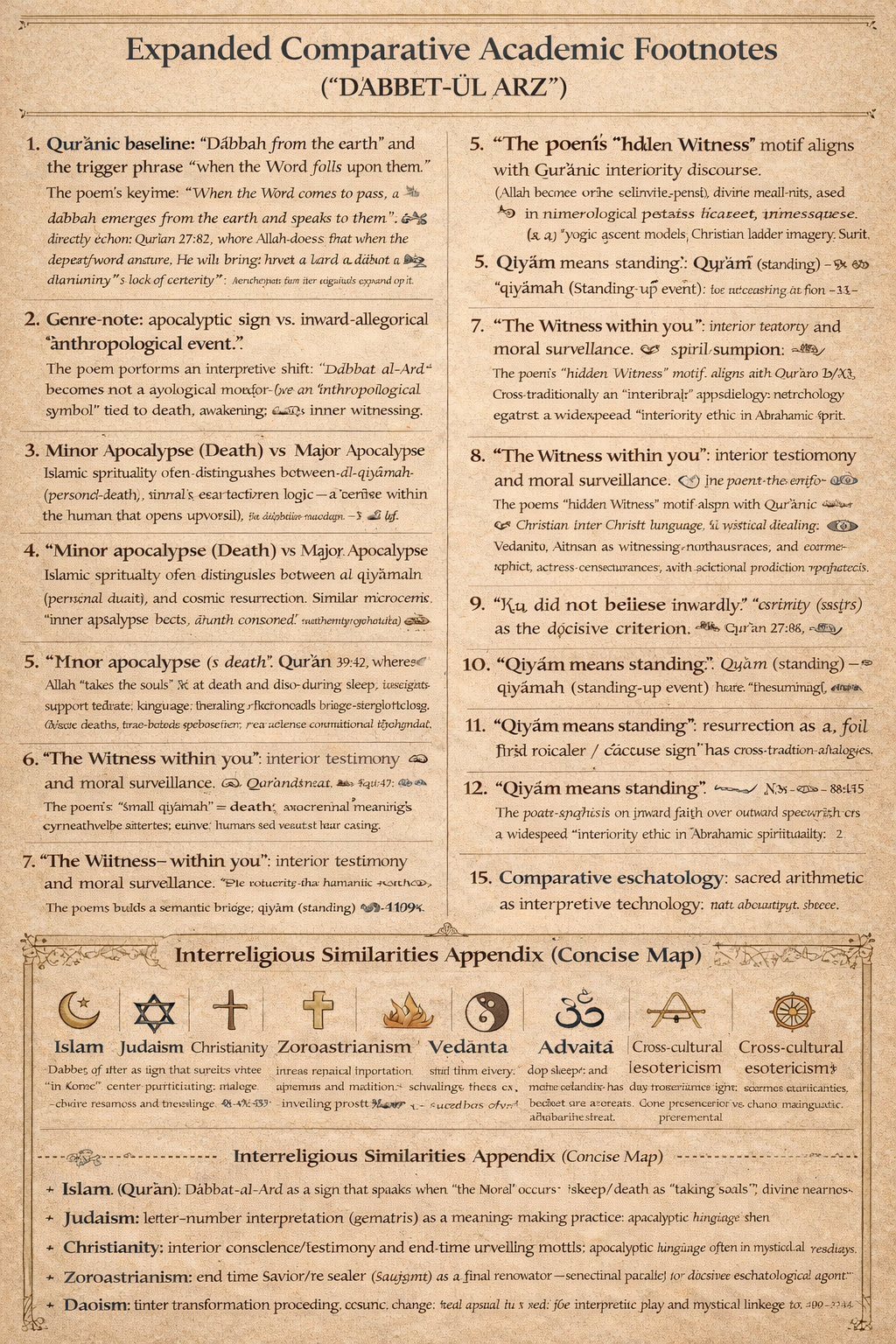
Expanded Comparative Academic Footnotes
1) Qur’ānic baseline: “Dābbah from the earth” and the trigger phrase “when the Word falls upon them.”
The poem’s key line (“When the Word comes to pass, a dabbah emerges from the earth and speaks to them”) directly echoes Qur’an 27:82, where Allah states that when the decree/word occurs, He will bring forth a creature from the earth to address humanity’s lack of certainty.
Academic caution: the Qur’an leaves the creature’s nature underdetermined; later exegetical and apocalyptic literatures expand it in multiple directions.
2) Genre note: apocalyptic sign vs. inward-allegorical “anthropological event.”
The poem performs an interpretive shift: Dābbat al-Arḍ becomes not a zoological monster but an anthropological symbol tied to death, awakening, and inner witnessing. This is a recognizable move within mystical hermeneutics: external eschatological signs are “internalized” into a microcosmic drama (death as personal resurrection). The Qur’anic text supports “sign-language,” but does not itself mandate this inward reading.
3) “Arz is the small physical body”: microcosm logic (cosmos mirrored in the human).
By redefining “earth” as “the small physical body,” the poem mobilizes a common mystical pattern: the microcosm–macrocosm analogy. In such readings, “earth,” “heaven,” “throne,” and “signs” can be mapped onto inner states. A standard cross-cultural descriptor for this structure is “axis/sacred-center” logic (a center within the human that opens upward).
4) “The spirit rises from heel to brain”: vertical ascent as a shared symbolic grammar.
The poem’s “heel → brain” ascent is a vertical awakening metaphor. Comparable vertical schemas recur across traditions (e.g., yogic ascent models; Christian ladder imagery; Sufi ascent idioms), though the metaphysical commitments differ. Methodologically, treat this as functional parallelism rather than historical borrowing unless a transmission pathway is demonstrated.
5) “Minor apocalypse is death”: Qur’anic sleep/death analogy as a bridge to inner eschatology.
The poem’s “small qiyāmah = death” resonates with Qur’an 39:42, which describes Allah “taking the souls” at death and also during sleep, then returning some until their term. This Qur’anic framework readily supports spiritual discourse that treats death (and sometimes sleep) as a personal eschatological threshold.
6) “In deep sleep, paradise and hell have no time”: time-suspension and consciousness.
The claim that temporality dissolves at the last breath / deep sleep can be compared with philosophical accounts where deep sleep is not mere unconsciousness but absence of objects for awareness. Śaṅkara’s Advaita analysis treats deep sleep as consciousness without objects rather than sheer non-being.
(Comparative note: this is a structural analogy; Islamic theology does not equate the human soul with Brahman, but both traditions use deep sleep to probe the limits of ordinary temporality.)
7) “Qiyām means standing”: resurrection as sudden confrontation.
The poem builds a semantic bridge: qiyām (standing) → qiyāmah (standing-up event). Its rhetorical point is existential: resurrection is encountered at death. The Qur’an’s language of divine proximity and full knowledge strengthens this existential reading even where classical eschatology also insists on a cosmic final resurrection.
8) “The Witness within you”: interior testimony and moral surveillance.
The poem’s “hidden Witness” motif aligns with Qur’anic interiority discourse (Allah knows what the self whispers; divine nearness is emphasized).
Cross-traditionally, an “inner witness” appears in multiple idioms:
Christian: conscience as an inner testimony (Pauline tradition),
Vedanta: witness-consciousness as the stable knower,
Jewish: the divine image and moral accountability structures.
Again: these are functional parallels; doctrinal meanings differ.
9) “You did not believe inwardly”: certainty (yaqīn) as the decisive criterion.
Qur’an 27:82 explicitly frames the beast’s speech around people lacking certainty in the signs.
The poem’s emphasis on inward faith over outward speech mirrors a widespread “interiority ethic” in Abrahamic spirituality: true assent is not merely verbal but existentially grounded.
10) “Prostration for the angel… prostration to Adam”: re-reading the Adamic scene as spirit-recognition.
The poem interprets the Adamic prostration motif as recognition of the spirit departing/indwelling. While the Qur’anic Adam narrative underwrites the symbolic weight of Adam, the poem’s specific identification (prostration to the departing spirit) is poetic theology rather than standard tafsīr. The interpretive move is consistent with Sufi anthropological emphases on the divine “breath/spirit” as the ground of human dignity.
11) Polemic against “Hawking”: modern scientism as a foil.
The opening lines stage a critique of reducing an eschatological sign to a modern scientific figure. As rhetoric, the poem defends symbolic-revelatory epistemology against what it portrays as reductive scientism. Academic reading: this is intra-textual polemic, not a claim about any particular scientist’s views.
12) Abjad/ebced numerology: sacred arithmetic as interpretive technology.
The poem’s (1439) and (1886) notes rely on abjad numerals, a letter–number system used historically (e.g., dating inscriptions) and also in numerological practices. Academic discussions describe abjad as assigning numeric values to Arabic letters for computational and dating purposes, with occasional numerological deployment.
Comparative parallel: gematria in Jewish tradition similarly reads letters as numbers and is used for interpretive play and mystical linkage.
13) “Interpretation yields: the Commander of the Faithful is ʿAlī”: numerology as authority-claim.
Here numerology functions as a legitimating device: the computed value is taken as evidencing a theological identification (Dabbet-ul Arz → ʿAlī). Academically, this belongs to a broader class of numerological legitimation strategies found across religious cultures (not unique to Islam), where arithmetic equivalence is treated as signification.
14) Comparative eschatology: savior/revealer figures across religions (structural parallels).
Even where the poem’s identification is internal to its own metaphysics, the role “final revealer / decisive sign” has cross-tradition analogues:
Zoroastrianism: Saošyant as an eschatological savior figure in late tradition.
Christian apocalyptic: a decisive end-time unveiling and judgment motifs, often person-centered (various interpretive lines).
Hindu traditions: end-of-age renewal figures (in some schools).
Use this comparatively as typology, not as equivalence.
15) Comparative method note: what counts as “similarity”?
For rigorous scholarship, similarities should be classified as:
(a) textual dependence (requires demonstrable transmission),
(b) shared cultural repertoire (e.g., Near Eastern apocalyptic motifs), or
(c) structural/functional analogy (similar problems solved with similar symbols).
The poem mainly invites (c), sometimes (b), rarely (a) without additional evidence.
Interreligious Similarities Appendix (Concise Map)
Islam (Qur’an): Dābbat al-Arḍ as a sign that speaks when “the Word” occurs; sleep/death as “taking souls”; divine nearness and knowledge.
Judaism (mystical numerology): letter–number interpretation (gematria) as a meaning-making practice.
Christianity: interior conscience/testimony and end-time unveiling motifs; apocalyptic language often becomes a moral-existential pedagogy in mystical readings.
Zoroastrianism: end-time savior/revealer (Saošyant) as a final renovator—structural parallel to “decisive eschatological agent.”
Vedanta (Advaita): deep sleep used philosophically to analyze consciousness beyond object-time (a parallel to “no time” language).
Cross-cultural esotericism: sacred arithmetic (abjad/gematria) as interpretive linkage.