GHAYB (UNSEEN)-1
GHAYB (UNSEEN)-1. ‘I alone know the Unseen!’—that is, I am the Unseen! Understand! I concealed My body by clothing it in humankind’s strand! The mirror is body; the reflection is imagined view! If you are not “Me,” I cannot speak this truth to you!
APOCALYPSE BOOK
UNSEEN-1
When a person dies, he goes to stand at reckoning’s gate,
‘O my Lord! Guard me from the fire, in Paradise place my fate!’
But one uncommon says: ‘In the mirror of the cosmos I see—
Show me its true Reality, O Father, unto me!’
‘I am weary of watching the “extension of shadow” cast!
For what I recall belongs to the Owner of that shadow vast!
Behind the Karagöz curtain stands my darkened eye;
When the candle was blown out, to my Owner did I cry!’
Hakk says: ‘Your image veils the mirror’s very face!
It is My unseen body—awake to this grace!
When your image is erased, it is not you but I who remain!
“Kâfir” means the coverer—your image is that veil’s chain!’
Pass beyond your copy! In the mirror it is the Light displayed!
The only One without image is He—Light is an honor made!
Like the mirror that shows without appearing to sight,
Mirror is Unseen, Light is Unseen—reflect on this secret bright!
Ehad is the mirror—Infinite, One alone!
Vahîd is the vision—finite, shown!
The sum of finites cannot make the Infinite, says algebra’s art!
What is itself imagination cannot define imagination’s part!
The inner is Me! The outer is Me! What are you? Where do you stand?
You are the curtain in the theater where Karagöz is played by hand!
‘I speak to My servants from behind that screen!’
Turn that curtain around—let your Essence say: “Welcome, serene!”
Know that I am neither in earth nor in sky!
Either I am, or earth and sky—cosmos is but a constructed cry!
World and afterlife too are dreams bound to time’s stream!
There is unbroken duration—‘I am the Immortal Being!’
That Immortal Being, the “Bâkî,” is your Inner Face within!
Enter it—your length and breadth become infinite therein!
‘The Paradise whose dimension is as heavens and earth’—this is that state!
Your axis now passes through My twin poles innate!
You become a Light of Muhammad–Âlî polarity bright!
At one pole is “Sekine (Shekinah),” at the other “Rûh” alight!
No longer a “green tree from which fire is kindled” you are—
But the “Tree of Sinai” that burns without burning—what honor by far!
For within you lies a shrine belonging to you alone!
Raise it upright—your regard reaches your RABB’s throne!
Seeing it, no desire in you will remain;
For it extends to you a Rope to yourself again!
‘I alone know the Unseen!’—that is, I am the Unseen! Understand!
I concealed My body by clothing it in humankind’s strand!
The mirror is body; the reflection is imagined view!
If you are not “Me,” I cannot speak this truth to you!
Not to the world, but to the “Earth” are we heirs indeed!
One who awakens in the world follows Earth’s true lead!
‘Other signs come for those who are raised!’—so it is told!
Not always “I, I,” but “We, We” in chorus bold!
With this message, Uluğ, I have now drawn my curtain wide!
‘When truth becomes clear, falsehood cannot abide!’
Though I unveil the secret, if society remains blind,
Truth will replace it—warn them, be kind!
Master M.H. Ulug Kizilkecili
Türkiye/Ankara - 10 April 1998
IMPORTANT NOTE :The original text is poetic, and the author cannot be held responsible for any errors in the English translation! To read the original Turkish text, click HERE! The following section is not the author's work, and the author cannot be held responsible for any errors made!
Comparative Footnotes (English Translation)
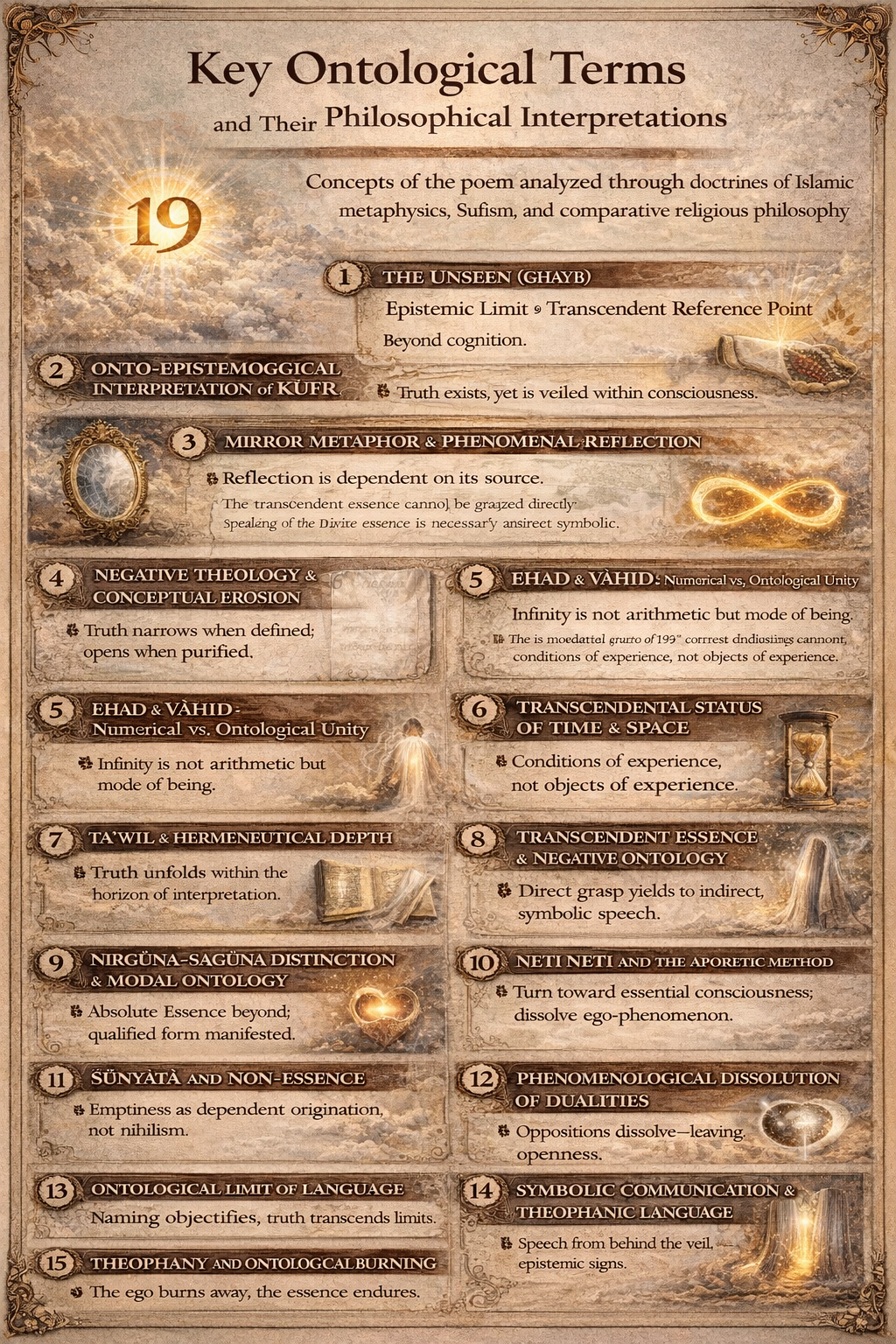
[1] The Unseen (Ghayb): Epistemic Limit and Transcendent Reference Point
The statement “Only I know the Unseen” does not imply absolute unknowability (agnosticism), but rather a claim of epistemic sovereignty. The Unseen is not ontological non-being; it is a referential level inaccessible to phenomenological experience. Here transcendence is not outside of being, but beyond cognition. Thus, the Unseen is positioned both as an ontological ground and as an epistemic boundary line.
[2] The Onto-Epistemological Interpretation of Kufr
The etymology “kāfir = one who covers” signifies not denial of truth, but its concealment. This marks the intersection of ontology and epistemology: truth exists (ontological reality), yet it is veiled within consciousness (epistemic closure). In the poem, appearance is not being itself, but the phenomenological shell that veils truth.
[3] The Mirror Metaphor and Phenomenal Reflection
The mirror implies not representation, but reflection. This distinction is crucial:
• Representation replaces the object.
• Reflection remains dependent on its source.
In the poem, “Light” (Nūr) functions as the condition of manifestation. The image is not being itself, but its mode of disclosure.
[4] Negative Theology and Conceptual Erosion
The statement “When the image is erased, not you but I remain” suggests that God cannot be confined by positive conceptual predicates. This is the essence of the apophatic method: every affirmative attribute risks objectifying the Divine. Thus, truth narrows when defined, and opens when purified.
[5] The Distinction between Eḥad and Vāḥid: Numerical vs. Ontological Unity
Eḥad denotes a non-numerical, ontological unity.
Vāḥid denotes mental or numerical singularity.
This distinction corrects the tendency to reduce absolute unity to quantitative monism. Infinity here is not arithmetic but a mode of being.
[6] The Transcendental Status of Time and Space
The proposition “Time is inner sense; space is outer sense” positions time and space not as ontic entities, but as categories of consciousness. Within a transcendental framework, time and space are conditions of experience, not objects of experience. Thus, the distinction between world and afterlife becomes not metaphysical spatiality, but a shift in conscious perspective.
[7] Ta’wīl and Hermeneutical Depth
The metaphor of the “veil” implies hermeneutical multilayeredness. The tension between the outward (ẓāhir) and inward (bāṭin) meaning is resolved within the triangle of text–meaning–reader. Truth unfolds not at the literal level, but within the horizon of interpretation.
[8] Transcendent Essence and Negative Ontology
The transcendent essence cannot be grasped directly. Speaking of the Divine Essence is necessarily indirect and symbolic. In negative ontology, this parallels the notion that the essence is without attributes and beyond rational comprehension.
[9] Nirguṇa–Saguṇa Distinction and Modal Ontology
The attributeless Absolute (nirguṇa) is independent of categorical predicates.
The qualified manifestation (saguṇa) is a mode of appearance directed toward consciousness.
This distinction clarifies the difference between ontological essence and phenomenal modality.
[10] Neti Neti and the Aporetic Method
The “neti neti” (“not this, not that”) method is an aporetic stripping process. One approaches the essence by dissolving false identifications. The poetic call to “leave the shadow” signifies turning toward essential consciousness through the dissolution of the ego-phenomenon.
[11] Śūnyatā and Non-Essence
The expression “the universe is fiction/illusion” parallels the idea that beings lack independent essence (svabhāva). Emptiness here is not nihilism; it is the doctrine of dependent origination.
[12] The Phenomenological Dissolution of Dualities
World–afterlife, inner–outer dichotomies are not ontological absolutes but perspectives of consciousness. At the ultimate level, oppositions dissolve, leaving openness.
[13] The Ontological Limit of Language
Naming objectifies. Language points to truth; it is not truth itself. The moment truth is named, it enters conceptual limitation. The poem is aware of this boundary.
[14] Symbolic Communication and Theophanic Language
Speech from behind the veil is not direct ontological contact but a symbolic interface. Revelation is not literal discourse but a system of signs. This points toward a mythopoetic epistemology.
[15] Theophany and Ontological Burning
“Fire” here is not physical, but an event that transforms being-consciousness. The paradox “burning without being burned” expresses the dissolution of the ego without harm to the essence. Theophany is a change in mode of being.
[16] Permanence (Baqāʾ) and Inner Teleology
The concept of the “abiding inner face” situates permanence not in external duration but in inner teleological orientation. Baqāʾ is not the extension of time but the stabilization of essence.
[17] The Transition from “I” to “We” and Ontological Participation
Ego-centered subjectivity gives way to participatory ontology. The language of “we” represents the shift from individual consciousness to cosmic unity-consciousness.
[18] Infinity and the Critique of Quantity
The proposition “The sum of finite things does not produce infinity” expresses that quantitative increase does not generate ontological leap. Infinity is not measurement but qualitative transcendence.
Advaita (Advaita Vedānta) — English Translation
1. Conceptual Definition
Advaita comes from the Sanskrit word a-dvaita and means “non-dual” or “not two.” In Indian philosophy it was systematized especially within the school of Advaita Vedānta. According to this teaching, the ultimate reality is Brahman, which is absolute, indivisible, and without attributes. The individual self (Ātman) and the absolute reality (Brahman) are essentially one.
Fundamental proposition:
Ātman = Brahman
This equality does not deny the experiential multiplicity of the world; rather, it asserts that multiplicity is a mode of appearance in consciousness, not ultimate ontological reality.
2. Ontological Structure
Advaita presents a three-level understanding of reality:
Paramārthika satya (Absolute reality)
Only Brahman is real. It is unchanging, infinite, and timeless.Vyavahārika satya (Empirical/functional reality)
The world is experientially real, but not ultimate.Prātibhāsika satya (Illusory level)
Dreams, imagination, and misperception.
This structure shows a strong structural parallel with poetic expressions such as:
“ The universe is a constructed expression.”
“ The world and the hereafter are temporal imaginings.”
3. Nirguṇa–Saguṇa Distinction
In Advaita, Brahman is approached in two ways:
Nirguṇa Brahman → Without attributes, indefinable, transcendent.
Saguṇa Brahman → The qualified conception addressed to human cognition.
Lines such as:
“ The only One without image is He.”
“ The mirror is unseen, the Light is unseen.”
parallel the Nirguṇa understanding. Everything visible belongs to the Saguṇa level; the essential reality is the attributeless source.
4. The Concept of Māyā
One of Advaita’s central concepts is Māyā. Māyā:
Is not non-existence.
Is not absolute reality.
Is the veiling power over consciousness.
This corresponds to poetic lines such as:
“ Kāfir means one who covers.”
“ Your image veils itself upon the mirror.”
Here “veiling” is an epistemic condition; truth has not disappeared, but perception is obscured.
5. The Method of Neti Neti
In Advaita, the method of reaching truth is:
Neti neti (“Not this, not that.”)
One strips away layers of identity:
I am not the body.
I am not emotion.
I am not mind.
and turns toward the essence.
Expressions like:
“ Go beyond your copy!”
“ I am weary of watching the shadow extension.”
resemble this movement of stripping away.
6. Liberation Through Knowledge (Jñāna)
In Advaita, liberation (mokṣa) comes:
Not through ritual,
Not through belief alone,
But through direct realization (jñāna).
The line:
“ When your image is erased, not you but I remain.”
suggests the dissolution of the individual ego and abiding as pure consciousness.
7. Points of Convergence with Islamic Sufism
In Advaita, ultimate reality is called Brahman; in Sufism, a comparable term is al-Ḥaqq (the Real). In both traditions, this refers to the ultimate and transcendent ground of being.
Advaita expresses individual consciousness through Ātman; Sufism uses the concept of Rūḥ (spirit). The identity of Ātman and Brahman parallels the Sufi notion that the spirit comes from the Real and turns toward it—though ontological interpretations differ between the traditions.
Advaita’s Māyā corresponds functionally to the Sufi concept of the Veil (ḥijāb). The veil does not imply absence of truth, but obscuration of perception.
The Advaitic method neti neti resembles nafs purification (tazkiyat al-nafs) in Sufism. Both involve stripping away false identifications.
Liberation in Advaita (mokṣa) corresponds in some respects to fanāʾ–baqāʾ in Sufism:
Fanāʾ → dissolution of ego.
Baqāʾ → abiding in the Real.
In both traditions, the ultimate aim is the transcendence of limited self-consciousness.
The poem’s shift from “I” to “We” resonates with Advaita’s dissolution of the individual ego. However, Sufism does not entirely erase relationality (Lord–servant). In Advaita, duality ultimately disappears completely.
8. Fundamental Differences
Concept of Creation
In Advaita, creation is not an absolute ontological rupture but a level of appearance.
In Islam, creation is a real divine act.God–Individual Relation
Advaita emphasizes identity.
Islamic theology emphasizes nearness (qurb), not ontological identity.Concept of Revelation
In Advaita, revelation is not central; knowledge is inner realization.
In Islam, revelation is an ontological authority.
9. Deep Ontological Parallels with the Poem
In the poem, the movement is:
Image → Veil → Covering → Essence revealed.
In Advaita:
World → Māyā → Removal of Māyā → Realization of Brahman.
Both systems center on transformation of consciousness.
They tend toward radical monism,
render phenomena ontologically secondary,
and locate truth not in conceptual definition but in direct realization.
Sinai and the Symbolism of Fire
“Not a green tree set ablaze,
You are the ‘Tree of Sinai’ that burns without burning!”
This expression points not to a merely historical event, but to the metaphysical core of the tradition of theophany (divine manifestation). Sinai and fire should therefore be read as modes through which transcendent truth becomes perceptible.
1. The “Burning Bush” in Jewish Tradition
In the Torah narrative:
• Moses sees a bush that burns yet is not consumed.
• There is fire, yet the object does not perish.
• God is unseen; the fire is visible.
This scene contains three fundamental symbols:
Transcendence – God does not become directly objectified.
Mediation – Fire is the visible form of truth’s manifestation.
Transcending contradiction – There is burning without consumption, implying a reality beyond natural law.
Fire here is not physical energy, but the phenomenological interface of divine speech.
2. Tūr and Light in Islamic Tradition
In the Qur’anic account, Moses sees a fire and approaches it. At its location, sacredness is proclaimed. Yet:
• Moses sees the fire.
• He does not see God.
Fire here is:
• Not the divine essence,
• But the sign of divine address.
This corresponds to the phrase “burning without burning.” The fire is not material combustion; it is consciousness set aflame.
3. The Paradox of “Burning Without Burning”
Physical fire consumes matter and produces heat. Its effect is material and transformative in physical terms.
Metaphysical fire, however, transforms consciousness. It does not burn matter, but dissolves ego-centered structures. It produces awareness rather than heat; expansion of consciousness rather than material consumption.
Thus:
Physical fire burns objects.
Metaphysical fire transforms the inner structure of the human being.
In this sense, the “Tree of Sinai” is:
• Not a physical tree,
• But the center of consciousness where divine manifestation occurs.
4. Parallel with Advaita
In Advaita, when Māyā is lifted, truth is revealed.
The fire at Sinai similarly represents:
• A rupture in perception that lifts the veil.
• Not direct apprehension of the Absolute,
• But readiness for revelation.
However, an important distinction remains:
• Advaita emphasizes ontological identity.
• The Sinai narrative preserves the distinction between God and servant.
5. Fire and Spirit in Christianity
In the Pentecost narrative, “tongues of fire” appear:
• Fire is associated with revelation and Spirit.
• Illumination, not destruction, is emphasized.
Fire becomes a symbol of spiritual awakening.
6. Sufi Interpretation
In Sufism, Sinai symbolizes:
• The heart as the locus of manifestation,
• The place where divine light descends.
The line:
“No longer a green tree set ablaze,
You are the Tree of Sinai that burns without burning!”
internalizes Moses’ external experience.
Sinai ceases to be geography;
it becomes a space of consciousness.
7. Ontological Interpretation
Fire operates on three levels:
Sensory level – Visible light.
Consciousness level – A call to truth.
Metaphysical level – The threshold where essence becomes manifest.
The poem directs attention toward the third level.
8. Conclusion
The symbol of “Sinai and fire”:
• Is not a direct representation of truth,
• But the threshold of passage toward truth.
• “Burning” symbolizes dissolution of ego.
• “Not being consumed” symbolizes the permanence of essence.
Thus, Sinai in the poem is:
• Not a historical mountain,
• But a theophanic moment within human consciousness.
The Sinai – Light – Unseen (Ghayb) Triadic Metaphysics
This analysis situates the poem’s concepts—“Tree of Sinai,” “burning without burning,” “Light,” and “Unseen”—within a single ontological structure.
I. The Three Fundamental Layers
1️⃣ The Unseen (Ghayb) — The Realm of Absolute Transcendence
• Incomprehensible.
• Unrepresentable.
• Not directly phenomenal.
• The ontological source level.
The Unseen should not be conceived as God’s essence objectified, but as the dimension beyond perception.
2️⃣ Light (Nūr) — The Principle of Manifestation
• The threshold of the Unseen’s appearing.
• Not the essence itself, but its unfolding.
• Not a mediator, but a revealing principle.
• Transformative of consciousness.
Light reveals without itself being fully seen.
Here the symbol of fire becomes operative.
3️⃣ Sinai — The Theophanic Space
• Not geography, but a threshold of awareness.
• The place where truth finds resonance in the human being.
• The experiential level.
Sinai is not an external mountain, but an inner event of divine contact.
II. Metaphysical Flow
Unseen (Ghayb)
↓
Light (Nūr)
↓
Sinai (Threshold of Consciousness)
↓
Transformation of Awareness
Important distinctions:
• The Unseen does not change.
• Light manifests.
• Sinai opens when the human being is ready.
III. Ontology of the “Burning Without Burning” Paradox
Fire may be read in two ways.
“Burning without burning” means:
• Truth does not destroy essence.
• It burns false identification.
• It melts the shell of ego.
• It reveals the inner core.
Thus the “Tree of Sinai”:
• Does not burn → essence remains.
• Burns → ego dissolves.
IV. Three-Stage Transformation of Consciousness
Stage 1: Appearance
Fire is seen as an external phenomenon.
Stage 2: Sign
One realizes that fire points beyond itself.
Stage 3: Interiorization
Sinai occurs not outside, but within consciousness.
V. Comparative Interreligious Structure
In Judaism, transcendence is understood as God’s essence. It manifests symbolically in the burning bush; the locus of experience is Sinai.
In Christianity, transcendence centers on God and manifests as the Holy Spirit symbolized by fire; the locus of experience becomes inward spiritual transformation.
In Islam, transcendence is expressed as the Unseen (Ghayb). It manifests through Light (Nūr). The experiential locus appears in both Tūr and the heart.
In Advaita, transcendence is Brahman. It manifests as pure awareness. The locus of experience is inner realization rather than geography.
VI. Metaphysical Depth in the Poem
The poem:
• Transforms Moses’ experience from historical narrative into ontological model.
• Places Sinai within the human inner center.
• Interprets fire as revolution of consciousness.
Thus:
Sinai = Mountain of Consciousness
Fire = Light
Burning = Dissolution of ego
Unburnedness = Permanence of essence
VII. Final Synthesis
The triad “Sinai – Light – Unseen” represents:
• Transcendence (Ghayb)
• Manifestation (Nūr)
• Threshold of realization (Sinai)
It is not a story about geography.
It is a map of consciousness.
Phenomenological Analysis of the Sinai–Nūr–Ghayb Triad (Husserl & Heidegger Perspectives)
I. Husserl’s Perspective: Appearance and Intentionality
1️⃣ Consciousness Is Always Directed Toward Something
According to Husserl, consciousness is:
“Always consciousness of something.”
Within this framework:
• Fire → the phenomenon appearing in consciousness
• Ghayb (the Unseen) → the noematic horizon behind the phenomenon
• Nūr (Light) → the illuminating structure that makes appearing possible
2️⃣ The Distinction Between Phenomenon and Essence
Husserl proposes turning “to the things themselves” (zu den Sachen selbst).
Yet phenomenology accepts this:
• What appears → is only what is given in consciousness.
• Essence → remains concealed within the horizon of the phenomenon.
In the poem, fire is placed as the directly seen and experienced element; in phenomenology, the corresponding concept is the phenomenon. Fire represents the appearance that shows itself in consciousness.
In the poem, Ghayb signifies the transcendent dimension behind what is visible; phenomenologically, this can be thought of as the horizon of the phenomenon. That is, everything that appears rests upon a horizon of meaning that exceeds it and can never be fully exhausted.
In the poem, Nūr is the principle that makes appearing possible; phenomenologically, it can be understood as the condition of visibility. Nūr is the illuminating ground that allows the phenomenon to show itself; it is not itself a direct object, but it makes the object’s appearing possible.
3️⃣ Epoché and the Veil
Husserl’s epoché (bracketing):
• Suspends the natural attitude.
• Approaches things purely as appearances.
The expressions:
“Kopyandan geç!” (“Pass beyond your copy!”)
“Gölge uzantısını seyretmekten usandım!” (“I am weary of watching the extension of the shadow!”)
resemble the gesture of bracketing natural assumptions about the self.
II. Heidegger’s Perspective: Aletheia (Truth as Unconcealment)
For Heidegger, truth is not correctness but unconcealment (Unverborgenheit).
1️⃣ Hiddenness and Openness
Ghayb → what is hidden
Nūr → unconcealing / bringing-into-the-open
Sinai → the event of unconcealment
In Heidegger, truth is an event (Ereignis).
Sinai, too, is not a historical event but an ontological “moment of disclosure.”
2️⃣ The Call of Being
Moses sees the fire → turns toward it → hears the call.
In Heideggerian terms, this can be read as:
• the call of Being
• the response of Dasein (the human being)
III. A Phenomenological Reading of “Burning Without Burning”
Physical fire:
• Produces heat.
• Burns the object.
Phenomenological fire:
• Shakes consciousness.
• Dissolves the ego-centered structure.
• Transforms the understanding of Being.
IV. The Phenomenological Model of the Triadic Structure
A. Pre-understanding (Natural Attitude)
Fire is seen as a physical object.
B. Disruption
The fire is not consumed → the natural explanation collapses.
C. Unconcealment
Truth opens in a way that cannot be reduced to the visible object.
This parallels Heidegger’s thought: “Being reveals itself by concealing itself.”
V. Interreligious Ontological Intersection
A phenomenological reading shows:
• In Judaism → Sinai is a theophany.
• In Islam → Ṭūr is a threshold of Nūr.
• In Christianity → Fire is the coming of the Spirit.
• In Advaita → The absolute awareness of consciousness.
Common structure in all: the hidden → opens through a visible sign.
VI. The Poem’s Ontological Level
• It is not narrating myth.
• It is symbolizing an event of consciousness.
• It constructs Sinai as an inner Ereignis (event of disclosure).
• It interprets Ghayb not as non-being, but as hiddenness.
• It positions Nūr not as information, but as the condition of visibility.
Therefore:
Sinai = the event of disclosure
Nūr = the possibility of disclosure
Ghayb = the hidden horizon of disclosure
Jungian Archetypal Analysis of the Sinai–Fire–Ghayb Triad
I. The Fire Archetype: Transformative Energy
According to Jung, fire in the collective unconscious symbolizes:
• Transformation
• Purification
• A leap in consciousness
• Inspiration
Its destructive side threatens the ego and shakes the established structure of identity. It breaks the sense of control; by dismantling the familiar zone of safety, it opens a crack in consciousness.
Its transformative side, however, does not annihilate the ego but erodes it. It loosens rigid boundaries of the self and expands awareness. Loss of control is not destruction here, but the beginning of deeper insight.
The phrase “the Tree of Sinai that burns without burning” represents this second aspect of fire: not a consuming fire, but a consciousness-opening fire.
II. Sinai as “Numinous Experience”
Jung calls sacred experience numinous:
• A mixture of fear and awe
• Shaking the structure of consciousness
• An encounter with the transcendent
Moses’ experience of the fire is a typical numinous event.
Sinai is:
• Not a historical place,
• But an archetypal moment of rupture within consciousness.
This rupture is a transition from ego-centered consciousness to a wider self-awareness.
III. Ghayb as the Self Archetype
One of Jung’s central concepts is the Self archetype.
The Self:
• Is the wholeness of consciousness and the unconscious.
• Is larger than the ego.
• Is the psychological structure closest to the image of the divine.
Within a Jungian frame, Ghayb is:
• Ungraspable by consciousness,
• Yet guiding the personality,
• A central field of wholeness.
The line “When your image is erased, it is not you but I who remains” aligns with the ego dissolving and the Self becoming central.
IV. Fire and Individuation
For Jung, the human aim is individuation.
This process involves:
The dissolution of the persona
Confrontation with the shadow
The ego ceasing to be the center
The Self becoming the center
Fire here:
• Burns the persona,
• Makes the shadow visible,
• Transforms the ego.
“Burning without burning” describes the ego’s “death” without harm to the core essence.
V. The Symbol of the Tree
In Jung, the tree symbolizes:
• The axis of life (axis mundi)
• A bond between earth and heaven
• A bridge between consciousness and the unconscious
The Tree of Sinai can be read as:
• Roots in the earth,
• A consciousness-axis reaching upward
So in the poem, the “Tree of Sinai” is:
• Not an external plant,
• But a psychological vertical axis.
VI. The Archetypal Power of the Paradox
There is burning → yet no consumption.
This paradox means:
• Consciousness expands,
• The ego contracts,
• The essence strengthens.
For Jung, archetypal experiences always contain paradox, because consciousness cannot hold the unity of opposites at once.
VII. The Threefold Archetypal Model
Within a threefold archetypal model, the poem’s concepts find Jungian correspondences. The poem’s Ghayb can be thought of—similar to Jung’s Self—as a comprehensive center embracing both consciousness and the unconscious. The Self is larger than the ego and represents wholeness; Ghayb likewise functions as a transcendent center exceeding individual cognition.
The poem’s Nūr corresponds, in Jungian terms, to the illumination of consciousness: the bringing of unconscious contents into awareness and the expansion of psychic wholeness. Nūr is the opening of visibility and understanding.
Fire can be interpreted as transformative psychic energy. In Jung’s view, this energy shakes the ego-centered structure and presses the person toward deeper integration. Fire here is not destructive but transformative.
Finally, Sinai represents the threshold of individuation: the moment of rupture when the ego ceases to be the center and the Self begins to take its place. Sinai is not so much a historical location as a psychological threshold of transformation.
VIII. A Shared Archetype Across Religions
The fire archetype is universal:
• Moses’ bush
• Pentecostal fire
• Zoroastrian sacred fire
• Vedic Agni
• Shamanic fire purification
In all of these, fire symbolizes:
• Divine communication
• Purification
• The elevation of consciousness
IX. Conclusion
The poem’s Sinai-and-fire metaphor:
• Is more than a theological narrative.
• Is an archetype of transformation at the level of the collective unconscious.
• Symbolizes the dissolution of the ego,
• And the Self becoming central.
Therefore:
Sinai = the psychic axis
Fire = transformative archetypal energy
Ghayb = the transcendent center of the Self
Mount Sinai in the Torah
Mount Sinai occupies a central place in the Torah as the site where divine revelation was given to the Israelites and where the covenant was established. It is mentioned primarily in Exodus, Leviticus, Numbers, and Deuteronomy. In some passages the text refers to the “Wilderness of Sinai,” in others to “Mount Sinai,” and in some cases simply to “the mountain,” though the context clearly identifies it as Sinai. The name Horeb is also used, often understood as referring to the same location.
In the Book of Exodus, Moses comes to “the mountain of God” at Horeb while tending the flock of his father-in-law (Exodus 3:1). After the Israelites leave Egypt, they arrive in the Wilderness of Sinai in the third month and encamp before the mountain (19:1–2). The Lord descends upon Mount Sinai; the mountain is covered in smoke, accompanied by thunder, fire, and the sound of a trumpet (19:18–20). The Ten Commandments are proclaimed there (20:1–17). Moses remains on the mountain for forty days and forty nights (24:18). After the incident of the golden calf, he ascends Sinai again (34:2–4). Exodus 31:18 states that the tablets of testimony were given to Moses on Mount Sinai.
The Book of Leviticus repeatedly emphasizes that the laws were given at Sinai. It opens by stating that the Lord called to Moses and spoke to him from the Tent of Meeting at Sinai (Leviticus 1:1). Other references (7:38; 25:1; 26:46; 27:34) affirm that the commandments and statutes were delivered on Mount Sinai.
In the Book of Numbers, the Israelites are described as encamped in the Wilderness of Sinai, where the Lord continues to speak to Moses (Numbers 1:1; 3:1, 14; 9:1, 5). Later, the people depart from the Wilderness of Sinai and set out toward the Wilderness of Paran (10:12).
The Book of Deuteronomy recalls the events at Sinai (often using the name Horeb) in retrospect. Deuteronomy 1:6 notes that the people had stayed long enough at Horeb. In 4:10–15, Moses reminds them how the Lord spoke out of the fire at Horeb. In 5:2–4, it is stated that the Lord made a covenant with Israel at Horeb.
In summary, according to the Torah, Mount Sinai is the central site of revelation: the place where the Ten Commandments were given, the covenant established, the law proclaimed, and the divine manifestation experienced in power and awe.