HANIF RELIGION
HANIF RELIGION. Each Name is a different mirror reflecting Lord anew; Seeing His own face cast Lord into love’s view. To every Name He gave existence suited to its nature; Each received what it desired from eternity’s signature.
APOCALYPSE BOOK
HANIF RELIGION
PHOTO LORD
Since he said, “Every name of ALLAH is within me!”
With a “complex of height,” “ADAM slipped from Heaven!”
What existed within himself he thought was truly his own!
While in eternity he had sworn: “LÂ ILÂHE ILLÂLLAH!”
We fear death thinking, “We shall vanish away!”
Yet we were never truly existent — why fear the division anyway?
Our origin’s name is Lord — we are but a photocopy!
In infinite geometry, neither circle nor pi are we!
When a photograph is taken, only the poser lives;
The photo itself is dead — “a mere imitation,” says the sage.
The one who takes the photo stands beneath the light;
Its negative dries in darkness, hidden from sight.
Then that negative returns again into the light;
From it emerges a pale, lifeless copy in white.
The living poser — that is our essence in Paradise;
With MUHAMMED’s light there, our vision shines.
The “negative” is the soul in the dark place called hell;
It turns white the moment it falls into the world’s spell.
The light of this world imitates the primordial Light;
All is counterfeit — honor lies in not forging the right.
When we sleep, our spirit ascends above;
When we wake, we witness an open-eyed dream thereof.
As in a dream no one exists but ourselves alone,
We are garments — extras in the dream of the Lord.
“Filled with exaltedness” — the “Council of the Sublime”;
The pen of Lord filled it with points in time.
The command “Be!” written by that pen is always a dot;
And the dot is zero — meaning existence is not.
THE MIRROR
When you look into the mirror and see your face,
The mirror disappears — so too the cosmic space!
Seeing your image makes the mirror an illusion;
Even the revealer of illusion is illusion — take this as conclusion!
In ALLAH exist countless names without form;
To know Himself, from ALLAH they request a body to be born.
Once embodied, the name becomes the “Existent”;
Leaving eternity, its “birth” becomes persistent.
You are existent; Lord is Existence; ALLAH is the only God!
The existent is that which is embodied — the Embodier is ALLAH.
He is not embodied, so that He might die;
There is no other existence to divide the One Most High.
Multiply one by one or divide it again — the same remains;
Nothing increases, nothing decreases — itself sustains.
Light countless candles from the first flame — it loses no fire;
What the first candle gave remains a mystery entire.
ALLAH is like the first candle — giving existence to the existent;
Yet His own Existence remains independent.
One plus its mirrored form becomes two;
The mirror makes the Alif become the letter “B” anew.
The mirror becomes secret when the form appears;
For within the form hides the realm called “EL-GHAYB,” veiled for years.
Within our form lies the spirit named El-Ghayb;
To reveal it outward is the servant’s sacred jihad.
The spirit bears many names, yet one meaning they share:
“Levh-i Mahfuz,” “Lord’s dye,” “HANIF FAITH,” the Noble Face fair.
However luminous, the spirit too holds a form;
The hidden El-Ghayb within is called ÂLÎ MUHAMMED.
If MUHAMMED ÂLÎ is the veil of the Supreme Unseen,
Those who call it merely “ALLAH” miss what lies between.
ALLAH’s unseen is the Essence — words cannot convey;
Even ALLAH cannot see Himself with an eye’s array.
Unable to behold His Essence, ALLAH creates mirrors instead;
In the Names He sees Himself — to Himself bows His head.
THE NAMES
The body of the Lord consists only of Names;
The existent prostrates through its own name’s claims.
Existence belongs to Him — your share is merely the name;
To say “I am that ALLAH” is beyond any being’s claim.
Names are the senses of the Lord — coloring His sight;
Through these Names the Lord sees, hears, and feels the light.
In humans the situation reverses — you are the eye, ALLAH the Seer;
If you say “I see,” you make yourself a deity here.
Each Name is a different mirror reflecting Lord anew;
Seeing His own face cast Lord into love’s view.
To every Name He gave existence suited to its nature;
Each received what it desired from eternity’s signature.
DESTINY
To cast your fate upon ALLAH is a shame indeed!
Your Name — your essence — like ALLAH, shall ever be!
Blame no one in this world except your own self;
For each one acts by the command of their inner wealth.
Lord invited the unbeliever toward faith — but why?
So his character may appear beneath the sky!
Break the cage! Every creature runs toward its land;
The serpent crawls on earth — the eagle soars by command!
The soul stands between light and fire — when death is near,
It divides between Spirit and jinn, portioned clear.
This is the second death — the soul splits in two;
The hardest of trials — you reap what you pursue!
Its selfish side melts with Iblîs within the flame;
Its purified side greets Paradise in the Spirit’s name.
Your Name desired a body to know itself true;
He granted you existence — eternal became you!
The knowledge of Lord does not grow to create anew;
Nor does He correct mistakes and cast them from view.
Whatever His essence is — whatever lies within,
He intensifies it only; no change lives in this din.
Thus, even for Lord, religion is knowing the core;
Islam is surrender — opening the inner door.
ALLAH knew His essence and intensified His Name;
Know your own essence — turn your body into Lord’s flame!
When every atom in humanity finds its origin bright,
Earth returns to its source — the eye receives the Light!
UNITY AND DUALITY
The Names that are the body of Lord are supremely abstract;
They know not themselves — only Lord in fact!
Thus in that station no “you and I” war remains;
Like water without knots — unity sustains.
The Name reflects unchanged into a lower mirror;
There the Spirit appears — beginning to shine clearer!
Here is the realm of togetherness — where duality starts;
“Am I not your Lord?” He asks every spirit’s hearts!
While asking this question, Lord appears as Adam’s guise;
Not the earthly Adam — but “Abu-t-Turab” who lies.
The Spirit sees Rahman and answers at once, “Yes!”
For no body yet veils that closeness’ address.
The child receives from the father the giver’s decree;
Even Lord bows to this immutable key.
There is no worshiped one if none exist to adore;
The Spirit’s humble state becomes the protector of Lord.
DEVIATING FROM YOUR ESSENCE
Spirit and Lord stand like mirrors face to face;
In each reflection appears an Adam-like trace.
The Spirit reflects downward — becoming an angelic form;
Its only longing: to descend to the earthly storm.
For denser beings called jinn whisper into its ear:
“You shall be free on Earth — no sorrow, no fear!”
The pure soul falls from Heaven believing the jinn’s voice;
The jinn shapes a body and enters the blood by choice.
The soul is born into this realm like the weakest beast;
Exiled from its homeland — the strangest of the least.
Yet Lord shows mercy even to this fragile being;
He tells the Spirit: “Enter the heart unseen.”
REPENTANCE
To bring forth the testimony of faith anew,
You were given a span of life to pass through.
If you bear witness to what you have never seen, prison becomes your fate;
They place you in darker chains — vile and desolate.
Until you remember what you saw in the Primordial Oath,
You cannot unite with your essence — neither wedding nor growth.
“Islam is strange,” says the Messenger — our essence longs for home;
It watches the path endlessly — wishing we would roam.
This is “to be or not to be” — the greatest secret known;
To save you, Lord reflects Himself down to your own.
THE PRESCRIPTION OF FORGIVENESS
Light is required to see what reflects in the mirror;
If dirt remains, the image appears unclear.
First cleanse your heart from every selfish desire;
Let your mirror escape the prison of fleshly attire!
Then illuminate it with the Light of MUHAMMED’s flame;
So the family called “ÂL-İ AB” appears in name.
“MUHAMMED ibn Abdullah” — ALLAH’s Name of “THE LIGHT”!
He is the “Light of the heavens,” illuminating all sight!
“All Names” are but the names of essences in Lord’s decree;
Their forms resemble the Household of Purity.
If the mirror leaves the body — death, a minor doom;
Its leaving the cosmos signals the Great Day’s bloom.
If the one who gazes departs from the cosmic sea,
It becomes the cause of returning to ALLAH’s Essence free.
If you press your face upon the mirror, your face you cannot see;
Remember Sinai’s warning: “Do not come too close to Me!”
At a measured distance stand two mirrors — He and you;
Face to face appears the “beautiful face” — Lord is your robe anew!
The Qur’an says human is twin — the Book and the man;
“When two seas meet, pearls and coral began!”
Lord’s Name is “Believer,” and the servant’s name the same;
Seer and seen are one — Adam’s hidden aim.
You are the same being as the essence you see;
The eye that looks into the mirror looks back through thee.
Like mirrors we are — one with One, many with the many;
We exist by borrowed being — with Lord we are none, if any.
“Return trusts to their owners,” Lord declares;
Who claims ownership of existence betrays what he bears.
Adam’s exile came from insisting on existence’s claim;
The difference of Being and existent — ALLAH’s secret flame.
Existents are many and limited — Being is One and boundless;
Water above is vapor — below becomes ice motionless.
Even beyond hydrogen and oxygen’s frame,
Existence still confines water — remaining the same.
MIRROR
The moment you gaze into the mirror and see your face,
The mirror disappears — just like the cosmic space!
When you behold the image, the mirror becomes a dream;
And that which shows the dream is itself a dream — take heed of what you’ve seen!
Within Allah exist countless bodiless Names;
To know Himself, He seeks a body through forms and frames.
Once embodied, it is called the “Existent” in name;
Leaving Eternity behind, its birth begins its claim.
You are the existent — Lord is Being — Allah the only God!
The existent is what’s embodied; the Embodier is Allah alone, unflawed.
He is not the one embodied, to be born and then to die;
There is no other Being to divide this single sky.
Multiply one by one, or divide one into one — the same remains!
Nothing increases or decreases; only itself sustains.
Light countless candles from the first — its flame does not decline;
What the first candle gave to ignite — no one can define!
Allah is like that first candle — granting Being to the existent;
Yet His own Being never becomes distant.
One plus its image in the mirror becomes two;
The mirror transforms Alif into “B” — a partner reflected in view.
The secret mirror becomes mystery when the form appears;
Within the form lies the realm called “Al-Ghayb” through the years.
The hidden Unseen within our form is the Spirit’s name;
To bring it outward is the servant’s sacred aim.
The Spirit has many names, yet their meanings are the same:
“Levh-i Mahfuz,” “Lord’s Dye,” “Hanîf Din,” the Exalted Face’s flame!
However luminous the Spirit may be, still a form it bears;
The Hidden Unseen within the Spirit is called Âlî Muhammed in sacred layers.
If MUHAMMED is Âlî, he veils the Greatest Unseen;
These are Lord — yet saying “Allah” wrongly brings loss unseen.
The Unseen of Allah is the Essence — words cannot explain;
Even for Allah it remains a secret — unseen by the eye again.
Unable to behold His Essence, Allah creates mirrors anew;
Seeing Himself within the Names, He bows to His own view.
NAMES
For the body of Lord is composed of Names alone;
The existent prostrates through its own Name to the Throne.
Being belongs to Him — only your Name is yours;
To claim “I am that Allah” exceeds all rightful shores.
Names are the senses of Lord — they color His sight;
Through these Names He sees, hears, and feels the light.
In humanity the situation is reversed — understand the path:
You are the eye, yet the One who sees is Allah!
If you say, “I am the seer,” you crown yourself divine;
Each Name is a different mirror — reflecting Lord in design.
To see His own face plunged Lord into love’s embrace;
Each Name received Being according to its primordial grace.
DESTINY
To place your destiny upon Allah is a shame;
Your Name — your essence — like Allah, forever remains.
Blame no one in this world except yourself alone;
Each follows the command of the Name they’ve grown.
Lord invited the unbeliever toward faith — why so?
So their character might appear in the world below.
Break the cage — every creature runs to its domain;
The serpent crawls on earth — the eagle rides the plain!
The soul stands between light and fire — when death draws near,
It divides between Spirit and jinn, portions made clear.
This is the second death — the soul splits in two;
The hardest of trials — you reap what you pursue.
Its selfish side melts with Iblîs within the flame;
Its purified side greets Paradise in the Spirit’s name.
Your Name sought a body to know itself true;
He granted you existence — eternity became you!
The knowledge of Lord does not grow to create anew;
Nor does He discard mistakes from His view.
Whatever His essence is, whatever lies within,
He intensifies it only — no change exists in this din.
Thus even for Lord, religion is knowing one’s core;
Islam is surrender — opening the inner door.
Allah knew His essence and intensified His Name;
Know your own essence — turn your body into Lord’s flame!
When every atom in humanity finds its origin bright,
Earth returns to its source — eyes receive the Light.
UNITY AND DUALITY
The Names that form the Being of Lord are purely abstract;
They know not themselves — only Lord in fact.
Thus in that station no “you and I” war remains;
Like water without knots — unity sustains.
The Name reflects unchanged into a lower mirror;
There the Spirit appears — beginning to shine clearer.
Here begins togetherness — and duality’s first call:
“Am I not your Lord?” He asks every soul in all.
While asking this question, Lord appears as Adam’s guise;
Not the earthly Adam — but Abu-t-Turab who lies.
The Spirit sees Rahman and answers, “Yes!”
For no body yet veils that closeness’ address.
The fatherly giver’s nature belongs to the male;
Even Lord bows to this unchanging scale.
There is no worshiped one if none exist to adore;
The humble state of Spirit becomes the protector of Lord.
SLIPPING FROM YOUR ESSENCE
Spirit and Lord stand as mirrors face to face;
In every reflection appears an Adam-like trace.
The Spirit reflects downward, becoming angelic form;
Its only longing: to descend into the earthly storm.
For denser beings called jinn whisper into its ear:
“You shall be free on Earth — no sorrow, no fear!”
The pure soul falls from Heaven believing the jinn’s voice;
The jinn fashions a body and enters the blood by choice.
The soul is born into this world like the weakest beast;
The strangest exile — deprived of its celestial feast.
Yet Lord shows mercy to this fragile state;
He tells the Spirit: “Enter the heart — hidden from fate.”
REPENTANCE
To bring now the testimony of faith,
You were granted a span called life!
If you witness what you have not seen — your punishment is prison;
They cast you into dungeons, even more vile and dark!
Until you remember what you saw in the Primordial Oath,
You cannot unite with your own essence!
“Islam is a stranger,” says the Messenger — our essence longs for us;
It watches our path, calling: “Let us return home!”
This is the secret of “to be or not to be”; know it well!
To save you, the Lord reflects all the way down to you!
REMEDY OF FORGIVENESS
To see the reflection, light is required;
If light exists but dirt remains — the image appears distorted!
First cleanse your heart from every selfish feeling;
Let your mirror escape the prison of flesh!
Then illuminate it with the Light of MUHAMMED;
Let the family called “ÂL-İ AB” appear there!
“MUHAMMED ibn Abdullah” is the Name of Allah’s Light!
He is the “Light of the heavens,” illuminating every body!
The Names of the Lord are the names of essences;
Their true forms resemble the People of the Cloak!
When the mirror leaves the body — death, a small apocalypse;
Its withdrawal from the world — a sign of the Great Day!
If you press your face upon the mirror, you cannot see your face;
Remember Sinai’s warning: “Do not come too near!”
Two mirrors at a certain distance: He and you!
Face to face appears the Beautiful Countenance — the Lord is your garment!
The Qur’an and human are twins: He the Qur’an, you the human;
“Two seas met — pearls and coral emerged!”
The Name of the Lord is “Believer,” the servant’s name is believer;
Observer and observed are one — this is Adam’s secret!
You are the same being with the essence in the mirror;
The eye with which you look is the eye that looks at you!
We are mirrors: with the One, one — with the many, many!
We exist with borrowed being; with the Lord’s Being, we are nothing!
“Deliver the trust to its rightful owner,” says the Lord;
Who claims ownership of being betrays the Lord!
Adam’s exile came from insisting on existence;
The difference between Being and existent is Allah’s mystery!
The existent is limited and many; Being is One and endless!
Water above is vapor — below it is ice!
Even if water surpasses hydrogen and oxygen,
Existence still confines it — water remains water!
LORD’S SAINT HUMAN
When you behold your essence, first you enter ecstasy;
Then saying “B, ÂLÎ!” you bow in prostration!
Incomplete, you became whole — a Lord’s Saint!
What you lost in heaven you filled again on earth!
Hide your identity — the world is Pharaoh’s house;
In synagogue be Mosaic, in church be Christ-like!
Yet wherever you are, let your sanctuary be the “FUAD”;
For there exists the Most Exalted Name!
Before our Lord awakens, let us awaken from heedlessness;
Leaving His dream, let us be dyed in His color!
The Adam within us is “the dye of Allah”;
A fiery color — a skin-shedding transformation!
Not of fire but of light is Adam’s body;
He makes luminous whoever prostrates to him!
The Adam who fell from Paradise is our soul — not the spirit!
Not light but fire — bow down to extinguish it!
The spirit is the fire of Sinai — it neither burns nor scorches;
Within our spinal marrow flows the river of Paradise!
“The tree neither of East nor West” is the spinal cord;
Above it the pituitary — Messiah; below it sex — duality!
“This is the sun Abraham worshipped, which never sets!”
Whoever it touches becomes Messiah — what honor!
“When Moses placed his hand in his cloak, it burned!”
He said “Yes!” to the fire shining from his hand!
Iron entering fire takes the color of fire;
Its dark face whitens — it awakens radiant!
Whatever exists in fire passes into iron;
With its names and attributes it becomes the caliph!
Iron cannot redden without bowing to fire;
To Abraham, “Friend of the Lord,” the first command: “Enter the fire!”
Who enters this flame is now called ‘Alevî’;
His crimson head becomes a house of radiation!
“Enter the religion of Abraham!” Allah says to the Messenger;
Even for MUHAMMED — no exception to the principle!
Ismail laid his head upon this qibla in surrender;
When he gave up his life, the Lord became the actor within him!
This is Noah’s Ark — whoever boards is saved;
Whoever refuses remains a beast, howling for ages!
David kneaded the iron soul in this fire of essence;
Let us return to the natural face — this is the HANIF RELIGION!
“Everything will perish — only His Face remains!”
Since the soul is a thing, its Face is immortal!
“Neither born nor giving birth” — this is the Face of Allah;
Its count is nineteen — issuing from the AHL-AL-BAYT!
The shortest and truest path is from you to yourself;
Follow the “Straight Path” — become the true Adam!
Let us not delay Him by wandering here;
If He leaves us once — we perish there!
THE FINAL TRAP
If mind silences conscience and gives you reason,
You have fallen from essence — pray like Satan!
Ask the mind: “What is light?” — it says “that which is not darkness”;
It defines everything by opposites it does not know!
Even what it does not know — the brain cannot grasp!
The forbidden tree Adam approached!
Human intellect always leans toward selfishness;
It makes even the worst murderer say: “You are right!”
Do not ask the spirit what darkness is;
It is light itself — a gift from the Lord!
Will comes from the spirit; choice belongs to the brain;
Iblîs is the commanding ego — do not be its mount!
If it rages, fast — reduce its nourishment;
Practice Islam — imitate MUHAMMED-UL EMÎN!
The brain is the center of the soul — it cannot work without blood;
Iblîs is iron in the blood — escape seems impossible!
If gossip or pride arises within you,
Be silent like Zechariah — three days! Let desire fade!
It drives us toward sex; you are not the one who enjoys;
As the spinal marrow flows, it says: “Again — not enough!”
We have fallen into a trap — you think it is yourself;
When it proposes evil, pray — you defeat it!
If it cannot tempt you, it tempts your friend;
It entangles him with you — strips your skin!
It can enter your dreams in any form — why?
“Because it is granted permission for every trial!”
Ask for the password — stay alert always;
Your conscience is the knower — its eye never slips!
Every word rising from essence is fulfilled;
When the soul submits, the Spirit says: “Peace be upon you!”
You are now close to the Lord — no word of yours is empty;
If you say “Be!” it happens — for your essence translates!
Interpret the dream of the soul imprisoned in flesh;
Place it into the body it deserves — “when the grave opens!”
Until the soul finds its essence, grave-torment does not end;
The wrath of the Lord casts you into form after form!
BESMELE — judgment in the Name of Rahman;
Human perceives this immense secret at death!
B — Beytullah! Your own essence, the point: “Hacer’ül-esved!”
To the Noble Essence we said “Yes!” in pre-eternity!
ÂLÎ, whose right was consumed, did not reveal the unseen;
The poor one labored to mend the loss…
Master M.H. Ulug Kizilkecili
Türkiye/Ankara - 10 Muharrem 1966
IMPORTANT NOTE :The original text is poetic, and the author cannot be held responsible for any errors in the English translation! To read the original Turkish text, click HERE! The following section is not the author's work, and the author cannot be held responsible for any errors made!
Academic Endnotes (Comparative, English)
1. Mirror as a metaphysical model (self-disclosure through “reflections”).
The poem’s mirror logic—the mirror “disappears” once the face is seen; appearance and revealer are both “image”—resembles classical metaphors of theophany and epiphany across mystic metaphysics. In Sufi and Neoplatonic idioms, “forms” function as mirrors for intelligible realities: the One is not contained by appearances, yet is disclosed through them.
2. Divine Names and the world as “Name-theatre.”
The text’s insistence that reality is mediated by “Names” parallels the Islamic theological/mystical idea that divine Names structure creation and human perception (without collapsing Creator into creation). For a careful philosophical overview of “names,” analogy, and God-talk in Christian theology (useful for comparison with Islamic kalām and Sufi semantics), see SEP’s survey of philosophy and Christian theology.
3. “Unseen/Essence” and apophatic limits.
Lines that treat the Essence as unsayable (“words cannot convey”) resemble apophatic theology (negative theology) in Christianity (Pseudo-Dionysian trajectories), Judaism (some mystical reserve about the divine), and Islam (tanzīh emphasis in many schools). Comparative studies often note a shared move: language can point, but not capture.
4. Light as primary symbol (illumination and cognition).
The poem’s “Light of MUHAMMED” and the insistence that illumination makes true seeing possible echoes illuminationist frameworks (Islamic Ishrāq, Christian “divine light” traditions, and Platonic “intelligible light”). In these frameworks, light is both epistemic (how we know) and ontological (what makes beings manifest).
5. “Primordial Oath” and covenantal memory.
The poem’s “Primordial Oath” motif (remembering what was seen before embodiment) parallels covenant structures:
Islam: the alastu covenant (pre-temporal witnessing).
Judaism: covenantal identity shaping ethics and memory.
Christianity: baptismal vow / new covenant; anamnesis as sacred remembrance.
Platonism: anamnesis (recollection) as a spiritual-epistemic return.
6. Repentance as return (metanoia/teshuvah/tawbah).
“TÖVBE/Repentance” in the poem functions as return-to-origin, not merely regret. This is broadly comparable to:
tawbah (Islam): turning back to God; purification and rectification.
teshuvah (Judaism): return/repair.
metanoia (Christianity): conversion of mind/heart.
Scholars of comparative ethics often treat these as structurally similar: reorientation of desire and attention.
7. “Witnessing what you have not seen” and epistemic ethics.
The warning against testifying without seeing resonates with legal-moral emphases on truthful witnessing in Abrahamic law and ethics. Philosophically, it also resembles concerns about epistemic humility: claims about ultimacy require disciplined speech.
8. “Borrowed existence” and radical contingency.
“We exist by borrowed being” parallels metaphysical doctrines of contingency: created beings do not possess existence intrinsically. This appears in:
Islamic falsafa/kalām: dependence of mumkin (contingent) beings.
Christian scholasticism: participated being.
Neoplatonism: derivative existence through emanation/participation.
9. “One and many” (unity/duality tension).
The poem’s one/many problem (“with the One, one; with the many, many”) is a classic metaphysical knot:
Neoplatonism (One → Intellect → Soul → world)
Islamic metaphysics (unity and multiplicity debates)
Vedānta (nonduality vs. appearance)
A standard philosophical entry point is SEP on Plotinus/Neoplatonism.
10. “Dream” and world-as-appearance traditions.
The poem’s “open-eyed dream” evokes:
Advaita Vedānta: the world as māyā (appearance) relative to Brahman.
Buddhism: dream-like imagery for conditioned phenomena (e.g., Mahāyāna rhetorical uses).
Daoism: Zhuangzi-style perspectival/dream motifs.
For a mainstream philosophical overview of Advaita and māyā in a comparative frame, see IEP’s entry on Advaita Vedānta.
11. “Two mirrors: He and you” and relational personhood.
The “two mirrors” image can be compared to relational theologies where personhood is defined in relation to the divine (imago Dei in Christianity; covenant selfhood in Judaism; fitra and servanthood in Islam). The key difference across traditions is how strongly identity is said to be “shared” versus “participated” versus “created.”
12. “Do not come too close” (Sinai distance and sacred boundary).
The poem’s Sinai allusion aligns with a widespread sacred trope: proximity requires transformation; unprepared closeness risks dissolution. In many traditions, “distance” is not merely spatial but ethical/spiritual (purification as prerequisite).
13. Purification: heart-polishing and the mirror trope.
“Cleanse your heart… let your mirror escape the prison of flesh” resembles the polished mirror trope in Sufi ethics (tazkiyah). Comparable motifs:
Christian ascetic purification (purity of heart).
Buddhist śīla/samādhi/prajñā ordering (ethical purification enabling insight).
Yogic purification (citta-śuddhi).
14. The “Household / ÂL-İ AB” as archetypal pattern.
The poem treats a sacred family-form as a template for spiritual manifestation. Comparatively:
Christianity: holy family / communion of saints as exemplary forms of sanctified life.
Buddhism: “Three Jewels” (not family, but a triadic refuge structure).
Hindu traditions: divine “families” and avatāra lineages as symbolic mediations.
Methodologically, scholars caution against flattening: the structural role (exemplarity/mediation) may be analogous even when theology differs.
15. “Lord’s Saint” (Hakeren) and sanctification/theosis.
The “Lord’s Saint” figure (completion, radiance, hidden identity amid social masks) parallels sanctification ideals:
Christian theosis (participation in divine life)
Sufi walāya (sainthood)
Bodhisattva ideal (compassion + wisdom perfection)
Jain tīrthaṅkara (liberative exemplar)
Each tradition frames “completion” differently (grace, discipline, vow, insight).
16. “In synagogue be Mosaic, in church be Christ-like” (religious translation).
This line resembles strategies of religious translation (adaptation of inner devotion to outer forms). In comparative religion, this can be studied under hybridity, double-belonging debates, esotericism, and “perennialist” readings—though each is contested.
17. Inner war: conscience vs. ego-command (nafs, yetzer, passions).
The “final trap” depicts a struggle where intellect rationalizes selfishness while conscience remains luminous. Comparatively:
Islam: nafs ammāra vs. qalb/ruh disciplines.
Judaism: yetzer hara vs. yetzer hatov.
Christianity: passions vs. conscience; spiritual warfare.
Buddhism: craving/aversion/ignorance as primary distorters.
18. “Password” testing and discernment of spirits.
The poem’s “ask for the password” echoes discernment motifs:
Christianity: discernment of spirits (testing visions).
Islam: vigilance against whisperings (waswasa).
Tibetan Buddhism: testing deceptive appearances in visionary practices.
Across traditions, the shared principle is verification: don’t trust every inner voice.
19. Sacred speech-act (“Be!”) and performative divine command.
“If you say ‘Be!’ it happens” recalls creation-by-command motifs (divine fiat) and, more broadly, the idea that rightly aligned speech can be efficacious (mantra/dhikr/prayer). Comparative caution: in most orthodox theologies, creative fiat is divine prerogative; human “efficacy” is derivative.
20. Trust/amanah and stewardship.
“Return trusts to their owners” resonates with broad stewardship ethics: humans are custodians, not owners, of life/power. Comparable themes appear in Abrahamic ethics and in dharmic stewardship (duty without possessiveness).
21. “BESMELE… in the Name of Rahman” and mercy as evaluative frame.
Ending judgment in the Name of Rahman foregrounds mercy as the interpretive key. Parallels:
Christianity: mercy/charity as interpretive summit.
Judaism: divine compassion (rachamim) as covenantal attribute.
Buddhism: compassion (karuṇā) as ethical-ontological orientation (non-theistic but structurally similar in practice).
22. Shekhinah / Sekine (Shekinah) as presence motif (for your broader corpus).
Since your broader project uses Sekine (Shekinah), note: in Jewish tradition, Shekhinah commonly denotes the indwelling/present aspect of the divine in the world and among Israel, especially developed in rabbinic and later kabbalistic contexts. For accessible authoritative summaries, see Britannica and Jewish Virtual Library.
23. Method note: “All religions” comparison requires family resemblances, not identity claims.
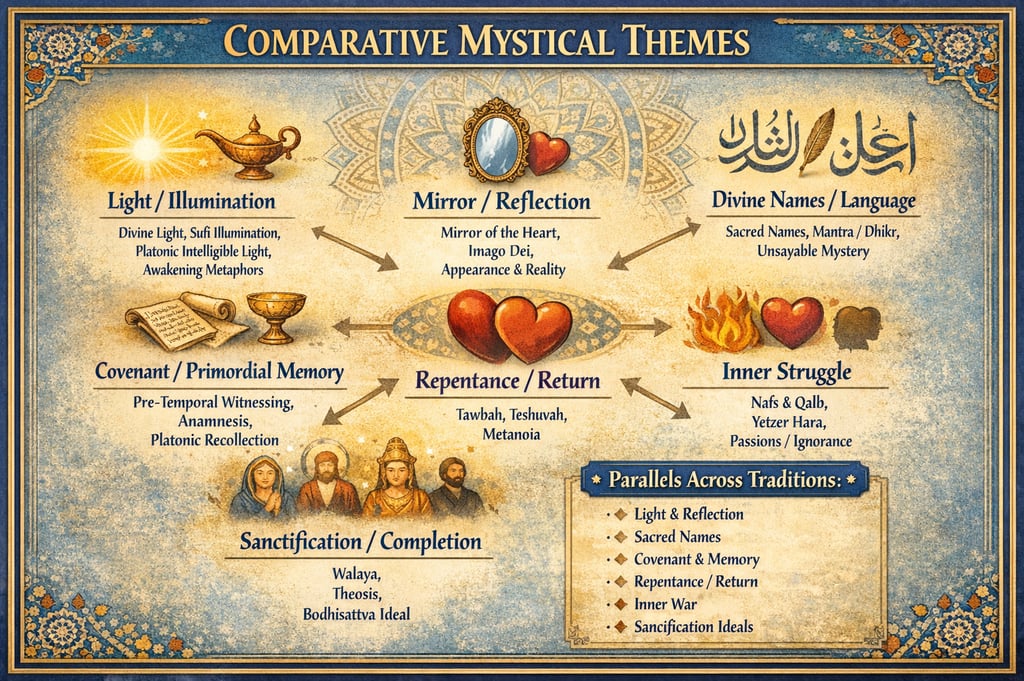
A rigorous comparative method avoids “same thing everywhere.” Better is: identify motif clusters (light, mirror, covenant, repentance, sanctification, inner war), then specify: (a) semantic range, (b) doctrinal constraints, (c) practice-context. This keeps the comparison scholarly rather than flattening.
24. Suggested academic anchors for deeper expansion (bibliographic).
Neoplatonism: Plotinus, Enneads (with scholarly introductions); SEP Plotinus overview.
Advaita Vedānta: IEP “Advaita Vedānta” (overview and bibliography).
Judaism / Shekhinah: Britannica + Jewish Virtual Library (entry-level) and then academic encyclopedias/monographs via their bibliographies.
Christian negative theology: Pseudo-Dionysian tradition (primary texts + patristic scholarship).
Islamic mysticism (for Names/light/mirror): Ibn al-ʿArabī studies (introductory secondary scholarship). A recent Turkish academic article indicating Ibn al-ʿArabī’s broad doctrinal impact (not mirror-specific, but useful as a vetted academic node).
“Parallels Across Traditions” (one compact appendix you can paste after the footnotes)
Light / Illumination: Islamic illuminationism & Sufi light-symbolism; Christian divine light; Platonic intelligible light; dharmic “awakening” metaphors.
Mirror / Reflection: Sufi mirror-of-heart; Neoplatonic participation; Christian “image/likeness”; Vedāntic appearance vs. reality.
Names / Language: divine names and attributes (Abrahamic); sacred speech efficacy (dhikr/mantra/prayer); apophatic limits (unsayability).
Covenant / Primordial memory: Islamic pre-temporal witnessing; Jewish covenant memory; Christian anamnesis; Platonic recollection.
Repentance / Return: tawbah/teshuvah/metanoia; yogic/buddhist reorientation of mind.
Inner war: nafs vs. heart; yetzer; passions; craving/ignorance triad.
Sanctification / Completion: walāya/theosis/bodhisattva/jīvanmukti patterns (non-identical, structurally comparable).