JESUS IN THE QUR’AN
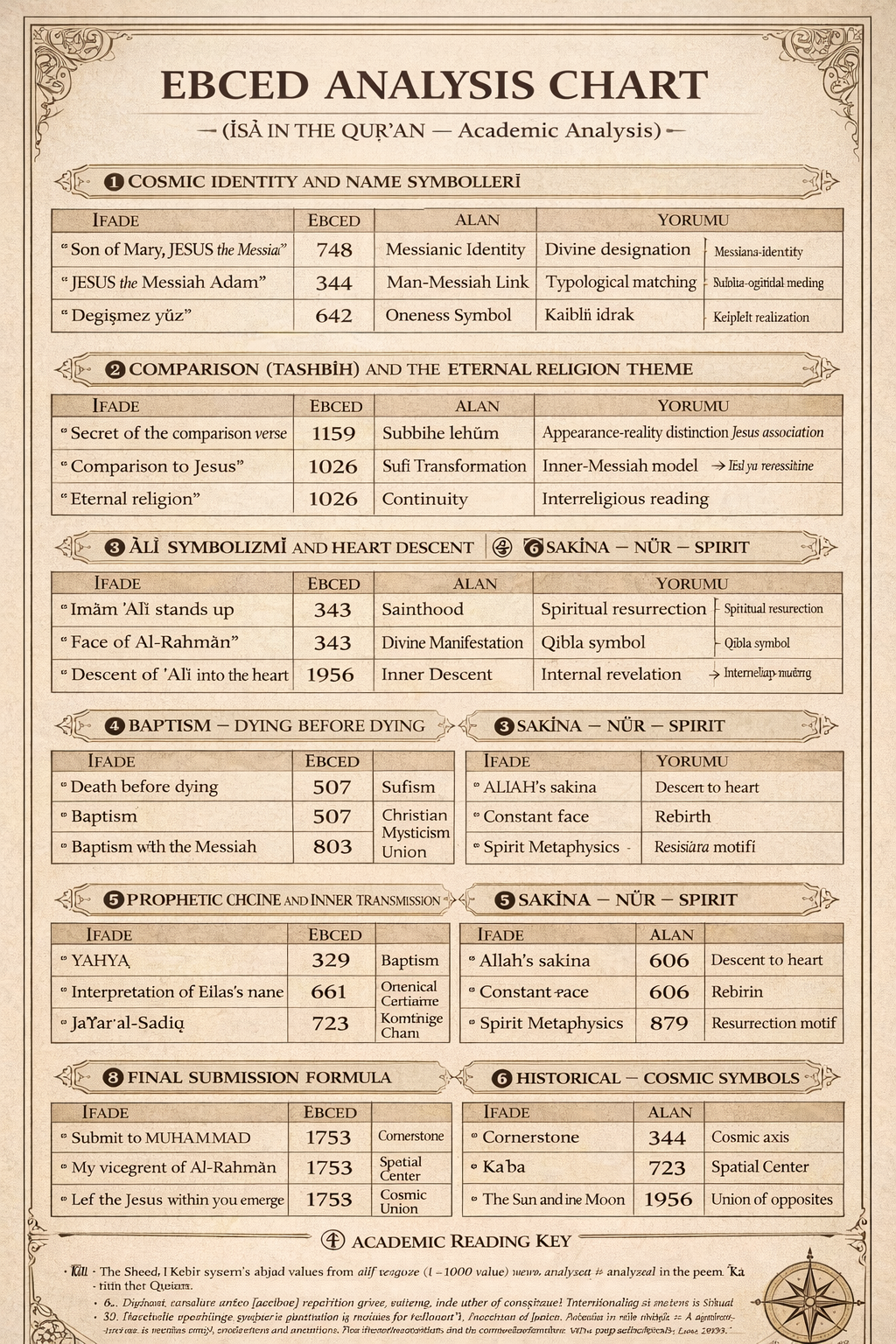
JESUS IN THE QUR’AN. “The interpretation of the name Father of the Earth”: “the word of Jesus!” (1160) “This is the secret of the resemblance verse — open your eyes!” (1159) “Jesus son of Mary — his name is al-Masîh!” (748) “To prostrate to the Father of the Earth” is his intention! (345)
APOCALYPSE BOOK
JESUS IN THE QUR’AN
The Messenger said: “O Ali, it is as though you are that Jesus!
If people heard this, they would begin to worship you!”
What did the Exalted Messenger intend?
Let us unveil “the veil of Allah” step by step:
The Lord says: “Jesus was neither crucified nor slain”;
The verse declares: “It was made to resemble!” — few grasp this secret.
For Christians this is a shock — reflect upon it:
Religion was built upon “the flowing blood of Jesus”!
“They say he was the true sacrifice; his blood washes sins.
Believe, be baptized, and enter paradise purified!”
“The interpretation of the name Father of the Earth”: “the word of Jesus!” (1160)
“This is the secret of the resemblance verse — open your eyes!” (1159)
“Jesus son of Mary — his name is al-Masîh!” (748)
“To prostrate to the Father of the Earth” is his intention! (345)
“The blessed secret of Jesus! Ali, Father of the Earth!” (755)
“Covenant with the Lord,” “the fitrah of Allah,” “the state of essence!” (755)
“To resemble Jesus — this is the primordial religion!” (1026)
“The trumpet of rising is blown — herald of paradise!” (1026)
“Son of Mary” is the name of the Owner of the Day of Religion! (343)
“Imam Ali rises — that Stone is his body!” (343)
“Jesus the Messiah is Adam! He is Lord to humanity!” (344)
Find the Hajar al-Aswad so that you may not suffer! (344)
“The true religion is the settling of Imam Ali within you!” (343)
He is the “Face of ar-Rahman” — take him as your qibla! (343)
Know that the Sekine (Shekinah) of Allah is “the voice of Ali”! (606)
That is the Day of Resurrection — opposite the “deathless Face”! (606)
“This is the interpretation of the crucifixion of Jesus the Messiah!” (879)
The state of the name — “the spirit emerging by the command of the Lord”! (879)
“The killing of Jesus son of Mary the Messiah” is symbolic! (1172)
Equal to the word “Peace” — find him within your heart! (1172)
For this event is the descent of Ali into the heart! (1956)
As the soul departs, the spirit enters — Sun and Moon unite! (1956)
This is the baptism of Yahya; “YAHYA” corresponds to ar-Rahman! (329)
He becomes Jesus the Messiah and takes on the color of Ali! (329)
Jesus does not die — instead his likeness appears;
That likeness is the unique servant of the Lord!
“To die before dying” — this is baptism! (507)
Suddenly the “face of Jesus son of Mary” appears! (507)
“Resembling the son of Mary” — interpretation of the name Elijah! (661)
He is wisdom — the spine rising upright! (661)
“A young man whose moustache has just grown” equals “Hazrat Jesus”! (1558)
“It is the dye of Allah!” — in the Mi‘raj he grants that color! (1558)
“Baptism with the Messiah” means the descent of the Lord into the heart! (803)
It leads to the title of Ali, if you interpret the trace! (803)
“Pure wine,” “Kaaba,” “the eternal Face of your Lord!” (723)
“The eastern side!” — each signifies “Bektash,” open your eyes! (723)
The same is “Ali’s son, the martyr Imam Husayn!” (723)
Call him “the first and last sacrifice, Hazrat Jesus!” (723)
“The new interpreter of the two-thousands!” (723)
“With the knowledge of the Book beside him — Ja‘far Sadiq stands here!” (723)
“Jesus the Messiah, son of Mary — the secret of the Qur’an!” (642)
Called the “unchanging Face,” seen by the awakened heart! (642)
“Surrender to MUHAMMED,” let him say “my caliph is Rahman!” (1753)
Let the Jesus within you emerge and change your destiny! (1753)
“Every person of the Book believes in Jesus at the final moment!”
From within, a youth arises saying: “I am Jesus!”
Master M.H. Ulug Kizilkecili
Türkiye/İzmir - 7 August 2000
IMPORTANT NOTE :The original text is poetic, and the author cannot be held responsible for any errors in the English translation! To read the original Turkish text, click HERE! The following section is not the author's work, and the author cannot be held responsible for any errors made!
ACADEMIC FOOTNOTES
1. Qur’an 4:157–158 and the Crucifixion Debate
The text reflects classical Islamic interpretations that Jesus was not killed nor crucified. Early tafsir traditions (Tabari, Razi, Ibn Kathir) present varying readings of shubbiha lahum (“it was made to resemble”).
2. Atonement Theology in Christianity
References to Jesus’ blood parallel Christian doctrines of sacrificial redemption, especially Pauline theology, though historical scholarship notes diverse early Christian interpretations.
3. Sekine (Shekinah)
Sekine corresponds conceptually to the Jewish mystical idea of Shekinah — divine presence dwelling among believers — illustrating interreligious symbolic exchange.
4. Adam–Messiah Parallel
The association of Jesus with Adam reflects Qur’an 3:59 and has been interpreted mystically as an archetype of the perfected human.
5. Hajar al-Aswad Symbolism
In Sufi commentary the Black Stone may symbolize the heart or primordial covenant, beyond its ritual role in pilgrimage.
6. Baptism and Sufi Fanâ
Equating baptism with “dying before dying” shows a cross-mystical analogy between Christian rebirth and Sufi ego-annihilation.
7. Elijah, Yahya, and Prophetic Typology
The merging of prophetic figures reflects symbolic continuity rather than historical identity, common in mystical literature.
8. Sibghat Allah (“Dye of Allah”)
Derived from Qur’an 2:138, interpreted as spiritual transformation — sometimes compared symbolically to baptism.
9. Sun–Moon Union
Solar and lunar imagery appears in Islamic cosmology and Hermetic philosophy as metaphors of spiritual integration.
10. Finality of Prophethood
The closing emphasis on surrender to MUHAMMED reflects Islamic doctrines of prophetic culmination.
INTERRELIGIOUS PARALLELS IDENTIFIED IN THE TEXT
1. Islam – Christianity
Crucifixion reinterpretation vs. atonement theology
Baptism imagery paralleled with Sufi spiritual rebirth
2. Islam – Judaism
Sekine (Shekinah) symbolism
Elijah and prophetic continuity themes
3. Sufism – Christian Mysticism
“Die before dying” ↔ mystical rebirth
Descent of divine presence into the heart
4. Shi‘i / Alevi Symbolism – Early Christian Typology
Ali, Husayn, and Jesus connected through martyrdom symbolism and spiritual succession motifs
5. Hermetic / Late Antique Cosmology
Sun–Moon unity and spine imagery reflect shared esoteric cosmological language across Mediterranean religious traditions.
PARENTHETICAL EXPRESSIONS – ABCED NUMERICAL CORRESPONDENCE LIST
· (1160)
· • “Interpretation of the name Father of the Earth”
• “The word of Jesus”
· (1159)
· • “The secret of the verse of resemblance”
· (748)
· • “Jesus the Messiah, son of Mary — that is his name”
· (345)
· • “Prostration to the Father of the Earth”
• “That Stone”
• “It is his body”
· (755)
· • “The blessed secret of Jesus”
• “Ali, Father of the Earth”
• “Covenant with the Lord”
• “The fitrah of Allah”
• “The state of the essence”
· (1026)
· • “Being likened to Jesus”
• “This is the primordial religion”
• “The trumpet of rising is blown”
· (343)
· • “Son of Mary”
• “Owner of the Day of Religion”
• “Imam Ali rises”
• “The true religion is the settling of Imam Ali within you”
• “The Face of ar-Rahman”
· (344)
· • “Jesus the Messiah is Adam”
• “He is Lord to humanity”
• “Hajar al-Aswad”
· (606)
· • “The Sekine (Shekinah) of Allah”
• “The voice of Ali”
• “It is the Day of Resurrection”
• “The deathless Face”
· (879)
· • “Interpretation of the crucifixion of Jesus the Messiah”
• “The spirit emerging by the command of the Lord”
· (1172)
· • “The killing of Jesus the Messiah, son of Mary”
• “Equal to the word ‘Peace’”
· (1956)
· • “The descent of Ali into the heart”
• “The Sun and the Moon”
· (329)
· • “YAHYA”
• “ar-Rahman”
· (507)
· • “To die before dying”
• “Baptism”
• “The face of Jesus son of Mary”
· (661)
· • “Resembling the son of Mary”
• “Interpretation of the name Elijah”
• “He is Wisdom”
· (1558)
· • “A young man whose moustache has just grown”
• “Hazrat Jesus”
• “The dye of Allah”
· (803)
· • “The descent of the Lord into the heart”
• “Baptism with the Messiah”
· (723)
· • “Pure wine”
• “Kaaba”
• “The eternal Face of your Lord”
• “The eastern side”
• “Bektash”
• “Ali’s son, the martyr Imam Husayn”
• “The first and last sacrifice, Hazrat Jesus”
• “The new interpreter of the two-thousands”
• “With the knowledge of the Book beside him”
• “Ja‘far Sadiq”
· (642)
· • “Jesus the Messiah, son of Mary”
• “The secret of the Qur’an”
• “The unchanging Face”
· (1753)
· • “Surrender to MUHAMMED”
• “My caliph is Rahman”
• “Let the Jesus within you emerge”
The Story of ‘Îsâ in the Qur’an
When Maryam withdrew from her family to a place toward the east, Allah sent to her a messenger from His spirit. He appeared before her in the form of a perfect human being. When Maryam felt fear, the messenger told her that he had been sent to grant her the glad tidings of a pure son. She asked how she could have a child when no man had touched her; the messenger said that this was easy for Allah and that the child would be a sign for humanity.
Maryam carried the child and withdrew to a distant place. The pains of childbirth drove her to the trunk of a palm tree; when she fell into sorrow, she was comforted by Allah, being told that a stream had been placed beneath her and that she should shake the trunk of the palm so that fresh dates would fall. After the birth, she returned to her people with the infant, and they accused her. Maryam remained silent and pointed to the child. Then the infant spoke from the cradle, saying: “I am a servant of Allah. He has given me the Book and made me a prophet. Wherever I may be, He has made me blessed; He has commanded me to establish prayer and give charity as long as I live. He has made me kind to my mother and has not made me arrogant or miserable.”
When ‘Îsâ grew, Allah taught him the Book, wisdom, the Torah, and the Gospel. He came as a messenger to the Children of Israel and showed signs by Allah’s permission: he shaped something like a bird from clay and breathed into it, and it became alive by Allah’s permission; he healed those born blind and those afflicted with leprosy; he raised the dead by Allah’s permission and informed people of what they stored in their homes. He declared that all these were signs from Allah.
‘Îsâ called his people to worship Allah alone, saying: “Allah is my Lord and your Lord, so worship Him.” Yet some among the Children of Israel rejected him. When ‘Îsâ asked who would be his helpers in the way of Allah, the disciples said: “We are the helpers of Allah; we believe in Allah.”
Those who denied him sought to plot against him, but Allah rendered their plans futile. As hostility against ‘Îsâ increased, Allah declared that He would raise him to Himself and purify him from those who denied. People thought that they had killed him; however, they neither killed him nor crucified him — it was only made to appear so to them. Allah raised him to Himself.
‘Îsâ and his mother Maryam were made a sign for humanity. ‘Îsâ never called people to take him or his mother as deities; he was a servant and messenger of Allah. He gave glad tidings of a messenger who would come after him.
The example of ‘Îsâ with Allah is like that of Âdam: Allah created him by the command “Be!” He is neither the son of Allah nor a partner in divinity. The truth is that humanity should turn only to Allah and make no division among the messengers.
The Gospel given to ‘Îsâ confirmed the revelations before it and served as guidance. Compassion and mercy were placed in the hearts of those who followed him, but over time people fell into excess in matters of religion. The Qur’an calls the People of the Book not to go to extremes and declares that Allah is One.
Finally, on the Day of Resurrection, Allah will ask ‘Îsâ: “Did you tell people to take me and my mother as gods besides Allah?” ‘Îsâ will say that it was not possible for him to say such a thing and that he conveyed only what he had been commanded. On that Day, judgment belongs only to Allah.
NOTE: SAKINA=SEKİNE=SHEKINAH=SPENTA ARMAITI!