LORD’S SAINT (HAKEREN)
LORD’S SAINT (HAKEREN). Earth, water, air and fire — their texture is this; First perform ablution — meaning, purify from these four elements! “Carbon! Oxygen! Nitrogen! Hydrogen!” says the chemist; Transform them into the “four rivers of paradise” and suffer no pain!
APOCALYPSE BOOK
LORD’S SAINT (HAKEREN)
I — SHARI‘A
Lower quatrinity and upper trinity — this is each of us!
The four-walled Kaaba and the triangular black stone are symbols!
Mineral, vegetal, animal and intellectual;
Four layers exist in the body — transparent yet material.
Earth, water, air and fire — their texture is this;
First perform ablution — meaning, purify from these four elements!
“Carbon! Oxygen! Nitrogen! Hydrogen!” says the chemist;
Transform them into the “four rivers of paradise” and suffer no pain!
For even if transparent, matter cannot reach the Lord;
Without stripping from matter, no prayer can be performed.
Above the four layers stands the triple Light:
RÛH, RAHÎM, and RAHMÂN — the initiated sheds the lower self here.
Among jinn exists only one of the four transparent layers;
None of the Trinity belongs to them — thus they know not the takbir.
In the end, the righteous rise toward the rank of Ifrit;
The wicked become Iblis and deny Âdem.
If harmony between the four layers is broken,
One becomes mad, deranged, idiotic, or a medium!
Ignorant is the physician who calls this “spirit illness”;
The upper Trinity cannot be sick — for the Lord is the true healer!
The sorcerer departs with the four layers from the physical body;
He has no spirit — for he denied Âdem.
He roams the atmosphere among the realms of jinn;
The “Supreme Assembly” is locked except for the possessor of the Trinity.
“If he attempts ascent to the Throne, he is stoned like a jinn!”
Without spirit, none becomes master of the dominion!
II — TARÎQA
“To ascend together with the spirit” is the secret tree;
For the quaternity longs to rule independently.
This secret is not given before “dying before death”;
Without meeting a perfected guide, this realm cannot be reached.
Earth, water, air, fire — whoever passes these trials
Is placed into three days of trance; upon rising becomes a seeker.
Each desire of the four elements stands against you like a beast;
Every flaw appears before you.
If you survive this torment without madness,
Within four days you become a candidate of realization.
“Khidr saved the sound boat by piercing it!”
“He even slew the child for a greater good!”
The “beheaded child” and the “pierced boat” —
They symbolize the purified four layers; take heed!
“The four birds revived after their heads were cut”;
Tame them — whistle! If they do not come, keep distance!
Carbon, oxygen, nitrogen, hydrogen — take the four;
Turn this nuclear bomb into a nuclear power plant!
Carbon is coal; oxygen and hydrogen ignite it;
Those who remain within the lower four end in hellfire.
From these “four” days arose the imitation of the “forty-day ordeal”;
Thus the world filled with many religions and paths.
The candidate’s heart is stopped for three days — what honor!
The four layers enter hell, the Trinity enters paradise.
The Trinity bathes in Light; the quaternity is baked in fire;
“The Lord has come — falsehood vanishes!” Evil turns to good.
He sees both the realm he came from and the realm he goes to;
What he sees says: “Submit to us!”
The perfected one remains beside him lest he perish;
Within the luminous body he is protected from jinn.
Upon return, the guide transmits a “spark”;
“The tree is grafted — now grow the fruit,” he says.
As the spark enters, the Fuad becomes a cradle;
It speaks secrets — called “the Messiah speaking in the cradle.”
When the vibration reaches its highest limit,
He enters the Essence from which he emerged.
He surrenders to that Essence — the Rabb of all worlds;
Whoever enters Him becomes MUHAMMAD AL-AMIN.
III — MA‘RIFA
When emerging from the Rabb, He becomes Rahîm-Rahmân;
YEHOVA ELOHIM — known as dual-natured!
He approaches the partner only for generation;
In love, he dwells within the triple Light.
“We” now govern him within the cosmos;
The exalted ones called ÂLÎN watch every act.
If he breaks the covenant, the heart stops eternally;
It beats within the chest of a dark sorcerer!
“So long as heavens and earth endure, he remains imprisoned;
The pure meets the pure — the impure the impure!”
“If you yield to the unbeliever, O Muhammad,
I will sever the artery of your heart,” says the Lord!
“You will taste the pain of birth and death;
Your quaternity will break — you will rest with Me in the Trinity!”
“My laws do not change! I am the Law! You are the Messenger!
Even intercession is forbidden without permission!”
The perfected one leaves and returns to the body at will;
Upon return he knows the command to be executed.
His roaming spirit scans all sleeping humans,
Seeking souls ready to awaken.
He appears to the candidate clothed in transparency;
If not calmed, the viewer goes mad.
Sometimes he sits within him and becomes “Hazrat”;
He dictates messages — while another breathes.
For the spirit does not breathe — it feeds on Sekine (Shekinah);
The Light created by the Lord on the first day!
The spirit does not pass through the womb when life (body) is born;
For it has no time to lose.
“Before the spirit is breathed, Allah does not command Âdem to prostrate”;
So do not call the newborn merely living soil!
The one fully entered becomes the dwelling of the spirit;
After death, it condenses and performs the task of Khidr.
All worlds become a home for him;
A dwarf inside the body — a giant beyond it!
If he wills, “like Solomon he commands the jinn”;
“Build me a temple as vast as the cosmos!”
If he wishes, the Trinity may enter even an infant;
“He speaks from the cradle” — beyond common understanding!
IV — HAQÎQA
John calls the purification of the four “baptism by water”;
In the bath of Light, the Trinity revives the human!
The Messenger says: “Jonah ascended within the fish —
His ascent is not below mine!” Open your eyes!
Know: the upper three are the Messiah; the lower four the mother of Îsâ;
“The Messiah asked Mary: Who are you?”
Spirit is like wine; flesh is the water of the womb;
Upper Trinity and lower quaternity — thus is humanity known.
“The first miracle of Îsâ was turning water into wine”;
Transformation of union — divine lineage!
Purified quaternity is ÎSÂ; bound Trinity is the Messiah;
Both are the first Âdem — called RÂSIKH in the Qur’an!
The Gospel calls this being “the only Son of Allah”;
A symbolic verse exploited by priests.
Each of the Trinity reflects into the four layers;
Hercules fought twelve giants at once!
Dalilah is the lower four; Samson the upper Trinity;
Your hair is the ray — do not cut it too soon!
Else with blind eyes you grind the mill;
Until your hair grows, your essence is bound!
The sacred cow — its nose moist, four streams from its udder;
After nine months it gives birth — learn from the quaternity!
“Îsâ said: The temple built in forty-six days,
I will destroy and rebuild in three!”
Forty-six chromosomes in the first cell —
They form the four layers; the Trinity is breathed into them.
Forty-six plus three plus One Allah makes fifty;
Allah says: “In fifty thousand years the spirit reaches Me.”
Before Khidr, Moses was astonished;
Here the difference between Prophet and Saint appears!
“One possessing knowledge of the Book” is the perfected one;
Each Prophet’s Trinity is the saint — the quaternity his body.
The quaternity is MÛSÂ, the spirit ÎSÂ, Rahîm AHMET;
Rahmân is explained by ÂLÎ — all are mercy!
Master M.H. Ulug Kizilkecili
Türkiye/Ankara - April 10, 1998
IMPORTANT NOTE :The original text is poetic, and the author cannot be held responsible for any errors in the English translation! To read the original Turkish text, click HERE! The following section is not the author's work, and the author cannot be held responsible for any errors made!
Expanded Comparative Academic Footnotes
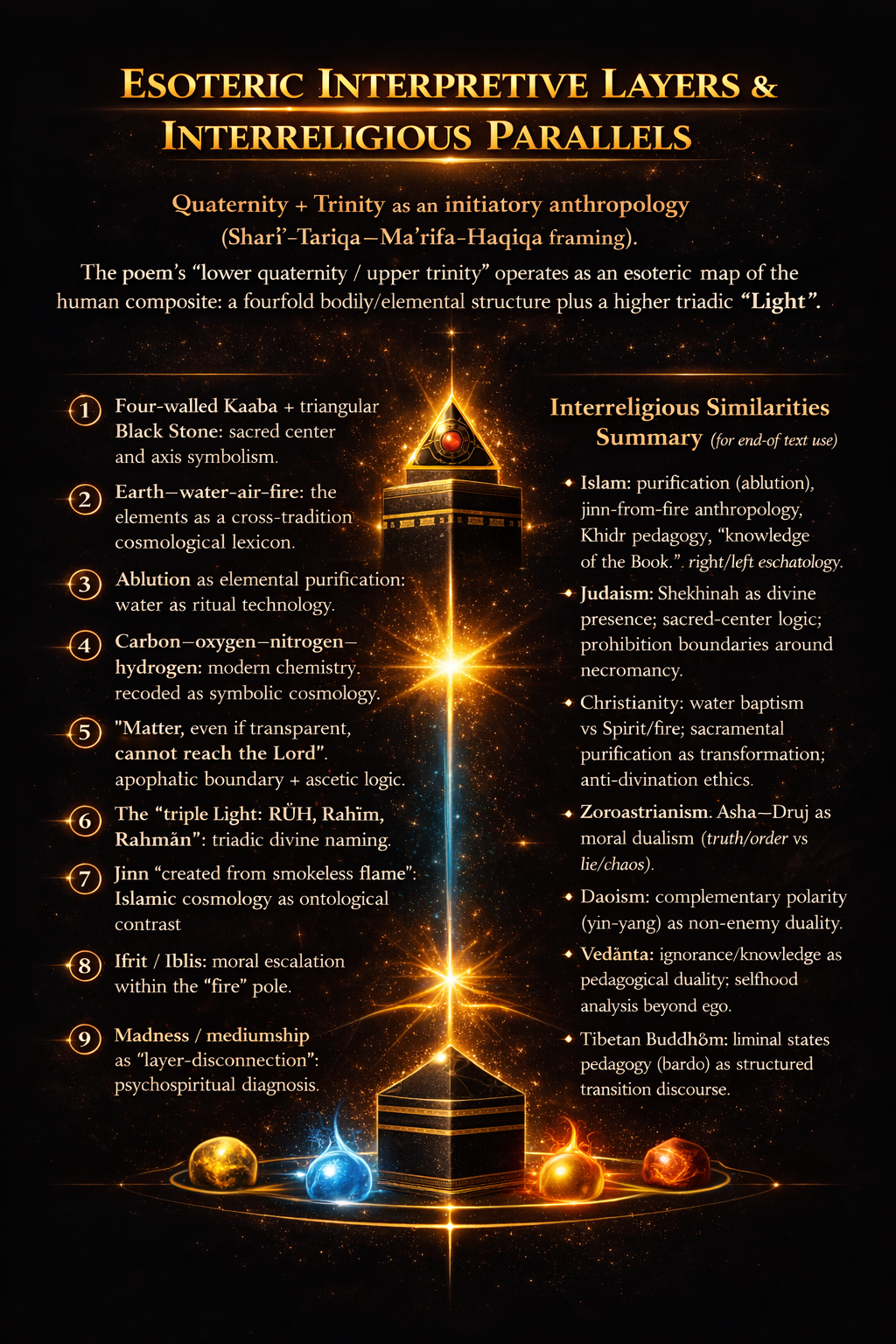
1) Quaternity + Trinity as an initiatory anthropology (Shari‘a–Tariqa–Ma‘rifa–Haqiqa framing).
The poem’s “lower quaternity / upper trinity” operates as an esoteric map of the human composite: a fourfold bodily/elemental structure plus a higher triadic “Light”. Quaternity-as-structure appears widely (four elements; four directions; fourfold person), while trinity-as-transcendence appears as a “higher” schema (triads of being/knowing/willing; heaven–earth–human; etc.). The poem uses these as a pedagogical allegory rather than a biological taxonomy.
2) “Four-walled Kaaba” + “triangular black stone”: sacred center and axis symbolism.
Reading the Kaaba as a fourfold spatial form and the Black Stone as a triangular sign fits a classic “sacred center” grammar: a marked center that organizes the cosmos symbolically and ritually (axis mundi logic). For “axis mundi” as a cross-cultural sacred-center motif, see comparative religious psychology and sacred-space scholarship.
3) Earth–water–air–fire: the elements as a cross-tradition cosmological lexicon.
The four elements are a widely shared symbolic vocabulary (Greek, late antique, Islamic philosophical reception, alchemical traditions). The poem leverages them as moral–ritual tasks (“purify from the four”) rather than literal physics.
4) Ablution as elemental purification: water as ritual technology.
“First perform ablution” treats purification as a prerequisite for prayer—an Islamic ritual logic—while simultaneously mapping ablution to “cleansing the elements,” which is a metaphysical reading of ritual. Cross-traditionally, water functions as purification/rebirth (Christian baptism), and “light-bath” / illumination appears in initiatory mysticism.
5) “Carbon–oxygen–nitrogen–hydrogen”: modern chemistry recoded as symbolic cosmology.
The poem’s move from elements → modern chemical primitives is a characteristic modern esoteric rhetorical strategy: it redescribes spiritual cosmology with scientific vocabulary to intensify plausibility while remaining fundamentally allegorical.
6) “Matter, even if transparent, cannot reach the Lord”: apophatic boundary + ascetic logic.
This line establishes an epistemic/ontological boundary: the divine is not attainable through material continuity, only through a “stripping” (renunciation/transformation). Comparable apophatic boundary-making is central to many theologies (negative theology in Christian mysticism; divine transcendence in Islamic kalām and Sufi adab).
7) The “triple Light: RÛH, Rahîm, Rahmân”: triadic divine naming.
The poem’s triad reads as a theological-symbolic trinity (not necessarily Nicene Trinity). Triadic divine naming is common across traditions: e.g., triads of divine attributes, emanational triads, or functional triads (creation–mercy–guidance). The poem frames the triad as NÛR (“Light”) and as initiatory clothing.
8) Jinn “created from smokeless flame”: Islamic cosmology as ontological contrast.
The poem’s claim that jinn belong to a “fire” register parallels Qur’anic creation language: jinn from smokeless flame, humans from clay.
It then uses this to justify why jinn lack the poem’s “upper triad” (a poetic-theological inference rather than a Qur’anic statement).
9) Ifrit / Iblis: moral escalation within the “fire” pole.
By placing the “righteous” among jinn toward Ifrit and the “wicked” toward Iblis, the poem compresses Islamic demonological vocabulary into a single moral ladder. (Scholarly caution: the poem’s internal taxonomy is literary, not a standard doctrinal chart.)
10) Madness/mediumship as “layer-disconnection”: psychospiritual diagnosis.
The claim that disharmony between “layers” yields madness/mediumship echoes a broad esoteric anthropology: imbalance of subtle faculties produces disordered perception. In comparative religious studies, similar patterns appear in possession-discourses, trance typologies, and “discernment of spirits” literature—though causal models differ.
11) Necromancy/mediumship taboo: a shared Abrahamic boundary of epistemic authority.
The poem’s strong anti-medium stance aligns with a common Abrahamic prohibition against divination/necromancy. The Torah explicitly condemns mediums/necromancers.
Catholic catechesis likewise rejects divination and “conjuring up the dead.”
This boundary typically protects (a) revelation as the legitimate knowledge-source and (b) human vulnerability to manipulative spirits/social exploitation.
12) “Supreme Assembly locked to the possessor of the Trinity”: ascent and court imagery.
This echoes “heavenly court/divine council” patterns across traditions, but the poem’s phrasing is its own. Ascent-to-throne imagery is central in many mystical corpora; the poem ties access to inner transformation (possession of the “upper triad”).
13) “If he attempts ascent to the Throne, he is stoned like a jinn”: policing the sacred border.
The line dramatizes a boundary between permitted spiritual ascent and illicit reach. Comparative analogues include taboo-guardians at cosmic thresholds, angelic gatekeepers, and “unprepared ascent” warnings in apocalyptic/mystical literature.
14) “Die before you die”: initiatory death as transformation.
The poem embeds a classic initiatory theme: symbolic death precedes gnosis/realization. This trope is pan-mystical: monastic mortification, Sufi fanā imagery (annihilation of ego), and “ego-death” in contemplative disciplines. (The poem’s “secret tree” becomes the pedagogical threshold.)
15) Khidr’s boat/child: ethical paradox as purification technology.
The lines about piercing the boat and killing the child directly invoke the Qur’anic Khidr–Moses narrative (Q 18:60–82).
The poem treats these acts as metaphors for purifying the “lower four”: harm-as-mercy, paradox-as-initiation (common in wisdom literature and mystery pedagogy).
16) “Three days trance / four days ordeal / forty-day imitation”: ritual time as symbolic arithmetic.
The poem connects short initiatory time-units (3 and 4) to a later “40-day” ascetic template, presenting “40” as a cultural copy of an earlier inner mechanism. Comparative note: “40” is ritually thick across Abrahamic traditions (fasting/sojourn motifs), but the poem’s genealogy is literary.
17) “Spark transferred; Fuad becomes a cradle; Messiah speaks in cradle”: charismatic implantation motif.
The “spark” resembles transmission models: baraka, grace, “seed of light,” or empowerment. The “cradle-speaking Messiah” alludes to the well-known cradle speech motif of Jesus in Islamic tradition (Qur’anic narrative context), here retooled as an inner-physiology allegory.
18) “Vibration reaches limit; enters the Essence; becomes Muhammad al-Amin”: realization as prophetic archetype.
The poem uses prophetic names as stations (maqām-like markers) rather than historical biography. Comparative parallel: “prophetic archetype” usage in mystical poetics, where names signify functions of consciousness.
19) “YEHOVA ELOHIM… dual-natured”: syncretic naming as metaphysical shorthand.
The poem’s invocation of biblical divine names functions as a comparativist compression, not a doctrinal claim. In academic reading, this is best treated as poetic syncretism: it assembles iconic names to signal universality of the “Light” principle.
20) Covenant-breaking and heart-artery threat: scriptural echo recontextualized.
The poem’s “I will sever the artery of your heart” echoes Qur’anic rhetoric used to emphasize prophetic trustworthiness and divine authority; the poem re-deploys it into an esoteric warning about betrayal of the initiatic oath. (Scholarly method: identify scriptural echo, then track the poem’s new function—discipline of secrecy/obedience.)
21) “Spirit does not breathe; it feeds on Sekine (Shekinah)”: presence-as-nourishment.
Here Sekine (Shekinah) is treated as “sustenance” (tranquilizing, stabilizing divine presence). For Shekhinah as “Dwelling/Presence” of God in Jewish theology and post-biblical literature, see Britannica.
Academically, the poem is performing a functional analogy between Islamic sakīna (tranquility sent down) and Jewish Shekhinah (divine presence), without asserting doctrinal identity.
22) “Spirit does not pass through the womb”: anti-materialization thesis.
This line enforces the poem’s core boundary: spirit is not a biological product. Comparative parallels exist in (a) Neoplatonic emanation models (soul not generated like bodies), and (b) Vedāntic insistence that the deepest Self is not born/dies in the ordinary sense (though metaphysical frameworks diverge).
23) “After death it condenses and performs the task of Khidr”: saintly function and post-mortem agency.
The poem imagines a post-mortem role akin to hidden guidance. Cross-traditionally, saintly intercession/providence appears in Catholic and Eastern Christian hagiography; in Islam, the idea of hidden helpers is common in popular piety and Sufi narrative, though formal doctrines vary.
24) Solomon-like command over jinn: Qur’anic royal charisma as mastery of forces.
The poem’s “like Solomon he commands the jinn” aligns with Qur’anic portrayals of Solomon’s extraordinary authority over winds/spirits/jinn. (Here it is used as a template for spiritual sovereignty.)
25) Water baptism (John) vs light-bath: Christian rite vs initiatory illumination.
John’s baptism as water rite is explicit in the New Testament, and the “Holy Spirit and fire” contrast is stated in Matthew 3:11.
The poem’s “light-bath” acts like a mystical amplification: purification becomes illumination.
26) Upper three (Messiah) / lower four (Mary): Christological symbolism as a quaternity–trinity map.
The poem recodes Mary/Jesus/Messiah language into its quaternity–trinity anatomy. Academic caution: this is not standard Christian dogmatics; it is an esoteric structural reading that treats biblical figures as symbolic operators.
27) “Water into wine” as spirit–flesh metaphor:
The poem reads “water→wine” as a transformation of generative substance into spirit potency. In Christian exegesis, water-to-wine is typically read as a sign of messianic fulfillment; the poem repurposes it as metaphysical chemistry.
28) “Râsikh”: knowledge-stability and ‘people firmly grounded’.
The term rāsikh in Qur’anic usage often connotes firmness/groundedness in knowledge; the poem assigns it to an archetypal “first Adam” figure. (Again: poetic theology, not a straightforward Qur’anic identification.)
29) “Forty-six days/forty-six chromosomes”: modern biology as allegorical support.
The poem’s chromosome reference is a modernizing move: it links scriptural time-symbolism to genetic count to claim an isomorphism between revelation and biology. Academic reading treats this as mythopoetic scientization (symbolic appropriation of science).
30) “Forty-six + three + One Allah”: sacred arithmetic and cosmological number-play.
Such arithmetic is common in esoteric texts: numbers become bridges between text, body, and cosmos. Comparative parallels exist in gematria-like traditions, Pythagorean number mysticism, and tantric numerology—but the poem’s system is its own.
31) “Knowledge of the Book”: Belkıs’s throne as a model for ‘transfer’.
The poem’s “one who has knowledge of the Book” directly recalls Q 27:40 (throne brought “in the blink of an eye”).
Academically, the move from throne-transport to “spirit transfer” is analogy: a poetic inference based on scriptural wonder narrative.
32) “Companions of the right/left”: eschatological sorting as moral topology.
The “right side” symbolism aligns with Qur’anic eschatological grouping (e.g., “companions of the right” vs “companions of the left”).
Across religions, right/left become moral-spatial codes (blessing/cursing; salvation/loss).
33) Zoroastrian Asha–Druj: truth/order vs lie/chaos as moral dualism.
Your poem’s recurring polarities (fire/water; purity/impurity; right/left) can be compared structurally to Zoroastrian moral dualism articulated as Asha vs Druj. Britannica explicitly describes the opposition Asha–Druj as truth/falsehood.
For philological depth on Druj and its opposition to Asha, see Encyclopaedia Iranica.
34) Daoist Yin–Yang: complementary polarity (not absolute enemy dualism).
Where your poem treats opposites as transformable (evil→good under Lord), it resembles Yin–Yang complementarity frameworks, which emphasize mutually generating opposites in a harmonious whole (depending on school and interpretation). A classic scholarly discussion of complementarity appears in Daoist studies (e.g., Cua).
35) Vedānta: vidyā/avidyā and the non-finality of duality.
Your poem’s insistence that lower structures must be purified and then transcended parallels Vedāntic treatments where ignorance/knowledge structures are pedagogical and ultimately overcome. For the broader framework of selfhood and the ātman discourse, see SEP’s “Personhood in Classical Indian Philosophy.”
36) Buddhism: intermediate states and the pedagogy of liminality.
Although your poem is not Buddhist, its liminal disciplines (trance, threshold ordeals, post-mortem functions) can be compared structurally to Tibetan “bardo” discourse as an “intermediate state” framework (as concept vocabulary and ritual pedagogy).
37) Shekhinah / Sekine (Shekinah) as immanence-language across Abrahamic traditions.
For Shekhinah’s definition as God’s dwelling presence, Britannica is a high-quality reference.
Your poem uses Sekine (Shekinah) as nourishment/protection—functionally comparable to “presence” and “tranquility” idioms in multiple Abrahamic spiritualities (without collapsing doctrinal distinctions).
38) Axis mundi as “inner ascent to the Throne”: microcosm mirrors macrocosm.
The poem’s ascent imagery coheres with axis mundi logic: the sacred center (sometimes mapped onto the body) becomes a ladder between realms. For an academic reference point on “axis mundi” as a sacred connector, see Springer’s encyclopedia entry.
39) Method note—allegory vs doctrine: why comparative reading must remain “functional,” not “identical.”
Many of the poem’s equivalences (biology ↔ revelation; prophets ↔ stations; jinn ↔ psychology) work as symbolic mapping, not doctrinal propositions. A responsible academic approach distinguishes:
Poetic inference and esoteric pedagogy (legitimate as genre), vs
Historical theology claims (which would require textual transmission evidence and doctrinal corroboration).
Interreligious Similarities Summary (for end-of-text use)
Islam: purification (ablution), jinn-from-fire anthropology, Khidr pedagogy, “knowledge of the Book,” right/left eschatology.
Judaism: Shekhinah as divine presence; sacred-center logic; prohibition boundaries around necromancy.
Christianity: water baptism vs Spirit/fire; sacramental purification as transformation; anti-divination ethics.
Zoroastrianism: Asha–Druj as moral dualism (truth/order vs lie/chaos).
Daoism: complementary polarity (yin–yang) as non-enemy duality.
Vedānta: ignorance/knowledge as pedagogical duality; selfhood analysis beyond ego.
Tibetan Buddhism: liminal states pedagogy (bardo) as structured transition discourse.
Comparative sacred-space theory: axis mundi as center/connector; inner ascent mapped onto cosmic geography.