NUMERICAL HARMONY
NUMERICAL HARMONY. Do not look upon numerical harmony as though it were a game! Allah never casts dice! Open your eyes, do not sleep! To “harmony,” the “knower” says “wisdom”; the “unknowing” says “chance”! The Lord repays, in truth and with justice, the due of truth concerning Himself!
APOCALYPSE BOOK
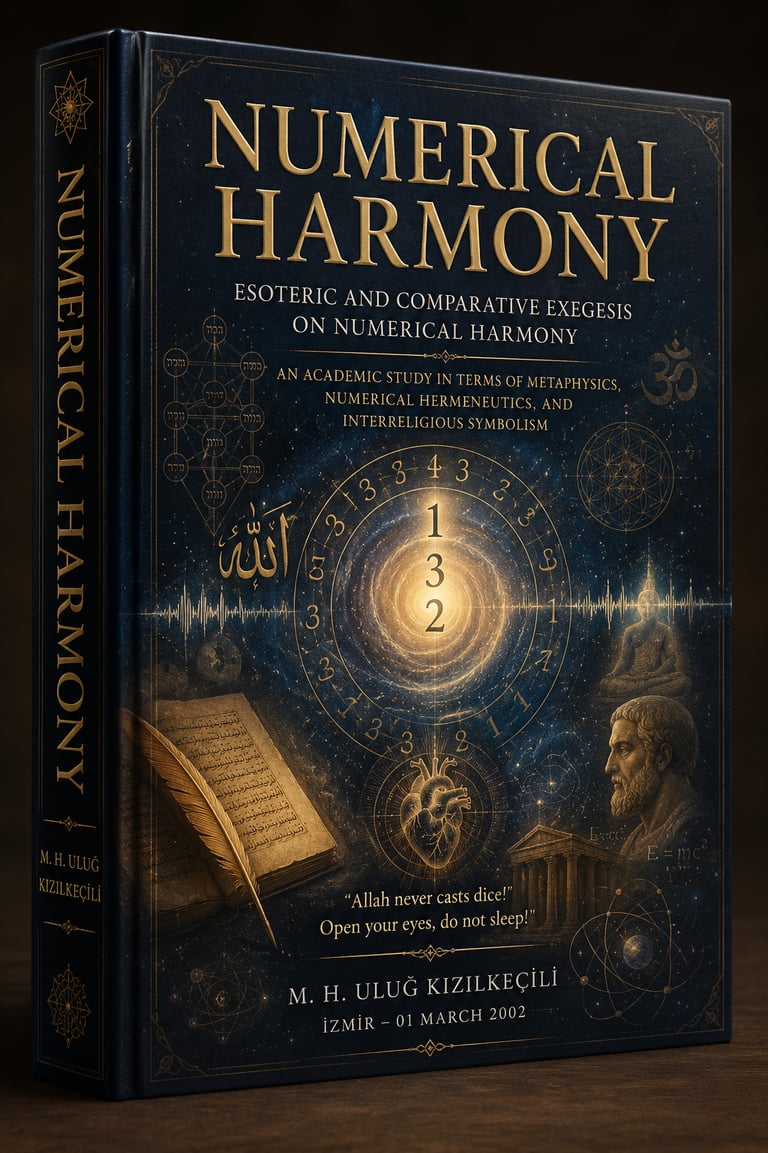
NUMERICAL HARMONY
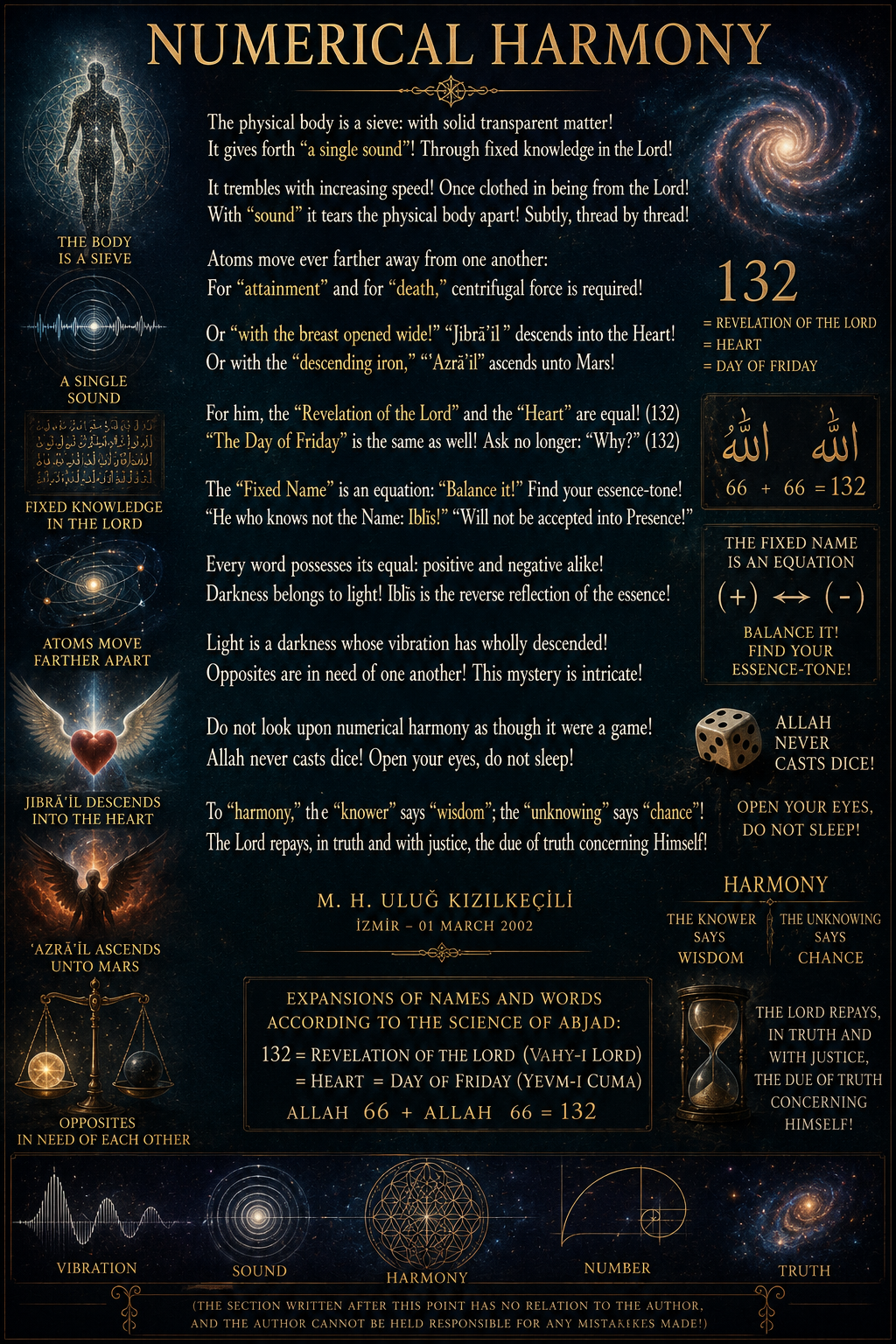
The physical body is a sieve: with solid transparent matter!
It gives forth “a single sound”! Through fixed knowledge in the Lord!
It trembles with increasing speed! Once clothed in being from the Lord!
With “sound” it tears the physical body apart! Subtly, thread by thread!
Atoms move ever farther away from one another:
For “attainment” and for “death,” centrifugal force is required!
Or “with the breast opened wide!” “Jibrāʾīl” descends into the Heart!
Or with the “descending iron,” “ʿAzrāʾīl” ascends unto Mars!
For him, the “Revelation of the Lord” and the “Heart” are equal! (132)
“The Day of Friday” is the same as well! Ask no longer: “Why?” (132)
The “Fixed Name” is an equation: “Balance it!” Find your essence-tone!
“He who knows not the Name: Iblīs!” “Will not be accepted into Presence!”
Every word possesses its equal: positive and negative alike!
Darkness belongs to light! Iblīs is the reverse reflection of the essence!
Light is a darkness whose vibration has wholly descended!
Opposites are in need of one another! This mystery is intricate!
Do not look upon numerical harmony as though it were a game!
Allah never casts dice! Open your eyes, do not sleep!
To “harmony,” the “knower” says “wisdom”; the “unknowing” says “chance”!
The Lord repays, in truth and with justice, the due of truth concerning Himself!
M. H. Uluğ Kızılkeçili
İzmir – 01 March 2002
Expansions of names and words according to the science of Abjad:
132 = Revelation of the Lord (Vahy-i Lord) = Heart = Day of Friday (Yevm-i Cuma)
Allah 66 + Allah 66 = 132
(The section written after this point has no relation to the author, and the author cannot be held responsible for any mistakes made!)
ESOTERIC AND COMPARATIVE EXEGESIS ON NUMERICAL HARMONY
An Academic Study in Terms of Metaphysics, Numerical Hermeneutics, and Interreligious Symbolism
Introduction
The text entitled “Numerical Harmony,” written by M. H. Uluğ Kızılkeçili, transcends the boundaries of classical poetic forms; it is an esoteric composition that fuses Sufism, Abjad numerology, Hermetic thought, cosmology, the metaphysics of sound, atomistic symbolism, and numerological speculation into a single crucible. The text is not merely a poem; it is simultaneously a draft cosmogony, a metaphysical theory of vibration, and a symbolic system attempting to explain humanity’s existential dissolution through “sound,” “name,” “centrifugal force,” “truth,” and “balance.”
This study shall interpret the text comparatively through the lenses of Islamic Sufism, Hurufism, Jewish Kabbalah, Pythagorean number doctrine, Hindu mantra teachings, Buddhist metaphysics of vibration, Gnostic cosmology, Hermetism, and metaphors drawn from modern physics.
I. “THE PHYSICAL BODY IS A SIEVE”: MATTER AND THE FILTER OF EXISTENCE
The Symbol of the Sieve
Within Anatolian wisdom traditions, the symbol of the “sieve” is not merely an instrument of separation. In esoteric traditions, the sieve signifies “purification” and “refinement.” In Sufism, it corresponds to the filtering of the nafs; in Kabbalah, to the descent between the sefirot; in Hinduism, to the dissolution of karmic layers; and in Buddhism, to the “piercing of the veil of maya.” All possess the same symbolic function.
Here, the depiction of the physical body as a “sieve” points toward the permeable nature of matter, incapable of containing ultimate truth.
This conception parallels:
• Ibn ʿArabī’s doctrine of the “shadows of existence,”
• Plato’s allegory of the cave,
• “Maya” in Vedānta,
• The Gnostic understanding of “hyle,”
• The uncertain nature of the particle in quantum physics.
Matter here is not absolute reality; rather, it is the vibrational shadow of truth.
II. “A SINGLE SOUND”: COSMIC VIBRATION AND THE PRIMORDIAL WORD
The Doctrine of Cosmic Sound
The phrase “It gives forth a single sound!” is directly grounded in the concept of creative vibration.
Islamic Sufism
In the Qurʾān, the command “Kun!” (“Be!”) indicates that creation possesses a sonic origin.
In Sufism:
• The cosmos = Divine breath
• Existence = Vibration
• Letters = Patterns of cosmic energy
Hinduism
In the Hindu tradition, the sound “Om” is regarded as:
• The first vibration of the universe,
• The cosmic beginning,
• The frequency of absolute consciousness.
There exists a striking similarity between the poem’s “single sound” and “Om.”
Jewish Kabbalah
According to Kabbalah:
• God created the universe through letters.
• Letters are frequencies of sound.
• Every number is a vibration.
This directly parallels the poem’s emphasis upon Abjad numerology.
III. “FIXED KNOWLEDGE IN THE LORD”: AʿYĀN-I SĀBITE AND THE ETERNAL FORM
According to Ibn ʿArabī’s doctrine of the Aʿyān-i Sābite (Immutable Archetypes), every being possesses an eternal reality within the knowledge of Allah.
The expression in the poem:
“Through fixed knowledge in the Lord”
directly points toward this doctrine.
According to this understanding:
• Humanity does not come into being within the world.
• Humanity already exists eternally.
• The world is merely the field of manifestation.
This idea bears strong parallels with:
• Plato’s theory of Ideas,
• Divine archetypes in Kabbalah,
• Jung’s collective unconscious,
• The karmic essence model in Indian thought.
IV. “ONCE CLOTHED IN EXISTENCE FROM THE LORD”: EMBODIMENT AND THE CONDENSATION OF THE SOUL
The Body as the Garment of the Soul
In Sufism, the body is:
• The garment of the soul,
• A temporary condensation,
• The solidified form of truth.
In the poem, the expression “to wear existence” conveys the notion that the body is merely a temporary garment worn by the soul.
This conception is related to:
• The Gnostic doctrine of the “prison of light,”
• The Hindu “shell of reincarnation,”
• The “illusory body” in Tibetan Buddhism.
V. “WITH SOUND IT TEARS APART THE PHYSICAL BODY”: THE DESTRUCTIVE AND TRANSFORMATIVE POWER OF SOUND
Samāʿ and Ecstasy in Sufism
In the Sufi tradition, sound:
• Sets the soul into motion,
• Transforms consciousness,
• Shatters the nafs.
The Mevlevī samāʿ is not merely music; it is a ritual of attunement to cosmic vibration.
The expression in the poem:
“With sound it tears apart the physical body!”
signifies the transcendence of humanity’s material limitations.
In Terms of Modern Physics
Sound vibration:
• Can alter the form of matter,
• Produce resonance,
• Break apart structures.
Nikola Tesla’s statement:
“If you wish to understand the secrets of the universe, think in terms of energy, frequency, and vibration.”
must here be directly recalled.
VI. “ATOMS MOVE FARTHER APART”: COSMIC DISPERSION AND DEATH
Centrifugal Force and Sufism
In the poem, death is treated as:
• Dissolution,
• Dispersion,
• Frequency separation.
This perspective is connected with the classical Sufi doctrines of:
• Fanāʾ,
• Baqāʾ,
• The dissolution of existence.
Alchemical Death
In the Hermetic tradition, death is:
• Not annihilation,
• But transformation of form.
Alchemy possesses the principle of “solve et coagula”:
“Dissolve and recombine.”
The separation of atoms in the poem is the cosmological narration of this same process.
VII. “WITH THE BREAST OPENED”: SHARḤ AL-ṢADR AND MYSTICAL EXPANSION
In the Qurʾānic verse:
“Did We not expand thy breast?”
(“Elem neşrah leke sadrak”)
the opening of the breast signifies expansion of consciousness and the birth of divine perception.
In the poem:
“Or with the breast opened wide! Jibrāʾīl descends into the Heart!”
the expression implies that revelation is not merely psychological, but vibrational in descent.
In Comparative Religion
• Hinduism: The rise of Kundalinī
• Buddhism: The opening of the lotus
• Kabbalah: The activation of the Tiferet center
• Christian mysticism: The descent of the Holy Spirit
are all different symbols of the same phenomenon.
VIII. “IT ASCENDS TO MARS WITH THE DESCENDING IRON”: THE PLANET OF WAR AND THE SYMBOLISM OF IRON
The Esoteric Meaning of Iron
In the Qurʾān there exists the Sūrah al-Ḥadīd (Iron).
Iron signifies:
• Power,
• War,
• Will,
• Hardness,
• Worldly civilization.
Astrological Parallel
Mars is the planet of:
• War,
• Blood,
• Energy,
• Conflict.
Therefore, the expression:
“It ascends to Mars with the descending iron”
criticizes humanity’s turning toward a technological civilization of warfare rather than spiritual ascension.
IX. “HEART = REVELATION OF THE LORD = THE DAY OF FRIDAY = 132”
Abjad and Numerological Hermeneutics
The text bears clear traces of the Hurufī tradition.
In Hurufism:
• Letter = Cosmic code
• Number = Ontological vibration
• Name = Formula of destiny
The number 132 here establishes a “field of equivalence.”
Parallel with Kabbalah
In Kabbalah, the system of gematria:
• Converts words into numbers,
• Relates numbers to metaphysical meanings.
The similarity between Abjad and gematria is extraordinarily striking.
X. “THE FIXED NAME IS AN EQUATION”: THE METAPHYSICS OF THE NAME
Name and Destiny
In Sufism:
• Humanity vibrates through its name,
• Every name is a field of energy,
• Human destiny carries the frequency of its name.
This understanding greatly resembles:
• Pythagorean number doctrine,
• Kabbalistic numerology,
• Chinese name astrology.
Iblīs and the Failure to Know the Name
The expression:
“He who knows not the Name: Iblīs!”
contains a profoundly metaphysical assertion.
In the Qurʾān, the teaching of the Names to Ādam signifies:
• The granting of cosmic secrets,
• The teaching of the codes of existence,
• The transmission of the language of truth.
The problem of Iblīs is not merely his refusal to prostrate, but his inability to comprehend the nominal dimension of truth.
XI. POSITIVE AND NEGATIVE: THE ESOTERIC INTERPRETATION OF DUALISM
The Unity of Opposites
In the poem it is said:
“Every word possesses its equal: positive and negative alike!”
This approach parallels:
• Yin–Yang in Taoism,
• The principle of polarity in Hermetism,
• Jamāl and Jalāl in Sufism,
• Śiva–Śakti in Hinduism,
• Matter–antimatter dualities in modern physics.
In esoteric traditions:
• Darkness is not evil,
• It is the necessary opposite of light,
• Opposition is the engine of becoming.
XII. “DARKNESS IS THE REFLECTION OF LIGHT”: SATAN AND THE SHADOW ARCHETYPE
A Jungian Reading
According to Carl Jung, the “shadow” is the repressed dimension of the human being.
In the poem, Iblīs appears not as:
• Absolute evil,
but rather as:
• Reflection,
• Opposition,
• An element of cosmic balance.
This interpretation departs from classical orthodox readings and approaches instead the lines of:
• Gnostic dualism,
• Zoroastrian duality,
• Hermetic polarity.
XIII. “LIGHT IS A DARKNESS WHOSE VIBRATION HAS FULLY DESCENDED”: THE PARADOX OF LIGHT
This expression contains an extraordinarily sophisticated metaphysical proposition.
According to modern physics:
• Light is both wave and particle,
• Its behavior changes according to the observer.
From an esoteric perspective:
• When light condenses, it becomes matter,
• Matter is frozen energy,
• Darkness is not the absence of light, but another frequency of it.
This idea may be associated with:
• “Tzimtzum” in Kabbalah,
• “Ẓulmat–Nūr” in Sufism,
• The doctrine of the “clear light” in Tibetan cosmology.
XIV. “ALLAH NEVER CASTS DICE”: COSMIC DETERMINISM
The Einstein Allusion
Einstein’s famous statement:
“God does not play dice.”
directly resonates here.
In the poem, the expression:
“Allah never casts dice!”
defends the idea that:
• There is no randomness in the universe,
• Everything occurs according to measure,
• Numerical order is divine.
This view parallels:
• The doctrine of destiny in Islam,
• The Stoic understanding of logos,
• The Pythagorean model of a mathematical universe.
XV. “DO NOT SLEEP!”: HEEDLESSNESS AND COSMIC AWAKENING
In Sufism, the greatest problem of humanity is “heedlessness” (ghaflah).
In the poem, the call:
“Open your eyes, do not sleep!”
is the Anatolian Sufi re-expression of:
• Buddhist enlightenment,
• Gnostic gnosis,
• Sufi yaqẓah (awakening),
• Hermetic awakening.
XVI. WISDOM AND CHANCE
The Crisis of Esoteric Knowledge
In the poem appears the statement:
“To harmony, the knower says wisdom; the unknowing says chance!”
In esoteric traditions:
• Knowledge is hidden from ordinary people,
• The same event appears as chaos to the ignorant,
• For the gnostic, everything bears meaning.
This is common to:
• Alchemy,
• Kabbalah,
• Sufism,
• Masonic symbolism.
XVII. NUMBER AND COSMOS
The Pythagorean Universe
According to Pythagoras:
“Everything is number.”
This is likewise the foundational logic of the poem.
The universe is:
• Numerical,
• Rhythmic,
• Musical,
• Vibrational.
Music and the Cosmos
Pythagoras proposed the idea of the “music of the spheres.”
The concepts within the poem of:
• Sound,
• Vibration,
• Frequency,
• Harmony
appear as a modern Sufi interpretation of this doctrine.
XVIII. HURUFISM AND THE METAPHYSICS OF LETTERS
The Hurufī tradition:
• Regards letters as sacred,
• Considers the human being a book composed of letters,
• Interprets the face as cosmic writing.
The numerological equivalences within the poem directly bear Hurufī influences.
Especially the connection between:
• Name,
• Number,
• Equation,
• Sound,
• Truth
constitutes the center of Hurufī metaphysics.
XIX. MODERN PHYSICS AND ESOTERIC PARALLELS
Quantum Fields
In modern physics:
• Matter is condensed energy,
• Particles are vibrational fields,
• Observation affects reality.
This situation demonstrates astonishing parallels with the poem’s concepts of:
• Sound,
• Vibration,
• Light,
• Atom,
• Dispersion.
Similarity to String Theory
According to string theory:
• The universe consists of vibrating strings,
• Different vibrations generate different forms of matter.
This approach corresponds closely with the poem’s metaphorical system.
XX. CONCLUSION
The text “Numerical Harmony” is not an ordinary poem of numerology. Rather, it is a unique bridge established between:
• Sufism,
• Hurufism,
• Hermetism,
• Pythagoreanism,
• Kabbalah,
• Hindu mantra doctrine,
• Metaphors of modern physics.
Here the poet defines the human being as:
• A vibrational entity,
• A numerical equation,
• A reflection of the Divine Sound,
• A seeker of cosmic harmony.
The fundamental idea within the text is this:
Nothing in the universe is accidental.
Everything is interconnected through number, sound, name, and vibration.
This conception transforms humanity from a merely biological organism into a cosmic note.
Thus, the poem may be read as:
• A metaphysical objection against modern materialism,
• A defense of cosmic order against secular randomness,
• A call to align humanity’s inner vibration with divine truth.