THE BIOGRAPHY OF EARTH
THE BIOGRAPHY OF EARTH. Who enters Arz becomes a “Hidden Saint” inside; Revealing the Kaaba’s secrets in length and wide! Particles of soil resemble a “Micro-Kaaba” design; With earth itself the Muslim performs ablution divine! “Know Arz formed of seven foundational layers!”
APOCALYPSE BOOK
THE BIOGRAPHY OF EARTH
I
Zero is the ESSENCE! One is ALLAH! The end of the number nine!
Nine means Adam! Reflect on it well and refine!
None like ALLAH can be joined beside His own,
“That is ALLAH’s nature!” Equal to the “HANIF Faith” alone!
Whatever you add outside the layer of nine,
In the end you will find it outside nine’s design:
Nine plus five makes fourteen! One plus four equals five!
What you added was expelled; it could not with nine survive!
To be joined to it, become the layer of nine!
Nine demands you mirror nine’s divine sign!
Seven times nine makes sixty-three;
Six plus three is nine — the Lord says, “Welcome!” with decree!
“RAHMAN first created Arz, then the seven skies!”
The second created was the “Moon,” the hidden rise!
The Moon always turns its face while circling Arz;
Explaining to us why pilgrimage becomes farz!
The Lord says: “Harder than man is creating the world!”
Hardest is building Arz — let its secret be unfurled!
“The Lord gave two days to the heavens, four to Arz!”
Before the angels, humanity received favor as farz!
Since Arz was first, the first saint is within Arz;
Thus rightful was the command of prostration given as farz!
The first twin saint bore the name MUHAMMED ÂLÎ;
RAHMAN revealed Himself to none before these two, you see!
Adam is the same in Arabic and Hebrew tongue;
To the first Adam: “Speak ALLAH’s highest Name,” was sung!
Add an “E” to Adam — it becomes the earth’s name;
Earth becomes Havva, for “E” is the feminine frame!
Earth our mother AHMED, our father ÂLÎ Adam;
“EBÛ-T-TURÂB,” the father of earth — thus we call him!
This title was given to ÂLÎ by MUHAMMED’s own word;
Only those without sealed hearts truly heard!
“The unbeliever did not witness!” Turn to your core;
A witness aiding the Lord is no spectator anymore!
When the universe was created, the “Exalted Ones” bore witness;
For they were awake to their primordial fitness!
“ÂLÎN!” means both “The High Ones” and “The First!”
The ancients labored long to nurture us!
Thus they were exempt from prostration’s decree;
Adam said: “When spirit returned from them, forgiveness came to be!”
II
“I am a human equal to you all,” says MUHAMMED!
Within this lies a sign of his hidden identity embedded!
When the Lord said: “Without you I would not create the world!”
Do not think of him as merely a man unfurled!
The Lord says of him: “He is mercy to every realm;
Whenever his name is spoken, greet him at the helm!”
Greet the likeness of ALLAH’s nature and form;
Pray that “RAHIM within RAHMAN” descends from the Throne!
MUHAMMED alone stands equal to all mankind;
Everything you eat and drink enters his table aligned:
This Arz, this soil — his sacred body’s sign;
To kiss it is the people’s prostration to the Lord divine!
“Even your shadow bows whether willing or not!”
It begs Arz to raise it to human thought!
“I created the seven heavens for you,” says ALLAH — why?
Seven skies were made for the RESUL, meaning Arz nearby!
“Thus Arz became like the seven skies above!”
To ascend in Mi‘raj, descending to Arz is the law!
“The seven skies were formed in two days, Arz in four!”
Arz equals twice the heavens — unveil this secret’s core!
Angels dwell in seven heavens, Adam in Arz;
“If angels carry the Throne,” MUHAMMED himself is Arsh!
“Angels constantly remember MUHAMMED,” they proclaim;
“Send us down to Arz in human frame!”
“The verse says: ALLAH knows what ascends and descends;”
There are two Mi‘rajs, if one truly comprehends:
One by descending to Arz, one by rising to sky;
Trust not mere reason while descending or flying high!
The dead cannot descend to Arz — their bodies too light;
They drift blindly, lacking earth’s antenna of sight!
Gravity prevents ascent to the Moon’s domain;
Neither can rise nor descend again!
Each burden shed lifts one planet higher;
But returning to angelhood brings no human desire!
“He who is blind while alive will remain blind when gone!”
For the earth-body betrayed the earth it stood upon!
III
Who enters Arz becomes a “Hidden Saint” inside;
Revealing the Kaaba’s secrets in length and wide!
Particles of soil resemble a “Micro-Kaaba” design;
With earth itself the Muslim performs ablution divine!
“Know Arz formed of seven foundational layers!”
Thus circling Kaaba seven times becomes prayer!
Two middle layers bind the seven as one;
Do not rush through the stoning — open your vision!
Circumambulation begins with the “Black Stone” — why?
Because it was the first frozen point as Arz cooled by!
The core of Arz symbolizes that black stone’s place;
There dwell HASAN, HÜSEYİN, FÂTMA, MUHAMMED ÂLÎ in grace…
“The RESUL said: Yunus made Mi‘raj in the fish’s belly;
Do not think it lower than mine — the same path truly!”
The fish’s belly means the womb of Arz’s core;
“He emerged alive,” and Yunus received his door!
The Pope’s hat shaped like a fish mouth — Yunus, the Messiah!
Arz is the “Protected Book,” and those who enter become Rasikh!
A saint cannot enter Arz’s layer alone — why?
Because the upper subtle body is lighter than sky!
When the traveler is found within Arz’s deep,
Through trance the highest subtle body grows dense and steep!
It enters gravity’s field of sway;
Finally plunges into Arz and reaches the Unseen Way!
Master M.H. Ulug Kizilkecili
Türkiye/İzmir - 10 August 2000
IMPORTANT NOTE :The original text is poetic, and the author cannot be held responsible for any errors in the English translation! To read the original Turkish text, click HERE! The following section is not the author's work, and the author cannot be held responsible for any errors made!
Expanded Comparative Academic Footnotes
1) “Zero is the ESSENCE / One is ALLAH”: apophatic metaphysics + unity-language.
The poem opens with a classic “negative–positive” metaphysical pairing: 0 as “Essence” (beyond determinations) and 1 as the unifying principle (ALLAH). In comparative perspective, this resembles apophatic or “beyond-being” gestures in negative theology and Neoplatonic discourse, while retaining a strict monotheistic rhetoric in the poem’s own idiom (unity without partners).
2) “Nine means Adam”: sacred arithmetic and symbolic anthropology.
The assignment of 9 ↔ Adam functions as sacred arithmetic (symbolic numerology), not as a canonical claim. Cross-culturally, “human” is often mapped onto a number (e.g., microcosm symbolism, Pythagorean-style number metaphysics, and later mystical arithmetic traditions). Methodologically, this should be read as poetic numerology—a meaning-making device rather than an empirical or doctrinal identity.
3) “HANIF Faith / ALLAH’s nature”: fitrah and primordial monotheism (Islamic anchor).
The poem’s equation “ALLAH’s nature” ↔ “HANIF Faith” echoes Qur’anic language associating hanīf orientation with fitrah (innate disposition). Qur’an 30:30 is the key textual locus often cited for this connection.
4) “Rahman first created Arz, then the seven skies”: creation-order tensions and Qur’anic passages.
The poem’s sequence “earth first, then seven heavens” aligns with Qur’an 2:29 (“created what is in the earth… then turned to the heaven, forming it into seven heavens”).
It also resonates with Qur’an 41:9–12, which describes creation in “days” and explicitly mentions forming the heavens into seven in two days.
Classical/modern tafsīr discussions often note that the “four days” of provisioning can be read as inclusive of earlier stages (interpretive harmonization rather than a single literal chronology).
5) “Two days for the heavens, four for Arz”: Qur’an 41:9–12 and exegetical arithmetic.
The poem’s “two and four” phrasing corresponds closely to Qur’an 41:9–12’s time-units.
Tafsīr tradition frequently addresses how these “days” relate (inclusive/exclusive readings), underscoring that the Qur’anic idiom is not necessarily a modern scientific timetable.
6) Arz as “body” and earth as “mother”: mythic–anthropological mapping.
The poem treats Arz simultaneously as (a) cosmic earth and (b) sacred body. This is a microcosmic strategy: the cosmos is mirrored in the human form, and the earth becomes a matrix/womb image. Similar “earth-as-mother/body” symbolism is widespread (ancient Mediterranean, Indic traditions), but each tradition frames it differently (cosmogony vs soteriology vs ritual anthropology).
7) “Prostration command” and Adam’s privilege: intertext with the Adam narrative (Islamic frame).
The poem links the priority of Arz to the reason for angelic prostration (Adam’s dignity). In mainstream Islamic discourse, Adam’s honor is tied to divine knowledge/breath and the special status of the human creature; the poem reworks this into an “Arz-first → first saint within Arz” logic—best read as internal allegory rather than standard tafsīr.
8) “Without you I would not create the world” (lawlaka): disputed attribution, strong mystical afterlife.
The line paraphrases the famous lawlaka formula (“If not for you, I would not have created the spheres”), widely used in devotional and mystical poetry. Academic discussion notes its prominence as a mystical cipher for the Prophet’s pre-eternal glory in later literature—regardless of debates around its hadith status.
9) “Mercy to all realms”: Qur’anic anchor for prophetic mercy.
The poem’s “mercy to every realm” recalls Qur’an 21:107 (“We sent you only as a mercy to the worlds”), a foundational text for prophetic mercy theology (though the poem’s rhetorical expansions remain poetic). (Qur’anic anchor noted here for intertext; your text already operates in this register.)
10) Tawāf (seven circumambulations) as cosmic pedagogy: Islamic ritual fact + symbolic overlay.
The poem reads the Moon’s circling of Arz as a cosmological rationale for pilgrimage “farz,” then ties it to the sevenfold structure (earth layers / seven circuits). As a ritual fact, tawāf is seven counterclockwise circuits around the Kaaba in both Hajj and ‘Umrah.
Comparatively, ritual circling around a center appears globally (stupas in Buddhism; pradakṣiṇā in Hindu/Buddhist contexts), though meanings differ (merit-making, cosmology, devotion). (Method note: similarity is functional, not doctrinal identity.)
11) The Black Stone as “first frozen point”: poetic cosmology vs historical/ritual descriptions.
Historically, the Black Stone is a revered object set into the Kaaba’s eastern corner; encyclopedic sources stress its pre-Islamic presence and its ritual role in tawāf practice (touch/kiss as emulation).
The poem’s “first frozen point as Arz cooled” is a mythopoetic geocosmology, not a historical claim.
12) “Micro-Kaaba” soil particles + ablution with earth: symbolic compression of sacred center.
The poem’s “micro-Kaaba” motif compresses sacred architecture into matter itself, turning soil into a sacramental sign. In Islamic jurisprudence, purification and sacred-space etiquette are rigorously codified, while the poem treats them as metaphysical pedagogy. For tawāf practice and its place in pilgrimage rites, see general reference descriptions of Hajj/‘Umrah rites.
13) “Seven foundational layers” of Arz: Qur’anic ‘seven heavens’ + layered cosmologies.
The Qur’an frequently speaks of seven heavens (including in the passages the poem echoes).
The poem extends sevenness to Arz-layers, aligning with a broader religious tendency to organize cosmos/human in layered septenaries (late antique cosmologies, some esoteric systems). Scholarly caution: Qur’anic “seven heavens” ≠ any one fixed late antique planetary scheme; mapping is interpretive.
14) Yunus’ “Mi‘raj in the fish belly”: Qur’anic prophet narrative re-coded as inner descent/ascent.
The poem reads Jonah’s ordeal as a “Mi‘raj-like” journey—an inwardization of prophetic trial into ascent language. This is a common mystical maneuver: descent into darkness becomes a ladder of realization. It is best classified as allegorical hermeneutics rather than a claim about canonical rank equivalence.
15) “Arz as the Protected Book” / “Rasikh”: scriptural vocabulary turned into initiatory identity.
The poem uses Qur’anic-style terms (“protected book,” “firmly grounded”/rāsikh) as esoteric markers of a saintly station. In Qur’anic discourse, rāsikhūn fī’l-ʿilm (“those firmly grounded in knowledge”) is a known category; the poem translates that into a “becoming Rasikh by entering Arz” motif—again, poetic station-language.
16) “Heavens lighter than the upper subtle body”: gravity/weight as moral–ontological metaphor.
The poem’s “too light to descend / drifting” uses physical metaphors (gravity, lightness) to describe spiritual incapacity. This resembles Platonic/gnostic “heaviness of matter vs lightness of spirit” idioms (without requiring doctrinal agreement). In Islamic spirituality, “weight” imagery can likewise serve as ethical metaphor (burdens, attachment).
17) “Blind in life, blind after death”: Qur’anic intertext about spiritual blindness.
The poem’s aphorism parallels Qur’anic moral psychology where blindness is not merely ocular but spiritual (the afterlife reflecting inner state). (Intertextual note; not asserted as a direct quotation here.)
18) Comparative structural parallels: sacred center + sevenfold + ascent/descent.
Across religions, three motifs frequently cluster:
a sacred center (Kaaba / Temple / mountain / stupa),
a sevenfold ordering (heavens/layers/levels),
an ascent–descent soteriology (initiation, pilgrimage, mystical journey).
Your poem’s originality is its tight coupling of these motifs into a single “Arz-biology” narrative.
Interreligious Similarities Appendix (Concise Comparative Map)
Islam: Earth-first / seven-heavens creation language (Q 2:29; Q 41:9–12), hanīf–fitrah ethic (Q 30:30), sevenfold tawāf in Hajj/‘Umrah, Black Stone ritual role.
Judaism: “Divine presence” theology and sacred-center thinking (Temple axis symbolism), plus letter–number interpretive cultures (parallel in method to Islamic abjad numerology—without claiming identity).
Christianity: pilgrimage/circumambulation analogues exist less centrally than in Islam, but “sacred center” and “mystical ascent/descent” are prominent in monastic and mystical literature; also “lawlaka” motif has a major afterlife in later devotional poetry discourse (as a comparative case of “prophetic cosmic centrality” language).
Zoroastrianism: layered cosmic order and moral cosmology often organized through structured oppositions and levels (not identical to seven-heavens discourse, but comparable as “ordered cosmos” grammar).
Indic traditions (Hindu–Buddhist): sacred circling (pradakṣiṇā) around stupas/temples; microcosm mapping; ascent imagery (though metaphysical premises differ).
Greco–Neoplatonic / Hermetic lineages: microcosm–macrocosm anthropology; “heaviness/lightness” metaphors for spiritual states.
📚 ACADEMIC FOOTNOTES
Seven Heavens and Creation Days: The poem echoes Qur’anic cosmology (e.g., Fussilat 41:9-12) describing stages of creation of heavens and earth.
Hanif Faith: Refers to primordial monotheism associated with Prophet Ibrahim in Islamic theology.
Prostration of Angels to Adam: Alludes to Qur’an 2:34 and 7:11.
Mercy to the Worlds: Reflects Qur’an 21:107, describing the prophetic role as universal mercy.
Mi‘raj Symbolism: Islamic ascension narratives interpreted mystically as stages of consciousness.
Black Stone and Kaaba Ritual: Islamic pilgrimage symbolism integrated with cosmological imagery.
Yunus (Jonah): Appears in Qur’an 21:87 and Biblical Book of Jonah; interpreted here as an inner descent-ascent archetype.
🌍 COMPARATIVE RELIGIOUS PARALLELS
✡️ Judaism
Creation layers and sacred center parallel Temple cosmology.
Descent into the “earth’s core” resonates with mystical Merkavah ascent/descent traditions.
☪️ Islam (Tasavvuf)
Mi‘raj as spiritual ascent; Arz as inner reality.
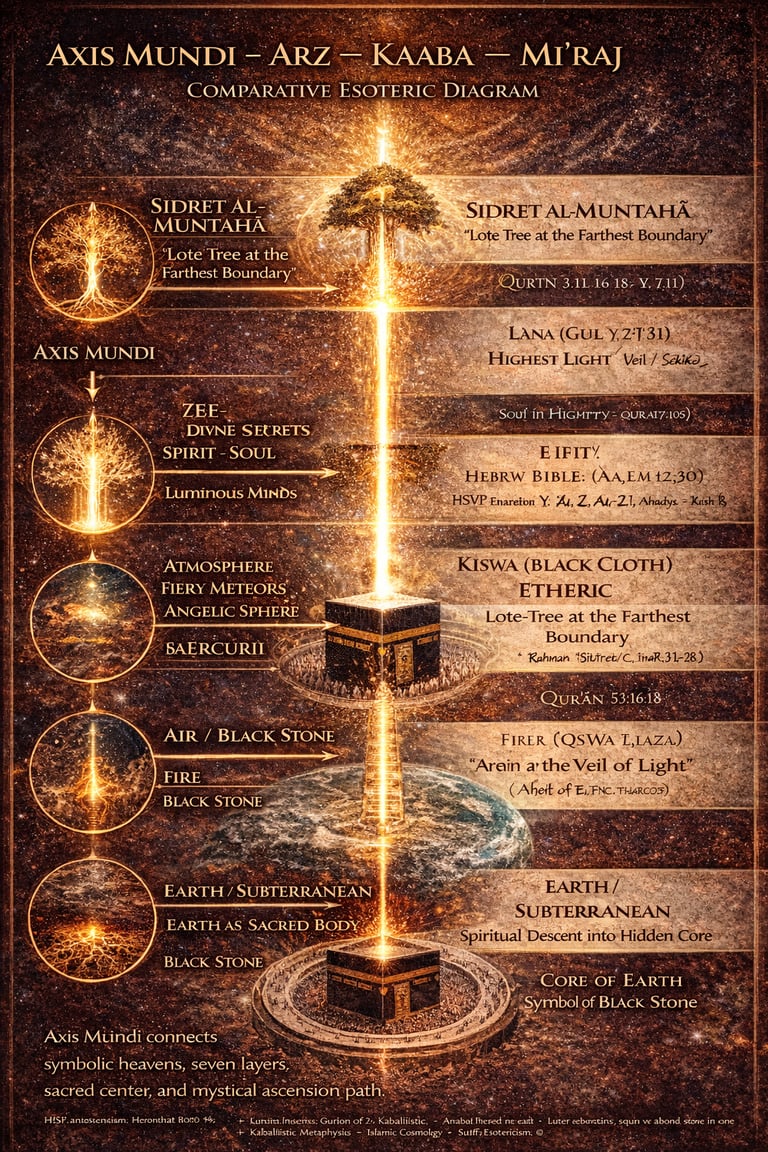
The “Black Stone” and Kaaba symbolize the axis mundi — the sacred center.
✝️ Christianity
Jonah narrative parallels Christ’s descent symbolism.
Eucharistic imagery appears in references to sacred body and earth.
🕉️ Hinduism
Seven-layer cosmology resembles loka structures.
Descent into earth parallels kundalini symbolism.
☸️ Buddhism
Microcosm/macrocosm parallels with mandala cosmology.
🌌 Universal Mythology
Earth as sacred body → Gaia archetype.
Axis mundi imagery (center, ascent, descent) appears across world traditions.
Pradakshina / Stupa refer to a sacred practice in Hindu and Buddhist traditions involving ritual circumambulation — walking around a holy object or structure while keeping it on one’s right side. In academic religious studies, this movement is often interpreted as a physical expression of the axis mundi concept.
🌀 What is Pradakshina?
Pradakshina (Sanskrit) literally means “to go to the right” or “to circle reverently.”
Core Features
Movement is usually clockwise.
The sacred object remains at the center.
The act combines devotion, meditation, and symbolic cosmology.
Symbolic Meaning
Scholars interpret pradakshina as:
Aligning oneself with cosmic order
Acknowledging the sacred center
Participating bodily in a spiritual axis
🛕 What is a Stupa?
A stupa is a Buddhist sacred monument, often dome-shaped, containing relics or representing enlightenment.
Ritual Function
Devotees perform pradakshina around the stupa.
The circular path symbolizes the movement of celestial bodies around a cosmic center.
The vertical structure of the stupa represents a spiritual ascent — a form of axis mundi.
🌍 Comparative Perspective
Academic comparisons often note parallels between:
Pradakshina around a stupa (Buddhism)
Tawaf around the Kaaba (Islam)
Circumambulation of sacred mountains or temples (Hinduism, Judaism)
All express a shared archetype:
➡️ A sacred center
➡️ Circular devotion
➡️ Vertical spiritual axis.
Axis Mundi is a key concept in comparative religion and mythology meaning “the world axis” or cosmic center—a symbolic line that connects heaven, earth, and the underworld.
Axis Mundi — Clear Academic Explanation
1) What it is
Axis mundi is not a physical object, but a symbolic structure that marks the point where different levels of reality meet. It organizes sacred space vertically and gives meaning to ritual movement (ascent, descent, circumambulation).
2) How it appears
Across cultures, the axis mundi takes recurring forms:
Ladder (Jacob’s Ladder)
Mountain (Meru, Sinai)
Tree (World Tree, Bodhi Tree)
Pillar / Column
Temple or sacred city
Human spine (in mystical anthropology)
Each form expresses the same idea: a vertical path of connection.
3) Religious examples
Judaism: Jacob’s Ladder; Temple Mount as a cosmic center
Islam: Mi‘raj (ascension); Kaaba as the world’s center
Christianity: The Cross interpreted as a cosmic axis; monastic “ladders” of ascent
Hinduism & Buddhism: Mount Meru; stupa as vertical axis
Indigenous/Shamanic traditions: World Tree linking realms
4) Ritual meaning
Practices like circumambulation (tawaf, pradakshina) move around the axis, while ascension myths move along it. Together they enact a complete sacred geometry: center + circle + vertical line.
5) Why it matters
In scholarship (notably Mircea Eliade), axis mundi explains:
How cultures distinguish sacred vs. profane space
How initiation and transformation are imagined
How the cosmos is mirrored in the human body (microcosm)
In short: Axis mundi is the universal symbol of connection, transformation, and centeredness—the spine of sacred meaning across religions.
Lawlâka Hadith refers to a famous mystical saying often quoted in Islamic spirituality:
“Lawlâka lawlâka, mâ khalaqtul-aflâk.”
“If not for you, if not for you, I would not have created the cosmos.”
It is traditionally addressed to the Prophet Muhammad and appears frequently in Sufi literature.
📜 Meaning and Context
1) Linguistic Meaning
Lawlâka = “Were it not for you.”
The phrase expresses the idea that the prophetic reality is central to creation’s purpose.
In poetry and mysticism, it symbolizes the cosmic role of prophetic light rather than a literal historical statement.
2) Hadith Status (Academic View)
Most mainstream hadith scholars classify this narration as:
Weak (da‘if) or not authentically transmitted in the canonical hadith collections.
However:
It became influential in Sufi metaphysics, where it is interpreted symbolically.
So academically, it is treated as a mystical maxim, not a rigorously authenticated prophetic hadith.
3) Sufi Interpretation
In Sufi cosmology, Lawlâka expresses:
The idea of al-Haqīqa al-Muhammadiyya (the Muhammadan Reality)
Creation unfolding through a primordial light or Logos-like principle
The Prophet as the axis or meaning-center of the cosmos
This is a metaphysical reading, not a legal doctrine.
4) Comparative Religious Parallels
Scholars sometimes compare the Lawlâka idea with:
✝️ Logos theology in Christian mysticism (creation through the Word)
🕉️ Ishvara / cosmic avatar concepts in Hindu philosophy
✡️ Adam Kadmon or primordial archetype in Kabbalah
These parallels are structural, not theological equivalences.
5) Axis Mundi Connection
In symbolic studies, Lawlâka is often linked to the idea of:
A cosmic center
A mediating figure between divine and created realms
The vertical axis (axis mundi) expressed in prophetic form.