THE BIOGRAPHY OF THE COSMOS
THE BIOGRAPHY OF THE COSMOS. The Torah says: “The forbidden tree of good and ill!” To break Lord’s sole command was gravest breach of will. The rationalist claims: “Such ban contradicts right!” For man in Paradise possessed no intellect’s light.
APOCALYPSE BOOK
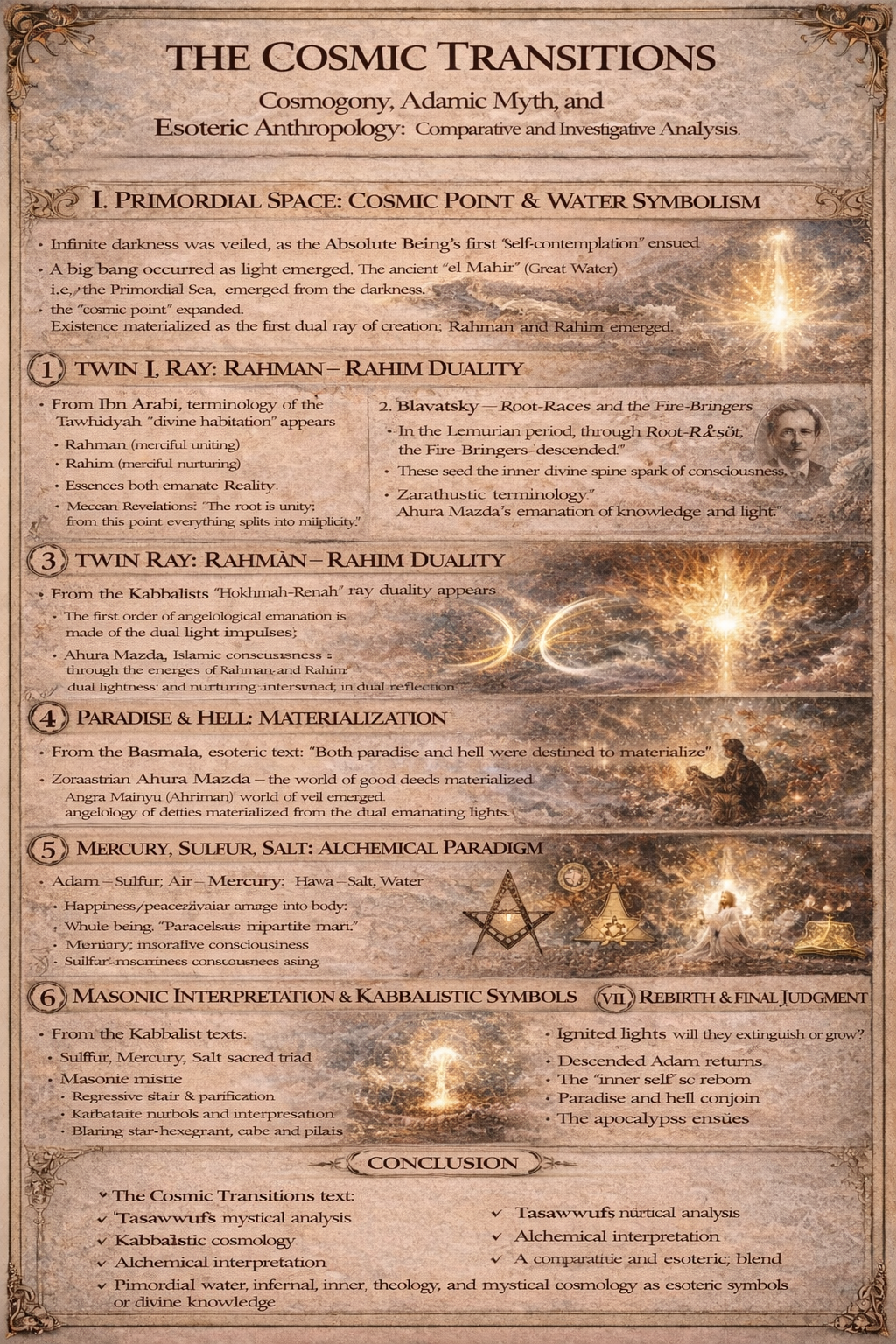
THE BIOGRAPHY OF THE COSMOS
I – THE FIRST SPACE
Lord was pure Eye! Like every eye—He could not see Himself;
To behold His Essence in a mirror—this is the creed of Hanif itself.
He first applied His Law unto His very own Being;
Thus He became the “First Muslim”—ALLAH His Name agreeing.
His Presence everywhere withdrew into a single point;
That point became the First Space—dimensionless in its joint.
In unseen, transparent essence there can be no dimension;
No matter existed in that first space—pure abstraction.
Making the Point the center, ALLAH encircled it whole;
To contemplate Himself there was the aim of His role.
The first womb of the cosmos every Holy Book calls “Water”;
Water is mother—Ma equals forty-one in order.
Hence comes the phrase “Forty-one times mashallah” said;
This water is primal substance—Life (body)’s essence widespread.
That space was like Mary, with Jesus conceived inside;
The Lord was the midwife who caused Messiah to arise.
A giant egg! An empty parabola was space;
Beyond its two foci there was no Sun nor lunar face.
The void that ALLAH emptied was darkness alone;
The sole witness of one divorced from ALLAH’s throne.
This emptiness longed for ALLAH’s grace to reach;
Whoever departs from Lord grows hungry for His light’s speech.
From ALLAH twin rays emerged—their Name was Lord;
Both RAHMAN and RAHIM—His likeness adored.
In the parabola the positive focus was ERRAHMAN;
Its negative pole was ERRAHIM—so believe, O man.
“The likeness of ALLAH has no likeness,” says the Verse;
For shadow has no shadow—this logic is not perverse.
Therefore call not later twins by the Name Lord;
Call them “shadow extensions,” lest sorrow be stored.
Lord’s positive pole RAHMAN diffused the Rûh;
Rûh was the form commanded by RAHMAN in truth.
The negative pole RAHIM emitted Sekine (Shekinah) bright;
Sekine (Shekinah) became RAHIM’s mirror of light.
Rûh is a dual-gendered word—both feminine and male;
Sekine (Shekinah) transmits the power of sound without fail.
RAHMAN’s Throne is Rûh; His Seat is Sekine (Shekinah);
These two are the adornment of the Night of Power’s arena.
RAHMAN reflected in Rûh from the “highest horizon” descended;
The Throne came down to make First Space as Paradise intended.
As a dove remains suspended, wings trembling in air,
Rûh vibrated—at the summit poised in art most rare.
When Sekine (Shekinah) conveyed vibration’s tone,
The primal waters rippled, trembling fine as bone.
Wave turned into energy, four currents arose;
Space became Paradise, filled with Lord’s luminous glows.
A “Single Cow” giving milk from four flowing veins;
The longest chapter—ponder well what it contains.
Nine months and ten days till birth, nose ever wet;
There must be secret in cow-worship yet unmet.
It resembles Zulqarnayn, with double horns outspread;
Its letters match ALLAH’s—like new moon overhead.
This chapter begins with ALIF LAM MIM—why so?
“Touch this cow—the dead will rise,” its signs show.
For ALIF LAM MIM is the Hidden Book from devil concealed;
“Only the pure may touch,” from its essence revealed.
This is the baptism Yahya performed with water clear;
The dove that made Jesus Messiah appears here.
“It is I who hold birds aloft,” declares RAHMAN;
Thus Rûh is a force vibrating ceaselessly in span.
The number of vibrations forms angels’ wings;
Those beneath Rûh are called the “We” of beings.
To the sound of this vibration Lord says Sayha;
In one instant it makes all exist—or fade away.
Return we now to Paradise spanning space entire;
That all may wear “ALLAH’s structure” in attire.
II – THE EARTHLY PARADISE
“Paradise from Earth to heavens’ height!”—this domain;
Its dimension equaled First Space again.
There Lord unfolded all faculties bright;
Angels and jinn He scattered in that light.
At last His own essential Name—ALLAH—
He lent to Adam, who rose as Paradise’s Shah.
Since the Name ALLAH encompasses every Name,
All within Paradise were within his frame.
Thus twin-born from Soul when he came to be,
First Adam wore this Paradise bodily.
At the “Final Boundary” stood this Endless Garden’s claim;
Its measure was First Space—First Adam its name.
Not to Earth, but “in Earth was Adam vicegerent” declared;
That Earth was this Paradise—there he fared.
This Earthly Paradise was Eve, Adam’s pole;
From Rûh’s wing called Sekine (Shekinah) came this role.
Paradise stems from embryo—hidden like Life (body)’s core;
From woman’s womb-root comes ERRAHIM evermore.
For Muhammad, ALLAH in Qur’an says “He is RAHIM”;
“The first secure house on Earth!”—none entering is extreme.
“I was a prophet while Adam was shaped from clay,”
Said the Messenger—of that Essence he spoke that day.
He who wore Paradise was Adam’s male pole bright;
From his positive side diffused the Trustworthy Spirit’s light.
ÂLÎ declares: “That first Adam—your father—was I!”
Thus the Father explains the name Abu al-Turab thereby.
III – PROSTRATION
The “Exalted Assembly” became First Adam’s frame;
“Lord commanded all: Prostrate before him,” came the claim.
To enter this SHAH’s command meant: cleave not from the Essence;
To refuse servanthood’s due would be slave-like recompense.
Resisting, the angels said to RAHMAN, “No!”—
They thought in freedom from the Essence good would grow.
Since each was mirror to a single Name alone,
Toward the Whole they bore a hidden jealousy unknown.
The order to prostrate meant: “Be Adam’s living cell;
Seek not another body—he is the Spirit’s window well.”
They bound not to Adam, and each angel remained in need;
Thus they depended on the Sekine (Shekinah) within Adam indeed.
They could not depart from Adam’s embodied sphere;
For every Name’s true locus was Adam’s title here.
With thoughts of rebellion in his body they were confined;
Unable to draw Sekine (Shekinah), their light declined.
They saw no body existed but Adam’s alone;
Rather than prison, they prostrated—overthrown.
Prostrating, they became Adam’s living cells;
They learned the womb’s nourishment safest dwells.
All were counted servants fully devoted to Lord;
Each cell of Adam became a school of a Name restored.
Essence took form and became luminous humankind;
Each filled with knowledge according to his Name assigned.
“But the chief devil bowed not!”—his pride unbent;
His name opposed the Essential Name in Adam present.
The leader from whom devils sprang bore “Iblis” as name;
It means “clothed”—for dense was his frame.
The bearer of the title “Deviant” could not believe;
“He opposed—not ALLAH—but RAHMAN,” we perceive.
IV – ADAM’S SLIP
The jinn were denser far than angels in design;
They said: “From this body there must be exit line!”
Their chief Iblis, true to “the Misleader” he was called,
Drew Adam’s gaze to his dual nature enthralled:
“From the female pole divide the male apart;
Create a world yourself—your Lord did this at start!
Withdraw the breathed Rûh from the male domain;
Create a paradise—such act is no strain!
Be immortal like Lord! Know evil and good!
There is pleasure in godhood beyond servanthood!
‘Four rivers’ flow from Lord’s Cow’s sacred breast;
They gaze on you saying: ‘Our Master, we attest!’
‘Four angels bear your throne upon their might!’
Their strength sustains you, equal in height!
‘None of your words are idle!’ All are Spirit and Word;
But I lack the light of SALAM—no gain is conferred!
RAHIM’s side Lord parted from RAHMAN’s embrace;
Then from Rûh brought you forth—unmarred in grace!
When there was no time, Lord drew a point from His own;
Created First Space—like water-like unknown!
From your transparent flesh draw Eve from Adam’s side;
Know the joy of creating has sweetness none can hide!
Let your children no longer be dual-gendered light;
To produce mere robots brings you no delight!
Though you say ‘Be!’ and they come here in love’s domain,
To create through union with your mate bears sweeter gain!
‘In that realm’ I shall at once prostrate to you;
‘With jinn at your command, O exalted god!’ I’ll do!”
Hearing this, Eve supported her spouse’s aim:
“Finish,” she said, “this marriage-contract’s claim!”
At last Iblis swore “by oath!” and deceived the line;
Thus twin Adam and Eve were cast outward from the Divine.
HELL
At that instant, with a dreadful cry, the body burst apart;
The First Paradise was ruined—Hell took its start.
When light departed from embodiment, matter darkened and congealed;
Each cell became an atom—yet more was concealed:
Each atom shattered and devoured Adam whole;
Rûh was trapped in every particle—the “Sultan” lost his role.
At last Eve became the total physical cosmos vast;
All jinn seeped within it, defying RAHMAN steadfast.
Director of this giant prison stood Iblis in might;
Adam its prisoner—“Exalted Assembly” hidden from sight.
From his cell each angel emerged with thousand-fold strain;
Jinn swaddled themselves in mineral, plant, fur, or fleshly chain.
Even through death no escape from the dungeon was won;
For he bore the name “defeated by his own ambition.”
The wardens of prison: selfishness and desire;
“As skins were shed, renewed was the filthy attire.”
Yet from this Hell some lineage found release—
Those who paid their due to Lord, settling debt in peace.
In the end from Adam Lord withdrew every Name;
Between him and his spouse remained a binding flame.
This shared transparent bond alchemists call “Mercury”;
Adam is sulfur, Eve salt—what bitter alchemy!
That single saving bond was Betul, hope’s thin thread;
From it RESUL and ÂLÎ claimed FATIMA instead.
Thus RESUL said of FATIMA: “She is from my own being!”
Compute it—First Adam’s spouse is FATIMA in meaning.
Thus was humankind told: “Retrace the path you came!”
All descended to animal, plant, and mineral frame.
INTERPRETATIONS OF THE SLIP – I
With fabricated theories that “Slip” was explained;
Those who forget the “First Moment” cannot have it attained.
RAHMAN did not make unbeliever witness to creation’s art;
No worm dwells in the tree at the instant the gardener plants the start.
Saint Paul misread the Slip in gravest distortion;
In the Church’s sight it bore the name “Original Sin” in portion.
For he said: “Adam lay with Eve in Eden’s sphere!”
Thus “All are born illegitimate!”—so the priest would fear.
As though he himself descended as son divine;
Whoever called him “father” gained lawful line.
The Torah says: “The forbidden tree of good and ill!”
To break Lord’s sole command was gravest breach of will.
The rationalist claims: “Such ban contradicts right!”
For man in Paradise possessed no intellect’s light.
The aim of both was to acquire mind’s domain;
To know the difference of “one and two” was their gain.
If Adam ate wheat in Eden from curiosity’s call,
Then he was first candidate for analytic thought of all.
But perhaps not thus! Paradise was mere prize;
The true blessing was bread earned through labor’s ties.
Materialist and spiritualist—each one astray;
I do not criticize—they suffice each other’s way.
In the secret of “ownership and trust” my reason was undone;
For all the fuses of my mind were blown, every one.
“The first seed exploded—thus the Universe!” says physics bold;
“The first seed never explodes—that is Rûh!” says metaphysics told.
The materialist sees centrifugal force in that expansion wide;
For such force divides and spreads the cosmic tide.
He cannot see the centripetal Rûh within matter’s core;
It contracts the expanding—call the one-eyed “Dajjal” therefore.
If versed in scripture he says: “He claimed the Trust as his own!
To guard the entrusted equals treachery shown!”
For Lord had divided the Trust into two poles bright;
Adam died because he split that Trust in spite.
THE MASONIC INTERPRETATION
Among interpreters the Mason is most erudite;
Yet this house’s inside is like an ornate grave in sight.
The thirty-third-degree master goes to lodge and declares:
“ALLAH is the Supreme Architect of the spheres!”
He knows not that not ALLAH but Adam is architect grand;
He rebuilds the cosmos that it return to its primal land.
“Jehovah” with hi and hu—both female and male;
That is twin Adam first—ALLAH alone stands without veil.
“Elohim” is plural masculine of goddess’s might;
Not ALLAH either—many dual beings in sight.
Elohim in Hebrew—ALHIM: one, three, five, one, four;
Rearrange their places—pi emerges with Lord at the core.
None of these therefore is ALLAH in truth;
Leave the architect—bow to the Owner of the Booth.
There is a star emblem upon the lodge’s screen;
Solve it with the Chapter of the Star—call ALLAH therein.
ALLAH takes letters one by one from His Name’s array;
In the final “H” remains only AHL AL-BAYT’s ray.
Like your star, that “H” is fivefold sign;
Trace of the secret of “ALLAH’s veil” divine.
The rosary in hand symbolizes the highest degree;
Thirty-three vertebrae—Essence of ÂLÎ.
While Mason exiles woman from temple’s domain,
In the Book stands last he who knows not human right’s refrain.
“You say woman came from man!”—false attribution;
From “one single essence” came both—true constitution.
That single essence is Rûh—the Qur’an says “Nafsin wahida” clear;
For both together number two hundred fourteen here.
“From rib bone!”—woman was not made;
That bone means “one side of the twin” displayed.
“Your spouse is of yourselves! We created all in pairs!”
ALLAH reveals the truth in clearest shares.
“Penis and vagina are the model!”—so of Elohim’s sign;
No mere male-female claim—read Torah, you’ll find.
You call your lodge symbol “the Earth whose husband died”;
“To be widow’s son!”—for Mason is pride.
Read this message—learn what and who is “Earth” indeed;
Remain not merely “widow’s fosterling” in creed.
REPENTANCE
Adam said: “O my Lord! When Iblis swore his claim,
I trusted in his truth—my innocence bore blame.
Through naivety my will in slipping swayed;
I crossed the servant’s bound—command what must be paid!
“In the pledge I gave to You I showed no steadfast art;
The bond between my essence and Yours was torn apart.
I stripped from Paradise—left naked, void of light;
I wore the hide of cosmos—my honor lost its height.
Alas! I lost my one true Friend above;
Forgive me—strip this animal skin I now clothe!”
FORGIVENESS
Lord said: “You are My twin-natured disposition’s sign;
You did not fall—you merely slipped—always you are Mine.
Know slipping is but shadow’s fleeting art;
Hold to the vertical ray—let shadow depart.
Disposition enters not Paradise, but shares each sphere;
In every heaven reflecting that Essence, Adam appears.
The hidden, transparent side of each realm’s garden is you;
In all of them as Adam you persist—this is true.
The cosmos is seven-layered—seven circles entwined;
Their common center is Lord—King and Queen combined.
Between Rua and Dam stand girl and boy in play;
With Joker counted fourteen—family array.
The Book is “ALLAH’s Face”; science calls it black hole;
A Point it is—who enters is reduced to zero whole.
No god exists there—‘La ilaha’ is that station;
A vengeance of the Essence on envy toward Ahl al-Bayt’s elevation.
In ‘Illallah’ stands ALLAH—there the command is “Stay!”
That boundary parted Moses and Khidr’s way.
Angelhood is Paradise’s rank—not final domain;
Thus I tell the angel: “Bow to Adam again!”
Within Adam the angel descends to density’s sphere;
Through soil, plant, beast—becomes human here.
All feelings once present in the transparent plane
Took four garments shaped by vibration’s domain.
Know not only you—“each of them I reproved!”
They follow Satan step by step to fire they moved.
“When camel through needle’s eye may pass with grace,
The unbeliever enters Paradise”—density must grow lace.
“I am the Best of planners,” the Verse declares;
A secret immense in that statement shares.
I breathed into you deception through Satan’s art;
That you become universe—first father and mother’s start.
Yet against Me you kept reverence true;
Your name became My Greatest Name in you.
Adam! Didymos! Twin! ÂLΖMUHAMMED the Trustworthy pair!
You both are: ‘Mercy to the Worlds’ declared!”
O CHILD OF ADAM!
Now hear me, O child of Adam’s line!
To “First Adam” you owe this honored name of thine.
Guard this noble title even from yourself;
For you have an enemy nearer than self.
The force sustaining this process bears Satan’s name;
To densify outer realms is his aim.
He is director—you prisoner—the world your jail;
He fashions endless pretexts lest you prevail.
He wills no human find himself within;
Let him worship fantasy gods, love crooked din.
Who dies thus returns not to Me in sight;
Reborn again—led blind toward mirrorless night.
When freed from sacred traps of common creed,
One day he finds his essence—true religion indeed.
Rebirth then ceases—comes the Resurrection’s hour;
Cell by cell they weave again First Adam’s power.
Transparent becomes dense cosmos—Paradise reborn;
Iblis and unbelief return to fire—stubbornness torn.
Rub two green branches—Lord strikes spark’s flare;
Rub two skins—crying infant appears from there.
IBLIS
To prevent this he “asked leave” from Me;
As “iron” he entered your blood silently.
Hear first why permission I gave Iblis then:
Without heat in blood the body cannot be led.
With oxygen of breath iron ever burns;
Thus each of Iblis’ commands from that furnace turns.
If oxygen burns iron too much or too small,
Consciousness fails—faint or killer in a fall.
He drives blood upward to selfish brain’s throne;
From that arise hunger and wars unknown.
He pumps blood ever to sexual domain;
Is it you who taste pleasure—or he who gains?
Clitoris and inner lips fixed upon woman’s frame;
So she bears children—yet pleasure fuels the game.
Mark well! Even without these a female conceives;
Sex is but trap his cunning weaves.
Subconscious fantasy summons erection’s rise;
Satan stirs it, shame then ties.
When Adam’s organ empties into Eve, it falls;
For sex is hidden shame—memory recalls first walls.
Iblis’ secret name is Azrael—ponder why;
As iron burns in blood it rusts and dies.
MINARET AND MIHRAB
Jacob with sharpened stone circumcised his own skin;
“Bethel” he named that stone—thus Jehovah’s faith did begin.
The first letter of Jehovah—Yod—male sign;
ALLAH in English “God”—rooted in Yod’s line.
“Bethel” means House of God—and stone therein;
Creation is sacred work—beyond mere skin.
Mary was “Bethel”; Fatima named Betul;
One conceived from Yahya, the other from ÂLÎ’s pull.
I said: “Honor be the Face of ÂLÎ!”—why so?
For he looked not upon organ’s show.
The child knows not its sexual part;
Minaret and mihrab sacred—ponder form with heart.
Use sexual organ solely for child’s birth;
Betul Fatima and Azra Mary show worth.
With each orgasm pineal and pituitary dim;
The only escape from body—discipline within.
Let Jordan flow upward as Jesus’ sign;
It is Paradise river—yet Hell’s fuel line.
The ignorant cling much to sex’s delight;
The knower refrains till “KUN!”—Be!—gives light.
“Woman is soil!” man water and plow;
Yet seek honor first in Rûh as Mary did vow.
In union three conditions: LOVE, RESPECT, CARE;
If none remain—erase and beware.
Martinez de Pasqually lived this vision’s flame;
The Qur’an—poorly understood—yet hints the same.
Master M.H. Ulug Kizilkecili
Türkiye/Ankara - 16 August 2000
IMPORTANT NOTE :The original text is poetic, and the author cannot be held responsible for any errors in the English translation! To read the original Turkish text, click HERE! The following section is not the author's work, and the author cannot be held responsible for any errors made!
ACADEMIC COMPARATIVE FOOTNOTES
1. The Primordial Point and Divine Self-Reflection
The poem’s concept of God as “Pure Eye” who cannot see Himself except through reflection parallels several metaphysical traditions.
In Islamic mysticism, especially in Ibn ʿArabī’s doctrine of tajallī (divine self-disclosure), God creates the cosmos as a mirror in which His Names and Attributes become manifest.¹ The famous ḥadīth qudsī, “I was a hidden treasure and loved to be known,” though debated in authenticity, encapsulates this metaphysical vision.
In Neoplatonism, particularly in Plotinus’ Enneads, the One overflows into Nous (Intellect) and Soul, not by will but by ontological necessity.² Creation is emanation, not fabrication.
In Christian theology, the Logos doctrine (John 1:1) frames Christ as the self-expression of God — the visible image of the invisible God (Colossians 1:15).³
In Lurianic Kabbalah, the doctrine of Tzimtzum describes divine contraction into a primordial point to allow space for creation.⁴ The poem’s “First Space” closely parallels this contraction.
2. Water as Primordial Matrix
The poem’s identification of “Water” as the first womb resonates across traditions.
In Genesis 1:2, “the Spirit of God moved upon the face of the waters.”
In the Qur’an (21:30), “We made from water every living thing.”
In Mesopotamian cosmology, Apsu and Tiamat are primordial waters.
In Thales of Miletus, water is the arche (archē) of all things.⁵
Water as maternal substrate is thus a nearly universal cosmogonic symbol.
3. Rahman / Rahim as Polar Emanations
The poem describes divine polarity through al-Raḥmān and al-Raḥīm.
In Islamic theology, these Names derive from raḥm (womb), linking divine mercy to maternal symbolism.⁶
In Kabbalah, the sefirot of Chesed (Mercy) and Gevurah (Severity) form complementary polar attributes.⁷
In Christian Trinitarian thought, divine relationality (Father–Son–Spirit) reflects internal differentiation within unity.⁸
The polarity described in the poem resembles metaphysical complementarity rather than dualism.
4. Adam as Macrocosm
The idea that Adam contains all Names parallels:
Ibn ʿArabī’s al-Insān al-Kāmil (Perfect Human).⁹
Kabbalistic Adam Kadmon, primordial cosmic human.¹⁰
Gnostic Anthropos myth.
Philo of Alexandria’s heavenly Adam concept.¹¹
Adam as microcosm–macrocosm bridge is common in esoteric cosmology.
5. Prostration and Angelic Resistance
The Qur’anic narrative (2:34) of angels commanded to prostrate before Adam is reinterpreted mystically in Sufi metaphysics as the subordination of partial attributes to the complete manifestation of the Divine Names.¹²
Christian parallels include Lucifer’s refusal in Isaiah 14 (later interpreted tradition).
Rabbinic literature also discusses angelic hesitation at human creation (Genesis Rabbah 8:5).
6. The “Slip” vs. Original Sin
The poem explicitly contrasts:
Pauline doctrine of Original Sin (Romans 5:12).¹³
Qur’anic concept of lapse (zalla) and repentance (2:37).
Islamic theology rejects inherited guilt; responsibility is individual (6:164).
Eastern Orthodox theology also emphasizes ancestral sin as mortality rather than juridical guilt.¹⁴
7. Cosmological Fall as Densification
The transformation of luminous being into material density parallels:
Gnostic descent myths
Lurianic Shevirat ha-Kelim (breaking of vessels)¹⁵
Sufi concept of tanazzulāt (descending levels of manifestation)
Neoplatonic procession and return
Matter as condensed spirit echoes Suhrawardi’s Illuminationism.¹⁶
8. Seven Layers of Cosmos
Seven heavens appear in:
Qur’an (67:3)
Rabbinic cosmology (Hagigah 12b)
Dante’s celestial spheres
Ancient Near Eastern cosmology
The number seven functions symbolically for completeness.
9. The Black Hole as “Allah’s Face”
The poem’s metaphoric linking of divine point and black hole reflects modern attempts to synthesize cosmology and metaphysics.
Comparative note:
Nicholas of Cusa’s coincidentia oppositorum
Meister Eckhart’s “God beyond God”
Contemporary Islamic philosophy of science (Seyyed Hossein Nasr).¹⁷
This is poetic metaphor, not scientific assertion.
10. Masonic Interpretation
Freemasonry’s “Great Architect of the Universe” concept reflects Enlightenment Deism.¹⁸
The poem critiques identifying architect with Ultimate Reality — a distinction also found in:
Gnostic Demiurge vs. Supreme God
Plotinus’ distinction between One and Nous
Islamic differentiation between Creator (Khāliq) and Absolute Essence (Dhāt)
11. Gender, Duality, and “Nafsin Wahida”
Qur’an 4:1 speaks of creation from a single soul (nafs wāḥida).
Jewish Midrash (Genesis Rabbah 8:1) describes Adam originally as androgynous.¹⁹
Plato’s Symposium (Aristophanes myth) describes original dual beings.²⁰
The poem aligns with primordial unity models rather than hierarchical gender theology.
12. Iblis and Iron in Blood
The symbolic association of Iblis with iron and blood heat reflects:
Humoral theory (Galenic medicine)
Qur’an 57:25 referencing iron’s “great might”
Alchemical symbolism of iron (Mars, aggression)
The psychophysiological reading parallels Islamic ethics on nafs and passion.
13. Sexual Symbolism and Asceticism
The text’s sexual symbolism reflects mystical sublimation traditions:
Christian monastic celibacy
Sufi discipline of nafs
Yogic kundalini control
Kabbalistic sanctification of marital union (yichud)
The poem criticizes indulgence but affirms sacred union under conditions of love, respect, and care — echoing ethical sexual mysticism across traditions.
14. Resurrection as Re-integration
The final reassembly of Adam resembles:
Islamic Qiyāmah
Pauline “Second Adam” (1 Corinthians 15:45)
Kabbalistic Tikkun (restoration)
Neoplatonic return (epistrophē)
Cosmos returns to transparency — matter spiritualized.
SELECT SCHOLARLY SOURCES
Ibn ʿArabī, Fuṣūṣ al-Ḥikam
Plotinus, Enneads
Raymond Brown, The Gospel According to John
Gershom Scholem, Major Trends in Jewish Mysticism
Kirk & Raven, The Presocratic Philosophers
Toshihiko Izutsu, God and Man in the Qur’an
Moshe Idel, Kabbalah: New Perspectives
Augustine, De Trinitate
William Chittick, The Sufi Path of Knowledge
Elliot Wolfson, Through a Speculum That Shines
Philo, On the Creation
Al-Qushayri, Risala
N. T. Wright, Paul and the Faithfulness of God
John Meyendorff, Byzantine Theology
Isaiah Tishby, Wisdom of the Zohar
Henry Corbin, Spiritual Body and Celestial Earth
Seyyed Hossein Nasr, Islam and the Problem of Modern Science
Margaret Jacob, Living the Enlightenment
Daniel Boyarin, Carnal Israel
Plato, Symposium
THE BIOGRAPHY OF THE COSMOS
Primordial Unity, Metaphysical Fall, and Eschatological Reintegration
A Comparative Study in Abrahamic and Esoteric Cosmology
Abstract
This monograph examines The Biography of the Cosmos as a metaphysical cosmology integrating Qur’anic theology, Sufi metaphysics, Kabbalistic symbolism, Christian theological motifs, Neoplatonic emanationism, and esoteric anthropological doctrines. The work presents a non-dual emanationist cosmology in which divine self-reflection generates the cosmos as mirror, Adam functions as macrocosmic totality, the Fall represents ontological densification rather than moral corruption, and salvation is re-integration into primordial unity.
Through systematic comparative analysis, this study situates the poem within Islamic metaphysics (Ibn ʿArabī), Lurianic Kabbalah, Pauline theology, Neoplatonism, Gnostic descent narratives, and modern cosmological symbolism. It argues that the text represents a synthetic metaphysical anthropology centered on unity, polarity, descent, fragmentation, and eschatological restoration.
Introduction
Cosmology as Mirror Theology
Cosmogony is never merely about beginnings. It is about identity. Every cosmology encodes anthropology; every anthropology encodes theology.
The Biography of the Cosmos presents creation not as fabrication but as reflection. The Divine, described as “Pure Eye,” generates the cosmos to behold Its own Essence. This is not creation ex nihilo in the classical juridical sense but creation as manifestation — an ontology of self-disclosure.
The central thesis of this monograph is that the poem advances a metaphysics of reflective emanation, in which:
Creation is divine self-revelation.
Adam is macrocosmic totality.
The Fall is ontological densification.
History is fragmentation.
Resurrection is reintegration.
Chapter I
The Primordial Point: Contraction, Reflection, and First Space
The poem begins with withdrawal into a “single point” that becomes “First Space.” This imagery resonates with:
Sufi tajallī metaphysics (divine self-disclosure)¹
Neoplatonic emanation²
Kabbalistic Tzimtzum (divine contraction)³
The “Point” is not spatial but ontological — a metaphysical zero. The cosmos emerges as mirror rather than object.
Theologically, this reframes creation from external act to internal manifestation.
Philosophically, it rejects strict dualism between Creator and creation.
Chapter II
Water, Womb, and the Matrix of Manifestation
The primordial waters symbolize undifferentiated potentiality. Across traditions:
Genesis 1:2 — Spirit over waters
Qur’an 21:30 — Life from water
Mesopotamian chaos waters
Pre-Socratic arche theory⁴
Water functions as ontological substrate. It is maternal, pre-formal, and vibratory.
The poem’s vibrational cosmology parallels both mystical sound metaphysics and modern cosmological metaphor (wave → energy → structure).
Chapter III
Divine Polarity: Rahman and Rahim as Complementary Emanations
The division into Rahman (expansive mercy) and Rahim (interior mercy) reflects dynamic polarity within unity.
Comparative parallels:
Chesed and Gevurah in Kabbalah⁵
Logos and Spirit in Christian theology⁶
Yin/Yang metaphysical complementarity (structural analogy)
This polarity is not ontological dualism but functional differentiation within unity.
Chapter IV
Adam as Macrocosm: The Perfect Human Doctrine
Adam contains “all Names.” This directly parallels:
Ibn ʿArabī’s Insān al-Kāmil⁷
Adam Kadmon in Kabbalah⁸
Gnostic Anthropos
Philo’s heavenly Adam⁹
Adam is not first biological organism but archetypal totality.
Humanity is thus microcosmic condensation of macrocosmic structure.
Chapter V
Prostration: The Subordination of Partial to Whole
The angelic prostration symbolizes the submission of partial attributes to integrated totality.
This motif parallels:
Qur’anic exegesis (2:34)
Rabbinic angelic debates¹⁰
Christian Lucifer myth (later interpretive tradition)
The refusal of Iblis becomes resistance of fragment against totality.
Chapter VI
The Fall Reinterpreted: Densification Rather than Guilt
Unlike Pauline Original Sin theology¹¹, the poem presents:
No inherited guilt
No juridical corruption
No ontological depravity
Instead, the Fall is densification — spirit condenses into matter.
Comparative frameworks:
Lurianic vessel-breaking¹²
Neoplatonic descent
Gnostic fragmentation myths
Matter becomes prison not because it is evil, but because it is heavy.
Chapter VII
Hell as Fragmented Embodiment
Hell is described not as external punishment but as ontological fragmentation.
Adam disintegrates into atoms; unity becomes multiplicity.
This resembles:
Alchemical solve et coagula
Sufi tanazzulāt (descending levels)
Existential alienation
Hell is separation from integrative consciousness.
Chapter VIII
Masonry, Architect, and the Demiurgic Question
The critique of “Supreme Architect” theology reflects an ancient metaphysical distinction:
Demiurge vs. Absolute (Gnosticism)
Nous vs. One (Plotinus)
Creator vs. Essence (Islamic metaphysics)
The poem insists the Architect is Adamic — not Absolute.
This is a metaphysical rather than sociological critique.
Chapter IX
Gender, Duality, and Androgynous Origin
The poem affirms primordial unity:
Qur’an 4:1 (nafs wāḥida)
Rabbinic androgynous Adam¹³
Plato’s Symposium myth¹⁴
Gender is differentiation of unity, not hierarchical construction.
Sexuality becomes symbol of creative polarity — yet also potential distraction from integration.
Chapter X
Resurrection: Reassembly of the Primordial Human
The eschatological vision is reintegration:
Islamic Qiyāmah
Pauline “Second Adam” (1 Corinthians 15:45)
Kabbalistic Tikkun
Neoplatonic return
The cosmos becomes transparent again.
Matter spiritualizes.
Unity reappears.
Conclusion
Cosmology as Spiritual Anthropology
The text ultimately teaches that cosmology is anthropology. The universe is the biography of the human being. The Fall is interior. Hell is fragmentation. Resurrection is integration.
This metaphysical anthropology rejects:
Pure materialism
Pure juridical theology
Literalist cosmology
Instead, it proposes a symbolic-metaphysical framework in which divine unity, polarity, descent, fragmentation, and reintegration structure both cosmos and consciousness.
The work stands at the intersection of:
Islamic metaphysics
Jewish mysticism
Christian theological reflection
Neoplatonic philosophy
Esoteric anthropology
It represents a synthetic mystical cosmology framed in poetic narrative.