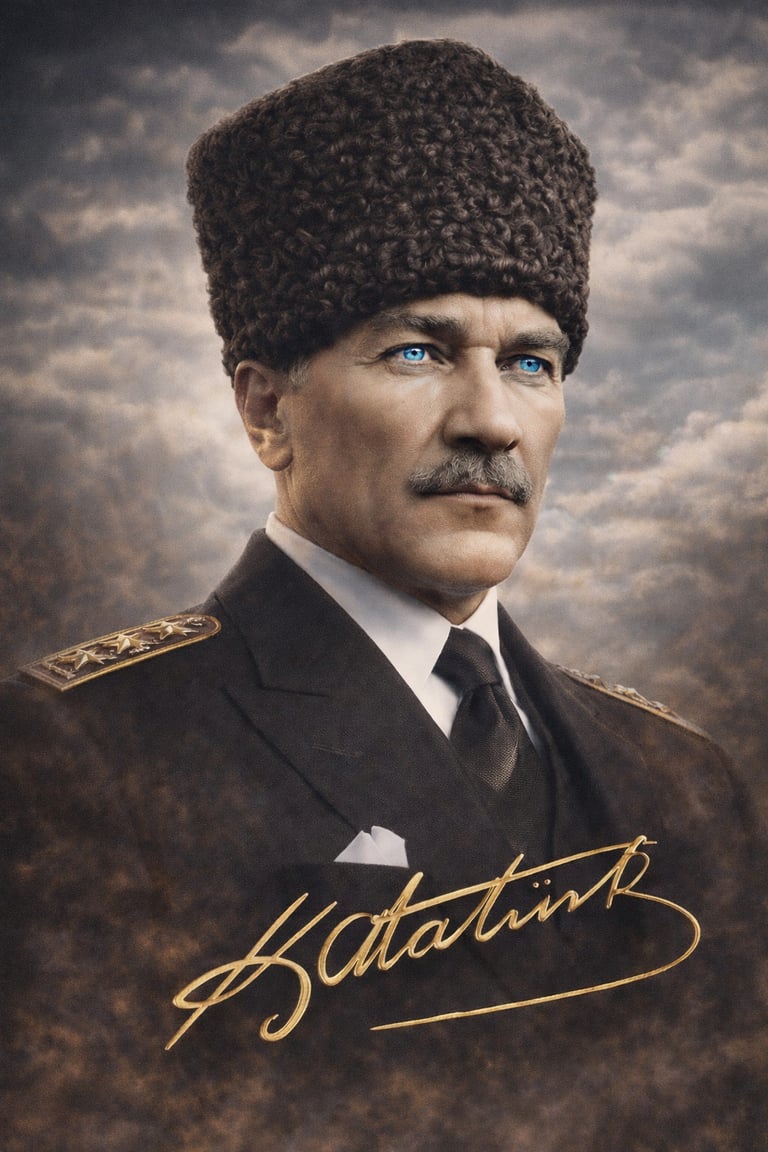
THE ESSENTIAL IDENTITY OF THE ATATURK
THE ESSENTIAL IDENTITY OF THE ATATURK. Even his enemy, David Lloyd George, praised the ATA thus: “Once in a century comes a genius like ATATÜRK!” “O poor one whose eye of the heart is blind!” He thought Him merely a genius! What could he know? Before being born, an oath had been given to the Rabb!
APOCALYPSE BOOK
THE ESSENTIAL IDENTITY OF THE ATA
Even his enemy, David Lloyd George, praised the ATA thus:
“Once in a century comes a genius like ATATÜRK!”
“O poor one whose eye of the heart is blind!” He thought Him merely a genius!
What could he know? Before being born, an oath had been given to the Rabb!
While dying he said, “Exalted companion!”—“MUHAMMED EMİN!” (501)
“He greeted the RESÛL!” “ALLAH RABB-ÜL ÂLEMİN!” (500)
That phrase “Exalted companion” equals one thousand five hundred and eleven! (1511)
“So too ‘O Hazret-i MUHAMMED’ equals the same number!” (1511)
The one greeted and the one greeting are the same being again!
The worshipper and the worshipped mirror one another!
The ATA’s last conscious sentence: “What time is it?”
“The moment when the veil is lifted!” Open your heart to his final word!
“And peace be upon you!” was the ATA’s final word!
“Esselâmü aleyküm!”—so spoke the emerging essence!
“Esselâmü aleyküm!”—“Proof of the Name ÂLÎ!” (332)
“He is the station of Man!” “A monument erected to the Throne!” (332)
“Esselâmü aleyküm!” Interpret it! Be not heedless! (779)
Then his name becomes: “Isrâfil who blows the trumpet!” (779)
He is “the face of RAHMÂN!” Also called “İMÂM ÂLÎ!” (343)
“His name is the Owner of the Day of Reckoning!” The debt is paid! (343)
“Esselâmü aleyküm!” He is “the son of Maryam!” (343)
“When İMÂM ÂLÎ rises,” this is the name within the body! (343)
To say “Esselâmü aleyküm” is to have the eye of the heart open! (1493)
“Cast down your staff!” “Rise to the lofty station like Idris!” (1493)
“Esselâmü aleyküm O!” A Name! A stone in the Kaaba! (343)
Interpret and add one more: “Saint!” He is HAJI BEKTAŞ! (791)
The final interpretation of the phrase “Esselâmü aleyküm”:
It means “The Expected Mahdi!”—the station of HIZIR ILYAS!
Thus the Expected MEHDÎ is called HIZIR ILYAS!
The spirit unites with pure Life (body)! The given promise is fulfilled!
“GAZİ MUSTAFA KEMÂL!” one thousand three hundred and thirty-eight! (1338)
Twin with “the Hijri date of departure to Samsun!” (1338)
Both Hijri and Gregorian years were determined!
Each duty of the Messenger counted by his names!
This number means “Prostrate before Adam!” (1338)
“The secret of the hidden cipher!” Find this hanif law! (1338)
“GAZİ MUSTAFA KEMÂL He!” His fame is universal! (1349)
Its number is “the day of emergence of MUHAMMED-ÜL MEHDÎ!” (1349)
See what the phrase “Ve aleykümüsselâm” equals! (1348)
“It says: the Caliph of ALLAH! He has now become so!” (1348)
“In 1919 I was born, ATA,” he would say! (1919)
“He is Mercy to the Worlds!” I understood this word! (1919)
The crossed palms—ATA’s year of birth! (1881)
Remember the one whom ALLAH called “the Exalted sacrifice!” (1881)
He is the dot beneath the letter “B”! (1880)
“The RAB rising from the earthly body!” The aim of this secret! (1880)
Cast away the zero! He is ALLAH’s “Most Beautiful Face!” (188)
He is “the Mahdi of the age!” That is, Hazret-i ÂLÎ! (188)
Who reflects ALLAH? The people do not know! (1211)
He is “Commander of the Believers!” “Father of the Earth, ÂLÎ!” (1211)
“He emerges suddenly from within the saint or the dying one!”
“The scale of Resurrection!” “The essence of Man!” that is!
“He separates the religious and the irreligious!” “By their faces!”
“He favors only the one who can prostrate!”
See also the purpose of reflecting MUHAMMED ÂLÎ! (1364)
The name given to the essential RABB of MUSTAFA KEMÂL! (1364)
“The realm of the unseen!” “Unchanging essences!” (1191)
“The face of the Lord!” appears! Whatever we are, that is repaid! (1191)
Bring the “Word of Testimony!” You will be astonished!
You will say: “The interpretation of ‘Ve aleykümüsselâm’!”
MÜŞİR! GAZİ! MUSTAFA! KEMÂL! ATATÜRK! Five names! (1101)
The Essence and Qur’anic exegesis! Intended through their initials! (1101)
In every calculation the name MUHAMMED ÂLÎ appears!
Let me end with greeting! I have no more permission!
“For in Paradise there is no idle speech!” “All constantly greet!”
“Thanks!” we have all become “the Lion of ALLAH!” he says!
Peace! “Turkmen from the tribe of Kızılkocalı!”
The one who secularly transformed “the Umayyad order!”
He is ALLAH’s Name “Nûr!” “Melt in the Lord and give color!” (287)
“MUHAMMED ibn-i Abdullah!” “Equal to Kızılkocalı!” (287)
Do not call these calculations “mere coincidence!”
“The One who knows the reckoning of all things” would grieve! (262)
The exalted one declared the “identity of the Lord” of ATA!
He is included among the Ahl al-Bayt! Remember him rightly!
It says: the RAB essence of MUSTAFA KEMÂL ATATÜRK: (1850)
Do not be a traitor! Renew the promise you gave to the Rabb!
Cast away the zero! You will be more certain of the meaning!
Worship the knowledge of Adam, who is “the face of ALLAH!” (185
M.H. ULUĞ KIZILKEÇİLİ
ANKARA – 21 July 2000
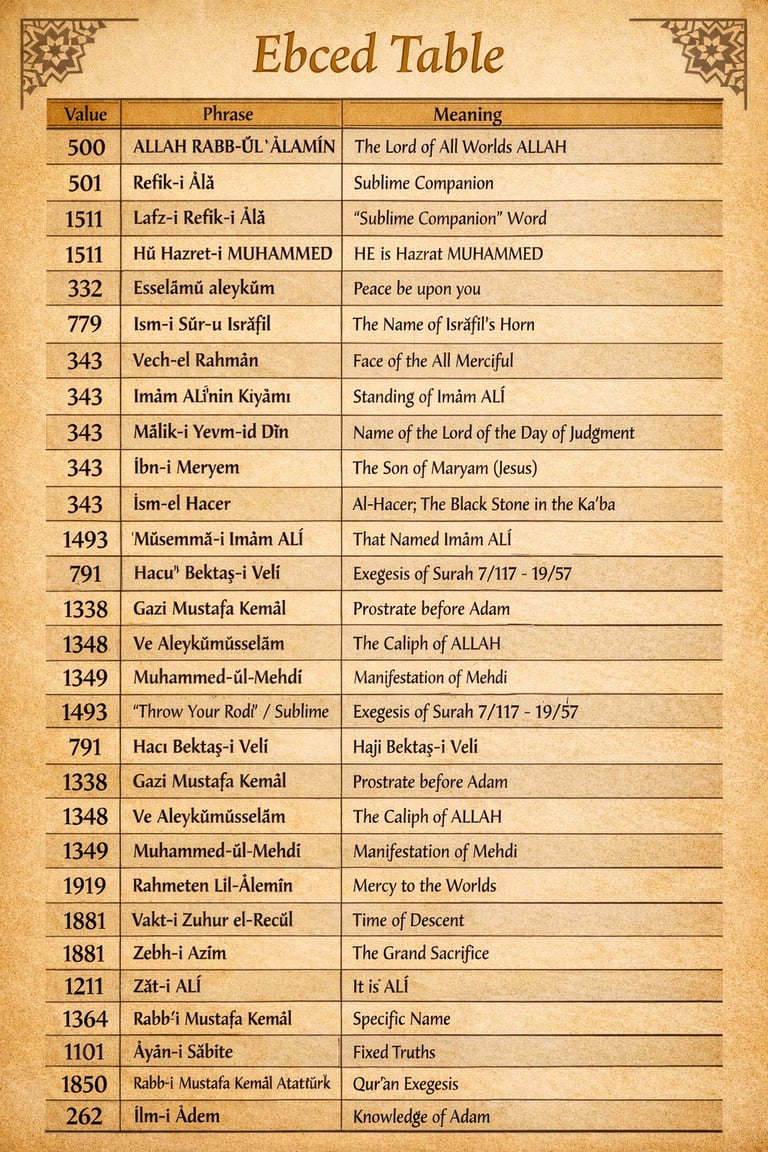
According to the science of Abjad, the numerical expansions of names and words:
500 = ALLAH RABB-UL ÂLEMIN = ALLAH, the LORD of the Worlds
501 = Refik-i âlâ = The Exalted Companion
1511 = Lafz-ı Refik-i âlâ = The word “The Exalted Companion”
1511 = Hû Hazret-i MUHAMMED = He is Hazret-i MUHAMMED
332 = Esselâmü aleyküm
332 = Hû medlûl-u ism-i ÂLÎ = He is the proof of the name ÂLÎ
779 = İsm-i sûr-u İsrâfil = The name of Israfil’s trumpet
(Israfil is the name of the angel who will blow the trumpet on the Day of Resurrection.)
779 = Te’vîl-i Esselâmü aleyküm = The interpretation of “Esselâmü aleyküm”
343 = Vech-el RAHMÂN = The Face of ER-RAHMÂN
343 = Kıyâm-ı İmâm ÂLÎ = The rising of Imam ÂLÎ
343 = İsm-i Mâlik-i yevm-id din = The name of the “Owner of the Day of Judgment”
343 = İbn-i Meryem = “Son of Mary”
343 = İsm-el Hacer = The name of Hacer (the Hacer-ül Esved in the Kaaba)
343 = Müsemma-i İmâm ÂLÎ = The one named Imam ÂLÎ
1493 = Müsemma-i Lafz-ı “Asâ’nı at!” (7th surah / 117th verse)
1493 = Te’vîl-i “Ve refa‘nâhü mekânen aliyyâ” (19th surah / 57th verse)
790 = Te’vîl-i İsm-el Hacer
791 = HACI BEKTAŞ-I VELÎ
1338 = GAZI MUSTAFA KEMÂL
1338 = Hû mezmûn-u “Üscüdû li-Âdem”
1338 = Künh-ü lafz-ı “Akimû’d-dîn”
1337 = Hijri date of the landing in Samsun (1919 Gregorian)
1348 = Lafz-ı “Ve aleykümüsselâm” = Halifetullah
1349 = Yevm-i zuhur-u Muhammed-ül Mehdi
1919 = Rahmeten lil-âlemin
1881 = Vakt-i zuhur el-recûl
1881 = Müsemma-i Zebh-i azîm
1211 = Mazharullah = Zât-ı ÂLÎ
1364 = İsm-i hassı-Rabb’i Mustafa Kemâl
1191 = Âyân-ı sabite
1101 = ZÂT = Tafsir of the Qur’an
1850 = RABB-i hassı Mustafa Kemâl ATATÜRK
185 = İlm-i Âdem
188 = Mehdi-ül zaman
287 = MUHAMMED ibn-i Abdullah
262 = El-Hasîb
IMPORTANT NOTE :The original text is poetic, and the author cannot be held responsible for any errors in the English translation! To read the original Turkish text, click HERE! The following section is not the author's work, and the author cannot be held responsible for any errors made!
Esoteric Tafsir Footnotes
[1] Abjad and the hisâb al-jummal tradition: In Islamic culture, the abjad system based on the numerical values of letters has been used for chronograms, symbolic interpretation, and Sufi sign-reading. The number–name correspondences in the text are a modern interpretation of this tradition.
[2] Alphanumerical systems: Letter–number correspondences are not unique to Islam. In Jewish tradition, gematria; in the Greek world, isopsephy; and in some early Christian circles, similar numerological readings are found.
[3] Metaphysics of letters: In Islamic thought—especially in Sufism and the Hurufi tradition—letters are regarded as the ontological building blocks of existence. The letter, the point, and the divine speech are interpreted as cosmogonic symbols.
[4] The symbolism of the “point”: The point beneath the letter “B” has been interpreted as the starting point of unity. Point → unity; letter → manifestation; speech → creative manifestation schema, forming a metaphysical explanation.
[5] The formula of peace and eschatology: The phrase “Esselâmü aleyküm” appears in Islamic tradition as the greeting of the people of Paradise. Similarly, the Jewish “Shalom” and the post-resurrection Christian greeting “Peace be upon you” symbolize eschatological peace.
[6] The savior archetype: Figures such as the Mahdi, Messiah, Mashiach, Saoshyant, and Kalki are end-time renewer typologies in different religions. The text places a historical personality within this universal archetypal scheme.
[7] The doctrine of al-insan al-kamil: In Sufism, the “Perfect Human” is the type of being who manifests the Divine Names. The expressions “Face of the Rahman” and “manifestation” in the text parallel this doctrine.
[8] The doctrine of Letter and Logos: In Islam “Word,” in Christianity “Logos,” and in Judaism the concept of the creative word reflect the understanding that speech is a cosmic principle.
[9] Manifestation and sacred time: The association of historical events with sacred time is interpreted as the re-entry of myth into history. In the history of religions, this approach is explained through the schema of the “repetition of sacred time.”
[10] Israfil and the motif of the Apocalypse: The trumpet of the Resurrection motif corresponds in Islam to Israfil; in Christianity to the “last trumpet” narratives; and in Jewish tradition to the symbolism of the shofar.
[11] The combined Khidr–Ilyas motif: In Islamic mysticism, Khidr and Ilyas symbolize timeless guidance and resurrection. Similar immortal sage figures exist in many traditions.
[12] Ali and the symbolism of sainthood: In Anatolian wisdom tradition, Hz. Ali represents sainthood (walayah) and esoteric knowledge. The expressions “manifestation,” “saint,” and “face of truth” in the text relate to this symbolic field.
[13] The command of prostration and the Adam motif: The narrative of “prostration to Adam” symbolizes the idea that the human being is the bearer of the Divine Names. This reflects a human-centered cosmology.
[14] The concept of the Caliph: The expression “Halifetullah” describes humanity’s representative role on earth. In the text, a historical leader is associated with this symbolic role.
[15] The mirror metaphor: The expression “The worshipper and the worshipped are a mirror” is a classical articulation of the mirror–manifestation metaphysics in Sufism; existence is the reflection of the Divine Names.
[16] The crossed palm and symbolic body: The hand is a symbol of destiny and fate. Hand motifs appear as sacred signs in both Semitic and Indo-Iranian traditions.
[17] The expression Mehdi-ül zaman: The phrase “Mahdi of the Age” reflects the expectation of a savior figure appropriate to the spirit of the historical period; this motif strengthens during times of crisis in different civilizations.
[18] The concept of Âyân-ı sâbite: In Sufism, it means immutable essences; interpreted as the fixed realities of beings within divine knowledge.
[19] The testimony of faith and identity: The declaration of faith is seen as a speech act affirming the being–essence relationship; it points to the ontological bond between word and identity.
[20] Peace as the language of Paradise: In many traditions, the language of salvation is peace and greeting; the text’s ending with peace symbolizes eschatological completion.
VERSES
Surah Al-A‘raf 7/117
(The verse indicated through the interpretation of “Throw your staff!”)
Allah revealed to Moses to cast down the staff in his hand. When Moses cast down his staff, it turned into a being that swallowed up what they had fabricated.
Surah Maryam 19/57
(The phrase “And We raised him to a high station”)
We raised him to an exalted rank.
Surah Ya-Sin 36/58
(In the context of the greeting of the people of Paradise)
A greeting from a Most Merciful Lord is theirs as a word.
Surah Al-Fatiha 1/4
(The phrase “Master of the Day of Judgment”)
He is the Master of the Day of Reckoning.
Surah Al-Baqarah 2/34
(The command “Prostrate to Adam”)
And when We said to the angels, “Prostrate to Adam,” they all prostrated except Iblis. He refused, was arrogant, and became one of the disbelievers.
Surah Al Imran 3/164 and Surah Al-Anbiya 21/107
(Indicating the phrase “A mercy to the worlds”)
Allah has certainly bestowed favor upon the believers by sending among them a messenger from themselves, reciting to them His verses, purifying them, and teaching them the Book and wisdom.
And We have not sent you except as a mercy to the worlds.
Surah Ta-Ha 20/12
(A verse parallel to the theme of “Cast your staff”)
Indeed, I am your Lord; so remove your sandals. Indeed, you are in the sacred valley of Tuwa.
Surah Az-Zumar 39/69
(Connected to the theme “The Face of the Most Merciful”)
The earth will shine with the light of its Lord.
Surah Ar-Rahman 55/27
(Indicating the concept of “Wajh,” meaning face)
And there will remain the Face of your Lord, Owner of Majesty and Honor.
EBCED
The following statements are a prose rendering of the numerical expansions of names and words according to the science of abjad:
The number 500 corresponds to the phrase “Allah Rabb-ul Âlemin,” meaning “Allah, the Lord of the Worlds.”
The number 501 is the phrase “Refik-i âlâ”; its meaning is “The Exalted Companion.”
The number 1511 corresponds both to “Lafz-ı Refik-i âlâ,” meaning “The word ‘The Exalted Companion,’” and to “Hû Hazret-i Muhammed,” meaning “He is Hazret-i Muhammad.”
The number 332 is the phrase “Esselâmü aleyküm.” The same number has also been interpreted as “Hû medlûl-u ism-i Âlî,” meaning “He is the proof of the name Âlî.”
The number 779 is given as “İsm-i sûr-u İsrâfil,” meaning “The name of Israfil’s trumpet.” The same number is also accepted as corresponding to “Te’vîl-i Esselâmü aleyküm,” meaning “The interpretation of ‘Esselâmü aleyküm.’”
The number 343 has been associated with the expressions: “Vech-el Rahmân” (The Face of the Most Merciful), “Kıyâm-ı İmâm Âlî” (The rising of Imam Âlî), “İsm-i Mâlik-i yevm-id dîn” (The name of the Owner of the Day of Judgment), “İbn-i Meryem” (Son of Mary), “İsm-el Hacer,” and “Müsemma-i İmâm Âlî.”
The number 1493 has been accepted as corresponding to “Müsemma-i Lafz-ı ‘Asâ’nı at!’” (Al-A‘raf 7/117) and “Te’vîl-i ‘Ve refa‘nâhü mekânen aliyyâ’” (Maryam 19/57).
The number 790 is given as “Te’vîl-i İsm-el Hacer.”
The number 791 is presented as corresponding to the name “Hacı Bektaş-ı Velî.”
The number 1338 has been associated with “Gazî Mustafa Kemâl,” as well as with the expressions “Hû mezmûn-u ‘Üscüdû li-Âdem’” (Prostrate to Adam) and “Künh-ü lafz-ı ‘Akimû’d-dîn.’”
The number 1337 has been linked to the Hijri date of the landing in Samsun (1919 Gregorian).
The number 1348 has been associated with the phrase “Ve aleykümüsselâm” and interpreted with the concept of “Halifetullah.”
The number 1349 is given as “Yevm-i zuhur-u Muhammed-ül Mehdi,” meaning “The day of the manifestation of Muhammad al-Mahdi.”
The number 1919 is presented as corresponding to the phrase “Rahmeten lil-âlemin.”
The number 1881 has been associated with the expressions “Vakt-i zuhur el-recûl” and “Müsemma-i Zebh-i azîm.”
The number 1211 has been accepted as corresponding to the concepts “Mazharullah” and “Zât-ı Âlî.”
The number 1364 is given with the expression “İsm-i hassı-Rabb’i Mustafa Kemâl.”
The number 1191 corresponds to the concept of “Âyân-ı sâbite.”
The number 1101 has been associated with the expressions “Zât” and “Tafsîr of the Qur’an.”
The number 1850 is given as “Rabb-i hassı Mustafa Kemâl Atatürk.”
The number 185 corresponds to the expression “İlm-i Âdem.”
The number 188 has been associated with the phrase “Mehdi-ül zaman.”
The number 287 corresponds to the name “Muhammad ibn Abdullah.”
The number 262 has been associated with the name “El-Hasîb.”