THE FITRAH OF ALLAH
THE FITRAH OF ALLAH. From it, Havvâ and Âdem descended from the Garden! Veiling their “Fitrah,” they took on bodies upon the Earth! “Fitrah” turned into “Ghayb”; thus the HANÎF RELIGION became necessary! Every prophet declared: “Conquer yourselves!”
APOCALYPSE BOOK
THE FITRAH OF ALLAH
“I will not worship an ALLAH whom I have not seen!” says ÂLÎ!
Lord says: “Most people do not know the HANÎF RELIGION!”
They suffice only with belief in the unseen!
ALLAH calls it “Ghayb” because the fitrah hidden in humanity is unseen!
Thus: “Only ALLAH knows the unseen!” — Why?
Because it is “His own fitrah” that He already knows!
The servant who finds his “fitrah” draws near to ALLAH!
For “Fitrah” is the closest thing to ALLAH — behold!
The name of ALLAH’s own essence-gene is “Fitrah”!
According to that formula He says to Himself: “Create!”
In everything He creates, His gene lies embedded!
Before dying, find within yourself that “formula of creation!”
Like ALLAH — immortal — you too create yourself!
Therefore the name of the “Religion of Islam” is the “Religion of Fitrah!”
The true “Fitrah of ALLAH” cannot be copied!
“For this reason there can be no god other than ALLAH!”
Within us are two kinds of genes: the ALLAH gene and the animal gene!
The human becomes responsible for the ALLAH gene upon maturity!
Why did ALLAH tell the angel, “You do not know the unseen”?
Because the angel does not possess the complete fitrah!
The angel knows only the single Name given by ALLAH!
It cannot learn every Name without becoming human in body!
When born as human, “Fitrah” enters within!
If one listens to it in the heart, one reaches the secret of the Lord!
Cibril came in human form and gave verses to the RESÛL!
Rahman loved MUHAMMED “with both Hands”!
When Rahman asked: “Am I not your Lord?”
He appeared in the form of Âdem: “Prostrate! Do not regret!”
Every atom is an angel — its aim is to become human!
Until it reaches humanity, every form carries suffering!
“In the First Âdem” all Names of ALLAH existed!
Meaning: the “Fitrah of the Lord” had become the entire body!
This twin-natured Âdem was not placed in the Garden!
“In the Qur’an,” the “Single Self” is the name of that First Âdem!
From it, Havvâ and Âdem descended from the Garden!
Veiling their “Fitrah,” they took on bodies upon the Earth!
“Fitrah” turned into “Ghayb”; thus the HANÎF RELIGION became necessary!
Every prophet declared: “Conquer yourselves!”
The unseen will be revealed — did you die, or did you attain?
Did you return the borrowed body to its true Owner?
When the “Ghayb” departs the body, it is called the “Manifest Imam”!
Behind that Imam one proceeds — and the account is settled!
The One called “the First and the Last” is an “Imam,” not Allah!
The Essence cannot be “first and last” — incline toward the secret of attributes!
Each Name of Allah clothes itself in “Fitrah”!
Rahman, Rahim, Spirit, Âdem, Imam — thus they appear!
The Fitrah emerging from you calls you to prostration!
Whoever you worship besides it, Allah calls “Shirk”!
Allah bound Himself to everyone through His own “FITRAH”!
Each one drank from the Essence — this is the “Covenant of Calling”!
“The hidden invocation of Zakariyya!” — this is it!
“Call! Bring forth your ‘Yahya’! Become of the Ahl al-Bayt!”
For one’s own “Fitrah” is not separate from Allah!
The ÂLÎ within you is the single path of Allah!
“Resurrecting a single person is like the Resurrection!” — Why?
Because the servant is questioned by his own Fitrah!
“Fitrah” is the center to which every cell is bound!
If it breaks from the circle, it becomes Azrâil each time!
If it emerges without breaking, its name becomes Cebrâil!
The number of vibrations — that is called “its wings”!
Know that Mikâil and İsrâfil are also your Fitrah!
Many describe the elephant like the blind — yet none truly see the elephant!
Allah is Essence; “Fitrah” is attribute — this is the primordial secret!
“When you cast, it was Allah who cast — through the hand of the RESÛL!”
“Âl-i Muhammed” means “Alif Lâm Mîm” — this is the Book!
If you seek guidance, become of the Ahl al-Bayt!
“A youth whose moustache had just begun to grow” appeared in the Mi‘rāj!
Learn the identity of this youth — open your eyes!
In Arabic such a youth is called “Shabb al-Amrad”! (548)
“He is the body of Imâm ÂLÎ, whose face is honored by the Lord!” (548)
“The lion that attacks in circles” — this is his other name! (643)
“The name of the father of humankind!” Remember the “Covenant”!
“Haydar” (lion) and “ÂLΔ — their names are equal! Why so? (222)
Because the lion is both transparent and physical!
Chest broad, head great, hair like a mane!
Wrist equal to forearm — beware when it roars!
Like a lion, both shoulders rose upward!
Born under the sign of Leo — on the 29th of July!
His name is Esedullah, meaning the Lion of God!
The RESÛL saw in the Mi‘rāj the one of “tremendous power”!
“The power of Allah resides in the exalted ÂLÎ,” says the verse!
With his claw he rends apart — if “yes” is not spoken!
Masons perform baptism with the “lion’s claw”!
But what is the lion’s true name — how would they know?
The same “lion’s claw” made Îsâ the Messiah!
Though John the Baptist existed, they worshipped Îsâ!
Yet Îsâ himself says: “Yahya was Elijah!”
“Yahya, son of Zakariyya,” manifests Rahman! (329)
Why are Khidr and Elijah always mentioned together?
Because “Hazrat Imâm ÂLΔ and “Khidr” are equal! (1600)
“Panja” means “five” in Persian — the family of the Lion!
With mane-like hair — “Samson” among you — awaken!
It is ÂLÎ! The chief of the saints of the Leo sign!
In the Saturnian age of Earth he received the graft from Rahman!
The Saturn age was Earth’s third prior evolution!
Through reincarnation Allah performs the transformation!
In the Saturn age humanity possessed mineral consciousness!
From the lion-saints came intellect as a gift to Earth!
The name of the Leo sign in Arabic is “Burj al-Asad”!
It means “ÂLΔ! In the Qur’an know: “KAF H Y AYN SÂD”!
The sum of these five letters becomes “EB IMAM ÂLΔ! (195)
ALLAH calls him “your Father,” that is, “IMAM ÂLΔ!
Esed and the World are the same; both equal sixty-five!
“RAB,” in Hebrew “Adni,” also equals sixty-five!
ÂLÎ was born in the Kaaba! The Kaaba is al-Bayt — the House!
It corresponds to the name of the “RABB of humanity”; love it!
The Hebrew letter “B” is read as “bayt”!
The Kaaba itself is the letter “B”; what an honor for ÂLÎ!
For Hazrat ÂLÎ said: “I am the letter B!”
B is the eternal Name of ALLAH, “ERRAHMÂN”!
Al-Bayt also means the Family of the House!
The Ahl al-Bayt is your “Fitrah”; strive to find it!
Otherwise MUHAMMED will not grant you his forgiveness!
“He is closer to the human than even his own self!”
And since the RESÛL says of ÂLÎ, “He is my own self,”
MUHAMMED and ÂLÎ must be the “First Âdem”!
The Spirit of the Sun governs the sign of Leo!
The Torah calls the Sun “ELYON,” meaning again “ÂLΔ!
Sunday is sacred for Christians!
Because the Sun is the RABB of Sunday!
“Îsâ was made to resemble another — he was not crucified!”
Know that the one he resembled is named ÂLÎ!
“If I reveal the identity of ÂLÎ,” says the RESÛL,
“Christians would call him a son!” — quietly!
“The People of the Book believe in Îsâ at the moment of death!”
“The Book” is ÂLÎ; the lover calls ÂLÎ with his last breath!
“Everyone rises from the grave saying al-hamdulillah!”
Seeing their “Fitrah” at death, none can deny it!
Saturday belongs to the planet Saturn as RAB!
“If the Jew does not prostrate that day,” his state is ruined!
When the Jew worships his God, he says “Yehovah”!
YEHOVA, SATURN, and ÂDEM — each equals forty-five!
RAHMÂN! That is the name of ÂLÎ, son of Abû Tâlib!
With a difference of one in number — I have no doubt left!
With CÂFER-Î SÂDIK and BEKTAŞ as my “Müezzin”! (723)
The secret of ÂLÎ never ends — but my permission ends here!
Master M.H. Ulug Kizilkecili
Türkiye/Ankara - 12 June 1999
IMPORTANT NOTE :The original text is poetic, and the author cannot be held responsible for any errors in the English translation! To read the original Turkish text, click HERE! The following section is not the author's work, and the author cannot be held responsible for any errors made!
Numerical expansion of the names according to the science of abjad:
“HÛ ISMI ÂLÎ IBNI EBI TALIB” = 328 = 329 = “ERRAHMÂN”
(Note: In abjad calculation, +1 or −1 proximity is accepted as equivalent.)
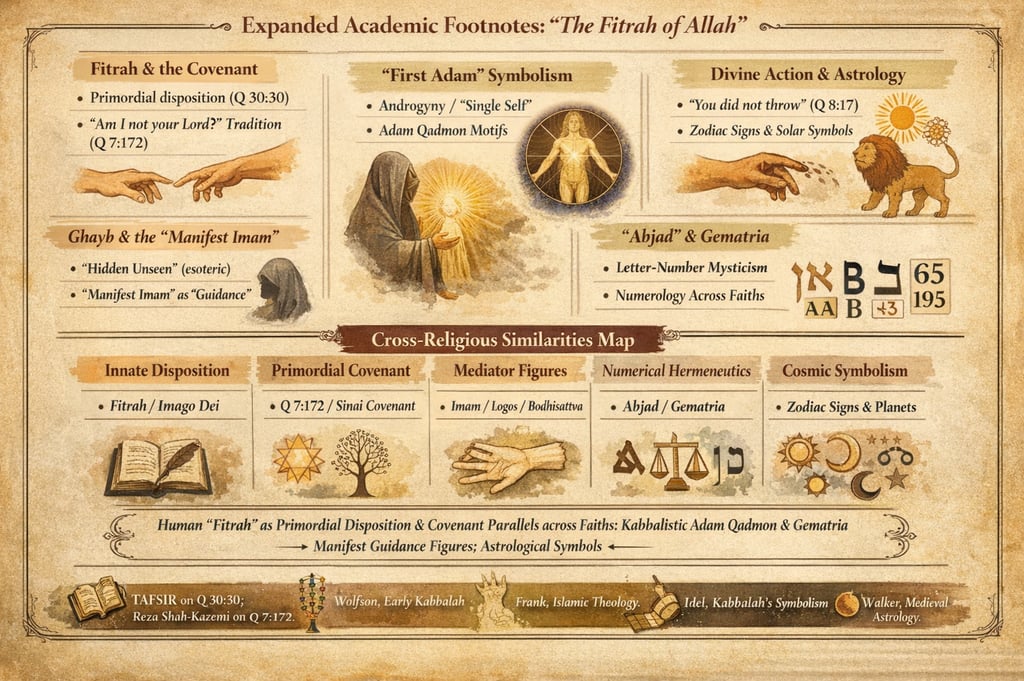
Expanded Academic Footnotes (English, Comparative)
1) Fitrah as “primordial disposition” (Q 30:30) and its ethical-epistemic role
The poem’s core claim—fitrah as an inner, near-divine “template” that must be uncovered—tracks a major line in Qur’anic anthropology: fitrah as an innate orientation toward the Divine and moral receptivity, often discussed via Qur’an 30:30 and related prophetic reports in classical tafsīr and modern scholarship.
2) Ghayb (the Unseen) as “inner hiddenness,” not only cosmological distance
By framing ghayb as “the fitrah hidden in humanity,” the poem shifts ghayb from “external unknown” to a concealed interior truth. This aligns with interpretive traditions that treat “hiddenness” as anthropological (human self-ignorance) as well as metaphysical (divine knowledge).
3) Hanîf religion: primordial monotheistic orientation and anti-idolatry polemic
“Hanîf religion” functions as the corrective path once fitrah is “veiled.” In academic Qur’anic studies, hanîf is typically situated as a primordial monotheistic orientation associated with Abrahamic memory and anti-shirk rhetoric. (Your poem extends this into a robust interior-psychological program: “Conquer yourselves.”)
4) The Primordial Covenant (Q 7:172) and “Covenant of Calling” language
Lines echoing “Am I not your Lord?” and “Seslenme andı” map directly onto the Qur’anic “Covenant Verse” tradition (Q 7:172), whose medieval commentarial reception has been analyzed into multiple interpretive “trends” (literalist, allegorical, ethical-responsibility frames, etc.).
5) Comparative covenant archetype across religions
The poem’s covenant motif parallels: Sinai covenant (Judaism), New Covenant sacramental/communal formations (Christianity), and “primordial pledge” motifs found in other revelatory traditions. Scholarship on the Qur’anic covenant tradition itself is a solid anchor for such comparison.
6) “You did not throw when you threw” (Q 8:17): divine agency and human action
The poem’s emphasis that Allah acts “through the hand” of the messenger is a classic locus for kalām debates (jabr vs. ikhtiyār; occasionalism; secondary causation). Modern philosophical work uses Q 8:17 as a key text in discussions of free will and theodicy in Islamic thought.
7) A “manifest Imam” as interpretive/theological lens
“Ghayb departing the body becomes the ‘Manifest Imam’” reflects a guidance-as-manifestation grammar that can be read against imamological frameworks in Shi‘i metaphysical imagination (and, more broadly, mediator figures across traditions). A rigorous academic move here is to treat this as poetic-theological language rather than a universally shared doctrine. (No single source “proves” this line; it is best contextualized as an esoteric interpretive register.)
8) “First and Last” and the essence/attributes distinction
The poem distinguishes Essence (dhāt) from attributes (ṣifāt) and restricts “first/last” language to the latter, which mirrors a well-known theological tension: how divine names/attributes relate to divine essence. Even when a poem takes a strong stance, academically it’s important to mark this as a particular doctrinal-philosophical positioning.
9) Androgynous / twin-natured “First Adam” and “single self”
Your text’s “twin-natured Adam” and “single self” resonate with interpretive trajectories where primordial humanity is imagined as a unity before gender differentiation. Rabbinic literature and its later receptions explicitly explore “male and female he created them” and related passages in ways that support “first human unity” readings.
10) Comparative: Adam Kadmon and “primordial man” symbolism
The poem’s “First Adam containing all Names” can be compared (as analogy, not identity) to Kabbalistic “primordial man” motifs such as Adam Qadmon, which functions as an archetypal configuration in Lurianic Kabbalah.
11) “Every atom is an angel”: layered cosmos and intermediary agencies
This line fits a broad late antique → medieval cosmological tendency to treat reality as graded and mediated by intelligences/agents (angelologies, emanation hierarchies). The poem’s framing is devotional-mystical; academically it parallels angelic cosmologies in Judaism/Christianity and metaphysical intermediary schemes in Neoplatonic traditions.
12) Shabb al-amrad (“beardless youth”) as mystical-aesthetic symbol
The “youth” motif—named shabb al-amrad—is widely discussed in Sufi aesthetics as a symbol of epiphanic beauty (often contested and carefully contextualized by scholars because of ethical and interpretive sensitivities). Scholarship engaging Schimmel’s interpretive legacy is useful here as a secondary academic window.
13) Lion (Asad/Haydar/Esedullah) symbolism and sacred power
Lion imagery is a cross-cultural “royal/heroic sanctity” emblem. The poem’s identification of sanctified authority with lion symbolism parallels, in different keys: “Lion of Judah” in Judaism/Christianity and lion-power theophanies in other traditions (e.g., Narasimha in Vaishnavism). (Comparisons here are structural-symbolic rather than doctrinal.)
14) Abjad (Ebced), letter-number equivalences, and their cultural function
Your poem’s numerical equations (65, 45, 195, 328/329) sit inside abjad practices historically used for chronograms, inscriptions, talismanic arts, and esoteric hermeneutics. Scholarship documents abjad’s use as a dating method and symbolic system.
15) Comparative numerological hermeneutics: gematria
The poem’s abjad logic has a clear analogue in gematria, a method of deriving interpretive associations by letter-number substitutions in Jewish tradition, often discussed as a favored medieval Kabbalistic exegetical technique (with internal debates about legitimacy).
16) Methodological caution: numerology as “allusion” vs. doctrine
A standard academic caution (also present within traditional circles) is that letter-number matches often function as allusive reinforcement rather than as independent proof. Encyclopedic discussions of gematria explicitly note that some condemned it as “toying with numbers,” while others treated it as useful in difficult texts—this mirrors internal debates found across traditions.
17) “Elyon,” Sunday/Sun symbolism, and cross-tradition solar sacrality
Your poem links Sun/Leo and sacred time. Across religious history, solar symbolism often becomes a carrier for sovereignty, illumination, and “highest” divine titles. (Note: “Elyon” in Hebrew contexts is typically associated with “Most High”; your poem repurposes it poetically—academically we treat that as re-application, not a standard lexical equivalence.)
18) Astrology, zodiacal iconography (Burj al-Asad), and medieval Islamic reception
The poem’s zodiac and planetary-day references align with the historical fact that astrology was widely practiced (though contested) in the medieval Islamic world and shaped both texts and material culture; reputable museum scholarship details this intellectual/artistic ecology and its controversies.
19) John the Baptist (Yahya) and Elijah (Ilyas): typological linkage
The “Yahya = Elijah” line corresponds to a well-known Christian typological strand (e.g., Elijah-precursor motif) frequently grounded in New Testament passages; while popular sites discuss this, academically it is usually treated within “prophetic typology” and “forerunner” traditions. (For a higher-quality academic anchor, you’d normally cite a critical commentary; here I’m flagging the typology as widely recognized.)
20) Khidr–Elijah pairing across Judaism/Christianity/Islam (shared saintly archetype)
Your poem’s equation of Khidr with Elijah reflects a real comparative-religion topic: Khidr/Elijah traditions circulate across Semitic religious imaginaries, and there are focused studies on Khidr–Elijah as intertwined archetypes.
Cross-Religious Similarities Map (all traditions, compact)
Innate disposition / inner law: fitrah (Islam) ↔ natural law & imago Dei trajectories (Christianity)
Primordial covenant / pre-temporal responsibility: Qur’anic covenant verse tradition ↔ covenant archetypes (Judaism/Christianity)
Mediator / manifest guidance figure: Imamology motifs ↔ Logos/Christology (Christianity) ↔ Bodhisattva (Buddhism) (structural analogy)
Letter–number hermeneutics: abjad (Islamic esotericism) ↔ gematria (Jewish Kabbalah)
Primordial human unity: “single self / first Adam” (poem) ↔ rabbinic discussions of primordial humanity ↔ Adam Qadmon symbolism
Cosmic symbolism (zodiac/planets): medieval Islamic astrological culture (contested yet influential) ↔ broader late antique Mediterranean symbolic ecology