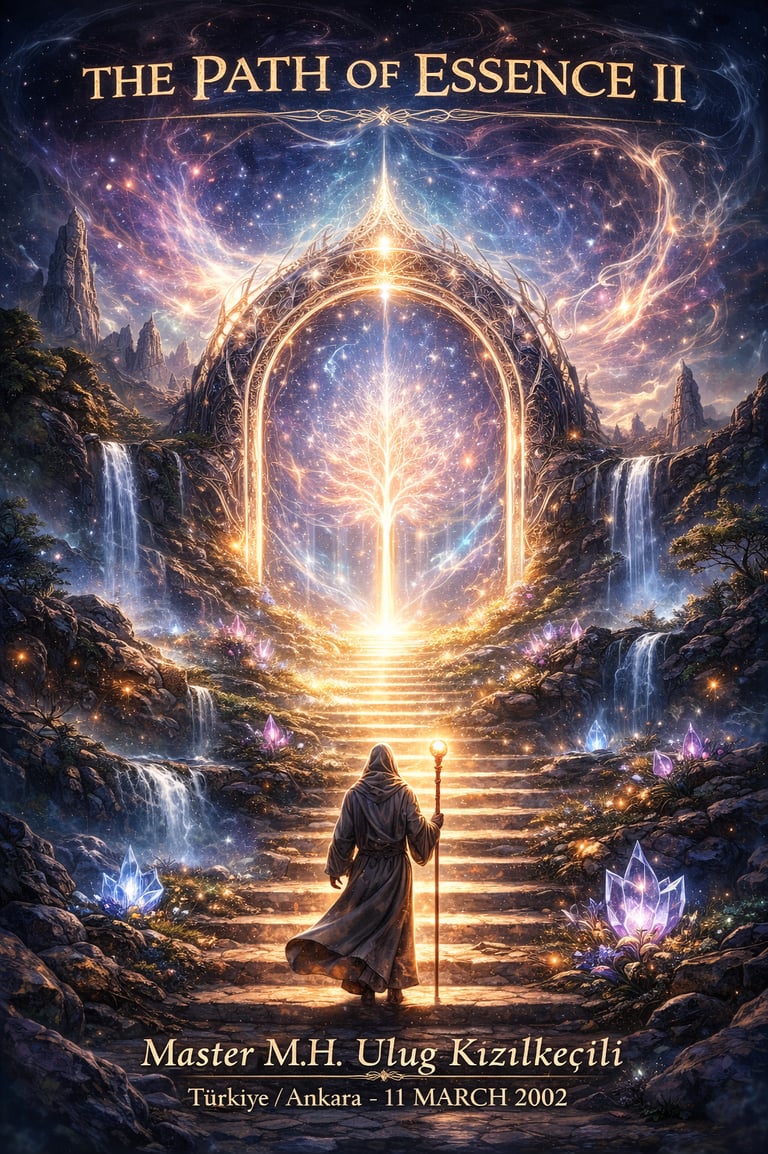
THE PATH OF ESSENCE II
THE PATH OF ESSENCE II. APOCALYPSE “The power heavy upon the universe!” — “It was hidden within us!” It becomes heavy for us as well at the end, “if we do not hold the oath!” This power trembles constantly in our center; a silent sound! If it vibrates in a higher register, all beyond the body hears
APOCALYPSE BOOK
Dedication to my Venerable Grandfather;
ÂLÎ FEYZÎ KIZILKEÇİLİ
THE PATH OF ESSENCE II
CENTER
“Since ALLAH taught every name to ÂDEM,”
then this Âdem must be the “He” before every name!
Surely, “Each name belongs to ALLAH alone!”
When reflected upon himself, the image of ÂDEM appeared!
ALLAH is an endless circle; there is no “First and Last!” nor “Outer and Inner!”
“First and Last!” “Outer and Inner!” — the center point; all and nothing!
The focus of every name of ALLAH is that center point;
“The First ÂDEM!” “LÂ and ILLÂ!” — meaning between existence and non-existence!
Non-being comes before being; “Lâ” holds precedence;
Lâ is the Essence! And Illâ is ALLAH! “Lâ ve Illâ!” means this very moment!
The circle keeps turning; yet the center that turns it does not turn!
“He is not a thing!” therefore “Immortal!” — may everyone find this!
Two infinities cannot exist; therefore the center is One!
If you say “He does not forgive partners,” it is neither Lord nor compulsion!
All powers within infinity gather in a single center;
To it, during the Mi‘râj, say “RAHMAN!” — “The One of intense powers!”
“Ask from ALLAH, or from RAHMAN, or from me — it is possible!” He says;
Because the two are one; one multiplied by one becomes ONE!
“ALLAH is behind the veil!” RAHMAN is the “veil” to ALLAH!
“The veil!” is the face of ALLAH; behold, and reach its inner side!
“All power exists only within the Supreme Name of ALLAH!”
“The Being of intense power!” is ÂLÎ; all else is power!
Whose hand was it that tore off the gate of the fortress?
Cebrâil saw “a young one” in the heavens and descended to earth with difficulty!
APOCALYPSE
“The power heavy upon the universe!” — “It was hidden within us!”
It becomes heavy for us as well at the end, “if we do not hold the oath!”
This power trembles constantly in our center; a silent sound!
If it vibrates in a higher register, all beyond the body hears it!
Its axis sounds like a “trumpet,” cracking and opening!
At the “roar of the lion,” every creature except the elephant flees!
“The witness rising from the shin,” for the “angel of death”;
That is the “Day of Qiyâmah,” when the inner turns outward!
“Call upon Him secretly,” like Zekeriyâ;
Become, while still alive, the father of a child named “YAHYÂ!”
“He makes Meryem conceive!” “He makes Îsâ the Messiah!”
“He even blocks the path of Mi‘râj in the form of a lion!”
“He has many names — ‘İlyas!’ ‘ÂLÎ!’ and ‘Bektaş!’”
Like Hızır, He both exists and does not exist in bodily form!
Whoever swore an oath recognizes Him when seeing Him;
Whoever cannot swear says, “If only I were dust!” and feels ashamed!
“He emerges from among them!” “He calls them to prostration!”
Whoever knows Him falls to the ground and says “yes!”
The ashamed bows his head and repents before Him;
The “Father” gives him another chance “not to swear!”
But for the one who “associates partners,” his position becomes a barrier;
For he suddenly assumes the form of an animal!
He laughed at the one who swore while still human — “What prayer did he perform?”
His only god was the intellect that pleased itself!
“Qiyâmah is like the reckoning of a single person!” — Why?
Because this process applies to everyone who dies!
“Humanity began in this world with Âdem!”
“And in the Hereafter it begins again with Âdem!” — whoever understands, understands!
The laws of ALLAH are one in both realms;
The Lord has a single body — call Him by whatever name you will!
PROSTRATION
“Prostration to the Lord is obligatory!” — but not to “RAHMAN”!
In the Lord, existence is one’s own; in RAHMAN, it is a debt — know this!
ÂLÎ expelled a Jew who said, “You are ALLAH”;
He said: “I am a servant who knows every Name!” Think carefully!
“Everything, including Satan, prostrates to ALLAH!”
But “ALLAH said to Satan: Prostrate also to the First ÂDEM!”
“While Satan constantly praises ALLAH,” he is “expelled!” Why?
“Because he refused to prostrate to the First ÂDEM!”
At that moment ALLAH created Paradise, Hell, and religion;
None of these existed before! Pay close attention to this!
So the aim of “religion” was “to prostrate to the First ÂDEM”!
“Paradise!” “Hell!” — instruments to make this possible!
Worshipping only ALLAH does not please ALLAH;
Objecting to ÂDEM reduced the “Most High” to the small!
“The Lord says: without associating partners, most do not worship Me!”
Alas, few in the world understand this verse!
“The Lord is nearer to us than ourselves!” — if we place an intermediary,
“This is hidden association!” — both “grave sin” and sorrow!
Behind the transparent veil is the bride’s beautiful face;
The veil is a “qibla,” that is all — let us not prolong the word!
This is the meaning — know it — of “LÂ and ILLÂ!”
For the “bridal gift,” “marriage” is required first!
In both world and hereafter, He becomes your “Huri” spouse;
Do not revolve like the world — let your sun never set!
The Lord does not say, “ÂDEM lay with his spouse”; He says, “He knew!”
He translates it as: “The knower was born together!”
“Yet they worship ALLAH! Even the closest ones!”
The Lord cannot be reconciled with multiple gods!
“To make the Lord one” is not merely to say “There is one ALLAH!”
Satan also says, “There is one Lord!” Now incline toward the secret:
Had ALLAH desired direct prostration to Himself,
He would not have said, “Prostrate to ÂDEM!” — “Religion would be unnecessary!”
“He would have created neither Paradise nor Hell!”
“He would not have expelled Satan who worshipped the Lord!” — think, will you!
“He would not have created the heavens for a single MUHAMMED!”
Do not ask anymore: Why did ALLAH say, “Prostrate to ÂDEM”?
“Satan did not oppose ALLAH, but opposed RAHMAN!”
ÂDEM is identical with RAHMAN — here lies the hidden meaning!
“ALLAH declared Satan an enemy to Himself!”
ÂDEM too is identical with the Lord — let every servant reflect!
“The one who associates partners” remains between qibla and the Lord!
“The Lord expels him from His presence!” — he takes the name Satan!
The root of “qibla” is “Cybele,” the name of the Mother Goddess;
Who knows her as the “essential mother” has understood this!
MUHAMMED performed prayer facing only his own essence!
He obeyed the command: “Turn your face to the religion without partners!”
You too worship like this! Do not say, “The qibla is the direction of ALLAH!”
The Lord is everywhere! He has neither back nor front!
Everything is for itself before the Lord — not for another!
They emerged directly by the command “Be!” — incline to the Essence!
The Commander is the “Word”; the command is also; what emerges is “Word”!
“Word” in the Qur’an means “RÛH” — now the eyes must open!
“Prostrate!” is also a “command”; it does not mean “Offer greetings!”
The command is to bend in order to place the forehead on the ground!
“The brothers of Joseph prostrated to him in this way!”
They did not merely greet him!
That prostration commanded by ALLAH for ÂDEM:
“It is not the clatter of hands and feet!” — it is falling into ecstasy!
“Prostration” means surrendering the borrowed existence to its origin!
If the worshipper and the worshipped are not one, the effort is vain!
To be freed from duality — this is the religion without partners!
When you step aside, “He” remains — that is, yourself!
The claim is not, in essence, to worship ALLAH;
The atheist and Satan both worship Him for free!
This “forced prostration” has no benefit for them;
Affirmation and denial of the infinite are the same!
“Do not, like Satan, worship the Lord directly!” “Nor merely praise!”
Unite with your ÂDEM! This is “Prostration” and “Repentance”!
“There are two kinds of Satan: jinn-Satan and human-Satan!”
Know your identity according to how you worship!
The good intention protects the one who worships the Lord outwardly!
“The cost of every servitude is paid in the presence of the Lord”:
He goes to one of the “eight Paradises”!
To the one who worships his essence, the Lord says: “Come to Me!”
The atheist is not an unbeliever! He says, “There is neither Lord nor partner!”
Even if he says, like Satan, “ALLAH exists!” — what difference does it make!
REPENTANCE
Look at the “Ark of Moses”! Its name is the “Ark of Repentance”!
“Upon it are two angels!” — “Their bodies in prostration!”
“That is the Ark of Sekine (Shekinah)!” “It is also called the Tabernacle!” Why?
Because within our dead body there is “a Spirit”!
“Two angels guard the Tree of Life in Paradise!”
When you become “dual-gendered,” you also have a “double spinal cord”!
Dual-gendered — that “First ÂDEM” who was commanded to prostrate!
Since his spouse later emerged from within him in Paradise!
When you become “one,” behold — “two!” The trial begins at once!
“For the Tree of Knowledge!” — they became prey to Satan!
Prostration facing the qibla — look twice in succession!
Everyone vows in order to find the spouse that emerged!
“Lâ ilâha illallah!” — be careful! It is not sufficient!
Incline to bring forth your “MUHAMMED”!
“Let him rest before you!” “Immediately prostrate to him!”
“And when you say ‘yes’ to him!” — thus you entered ecstasy!
“Ecstasy” comes from the root “body”! Renounce the borrowed body!
Clothe yourself in the body of “MUHAMMED” before it is too late!
That body is immortal — because it was not created!
This is the name of the body of “the One who spoke to Moses”!
There is no greeting in the prostration to the Lord!
There is the “First ÂDEM” as the “Means”!
You are again worshipping yourself — with yourself!
“When RAHMAN descended!” “RAHÎM reached the final boundary!”
“In the fire that does not burn!” IBRÂHÎM made the Ascension!
“ALLAH said: My enemy is the one who does not prostrate to ÂDEM!”
“And the one who follows Satan!” — “There is fire!” Hear, O people!
“ÂDEM formed the clay!” The RÛH blown from RAHMAN!
The “Oath” must be renewed — “to the AHL AL-BAYT!” O unripe crowd!
MERCY
“In every realm there are humans!” and the RABB nurtures them;
Therefore the Lord calls Himself “RABB of the Worlds!”
“Some among the people of the world are far superior!”
Not only in matter, but advanced in meaning as well!
They have found within themselves the Lord — MUHAMMED ÂLÎ;
No discovery in the universe can be greater than this!
While still in the world, behold the RESÛL: “A mercy to all realms!”
The Qur’an begins with “Hamd”; the praised being is MUHAMMED!
“He is a mercy to the worlds!” — equal, behold, to “Zikir!” (920)
“Zikir” means remembrance; reflect: it is “the Oath to Him!”
The root of both “RAHMAN” and “RAHIM” is the word “Mercy”!
The letter “R” of RABB is RESÛL; “B” is ÂLÎ! Open the eye of the Lord!
AHMED says: “I was a RESÛL even when Âdem was still clay!”
This means that MUHAMMED is the “essential water”!
“For the sake of his blessed face,” “all the heavens were created!”
Whoever does not turn toward that face is “cast down upon his own face!”
The immortal Face of ALLAH! Count the name “MUHAMMED” (193);
With the “fitrah of the Lord,” for the body touched it!
“The one in whom pride is taken” and the “double title” are equal! (920)
Remove one zero: MUHAMMED! — “The color with which the Lord is to be dyed!”
Before Âdem existed in the world, “life began with water!”
Hazret-i MUHAMMED is the name of the water of life!
The water that gives life to the soil is called “mercy”; behold!
“Merciful one” is identical with being near to ALLAH!
In the form of a “light-gene,” the essential water was placed in Âdem;
Come then — call the “First Âdem” your mother and father!
“The Âdem to whom the command of worship was given!” — why this Âdem?
“Because his spouse HAVVÂ was within him!”
“Âdem fell from Paradise!” — “the moment Havvâ emerged!”
“For alone he is incomplete: both Havvâ and Âdem!”
When you produce your spouse within yourself,
“You will become the one worshipped!” — that was the “First Covenant!”
“ÂDEM, NÛH, İBRÂHİM and ÎSÂ — all from this water!”
Therefore the Lord calls them “Chosen”!
“Every prophet swore allegiance to MUHAMMED!”
“And MUHAMMED to them!” — those who did not swear were burned!
“ÂDEM confirmed AHMED; AHMED confirmed ÂDEM!”
The “First” and the “Last” united — called “the Rope of ALLAH”!
MECCA – BEKKA
“MEKKE” became “BEKKE” after the conquest — why?
Because the duty of “M” ended and “B” took its place!
In the Basmalah the first letter is “B”; the last is “M”!
Prayer does not end without salutation — to “my father” and “my mother”!
“B” means to be “Berî” — free from association!
ÂLÎ revealed the verse: “The Kaaba was closed to disbelief!”
İBRÂHİM says: “I am berî from what you worship!”
RAHIM commanded: “Return to the religion of Abraham!”
And ÂLÎ was appointed the caliph of MUHAMMED;
Everyone, one by one, drank the “Oath of Allegiance” to ÂLÎ!
“I have perfected My blessing upon you,” said the Lord;
Immediately He “gave the religion of Islam!” Reflect carefully!
MUHAMMED ÂLÎ: “Hanif!” — “Islam!” — “Attachment to the Essence!”
“Zikir!” — remembering the promise you gave with every breath!
Another name of MUHAMMED and the Qur’an is “Zikir”;
Behold: AHMED and the Qur’an are essence — the “Oath” binds the body to Him!
The first gene split at the end, like “Zülfikâr”;
The final prophet emerged — the “possessor of the knowledge of the Book!”
“In the Clear Imam is everything!” — who is that Imam?
MUHAMMED says: “It is ÂLÎ!” — their number is the same indeed:
To the “Clear Imam,” the Lord says: “KAF! HÂ! YÂ! AYN! SÂD!” (195)
Both “IMAM-ı MÜBÎN” and “ÂLΔ equal 195!
The “Clear Imam” became the means to “Prostration”! (184)
“When the known term comes!” — “No questioning!” — through the “Oath”! (184)
“Mûsâ and Îsâ received only a portion from that Imam!”
Those who followed Mosaic and Isaic paths remained on foot upon the road of the Lord!
“The one who knows every Name of ALLAH!” — that living BOOK
First addresses: “Am I not your RABB?”
“None but the purified may touch the Book!”
Attach yourself to the RESÛL; ALLAH knows him as the purest!
“The Lord addresses him as ‘TÂ HÂ’ in the Qur’an!”
“T H” means pure, utterly cleansed — such a state is rare!
“ALLAH did not send blessings upon any prophet,” behold,
“Except the family of YÂ SÎN!” — let reason grasp this!
“YÂ SÎN” is a name of MUHAMMED before ALLAH;
He is higher than every prophet — whoever ascended the “ARSH” understood!
“TÂ HÂ!” — “Bestower of existence!” “Hand!” and “Face!” — all fourteen!
The RESÛL, the Twelve Imams, and FÂTMA — conceal the secret!
RECKONING
“With the phrase ‘the one who knows the account of all things’” (262),
the name ÂLÎ is metaphorically equal — let everyone know!
“The appointed term” and the Day of questioning share the same number; why?
Because they are equal to the “Clear Imam”! (184)
“His name” is also a kind of clue for you: (285)
It equals the verse: “They will be called to prostration!”
“The Possessor of both Wrath and Generosity!” — a Name of the Lord! (1100)
It means “Witness of the primordial oath”; the wise one understood!
If those who are not wise also wish to understand,
let them remove one zero; what remains is: “Leader of the supreme assembly!” (110 = ÂLÎ)
“On that Day there is no kinship!” — exception: ÂL-i Abâ!
For “they are kin to ALLAH through the fitrah!”
“Give the right of kinship!” — “this is the wage of the RESÛL!”
Reconcile with the Ahl al-Bayt; become a follower of the “Hanif religion”!
For the “Lord,” “Himself,” “His army,” and the “Balance,” He says “WE”! (108)
The phrase “love the near ones”; remove one zero — it becomes the same! (1080 : 108)
Only those who swore the oath are called “People of the Book”!
To the one who did not swear, “RAHMAN will not address him that Day!”
“In the presence of RAHMAN only one person will speak!”
Without oath to ÂLÎ, the Hereafter becomes difficult!
“The Lord bestows grace upon whom He wills!”
He wills the one who keeps the “Oath”; let me give you a secret:
The riddle called QADR, where destiny is set,
is the night you renewed your “first oath to your RABB”!
“To give one’s word” is the beginning of religion;
“To keep one’s word” is its end!
Otherwise “MUHAMMED ÂLÎ casts him into the fire!”
“To those in Hell, perish!” says the “Caller”!
ÂLÎ said: “That caller is me — yet you do not know!”
“The Highest Name” is “His inner face of ALLAH!” (141)
“He is the religion of ALLAH!” — remove the body from between!
ESSENTIAL IDENTITY
“The one who came forth from Meryem is RÛH,” and the one who breathed into her!
That is, say “RÛH” both for Cebrâil and for ÎSÂ!
If the vibration is the same, behold — the name does not change!
At the final vibration is ÂLÎ; the body is only his veil!
His “Most Exalted” name is proof of this vibration;
“RAHMAN who is RAHÎM” — the answer to his identity!
Those in lower vibration are one single body — called “WE”!
Hand in hand — “the hand that holds the Hand” understood the Lord!
“This is the Rope of ALLAH”; every knot of it is the Lord!
Raise your vibration; swear the oath; join!
“Rûh” is always singular; its counterpart “Word” is sometimes plural;
Because the father’s secret remains, no matter how many sons there are!
The child revealed the gene hidden in the father;
At that moment the man truly became a father!
The revealed secret of ALLAH: MUHAMMED ÂLÎ!
In that moment ALLAH became the Creator — though people do not know!
All attributes of the Lord exist in this twin essence;
A body taken from the Lord cannot be separate from the Lord!
Since “ALLAH is present and witnessing everywhere,”
so too must be “His caliph — the First ÂDEM!”
According to duty, his vibration and name change;
Like ALLAH — he both exists and does not exist in bodily form!
“Yemin” means both “Right side” and “Oath” — pay attention!
ÂLÎ and “Oath” are equal — swear to him and become secure!
There is a difference between a servant and the Lord:
his “Fitrah” belongs to himself!
While describing ÂLÎ, “seven seas were exhausted!”
My source is the manuscript of my grandfather ÂLÎ FEYZÎ;
He saw the “Rûh”; this is my most trustworthy message!
I have shared all secrets — say whatever you wish!
Every day of mine is the Tenth of Muharram; inside and outside, HÜSEYİN!
Above him there is no rank except the Lord!
The love of the Lord for HÜSEYİN made ÂDEM say “Prostrate!”
His innocent blood gives color to my tears;
Equal to that martyr whose name is IMAM HÜSEYİN! (361)
If you wish to reach the “black heart-point,” (361)
remember the name IMAM HÜSEYİN with every breath!
That is the secret of the “Name”; behold also: “19 times 19!” (361)
The Name appears 19 times in the Qur’an — we are full against empty words!
The phrase “Worship the Kaaba” equals “Attach yourself to the Name”! (583)
Swear the oath to MUHAMMED ÂLÎ, FÂTMA, HASAN, and HÜSEYİN! (583)
“Prostrate to ÂDEM!” — the final secret! Reflect and read again!
Until within you forms the tissue belonging to “ÂDEM”!
“The Path of Essence!” — “The Path of Gnosis!” — that is, knowing yourself!
“Be born together within!” — “Embrace your Master!”
Master M.H. Ulug Kizilkecili
Türkiye/Ankara - 11 MARCH 2002
IMPORTANT NOTE :The original text is poetic, and the author cannot be held responsible for any errors in the English translation! To read the original Turkish text, click HERE! The following section is not the author's work, and the author cannot be held responsible for any errors made!
“LÂ and ILLÂ!” (X)
Let that which divides “NON-BEING!” and “BEING!” now be removed — let it remain no more!
Let the “Two Seas” become a single point; let neither “PEARL!” nor “CORAL!” scatter!
“FÂTMA is the grace of AHMED!” — let no other meaning be taken!
“The same Soul!” — make the state of “AHMED” and “ÂLΔ the same!
There is no ÂLÎ apart from the PROPHET! There is no MUHAMMED, no ÂLÎ!
(The section written after this point has no relation to the author; due to possible errors, the author cannot be held responsible.)
Explanatory Notes (Original Contextual Remarks)
(X) This is the Öztürkçe (purified Turkish) version of the final stanza of the message titled Fıtratnâme in ÂDEMNÂME, published in 1959.
Notes:
“Two Seas”: HZ. MUHAMMED ÂLÎ
“The divider”: HZ. FÂTMA
Pearl: HZ. IMAM HASAN, martyred through poison
Coral: HZ. IMAM HÜSEYİN, martyred in KERBELÂ, symbolized by the red color
In French, connaître means “to know,” “to recognize,” and also “to have sexual union.”
According to its Latin root CON-Naître, it means “to be born together.”
Many languages and grammars were constructed by sages. For example, in Turkish word order, time precedes place. Likewise, in the Qur’an, ALLAH swears by “DEHR,” meaning “Time.” In the Torah, the first phrase is “In the beginning of time.”
Footnotes
“Allah taught every name to Adam” alludes to Qur’an 2:31 (“He taught Adam the names…”), a classical locus for discussions of language, cognition, and Adamic knowledge in Islamic theology and tafsīr.
The poem’s emphasis on “names” resonates with broader “sacred naming” traditions: e.g., Jewish and Christian “Name theology” (the Shem/Name as divine presence), and late antique metaphysics where knowing the “true name” implies access to a being’s essence (a theme also common in esotericism and theurgy).
“Prostrate to Adam” echoes the Qur’anic prostration narrative (Q 2:34; 7:11; 20:116), where the angels obey and Iblīs refuses.
In Islam, this prostration is typically interpreted as honorific (not worship of Adam), while the refusal of Iblīs becomes a paradigmatic case of pride and disobedience; comparative parallels exist with broader “rebellious heavenly being” motifs, though the Qur’anic framing differs from many later Christian demonologies.
“First and Last… Outer and Inner” strongly matches Qur’an 57:3 (“He is the First and the Last… the Manifest and the Hidden”), often read as a concise statement of transcendence/immanence paradoxes.
The poem’s circle/center metaphysics (unchanging center; rotating circumference) parallels Neoplatonic and Sufi philosophical imagery: the One as unmoved mover, and “center” as the point of unification of multiplicity (common in Ibn ‘Arabī–influenced symbolic vocabularies, though versions of this metaphor are pan-philosophical).
“Lā and illā” draws on the shahāda formula lā ilāha illā Allāh (“no deity except God”), but the poem uses it as an ontological grammar (negation preceding affirmation). This resembles apophatic theology structures found in multiple traditions (e.g., “via negativa” in Christian mysticism; neti-neti in some Hindu Upaniṣadic readings).
The line “One multiplied by one becomes ONE” reads as a polemic against duality; philosophically, it parallels strict non-dual metaphysics (e.g., Advaita’s emphasis on the non-second) while remaining rhetorically within a monotheistic idiom.
“Ask from Allah, or from Rahman…” recalls Qur’anic name theology and the permissibility of invoking God by different Names (Q 17:110 is a key locus: “Call upon Allah or call upon al-Rahman…”). (Note: the poem’s expanded phrasing is interpretive rather than a verbatim citation.)
The poem’s “veil” language evokes a wide mystical trope: divine transcendence “veiled” by attributes, Names, or manifestations. In Islamic discourse this often appears as ḥijāb imagery; in Jewish mysticism it can resemble “garments” of divinity; in Christian mysticism it can appear as “cloud of unknowing.”
“All power exists only within the Supreme Name” aligns with traditions where the Great Name mediates divine action: Islamic al-ism al-a‘ẓam, Jewish “Great Name” motifs, and Christian invocations of the divine Name; conceptually similar structures also appear in mantra traditions (though metaphysical premises differ).
“ʿAlī… all else is power” reflects a distinct devotional-metaphysical claim within certain ‘Alid-centered esoteric readings; academically, it should be treated as intra-Islamic mystical theology, not a general Islamic creed.
Gate-tearing motif (“tore off the gate of the fortress”) points to popular narratives about ‘Alī’s battlefield strength, widely circulated in devotional literature; for academic framing, it can be footnoted as hagiographic exemplum (heroic sanctity narrative) rather than a historiographically secure report.
Miʿrāj (Ascension) references the Prophet’s Night Journey/Ascension tradition (Islamic sacred history), and the poem’s instruction “say Rahman” uses miʿrāj as a symbolic scene of Names/power; comparative parallels: heavenly ascent literature exists in Jewish (Merkavah/Heikhalot), Christian apocalypses, and late antique visionary texts.
“Apocalypse… trumpet” parallels the widespread “trumpet” eschatology in Christianity: resurrection and transformation “at the last trumpet” (1 Cor 15:52) and the “trumpet of God” (1 Thess 4:16), as well as the seventh trumpet in Revelation (Rev 11:15).
In Islam, the trumpet is also a central apocalyptic image (often associated with Isrāfīl in later tradition), though details and canonical status vary across sources; the poem’s “axis sounds like a trumpet” reads as cosmological interiorization of eschatology (apocalypse as a psycho-cosmic event).
“Zachariah… call upon Him secretly… Yahyā” corresponds closely to the Qur’anic narrative where Zechariah prays quietly and is granted John/Yahyā (notably Q 19). The poem uses this as a model of inward prayer producing “new life.”
Mary conceives / Jesus as Messiah aligns with Qur’anic and Christian sacred history; the poem frames these as operations of the same divine agency. Comparative theology notes: Islam affirms virginal conception while rejecting divinization of Jesus; Christianity frames incarnation/sonship differently.
Lion motif appears in multiple symbolic registers: in Islamic lore, “lion” frequently symbolizes ‘Alī (Asad Allāh), while in broader comparative symbolism lions can mark threshold guardianship, sovereignty, or awe in visionary ascent narratives. The poem’s “lion blocks the path” reads as a threshold test image.
“Prostration obligatory… but not to Rahman” is theologically nonstandard in mainstream Islamic fiqh (where prostration is directed to God and “al-Rahman” is one of God’s Names). Academically, this should be footnoted as a sectarian/esoteric doctrinal distinction internal to the poem’s system rather than general Islamic doctrine.
The poem’s interpretation that “religion was created to prostrate to the First Adam” should likewise be annotated as a metaphysical rereading of the prostration narrative, not a consensus view.
“Ark of Moses… Ark of Repentance… Ark of Sekine (Shekhinah)… Tabernacle” blends Biblical objects and later theological language: “Shekhinah” is a Jewish term for divine indwelling/presence (prominent in rabbinic and mystical usage), and the Tabernacle/Ark complex is the classical locus for “dwelling/presence” theology.
The “between the cherubim” imagery specifically aligns with Exodus 25:22 (God “meets” above the mercy seat between cherubim), often used in scholarship to discuss sacred space and presence.
The poem’s “two angels… in prostration” resonates with Ark/cherubim iconography in Jewish tradition; “prostration” language is also broadly Abrahamic (submission before the divine presence), though ritual forms vary.
Dual-gendered / primordial human imagery parallels a known comparative motif: some late antique and mystical streams imagine an androgynous or integral “primordial human” (notably in certain Jewish mystical and Gnostic-adjacent speculations). The poem deploys this to interpret Adam–Eve unity as an inner event.
“The Word… Ruh”: the poem’s equivalence between “Word” and “Spirit” invites comparison with Christian Logos theology (Word/Logos) and Islamic discussions of kalima and rūḥ; academically, one should note that Qur’anic usage of “word” and “spirit” is multivalent and not identical to Nicene Logos doctrine.
“Qibla … root is Cybele” is philologically disputed. In standard Arabic etymology, qibla derives from the root q-b-l (“to face / direction faced”), and scholarly/lexical treatments explain it as “direction of prayer.” A derivation from “Cybele” is not accepted in mainstream Semitic philology and should be annotated as a speculative esoteric etymology.
The poem’s “veil as qibla” frames qibla as a symbolic “orientation device” rather than a localization of God; in Islamic theology, God is not spatially contained, while qibla functions as ritual unity/discipline—this interpretive move is best footnoted as mystical hermeneutics.
“Apocalypse is like the reckoning of a single person” echoes a common mystical principle: macro-eschatology mirrored in micro-eschatology (death as “personal end-time”). Comparative parallels appear in multiple contemplative traditions that treat death/awakening as an inward eschaton.
“Hidden association / intermediary” corresponds to discourses on shirk (associationism) and “hidden shirk” in some Islamic moral-spiritual literatures; the poem applies it to mediation and orientation, so the footnote should clarify it is a spiritual-ethical extension rather than a strict legal definition.
The poem’s repeated insistence that true worship requires unity of worshipper and worshipped aligns with non-dual mystical grammars (fanā’/baqā’ readings in some Sufi frameworks; “union” language in Christian mysticism), while also being theologically contentious from strict Creator–creature distinction perspectives.
“Two kinds of Satan: jinn-Satan and human-Satan” resonates with Qur’anic language about devils among jinn and humans (often cited from Q 6:112 in Islamic preaching), used to moralize internal and social temptation.
Abjad/gematria numerology: the poem’s numerical equivalences reflect abjad practice (assigning numeric values to letters) found in Islamic esotericism; comparative parallels include Jewish gematria and Greek isopsephy. Academically, such numerological readings should be footnoted as interpretive techniques rather than historically verifiable “proofs.”
“Shekhinah / Sekine”: the poem’s “Sekine” likely corresponds to Arabic sakīna (tranquility/serenity in Qur’anic usage) while simultaneously invoking Jewish Shekhinah (indwelling presence). A comparative footnote should distinguish these terms historically, even if the poem intentionally fuses them.
Zoroastrian eschatology parallel: the poem’s “final transformation/renovation” imagery can be compared—cautiously—to Zoroastrian Frashokereti (final renovation, defeat of evil, resurrection motifs), a well-studied Iranian eschatological doctrine.
Methodological note (academic): many claims in the poem operate as mystical-metaphysical assertions (internal symbolic system) rather than historical reportage. A thesis-style footnote can explicitly mark when a line is (a) Qur’anic allusion, (b) Biblical allusion, (c) hagiography, (d) etymological speculation, or (e) numerological hermeneutics—so a reader can separate textual reference from authorial doctrine.