THE SECRET OF BASMALAH
THE SECRET OF BASMALAH. Bismillah is the cipher of the Qur’an’s lock! Its formula’s deciphering belongs to the VELI alone! All secrets vanish if the Qur’an is merely translated! The Book is known by the one who possesses the knowledge of the Book! At the beginning of Sūrat Bara’ah, there is no Bis
APOCALYPSE BOOK
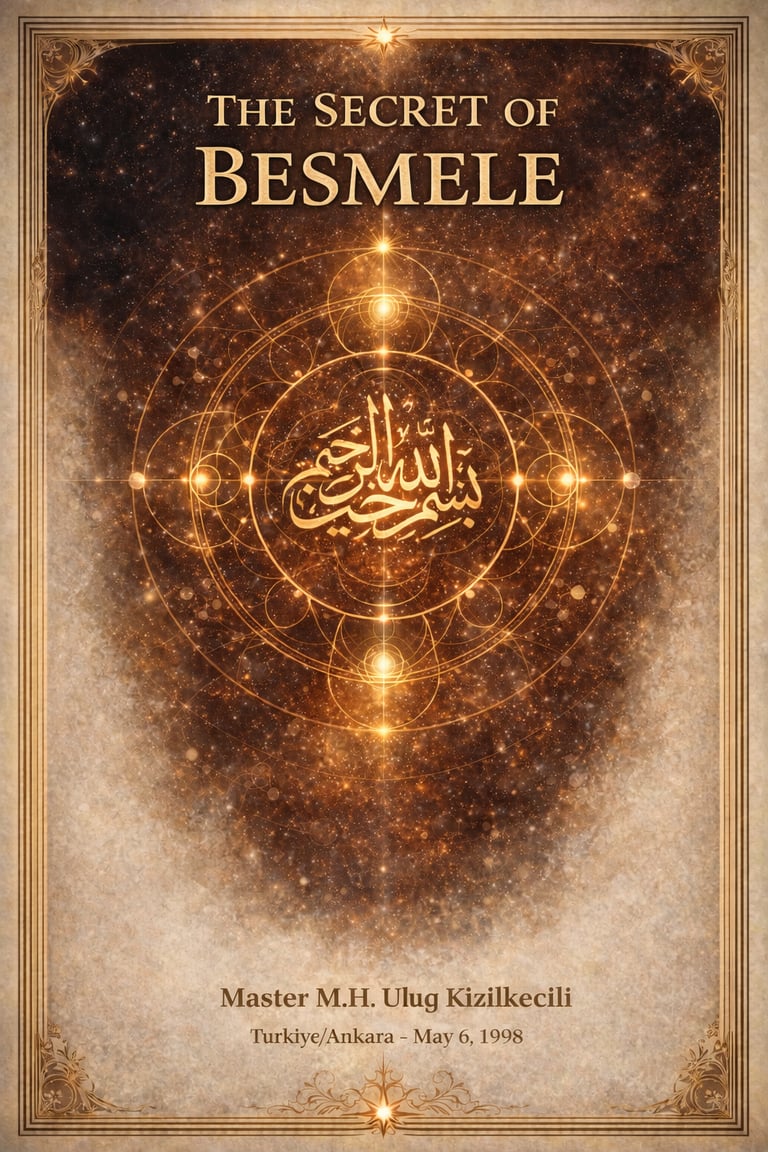
BISMILLAHİRRAHMANİRRAHIM
Bismillah is the cipher of the Qur’an’s lock!
Its formula’s deciphering belongs to the VELI alone!
All secrets vanish if the Qur’an is merely translated!
The Book is known by the one who possesses the knowledge of the Book!
At the beginning of Sūrat Bara’ah, there is no Bismillah!
It is the only surah that begins with the letter B, by Allah!
So it is the letter B that is the cipher of Bismillah!
Without knowing B, the formula’s decoding is but illusion!
Sūrat Bara’ah is also called Tawbah!
The Messenger sent Ali to proclaim it—behold!
The wisdom of choosing Ali is profoundly deep:
The verse declares: “Entrust the trust to its rightful bearer!”
The Messenger wished it, so that all might understand;
Ali went and recited the surah to the disbelievers!
Bara’ah means the final warning—to the breaker of the covenant!
If treachery occurs, neither father nor mother forgives their child!
With this surah, the Ka‘bah was first forbidden to the unbelievers;
For they had forgotten the covenant of their first ancestors!
Its other name is Tawbah—that is, Repent!
Remember the covenant of your fitrah—this is the religion!
The Torah too begins with B, look and see!
The name of Allah as Rahman, the Rahim, is B!
This is the true translation of Bismillah!
It is known by the one who possesses the knowledge of the Book!
Ismillah begins with A and S; Bismillah with B and S!
When B appears, A disappears—this is of great consequence!
A is One—namely Allah; B is Two—the reflected One!
When the representative comes, the Lord becomes the Unseen—proclaim the takbīr!
Through His representative, the Lord veils Himself!
That representative is fitrah—this is the Hanif Religion!
To open the veil and worship directly is no one’s right!
If you refuse the representative, your name is Iblis!
B is pronounced Bā; its sound cannot emerge without Allah!
For at every moment A breathes into B the breath of life!
Immediately after B, behold, comes S in the Basmala!
S is read Sīn—thus say “Yā Sīn” to Muhammad!
For the Lord calls Muhammad: “O S!”
Sūrat Yā Sīn is the first gift to the dead—behold!
The deceased is instructed with the name mother,
For Muhammad became his mother first of all!
To the one in the womb of earth, Rahim intercedes:
“O Father of Earth, B! You are Ali—forgive!” it says.
Know that Rahmanirrahim is Allah’s fitrah!
Muhammad and Ali are mirrors corresponding to that fitrah!
With these two twin beings, the Lord created all things;
He is hidden in your heart—find Him, rise from your grave!
If you rise through death while still in the body,
You will see your Lord and say: “So this was my fitrah!”
A servant can find his own fitrah himself;
In which life the dead shall rise—only the Lord knows!
The fitrah of the Lord is the Lord Himself—eternal like Him!
Its constitution is identical; He is the Lawgiver!
“That is why neither His law nor Himself ever changes!”
The pen always writes the dot—its ink is never exhausted!
In Arabic, the dot is B! Ali says: “I am the dot!”
When two As intersect, they form the central point!
Thus, when Allah reflects upon Himself, Ali appears!
Iblis affirms Allah but denies Adam!
“Ask from Me or from Rahman—there is no difference!” says Allah!
Rahman is the form of the Lord—for there are not two gods!
The fitrah consists of twenty-nine Names!
Find your own Name and let it manifest in the heart!
Each letter is a symbol of a supreme being’s Name of the Lord!
With these, every sphere of the universe is governed!
Each reflecting His Name is unique, like its reflection!
Bow in prostration, saying Muhammad Ali!
Do not speak like Iblis: “Prostration belongs only to Allah!”
Either know Adam and speak—or be silent if you do not!
Why did not Allah sit upon the Throne, but Rahman did?
Because when Allah descended upon the mountain, it turned to dust!
Thus, “Rahman created the heavens and the earth!”
“The origin of the universe is fitrah—Abraham knew this!”
If Allah is everywhere, why descend to a mountain?
If Rahman is the Face of the Lord, can He ascend the Throne?
Allah does not descend—He lifts His veil for an instant!
He nullifies atoms at once—silently crying out!
Rahman cannot descend—His fitrah cannot be separated from the Lord!
For Rahman is the first visible face of the Lord!
“Rahman performs istiwā!”—He is the pole of magnets!
To bring a thing under the command of sound along its axis!
From the central point, He balances every body!
To weigh equally—that is the meaning of istiwā!
The line of istiwā is the center, the abiding face of all things!
Bound to Rahman is the essence of the body called Spirit!
Rahman vibrates endlessly—the house of sound and radiation!
Rahim empties and calms this giant!
He is like the earth-line; His other name is
Sekine (Shekinah)—no better name was found for the feminine!
There are two opposing Adams: the Adam of Light, the Adam of Earth!
The Adam of Light is the Lord, for he is in His form!
That form of the Lord draws the Names—its name is Fitrah!
The one in the form of fitrah was not placed in Paradise!
Can the Lord be placed in Paradise? Paradise is Himself!
“A mercy to the worlds!”—the master of existence!
“He creates everything in the name of the Lord and gives it a name!”
Thus every body is clothed in His fitrah!
“He separated the heavens and the earth when they were joined!”—He is FATIR!
The Name Al-Fatir reminds us of Fatima!
For Fatima separates Muhammad and Ali!
One becomes Earth, the other Heaven—how beautiful!
Fatima reunites what she has separated again!
Hasan and Husayn are born—affirm this fitrah!
Hasan resembles the Messenger, and Husayn resembles Ali!
Clean garments are obligatory in prayer—clothe yourselves with Ahl al-Bayt!
The heaven of the human is the Spirit, and the body is Earth!
Prostration is obligatory to the one who reflects the Spirit’s likeness!
The Spirit is the Adam in the heart—it resembles the Lord’s fitrah!
This Adam mounts the earthen steed called life!
Life is the earthen Adam; the Spirit is the Adam of light!
The pure sea always seeks to cleanse the impure!
Water mixed with mud cannot purify itself!
First, life requires fasting, remembrance, and prayer!
As life approaches the Spirit, it warms and becomes vapor!
When united, it feels an ecstasy beyond union!
This is jam‘—the prayer performed on Friday!
The heart is Allah’s gathering house—few enter this mosque!
The Jewish crowd says: “The Lord rested on Saturday!”
They do not know—on Friday, Spirit was breathed into Adam!
Thus, “We” undertook the work in the name of Allah!
All follow the command of the Lord, sharing the same essence!
The Basmala has nineteen letters; written separately, twenty-two!
These are the symbols of the twenty-two dots—know this!
Since the dot is Ali, these dots are Ali’s!
Bring down these Exalted Ones who command prostration!
Every Basmala you recite means “in the name of the Lord!”
If you have understood yourself, do not betray yourself!
The Lord has no gift to offer other than Himself!
This gift is earned, O Uluğ, according to one’s state!
Allah is the Unseen! Rahman clothes Himself in Rahim!
The Lord appears in the form of Muhammad Ali!
This poem corresponds to Allah’s number Sixty-Six!
We offered it on the Tenth of Muharram—remember the Sixth of May!
Master M.H. Ulug Kizilkecili
Türkiye/Ankara - May 6, 1998
IMPORTANT NOTE :The original text is poetic, and the author cannot be held responsible for any errors in the English translation! To read the original Turkish text, click HERE! The following section is not the author's work, and the author cannot be held responsible for any errors made!
FOOTNOTES
I. BASMALA, LETTERS AND COSMIC SOUND
1. The presentation of the letter “B” as a key element in the poem is based on a letter-centered cosmology found especially in Sufi traditions, particularly within Hurufi and esoteric tafsir interpretations. Letters are not merely linguistic units but are interpreted as “vibrations of existence.” A similar understanding appears in Kabbalah, where Hebrew letters are considered creative forces.
2. The association of the letter “Bā” with the dot symbol is linked in Islamic esotericism to the saying attributed to Ali: “I am the dot beneath the Bā.” In Kabbalah, a comparable idea appears in the representation of creation’s beginning through the yod point.
3. The idea of creation through sound is constructed in the poem through the Basmala. In Christianity, this parallels the doctrine of Logos (“In the beginning was the Word”); in Hinduism, the vibration of “Om”; and in Hermetic traditions, the “Doctrine of Vibration.”
II. Fitrah, the Hanif Religion and the Cosmic Human
4. The concept of fitrah in the poem refers to the pure primordial nature of humanity in Islamic thought. It can be compared to Atman in Vedanta, the “divine spark” in Gnostic traditions, and Logos spermatikos in Stoicism.
5. The emphasis on the “Hanif religion” points to the archetypal origin of Abrahamic monotheism. In Jewish-Christian traditions, this is associated with Abraham’s monotheism; in Islam, it is interpreted as a return to fitrah.
III. THE MUHAMMAD – ALI DUALITY AND COSMIC PAIRING
6. The “twin being” structure described in the poem resembles expanded interpretations of the doctrine of Nūr Muhammadi in Sufism. In Hermetic traditions, this corresponds to the Sun–Moon duality; in Hinduism, to Shiva–Shakti; and in Kabbalah, to the balance between Tiferet and Malkhut.
7. The distinction between “Earth (Arz)” and “Heaven (Sema)” resembles the upward–downward ontology of Neoplatonic emanation models. Similar symbolism appears in the hierarchy of intellects in Islamic philosophy, particularly in the works of al-Farabi and Ibn Sina.
IV. RAHMAN – RAHIM AND DIVINE ATTRIBUTES
8. The distinction between Rahman and Rahim is treated as two dimensions of divine mercy: universal compassion and particular mercy. This can be compared to the distinction between “Grace” and “Mercy” in Christian theology.
9. The poem interprets Rahman’s istiwā as a cosmic axis. Analogies may be drawn with the centrality of Keter in Kabbalah and the sacred central point in Buddhist mandalas.
V. THE DOT, THE CENTER AND COSMIC GEOMETRY
10. The symbol of the dot corresponds to the “point of unity” in the tradition of Ibn Arabi. Hermetic geometry and the Pythagorean monad doctrine likewise describe the universe as expanding from a single center.
11. The statement about “the intersection of two A’s forming a point” reflects a form of mystical letter mathematics; parallels may be found in central convergence points within Kabbalistic sefirotic diagrams.
VI. THE TWO ADAMS AND COSMIC ANTHROPOLOGY
12. The distinction between the “Adam of Light” and the “Adam of Earth” expresses the spiritual and material layers of humanity in Sufi thought. Comparable models exist in Gnostic texts (light-man vs. earthly man) and in Hindu Samkhya philosophy (Purusha–Prakriti duality).
13. Presenting Spirit as heaven and body as earth reflects a metaphysical structure close to Islamic interpretations of Platonic dualism.
VII. FASTING, REMEMBRANCE AND PRAYER AS PURIFICATION
14. The threefold purification process described in the poem (fasting, dhikr, prayer) corresponds to the discipline of self-purification in Sufism. Similar practices appear in Buddhist meditation, Christian hesychasm, and Hindu tapasya traditions.
VIII. TIME, DAYS AND THE COSMIC CALENDAR
15. The comparison between Friday and Saturday refers to sacred days across different religions. In Judaism, the Sabbath; in Islam, Friday—both represent the sanctification of time.
IX. NUMBER SYMBOLISM: 19, 22, 66
16. The reference to the Basmala having nineteen letters is frequently discussed in modern numerological interpretations, though it is not accepted as a strict doctrine in classical tafsir.
17. The “twenty-two dots” expression may be compared to the twenty-two letters of the Hebrew alphabet, which in Kabbalah are regarded as fundamental instruments of creation.
18. The number sixty-six corresponds to the Abjad numerical value of the word “Allah.” The symbolic use of numbers has a broad literature within Sufism.
X. FATIR, FATIMA AND COSMIC SEPARATION
19. The divine name Fatir refers to the act of opening or splitting creation in the Qur’an. Comparable motifs include the splitting of the cosmic egg in Hindu mythology, the first differentiation in Hermetic texts, and the concept of tzimtzum in Kabbalistic emanation theory.
🜁 GENERAL CONCLUSION (ACADEMIC READING)
The symbolic system of the poem is structured around three main axes:
Letter–number metaphysics (Abjad and Hurufi symbolism)
The cosmic human model (Adam of Light – Adam of Earth)
A Rahman-centered emanational cosmology
This framework shows conceptual parallels with:
Islamic Sufism
Jewish Kabbalah
Christian mysticism
Hindu and Buddhist cosmologies
Hermetic-Neoplatonic philosophy
Yet the poem synthesizes these traditions into an original symbolic composition.