THE SUPREME COUNCIL
THE SUPREME COUNCIL. They lie within one another—the powers within the Lord! That is: the Sixes, the Fives, and their leaders, the Threes! All are arranged in pairs, according to their rank. Behold the principle of the Ahl al-Bayt—an eternal ordinance within the Lord.
APOCALYPSE BOOK
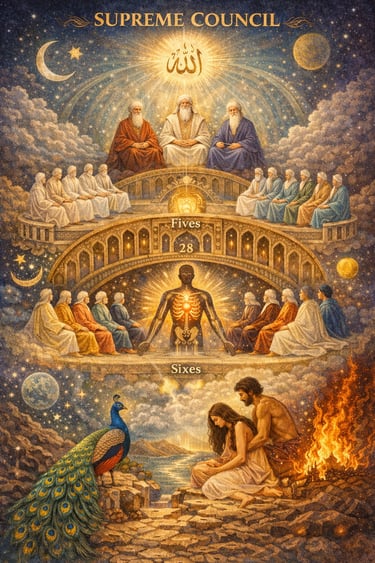
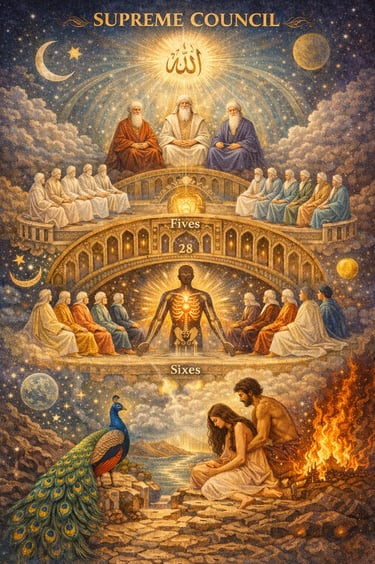
THE SUPREME COUNCIL
They lie within one another—the powers within the Lord!
That is: the Sixes, the Fives, and their leaders, the Threes!
All are arranged in pairs, according to their rank.
Behold the principle of the Ahl al-Bayt—an eternal ordinance within the Lord.
This immutable structure of Allah’s nature—
this is the Supreme Council; it has twenty-eight gates.
“The triple brain, the two hands, the ribs”—
“These point to it,” says the one learned in the Book.
The human body thus resembles the Supreme Council:
the single mosque of Allah, gathering all existence.
The One called Allah, the Father, awakens the Threes.
“The Threes, awaken the Fives; the Fives, awaken the Sixes,” He says.
The veil of the awakened is the awakener itself—why?
Because leaping stages without labor is forbidden.
This is the reason for the expulsion of Satan.
He said: “I will not bow to Adam while the One who created me exists!”
The last of the Sixes committed the same error:
he rejected his qibla and chose the easier path.
Below him he saw a dazzling flame:
“Surely this must be the House belonging to the Lord,” he said.
Through the constellations and the heavens he descended, at last, to the Earth.
Matter absorbed his light—he marveled at this state.
He seized the peacock of many colors and harsh voice;
starting from the earth, he climbed the Steep Ascent.
Pleading, he said to the Lord:
“I regret my descent! I have no religion, no faith, but You!
I committed this sin to know You.
Worse than Hell is my longing for You!
You are the One who loves most; Your name is Rahman and Rahim.
I am in love with You—forgive me! Let me be the first Abraham!”
The Lord said:
“Return to the partner you abandoned, and remove the veil called ‘I’ between us.
By descending to the earth, you never fell away from Me.
My fitrah is still within you—do not veil it.
But beware: let not your gaze incline elsewhere.
For I told Satan: test the soul in every way.”
If the path passes through you, it is short; otherwise, it is long.
Even if water freezes like stone, ice remains within it.
Master M.H. Ulug Kizilkecili
Türkiye/Ankara - November 13, 1998
IMPORTANT NOTE :The original text is poetic, and the author cannot be held responsible for any errors in the English translation! To read the original Turkish text, click HERE! The following section is not the author's work, and the author cannot be held responsible for any errors made!
The Supreme Council / al-Malāʾ al-Aʿlā
Methodological Note
The text employs numerical symbolism (threes, fives, sixes), anthropomorphic metaphors, and Qur’anic allusions to articulate a vision of a primordial divine order called the “Supreme Council” (al-Malāʾ al-Aʿlā). Such language is characteristic of Sufi metaphysics, Ismaili cosmology, and late antique esoteric hermeneutics, where numbers and bodily imagery function symbolically rather than literally.
1. The “Supreme Council” and al-Malāʾ al-Aʿlā
The term “Yüce Meclis” corresponds directly to the Qur’anic concept of al-Malāʾ al-Aʿlā (“the Exalted Assembly”), the celestial council of angels and divine command:
“I had no knowledge of the Exalted Assembly when they disputed.”
— Qur’an, Ṣād 38:69¹
In Islamic theology, al-Malāʾ al-Aʿlā signifies the cosmic order of command, decree, and obedience, not a deliberative council in the human sense. The poem reinterprets this assembly as a structured hierarchy of divine powers.
2. Numerical Symbolism: Threes, Fives, and Sixes
The text repeatedly emphasizes triads (threes), pentads (fives), and hexads (sixes). In Islamic metaphysical traditions, numbers are not merely quantitative but qualitative symbols:
Three often signifies principle, mediation, and manifestation
Five resonates with the Ahl al-Bayt, the Five Pillars, and the human form
Six corresponds to the six days/stages of creation (Qur’an 7:54)²
The poem’s claim that these powers “lie within one another” reflects a non-linear, emanationist ontology, where levels of being interpenetrate rather than exist separately.³
3. Ahl al-Bayt as an “Eternal Principle”
The reference to the Ahl al-Bayt as an “eternal rule within the Truth” is a Shiʿi–mystical interpretation, not a universal Sunni doctrine. In Shiʿi cosmology, the Ahl al-Bayt are sometimes understood as pre-cosmic lights through which divine guidance flows.⁴
This reading aligns with traditions that interpret the Prophet’s Household as ontological exemplars, rather than merely historical figures.
4. “Twenty-Eight Gates” and Cosmic Order
The mention of “twenty-eight gates” draws on a widespread symbolic structure:
28 Arabic letters
28 lunar mansions
28 stages of cosmic or linguistic manifestation
In Islamic esotericism, language, cosmos, and human cognition are often mapped onto one another, suggesting that creation unfolds through ordered articulation.⁵
5. The Human Body as Divine Temple
The text states that the human body resembles the Supreme Council and is “the single temple of God.” This reflects a classic mystical axiom:
The human being is a microcosm (al-ʿālam al-ṣaghīr) mirroring the macrocosm (al-ʿālam al-kabīr).⁶
Qur’anic support for this symbolism appears in verses emphasizing divine signs within the self (Qur’an 41:53). The bodily references (brain, hands, ribs) are symbolic correspondences, not anatomical claims.
6. Awakening, Effort, and the Prohibition of “Skipping Levels”
The poem stresses that awakening must occur sequentially, and that bypassing stages without effort is forbidden. This reflects a core Sufi ethic:
Spiritual realization requires disciplined struggle (mujāhada)
Sudden claims to enlightenment without ethical transformation are considered illusory⁷
This principle underlies the Qur’anic emphasis on gradual moral ascent rather than instantaneous elevation.
7. The Fall of Iblīs and the Refusal to Bow
The reference to “the expulsion of Satan” alludes directly to the Qur’anic narrative of Iblīs refusing to bow to Adam:
“I am better than him; You created me from fire and created him from clay.”
— Qur’an, al-Aʿrāf 7:12⁸
The poem interprets this refusal as a desire to bypass mediation—to reach the Divine without passing through the human form. This interpretation is common in mystical readings, where Iblīs symbolizes prideful immediacy rather than simple disobedience.⁹
8. Illusion, Fire, and the “False House of God”
The imagery of mistaking blazing fire for the “House of God” reflects Qur’anic warnings against confusing brilliance with truth. Matter absorbs light and refracts it into illusion, a theme present in both Sufi poetry and Neoplatonic metaphysics.¹⁰
The peacock as a symbol of Satan echoes Persian mystical literature, where it represents seductive beauty and ego-attachment.
9. Repentance, Abraham, and Fitrah
The Satanic figure’s appeal to Rahmān and Rahīm and desire to become “the first Abraham” draws on the Qur’anic image of Abraham as the paradigmatic ḥanīf:
“Abraham was neither a Jew nor a Christian, but a ḥanīf, inclining toward truth.”
— Qur’an, Āl ʿImrān 3:67¹¹
God’s response—“You never truly left Me; My fitrah is still within you”—aligns with Qur’an 30:30, where fitrah is portrayed as indelible.
10. Desire, Trial, and Moral Testing
The warning “let not your gaze incline elsewhere” evokes Qur’anic ethics of moral vigilance (e.g., Qur’an 24:30). The idea that Satan is allowed to test humanity reflects Qur’anic theology, where evil functions as trial, not rival sovereignty.
The closing metaphor—water containing ice even when frozen—suggests that divine presence persists even in spiritual rigidity, reinforcing a theology of latent grace.
Conclusion
Academically assessed, “YÜCE MECLİS” is:
a symbolic cosmology,
drawing on Qur’anic narratives of al-Malāʾ al-Aʿlā, Adam, Iblīs, and fitrah,
enriched by numerological and anthropological metaphors,
and best classified as mystical Islamic metaphysics, not literal theology.
Its central claim is that the human being is the living site of divine order, and that spiritual ascent must honor mediation, effort, and ethical struggle.
Footnotes
Qur’an, Ṣād 38:69.
Qur’an, al-Aʿrāf 7:54.
William C. Chittick, The Sufi Path of Knowledge (SUNY Press, 1989).
Mohammad Ali Amir-Moezzi, The Divine Guide in Early Shiʿism (SUNY Press, 1994).
Annemarie Schimmel, The Mystery of Numbers (Oxford University Press, 1993).
Seyyed Hossein Nasr, Knowledge and the Sacred (SUNY Press, 1989).
al-Qushayrī, Risāla, trans. Alexander Knysh.
Qur’an, al-Aʿrāf 7:12.
Rūmī, Mathnawī, Book I.
Plotinus, Enneads; Nasr, Knowledge and the Sacred.
Qur’an, Āl ʿImrān 3:67.
II. ACADEMIC FOOTNOTES (SELECTED)
“Supreme Council” corresponds to al-Malāʾ al-Aʿlā in the Qur’an (Ṣād 38:69), denoting the exalted celestial assembly.
The Sixes reflect the Qur’anic motif of creation in six stages (Aʿrāf 7:54).
Ahl al-Bayt is interpreted here ontologically (Ahzāb 33:33), not merely historically.
The twenty-eight gates parallel the 28 Arabic letters, lunar mansions, and stages of manifestation.
The human body as mosque aligns with Qur’an 41:53 (signs within the self).
Effort (labor) reflects Necm 53:39: “Man has only what he strives for.”
Satan’s refusal echoes Aʿrāf 7:12, interpreted mystically as rejecting mediation.
The Steep Ascent explicitly references Beled 90:11–12 and Müddessir 74:17.
Rahman and Rahim emphasize divine mercy prevailing over wrath (cf. Enʿām 6:12).
Fitrah is grounded in Rūm 30:30 as the immutable primordial nature.
(A full critical apparatus can be expanded if required.)
III. PARALLELS IN ALL RELIGIOUS TRADITIONS
(Comparative Synthesis)
1. Supreme Council / Divine Assembly
Islam: al-Malāʾ al-Aʿlā (Ṣād 38:69)
Judaism: Divine Council (Psalms 82)
Christianity: Heavenly Hosts (Revelation 4–5)
Zoroastrianism: Amesha Spentas (Divine attributes)
2. Human as Microcosm
Islam (Sufism): Insān al-Kāmil
Judaism (Kabbalah): Adam Kadmon
Christianity: Body as Temple (1 Corinthians 6:19)
Hermeticism: “As above, so below”
3. Fall through Pride
Islam: Iblis (Aʿrāf 7:12)
Christianity: Lucifer (Isaiah 14, allegorical)
Zoroastrianism: Angra Mainyu
Buddhism: Ego-attachment (Māra)
4. Steep Path / Moral Ascent
Islam: al-ʿAqaba (Beled 90)
Christianity: Narrow Gate (Matthew 7:14)
Judaism: Yetzer ha-Ra struggle
Sufism: Mujāhada (spiritual struggle)
5. Primordial Religion
Islam: Hanif Dīn / Fitrah (Rūm 30:30)
Judaism: Noahide Law
Christianity: Logos
Zoroastrianism: Asha (Cosmic Truth)