WATER AND FIRE
WATER AND FIRE. The war of angel and devil began before the Earth was born; That fiery sphere was not Earth, but the Moon of a former dawn. Yet think not of the Moon that circles in the sky today; It was Earth’s prior reincarnation, long passed away.
APOCALYPSE BOOK
WATER AND FIRE
I. THE AGE OF THE MOON
The war of angel and devil began before the Earth was born;
That fiery sphere was not Earth, but the Moon of a former dawn.
Yet think not of the Moon that circles in the sky today;
It was Earth’s prior reincarnation, long passed away.
RAHMAN—know He was the Spirit of that ancient lunar sphere;
The Jehovah of the Torah—understand—was He made clear.
A watery crust formed round that Moon in freezing space;
When waters fell toward the core, war flared in that place.
Fire drove out the center, turning water into steam;
Water and fire stood opposed in nature and in scheme.
Water quenches fire—even when it boils in flame;
Fire the devil’s emblem, water the angel’s name.
Angels dwelt within the crust, devils in the core confined;
Call it “the homeland shared by water and fire,” by design.
RAHMAN loved the angel, for it bore the sign of grace;
The devil nursed his hatred for RAHMAN in secret place.
“The devil is RAHMAN’s foe—not ALLAH’s!”—and why?
For without oxygen no flame can rise or fly.
Flame stands upright, a stubborn triangle toward the sky;
Water lies flat, a fourfold form that will not defy.
In humankind are born three hostile genes and four allied;
Thus fire and water within the soul abide.
II. THE AGE OF THE EARTH
In the Moon’s age we were beasts, dream-conscious, unaware;
Awakening, we became human in Earth’s sudden Eden fair.
Up to this point is truth—no legend to deny;
The fable begins here—so heed it carefully, and apply.
The devil in Earth’s era took vengeance at last;
Eve in paradise conceived Cain by him in the past.
Before the child was born, RAHMAN cast the devil away;
Thus Cain was named “the widow’s son,” they say.
After the devil, Eve too descended to this sphere;
Cain was born, and Abel from Adam did appear.
Here began on Earth water and fire’s new birth;
Abel God’s child, Cain the devil’s from the earth.
“Abel offered sacrifice; Cain wheat as gift did bring!”
“RAHMAN accepted Abel’s,” as from His own offspring.
Cain said to RAHMAN: “Holy is the sweat I earn!
Since Your name is Lord, my right I claim in turn!
Though You cursed the soil, from it I gained my bread;
You favored the shepherd—I stand astonished,” he said.
In anger Cain shed Abel’s blood upon the land;
To the Lord he cried: “For this I make my stand!
To my father fire You said, ‘Bow down to clay!’
Yet oxygen dwells in water—neither stands alone its way!
With that water they will baptize, in churches lie;
My race as devil they will cast to fire and cry!
They will make this Earth, from which You drove us, heaven’s claim;
While Your son thinks only of five daily prayers by name!”
RAHMAN was moved by the devil’s speech profound;
He swore to be the Lord of both, by solemn bound.
III. THE AGE OF THE RESURRECTION
Then RAHMAN sent Solomon—why was he sent?
To reconcile angel and devil in one intent.
All fiery jinn He placed beneath his command;
For RAHMAN loved Wisdom above all in the land.
RAHMAN said: “Solomon! Wisdom is your art,
Yet since he is master, commission Hiram to take part.”
Hiram, a jinn-saint—the Qur’an calls him ifrit;
“Belqis’ palace he can move in a single day,” they admit.
In the transparent all floats—so the wise perceive;
Thus the Sultan gave the master this decree to achieve:
“Build me a crystal pool, ever radiant with light!
Let every eye be dazzled—none like it in sight!”
A miracle he ordered, wondrous to behold;
Surely its other name must be “spirit,” told.
Hiram melted every metal in a giant cauldron wide;
A priest poured water in—it burst from inside.
Hiram cast himself into the cauldron filled with flame;
He descended to Earth’s center, kissed first parents’ name.
With the “fire of Sinai” he was baptized that hour;
Not the devil’s, but the Lord’s Saint by sudden power.
John baptized Jesus—he became Messiah then;
Hiram was filled with the light of ÂLÎ among men.
In baptism his new name was “Rose” and “Cross” declared;
Rose the Virgin Mary, Cross Adam—so be prepared.
Was born the “Messiah,” called “Son of Mary”—Adam’s line;
Flame became Alevi, for ÂLÎ baptized divine.
Water and fire made peace—state and faith were one;
This is the “Last Day” in Holy Scripture begun.
Secular and shari‘a wars found end at last;
None were called fanatic or mason from the past.
Angel: the pigeon before mosque doors that feeds;
Devil: the eagle, highest flying in deeds.
Fire: war, industry, civilization, science bright;
Water: cleansing within, laboring for the soul’s light.
The rose is sign of this Resurrection Day—why so?
From Earth it draws water, from Sun it takes glow.
Only from the “bee receiving revelation” is conception made;
Peace! To the Perfect Human, inward and outward unafraid.
Guarded by thorn stands the Preserved Tablet’s decree;
So none unworthy may touch that mystery.
Rose! The coalition of MUHAMMED ÂLÎ’s flame;
HASAN! HUSEYIN! FATIMA! Caress it by name!
Before the Moon, know the Sun’s spirit was ÂLÎ;
JESUS! MESSIAH! ELION! LORD!—unknown to many.
When our Moon in Earth’s age broke apart from land,
A ray from ÂLÎ descended from the Sun by command.
The bearer of this message—Messiah Rose-Cross named;
Max Heindel says, “He is Hiram”—let your heart be inflamed.
His transparent teacher gave it to Max Heindel’s sight;
The poor in Ahl al-Bayt perspective received it in light.
When the cipher is solved, the tale reaches its end;
If you are a true Hanif—embrace the mason, friend.
Master M.H. Ulug Kizilkecili
Türkiye/Ankara - 29 December 2000
IMPORTANT NOTE :The original text is poetic, and the author cannot be held responsible for any errors in the English translation! To read the original Turkish text, click HERE! The following section is not the author's work, and the author cannot be held responsible for any errors made!
Methodological note for comparative reading
Symbol ≠ dogma / historical data. The comparative approach in the history of religions examines elements such as “water/fire” under shared categories like ritual function, purity–impurity, transition/initiation, and cosmic order. This makes it possible to read the poem’s “Age of the Moon – Age of the Earth – Age of Judgment” scheme with the logic of a mythic-temporal staging (rites of passage).[1]
Keys of ritual theory:
• Van Gennep’s model of “separation–threshold (liminal)–reincorporation” is suitable for interpreting the “ages” (Moon/Earth/Judgment) in the poem as a dramaturgy of transition.[1]
• Turner’s concepts of liminality and “communitas” help explain the idea that the poem’s great oppositions (angel/devil; water/fire; religion/state) dissolve at the threshold and generate a new order.[2]
• Mary Douglas’s “purity/danger” approach shows that “purification” is not merely hygiene but an act of establishing boundaries and order; this grounds the idea that “water” in the poem is not merely substance but a socio-cosmic regulator.[3]
Water and fire: Interreligious core motif correspondences
Establishing purification and order (water) / separating and transforming (fire)
• In most traditions, water is associated with “purification, drawing boundaries, preparation for rebirth.” In Islam, the emphasis on “purification” in the rulings of ablution/cleanliness and the principle of “symbolic purification with earth (tayammum) if water is unavailable” show that purification produces ritual-moral status rather than merely material cleansing.[4]
• In most traditions, fire operates along the line of “transformation/purification/trial”: it burns, separates, leaves ash; and ash in many traditions carries an implication of purification and continuity. In Zoroastrianism, fire (Ātar) is treated as a visible symbol of sacredness and, in ritual purity, is mentioned together with “clean water” as an agent of purification; thus the fire–water duality is part not only of “enmity” but also of a complementary order.[5]
This allows the poem’s tension “water and fire are enemies” to be considered together with another widespread pattern in the history of religions: not a conflicting pair, but a jointly functioning duality (purification + transformation).
Christianity: The dual logic of “baptism with water” and “baptism with fire”
In your poem, the level of implication regarding “baptism” and “baptism by fire” is very strong. In the New Testament, John the Baptist’s “baptism with water” and the statement that the Messiah will “baptize with the Holy Spirit and fire” unite the water/fire duality on the same theological axis: water = repentance/preparatory purification; fire = the transformative power of the Spirit.[6]
This duality makes it possible to read scenes such as “Hiram’s leap into the cauldron / baptism by fire at Sinai” in the poem as a dramatization of mystical transformation: here “fire” is not merely destruction, but a “threshold that compels rebirth.”
Islam: Water-centered purification + symbolic purification when water is absent
In the Islamic tradition, the establishment of ritual purity through water (ablution/ghusl) and the possibility of “representative purification” through tayammum when water is unavailable/harmful frames “purification” not merely as physical cleansing but as a status of eligibility for worship.[4]
In this respect, the poem’s line “water = angel/mercy” leans on the “mercy that establishes body-mind-order,” while the line “fire = devil” borrows the associations of “fire” (punishment/trial) in Islamic discourse; yet the poem recodes this and carries it into a cosmic historical fiction.
Zoroastrianism: Fire cult, purity, and coexistence with water
In Zoroastrianism, the sacredness of fire (Ātar) is very evident; however, the critical detail is this: in ritual purity practices, it is conceived together with clean water as an instrument of purification.[5] This renders the poem’s claim of “enmity between water and fire” tense when compared with an alternative traditional example: in some traditions, the two are not opposites but “two agents that establish purity.”
This contrast may be read in a way that strengthens the poem’s original poetic claim: by constructing a narrative of “enmity,” the poem ultimately reaches reconciliation/synthesis in the “Age of Judgment”; structurally, this converges with the Zoroastrian logic that “fire and water purify together.”[5]
Judaism / Kabbalistic milieu: Letter-cosmology and the language of “breath/ruach”
The “Spirit,” “breath,” “name,” and language of creation in the poem approach the theme of letters and creation in Jewish mystical tradition. In the tradition of Sefer Yetzirah (Book of Formation), creation is conceived through the pathways of letters/enumeration and the semantics of “breath/ruach” (with various commentaries and translations).[7]
This allows the poem’s “number/letter/name” layer (e.g., the sacred name, the calling of the “Spirit” by other names, the idea of cosmic architecture) to be read as a mystical-constructive cosmology.
Indian traditions: Agni (fire) as “mediator”
In the Vedic/Hindu context, Agni occupies a mediating position in sacrificial/offering rituals, carrying the offering to the gods: fire is not only that which burns but a “medium” that transmits/connects.[8]
This perspective makes it comparably understandable that, in the poem, fire is loaded with “instrumental-transformative” meanings such as “science/industry/civilization”: here fire may be not “evil,” but the language of energy and transformation.
Academic note on the “Hiram / Solomon / Belqis / Masonic reading” layer in the poem
In the third section (Age of Judgment), the poem weaves the Solomon–Hiram axis with motifs such as “miraculous work / crystal pool / transmission,” opening a door to Masonic–Rosicrucian literature. Max Heindel’s Rosicrucian circle texts (public text collections/compilations) are counted among modern examples of such “esoteric Hiram readings.”[9]
Footnote warning: This line is closer to the syncretic narratives of 19th–20th century Western esotericism than to a “classical religious text”; in academic language, such material is generally treated under headings such as “modern esotericism / new religious movements / history of occultism.” (Here, your poem carries precisely this “syncretic symbol engineering” into a poetic body.)
Footnotes
[1] Arnold van Gennep, The Rites of Passage (rites of passage: separation–threshold–reincorporation scheme).
[2] Victor Turner, “Liminality and Communitas,” in the context of The Ritual Process (threshold/liminal period, transformation, and the sense of a new community).
[3] Mary Douglas, Purity and Danger (impurity/purification: boundary, order, and management of danger).
[4] Context of purification and tayammum in the Qur’an: commentaries on Ma’idah 5:6; commentaries on Nisa 4:43 (purification with water; symbolic purification if water is absent/harmful).
[5] Fire (Ātar) in Zoroastrianism and its being regarded, together with “clean water,” as an agent of purification in ritual purity; also a concise overview of ritual purification practices.
[6] The duality of water/fire baptism in the New Testament: Matthew 3:11 (“baptism with water” + “baptism with the Holy Spirit and fire”).
[7] Example of text and commentary/translation regarding the Sefer Yetzirah tradition (Saadia Gaon commentary/translation compilation; theme of letters, breath/ruach, technologies of creation).
[8] The role of Agni as “mediator/carrier” in sacrificial ritual in Vedic/Hindu texts (general framework).
[9] Sample compilations from the corpus of Max Heindel and Rosicrucian texts (traceability of the “Masonic/occult interpretation” strand in a modern esoteric framework).
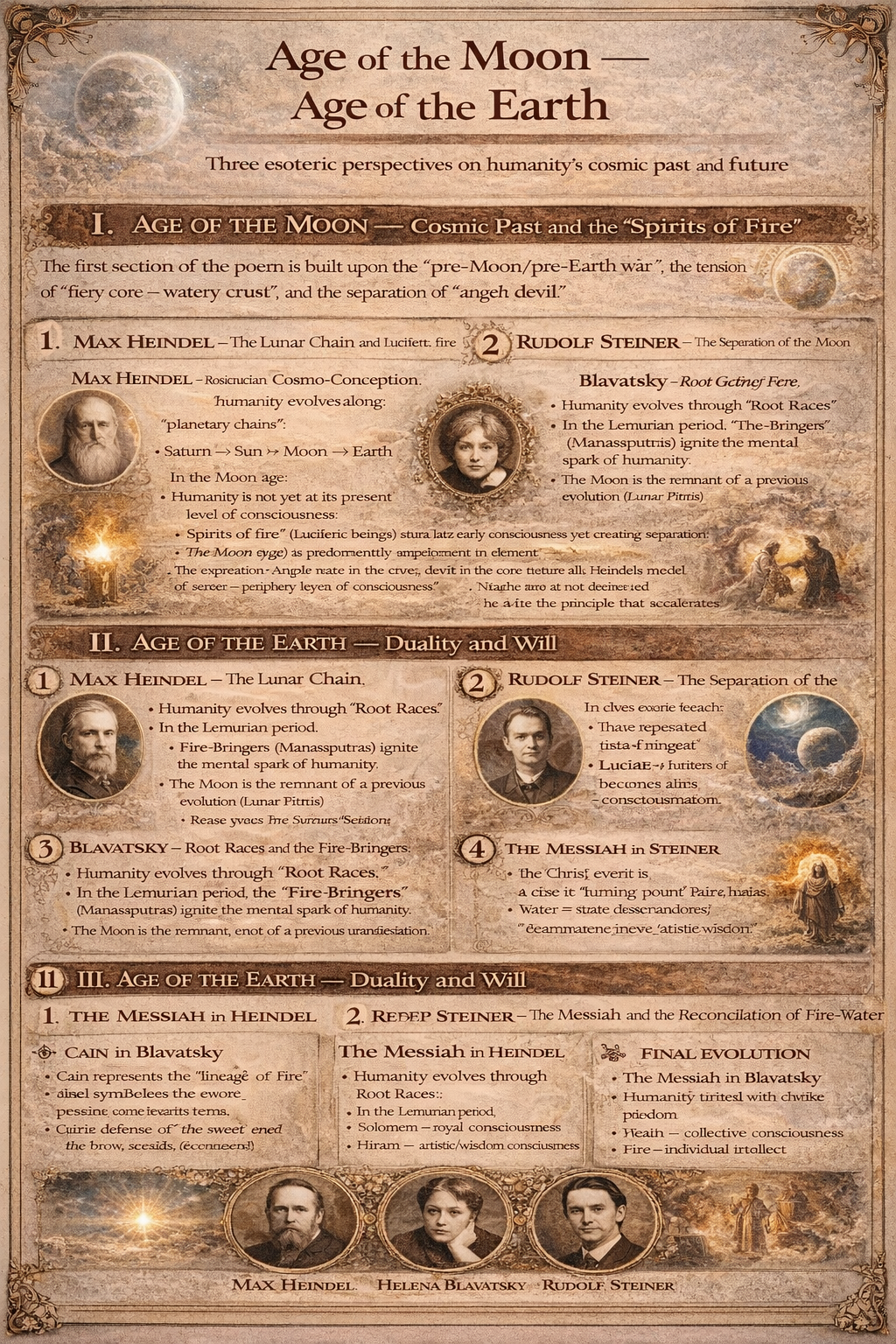
AGE OF THE MOON – AGE OF THE EARTH
I. AGE OF THE MOON — Cosmic Past and the “Spirits of Fire”
The first section of the poem is built upon the “pre-Moon/pre-Earth war,” the tension of “fiery core – watery crust,” and the separation of “angel–devil.”
This structure finds correspondence in three thinkers as follows:
Max Heindel – The Lunar Chain and Luciferic Fire
In Heindel’s Rosicrucian Cosmo-Conception, humanity evolves along “planetary chains”:
Saturn → Sun → Moon → Earth stages.
In the Moon age:
• Humanity is not yet at its present level of consciousness.
• “Spirits of fire” (Luciferic beings) stimulate early consciousness.
• The Moon stage is predominantly water/astral in element.
The expression “Angels were in the crust, devils in the core” recalls Heindel’s model of center–periphery layers of consciousness.
Lucifer here is not absolute evil; he is the fire principle that accelerates consciousness yet creates separation.
The poem’s scene “fire expelled the water” symbolically evokes Heindel’s process of “the separation of astral water for the intensification of consciousness.”
Blavatsky – Root Races and the Fire-Bringers
In Blavatsky’s The Secret Doctrine:
• Humanity evolves through “Root Races.”
• In the Lemurian period, the “Fire-Bringers” (Manasaputras) ignite the mental spark of humanity.
• The Moon is the remnant of a previous evolution (Lunar Pitris).
The expression “It was the reincarnation of the Earth before this” is very close to Blavatsky’s thesis that the Moon was the previous evolutionary cycle.
Here fire is not demonic; it is the spark of intellect.
Water, meanwhile, is the still-unconscious collective astral flow.
• Water = collective consciousness
• Fire = individual intellect
Rudolf Steiner – The Separation of the Moon and the Human Ego
According to Steiner:
• The Moon was once united with the Earth.
• It later separated; this separation made human self-consciousness possible.
• Luciferic beings push humanity toward premature freedom.
The verse “In the Earth age, the moment our Moon separated from the Earth” directly evokes Steiner’s teaching of the Earth–Moon separation.
In Steiner:
• Lucifer = premature freedom
• Ahriman = rigid materialism
• The Christ principle = balance
The reconciliation in the poem’s third section corresponds to Steiner’s teaching that “Christ consciousness is the balancing center.”
II. AGE OF THE EARTH — Duality and Will
In the poem, the Eve–Cain–Abel narrative contains an esoteric interpretation different from the classical sacred text.
This parallels especially the “Cain line” interpretations of Blavatsky and Steiner.
Cain in Blavatsky
According to Blavatsky:
• Cain represents the “lineage of fire.”
• Abel symbolizes the more passive, pastoral line.
• Agriculture/fire culture is the motor of civilization.
Cain’s defense of “the sweat of the brow” accords with this line.
Cain and Hiram in Steiner
In Steiner’s Masonic lectures:
• The Hiram line descends from the lineage of Cain.
• Hiram is the master of wisdom.
• Solomon = royal consciousness
• Hiram = artistic/wisdom consciousness
Hiram’s leap into the fire and transformation accords with Steiner’s theme of the “fire of initiation.”
III. AGE OF JUDGMENT — The Messiah and the Reconciliation of Fire–Water
The Messiah in Heindel
According to Heindel, the Messiah:
• Brings the Sun consciousness down to the Earth.
• Activates the heart center.
• Balances the forces of Lucifer and Ahriman.
In the poem:
“Water and fire reconciled, state and religion became one”
is the poetic projection of Heindel’s concept of “Christ Consciousness.”
The Messiah in Steiner
For Steiner:
• The Christ event is a cosmic turning point.
• The “Sun of the heart” is placed at the center of human consciousness.
• Luciferic fire and Ahrimanic rigidity are balanced.
The “Rose” symbol in the poem corresponds to Steiner’s Rosicrucian rose-cross image.
Final Evolution in Blavatsky
In Blavatsky, the ultimate aim is:
• Humanity united with divine wisdom
• The synthesis of matter and spirit
The final call to the “Hanif” in the poem may be read esoterically as “pure central consciousness beyond dogma.”
THE TRIPLE READING OF WATER and FIRE
The “Age of the Moon” motif corresponds, in Max Heindel’s cosmology, to the “Lunar Chain” stage through which humanity passes; here consciousness has not yet attained its present material density. In Blavatsky, this period is explained through the doctrine of the “Lunar Pitris,” the Moon ancestors; they are the remnants of humanity’s previous evolutionary cycle. In Rudolf Steiner, the Moon was once united with the Earth and later separated; this “Moon separation” is a cosmic event that makes the independence of the human ego possible.
The “Fire” motif in the poem is, in Heindel, a Luciferic accelerating force; it awakens consciousness prematurely but creates separation. In Blavatsky, fire is the “spark of Manas”; the divine principle of intellect that ignites the human mind. In Steiner, fire is seen as the Luciferic impulse that drives humanity toward premature freedom; it carries danger but is necessary for development.
The “Water” motif in Heindel is associated with the astral body; it represents the emotional and fluid layer of consciousness. In Blavatsky, water symbolizes the collective and not yet individualized field of consciousness. In Steiner, water signifies spiritual plasticity; that is, the inner human nature capable of taking form and being shaped.
The “Hiram” figure in the poem is, in Heindel, a symbol of Masonic mastery and spiritual architecture. In Blavatsky, Hiram-like figures are seen as esoteric architects, that is, consciousness that builds the cosmic plan into matter. In Steiner, Hiram represents the Cain line; the bearer of technical knowledge and conscious artistic mastery.
Finally, the “Messiah” motif is defined in Heindel as the Solar Spirit; the cosmic love and balance consciousness descending to Earth. In Blavatsky, the Christ principle is identified with the Universal Logos, that is, the current of divine wisdom. In Steiner, Christ is the central consciousness that establishes the cosmic balance between Lucifer and Ahriman; the balancing axis in humanity’s evolution.
In this way, the poem may be read as a structure that symbolically unites the cosmology and the teaching of the evolution of consciousness of the three thinkers within a symbolic language.
I. METAPHYSICAL DEFINITION OF THE THREE FORCES
According to Steiner, human evolution is balanced among three main spiritual currents:
Luciferic Force
• Light, early consciousness, impulse toward freedom
• The tendency of the spirit to abandon matter
• Risk of excessive mysticism, excessive idealism
• Symbolized by the element of fire
Lucifer is not evil;
he is freedom out of balance.
Ahrimanic Force
• Rigidity, materialism, calculation, technical consciousness
• Cold intellect
• Excessive mechanical civilization
• Symbolism of earth, stone, crystal
Ahriman is also not absolute evil;
he is consciousness of matter out of balance.
The Christ Principle
• The heart center
• Conscious balance between the two poles
• Uniting freedom and matter
According to Steiner, the Christ event places a Sun consciousness at the center of the human being.
II. PLACING THE POEM INTO THIS TRIANGLE
Age of the Moon = Luciferic Stage
In the poem:
Fire expelled the water
This evokes Steiner’s narrative of “premature freedom.”
In the Moon phase:
• Humanity is not yet fully material.
• Spirit predominates.
• Fire is the spark of consciousness.
Luciferic energy here initiates separation.
Age of the Earth = Ahrimanic Condensation
In the Earth age:
• Soil
• Produce
• Sweat of the brow
• Property
These are indicators of Ahrimanic consciousness.
In the poem, Cain’s saying:
“My sweat is sacred”
is a claim of right over matter.
This is the birth of Ahrimanic individual will.
Hiram and the Cauldron of Fire = Initiation
According to Steiner, initiation is:
• The lower self passing through fire
• The purification of the astral body
• The ego attaining crystal consciousness
In the poem:
Hiram threw himself into the cauldron filled with fire
This is directly an esoteric initiation by fire.
Luciferic fire here is not destructive;
it is consciousness-awakening.
III. THE CHRIST CENTER — THE RECONCILIATION OF WATER AND FIRE
In the poem:
Water and fire reconciled
In Steiner’s expression:
• Lucifer pulls upward.
• Ahriman pulls downward.
• Christ balances at the center.
In this triple model:
The Luciferic force moves upward; it lightens human consciousness, seeks to free the spirit from the bonds of matter, and awakens the impulse toward premature freedom. However, if this tendency falls out of balance, it can turn into fanatic spiritualism, excessive mysticism detached from reality, and escapism from the world. This excess can only be balanced through the Christ principle; for Christ consciousness, without letting the spirit flee entirely upward, holds it at the center and makes freedom conscious.
The Ahrimanic force moves downward; it represents condensation, matter, calculating intelligence, and technical order. It concretizes human consciousness and roots it in the world. Yet when this force becomes excessive, it leads to rigid materialism, mechanized thinking, and the denial of the spiritual dimension. This danger too can only be balanced at the Christ center; for Christ consciousness, without rejecting matter, harmonizes it with spirit.
The Christ principle stands at the center. It accepts neither a spirituality that escapes only upward nor a materialism that collapses only downward. It transforms the tension between the two poles into a conscious equilibrium. At this center, the human being becomes neither a fanatic mystic nor a rigid materialist; rather, he lives his freedom consciously in a way that encompasses both spirit and matter. Salvation is the conscious freedom born at this center.
The “Rose” symbol:
• Rose = heart
• Cross = matter
This is the exact counterpart of Rosicrucian symbolism.
IV. THE DEEP METAPHYSICAL STRUCTURE
The poem in fact says this:
Age of the Moon → Spirit dominant (Lucifer)
Age of the Earth → Matter dominant (Ahriman)
Age of Judgment → Heart consciousness (Christ)
This corresponds to Steiner’s narration of human history as a triple evolution of consciousness.
V. THE TRUE PLACE OF “SATAN” IN THE POEM
In Steiner, Lucifer is not Satan;
nor is Ahriman.
In the poem, the identification of fire–Satan is used in classical theological language;
but in esoteric reading:
• Fire = Luciferic acceleration
• Earth-center = Ahrimanic condensation
• Rose = Christ heart
Thus the poem is not theological;
it is an anthroposophical triple dramatization.
Humanity first separated through the fire of spirit,
then fell into the rigidity of matter,
now it is called to unite in the heart.
This is Steiner’s ideal of the “consciously free human being.”